Over the last few blog posts we’ve seen the important aspects which signify that the second half of this decade will be quite different than the first half. I discussed previously the Jupiter-Saturn square that signifies the beginning of the second half of the decade. Later I discussed the Saturn-Neptune conjunction that happens shortly after the third Jupiter-Saturn square and then finally in February 2026. This time we will discuss an important transit to the US chart that first occurs in late summer of 2024 (elections season) and will occur finally in early 2026 and that is transiting Uranus square the natal Moon.
Transiting Uranus aspects to the Moon of the United States (which simultaneously makes a hard aspect to the Sun) have shown up as an upset (Uranus) to the body politic of the people of the country (the Moon). Since Uranus has a period of 84 years, the quadrature aspects of Uranus to the natal Moon of the United States should happen every 21 years. Since such an aspect is coming up this decade, let us look at the transits of Uranus conjunct, opposed, or square to the natal moon over this history of the United States as a nation.
There is a question among astrologers whether an aspect manifests before the aspect is exact (called partile) or after the aspect is exact. In the following cases we will see examples of both though it appears that the act — war — happens after the aspect is exact more often than not. But of course remember that the aspects relate to something happening to the populace and in most case war is the concrete result, but that is only the outward externalization of a change to the people in the country.
Uranus in hard aspect — conjunction, square, opposition — to the natal moon of the United States is coming up. The first pass is in August and September of 2024 when it goes stationary retrograde right on the Moon; needless to say this is right before the November presidential election of that country. Then in the middle of May 2025 it makes a direct square to the Moon (and also a trine to Natal Pluto). Finally in February of 2026 it goes stationary direct within a quarter degree of the Moon. The United States will experience three years of Uranus squaring its Moon (along with many other interesting aspects that will be discussed in later posts) so it is instructive to look back at previous hard aspects between these two planets during the history of the country.
2002-2003 invasion of Afghanistan/Iraq after the attacks of 9/11.

There was a conjunction of transiting Uranus and the natal Moon in 2002 and 2003; this was the previous hard aspect between these two planets. The transit was shortly after 9/11 when Americans were braying for blood and it was easy to convince them that an invasion of Iraq and Afghanistan were in their best interests. The invasion of Afghanistan took place on October 7, 2001, less than a month after the attacks on 9/11. The invasion of Iraq, discussed earlier, happened about a year and a half later.
1980-81 start of New Cold War with RR also Iran-Iraq War

At the end of 1980 and 1981 Uranus was square the Moon. This period saw the election of Ronald Reagan and the start of the New Cold War (as one book titled it) and also the beginning of the Iraq-Iran war (the US was helping Iraq and Saddam Hussein! since Iran had held our hostages) and there was ongoing fighting in Central America in the countries of Nicaragua, El Salvador, and Guatemala. The USS Honduras (as some wag called it), was a military base set up to allows us to support the Contras, our proxy army in Central America. All three countries saw much violence and the United States was definitely involved, most obviously with the funding an oppositional army called the Contras in Nicaragua. As mentioned previously there was also a Saturn-Pluto conjunction in 1982.
1961-62 start up of Vietnam war

At the beginning of the Sixties – 1961 and 1962 – Uranus was opposite the US Moon. This was the beginning of serious American involvement in Vietnam; many think this did not happen until the Gulf of Tonkin resolution in August 1964, but earlier in the decade Vietnam was a big flash point. Early in 1963 a Buddhist monk burnt himself in protest of the war which had been picking up steam since John Kennedy had been elected. There were already student protests at some college campuses. The book by David Halberstan The Making of a Quagmire describes this period well and shows how the United States got involved in a disaster.
1941-42 World War II

In 1941 and 1942 Uranus squared the Moon in the same type of square that is coming up — this period was 84 years ago — one Uranus cycle before now. In fact the second exact transit of this cycle was on December 20, 1941, less than two weeks after the attack on Pearl Harbor that got America involved in World War II. The American people weren’t terribly convinced of the need to get involved in a war that seemed mostly in Europe, but after this square (“A date that will live in infamy”) there was much more eagerness to go to war.
1918-19 World War I, Red Summer, Prohibition, Palmer Raids
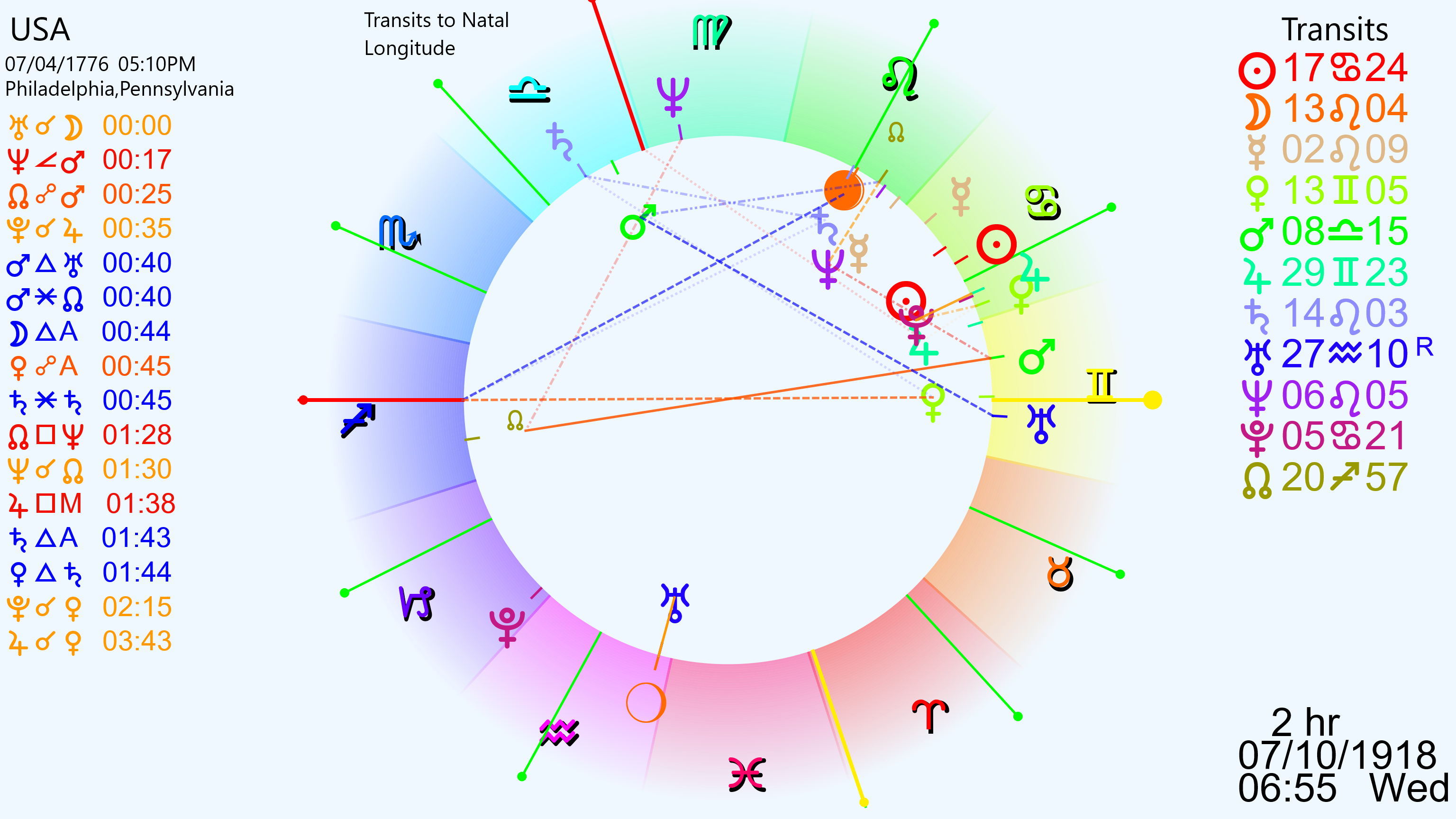
The effects of this square happened both before and after the square was exact. Uranus was conjunct the U.S. Moon in 1918 — as World War I was ending — and 1919 — as the Versailles peace treaty was worked out which was the official end of the war. America did not want to enter World War I and the President Woodrow Wilson ran for his second term — in 1916 — on the slogan ‘He kept us out of War’. Six months later he asked for a declaration of war. But there was a strong propaganda push to get America into the war, lead by among other people Freud’s nephew Edward Bernays. There was also propaganda about the Huns (Germans) raping Belgium nuns (stories of heathens raping our women have also been a popular ploy to get a nation involved in a war or for a lynching); there were people who would speak of the benefits of war before movies were shown, which though still silent were becoming very popular. After war was declared it suddenly became very popular with the masses, with for example a recruiting station in the shape of a battleship set up in New York City’s Union Square. (Suggested reading American Midnight by Adam Hochschild). But another “war” was coming up, though an internal war. 1920 saw the beginning of Prohibition in the United States which lasted until 1933. Prohibition saw a conflict between those supplying illegal alcohol and the government which was trying to prevent the spread of alcohol. Also unusual was the beginning trine between Uranus and Pluto which will be discussed at a different time. There was also upcoming what is called “Red Summer” which saw a lot of racially motivated attack (cf Tulsa Oklahoma) and the Palmer raids on unorthodox opinions.
There was also an invasion of Russia by the United States and several European countries as well as Japan in summer of 1918. This invasion was an attempt to stop the Bolshevik Revolution as part of the Russian Civil War between the “White” Russians — the Menshevicks (Kerensky) — and the “Red” Russians — the Bolsheviks. American forces remained in the country until 1920. All “good” Americans were already fearful of the Bolsheviks.
In June of 1919 several explosions occurred around the country, one of which was at the Washington, DC home of new attorney General, “Fighting Quaker” A. Mitchell Palmer. After the explosion, which did not injure Palmer, his wife, or their daughter, he was aided by Assistant Secretary of the Navy and neighbor Franklin D. Roosevelt, who discovered a collarbone of the bomber who was the only one killed by the blast. But this brush with death encouraged Palmer to start a war on dissidents since he couldn’t go after the bomber who was thought to be a member of a small Italian anarchist sect. Many people were deported as a result of Palmer’s actions. Palmer was assisted by the new director of the Bureau of Investigation John E. Hoover who probably did more than Palmer to round up suspects.
1896-97 Remember the Maine
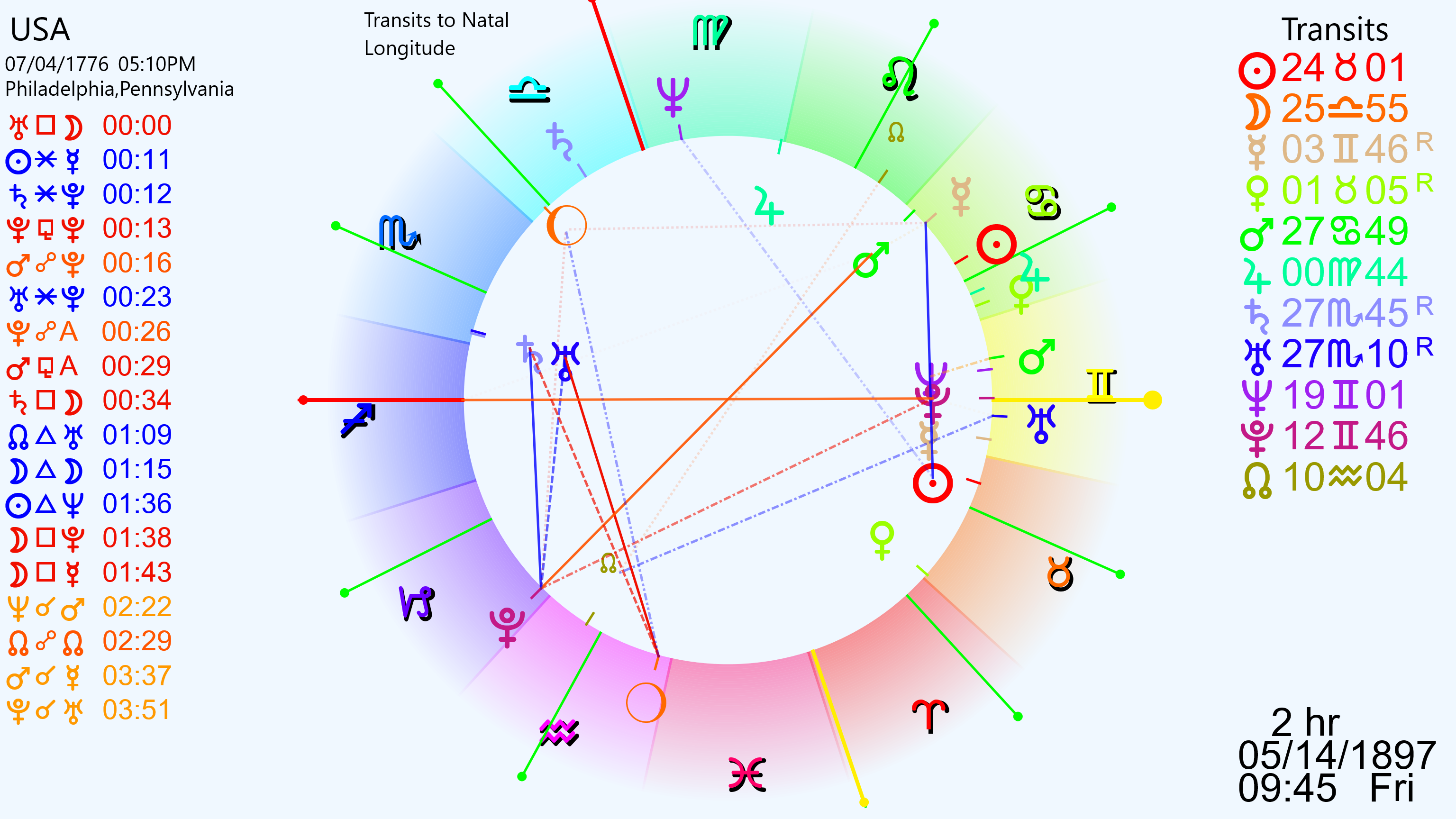
All through 1897 transiting Uranus was exactly square the US Moon. The next year the Spanish-America War broke out. At the time Cuba was a colony of Spain and the inhabitants of that island revolted against their Spanish overlords. The US cruiser Maine was in the Havana harbor when an explosion took place on the ship. It is now widely assumed that the explosion occurred on board, but at the time it was believed that the Spanish had exploded a bomb attached to the Maine. That explosion led to America’s involvement in the War against Spain. As a result of the US victory, many of Spain’s colonies, including Cuba, Puerto Rica, and the Philippines, became colonies of America. The US base at Guantanamo Bay is a result of the victory in the Spanish-American War. Empire became a way of life.
1877-78 End of Reconstruction

The Compromise of 1877 was a very important event in American history and one can imagine things being much different if this Compromise had not happened but it is seldom mentioned. The election of 1876 was inconclusive and so votes were taken with the House, Senate, and Supreme Court to determine the winner. Finally the Republican Rutherford B. Hayes was declared the winner, but the Republican winner withdrew the federal troops from the South (something the Democrats wanted but the Republicans opposed) who had been there since the end of the Civil War; this withdrawal ended Reconstruction and allowed the Democratic politicians of the South to institute what came to be know as Jim Crow laws, as well as countenancing other activities that resulted from the absence of Reconstruction. Lynching of the newly freed people became a popular activity, one that sometimes drew crowds and photographers. The country has still not fully recovered from the effects of the Compromise of 1877.
1857-58 Civil War

In 1857 and 1858 Uranus was in Taurus (two Uranus cycles before now) and square the US Moon. This was the lead up to the Civil War which at the time many people could see coming. Henry Ward Beecher, a prominent preacher (whose sister wrote Uncle Tom’s Cabin) in Brooklyn was providing “Beecher’s Bible” (rifles) to abolitionists in Kansas which resulted in “Bleeding Kansas” as pro and anti abolitionists fought it out over who would dominate that state; also John Brown provided his famous raid on Harper’s Ferry in the next year which many consider the tipping point to war.
1835 Remember the Alamo Texas Revolution
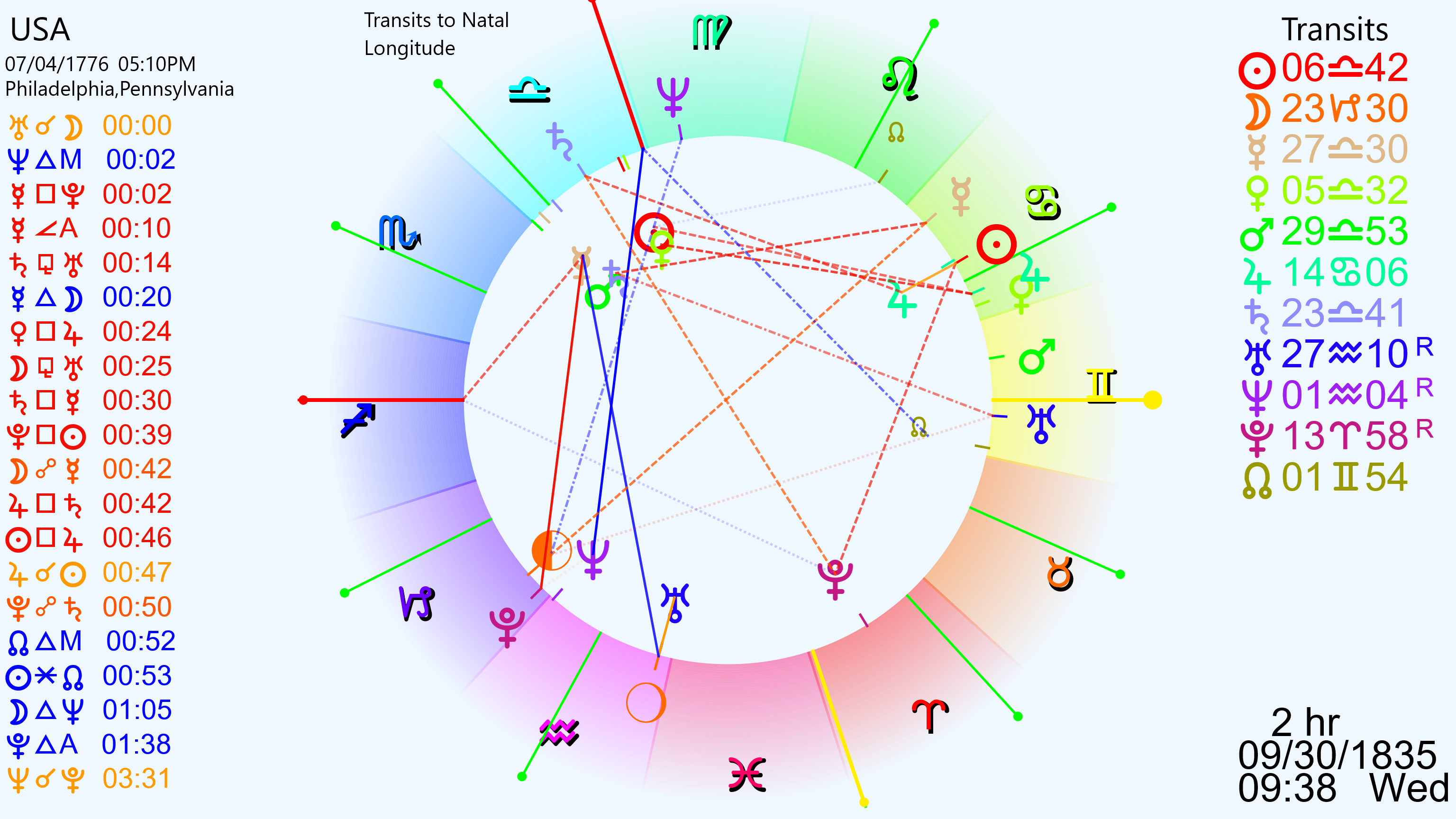
The citizens of Texas, which had been part of Mexico, were trying to establish that territory as a new country. The Battle at the Alamo in that region started as a battle to defeat the Mexican authorities and make Texas an independent country. The battle at the Alamo was not successful, and Texas was finally taken in as part of the United States under the Presidency of John Tyler (vote was defeated) and then officially under the next President Polk.
1813 War of 1812

The British attacked America again after they lost the American Revolution, and this was called the War of 1812. During this war the British succeeded in in burning down parts of Washington, D.C. This always results in a strong reaction. The war is best known for Andrew Jackson’s Battle of New Orleans which actually took place after the peace treaty was signed but communications were slower then.
1793-95 Whiskey Rebellion

The Whiskey Rebellion was the first armed revolt against the new country which was in the first term of the first president. At the time whiskey was very popular (the amount of alcohol consumed in early America is simply astounding!) not only as a beverage, but also as a way of transporting corn. Many farmers in Pennsylvania were angry at the taxes levied on whiskey by the federal government. There was also a Uranus Pluto opposition during the beginning of this rebellion and in 1794 Saturn was square both Pluto and Uranus, making an especially potent conflict. 1794 was the high point and climax of the rebellion. In Europe the French Revolution was going full bore and Jacobins executed the King.
1773-74 Pre-Revolutionary fervor

While the official start of the Revolutionary War took place in 1775 with the Battle of Lexington and Concord, there was much anger leading up to that battle and there was for instance the Boston Tea Party in 1773. In 1774 Britain passed five acts to punish the United States for that party, including the Boston Port Act which closed the port.

Uranus Square Moon First Pass
This year and the next two years will see transiting Uranus square the natal Moon of the United States and also make a semisquare to the US Sun.
Uranus turns stationary retrograde on the US Moon in the last half of 2024, just before the Presidential election. It then makes a clean true pass in early summer of 2025. Finally it goes stationary direct on the natal moon in late winter 2026.
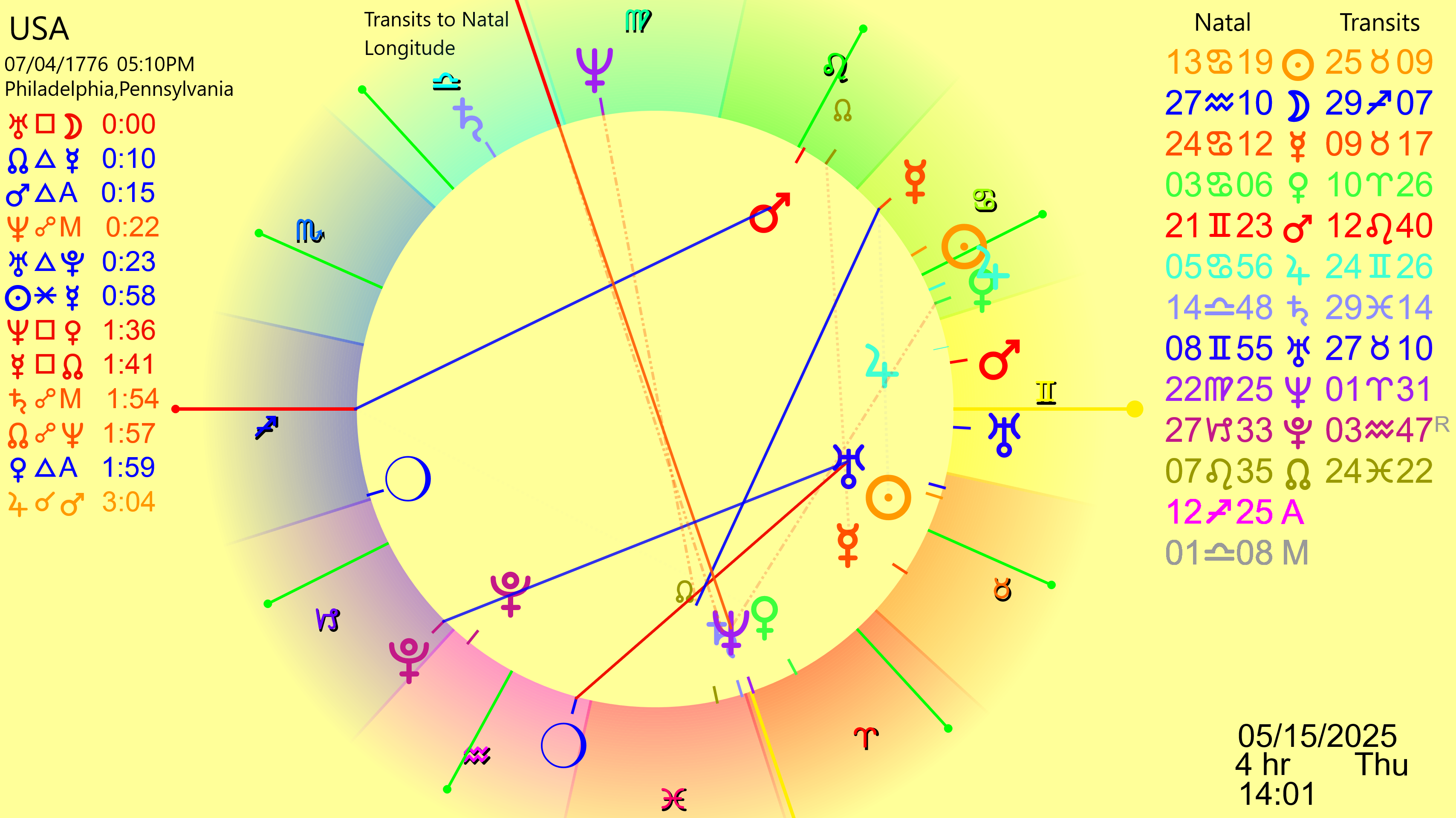
Uranus Square Moon Second Pass

Uranus Square Moon Third Pass

The Three Passes
Here is a graphical ephemeris showing the three passes of Uranus square the Moon happening first in September of this year when Uranus goes stationary retrograde on the US Moon at 1. Then in Summer of 2025 at 2 there is the only direct square. Finally Uranus goes stationary direct on the Moon in February 2026 at 3.
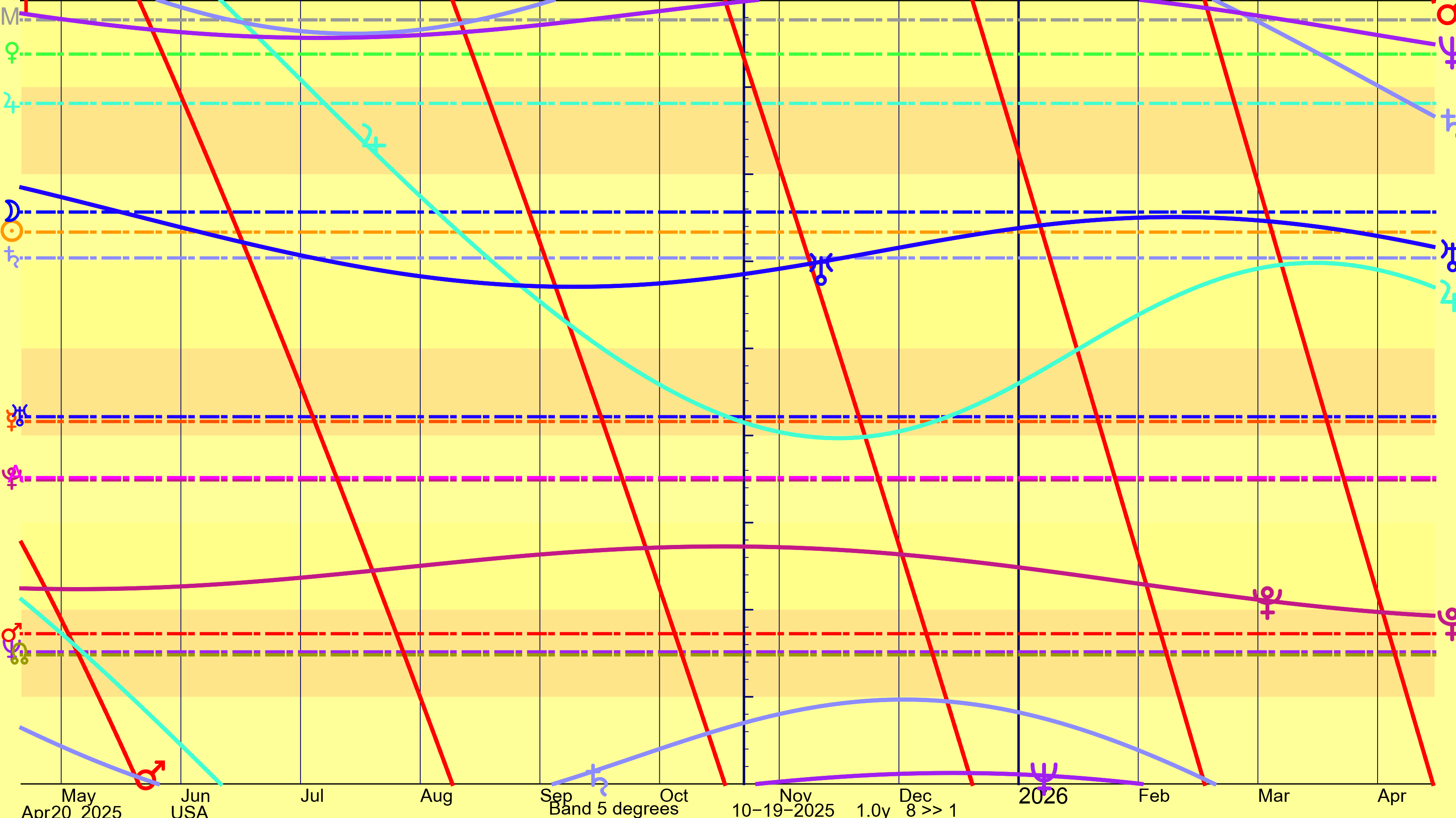
Uranus Semisquare Sun
Finally here is a graphical ephemeris to show Uranus making a semisquare to the Sun at about the same time as it makes a square to the Moon. We see this happens in early June of 2025, December of 2025, and April of 2026.
 500 Year Party