The People Are Disturbed: Uranus-Moon

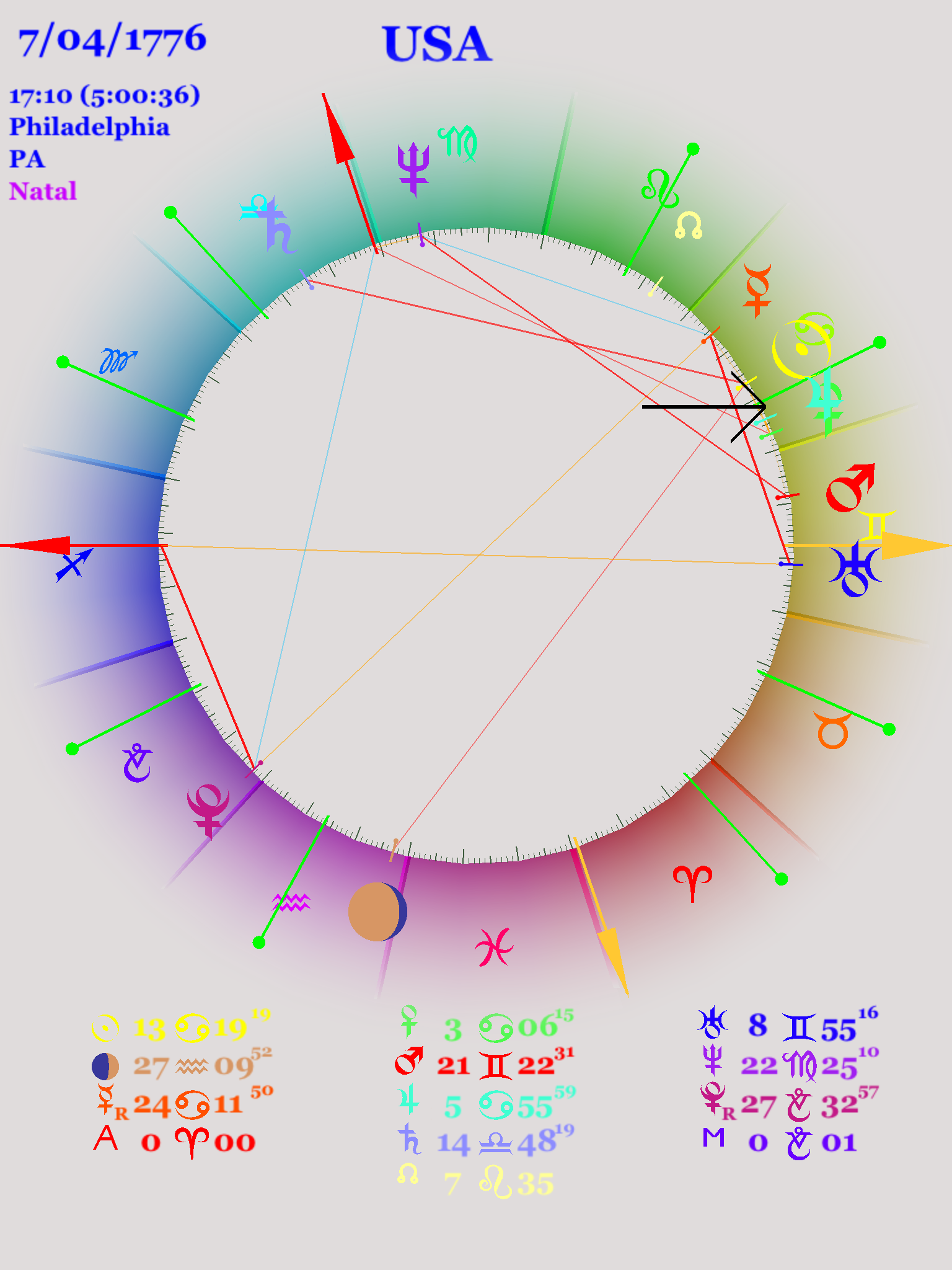
The symbolic meaning of the planet Uranus transiting over (conjunction, square, opposition) the Moon in the United States chart is that the people of the country (symbolized by the Moon) become upset, disturbed, shocked, perhaps even revolutionary.  If we look back through the history of the United States we can see this pattern in play; usually it results in the country going to war.

Now some may argue that the United States goes to war so often, at the drop of a hat, that any cycle could point to an agitation of the people.  And in fact I notice an agitation half-way between each of these points to be discussed, which hints at an eighth harmonic cycle.  But on reflection, each of these occurrences seem to be a really important incident.

After looking at these cycles through the history of the United States, the next obvious  question is when does the next one occur.  We will discuss that at the end.

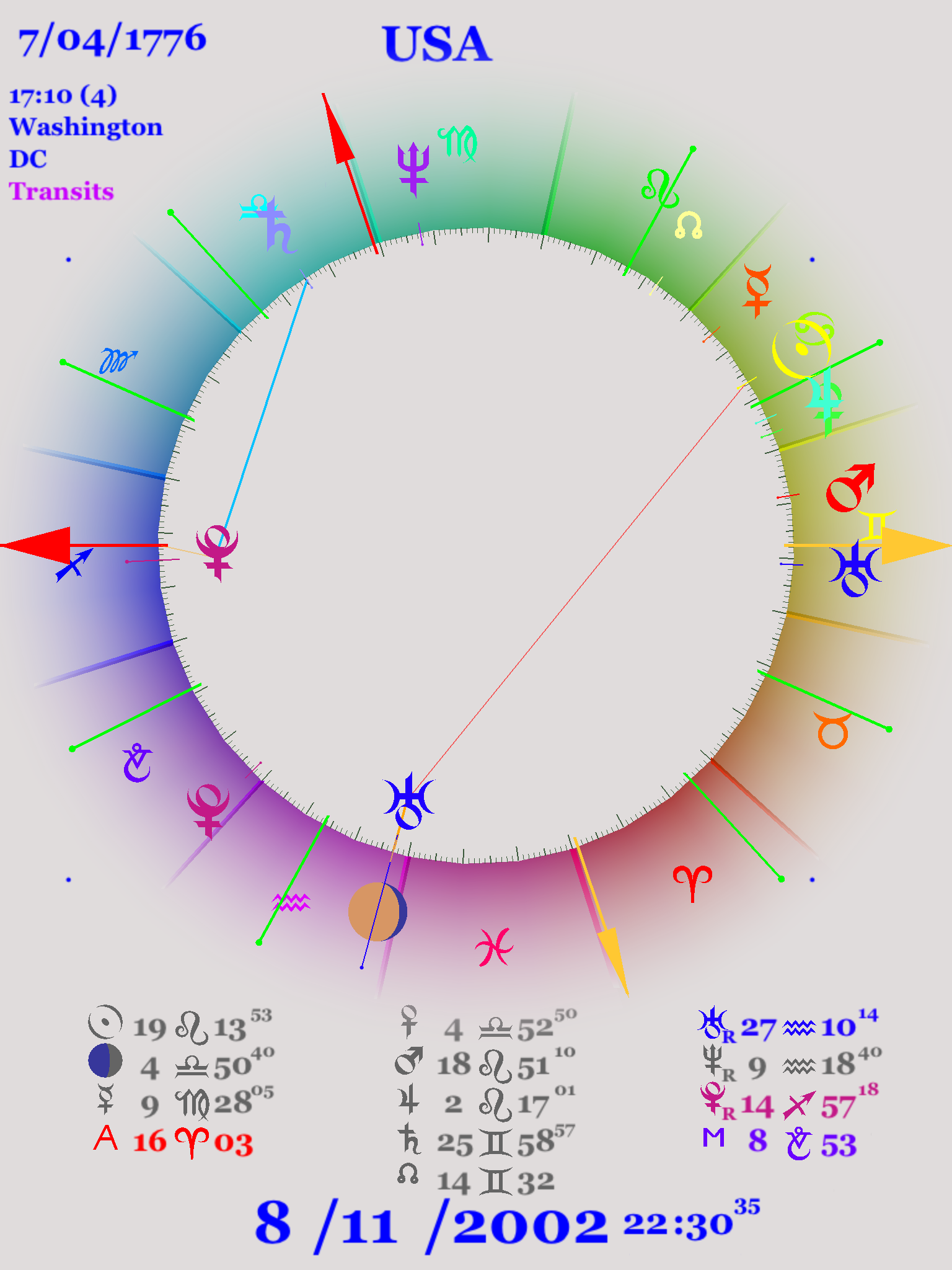
urmo2002

Afghanistan 2002-03

The United States had been attacked in September of 2001 and people were very agitated.  They wanted revenge.  The President of the United States, his Secretary of State, and many news outlets were helping to get the populace of the country riled up for war. Many compared the attack on the World Trade Center to the attack on Pearl Harbor, and were hoping for the same response.

urmo1981

New Cold War 1980-81

People were unhappy with the “lack” of militancy of the Carter administration, especially after the  hostages were captured in Iran after their revolution, and especially after an attempt to rescue those hostages failed but resulted in the deaths of eight men sent to rescue the hostages.  So people were  primed for the new militancy of the incoming Reagan administration, and he did not disappoint.  Defense spending greatly increased under the new administration and a new Cold War was born, with increased hostility towards the Soviet Union.

urmo1962

Cuban Missile Crisis 1961-62

This  was a peak in the Cold War.  Cuba had been invaded by a group financed by the United States in April of 1961 that had resulted in their capture, so passions on both sides  were inflamed.  Then in October of 1962 the Soviets attempted to put missiles in Cuba to protect it from another invasion by the United States.  The US then blockaded Cuba to prevent the missiles from arriving and the world was  on the brink of a nuclear war. Records released at a much later date showed that we were closer to war than anyone had known at the time, and one Soviet torpedoman who said “no” at a critical juncture was all that prevented nuclear missiles from being launched.

urmo1941

World War II 1941-42

The  attack by Japanese planes on the Pearl Harbor naval station in Hawaii on December 7, 1941 really got the American upset at the Japanese and ready to go to war.  Previously to that attack the US was largely isolationist and did not want to have anything to do with the European War,  let alone an Asian one.  Of the three  exact squares of these two planets the second was on December 20, 1941, two weeks after Pearl Harbor.

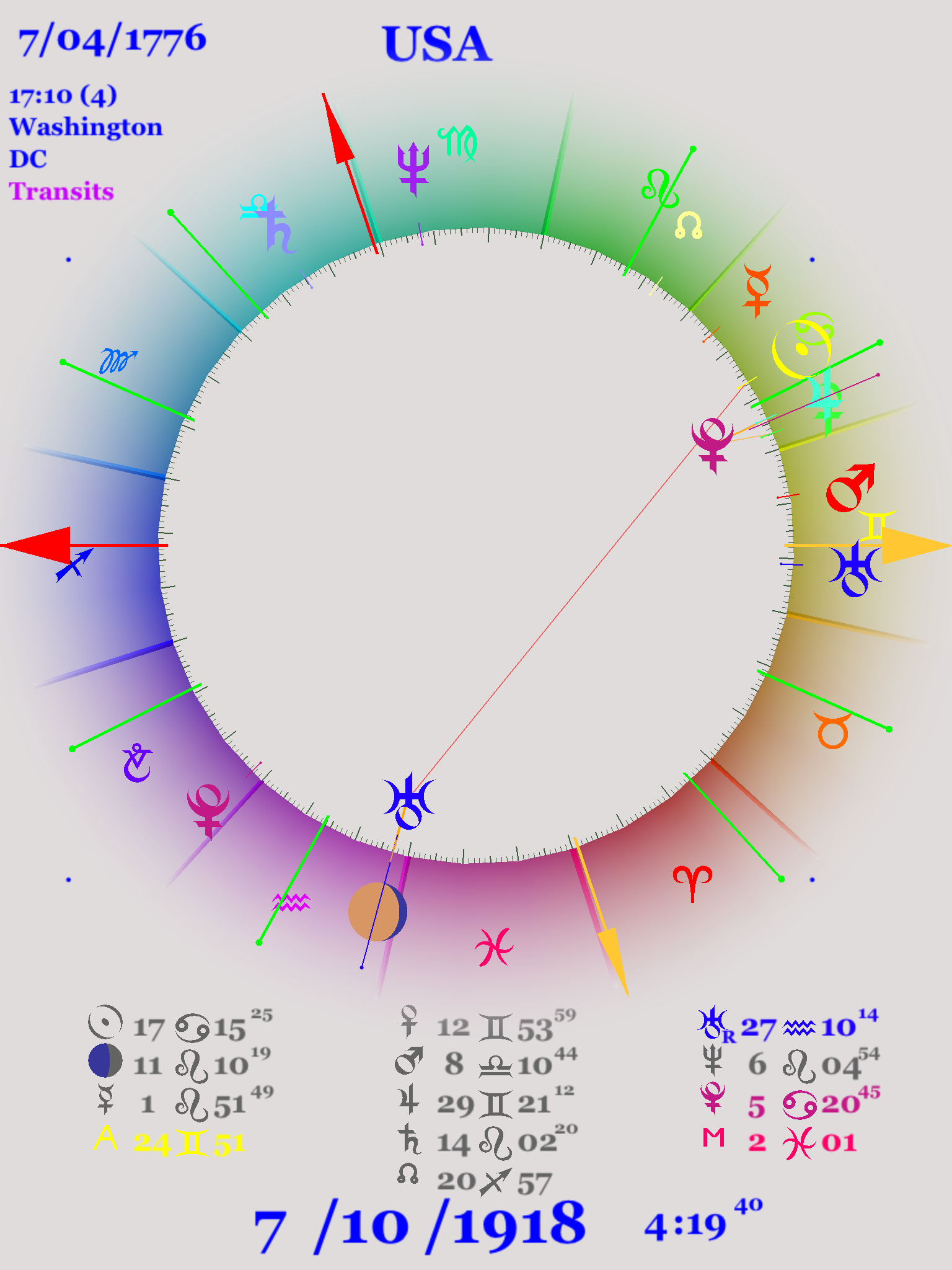
urmo1918

World War I 1918-19

Initially the Americans did not want to enter the war, but through clever propaganda from the Wilson administration the Americans became extremely pro-war, even replacing the name hamburger (named for a town in Germany) with Salisbury steak and sauerkraut with Liberty cabbage.  After the War some people were still agitated (the Revolution in Russia had just taken place) and there were bombings of public buildings, increased anarchist activity, and many raids of dissidents by Attorney General Palmer.

urmo1897

Spanish American War 1896-97

As  discussed previously Americans were itching for a War with the Spanish over Cuba for several years,  not only to relieve the Cubans from their hideous Spanish overlords, but also to provide a boost to what was thought to be the falling manhood of Americans since the Civil War was in the distant past.  This buildup came to a climax with the explosion on the battleship Maine in the Havana harbor in February of 1898.

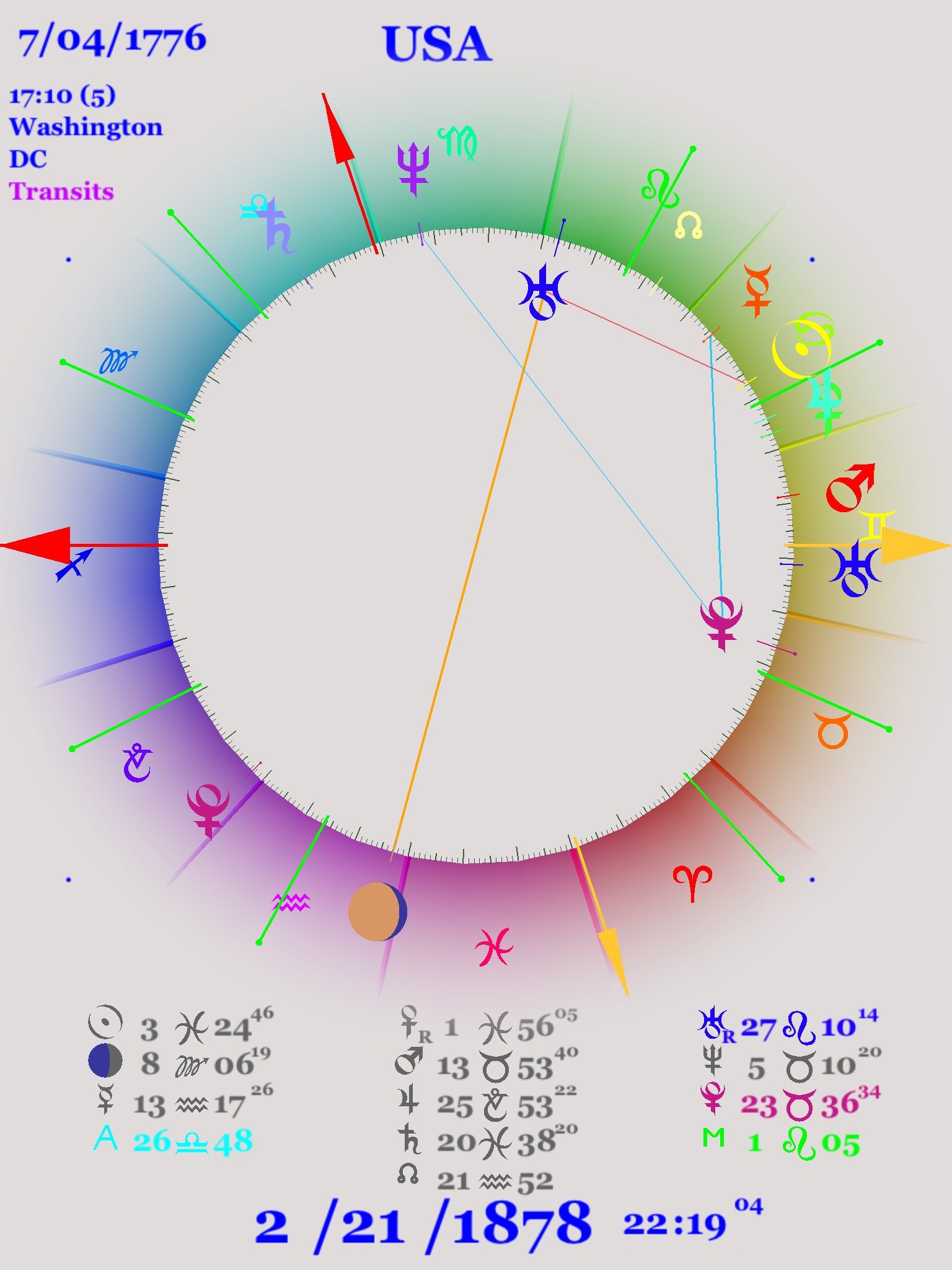
urmo1878

Railroad Strike 1877-78

Eighteen Seventy-Six had seen the Centennial of the country, Custer’s Last Stand, and a contested presidential election that made Bush v Gore look mild.  The Panic  of 1873, which extended more-or-less for the next quarter century, resulted in some railroads lowering their pay for workers in the summer of 1877, while stockholders got bonuses.  As a result there was a nation-wide strike of workers called the Great Labor Uprising that saw scores killed by local, state, and federal militias.   The strike ended with no raise for the workers, but it resulted in increased labor solidarity and increased class consciousness among both workers and the burgeoning middle class, as well as increased animosity towards strikes among the owning class. There was also an opening Uranus-Pluto square that year, such as the one we are having this decade.

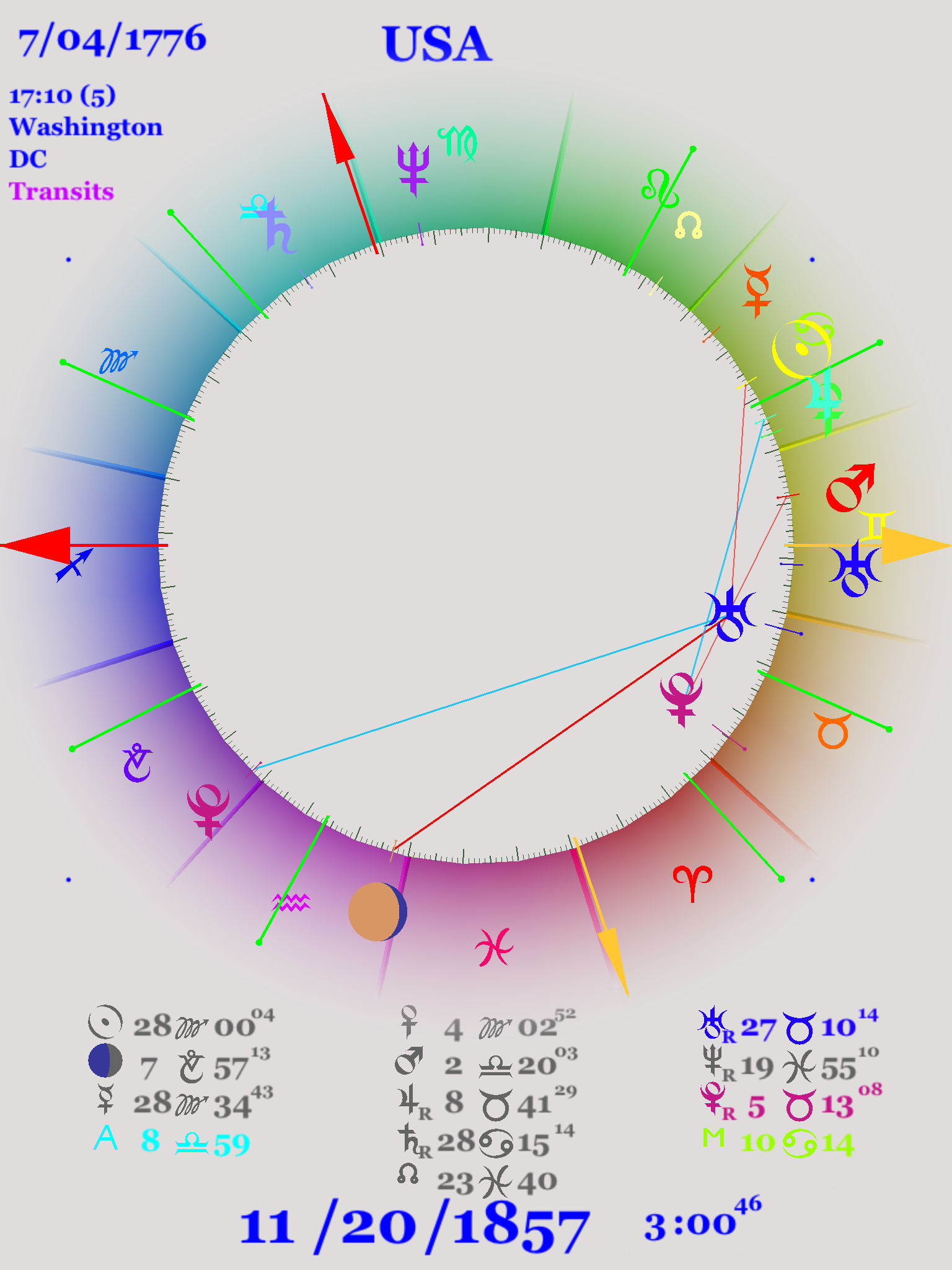
urmo1857

Civil War 1857-58

The Fugitive Slave Law of 1850, which  required run-away slaves to be returned to their owners, the Kansas- Nebraska Acts in 1854, which essentially overturned the Missouri Compromise of 1820 and allowed all new states to determine if they wanted slavery within their borders, and the Dred Scott Decision in 1857 had  all occurred recently.  Because of all of these, abolitionist sentiment was running high in the North when John Brown made a raid on slaveholders in Kansas, killing five, and then made his raid on Harper’s Ferry in 1859.  Some think he was insane and some think he was a hero, but this act helped bring the Civil War.  John Brown was financed by a group of prominent New England abolitionists known as the Secret Six and supported by such people as Henry Ward Beecher, brother of the author of Uncle Tom’s Cabin and a prominent preacher in Brooklyn.  In  fact, many Southerners blamed the Civil War on Lincoln and the two Beecher children.

urmo1835

Texas Revolution 1835

This was near the end of Andrew Jackson’s second term, and he was called by his opponents “King Andrew”.  Someone was really agitated about him since the first attempted presidential assassination occurred this year.  In Florida white settlers wanted  the land that the Seminoles had moved  to after losing the First Seminole War, one that was started by Jackson and which involved the murder of two English subjects and could have resulted in an international incident.  In this, the start of the expensive Second Seminole War, Jackson asked the Seminoles to move.  Meanwhile, gold was discovered on Cherokee land and they were forced to move so that the whites could get the gold. Meanwhile, down in Texas, at the time not a state of the US, Mexico had rebuffed an attempt by Texas to become part of Mexico, and so the Texans were in rebellion against Mexico.  The Battle of the Alamo took place the following year.

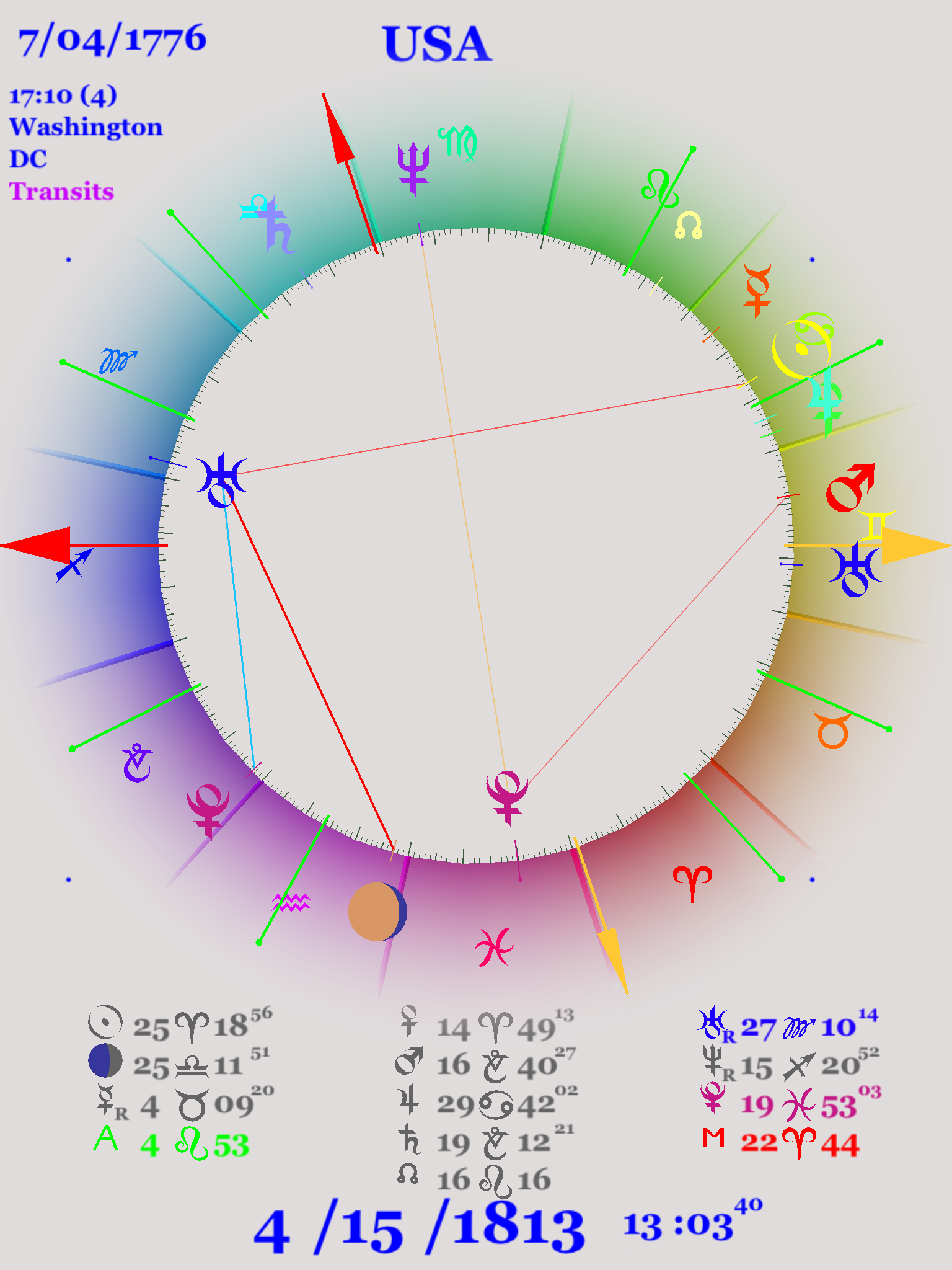
urmo1813

War of 1812

Hints of the war started almost two decades earlier.  The French Revolution and the Napoleonic Wars  were happening, and the British, who were fighting the French, were keeping the Americans from trading with the French.  Americans were getting increasingly upset with  this, and Western voters elected a group of “War Hawks” to Congress to push for a  war with Britain.  The resulting war did not turn out  well for America, with Washington, D.C. burned, but  it did result in the National Anthem for the country.  The greatest victory of the war, by Andrew Jackson in the Battle of New Orleans, happened after the war had ended, but propelled Jackson  to become a war hero which resulted in his running for President in ten years.

urmo1794

Whiskey Rebellion 1893-94

The farmers of the Western Frontier, which in the late Eighteenth Century meant Western Pennsylvania, were upset at a tax on distilled liquor, which meant mostly whiskey.  They were also upset that small distillers were taxed at a higher rate than large distillers. This was the first major rebellion against the federal government after the Constitution was adopted. President Washington and Alexander Hamilton led federal troops to put down the  rebellion, the first demonstration that the federal government would act to quash revolution.  But this activity of the Federalist govenment paved the way to a more democratically-oriented Jefferson Presidency.

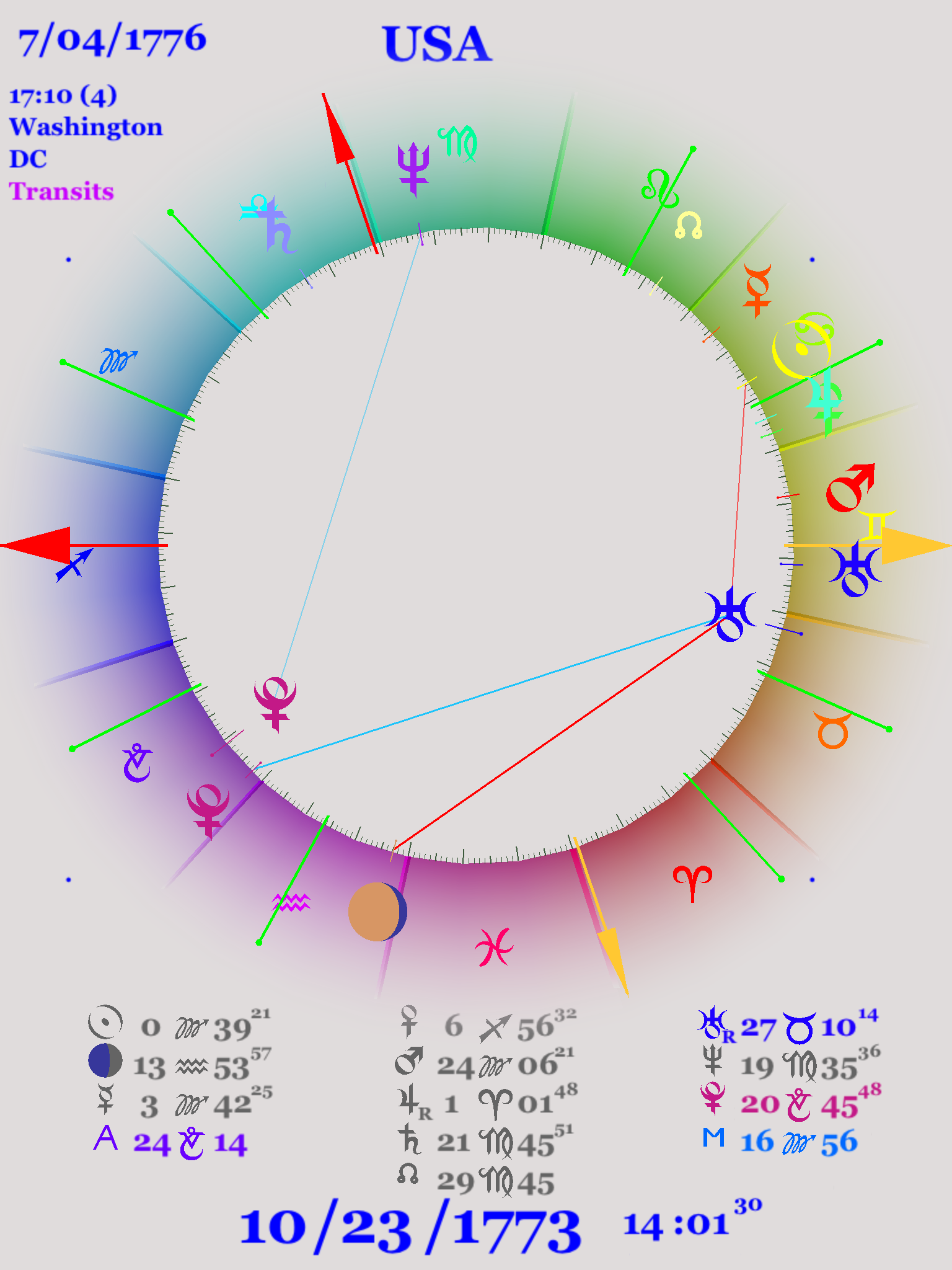
urmo1773

Revolutionary War 1773-74

The British had imposed  various levies on products that the colonists used, and many people were upset at this.   Agitations resulted in the Boston Massacre, where colonists were killed by British soldiers, and the Boston Tea party.  War broke out with Britain in the next year, 1775.

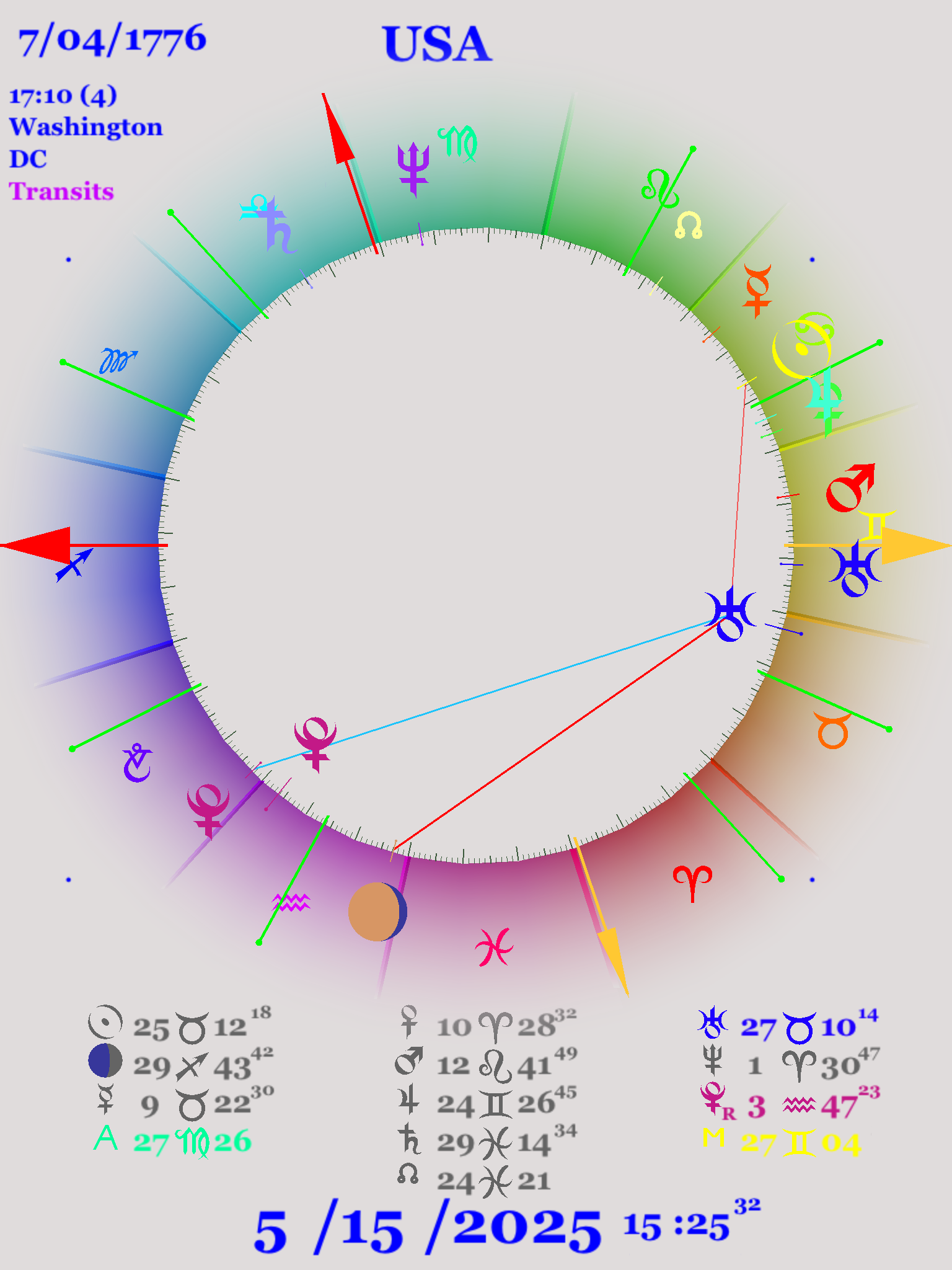
urmo2025

The Next War? 2024-25

The next Uranus aspect to the US Moon comes up in 2024-26.  We have looked at this period before  and we will look at it again, since it is a very important time that we are rapidly moving towards, now only a decade away.  In the previous entry, I said this period — 2028 — would see the “nations of the world … finally decide that the global crises are so ominous that they need to band together in a  World War II-scale attempt to fight for the survival of the planet.”  This Uranus square Moon is the years just preceding this date of 2028.  It suggests that the people of the United States (not to mention the other people in the world) will be getting very upset at what has been  done to their planet by the forces of capitalism over the last 500 years.

World War One

This war started 100 years ago, and there is still controversy about the causes.  The proximate cause, which set the official date for the start of the war, is the assassination of Archduke Franz Ferdinand of Austria and his wife in Sarajevo by the anarchist Gravilo Princip on June 28, 1914.  But there was much buildup  of armed forces in preparation for war at that time, as  well as much hope for peace.  As an example of the latter is the opening of the Peace Palace in The Hague in 1913.  Another question hovering around the edge of the debate is “was the  war inevitable?”  At this point most historians answer that question in the negative.

The world before the outbreak of World War I  was, in many ways, modern, as has been discussed previously.  At the time some people thought that war was possible, some people thought that war was not possible, and some thought that if war came it would last but a few months.  Perhaps the most accurate prediction was from a German general who said that the war would be as violent as the Thirty Years War (1618-48) but would last four years.  Since the Thirty Years War killed at least a third of the German population and laid waste to their territory, this German knew of what he spoke.

The major players in this war showed how incestuous European royalty was.  The leader of England was King George V (grandson of Queen Victoria); of Russia Tsar Nicolas II; and of Germany Kaiser Wilhelm II.  All were cousins, descended from Queen Victoria. Perhaps we should call this the Cousins’ War.  King George  and Tsar Nicolas looked so much alike they could have been mistaken for twin brothers.  By the end of the War, one of those cousins had died, one was no longer in power, and one had changed his name to Windsor, since anti-German feeling was high in Britain during World War I.  After King George V  died he was followed by his son George VI (after another son Edward VIII abdicated to marry the divorcee Wallis Simpson)   who was king during World War II. He was succeeded by his eldest daughter Elizabeth II.  So when you look at the Queen of England  you see a relative of the rulers of the World War I participants.  The year before the start of the war there was a big event — the social happening of the year — which was the wedding  of the daughter of Kaiser Wilhelm II in Germany.  All of the cousins   attended  the event, and people believed that with all the royalty of Europe together war could not possibly happen.

As we saw previously, the first decade of the Twentieth Century saw the growth of Modernism with cars, planes and movies, new types of painting and music.   This was abruptly altered when Pluto crossed the cardinal axis  and went  into the sign of Cancer.  Also, as mentioned previously, the start of the War saw a conjunction of Saturn and Pluto, never a good sign.

worldwar1

World War One

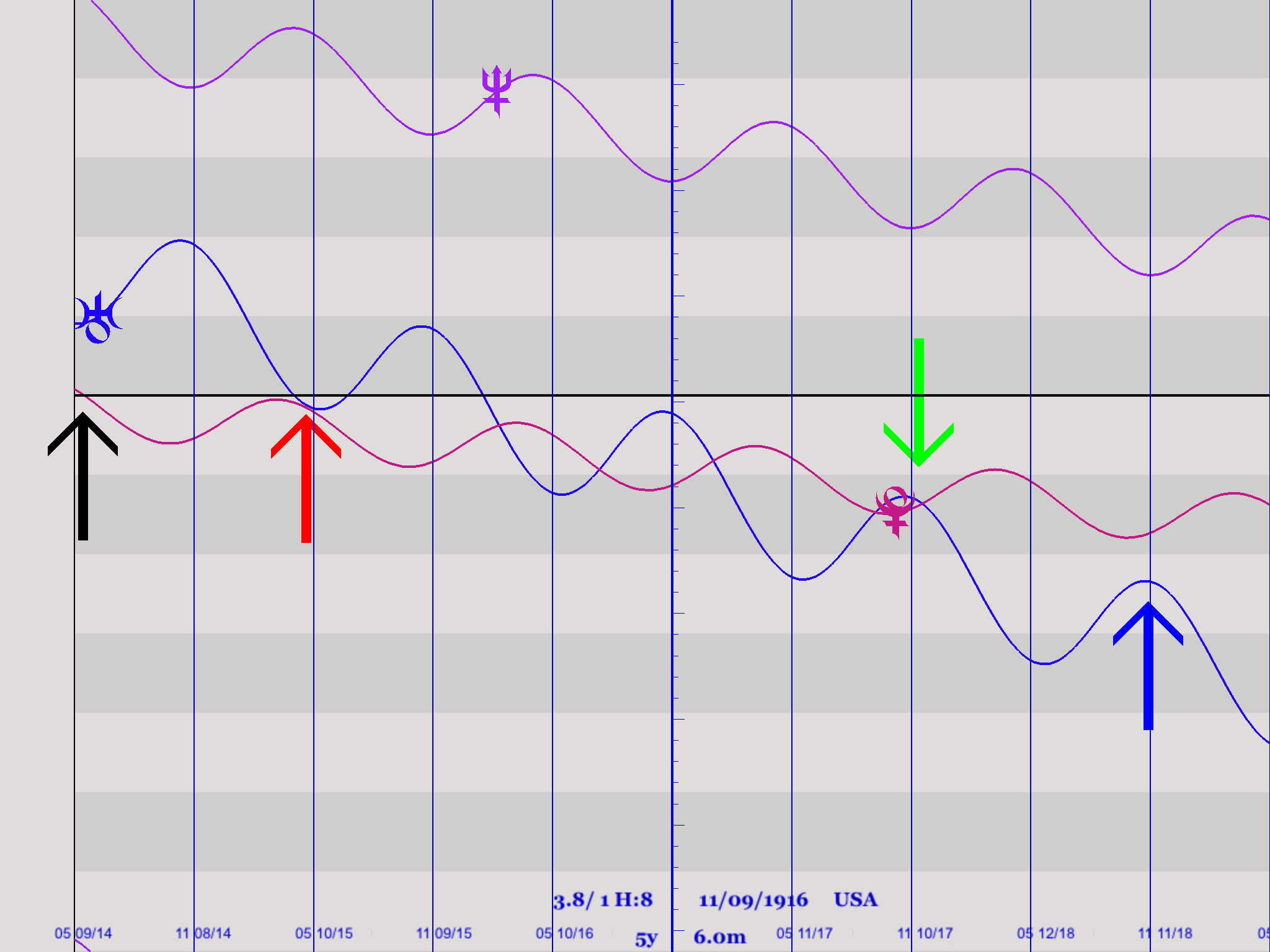
The defining aspect for World War I  was the sesquiquadrate between Uranus and Pluto. If we look at the graphical ephemeris (harmonic eight) we will see that this aspect lasted the length for the war, going in and out of orb during the whole war. From the graphical ephemeris we see that the last time the aspect was close was shortly before the  war ended.  When the War started, Uranus and Pluto were within three degree of a sesquiquadrate and Pluto had just gone over the Cardinal axis (black arrow).    Then, about 10 month later was the first exact Uranus sesquiquadrate Pluto (red arrow); we will look at this chart later.  The last  exact Uranus Pluto sesquiquadrate took place at the end of 1917  (green arrow). Finally, the last close approach of the two planets (blue arrow) happened at the end of the War, reflecting the first close approach at the  start of the War.

The official end — the Armistice — was the eleventh hour of the eleventh day of the eleventh month in 1918.  This brought to an end the fighting , but the justice brought was so harsh  that it helped set the stage for World War II.

The old world — before the War — was no longer. Many things happened to change the world in ways that we are still dealing with.  The end of the War saw the end of a long lasting empire, the Ottoman Empire (started in the Fourteenth Century but it really took off with the fall of Constantinople at the Uranus Pluto conjunction of 1453) which fought on the losing side and was broken up to form the modern Middle East –Syria, Iraq, Lebanon, Jordan — which was created through the Sykes-Picot agreement.  Palestine was promised to the Zionist and, unfortunately  promised to the native people of Palestine as well.

Even though Britain was  on the winning side of the war, and still the major Empire at the time, the position of Britain as the number one power in the world was  over, and the baton was passed to the United States, even though neither realized it at  the time.

After delaying entry to the war for several years — President Woodrow Wilson campaigned in 1916 on “He kept us out of war” — the US entered the War in 1917. Also an influenza epidemic began in the military camps of the US and eventually spread around the world.  There is even some evidence that the outbreak of the epidemic in Germany  hastened the end of the War.  Either through the epidemic from America or the new force of Americans in the War, America helped to bring the end of the War.

After  his successful election in 1916, Wilson assembled a group of people, such as George Creel, Walter Lippmann, Edward Benays, and Harold Lasswell, to create propaganda to convince citizens that entering the war was necessary.  This set the template for  all future war campaigns and today we can witness the successful propaganda to goad us into war.  The public  relations industry was an outgrowth of the pro-war campaign.  One of the notable  achievements of this campaign was the Four Minute Men, who gave a pro-war speech from the stage before cinema performances.

Another event that helped prepare the United States to enter the War was the sinking of the cruise ship Lusitania on May 7, 1915.  At one time the biggest cruise ship, it was torpedoed by a German submarine off the coast of Ireland. The British claimed in was carrying no war supplies, but later it was revealed that it was and thus considered by the Germans as fair game.   The British, who were anxious to get the Americans into the War, used the sinking to inflame American passions.  America did not enter at that time — Wilson still had to  run on his anti-war platform — but this incident did have an effect when  it came to going to war after the election.

lusitania

Sinking of the Lusitania

In this chart, set for the same date as indicated by the red arrow in the graphical ephemeris, we see that the Saturn Pluto conjunction is almost exact at  0 Cancer.  The conjunction of Saturn and Pluto was exact 11 days later.  Also in this chart for the sinking of the Lusitania the Uranus-Pluto sesquiquadrate is exact within 4 minutes.

lusitania_us

Sinking of the Lusitania within US chart

But this event had special repercussions in the United States.   This next chart is for the same event, but as transits to the US chart.  Uranus is sesquiquadrate the Midheaven of the US (black arrow) and Pluto and Saturn are square the Midheaven (red arrow) so  the two transiting planets which are in an almost exact aspect to each other are also aspecting the MC of the US, and there was much public clamor about the event. In addition, transiting Neptune is sesquiquadrate the US Ascendant (green arrow)  and opposite the US Pluto (blue arrow), again pointing to the natal Pluto semisquare Ascendant that we have talked about before.  This aspect suggests some of the uncertainty and confusion about the sinking, which I pointed out previously in terms of the doubt about whether the ship was carrying war implements.  Finally we have Jupiter opposite Neptune and square Mars (yellow arrow) again emphasizing the confusion, the warfare, and the Mars Neptune square in the US chart.  So the US was strongly connected to the sinking of the Lusitania.

The predictions of the German general were borne out  — World War I was the bloodiest yet seen.   The introduction of the Industrial Revolution  into warfare  — which happened to a small  extent  with the Crimean and US Civil Wars — was fully incorporated into World War I.  About 16 million people were killed, with Austria-Hungry, France, Germany, and Russia suffering the most, with over one  million deaths each.   The sheer pointlessness of it all affected many of the poets and writers who survived the War to End All Wars.  Several imperial powers, the Ottoman, German, Austro-Hungarian, and Russian, fell as a result of the War.  This changed the map of Europe and we are still living with the consequences.

Birth of the National Security State

The end of World War II saw a great many changes in the way the world is today,  so many that people born after this watershed moment cannot remember or imagine a world different than what they have always lived in. This world is radically different from what was before. There were many changes throughout the world. Most were in the developed countries which would affect the developing countries as time went on.  One of the biggest changes, which would affect the whole world  rather quickly, was the development of the National Security State within the United States  and the subsequent development of the Cold War between the United States  and its allies and the Soviet Union and its allies. This Cold War would be played out around the world and not just, or even mostly, in those two countries.

The world changed after the Second World War in so many ways.  Many so-called third world countries that were colonies  of major powers, such as India as a colony of Great Britain, were allowed to choose their own government.  This allowed a great many countries, mostly in Asia and Africa, to become independent and to try and choose their own government.  There was even a movement of the non-aligned countries that tried  to place themselves outside the orbit of either the United States or the Soviet Union.

The industries that developed during the Second World War — especially in the United States since it had not been invaded or directly attacked — subsequently released many consumer products  based on the developments to  support the war.  People had been starved  for new consumer products during the war, so that after the war the bought the new offerings willingly.  Not only were consumers the recipients of these new products, but also industries, such as agriculture, were willing purchasers of these new offerings.

While a couple of plastics, such as Bakelite, existed before World War II, the real explosion of plastics and other artificial materials – the pictures of women trying on nylon stockings right after the War are famous –  came right after the War, encouraged by all the development that happened to support the war effort.  Plastics of all forms  have begun to dominate our society, including the  computer you are viewing this on, and all of the plastic garbage has now begun to accumulate in five zones in our oceans  as well as mount up in our “sanitary” landfills.  We do not realize that there was a  time before plastics were an omnipresent feature of all our landscapes. As the Dustin Hoffman character was told in the 1967 movie The Graduate, plastics are indeed the future.

While fertilizers for crops existed for a long time, the real use of inorganic chemically-created fertilizers took off after World War II, for much the same reason that plastics became increasingly popular.  Chemical industries, some of whom had been active with the Nazis in Germany,  gained a lot of power and strength during the war.  But of course during the War most of the demand on these  industries was to support the war effort, on either side; after the War, all the energy that had driven the chemical industries was available of peacetime use.

What has been said about plastics and fertilizers can apply to many other created compounds.  The period after World War II became the world of “Better Living Through Chemistry” as the modified motto of the DuPont Corporation had it. And that is what the post-war world was all about.  Many, many things were created in the laboratory and sold to the public,  plastics of all types, pesticides and insecticides of all types, and weed killers.  All homes now have many toxic chemical compounds that are used for things from cleaning the toilet to ridding the house of ants.  One can take a tour of any modern house to get an idea of the full extent of artificial chemical compounds everywhere.

Before the Second Word War, most food was organic.  The concept of “conventional” or “non-organic” food did not exist, even though there were a few artificial chemicals used in agriculture.  In the Twenties, there were no ”Organic” sections  of supermarkets;  in fact, there were relatively few supermarkets in existence before World War II.  But soon after the war, chemicals were used to create a faster growth of vegetables  or to kill weeds.  Foods grown without the use of chemicals became more and more rare.

Along with this process was the creation of industrial agriculture. This was  was a case of driving the small, family farmer into the city and the rise of large scale farming  and industrial feedlots for cattle.  As a consequence there was no more grazing in the field, small cramped warrens for chickens, and large scale disposal of the wastes of a massive number of pigs confined to a small space.  The introduction of genetically modified organisms (GMO) was just another step along the path that was set out in the years following World War II.

Television was another phenomena that existed before the War, but came into prominence after the War.  During the late Forties and early Fifties  few people owned television sets, but groups of people would gather in front of shop widows displaying large televisions to catch the latest shows or breaking news events. The effect of television, and not just television advertising, on the development of “culture” is far reaching, and has not stopped yet.  One can notice that the whole of political campaigns changed considerably after enough people had television sets that they could watch national political conventions.  The first television president debate, now a fixture, was inaugurated in 1960 for Kennedy and Nixon after there were enough television viewers.  And the difference that television made is illustrated by the fact that radio listeners thought Nixon had  won the debate, while television views, who could see the haggard face of Nixon (recovering from an illness) thought that Kennedy had won.

I  will  mention one further change in this period before we move on to the mammoth event that dominated the world for the next 45 years.  Along with the industrialisation of agriculture practices, ocean fishing received a big boost.  Larger and larger ships were launched, harvesting more and more fish, to feed a  growing populace.  This fishing was so huge that,  over time, it decimated the stock of fish in the ocean, which people somehow seemed to believe was limitless.  This occurred at  the same time that runoff from the factory farms sent pesticide residue into the oceans, creating dead zone devoid of oxygen and fish, and remnants of all the plastic being used on land were also ending up in the oceans

One big event that happened  in this period, whose significance can not be overstated, was the dropping of two atomic bombs on the country of Japan.   This was something that had never happened,   or really even been contemplated (except for a  few science fiction writers such as H. G. Wells or Cleve Cartmill ) before, and  it changed the way the world  looked at the future.  Almost overnight, it became possible to believe that the entire world could be destroyed in a short period.  As some scientists and writers realized at the time, the world  had changed for good.  We can not begin to imagine the effect of this since most of us have lived with the threat of nuclear war all our lives.  I think that when we look back at this period from the future, we will see that a mass insanity gripped the world because of the knowledge that we could  literally destroy humanity.

nss

Midpoint when Atomic Bomb Dropped

The  significant astrological event happening at the end of World War was the midpoint between the three outer planets: Pluto at the midpoint of Uranus and Neptune. This was only the second time this century that such a configuration had  happened, and note that in the midpoint shown, Pluto is at the apex of the midpoint.  This is not common; most often Uranus is at the apex as was the case for the first midpoint of the century as discussed  on August 22.  This is significant since Pluto rules nuclear bombs, which were of course unknown before this midpoint happened.  Pluto is also prominent in the aspect representing the shadow side of the USA, Pluto semisquare Ascendant, as has been discussed before.

As I have said, these midpoints, at most three a century, indicate a sea change in society so that the future is entirely different from the past.  And that was certainly the case with this one.  For example, almost everyone believes that high defense spending of the US has always gone on, but it is a rather recent development; essentially the high defense spending  needed for World War II never decreased by that much after the war, though our lifestyle certainly did.

nss1

Midpoint at Beginning of Cold War

In   1945, right after the Yalta Conference, Franklin Roosevelt went to Saudi Arabia for a meeting with the King of that country.  As a result of that the world  has gotten oil from that country and  the rest of the world has looked the other way.  Saudi Arabia has backed very reactionary elements, such as Osama Bin Laden, and nothing has  really been said  to them,  while other countries which do not provide the large quantities of oil are subject to much pressure from the United States.  As a result of this meeting the world has had much access to oil but a whole host of problems — see the current Middle East crises for an example — are the result.

During the war, companies were not allowed to increase the wages of their employees, so instead they gave them health care plans.  That decision, made to skirt the law, has had enormous repercussions into the present time.  Company-provided health care has been seen as normal, giving rise to health insurance companies that exist to this degree nowhere else.

But perhaps the most significant  event of this period, and the one that gave its name as title to this article, was the formation of the National Security State (NSS).  Few  people realize  what a change in our military expenditures has happened  since this critical turning point.  Before the Second World War  the United States spent relatively little money on “defense”.  In fact, before the NSS there was no Department of Defense but rather more more accurately named Department of War.  Gore Vidal calls  this inception of the National Security State a coup d’etat;  I’m not sure if this is a metaphor but it certainly an apt description to what has happened in this period.  This led to increased spending for “defense” after the war and the Pentagon, which was built during the War, become a very public symbol of the United States’ fascination with the military, something I’m sure would have alarmed the Founders,  who always warned about foreign entanglements and a standing army.

There are at least two ways of measuring the amount of money spent on defense: percentage of GDP or adjusted dollars.  The graphs below show both.  Since the GDP has increased faster than the defense budget, the actual dollars figure is a more accurate way of showing money spent.

The final way of looking at our defense expenditures is as a percentage of the budget.  In other words, how much of the money that the federal government collects in taxes is spent on military-related items.  But there are  several ways of answering this question that are deceptive, to say the least.    The first is to include income that the government has no control over spending, most obviously Social Security, as part of the budget. Social Security taxes — FICA — are something that most people have seen as a separate tax on their income checks.  This money goes to a trust fund and must be spent for Social Security payments, it is not discretionary.  But often the SS  expenses are included as part of where the government money goes.  This is as deceptive as, for example, if someone gives you $5000 for safekeeping while they are out of the country, only to expect it back when they return.  It would be deceptive to consider the $5000 as part of your money when you consider how much of your money is spent for rent, since it is not really your money but you have it only for a short time.  In the  same way, it is deceptive to consider money collected as Social Security taxes as part of the money the government can spend as it wishes.

Another problem is neglecting the military related expenses that are not in the defense budget.  The could be separate money for wars that are not part of  the initial budget, money for the many covert services, money in the space and nuclear programs that are military related, but the two biggest items that are often not considered are veterans healthcare and pensions  for ex-military personnel, which can go on for many, many years  after the initial war they served in is over, and interest on the debt, much of which  was borrowed to pay for a given war.

When you make the adjustments, the percentage of the budget spent for military purposes  — past, present, and future wars — is much higher than commonly assumed.  The amount these days is 62%, which tells us that the main purpose of our government to to conduct military operations.  This is something most people would rather avoid knowing.

Most of the graphs are from the Washington Post.

defense_adjdol

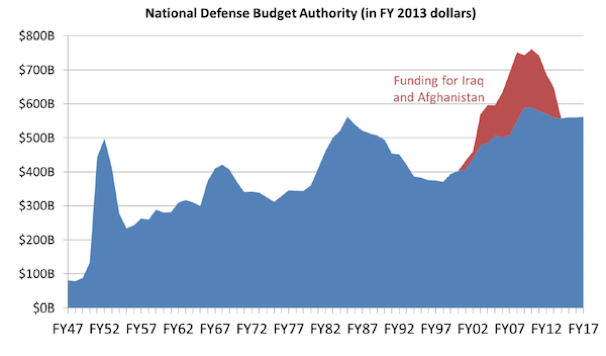
This first graph indicates the national defense budget in 2013 dollars.  Since there has been much   inflation since 1945, it is    necessary to adjust the dollar amount to get an accurate comparison with past expenses.  We can see that the defense budget   ballooned in the late Forties and early Fifties because of the new Cold War and the Korean War.  There is a bump in the late Sixties and early Seventies because of the Vietnam War.   Then there is the huge bump in the Eighties because of the Reagan defense buildup; during this period the defense budget got to be greater than the Cold War beginnings of the early Fifties.  Finally we can see that about 2010 the defense budget rose to another peak, and this is   without counting the expenses of the wars in Iraq and Afghanistan, which were separate.  When these are added in — red peak — the defense expense are 50% higher than in  the beginning of the Cold War, even though the Cold War supposedly ended in  1991.  Note that these figures do not include items mentioned above such as veteran’s benefits.

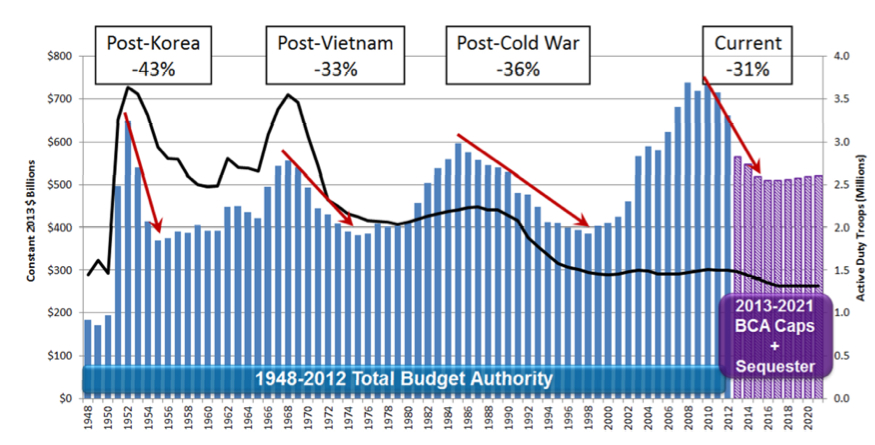
defense_adjdol2The next graph shows the expenditures again, from 1948  to 2012.  You can see the fall-off after Korean, Vietnam, and Cold Wars ended.  It also shows the fall off after  the current wars are ended.  As I write this we have sworn a “bombing campaign” on what is called ISIL or ISIS or IS in Syria and Iraq, so the expenditures will probably go up again.

defense_gdp

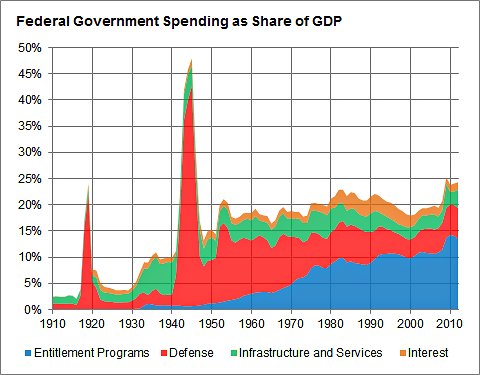
The third graph shows  expenses as a percentage of GDP.  Note that the bottom blue section is labelled “Entitlement” and remember what I said above that these are not part of the discretionary expenses, since most entitlements are from a separate part of the money collected from taxes; they are from FICA and not income taxes.  The part we are interested  in is the red second band.  The defense expenses went way up during World War I, just before 1920 and them returned to almost the same level, about 1 to 1.5%.  They went up again  during World War II in the Forties, but in this case after the War  the defense expenditures did not go back to what they were before the war, but only fell to 8%, at least four times greater than what it was before the war.  These defense expenditures decreased as a percentage of GDP over time, but only because the GDP increased at a faster rate.  The true increase is shown in the first two graphs.

To sum up, spending by the United States for defense increase greatly after World War II, and  has  remained at elevated levels ever since.  One can argue that this increased defense spending was necessitated by the threat of he Soviet Union, even though we were allies with them and they suffered the lion’s share of causalities during that war, but the defense spending did not fall after the Soviet Union did, and in fact the spending now has increased to  almost double what it was at the end of the Twentieth Century.  The question remains whether the defense spending increased after the war because of the threat poised by our erstwhile allies or if the threat of a greatly reduced spending for the military caused the danger of the Soviet Union to be seen.  The Great Depression before World War II never really ended until the increased spending for weapons needed for the War; perhaps after the War some were afraid that the depression would return unless the defense spending remained at high levels.  This is called Military Keynesianism.

Another big event of the period, which was to influence the post-war world and   still has repercussion today, is the Bretton Woods Conference of July 1944.  Delegates from many countries met in New Hampshire to plan out the world economy after the War was over.  The International Monetary Fund (IMF) and the World Bank were both formed during that meeting.  It also resulted in an agreement among the countries of the world to maintain a certain type of order in the world’s financial system.  That agreement was broken when Richard Nixon, in August of 1971, took us out of the Bretton Woods system.  While the system was working, it was a financial golden age for American workers.  The rate of unionism was at a high level,  and many of these same workers joined the middle class.  College education was relatively inexpensive  and many people poured into colleges, resulting in an educated workforce and the many student protests that marked the decade of the Sixties.  Government intervention to assure the financial well being of the nation’s populace  became more used.

spending_2013

This final graph shows the true cost of defense after the end of the Cold War.  Very few people make this knowledge available because America wants you to believe that it is not a war-based economy, but if you remove “entitlements” (as mentioned above) you see the real figure, that 62.5% of the budget — Military and Veteran’s Benefits — goes to past, present, and future wars.  This data is  from the American Friends Service Committee.  It is clear that our country is dominated by defense spending, much, much more that any time in our history before this period when the National Security State took   power in the United States, something that President Eisenhower warned of: the Military-Industrial Complex.

The Death of John Lennon

I thought of this entry’s topic while listening to “I Just Shot John Lennon” from the Cranberries To the Faithful Departed, an album from the last century. In fact, that album was released longer ago than John’s death was before the album’s release.

Shortly before an astrological conference at Mills College in Oakland (mentioned in the post of April 4), there was a gathering of astrologers that I was invited to.  At the gathering Rob Hand was excitedly describing his new book about the planets, with new descriptions of them.  Unfortunately, as far as I know, that book was never published.  Rob and I got into a discussion about the death of John Lennon, and I told him my theory.  I thought that John Lennon took the bullet for Ronald Reagan.  The assassination attempt on Reagan was about three and a half months later  from when Lennon was shot down outside his apartment.

It was well know in astrological circles that every president elected under a Jupiter-Saturn conjunction, which happened in  1840, 1860, 1880, 1900, 1920, 1940, and  1960,  had died while in office.  This was also called the Curse of Tecumseh.  But the President elected in 1980  was suppose to die according to this “curse”, and in fact that President almost did die.

I thought that John Lennon — or his oversoul — knew that if Reagan  served as President, any attempt to ameliorate the growing global crises  would not happen.  Instead, America, and the world, would embark on a binge of consumption, an increase of the already dangerous party, and as a result when change was  finally implemented it would be far more radical than the mere replacement of light bulbs or the use of electric cars.  So he realized  that a Reagan presidency was  needed to insure a radical change in the direction of this country and the world.

Since the election of Ronald Reagan the world has partied like there was  no tomorrow, and in fact all the moderate solutions being proposed now might have actually worked if implemented in 1980.  But now the situation has gotten radically worse, as even a brief following of current events can tell, and only a radical change can make any difference.

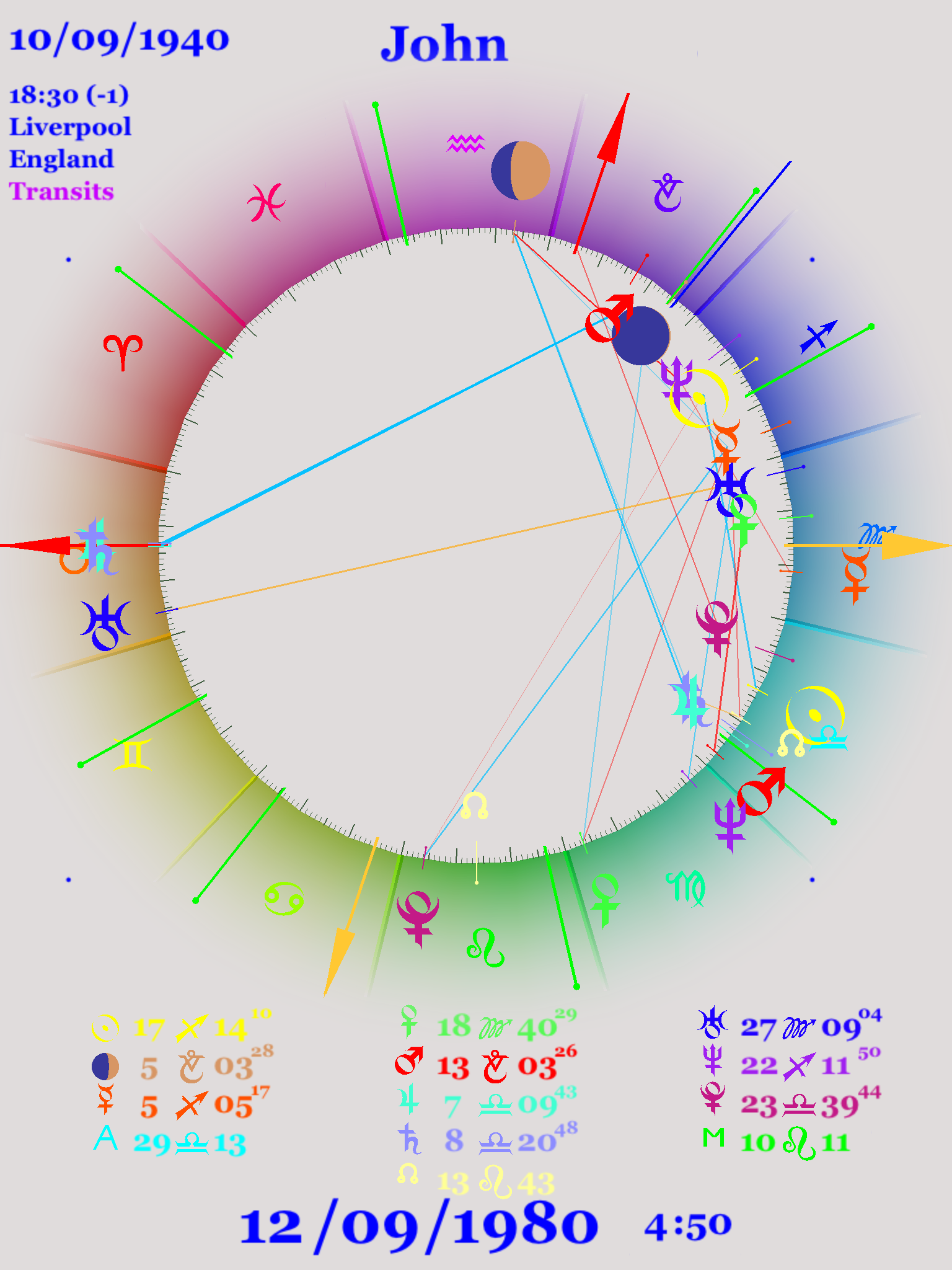
Let’s first look at the time of the assassination for the United States chart.  Obviously (I hope) the effect of the assassination on John Lennon was greater than the effect on the United States,  but the United States still was affected.  Some people can still tell you where they were when they heard that John was  dead.  Since this was a killing with a gun, one should expect that the planet Mars will feature prominently.  According to Wikipedia, the killing occurred on December 8, 1980 at 10:50 PM.

lennon_usa

Death of John Lennon for USA

Looking  at the chart of the United States at the time of John Lennon’s killing, we find that Mars is opposite the Sun of the US with an orb of about a quarter of a degree.  This is not too surprising, this was  obviously the best known shooting taking place at the time.  Transiting Neptune is square natal Neptune and thus opposite natal Mars, accentuating the natal Mars Neptune square and  the dubious use of guns in our society.  Transiting Uranus was square the Moon — the people are upset.  There was certainly an outpouring of grief among people who knew who John Lennon was; for many he represented the Beatles and the Sixties.  For many the death of John Lennon meant that the Sixties were gone, even though the concert at Altamont in 1969 also was suppose to indicate that.  And of course any hope for a Beatles reunion was  down the drain.  And the shooting was totally unexpected — Uranus is surprises, unexpected event — since he seemed in perfect health and was continuing to record.  In fact, he had just returned from the studio.  Also, there was a Jupiter-Saturn conjunction, which only happens every twenty years; it can be said to indicate the start of  a  new twenty-year period, just as the one in 1960 did.  And this shooting was one indication (the election of Ronald Reagan a month earlier was another) that the next twenty years was going to be quite different that the previous twenty years.  But also, as we can see from the first assassination chart for John Lennon, he was born under a Jupiter-Saturn conjunction, the one before the one that indicated the start of the Sixties.
lennon_assassination

Lennon Assassination

Looking at the assassination chart, we see that the Moon  is almost to the Midheaven and loosely conjunct Mars, which is trine that Jupiter-Saturn conjunction that we have just talked about.  Mars was the highest planet in the sky at the time he was killed  by a gunshot.  Transiting Uranus was opposite his natal Uranus.  This transit always happens at about this point in a person’s  life, and indicates a  mid-life crisis, though not often this serious a mid-life crisis.

In astrology there is something called a relocated  chart, drawn up  for where you live.  Many people, especially in the past, lived near where they were born, so such a topic as relocation did not make much sense.  But it can make a difference if you move far from your place of birth in an  east-west direction.  Currently I live at the same longitude as where I was born, but further south.  But for ten years I lived two time zones  east, and I felt like a different person.  In this case, John had relocated five time zones west of where he was born, and  so the relocated angles were much different than the natal angles.

lennon_relcated

Lennon Assassination – Relocated to NYC

When we  relocate the chart to New York City that Jupiter-Saturn conjunction is right on his Ascendant, which might explain  why he found New York to be a comfortable place to live in.  But this also means that the Mars  — gunshots — is  trine to his New York City Ascendant, a personal point.  And being shot is a very personal event. Notice also in this relocated chart Pluto is square the Midheaven, a sign of transformation of his public persona, which of course this  was.  Notice that the positions of the planets are the same as in the  non-relocated chart, only the Ascendant and Midheaven change.  Also notice that the time changes to allow   for the different position.

Adolf Hitler

Adolf Hitler has great name recognition, one of the best of the Twentieth Century.    He has become the epitome of evil, as well as the man by which evil is judged.  Even young, ignorant, wannabe Neo-Nazis knows the name Adolf Hitler.  Recently Hillary Clinton, among others, has compared Vladimir Putin to Hitler, and in the past Saddam Hussein has been compared to Hitler.  These are extremely hyperbolic utterances; I would expect people to be more precise,  Perhaps they could say Putin is only half a Hitler.  I mean, it is hard to live up to Hitler’s reputation.

The mother of the astrologer Reinhold Ebertin  was thrown into prison  when an interpretation she made was not suitable to the Fuhrer.  Supposedly the British used astrologers to send  bad predictions into Germany, thus throwing them off.  Hitler had  the personal astrologer Karl Krafft  — you can find discussion of this on the Web.  Thus Hitler and the Third Reich were aware of astrology, and there was an active  astrological presence in pre-war Germany.  So it seems only fitting to look at the astrology of Adolf Hitler.

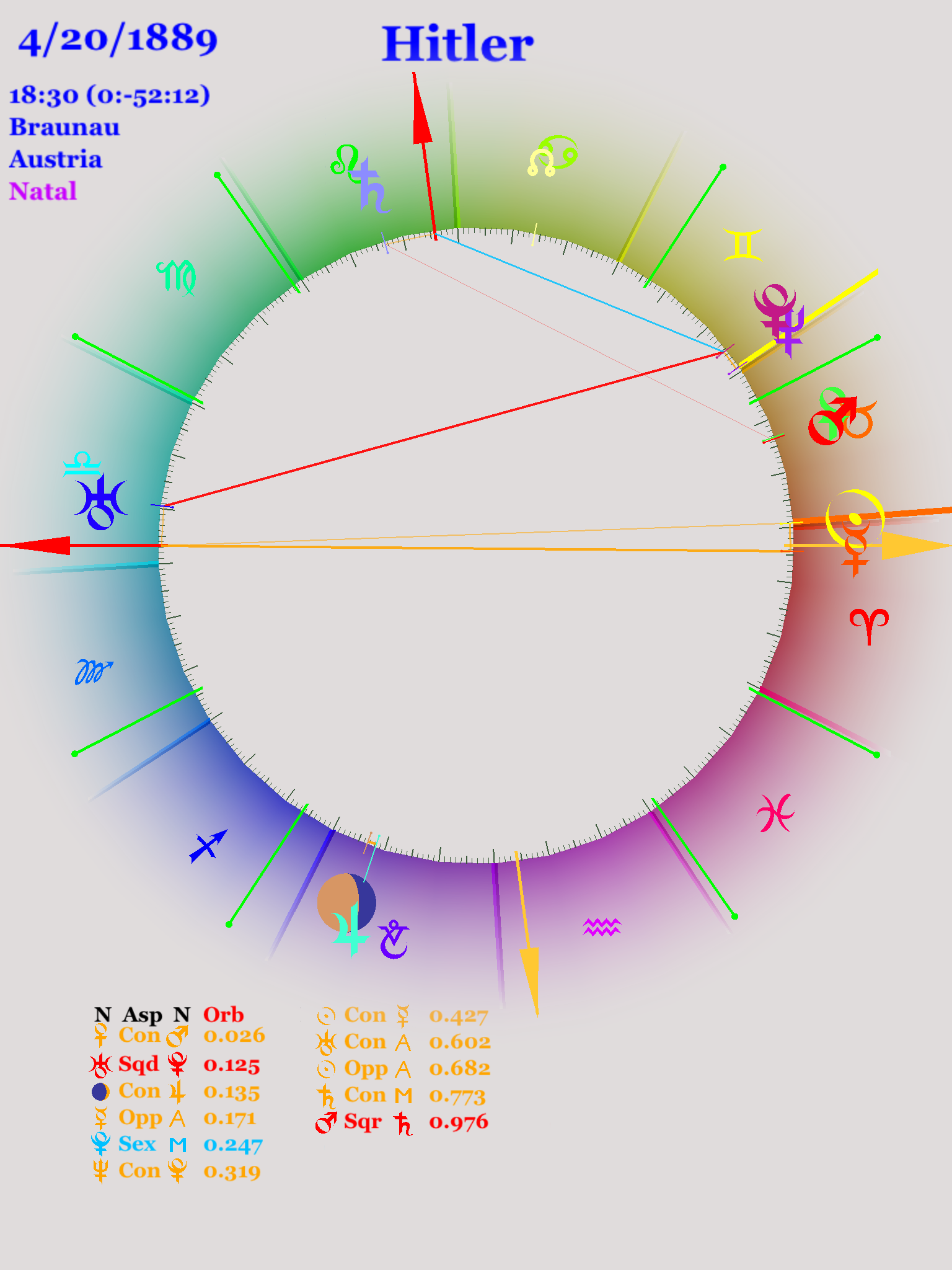
Below is Hitler’s birth chart.  For such a monster as Hitler, one would think that he would have an extraordinary chart.  There should be something that indicates  that he is evil.  Certainly his chart should have something outstanding.  For someone as major and evil as Hitler I would expect at least a prominent Pluto, and it should aspect at least one of the personnel points Sun, Moon, Ascendant or Midheaven.

Hitler

Hitler

When we look at the chart we see a Taurus Sun and Capricorn Moon.  Grounded, down to earth, practical. He has Pluto sesquiquadrate Uranus, which all born at about that time have, and Pluto conjunct Neptune.  We’ve recently talked about that conjunction in the Birth of the Twentieth Century, and thus Hitler can be seen as a Twentieth-Century Man.     Perhaps the Uranus-Pluto aspect indicates that  Hitler is some type of retrograde hippie, and it is known that he tried peyote and was interested in esoteric studies.  He has a Moon-Jupiter conjunction sextile the Ascendant. Of Moon and Jupiter Ebertin says happiness, kindness, a good heart.   I hear he was good with children.  Then there’s Saturn conjunct Midheaven; perhaps he was overly serious, a hard worker, and had trouble advancing it his career.  I understand he wasn’t that successful as a painter.
The most interesting aspect is a  tight conjunction of Venus and Mars, and both are retrograde.  These  are the  two planets least often retrograde.  I’ve read that a young Hitler once stumbled upon his parents (the father was much older than the mother) making love, and that Hitler and Eva had some non-conventional sex habits, but still unless you are a full-blown Freudian, it is hard to make the case that this conjunction results in the Hitler we know.

Another book, (Geoffrey Dean, et al Recent Advances in Natal Astrology)  claims that Hitler’s character is shown by the large number of unaspected planets, though what these  planets are is  unclear unless extremely tight orbs are used.

Some might attribute Hitler’s evil ways to PLuto on the cusp of Hitler’s Eight House, probably the most notorious house that rules death and other people’s money.  But of course that depends on the house system (Koch in this case) and is a pretty thin  reed to base his personality on.

Or maybe there are some unknown planets or asteroids that account for  his notorious ways.  I looked at the eight Uranian planets, originated in a German astrology  group called the Hamburg School,  but Saturn-Appollon and Zeus opposite Moon describe Hitler but only show him to be a cheerful and creative  teacher.

Repeating, none of these standard astrological techniques  suggest that Hitler was Hitler.  Perhaps astrology does not work, perhaps  Hitler  was so beyond our Universe that astrology did not apply to him.  I’m sure there are plenty of excuses, or esoteric interpretations.    But looking at this chart does not indicate anything special, and if you have to depend on some esoteric technique to prove that Hitler was Hitler,   you’ve already lost the argument.

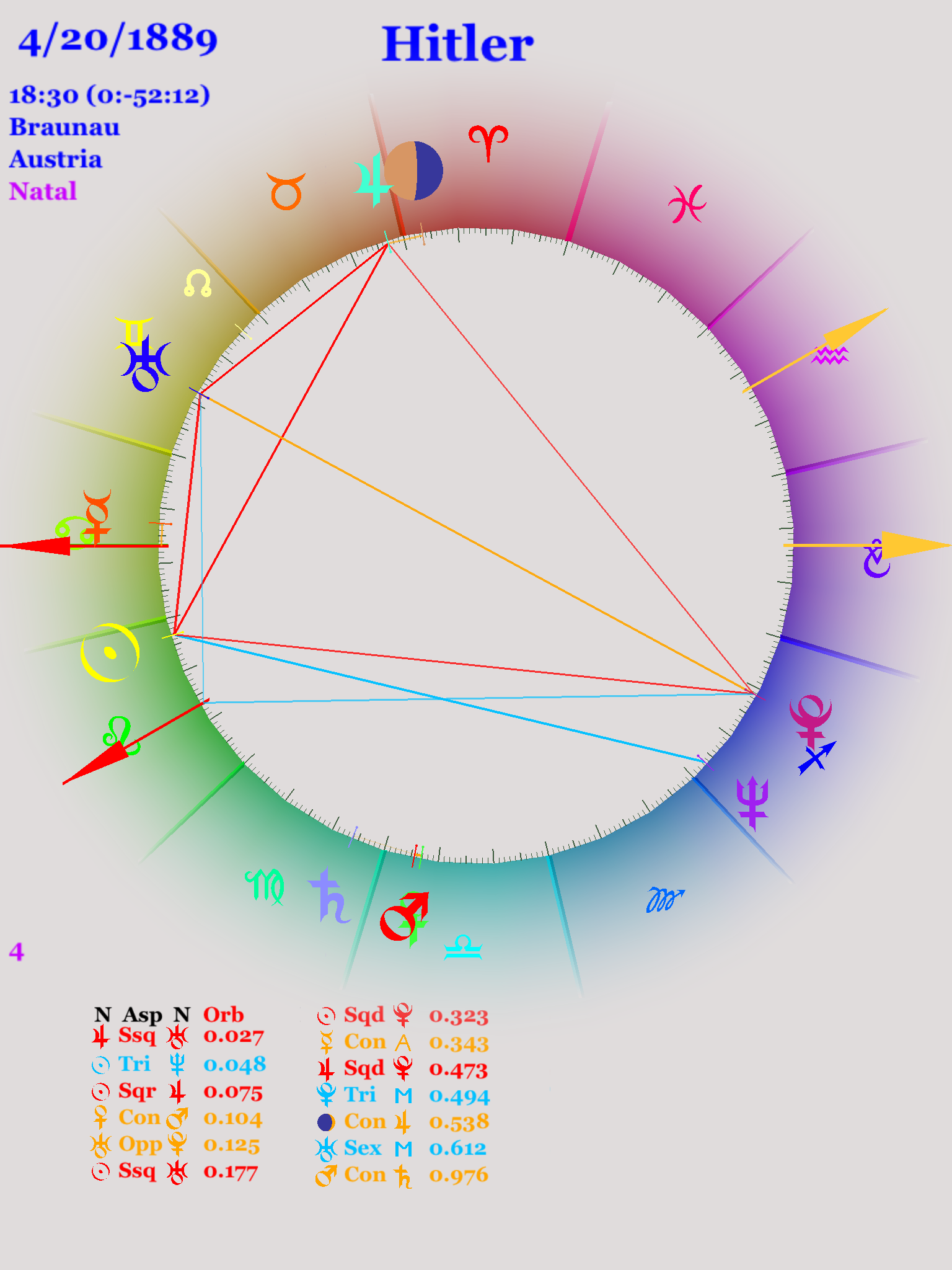
Then lets look at the fourth harmonic chart. A pattern of hard aspects (red lines) jumps out at us immediately.  There is a kite formation with the axis of the kite defined by the Uranus-Pluto opposition (which is a  sesquiquadrate in th first harmonic chart).  It appears that the arrow of this formation points to Pluto, obviously as the important planet.  And the Sun is part of the formation.  Also notice that all the lines are darker red, indicating close aspects.  In fact, looking at the list of sorted relative orbs at the bottom of the chart indicates that all the aspects in the formation are of orb under 50% of maximum.  And we know that all these aspects have a tight orb even in the first harmonic.  See the discussion of Harmonics under the Definitions section for more explanation.  It’s a complex formation, hard to interpret, but the chart is dominated by Pluto.

Hitler4

Hitler — Fourth Harmonic

There are also trines between Pluto and Midheaven and Neptune and Sun.  The Pluto-Midheaven trine is the sextile between those two points in the first harmonic, and the Neptune trine aspects is a quinqunx in the first harmonic.  A quinqunx suggests an incompatibility between the two principles involved; in this case Hitler had trouble between his will (the Leni Reifenstahl movie about Hitler is called Triumph of the Will) and reality.  And the Pluto-Midheaven sextile shows that Pluto not only is involved with the Sun, but also with the Midheaven, two personal points.  This is indeed a Pluto dominated chart.

The lesson I gained  from  this is  that even though it may not be obvious, a chart can contain important aspects that are hidden.  The fourth harmonic is the most useful for seeing these “hidden” aspects.  I want to stress that these hard aspects shown in the fourth harmonic chart are all valid, with very small   orbs, and would appear in the regular first harmonic chart if   we bothered   to show  them.  For example, the    hard  aspect between Hitler’s Sun and Pluto is actually an angle of 33 degrees 45 minutes (which  could be called a demi-semi-octile) with an orb just under 5 minutes, which is the equivalent of a   square with orb of 40 minutes.

500 Years – Part II

The first part of this post was published on March 21, 2014.  It may be valuable to read it (again) before reading this.  It was important to have the Axial Age post before this one was published.

The next question is how do we determine when a particular 500 year period ends and the next one begins.    I use the analogy with how we know when one synodic cycle ends and another starts, and the answer is obvious.   The conjunction of the two planets involved in the synodic cycle is what marks the change from one cycle  to the next.   What I am   proposing for the boundary between two cycles, where the cycle involves all ten planets, is when their collective distance is at a minimum.     This idea also has some support in the work of the great French astrologer Andre Barbault.   

Intuitively, the concept of “minimum distance” is easy.  The planets spread out across the sky and come together.  We can see sometimes that they are spread out and sometimes more bunched together. It turns out that this minimum occurs once every 500 years.  While there are several ways of measuring this angular separation, they all give the same results within a few days.  The one I am using now is based on the common statistical method of standard deviation.  For a group a data points (in our case read planets)  the standard deviation measures how far the points vary from the mean of all points.  If the standard deviation is large, the points are spread out at far distances from the mean point, and conversely if the standard deviation is small the points are clustered close to the mean point.  This  sounds like just what we need.

Technical note.  (Warning: Don’t try this at home.)  I have written some Python programs that can calculate a chart for any date.  What I do is calculate a chart for every day for the last 2600 years and then compute   the standard deviation of the planets for  each day.  It is then easy to find the minimum.

Note that the planets clustering together is much dependent on the position of the three outer planets, since they have a period much greater than all the others.   The fastest moving outer planet – Uranus – takes 84 years to go around the sun, three times longer than the next slower planet, Saturn, at 29 years.  So at first approximation, the minima will occur near the time of the Neptune-Pluto conjunction.   After that we need a Uranus-Pluto and a Uranus-Neptune conjunctions.  So these three conjunction will by themselves determine the 100 year period when this minima occurs.  Then we need Saturn and  Jupiter, which conjoin every 20 years, to get within the group.

As we saw in the entry on the Axial Age, the three out planets were  all conjunct in 575 BCE.  There is one conjunction of Neptune and Pluto every 500 years, four Uranus Pluto conjunctions every 500 years, and three  Uranus-Neptune conjunctions.  As the cycle goes on, the Uranus-Pluto and Uranus -Neptune conjunctions  get further and further later from the Neptune-Pluto conjunction, which would indicate that the planetary minimum occurs further and further after the Neptune-Pluto conjunction as the cycles go on,  until they start over after 4000 years.  In general, the Neptune-Uranus conjunction gets later than than than the Uranus-Pluto conjunction as time goes on also, but not as much as the spread from the Neptune-Pluto conjunction.   In the current period, the Uranus-Pluto conjunction of the Sixties was some 70 years after the Neptune-Pluto of the 1890s, and the Uranus-Neptune conjunction of the 1990s was almost 30 years after the Uranus-Pluto conjunction.

The ancient Chinese thought that there was a 500 cycle ruling the rise and fall of civilizations.   Each of these 500 years is different, although the changes start well before the date – the preceding Neptune-Pluto conjunction indicates that changes are starting. But each period is different than the preceding  one, and it is futile to think that the rules that applied in the preceding 500 year period will apply to the current one.  This lesson applies most forcefully to our current situation, since the number of people in the world  is so much greater than what it was 500 years ago, and civilization  has gotten so much more complicated.  But the lesson can’t be leaned well enough:  Things are bound to change, you can not stop that but only fight a losing battle.  We can not use measures from the past to suggest what the future will be like.  The gifts of the old cycle, which  as I’ve mentioned before are capitalism, industrialism, rationalism,  can no longer  be depended upon.

There is a large cycle called  the Great Year, which is  26,000 years.  This is the time it takes the equinox —  which   creates the Aries point — to move backwards and return to its original position, an action called Precession of the Equinox.  Supposedly, this first point of Aries, marking the intersection of the ecliptic — the path of the Sun through the heavens —  and the celestial equator — is moving into the sign of Aquarius, giving rise to the idea that this is the dawning of the Age of Aquarius.  But what I want to point out is the ratio of this 500-year cycle to the Great Year is the same as the ratio of one week to one year.  Thus I propose that the name for this 500-year period that I have been  talking about, and which gives its  title to this blog, is the Great Week.

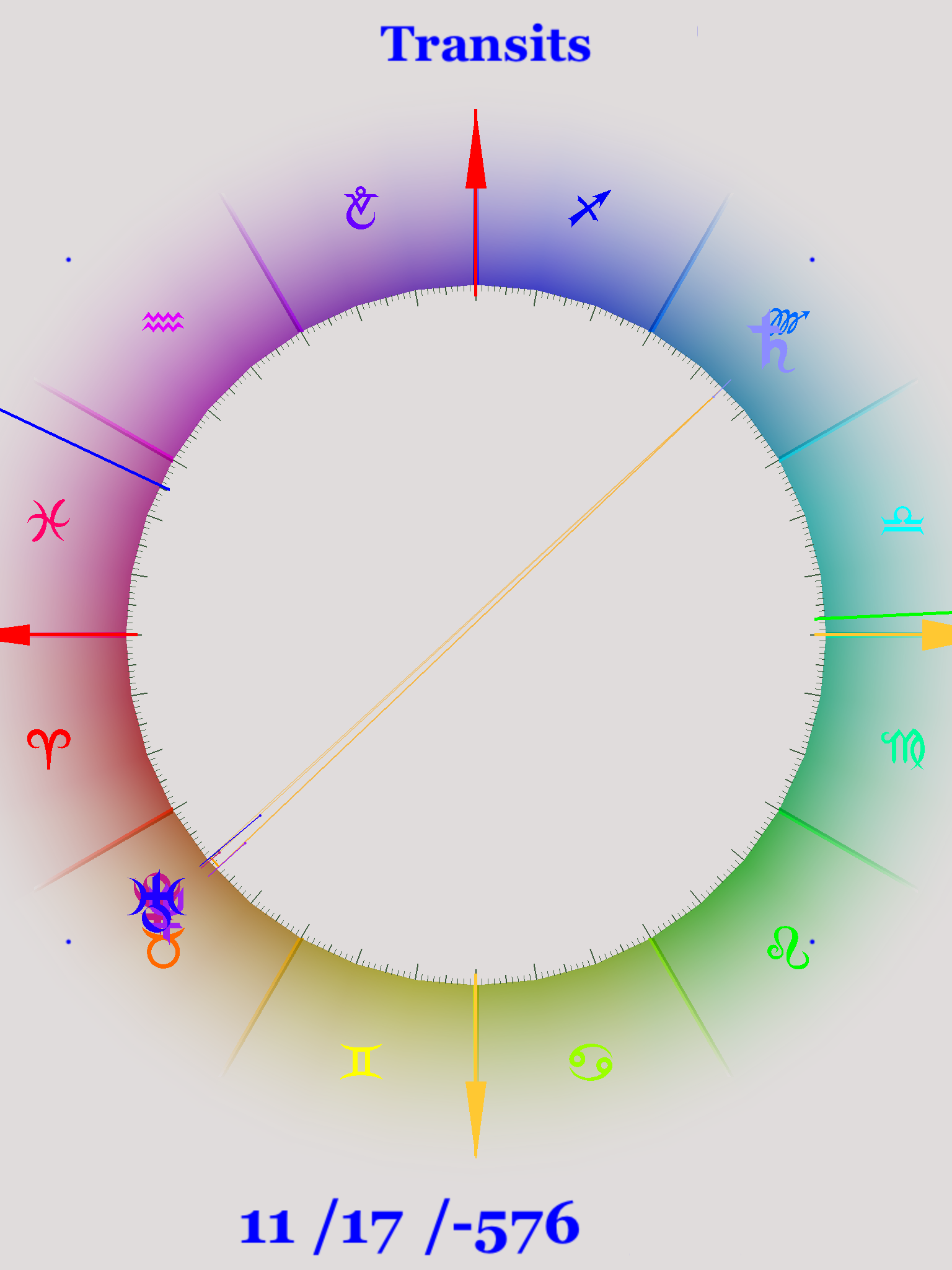
Here is a brief overview of the minima, with the dates that the minima occurred.  Remember this is not a magic date, but rather the dates indicate  periods  where one cycle changed — with time — to another cycle.  I will gives memorable events that happened a each date, usually involving the Roman Empire, since that has been a dominant feature of the last 2600 years. Changes are slow to happen, so take these dates with much salt. 

Note that while people insist there was no year zero, as far as date computations go, there is a year zero, which corresponds to 1 BCE.  With the following charts, dates are given in chronological time, so that year -576 is 577  BCE.


560bce

Minima #1

July 28, 559 BCE. This was the height of the Axial Age, as discussed previously, and is just a short time (as far as history goes) after triple conjunction of Uranus, Neptune, and PLuto.  The Roman Republic starts.


61bce

Minima #2

June 7, 60 BCE.  Julius Caesar crosses the Rubicon and the Roman Republic ends, the Roman Empire begins.


449

Minima #3


August 5, 449 CE.  The Fall of the (Western) Roman Empire, the beginning of the Dark Ages.


947ce

Minima #4


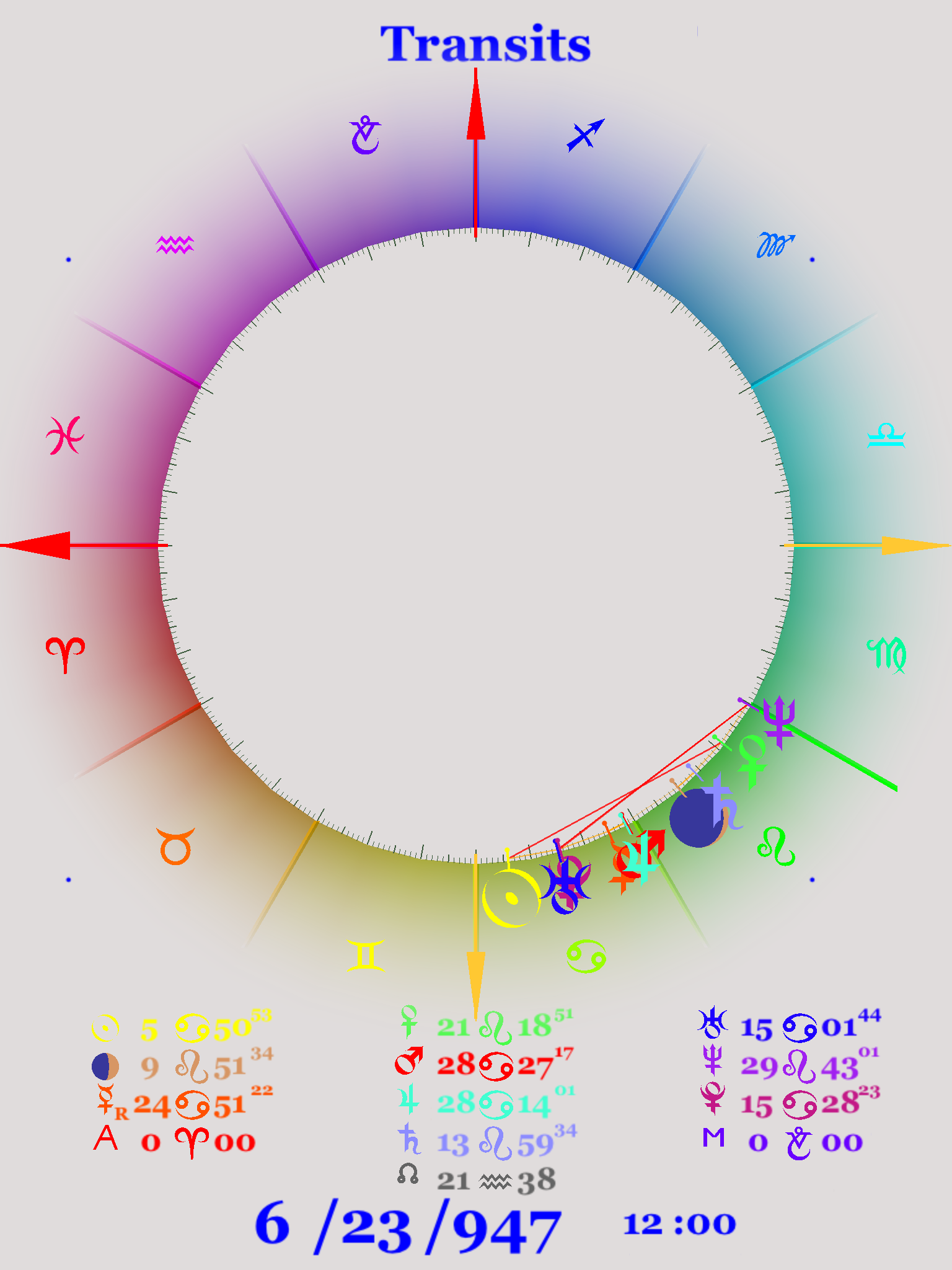
June 23, 947 CE. The Ottonian Renaissance and the beginning of the Upper Middle Ages.  Song Dynasty and the Chinese Renaissance.


1485

Minima #5

November 8, 1485. The Fall of the (Eastern) Roman Empire, the discovery (for Europeans) of the New World, beginning of the Tudor Age in England.


1982

Minima #6


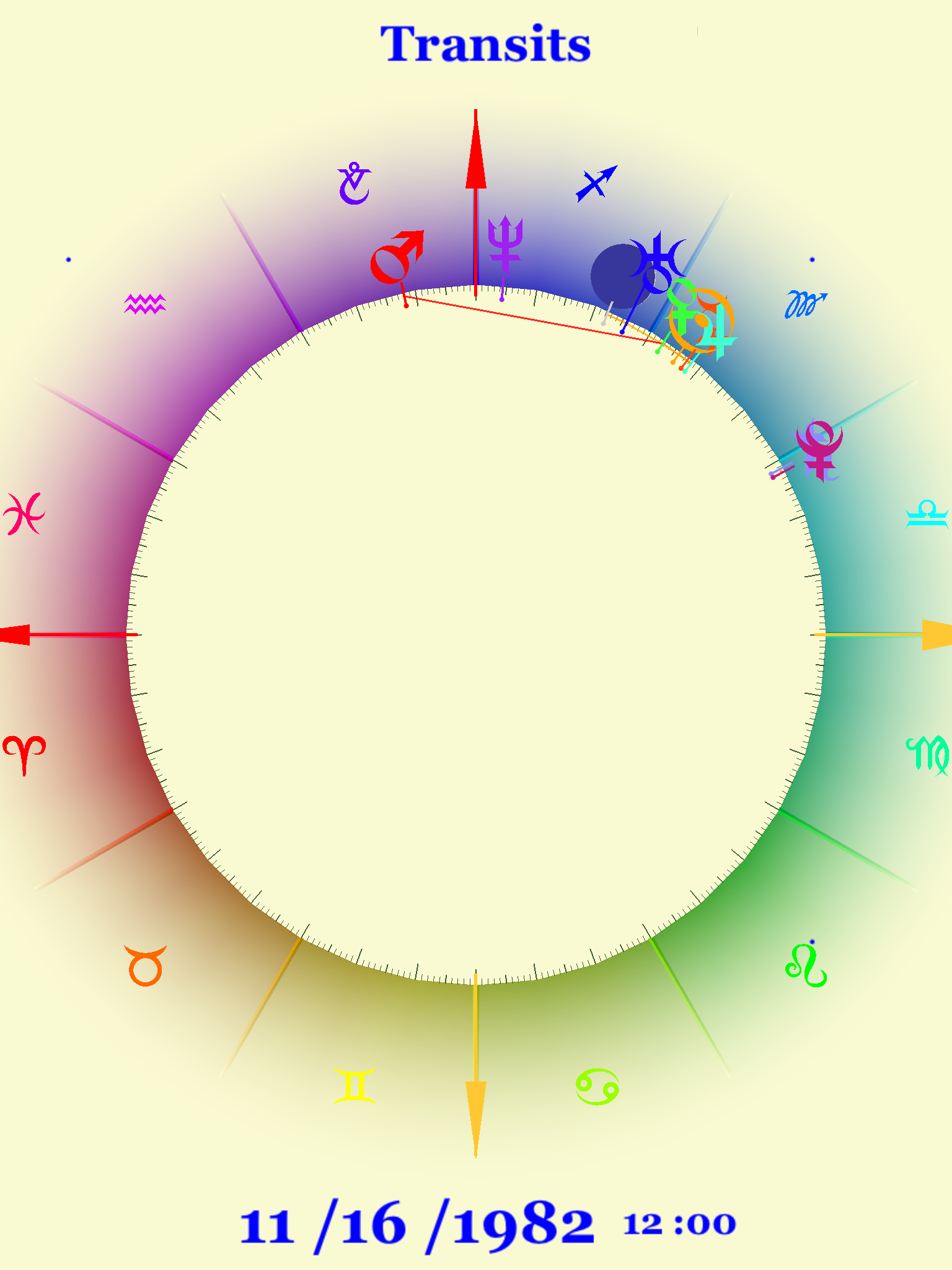
November 16, 1982.  The world reaches the use of 100% of its resources.

Axial Age

German philosopher Karl Jaspers coined the term Axial Age to describe the period 800-200 BCE which  was a time of intense growth leading to the modern world.  Some scholars criticize the concept of the Axial Age, though it is notable that so many important events  happened in a short period of time, as we detail below.  But then, of course, most scholars criticize the concept of astrology.  What I want to  talk about is the peak of the Axial Age, the Sixth Century BCE  in which an incredible amount of what we call modern thinking developed throughout the world, coinciding with a tripe conjunction of the three outer planets – Uranus, Neptune, Pluto – which were of course unknown at that time. In the years following this conjunction many notable events occurred. It was almost as if a rock had been thrown into earth’s timeline and the ripples followed for centuries.

This triple conjunction happens every 4000 years, so the next one will be due in 3368 CE at 13-14 Gemini. This triple conjunction is actually three conjunctions, that of Neptune-Pluto, Uranus-Neptune, and Uranus-Pluto.  Over the succeeding years, the  Uranus-Neptune and Uranus-Pluto conjunctions get further and further ahead of the Neptune-Pluto conjunction, so that, for example, in  the current time the gap is 96 and 70  years, respectively ahead of the Neptune-Pluto conjunction.  These last two  conjunctions also occur later and later from one another, but not to such an extent.  The current ones occurred about 25 years apart.  There are four Uranus-Pluto and three Uranus-Neptune conjunctions   per one Neptune-Pluto conjunction in a 500 year period. 

axialage1

Triple Conjunction of Outer Planets in Axial Age

There were many changes leading to the modern world in the Sixth Century BCE, in the Mediterranean area, India, China, America, in science, religion, history.  For an overview of this period the book Creation by Gore Vidal gives a tour through much of the known world.    I want to apologize in advance for my lack of knowledge of Chinese and Indian culture of this period, so as a  result there are only a few  events from those cultures.  I’ve given some dates but they are often controversial.

This period can be seen as the beginning of history, the beginning of the Modern Age.  While history obviously existed  before the Sixth Century BCE, the first named historian lived in this period.  As we will see below, many of the items that we take for granted  in the world, such as theater and religion, took a modern shape in this period.  Considering the rare triple conjunction that happened in that century, this is not surprising.

First lets look at religion.  Nebuchadnezzar destroyed Jerusalem 586 BCE, and brought people from there to his country, resulting in what is called the  Babylonian Captivity which lasted to 538 BCE.  While the Israelites were   held captive, they  essentially created  monotheism and wrote many books of the Bible.  This was the true beginning of the Jewish religion, which spawned Christianity and Islam. The Old Testament prophet Jeremiah also lived at this time.   In India both Buddha (563-483 BCE) , who gave rise to his eponymous religion, and Mahavira (540-468 BCE), who revitalized and systematized the religion of Jainism, lived during this period. In China Confucius (551-479 BCE) gave rise to again an eponymous  religion as well as Lao Tsu (6th Century BCE), father of Taoism and the I Ching.  In Persia Zarathustra (6th Century BCE), who founded Zoroastrianism, lived.

We had the beginning of science with Pythagoras (570-495 BCE) the Greek mathematician and philosopher whose theorem many high school students have had to learn,  Anaximander (610-546 BCE) a Greek philosopher who is though to have conducted the first scientific experiments, and Heraclitus (535-475 BCE)  another Greek philosopher and metaphysician also lived during this period.

In the field of history and politics the Greek Solon (638-558 BCE) whose name is still  given to elected members of government lived.  His reforms marked  the beginning of Greek democracy. Thales (624-546 BCE) is considered the beginning of Western philosophy, Herodotus is considered the father of history (484-425 BCE) and Thucydides (460-395 BCE), another famous Greek historian all were extant in this  period. The classical age of Greek democracy started in 510-490 BCE.

Nearby, the last of the seven traditional  Roman kings – Tarquinius – was overthrown in 510 BCE and the Roman Republic was created, which would last almost 500  years until Julius Caesar crossed the Rubicon.

The (first) Persian Empire was founded in this period by Cyrus the Great about the middle of the Sixth Century BCE.  This was the greatest empire the world had seen at that point in history, and it stretched from southwest Asia to the Mediterranean Sea.  It was further expanded after his death into Egypt.

In the fields of theater and poetry there were Aeschylus, father of Greek tragedy (525-456 BCE)  and  Sappho (625-570 BCE)  who is  known as one of the greatest poets who ever lived, though most of her poetry has been lost.

The history of metal coins, small pieces of metal that represent money and can be used for exchange, is somewhat shrouded.  From the best I have seen, metal coins were developed independently in China, in India, and in  Asia Minor in the Sixth Century BCE.

The so-called Roman republican calendar was supposedly introduced by the Etruscan Tarquinius Priscus (616-579 B.C.E.), according to tradition the fifth king of Rome.

In  summary, the period, the Sixth Century BCE, was the height of the Axial Age.  Many of the developments that we take for granted, in religion, science, theater, government, history, were first started in their modern form — that could be recognized as such — in this period. The Sixth Century was highlighted by the three conjunctions of the three outer planets — Uranus, Neptune, Pluto.  This century could be considered the Birth of the Modern World.

Modernism and the Birth of the Twentieth Century

I define Modernism as more than an art form, which was merely the outward manifestation of the changes that were taking place in civilization.  A number of events, both physical and astrological, defined the birth of the XXth Century, and the changes start before the official date.

In this entry I will start the beginning of the “Twentieth Century” at 1886.  This was before the first major aspect, the twice a millennium conjunction of Neptune and Pluto.

The memorable event of 1886, which is stills as relevant  today, if not more so,  was the Supreme Court ruling know as Santa Clara County v. Southern Pacific Railroad.  The upshot of this decision, even though it wasn’t in the actual decision, is that corporations are people as far as the Fourteenth Amendment goes.  In fact, the Fourteenth Amendment was applied more often to corporation than to the freed blacks that it was intended for.

nepl

Neptune-Pluto Conjunction

The 1890s saw the rise of Corporate Capitalism, the third period of that financial system.  (I am indebted to the historian William Appleman Williams and his book Contours of American History for the  terms for the first three stages of capitalism.  Since the book was published in 1968 he missed  the next two stages which will be described at a later time.)  This  was an entirely different beast from laissez  nous faire  (William’s term) capitalism – leave us alone.  Laissez faire is the mythic system of capitalism that grew up in the 1820s  (we’ll look at the astrological signifiers at a later date) after Adam Smith published The Wealth of Nations in 1776. Often when  people refer to the glories  of capitalism they are thinking of this type of capitalism that has long since gone.

Corporations became increasingly powerful in the 1890s, for example (in the United States)  U. S. Steel (Andrew Carnegie) and Standard Oil (John D. Rockefeller).  The “Trusts” that Progressive politician like Theodore Roosevelt wanted to bust grew up on this period.  The Uranus-Neptune conjunction took place near the Descendant of the United States, which is why the United States was so strongly affected by this Corporate Capitalism.

Another important event of this period was that the United States got an  empire, not just in the Caribbean (Cuba, Puerto Rico) but in Asia (Philippines, Guam).  This started with the Spanish-American War of 1898, America’s first major venture into the outside world, after the North American continent had been conquered and the native population successfully  put down.  The Open Door Policy (Secretary of State John Hay)  gave notice to the rest of the world  that America was a world power, and it would soon surpass Great Britain as the dominant power in the world.

In this period the world  was changing rapidly through electric lighting  (Thomas Edison 1879), the telephone (Alexander  Graham Bell 1876), and the box camera (George Eastman 1900).

In this period there were not only crossings of the cardinal axis by all three outer planets, but there were two important oppositions that describe so much of what was going on in the world at the dawn of the Twentieth Century.  The Uranus opposite Pluto was strongest in the first half of the first decade of the new century, and the Neptune opposite Pluto was strongest during the second half of the decade, extending through a few years of the second decade.   This period was filled with all kinds of  changes, which I will briefly outline below.  A good description of this period is found in many books, such as The Vertigo Years by Philip Blom.

A brief list of the important event in this period:

The first Russian Revolution took place in 1905;  it wasn’t successful and made the Russians even angrier.  Then,  after the disastrous World War I, they fought the second  Russian Revolution of 1917, which  was successful.

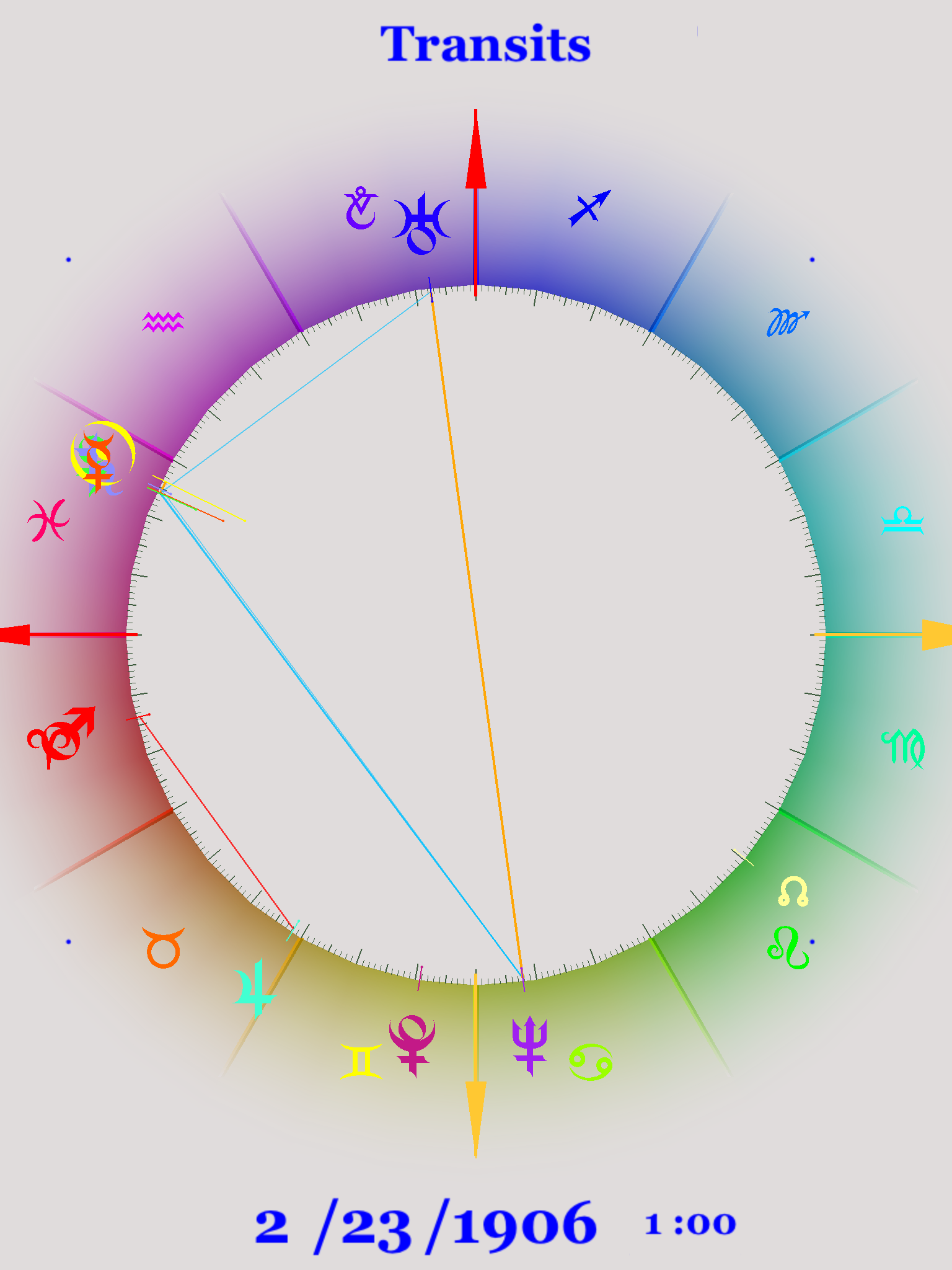
The  Emperor of China, Puyi, who was the twelfth ruler of the Qing Dynasty, served as a child for a few years.   A film was made about his life in 1987.  Born in 1906, he ruled from 1908 to 1912.  He was not only the last emperor of his dynasty, but in fact the last emperor of China.  The Twentieth Century was encroaching on China.

The NAACP – then called the Niagara Movement, so called because they were not allowed  to eat in a hotel in the United States so they had  to meet on the Canadian side of Niagara Falls  –   was formed in the United States in 1905.

The International Workers of the World, commonly known as the Wobblies, were formed in 1905 with the intent to be One Big Union.  They wanted all workers to join together to  form a union, and were and the forefront of radical labor action, for which they paid a   high price.

An Indian lawyer in South Africa   by the name of Mohandas Gandhi, promulgated his doctrine of non-violent protest, called Satyagraha,  on September 11, 1906.   This is often referred  to as “the first 9/11”  but has a much different meaning in history that what the phrase “9/11” usually refers   to.  He later moved back to India where that doctrine changed the government.   His doctrine was also  adopted by Dr. Martin Luther King in the United States, with far-reaching repercussions.

There were anarchist and syndicalist movements forming all around the world, such as in Korea, China, Japan, Mexico, Puerto Rico, Cuba, Peru, Brazil, Argentina, Egypt, and South Africa.  Details of this international anarchism are found in the book Anarchism and Syndicalism in the Colonial and Postcolonial World 1870-1940 edited by Steven Hirsch and Lucien van der Walt.

In America in 1904 there was one of the biggest ecological disaster that had ever happened  in that country.  In that year started a chestnut bight that destroyed an estimated     3.5 billion chestnut trees  in  the country.  The cause was   a fungus imported from Asia.  By the time the Great Depression hit America in less than 30 years   the people of  especially Appalachia   were hit by this lack of food and lumber.

In the realm of science, two major theories were developed in  this period which revolutionize science and our concept of the Universe, which up until that time had been based on theories of Issac Newton in the Eighteenth Century.  In  the very small quantum mechanics was developed by Max Planck, Niels Bohr, Werner Heisenberg, Albert Einstein, and others.  In the very large  the Special and General Theories of Relativity were developed by Albert Einstein with help by Max Planck and others.  Both these theories  had profound implications and brought science beyond Newtonian physics.  And in 1912  the meteorologist Alfred Wegener developed  theory of continental drift, which was  immediately rejected only to be accepted a quarter of a century later.  The theory was first suggested in the late 16th Century under a Uranus-Pluto conjunction.  Also in the first decade of the Twentieth century scientists like Henri Becquerel, Ernest Rutherford, and Marie Curie made discoveries that laid the foundation for the atomic bomb.

But there were also big changes in our concept of the interior world, lead by  Sigmund Freud and Carl Jung, who first communicated in 1906.  There were many others developing the new fields to explore the mind, such as psychoanalysis and psychotherapy.  The concept of the subconscious  and the interest in analyzing dreams were just two of the ways their ideas changed the world.

Les Demoiselles d'Avignon

Les Demoiselles d’Avignon

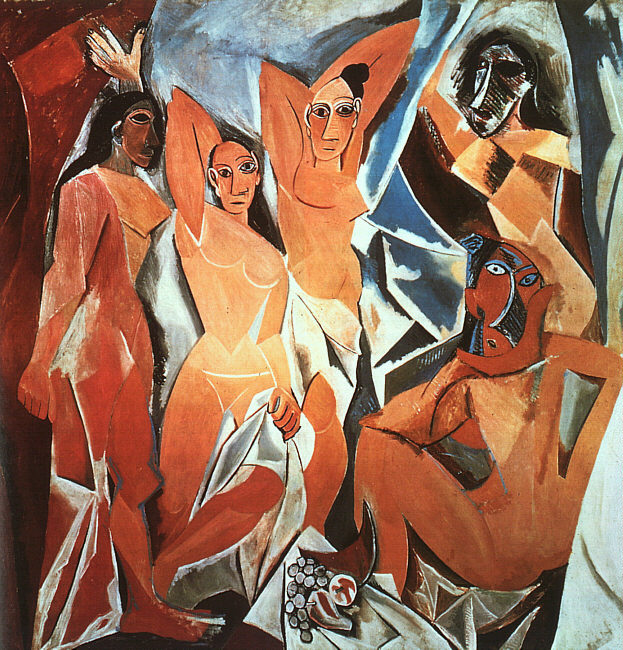
The art world also saw a big burst of change.  The Spanish artist  Pablo Picasso and the   French artist Georges Braque were starting their careers which would lead   to the school of Cubism.  Picasso’s painting  Les Demoiselles d’Avignon from 1907 shocked and scandalized the art world.   Also at this time an artist who is considered one of the best of the Twentieth Century, along with Picasso, was  at  work.  This was Henri Matisse. Marcel Duchamp, who later would be famous in the world of Dada, created the  painting was Nude Descending a Staircase, No. 2, which was shown in 1912.  I  did not see this  clearly until I saw a stroboscopic picture by Gjon Mill of a figure descending.   Duchamp had captured  the idea of strobelights long before they were actually used.

Nude Desdendnig a Staircase No.2

Nude Desdendnig a Staircase No.2

In Italy the movement know as Futurism was developed.  There was recently a show of art from this school at the Guggenheim in New York.  The artists of this school were enchanted by the speed of cars and planes, of the new world forming at the beginning of the century.

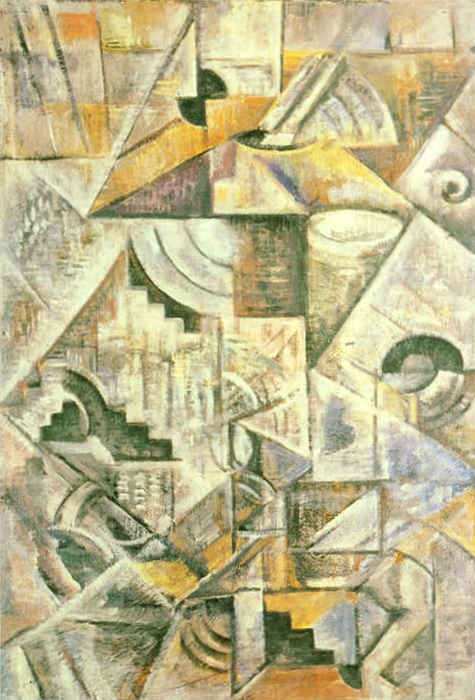
Improvisation-x Kandinsky

Improvisation-x Kandinsky

Picture With White Form - Kandinsky

Picture With White Form – Kandinsky

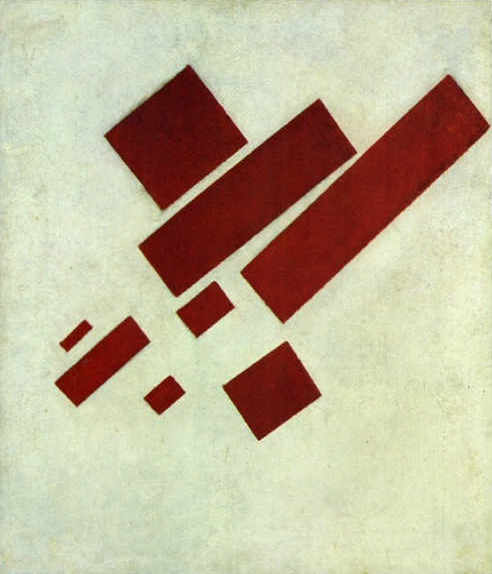
In Russia  what has been called the Russian avant-garde was developing.  The best known  artists of this school  were Wassily Kandinsky and Kazimir Malevich  but there were many others.  They took abstraction far beyond the ideas of Picasso and Duchamp.

Samovar - Malevich

Samovar – Malevich

Suprematism Eight Rectangles - Malevich

Suprematism Eight Rectangles – Malevich

Among writers there was James Joyce,   who often considered the outstanding author of the Twentieth Century, and Virgina Woolf and the Bloomsbury Group.  Upton Sinclair and Jack London were publishing novels   that shook up the view of the world.  And don’t forget L. Frank Baum and his Wonder Wizard of Oz, rumored  to be a political parody, which is still influential. Theodor Herzl published his idea of Zionism, whose influence is felt strongly 100 years later.

The development of computers took a step forward with the work of Herman Hollerith.   He developed the 80-column punch card that could be used  to tabulate data automatically.  This device was used to automate the 1890 census, speeding up the time it took to finish the count by a factor of eight.  He founded a company which was later merged  to form IBM. The use of 80 columns was popular in the computer field through the Eighties.

Cars were becoming increasingly popular in the first decade of the Twentieth Century.      This popularity was greatly helped by the  introduction of the first affordable automobile,  the Model T Ford in 1908.  This automobile was released by the Ford Motor Company of Detroit Michigan and not only allowed the middle class to afford an automobile, but provided employment to many,  including recent immigrants to the United States    and Blacks fleeing the Jim Crow South.    The implication of the automobile were profound but they weren’t realized  for many years.  All of the gas burned  polluted the atmosphere causing the greenhouse effect, and people stopped moving, leading to many   diseases of inactivity. As a result of the widespread use of the automobile   large stretches of open land has been paved over, for highways, parking lots, and driveways—personal parking lots for each home.  In fact , some homeowners associations require all houses to have driveways, whether of not they are used.  If an alien viewed Earth, the alien might believe that automobiles are  the dominant life-form on the planet.  These automobiles are attended by small symbiotes who feed them and  keep their outsides clean, and buy them fuzzy dice   and dashboard mascots, in exchange for which the small symbiotes  are taken places by the automobiles.

Motion pictures    were developed during this period.  Names like Edison in 1891   and Lumiere in 1895 developed a  way of projecting a picture onto a screen – if this was done often enough the human brain would not see individual frames but rather continuous  motion.  But  by  the early years of the Twentieth Century motion pictures  became wildly popular  as the art of cinema developed and people no longer had to be content with images of simple motion.  By the middle of the first decade of the XXth Century feature films – films longer than one reel –  were being produced.  At the same time actors began to get credit and production companies were organized.

But it was not only motion pictures that became increasingly popular, but still pictures that could be taken by an individual.  Today when many people carry  camera with them on their cell-phones, we forget what a breakthrough this was since before this time photography was a difficult process not suitable for someone not  truly interest in the act.  This change was due to George Eastman and his introduction of the Brownie camera in 1900 with the motto “You push the button, we do the rest”.

The development of the airplane, most famously by the Wright Brothers, in the first decade of the new century,  revolutionize life.  Another person famous in  the history of powered flight, who may also have a claim to the first flight, is Glenn Hammond Curtiss, who made the first officially witnessed powered flight and founded the aircraft industry.  The names of both these pioneers lives in  the name of the current aerospace company Curtiss-Wright Corporation.   The dream of flying like a bird had been a long one for mankind, as the myth of Icarus  suggests.   It was given a boost with the development of hot-air balloons by the Montgolfier brothers in  1783, allowing humans to float over Paris.  But by the Twentieth Century powered  flight came into being, and there were many developments after that in the field.  This allowed humans to move easily from place to place in the world, and also, as an unforeseen consequence, to transfer all types of animals and microbes  from one part of the world, where immunity existed, to other parts of the world were that particular disease had never been seen.  We are living with the consequences.

Music also changed in this period. Igor Stravinsky changed music with his Rite of Spring, first performed in 1913.  The production was shocking, and the use of chords changed the way future composers looked at music. There was also a Futurist movement in music with many of the same origins as in painting.  Charles Ives was one of the first American composers to be known throughout the world.  The French composer Edgard Varese was relatively unknown at the time, but he has influenced many such as the rock artist Frank Zappa. Sergei Prokofiev was another composer who broke away from the Nineteenth Century

Much was happening astrologically at this time – it was very crowded.  The first significant aspect was the once every 492 year conjunction of the two most outer planets Neptune and Pluto in the 1890s.   This conjunction took place close to the Descendant of the United States which is why the United States was so strongly influenced by the changes that took place around the world.

During the first 15 years of the Twentieth Century all three outer planets crossed the Cardinal Axis.  In  1901 and 1902 Neptune crossed the Cardinal Axis  at 0 Cancer, then in  1904 and 1905 Uranus crossed the Cardinal Axis at 0 Capricorn.  The whole thing, the changes of the first decade, were brought to an abrupt close when Pluto crossed the cardinal axis in 1913 and 1914.  It was to be a far different world by  1920 that it had been at the end of the Nineteenth Century.

Uranus Opposite Pluto

Uranus Opposite Pluto

There were two important oppositions of the other planets in this period, in addition to the twice a millennium conjunction of Neptune and Pluto.  The  opposition of Uranus and Pluto   was most intense from 1900 to 1903;  this was the opposition preceding the conjunction of those two planets in the 1960s.

urOppne

Uranus Opposite Pluto

But the most important configuration of this period  was Uranus at the Neptune/Pluto midpoint.  Midpoints involving the three outer planets are quite rare, happening about three times a century, and they represent a zeitgeist change so that people living after the midpoint have trouble remembering what life was  like before the midpoint, the changes they have gone through are so profound.  In this case of the first midpoint we see that Modernism grew up, and people soon forgot what the slower world of the Nineteenth Century was like.  The strongest part of the midpoint was 1903  through 1905, and at one point Uranus  was also crossing the cardinal axis, adding more power to the midpoint.  We can see from the graph that this midpoint was close from early 1902 to late 1906  and both were crossing the cardinal axis  together in late 1904.  The most common type of midpoint involving the three outer planets has Uranus as the apex planet, because Uranus is the fastest moving of the three.   That was the case in    this early Twentieth Century midpoint.  The least common is with Neptune at the apex.  There were two other outer planets midpoints in the Twentieth Century, which we will look at later.    One may want to guess as to which turning points in the last Century corresponded to midpoint configurations.

urmpnepl

Uranus = Neptune/Pluto

In this final chart there is a grand overview of all the important configurations taking place in the period we are talking about.  It is a graphical ephemeris for a twenty-year period starting in 1896 on the left. We can see that the Neptune-Pluto conjunction is separating from exact (black arrow).  Then  the Uranus-Pluto opposition takes place (red arrow)  while at the same time Neptune crosses the Aries axis, shown by the horizontal black line.  Next Uranus comes to the Neptune-Pluto midpoint (green arrow) and shortly thereafter both Uranus and the Neptune-Pluto midpoint cross the Aries axis, just before the center of the graph.  Next there is the Uranus opposite Neptune (blue arrow) which lasts longer, five years  exact, than the Uranus-Pluto opposition at two years.      Finally, at the right, we see Pluto cross the Aries axis (yellow arrow) ending the period.  World War I, the War to End All Wars, starts and the world of the Nineteenth Century is totally gone.

twentieth_century_tg

Graphical Ephemeris – 1896-1916 – The Birth of the Twentieth Century

The Virtuous Nation – Conclusion

Jupiter conjunct Venus conjunct Sun

Virtuous

Here we have both the Greater and Lesser Benefics conjoined with the Sun, representing the Spirit of the United States.  This is a powerful configuration, and while there is no evidence that the birth of the United States was planned for this triple conjunction, it certainly is very beneficial.  This triple conjunction only existed for two weeks centered  around July 4.  It is as if a halo of goodness surrounds  the United States, to protect it from misfortune, and to allow people looking at it to see a beacon of good.  


usa_ju

Triple Conjunction of Sun, Jupiter, Veenus for the USA

But this triple conjunction also effects the way Americans look at themselves, at their country.  They see themselves as virtuous.  This belief underlies much American behavior.  A vocalization of this was seen clearly after 9/11  when the common question was heard “Why do they hate us?”  This was often expressed with a mixture of shock and disbelief.   If you believe that you are virtuous, you can not understand why anyone would do you harm. If such an event occurs, one can either reassess one’s virtue, or consider the attacker mad.  While Americans believe themselves as uniquely virtuous, there is little evidence for this [I am not talking about personal virtue, which was much in evidence in the personal response to the catastrophes of 9/11 and Katrina, for example, but in national actions].  The Marshall Plan after World War II, an attempt to help rebuild war -ravaged Europe, is most often cited as an example of American generosity [See H. W. Brands, The Devil We Knew,  Oxford University Press, 1993 p  16-17 for a more balanced discussion of the Marshall Plan], but, in this author’s opinion,  the actions of the America Relief Administration, formed by Herbert Hoover, in the relief of the Russian famine of 1921-23 more clearly  qualifies as a noble and selfless act.

Virtue has always been important to Americans culture.  But because of a historical phenomena in which words remain the same but the meaning changes, virtue in the present has a different sense than it had to the founders of the country.  To the Revolutionary  Generation, virtue meant civic virtue, “the capacity of some men to rise above private interests and devote themselves to the public good” in the words of historian Joyce Appleby [Joyce Appleby, Capitalism and a New Social Order: The Republican Vision of the 1790s, New York University Press, 1984, p 9].  This can be seen as a Jupiter virtue.  Jupiter is a social planet, concerned with other people and the wider world.  This type of virtue still remains in the phrase noblesse oblige .  It is a concern for the commonweal, for the well-being of other people, a concern for the community.

Compare this to the type of virtue that arose in the United States  after 1800, and  especially after 1820 and the growth of what historian William Appleman Williams calls the Age of Laissez Nous Faire [William Appleman Williams, The Contours of American History, W.W. Norton & Company, 1988, p225 ff] — Leave Us Alone.  This was private virtue, described as “autonomous individuals freely exerting themselves to take care of their own interests” [Appleby, p94].  This can be described as Venus virtue, one more concerned with oneself and one’s family.  Venus is definitely not a social planet in the sense that Jupiter is, but is more concerned with one-to-one relationships and one’s personal well-being.  This change in the meaning of virtue in the early American republic was because of the belief that America was a great land of opportunity – as discussed above – and because of that all Americans could rise to a position of comfort, if not wealth, if only the government would stay out of the way.  This meaning of virtue has by now become the only one recognized by the majority of Americans.  The Founding Fathers were aghast at this change in the country that they helped birth [Gordon S. Wood, The Radicalism of the American Revolution, Alfred A. Knopf, 1992, p365,366].  This difference between virtues has  also been described  as a change from a democracy of fraternity to a democracy of cupidity [Richard Hofstadter, The American Political Tradition, Vintage Books 1989].

This change in meaning of a simple word was profoundly significant for the development of America.  Instead of a community minded country, America became a nation of individuals only interested in getting more for themselves [Wood discusses this in detail]. The government was considered the problem that prevented individual initiative from functioning, and so its role was reduced  for most of the history of the United States, in comparison to many other countries of the world. We can see this at present in, among other things, the attack on Social Security.   Social Security was  created at a rare time, the Great Depression, when America needed more Jupiter – perhaps because the country as a whole was feeling an extreme lack of Jupiter — and the program is one in which all  people are  supported by the community. The attempts to modify if comes from a more Venusian place, where  each individual needs to be concerned only with him- or herself.  We have seen where the Venus virtue operating within a laissez-faire economic system has offered great abundance to the majority of American people,  but the bill has finally come due. This conflict between Venus and Jupiter can be seen in several current controversies, such as health care,  where Venus insists that each individual should be accountable for their own health, while Jupiter believes that health care is so important that the community as a whole  should guarantee it to all citizens;  and global warming, where Venus believes that private, individual initiative will solve the problem, and Jupiter believes that only a larger social plan of  action will correctly address the situation.

The triple conjunction of Venus, Jupiter, and the Sun in the natal chart of the United States describes many fundamental features of the national character of the United States.   Ever since its founding, the country that was to become the United States displayed strongly Venus and Jupiter characteristics; at the beginning Venus and Jupiter manifested themselves in different ways than when America was a well-established country. This triple conjunction was extremely beneficial to the United States and its reputation around the world.  Currently, as America and the American lifestyle become attractive around the world, the Venus-Jupiter characteristics are appearing outside the United States as well  — the world  is becoming Americanized.  This virtuous country, that had its birth in 1776, has, partly because of the appreciation of this virtue, become the model for many other countries who try to emulate the United States.

Nixon Resigns

Coming up, the fortieth anniversary of the only resignation of a US President in history, Richard Nixon, on August 9, 1974. Sure to be a jubilant time! I’ve used this chart for a long time to show that the Sun of the United States chart represents the President – the head of the government. But looking at it again recently showed that it also illustrates a theme that we have seen pop up before.

Richard Nixon has been called the last liberal President (Noam Chomsky, Michael Moore) and the last New Deal President (Douglas Brinkley, Michael Lind). He went to small college in Whittier, California and did not go to Harvard or Yale. But his paranoia got the best of him in the Watergate scandal which erupted after he was elected to a second term in 1972.


nixon_resigns

US Chart on Nixon Resignation


Nixon gave a speech announcing his resignation the evening of August 8, but didn’t actually leave office until the next day, when his Vice President Gerald Ford was sworn in. The time I chose for the chart is two in the morning. Not only does this split the difference between the time of the speech and the actual leaving of office, but it is also the time Saturn was exactly conjunct the Sun in the United States chart (black arrow). This is the first time in this cycle that Saturn was on the Sun of the US; it later went retrograde and was again on the Sun in five months. It had previously been conjunct the Sun – only one time – in late June of 1945 two weeks before the Potsdam Conference took place at the end of World War II.

Notice that Uranus is in the same spot as Neptune in the Brown v Board of Education chart. It squares Mercury (red arrow) and sesquiquadrates Uranus (green arrow) once again accentuating the Mercury-Uranus semisquare that epitomizes the positive side of America – see discussion under the Brown v Board of Education entry for more detail. And indeed, the resignation, to avoid a certain impeachment, proved the glories of America. Many people said that this action again proves that the system works. People even lauded his resignation speech.

But the natal Mercury-Uranus semisquare was further highlighted: Mars is semisquare Mercury (brown arrow) and square Uranus (blue arrow), and even the Moon at this time is square Mercury (aqua arrow) and semisquare Uranus (white arrow). Even Neptune tries to make a match with it opposite Uranus (dark blue arrow) and a loose sesquiquadrate (too wide to be shown) with Mercury. Many of the planets are lining up to emphasize that Mercuty-Uranus semisquare which is so fundamental to the United States self-image.

Pluto is now beyond the Midheaven, but it had been going back and forth over the Midheaven of the US chart during the whole Watergate incident. The Watergate scandal was one of the largest tests of the United States government in its history But Pluto is in square aspect to both Venus and Jupiter (yellow arrow) which are core components of the US belief system, as we’ve discussed in a series of posts called The Virtuous Nation. This suggests some of the fundamental tensions engendered in America by the Watergate scandal. It was so important that now the suffix “-gate” is attached to any potential scandal in the US government.

Finally, the Moon of the United States, representing the People as opposed to the Government, is receiving sesquiquadrate from Saturn (olive arrow) indicating that the people are being stressed by this scandal. In fact, Americans were rooted to their television sets during what was called “Watergate Summer” (Summer of 1973) when the Congressional Hearings about Watergate were taking place. Interestingly, it was an event that helped bring Americans together. There were many repercussions from the whole Watergate imbroglio, such as the Church Hearings starting the next year which investigated the activities of the CIA, NSA, and FBI. Back in those days the Congress was much more daring than the current Congress.


nixon

Nixon Resigns


It is only fair to also look at the chart of the man in question, Richard Nixon. Nothing spectacular here. Jupiter had been hanging out – it had gone retrograde – opposite his Ascendant and square his Midheaven (red arrow) for the last two and a half months, and after the resignation Jupiter had rapidly sped away from any connection to the two angles. I’m sure Richard Nixon felt a lot of relief after this whole ordeal was over, that the resignation was a relief. Pluto is a very important planet in Nixon’s chart, up near the Midheaven natally and opposite his Mercury-Mars-Jupiter conjunction, that attests to his skill as a lawyer and his paranoia. At the time of the resignation transiting Pluto is closely sesquiquadrate (14 minutes – black arrow) to his natal moon. Because Pluto had been retrograde and went direct on (sesquiquadrate) his Moon, this aspect had lasted for over four months and was almost exact on the day of his resignation.