The Disenchantment of the World – Part II

We have seen the growth of a materialistic viewpoint over the last 500 years.  It started  very slowly but with the Scientific and Industrial Revolutions and the Enlightenment, that worldview has become dominant.  Scientists were praised as gods after the dropping of the Atomic bomb 75 years ago and that has not really abated in the years since.  And even those religions that claim to be rooted in the older worldview have subscribed to the modern materialism.  Everyone has so bought into the Cartesian worldview that any alternative is quickly banished or mocked.

In the current world, science is the new religion, and scientists are looked to as authorities just as in an earlier age religious figures were sought for guidance.  This is a direct example of Uranus killing Neptune.  In the modern age, science has been bought out by Capitalism whose handmaiden it has become, totally prostituted by Mammon.  As an example see how many medical organizations are funded by pharmaceutical companies who support a certain theory of disease.  It is no wonder that the promptings of science are increasingly disbelieved by the populace.  Consider such subjects as nuclear power, genetically modified organisms (GMO), vaccines, various psychiatric drugs for whatever ails you, wireless transmission for cell phones and WiFi and especially 5G, geoengineering, fluoridated water, even astrology.  I’m sure you can add or subtract from that list.  And for almost all of those items, corporations stand to make much money from the use of them. Though l’m not aware of any astronomers who make more if people disbelieve in astrology, astrology is such obvious nonsense to the scientific world view that scientists disbelieve and criticize the belief in astrology as a freebie, to show that they are honest.  Many years ago 86 scientists signed a letter condemning astrology (I remember this since my mother would send me newspaper clippings of this story).  Carl Sagan refused to sign that letter since he had not studied astrology.  That was a true scientist.

Science has been corrupted by corporations; as long as that is the case science will cease being believed even though it has truth to share.  In fact, a scientist recently wrote that “The case against science is straightforward: much of the scientific literature, perhaps half, may simply be untrue.  Afflicted by studies with small sample sizes, tiny effects, invalid exploratory analyses, and flagrant conflicts of interest, together with an obsession for pursuing fashionable trends of dubious importance, science has taken a turn towards darkness…  The apparent endemicity of bad research behaviour is alarming.  In their quest for telling a compelling story, scientists too often sculpt data to fit their preferred theory of the world.  Or they retrofit hypotheses to fit their data.”  That was a statement of the editor of the prominent British medical journal The Lancet, Richard Horton, in 2015.

A recent article published and then retracted by The Lancet (with the same editor) shows that this problem has not gone away.  The President of the United States has touted the long used anti-malaria drug hydroxychloroquine (HCQ) (with zinc, it is important to add) for Covid19.  The drug has been used without safety warnings for 70 years.  Soon after the recommendation a study documenting the health risks of such a regimen appeared in The Lancet.  The report was so dodgy one wonders why it was accepted in the first place.  Since HCQ is inexpensive ($20 for a two week supply), its use is a threat to the large profits that can be made by a vaccine.  It appears from analysis of the report that it was an obvious fraud.  This kind of scandal will again darken the name of science and medicine, being yet another example why science will not be trusted in the future.  So again Capitalism has bought out Science.  A sad day for science.  (On a personal note, as a college undergraduate I took many lab courses in both physics and chemistry and one of the first things a student figures out is how to fudge results.  Just sayin’.)  Doctor Horton explained this fault by saying that pharmaceutical companies are so powerful, and have so much money, that it is difficult to withstand their onslaught.

Technocracy is another word that indicates this over-dominance of the rational.  Technocracy was a political movement of the early Twentieth Century that has since become unpopular as a word but very popular in reality.  Both former President Obama and all of Silicon Valley are heavily technocratic.  The basic philosophy behind technocracy is that only scientists really know what is happening and so scientists should rule the world.  People think you must listen to science (Greta Thundberg on the occasion of Earth Day said exactly that) which is a direct statement of technocratic thinking.  But technocracy is not a new concept.  Francis Bacon, the father of the scientific method, wrote New Atlantis, a utopian novel published in 1626.  In this novel a Pacific island is discovered — this being the time when new lands were being found — that is run by scientists and where everyone on the island is morally superior.

Technocracy is an example of technological fundamentalism: technology will save us, which has been called (James Howard Kunstler) the Google mindset – ‘Dude, we’ve got technology so no worries’ and so we don’t have to change our way of thinking.  One example of this belief that technology will save us is the current negative reaction (and censorship) among environmentalists to the recent film The Planet of Humans produced by Michael Moore, who once was a darling of the Green Set.  Many in the green energy movement believe that once everything is electrified we will be be free to continue our previous lifestyle.  Many who don’t think of themselves as “climate deniers” nevertheless don’t really see that they deny the magnitude of the “problem”, which is not a problem but rather a predicament (John Michael Greer).  A problem needs a solution; a predicament needs a change so you can live with it, since the predicament will not go away once a (not the) solution is found.

Transhumanism is another concept promoted by technocratic oriented individuals, especially those around Silicon Valley.  Loosely, this is the idea that human beings can avoid illness and even death through technology, though one may wonder if the resulting being can still be considered human.  A current streaming show called Upload illustrates this belief in overcoming death through technology.   Expect to see more news about transhumanism in the future as the wealthy geniuses of Silicon Valley reveal more of their plans to the public, worked up about health threats from the latest pandemic.


rationalism

Rationalism


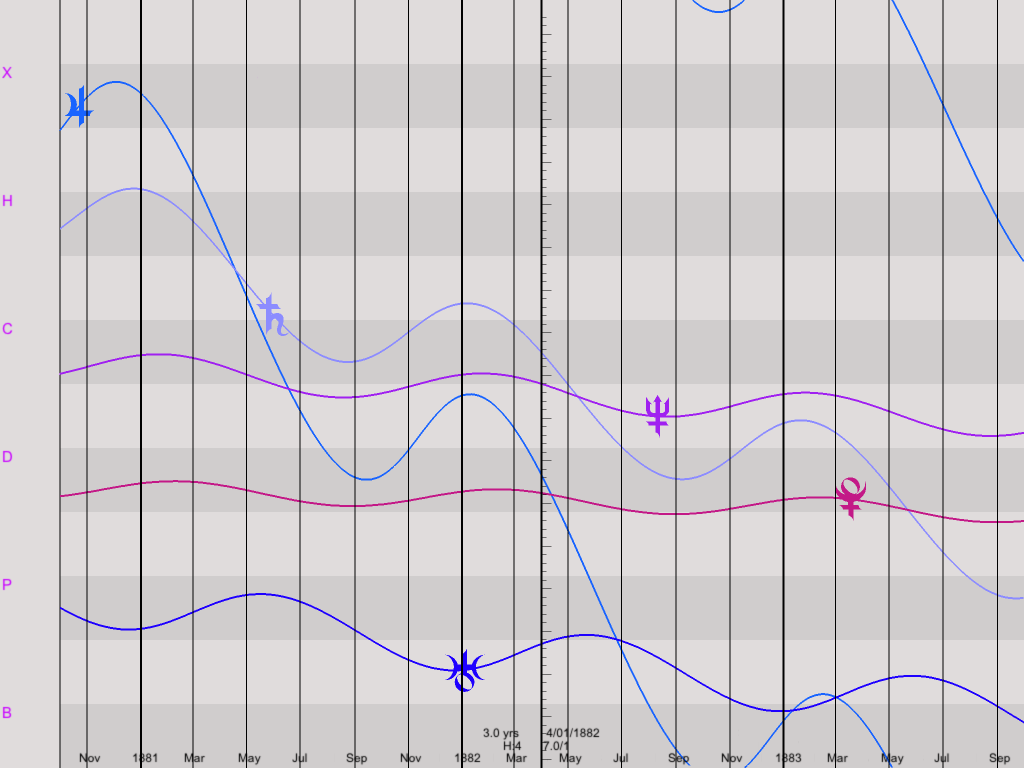
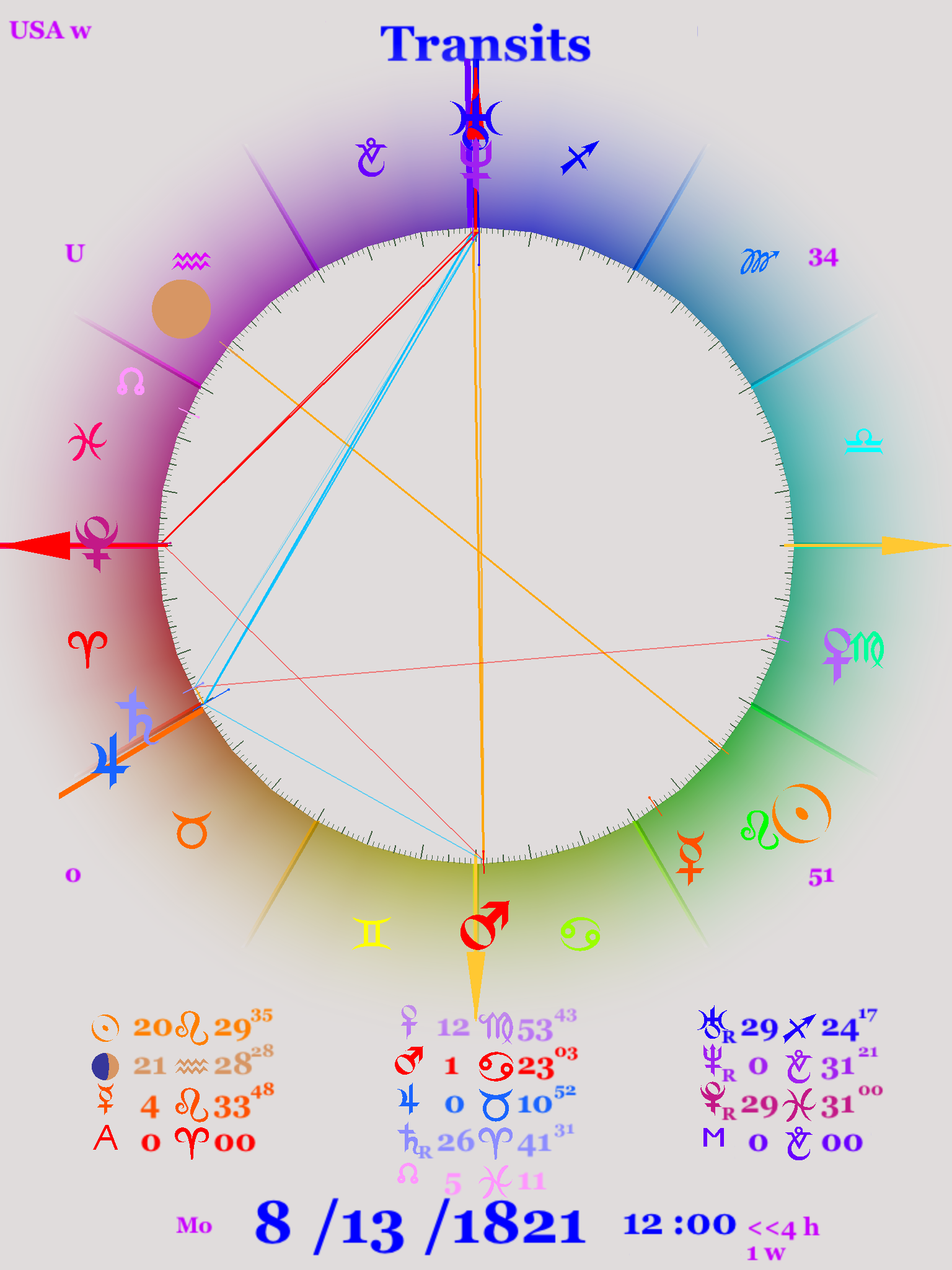
While it is hard to produce a date and chart for this overriding event of the last 500 years, a good chart for the crux of this turning is found in 1821, just as the Industrial Revolution was reaching a wider world than just Great Britain.  It has been a doctrine of this blog that the outer planets and their angular relations are important in historical events.  Aspects of the three outer planets, such as the conjunctions of Uranus and Pluto in the decade of the Sixties or the conjunction of Uranus and Neptune in the decade of the Nineties were defining of the nature of that decade.  Even more potent are aspects involving all three outer planets, especially midpoints.  Also important for world events are aspects to the cardinal — Aries, Cancer, Libra, Capricorn — points, as in for example the conjunction of Pluto with zero Capricorn as signifier of the Great Recession.  So it interesting to look at the aspects of the third decade of the Nineteenth Century, with Pluto a 0 Aries square the Uranus-Neptune conjunction at 0 Capricorn.  Many charts could be drawn for this period of time; the one I chose has Uranus and Neptune conjoined at zero Capricorn square Pluto at zero Aries; Mars is opposite the conjunction at one Cancer forming a T-Square with Pluto at the apex; Jupiter and Saturn are a few days past a conjunction showing the start of a new twenty year cycle.  There is also a Full Moon.  This is an important time for humanity.  And if you graph the per capita GDP for the world over time, it continually grows at a steady rate with only two upwards bends: around 1820 and just after 1945.

The Romantic Movement was a large reaction to the rise of rationalism in the Eighteenth Century indicated by the Enlightenment, the rise of laissez faire capitalism, and the Industrial Revolution.  This too is signified by this chart.  The Romantic Movement was an intellectual fashion during the late Eighteenth and early Nineteenth centuries in literature, art, and many other fields that emphasized emotion, intuition, nature, and a return to historical roots.  The planet Neptune is almost synonymous with the Romantic idea, as opposed to Uranus, a good symbol for the Rational, Enlightenment period.  Uranus was discovered in 1781 just as these trends were getting started, whereas Neptune was discovered near the End of the Romantic Movement in 1846.


urne1908a

Cinema


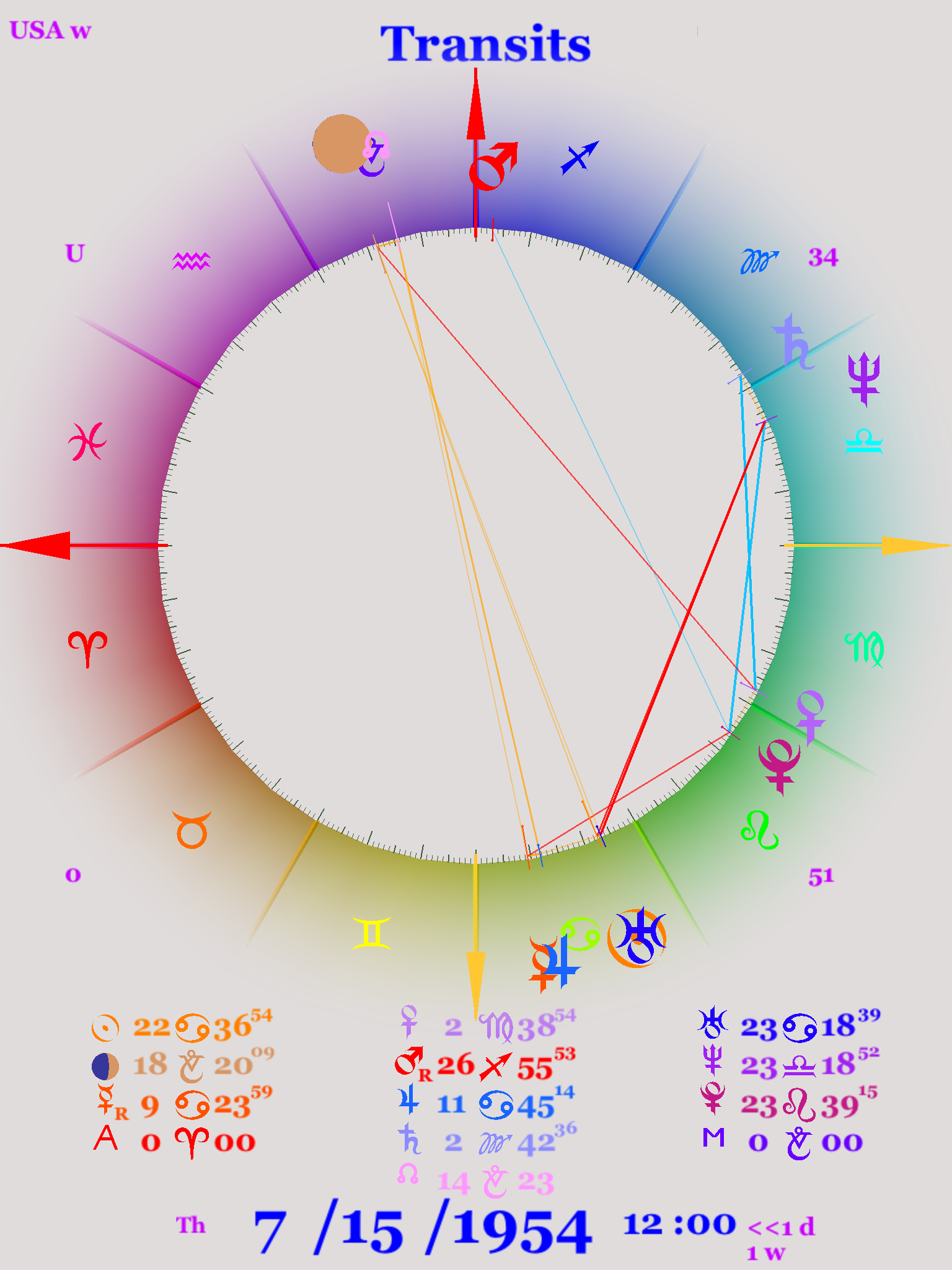
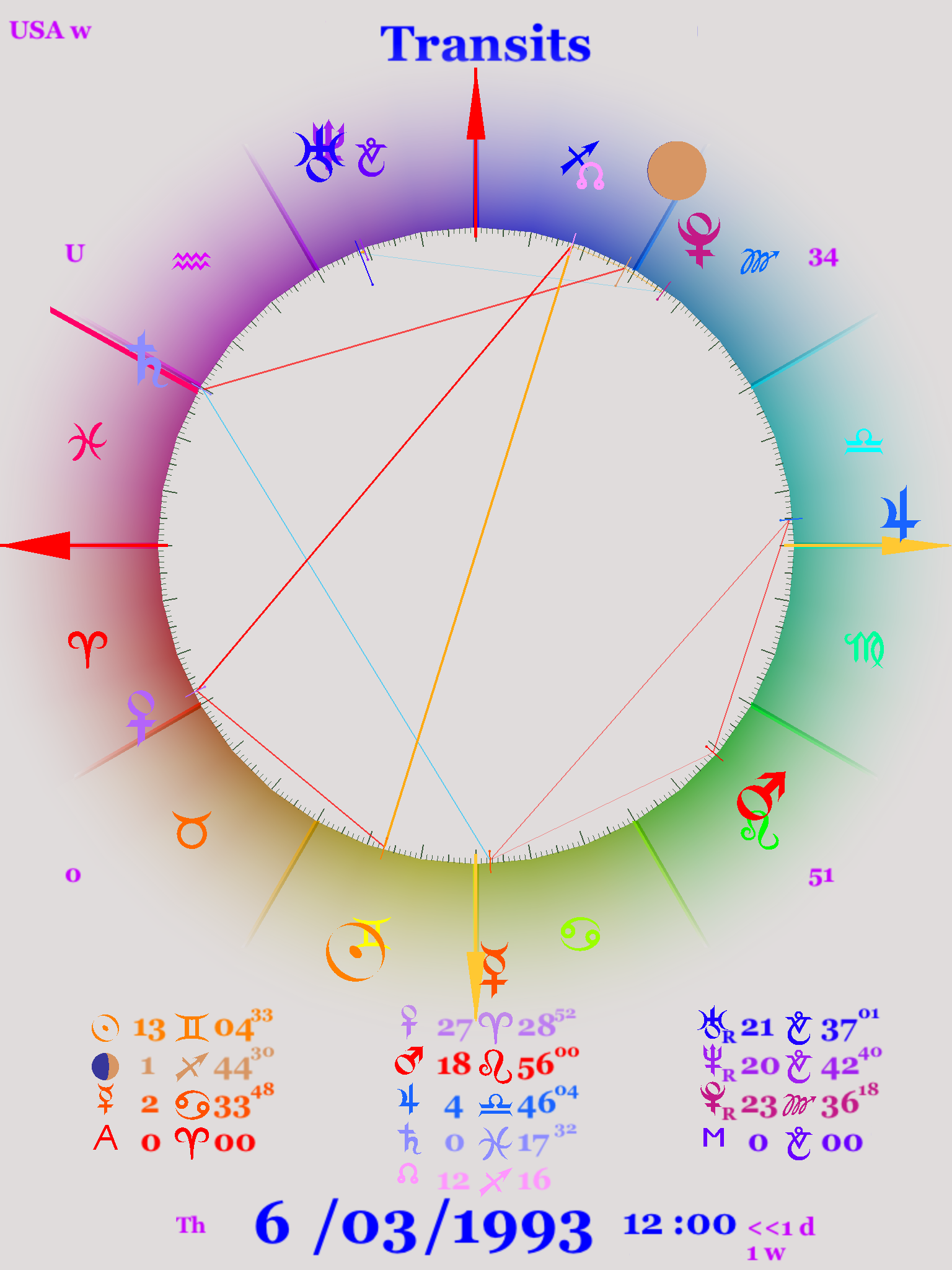
In every case over these many centuries with hard aspects of Uranus and Neptune, Neptune was bent to Uranian principles, because that is what served the direction of society.  The way this manifested itself is what I call “Electronic Drugs”, the Electronic part suggesting Uranus and the Drugs part suggesting Neptune.  For example, in the conjunction of 1821, the “Electronic Drug” was photography.  We can not imagine, since photography is so common these days and many people take photographs many times a day, what an immense change this was from the norm of the preceding millennia.  The only fixed representation of a scene known by people before that time was a painting.  Then for the opposition of the early 1900’s the electronic drug was moving pictures, which again was a huge change from what had gone before.  Previously only in a stage play could one see life recreated, but with cinema this could happen often.  Also at this time George Eastman introduced the box camera so that individuals and not just professionals could create photographs.  Radio also was developed in this time frame.  Then for the square of those two planets in the middle Fifties the electronic drug was television, which had existed before but by that period became immensely popular.  Again this was a huge change where people could watch moving pictures in their home.  This also changed politics, for example in the Kennedy-Nixon debates of 1960.  Then, with the conjunction of the early Nineties, the world saw the rise of the World Wide Web, the Internet brought to the masses.  Video and more are now streaming.  Many more ideas are now set loose on the world, it could be a hard time for orthodoxy.  The web will be seen to have huge implication of most everything in life, and we are only beginning to see some of the changes.  You can see this with the censorship of the web becoming more and more popular.


urne1954a

Television


But notice in every one of these hard aspects, Neptune has not really been manifested in a Neptunian way, one that is gravely needed.  Perhaps when Neptune goes to zero Aries and at the apex of Uranus and Pluto, these totally Neptunian manifestation will be shown.


urne1993

World Wide Web


The development of the industrial world and all that implies was made possible by these scientific inventions of the last 500 years, and especially made possible by hydrocarbon based energy, first from coal for the first 100 years and then by oil.  This made growth the watchword of the industrial world.  Some have called the Nineteenth Century the Coal Century and the Twentieth Century the Oil Century; what energy source will define  the Twenty-First Century?

Growth is the mantra that all government systems – fascism, capitalism, socialism, communism, whatever — follow wholeheartedly.  This system of growth practiced by all governments worldwide is what is breaking down.  This was highlighted almost 50 years ago by a book called The Limits (Saturn) of Growth (Jupiter) which was immediately rejected by many “serious” thinkers upon publication in 1973.  What seemed as a fantasy by many people back then now seems like a description of the world.  The book’s projection of the world in 2000 is now seen as hewing closely to reality.  That book’s lessons on exponential growth is something everyone should know.

So this is the result of 500 years of rejection of an ancient way of looking at the world and thus disenchantment.

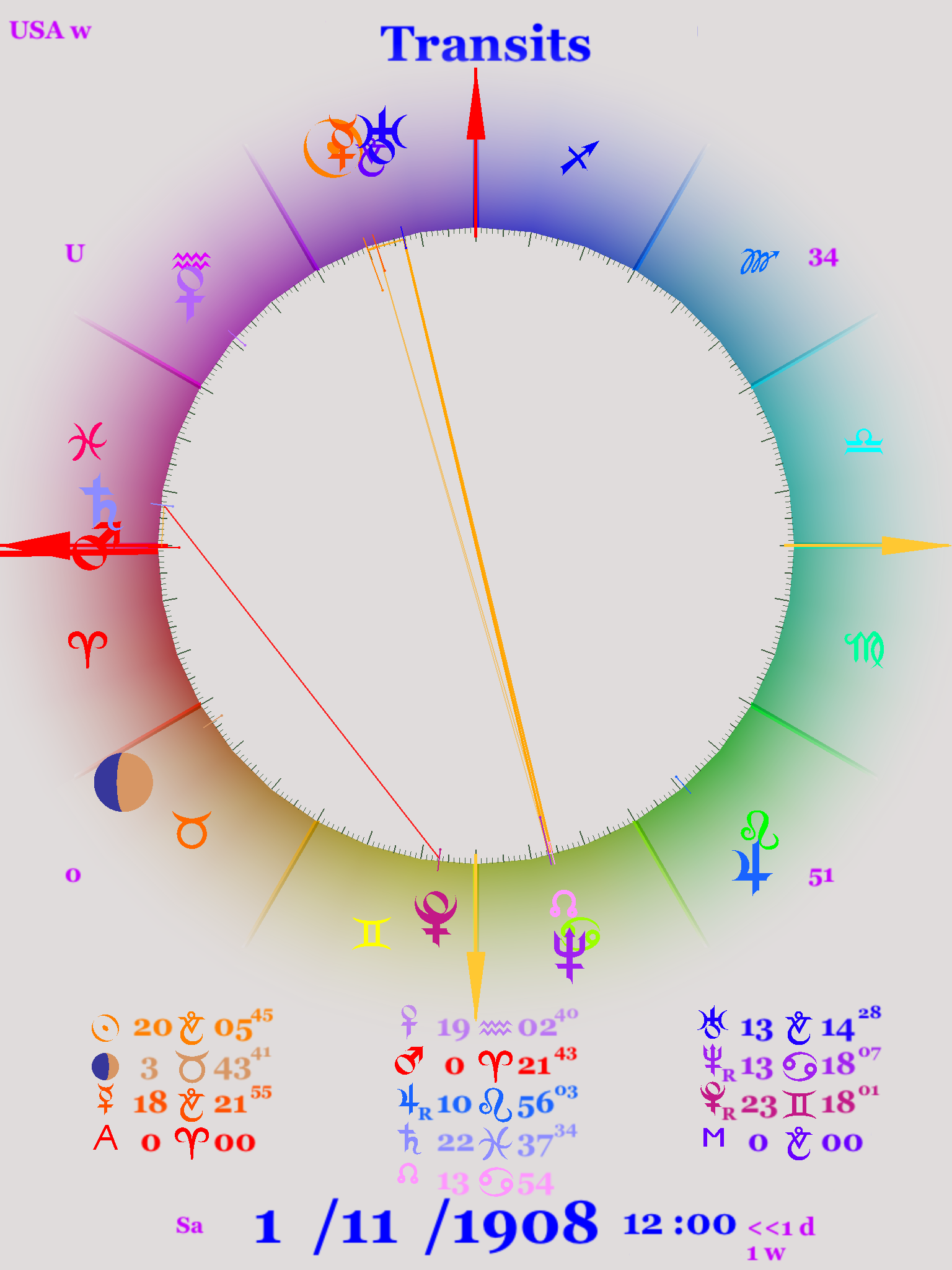
There are signs that the materialistic worldview in Science is changing, that there is a recognition that mysticism has something to teach science.  There are bookshelves of volumes indicating this, and the rush was started by the publication in 1975 of the book The Tao of Physics by physicist Fritjof Capra.  That field of study has only expanded in the last 45 years.  Those interested should check out the works of physicists David Bohm (“implicate and explicate order”) and biochemist Rupert Sheldrake (“morphogenetic fields”).  Many of the ideas expressed in these books extend from quantum mechanics, a major scientific revolution that started in the first decade of the Twentieth Century which I most closely associate with German physicists Max Planck and Albert Einstein, but many others contributed to the study.  These developments started under under the midpoint of Uranus (at zero Capricorn) at the apex of Neptune and Pluto, the first major zeitgeist change of the Twentieth Century that I pointed out previously.  That these  developments in what could be called “meta-physics” started with the ferment of the Sixties is nakedly indicated by the book called How the Hippies Saved Physics by David Kaiser.


mp1905

Quantum Theory


I’ve discussed previously the predominance of Neptune in the next 10 years.  Combining this with the above discussion of Neptune as the irrational, one may read this as the end of the over reliance on the rational, that is a growth of irrational or Romantic in this decade as one possible interpretation of Neptune.  One of the trends we may see in this decade, still new and according to some not starting until 2021 (the argument being that there was no year zero) is an increasing respect for the irrational, the right brained, the feminine, the lunar.  We need to make the world whole again by bringing back the irrational.  We need a re-enchantment of the world.  Another useful book in this regard is by Morris Berman called The Reenchantment of the World published in 1981, which lays out another argument along the lines of this post.

But Neptune can play out in many ways.  For example, the powers in charge of the world are currently trying to form a Dickian (after the science fiction writer Philip K. Dick) world (called the Great Reset by the World Economic Forum) if we let them, and they are using Neptune to hide what they are doing from us.  Hyper rationality is being used as a cover.  (You don’t want to argue with Science; are you some kind of Luddite??)  Will we see through the illusion in time to wrest control back into peoples’ hands and restore democracy?  Neptune can go several ways and so which one will it be?  This dominance of Neptune also suggests (self) deception so we must be eternally skeptical of pronouncements and always look beneath the surface truths.  But Neptune also represents the Irrational as shown above, and perhaps this prominence of Neptune over the next 10 years represents the return of the irrational for a more balanced position in the world.  Perhaps this coming decade will see the re-enchantment of the world after 500 years of the growth of the rational.

The Disenchantment of the World – Part I

For the last five hundred years, the rational side of human beings — symbolized by the planet Uranus — has grown continually, while the irrational side — symbolized by Neptune — has been considered not worthy of discussion.  This growth of the rational at the expense of the irrational — a term now considered so pejorative it is used as an insult — has reached its climax in the current day.  But “rational” versus “irrational” can be thought as the same type of polarity as “left brain” versus “right brain” or even Masculine versus Feminine.  This dichotomy has been given many names throughout the ages.  And usually one side is dominant over the other.  (Fortunately, we don’t have a problem with the Masculine dominating the Feminine in this society !!!)  Humanity needs both sides of this division in order to survive.

This polarity can also be seen in the concepts Apollonian and Dionysian, a dichotomy made famous by philosopher Friedrich Nietzsche.  These names are respectively from the Greek god of the Sun — Apollo — and the Greek god of wine and madness — Dionysus; these two gods and their respective eponymous classifications represent rationality and irrationally, the two opposing ideas of this post.  Nietzsche divides people into Apollonians and Dionysians; these concepts appears in popular culture in such widely divergent sources as Eugene O’Neill’s play Desire Under the Elms and Robert A. Heinlein’s novel Stranger in a Strange Land.  One can even apply this division to the last two Presidents.

We sometimes confuse the polarity of Uranus-Neptune with that of the Sun-Moon.  You can see this conflation in the statement, no longer popular or allowed (but current 100 years ago) that men are rational creatures while women are irrational (and for example shouldn’t be allowed to vote).  Perhaps now that women are more noticed/respected in general culture it could presage a greater recognition of Neptune and all that it represents in the zeitgeist.


urpl1454

Gutenberg Bible


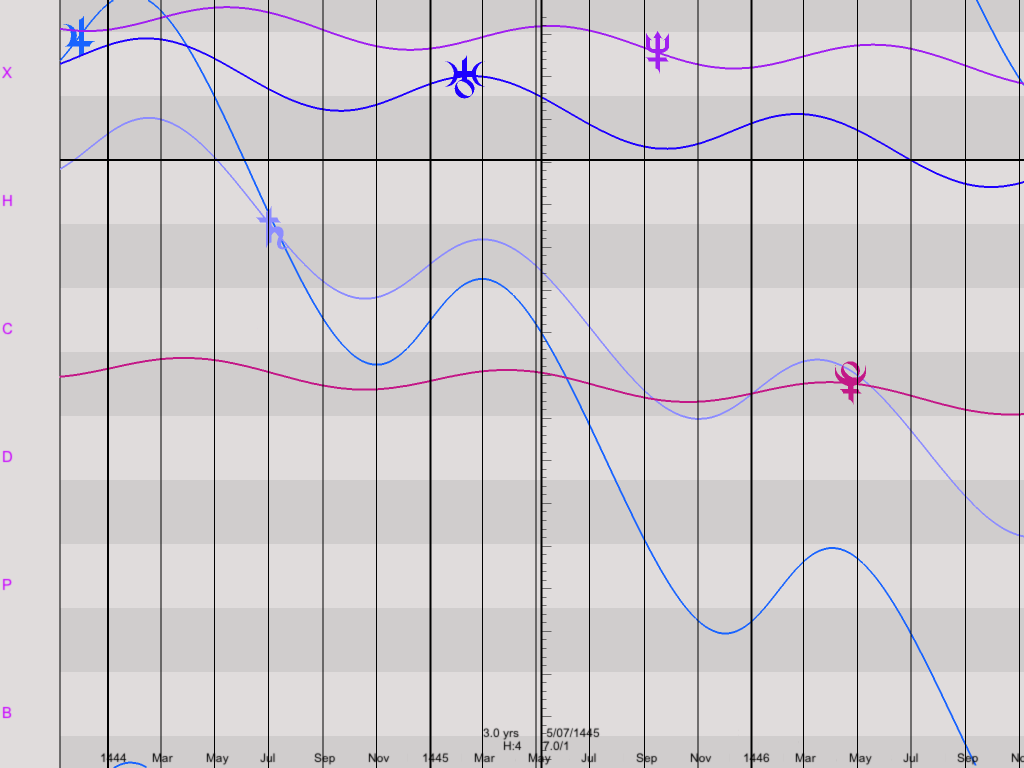
This trip into the hyper rational can be considered to have begun with the Uranus-Pluto conjunction of 1453-4 — almost exactly 500 years before the Uranus-Pluto conjunction of 1964-65 — which saw the invention of something that was incredibly important to not only the development of science but also to the Reformation and even the Renaissance itself; that was the creation of the printing press, which has been compared to the development of the Internet as a element of cultural change.  Because results could be delivered in the printed form it became possible to communicate scientific discoveries easily.  It is hard to list all things that have been “caused” by printing.

The first real printed document is called the Gutenberg Bible, and the first date we have for this is October 22, 1454.  In the chart for this event, we see the Uranus-Pluto conjunction in Leo square the Sun and Saturn in Scorpio.  There is also a Jupiter-Saturn opposition, showing that this period of time is half-way through the Jupiter-Saturn cycle that began ten years earlier, the equivalent of a full moon.


urpl1597

English Renaissance


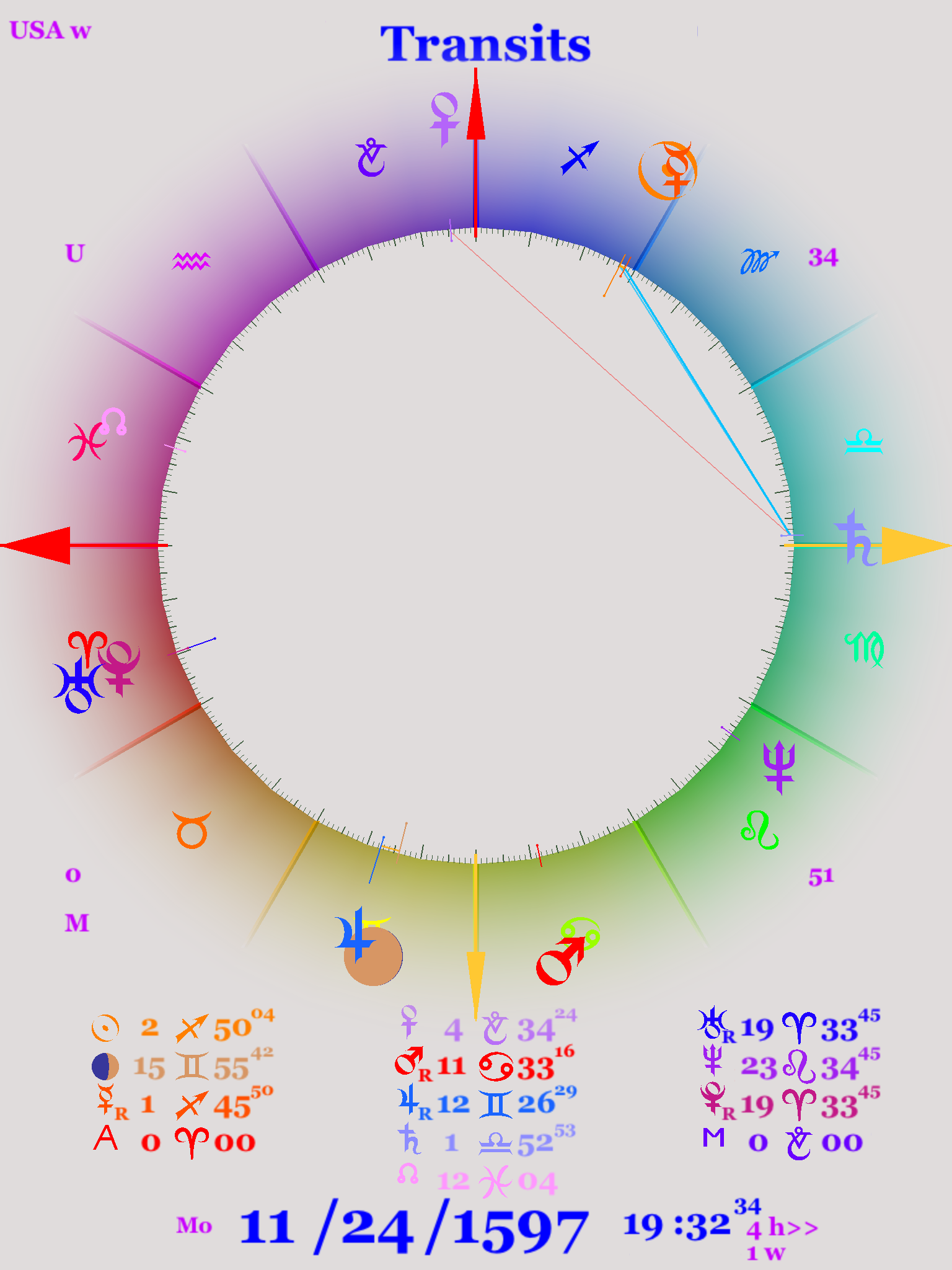
The Scientific Revolution in Europe started with the Uranus-Pluto conjunction of 1596 through 1598.  In England, this was the High Renaissance, best known for the many famous playwrights such as Shakespeare, Marlowe, and Spenser.  A man who is thought of as the father of the scientific method, Francis Bacon, was coming of age in this period and influenced by the pace of the English Renaissance.  Galileo, in Italy, made some fundamental discoveries at this time that would later allow for his belief in a book published by Copernicus about 50 years earlier.  Kepler was publishing a book that laid the foundation for his belief in the heliocentric theory first promulgated in the same book by Copernicus at the preceding Uranus Pluto opposition.

In the chart for an exact conjunction of those two planets at this time, we see the conjunction in Aries.  This was the Uranus-Pluto conjunction one cycle after the one that saw the printing press.  Many things had changed in the ensuing 140 years.  When the Gutenberg Bible was printed, the Western hemisphere was unknown to Europeans.  Note that because of the very elliptical orbit of Pluto, the period between two conjunctions can vary widely.

The scientific movement grew throughout the next century with, for example, the founding of the Royal Society in England on November 28, 1660, a few years after the Uranus conjunct Neptune opposite Pluto, which marked the height of the English Civil War and increasing belief in science.  To see how science was growing during this period consider that Galileo died in 1642 and Newton was born less than a year later.


urne1649

World Turned Upside Down


The middle of the Seventeenth Century saw an imposing astrological configuration: Pluto in Gemini opposed to the conjunction of Uranus and Neptune in Sagittarius mentioned previously.  This is representative of the powerful changes that occurred in this century, with the English Civil War and all the social changes that went along with that, so many that this time has been call a World Turned Upside Down ( cf history of this period under that title by English historian Christopher Hill).


descartes

Rene Descartes


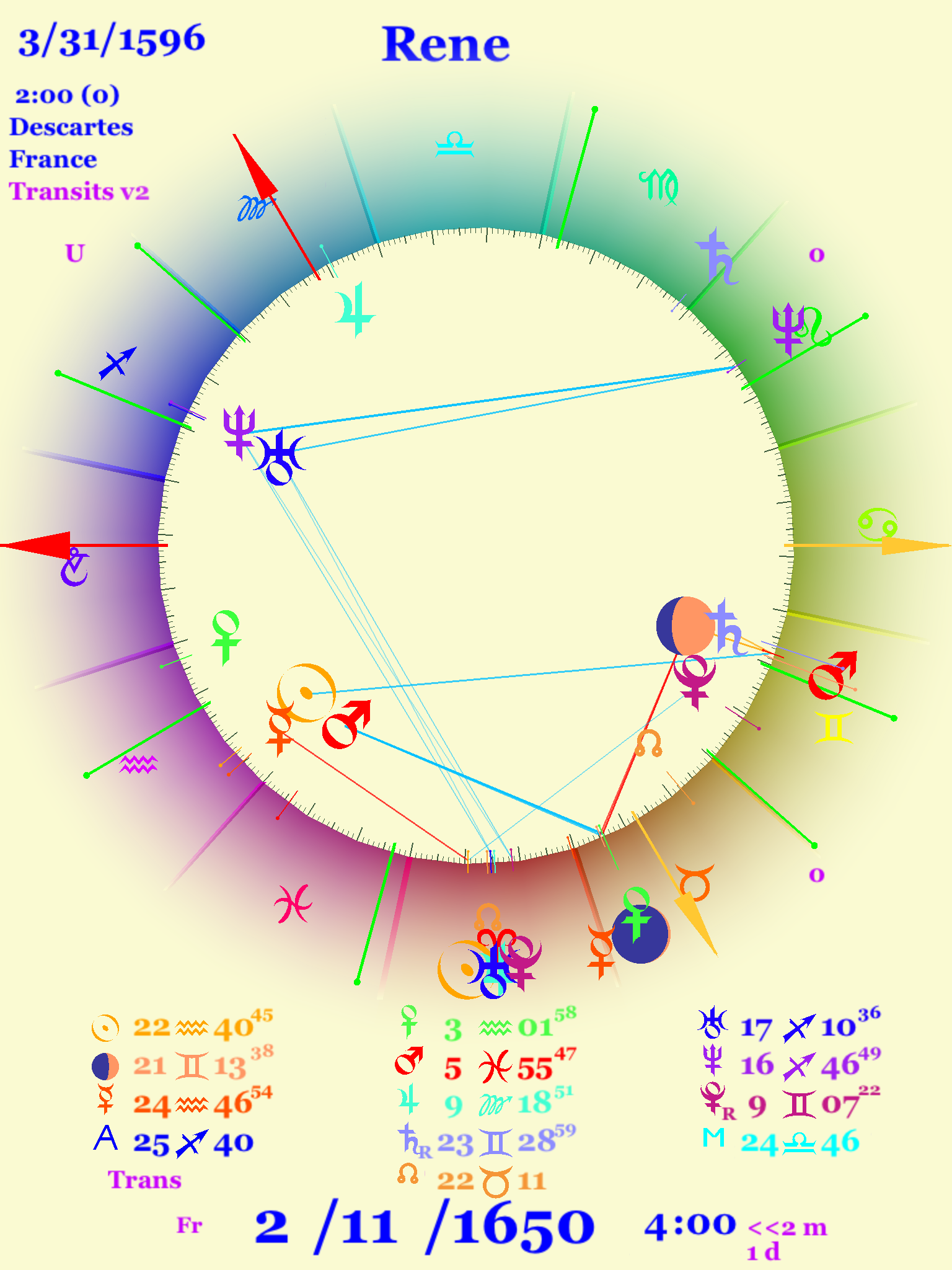
The French mathematician and philosopher Rene Descartes personifies this growing rationalism.  He was born during the Uranus-Pluto conjunction of the late Sixteenth Century and died during the Uranus-Pluto opposition in the middle Seventeenth Century which are illustrated above.  He invented what is called the Cartesian coordinate system (used in for example the graphical ephemeris) in which the X coordinate is horizontal and the Y coordinate is vertical.  Cartesian coordinates allow one to look at reality reduced to points on a graph.  This is a concepts all mathematicians know instinctively.  Descartes was influenced by the teaching of Galileo and is thought to be the major influence on Newton, so one can see him as a binding person between these two great scientists.


deathdec

Descartes Death


While we have a time for his death, the time of his birth is only a guess.  Some suggest that Descartes, knowing the power of astrology, did not want his birth time revealed, but had no power over the release of his death time.   In his birth chart, we see the Uranus-Pluto conjunction on his Sun, an indication of someone who would epitomize the Uranus-Pluto power.  At his death the Uranus-Neptune conjunction was trine the Uranus-Pluto conjunction of his birth.


descartesvision

Descartes’ Vision


On November 10, 1619 Descartes has a “vision” where he saw the whole universe and thus human beings as a mathematical system.  This vision laid the basis for his mechanistic philosophy that was to influence the beliefs of science from that day forward.  If we look at the transits for that day to Descartes’ chart we see a close opposition of transiting Neptune to his Sun, almost a cliche for a vision.  There is also Pluto opposite his Midheaven but since his birth time is not good, I would not give this aspect much credence.  But since the Sun moves only one degree per day, the Neptune transits is correct.

While Galileo and Newton (among others) are considered the founders of modern science, it is important to note that that they had not totally entered the realm of the hyper-rational which did not develop until the later Nineteenth Century.  Galileo was also an astrologer and Newton was an alchemist, interesting but seldom reported facts about two important men in the history of science.


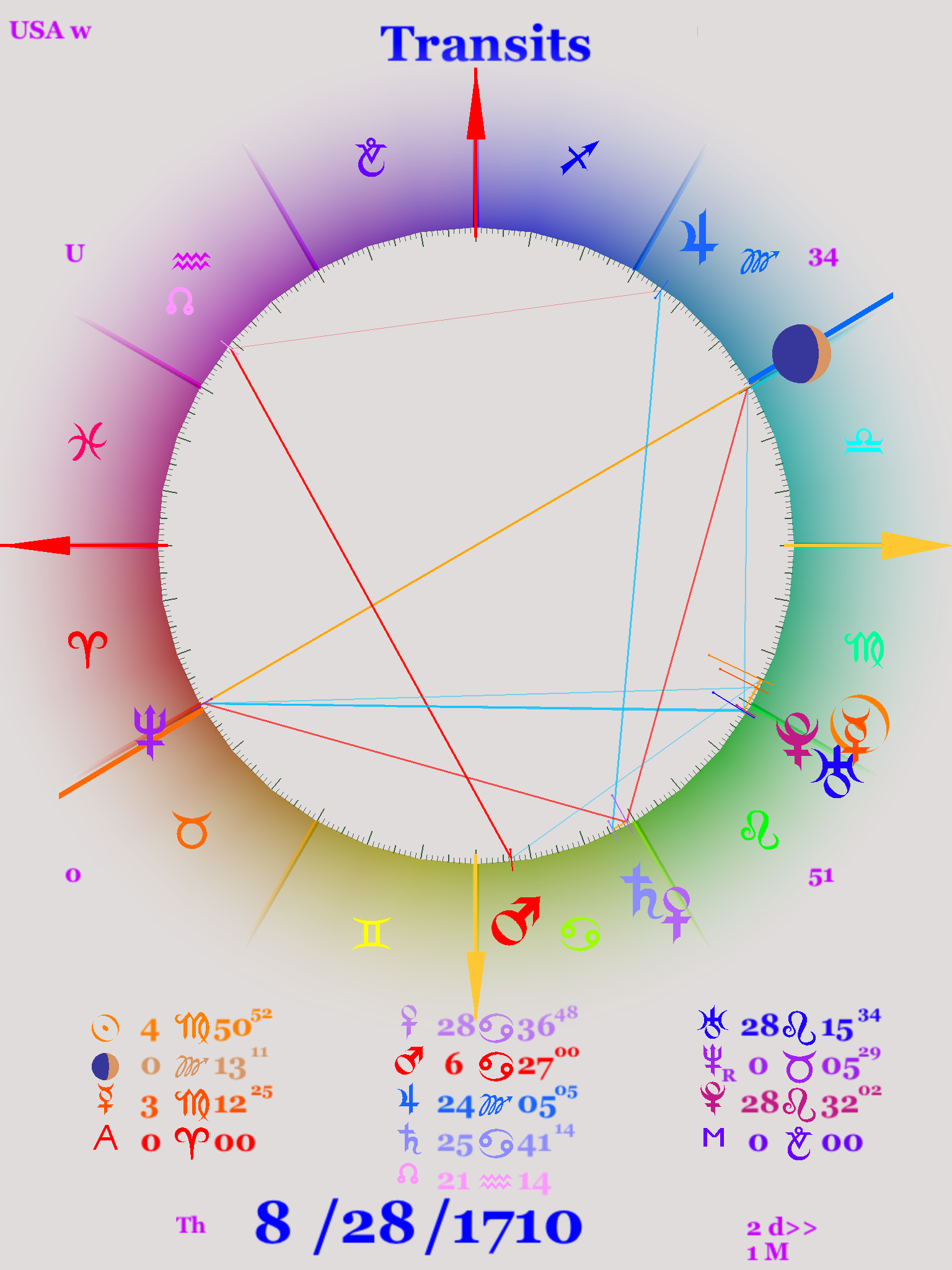
urpl1710

Birth Industrial Revolution


The next century — the Eighteenth — saw the first developments of what was to be called the Industrial Revolution with the next Uranus Pluto conjunction (trine Neptune) of 1710.  In England Abraham Darby created iron in a blast furnace powered by coke rather than charcoal setting the stage for the use of iron and steel in manufacturing and Thomas Newcomen created the first practical steam engine (later refined by James Watt) also advancing the coming of industrialism.  At the time the Industrial Revolution was only in England, and they kept tight hold of it.  The Industrial Revolution came to America with Samuel Slater (illegally) liberating the ideas from Britain and establishing them in America at the end of that Century.  The Industrial Revolution hit the rest of Europe by the early Nineteenth Century.  This Neptune-Pluto trine was to last most of the century, the Century of the Enlightenment.


grtr1770

The Grandest Trine


This century also saw the Enlightenment, where many rejected the church as a final authority and instead depended on science and reason, the science that had developed in the Seventeenth and Eighteenth Centuries.  The French philosopher Rene Descartes is a prime example of Enlightenment thinking though he lived in the previous century.  The Enlightenment is best symbolized by the Grand Trine of the three outer planets, a configuration that only occurs once every 500 years.

This growing rationalism resulted in what German sociologist Max Weber called the disenchantment of the world (die Entziehung der Welt).  The magic of the world, something known to ancients and also taught in various Mystery Schools, was reduced to a materialistic, mechanistic worldview, symbolized by the Cartesian coordinate system where life and the world are reduced to just a series of events operating as if by clockwork, in which everything can be determined if we only have enough data.  In fact, the mechanical clock was a paradigm for how the world and the universe were thought to work.  Humans are also thought of as machines, with the mind like a computer, thought this analogy did not occur until the later Twentieth Century.

This split, this disenchantment of the world, was the subject of a popular movie about 40 years ago called Koyaanisqatsi.  This title means in the Hopi language “Life Out of Balance” which describes exactly the same conflict we have been describing, that something is out of balance, that the rational — Uranian — side of out natures is not balanced by the much weaker irrational — Neptunian — side, and the movie shows what has been the result.  It is not pretty, but we know the resulting world well — the passage of forty years has only made things worse.

This disenchantment has reached its peak in the current era, where it is finally seen that this worldview, that the world is ours to use, is leading in a short time to the destruction of the planet.  While it was taught in that ancient text, the Bible, that humans have dominion over the world, it was not until the last 500 years that this could be realized.

There once was a world view opposed to this, believed in by so-called primitive humans who saw the world as a magic place.  Perhaps in the current era the foremost proponents of that philosophy are astrologers, who claim that the planets determine/signify what happens here on earth even though science says that is clearly impossible.  One can see why this view is called magic by most.  For further discussion of these ideas, see The Secret History of the World by Mark Booth, or for traditionalists, The Secret Teachings For All Ages by Manley P. Hall.

Neptune Über Alles

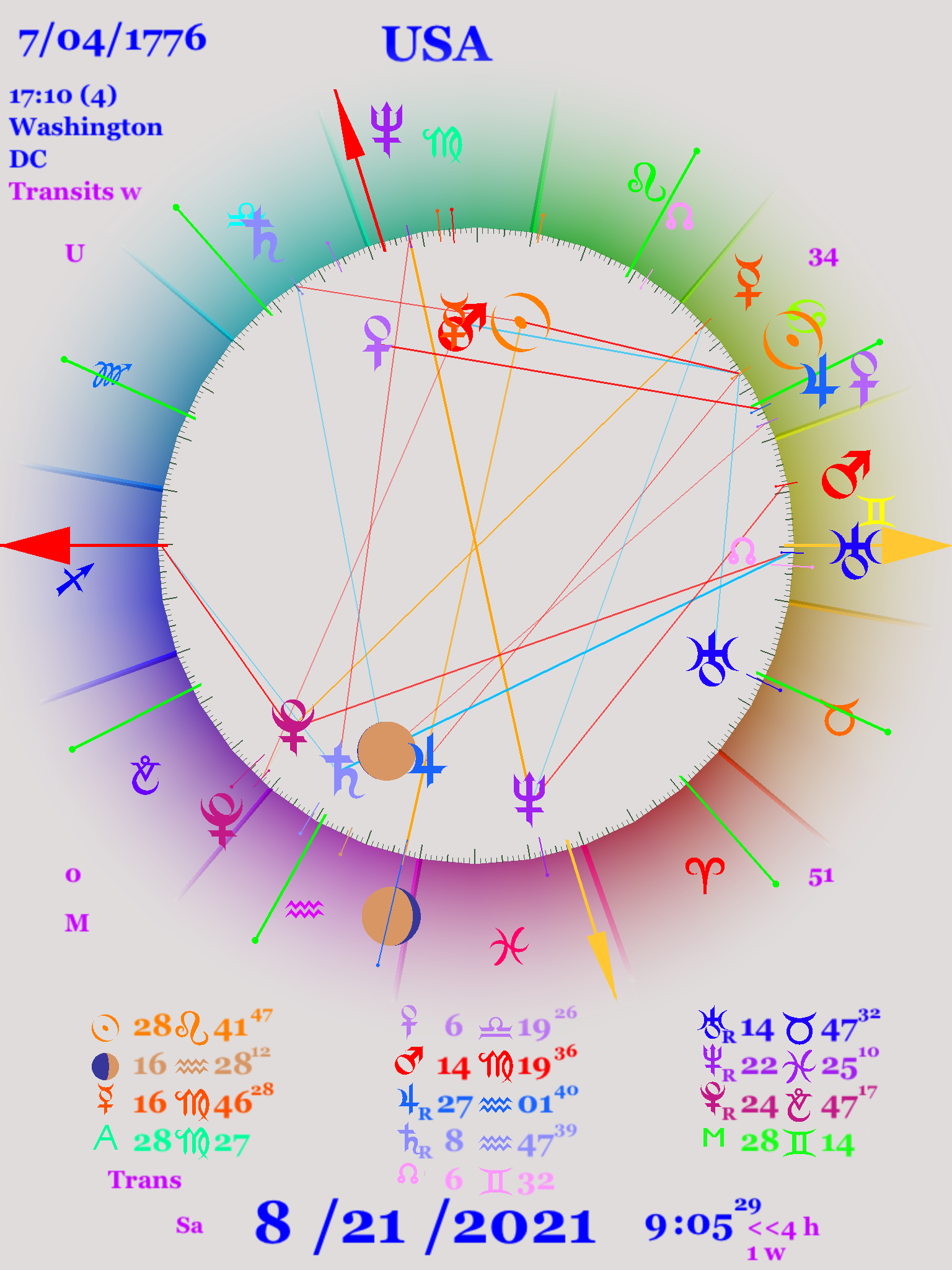
We have had a whole lot of Neptune over the last few years, and it is not going to end any time soon.  I’ve previously written about the Neptune transits to the Ascendant and the Sun of the United States.  The last of those transits has just about finished.  But coming up is the Neptune demi-return, the return of Neptune to be opposite its natal position.  This occurs at almost the same time as the Pluto return.  This is not too surprising, since the period of Neptune — 168 years — is almost two-thirds the period of Pluto — 248 years — so there is a certain resonance to their periods.  This Neptune demi-return will be followed soon after by Neptune hitting 0 Aries and Neptune crossing the IC — opposite the Midheaven —  of the US, so soon the whole world, and especially the United States, will have more than a touch of Neptune.


NE2021

Second Neptune Demi-Return


Neptune the planet — who was in Roman mythology (Poseidon in Greek) the god of the Seas (and also earthquakes) — covers many ideas.  In the best sense it can relate to spiritual matters, but also deception and illusion in a mundane situation or for those who are not spiritual adepts.  Neptune should be strong in actors (witness Elizabeth Taylor’s birth in Neptune-ruled Pisces) who need to behave like someone they are not.  But is difficult to manifest the spiritual side of Neptune when we are talking about countries (eg US) or many people in their mundane existence.  In such cases Neptune can represent lies, deception, dissembling, but also vapors, poison gas, and illness, especially when the causes are not well know.  In particular, with the current COVID-19 pandemic that is engulfing the world, Neptune is a fitting symbol.  But remember Neptune symbolizes many things, so don’t get caught up in assigning it just one meaning, as Neptune is more difficult to tack down than other planets.  Though is seems a little too obvious, Neptune can easily be associated with plagues or pandemics.  More fundamentally Neptune can represent invisible or at least unclear things, as in the term “Neptunian” fog.  So things now are very Neptunian — the situation is unclear, and it is almost as if everyone has an opinion of what is happening, and some quote “experts” but in a more general sense, no one really knows what the future will be, but it wouldn’t be “more of the same”.

Let us briefly look at previous times Neptune made hard aspects — conjunction, square, opposition — with its natal position.  There are relatively few of these, since Neptune moves slowly around the Sun.  In a human being with a limited lifespan, the stages of a life can be measured with the aspects of Saturn to its natal position, most commonly labeled with the term “Saturn Return” though other aspects are important also.  But with a country, and especially the United States, the progress of the country can best be measured with the aspects of Neptune, as I indicate in the following paragraphs.


NE1817

First Opening Neptune Square


The first opening square of transiting Neptune to its natal position was in 1817.  This was an interesting time even if there were no stand-out events.  The last of the “Virginia Dynasty” Presidents, all of whom came from the state of Virginia, James Monroe, had just been elected.  It is known as “The Era of Good Feelings” when past animosities were ended.  The War of 1812, which had seen the burning of the nation’s capital city, had ended two years earlier.  The Federalist Party, those who had essentially started the country before there were actually political parties, and had been represented by the first two Presidents, was for all intents and purposes dead.  This time represents the end of the “childhood” of the country and a time when it moved into adolescence.  Not only were Presidents elected that were different than the first few, for example Andrew Jackson in another ten years, but the contentious issue of slavery was about to become very obvious and could no longer be ignored with the Missouri problem that was solved by the eponymously name Compromise.


NE1858

First Neptune  Demi-Return


The first time it was opposite its natal position was in 1858 and 1859.  We all know what was happening then:  This was the final run-up to the American Civil War, which had been developing for at least forty years since the opening square, but by the time of that demi-return the war was almost here.  This Civil War marked America’s entrance into young adulthood after it “solved” a problem that had been with the country since its founding.


NE1898

First Closing Neptune Square


The closing square of Neptune was in 1898.  It is noteworthy how often several important transits happen at the same time — the current decade is a hallmark example of such a phenomena.  But this Neptune aspect was also an example; this period saw the Spanish American War and the beginning of the Philippines War while there was a Saturn Pluto opposition.  America was now passing out of earlier adulthood which was marked by the Civil War and was becoming a full adult and, wanting to be considered a “successful” country, became an empire.  This can be seen as the beginning of the “American Century”.


NE1939

Neptune Return


The first complete Neptune cycle, which involved Neptune returning to its natal position, was 1938 and 1939; in the same way that that first demi-return was a run-up to the American Civil War, this return was the run up to the Second World War, though most Americans at the time were just happy that the worst of the Great Depression was over.   Those who paid attention to what was happening in Europe or the Far East knew something was coming down.  By the end of the War, America had achieved the promise that had been set in motion at the closing square: it was truly a world-spanning empire.


NE1980

Second Opening Neptune Square


The second opening square, which also corresponds to a Saturn-Pluto conjunction and much else was happening in 1980 and 1981.  As has been mentioned before, this is the beginning of Neo-liberalism, that branch of extreme capitalism that has dominated the world for the last forty years, and, I believe, is coming to an end with the Neptune demi-return.  This closing square represented elderhood for the country, but not in a good way — the country has become older without becoming wiser, like an elderly teenager.  This upcoming decade represents hopefully a maturing out of that difficult stage.  Unlike a physical human being, countries can have more than one “lifespan”.  In this sense the upcoming Pluto return (symbolically, since Pluto can represent death) is the end of that stage most represented by the promise of the first Neptune return.

Since in the US chart, Neptune is close to the Midheaven, it is not surprising that the Neptune returns and demi-returns corresponds closely to Neptune at the MC or opposite the MC, which has been shown before to correspond to a crisis in America.  The first such crisis was the Revolutionary War, then the Civil War, then World War II.  This next crisis is coming up, and one indicator is the Neptune demi-return that also corresponds to the Pluto return, so one might guess that this return/demi-return of two outer planets will be more impressive/significant than either by themselves.  But these returns also correspond to Neptune on the Cardinal axis, either at 0 Aries or 0 Libra so they also represent major changes in the World.

US history in textbooks is often divided into four periods — before the Revolutionary War, between Revolutionary and Civil Wars, after the Civil War but before World War Two, and after World War Two, that is today.  So American history is conveniently demarcated by those the events, though all signify ongoing events to which those turning points — Revolutionary, Civil, World War — are significant.  And it should be obvious that life before the Revolutionary War, when people were British citizens, was different than life after when they were citizens of a new country.  After the Civil War, those who were slaves were now free and could, theoretically at least, vote and travel about.  And after World War Two so many things changed that it is often called the Great Acceleration or the start of the Anthropocene — literally a new era in world history.  We are soon to reach another one of those turning points.  The time after this Neptune demi-return (and many other events which I have talked about before)  will be unlike the time before (ie, now).  The history of the world, when looked back at from the future, will show that there was a major change that happened in the third decade of the Twenty First century.  Neptune is a big, but not the only, part of this, symbolized by the only outer-planet midpoint configuration with Neptune at the apex in 500 years and Neptune crossing the Cardinal axis at Zero Aries, the start of things.

This future could be determined by the same forces that made the last 70 (or 500) years what they have become, or it could be determined in a more democratic way.  I believe it was the Scottish Enlightenment philosopher David Hume who said that in all societies the people are the ones that truly have the power, but they have been convinced that they don’t, so it does not matter.  In authoritarian societies like the former Soviet Union, it was obvious that the media and the government were lying to citizens and so they paid attention to the samizdat (unauthorized newspapers), but in more “democratic” societies people don’t know they are being lied to, so it is almost a harder problem to convince them that they have the power.  What we need to see now is that the individuals come to believe that they are the powerful ones and not allow themselves to be controlled by the government and that handmaiden of government, the mass media, all of whom are owned by large corporations that do not have the interests of individual citizens as their prime concern.

In the chart of the US, Neptune is square Mars.  This is an extremely problematic aspect for a nation.  The country in question is deluded about its use of power, which in the case of a nation is military power.  It — the country — tends to believe that all uses of force are only for the benefit of others and military operations are done with the best of intentions: Deception is paramount.  When transiting Neptune is conjunct/opposed the natal Neptune it is also squaring the natal Mars, further emphasizing the ingrained Mars Neptune square.  This demi-return could be the time of another crusade to save the world.  In the current US this crusade comes in two flavors: straight neoconservative, often the favorite of Republicans, and the responsibility to protect (R2P) which is favored by Democrats (also called “the cruise missile left”).  In practical application, there is not much difference in outcome, but the R2P crowd (Samantha Powers is a good example) are often cheered in elite publications.  That is the “respectable” type of intervention.


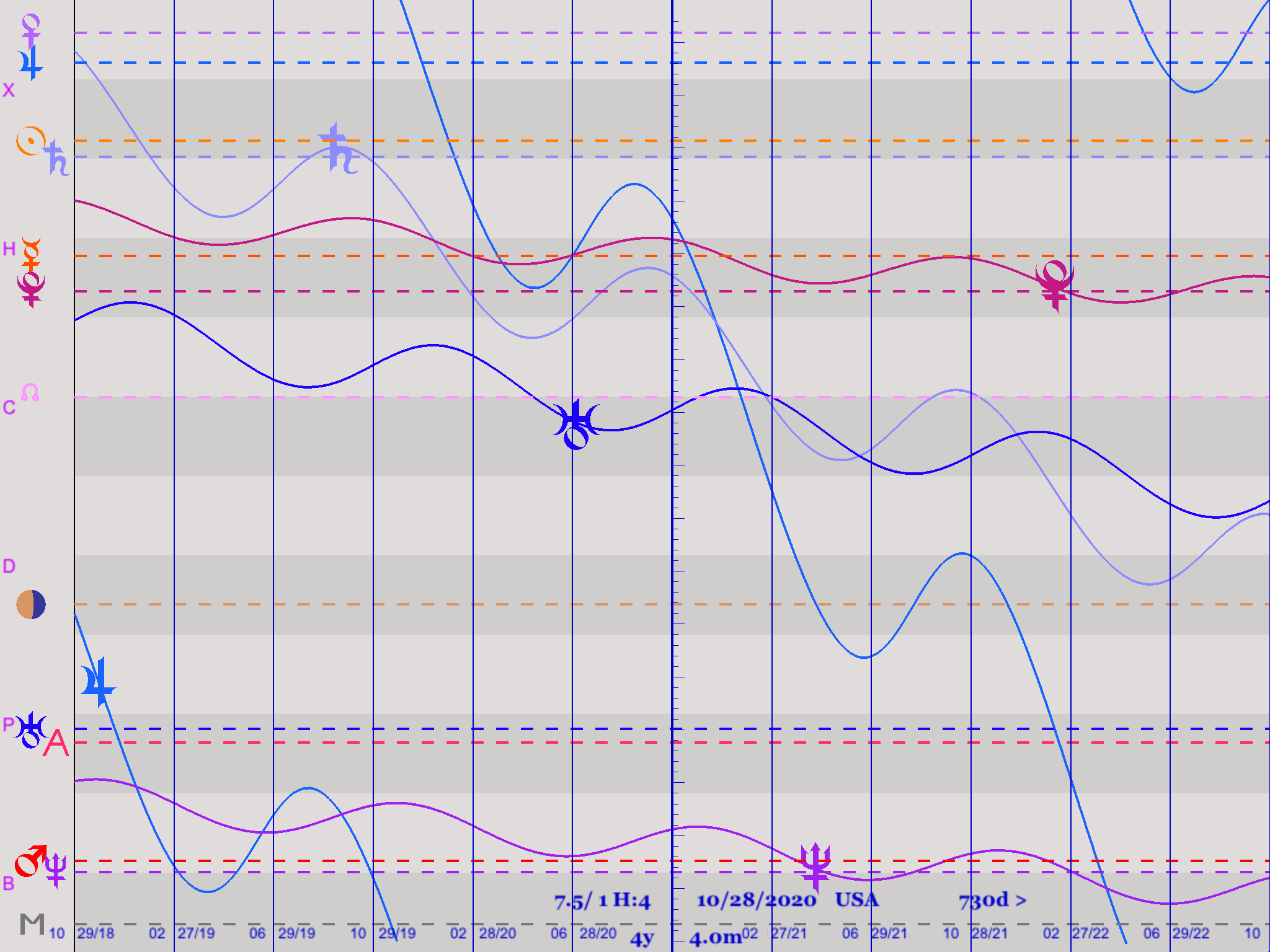
netg2020


In the fourth harmonic graphical ephemeris we can see how close the lines for Mars and Neptune are, near the bottom of the image.  Neptune first comes close to Neptune-Mars in the summer of 2020 and first exactly contacts both planets in Spring of 2021.  Both planets are contacted throughout the remainder of 2021 and 2022 and the last exact opposition to natal Neptune is at the end of 2022.  Also visible in the upper half of the graphical ephemeris is the progress of the Pluto Return which starts and ends a little later than the demi-return.

But I don’t want to be all negative.  This Mars-Neptune emphasis could be a time for self reflection (in the country) and a realization of how much the National Security State (aka Military Industrial Complex or Deep State), that was born shortly after World War II, has come to influence and even determine what the United States does.  The current media mindset with Russia,Russia,Russia (they’re going to hack our 2020 elections also!) shows how much an enemy is needed.  And before Russia the enemy was terrorism, and before that drugs, and before that Communism, and before that Germany, and before that Spain, and before that the South (from a Northern perspective), and before that the British.

Neptune indicates the very fluidity of the situation.  It is at such a time that the maximum amount of change can be made, or else we can fight among ourselves and let our “Masters” control the situation and its outcome.  But one thing is certain: with Neptune so involved, don’t accept anything at first impression, always look beneath the Neptunian surface.


Prelude to the Pluto Return

Mercury rules mentation — the use of the mind — and communication, and other related topics.  But when you consider the chart for an entity, in this case the United States, the meaning of Mercury subtly changes but still has the same core meaning.  For a nation, Mercury represents the press, formerly just the printed press, but now also the cable news networks and news carried on the Internet in places such as Facebook and YouTube.  As the means of communications have expanded, so have the referents of Mercury.  This brief discussion of the meanings of Mercury is a foreword to the discussion of a transit of Mercury coming up in the next two years.

In the natal chart of the US, Mercury is opposite Pluto with an orb of a little over three degrees, not terribly tight.  This suggests that the press has been a transformative medium in American history.  For example, with the rise of political parties in the late Eighteenth Century, newspapers were also created simultaneously to support the parties being formed and that press did much to support the birth of those political parties.  And even today most of the press, while perhaps called “non-partisan”, are closely associated with political parties: the New York Times is associated with the Democratic Party these day, and so are the cable channels CNN and MSNBC, so much so that it is often called MSDNC.  Fox Cable news channel is a mouthpiece for the Republican party.


me2pltg

Pluto Opposite Mercury


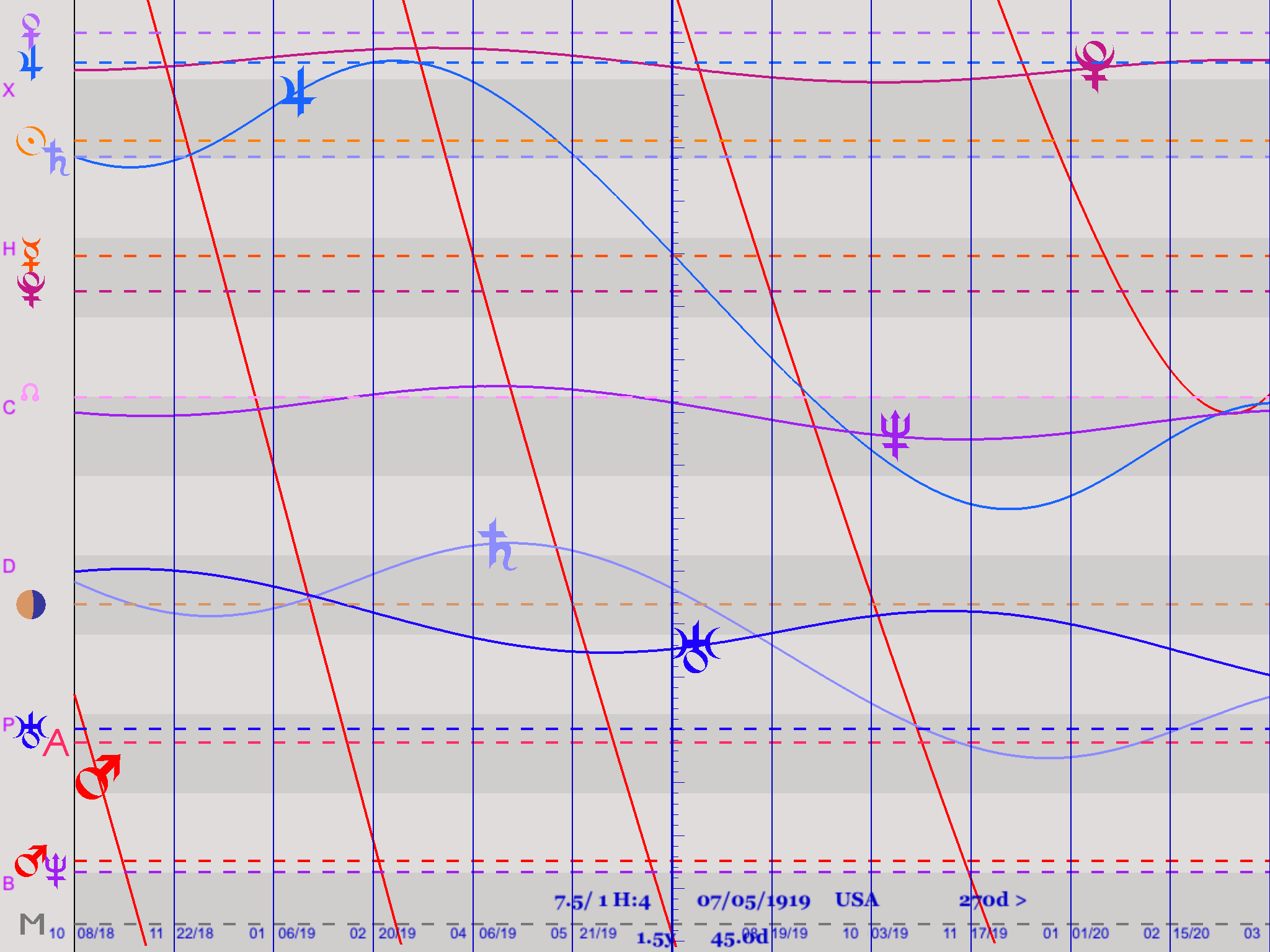
But coming up will be a transit of Pluto opposite the natal Mercury just before the Pluto return, as can be expected from the geometry of those two planets as just mentioned.  This is likely to change our relationship to the press.  First, lets looks at a graphical ephemeris showing the whole period of the opposition.  We can see that the opposition first becomes close in early 2019, where the red curved line representing transiting Pluto comes close to the dashed horizontal gold line representing natal Mercury.  The first exact opposition happens shortly after the Saturn Pluto conjunction of January 2020.  The exact opposition continues to happen throughout 2020 and 2021, including a stationary period in the Fall and Winter of 2021 about three quarters into the graphical ephemeris.  Finally, in 2022 as the actual Pluto return happens, the opposition is ending but still as close a it was in 2019.  So we have Pluto opposite natal Mercury being effective for at least four years, 2019-23, if not extending even further.  Perhaps it can be considered to be happening now, with the rise of the term “Fake News”.  If so, it will grow, though the standard theory of time suggests that it will be more powerful after the aspect than before.

One can see that as soon as Pluto went away from the opposition of the Sun, which continued on at least through 2017, it began approaching the opposition to Mercury and the shouts of “fake news” began to be heard.  Since in the current times the Sun represents the government and especially the President of the United States, this opposition to the Sun represented the animosity toward whomever was President before 2017, resulting in the obvious upset election in 2016.  Not only were people angry with the government and its representative, but they were also mistrustful of the press.  Jim Acosta from CNN being booed should have been no surprise.

Today in America — and perhaps other places in the world, witness the UK, Spain, Brazil — “truth” is a very partisan issue; depending on your political viewpoint a thing is either black or white (or perhaps in America we should say blue or red), with no shades of grey allowed or even an expression of a wrong color viewpoint.  And if you believe white then black believers are a spawn of demons and deserve to be in a low circle of Hell.

But here we are talking about Pluto opposite the US Mercury, so let’s restrict our comments to the United States.  This opposition suggests some major changes in store for the press and their connections to the bigger world, and the way we believe in truth in the United States.

According to Democrat partisans it is only because of the brave American press that we know of the nefarious crimes of President Donald J. Trump, such as his attempts at bribery of the new president of the Ukraine, a place that we need to help fight the Russians so that we don’t end of fighting them in America, as one Democrat-sponsored witness in Congress said, later quoted by the Congressman from Hollywood California.  If this sounds familiar, it is because George W. Bush said that we had to fight terrorists in Iraq so we did not have to fight them here.  To the Republican partisans Trump is a brave man who is trying to stand up to the nefarious doings of the Deep State which thinks him a bad spokesman for the American agenda: he’s not smart enough (or politician enough) to know he should put lipstick on the pig, and the press is not telling this story of the Deep State coup.

Currently there are several extremely important issues that a free press should be reporting on, but we hear mostly nothing about them in the prestige press.  This lack of reporting of vital matters that could be of use to Americans in seeing the world represents a big problem for citizens who want to understand the true relationship of their country to the world.

The Washington Post recently published what is called the Afghanistan Papers that reveal that throughout America’s longest war, which is still happening, Americans were lied to with great regularity, that the people running the war did not know what was going on, and that the press pretended that all was going smoothly.  This has been compared to the release of the Pentagon Papers in the Seventies that disclosed similar stupidity in regards to the Vietnam War, which at the time held the distinction of being the longest war of the United States.  The Pentagon Papers were a phenomena at the time.  Newspapers published excepts, and there was much talk about them.  They even played a role in the Watergate crisis, whereas the President sent people to burgle the office of the psychiatrist who was treating the person who released the Pentagon Papers.  But in today’s world, these newly released documents which expose a similar malfeasance for a recent war don’t get any respect.  Perhaps now that we only have an economic draft so that only the children of the poor end of fighting the wars it is of little concern to Democrats to represent families with children killed in the current iteration of what has been called regime changes wars.

The UN commission called the Organization for the Prohibition of Chemical Weapons (OPCW) released a report in 2018 accusing the Syrian government (a putative enemy of the United States) of using poison gas on its population, even though this did not make sense since the Syrian side was winning and had no reason to do something that would bring international condemnation with no upside for them.  In response the US, UK, and France bombed Syria.  But in recent weeks there have been several whistle-blowers from inside the OPCW and a document dump from Wikileaks that have shown the the OPCW report was contrary to the opinions of its staff and was oriented to align with US government beliefs and so that the report (and thus the OPCW itself) has no credibility.  One would expect this to be a big story, that a UN commission lied and thus several countries committed war crimes as a result, but there is no news of this.

The third major story that is not given coverage is the unlawful imprisonment and torture of a man who is considered by many independent observers as the most important journalist in the world today, whose reports many mainstream newspapers published once upon a time, but who now can not give that journalist the time of day.  The extradition trial of Julian Assange has been truly a kangaroo court that is happening in Great Britain, a travesty that has been compared to the Dreyfus case that eventually roiled France at the end of the Nineteenth Century.  But if the press reports about Assange at all, it is to deposit calumny on him.  Many Democrats consider him — in cooperation with Vladimir Putin — the reason Hillary Clinton lost the election in 2016.

Around the world at the time we are seeing a huge number of protests against the government of each country.  When looked at from above, all these protests are against the neoliberalism that has dominated the world for the last forty years.  But some protests get much more coverage in the American press than others.  The coverage of the Hong Kong protests against an official US opponent, even though they have been quite devoid of deaths and injuries, has been given very great media coverage, as opposed to the limited converge of the Yellow Vest movement against the government of a US ally, even though many have lost limbs or eyes from the activities of the French police, who apparently are more violent than the Hong Kong police.


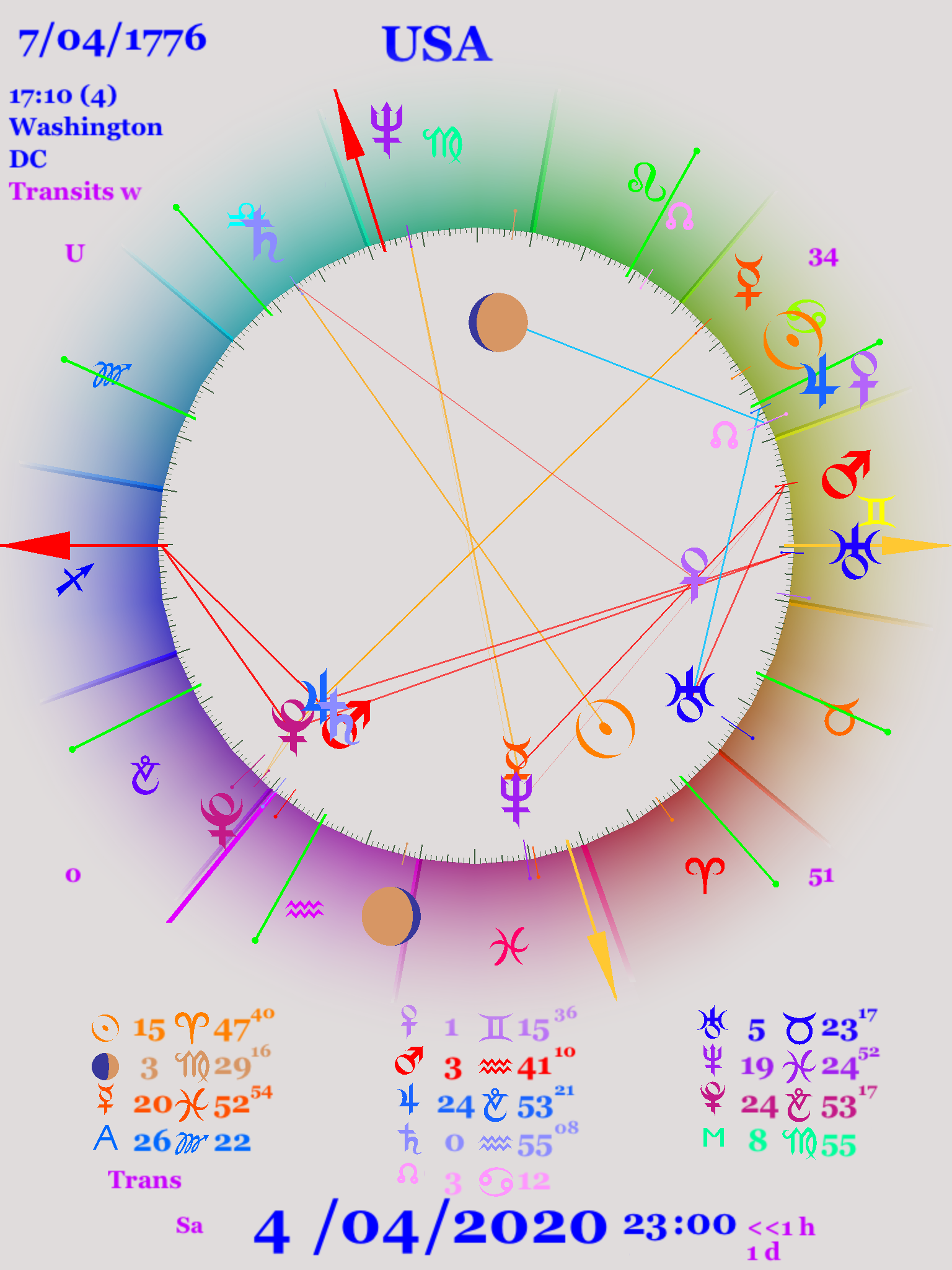
juplme2pl

Jupiter-Pluto Conjunction


The first Jupiter Pluto conjunction on April 4, 2020 is interesting because it is right opposite the natal Mercury, so this conjunction will have something to do with the media.  Pluto on this date is opposite natal Mercury with an orb of less than one degree.  The transiting Sun is opposite the natal Saturn, and to further accentuate Saturn, transiting Saturn is trine the US MC, as is transiting Venus (and thus transiting Venus and Saturn, both at the beginning of air signs, are trine), and thus the transiting midpoint of Venus and Saturn is on the Midheaven.  Venus and Saturn together talk about a limitation of justice, a concept that can be applied to many issues effecting the world today.  One of the meanings Ebertin gives for this midpoint is “the urge to seek  solitude” which I’m sure we can all relate to.

What I have called the mainstream media in the United States, for example the New York Times, the Washington Post, CNN, MSNBC, NPR, is being increasing paid attention to only by older readers and watchers, while younger people, those who grew up more in what can be called The Internet Age, get more of their news online.  This has caused a spilt in the Democratic Party which I call the split between the MSNBC Democrats — who get there news from the cable TV channel MSNBC — and the Jimmy Dore Democrats — who get their news from the YouTube channel The Jimmy Dore Show.  This dynamic can also be seen in the current Democratic primaries across the country, playing out  in the dichotomy of the two remaining candidates.  As the population ages and people born before 1960 continue to die, one can expect more and more news to be gotten online, which causes much worry among those producing legacy media.  But they also have themselves to blame: if they better reported the truth instead of what their owners want, there would be more trust of them among younger people.

A good source showing that media criticism is nothing new is the book Manufacturing Consent by Edward Herman (the main author, which is why his name came first on the title page) and his long time collaborator Noam Chomsky, published in 1988.  There is also a YouTube video.  After the book was published, Herman (who was an economics professor at Wharton) edited a magazine called Lies of Our Times, specializing in debunking the lies of the New York Times, which is indeed a full time job.

And of course before that were truth telling journalists such as I. F. Stone (who reported about what was really happening in Korea or Vietnam and whose Weekly newsletter was a must-read for Vietnam War protestors), A. J. Liebling (who famously said the press is free only for those who own one), Wilfred Burchett who was the first reporter at Hiroshima after the bomb was dropped, despite an embargo of Japan by the United States, and George Seldes, a critic of the press in the Thirties and Forties (even though he died at 104 in 1995) who said “The most sacred cow of the press is the press itself”.

So among the great changes that we will see in the upcoming decade will be changes in the media landscape of America and citizens’ relationship to it.  As the story “The Boy Who Cried Wolf’ reminds us, after you fail to tell the truth for a long time you will be disbelieved even if what you say is now true.

As Fast as Molasses in January

Molasses is a product derived from sugar cane and few are familiar with it anymore, though it is often used to make brown sugar and rum.  It can be a sweetening agent and it is more nutritious than for example honey.  But an interesting historical event happened one January in Boston where molasses took center stage.

I’ve previously written about all the things that happened in 1919  but here is one that I did not mention, and it is not signified by what I said was the major astrological configuration of that year: Saturn opposite Uranus, the staid versus the new.  But perhaps if you squint you eyes and try real hard you can see this case as the structure of the vat against the changeable molasses.

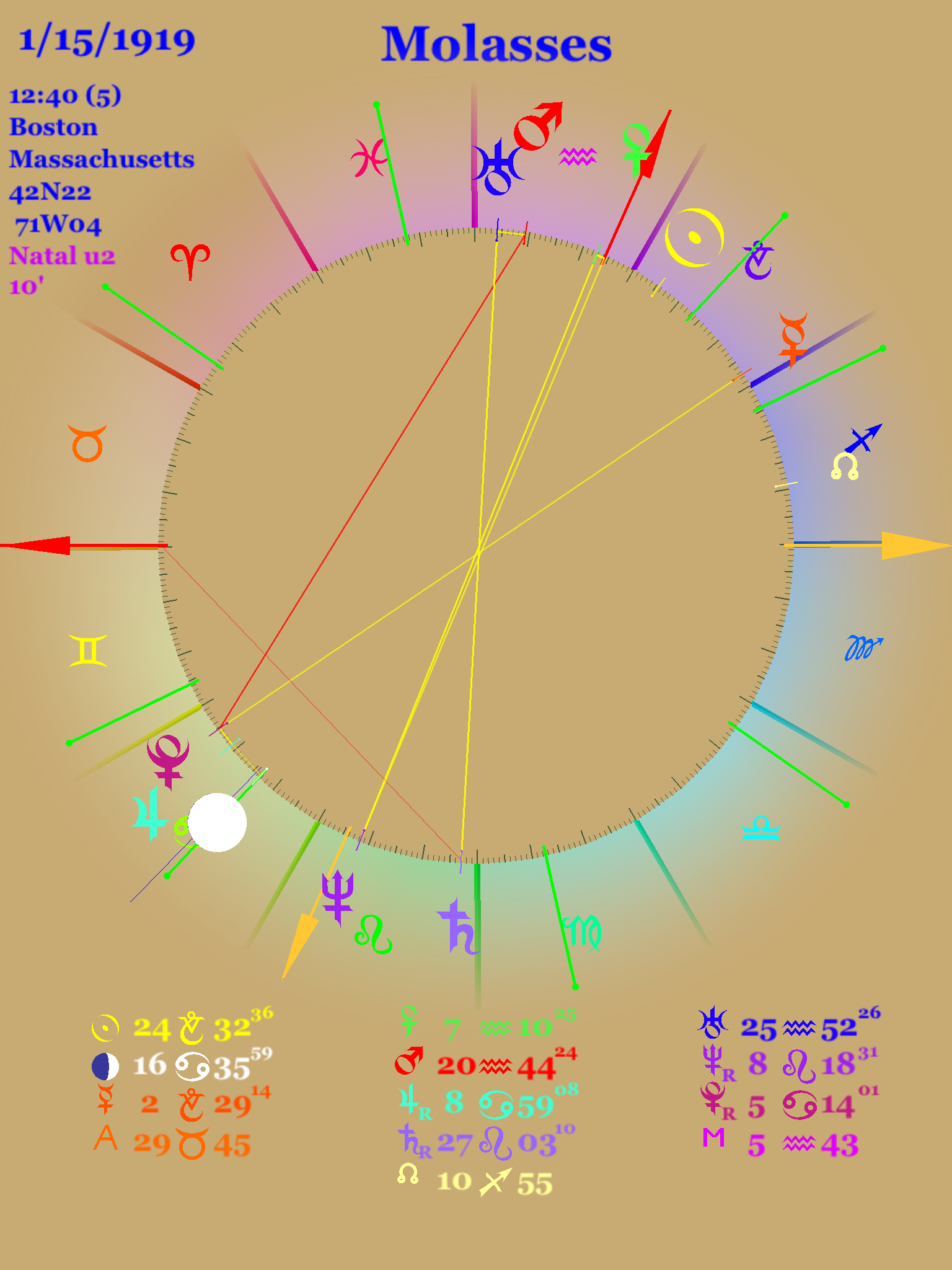
On the afternoon of January 15, 1919, at 12:40, a huge vat — 50 feet tall and 250 feet around — of molasses gave way, flooding the city of Boston, or at least the surrounding blocks on Commercial Street, with molasses.  The tank was owned by Purity Distilling Company, a subsidiary of U. S. Industrial Alcohol which used the molasses stored in the vat for war purposes.  That day was relatively warm for January in Boston: the temperature got to 45.  The vat was on Boston’s North Beach between what is now a skating rink and a park.  The location of the vat is now a baseball diamond.  The 2,300,000 gallons of molasses, weighting 13,000 tons, spread in all directions in a 30 foot wave.  Tenements in the region had their basements filled with molasses, and it was difficult to clean.  Molasses was tracked around Boston over the next few weeks as cleanup preceded.  Fresh water from fire hydrants proved unable to dilute the sticky substance, so finally salt water from the bay was used, resulting in much molasses being dumped into Boston’s harbor.  The situation would have been less serious if it had happened in July.  But in the colder temperatures of January, the molasses was slow and hard enough that some people and animals were trapped in it, and it was difficult to rescue some since the molasses, which had previously been warmed, was initially as fast moving as it would have been in summer months.  An estimated 21 people died as a result of the molasses flood; there were 150 injuries and 14 buildings were destroyed, including a two story brick firehouse that was almost dumped into the Boston Harbor.

Later scientists built scale models of the vat to determine what actually happened.  Using these measurements, they were able to estimate the speed of the molasses at 35 mph.  So now we know the speed of molasses in January!


mollases


It is fortunate that we have a time for this incident, so that the angles — the MC and the Ascendant — are somewhat accurate.  And the MC-IC axis definitely tells a story.  As we can see from the chart for this incident, not an especially big one like the start of a major war, but something definite, that Venus, the planets of sweet substances, was at the Midheaven, and opposite Neptune at the IC, a planet suggesting a liquid or lack of clarity or uncertainty at the foundation of the subject.  And if you are familiar with the planetary patterns of famous astrologer Marc Edmund Jones (who also gave us Sabian Symbols) this chart is an obvious see-saw, suggesting the theme of opposition and conflict.  There is also the Saturn opposite Uranus that was talked about previously and also Mars sesquiquadrate Pluto, suggesting transformation through motion (even if only at 35 mph), and the North Beach was certainly transformed, and an opposition of Mercury and Pluto suggesting the spectators that for several weeks gathered on the North Beach to marvel at the changes in that part of the city.  There is even a loose conjunction of Mars and Uranus in the tenth house, that almost stereotyped astrological signature of an accident.

And yes, it was later decided that the foundation of the vat holding the molasses was not especially sturdy.  Proper trace minerals that would have hardened the steel used for the vat were not added, the sturdiness of the vat was never tested with for example water before it was filled, and this time the vat held more molasses than was usually the case.  Some warm molasses was added shortly before the accident.

The molasses, imported from the Caribbean, was used to make alcohol for the First World War, and it had been a profitable business for U. S Industrial Alcohol.  But then this accident happened two months after the war ended.  This incident was a major source of litigation over the next years– one of the biggest set of legal cases in the history of Massachusetts, as families of people who were trapped or of animals that were lost sued USIA.  There were 119 claimants involved and 25,00 pages of testimony were produced from all the trials over a three year period.  U. S. Industrial Alcohol was the company that had owned the vat of molasses so important to the war that had just finished.  Since there was a Red Scare happening at the time with much accusations of anarchism and communists under the bed (the crime that Sacco and Vanzetti were accused of happened 15 months later in Braintree, Massachusetts, a dozen miles south), USIA initially accused saboteurs of destroying the vat.  But in the end USIA had to pay out $600,000 for the lack of technical supervision in construction of the vat.

And Just in Time For The Election

The dominant story of 2020 involves the three planets Jupiter, Saturn, and Pluto.  Each pair of these planets has a conjunction during the year, and there is much expectation of what those conjunctions will bring.  The first is the Saturn-Pluto conjunction on January 12.  Then the first of three Jupiter-Pluto conjunctions takes place on April 4.  Finally the Jupiter Saturn conjunction occurs on the solstice of December 21, 2020.


sapl2020

Saturn Pluto Conjunction


jupl2020

Jupiter Pluto Conjunction


jusa2020

Jupiter Saturn Conjunction


But I want to point out a combination of the three planets with Mars added in just to give the whole thing some spice.  That is, as illustrated in the chart below, on or about October 16, 2010, less that three week before the Presidential election in the United States.


oct162020

New Moon Before Election


Does this chart portend anything interesting?  It’s hard to pick the best date here, but I chose this one because there is also a new moon, which indicates new beginnings.  In this chart we have Jupiter conjunct Pluto conjunct Saturn within a total spread of about six degrees.  Pluto is at the midpoint of Jupiter and Saturn.  Mars is square Pluto and most especially Jupiter.  The New Moon is opposite Mars and square Saturn and closely square Pluto and thus there is a T-Square with that triple conjunction of those three planets that are the stars of 2020 at the apex.  Completing the picture we have Venus opposite Neptune (romantic love/deceptions in justice) and Uranus opposite Mercury (changes in the way of thinking).  So the two other outer planets, Uranus and Neptune, are aspecting two personal planets, Mercury and Venus.  On that day every planet is making an aspect.


oct162020us


Furthermore, looking at the US chart, the triple conjunction is opposite the US Mercury, representing the press of the nation, and the New Moon is squaring Mercury and sesquiquadrate Uranus, completing the natal Mercury semisquare Uranus, which represents a basic theme of the United States, freedom.  I am sure that basic issues about the nature of America will come up at this time.  And this year will bring up many issues regarding the press, which will be discussed in another blog post soon.


oct092020

Last Quarter Moon


Another interesting chart is for the last quarter moon just before this new moon.  In this one retrograde Mars is exactly square Pluto, the Moon is opposite Jupiter and thus completing a T-square with the Sun at the apex, Neptune is sextile Jupiter and trine the Moon thus forming half a kite formation that shares a base opposition with the T-square.

If we compare this with the earlier chart Mars is even tighter in a square to Pluto and the Moon is opposite Jupiter and thus the Sun is square Jupiter, forming a T square.  Pluto is closely at the midpoint of Jupiter and Saturn chart on October 9, the last quarter moon before the New Moon on October 16.  In this chart the square of Mars and Pluto is almost exact.


tg2020

 
These various permutations of Mars, Jupiter, Saturn, and Pluto are obvious in the graphical ephemeris for the period in question.  Starting in August Mars (red line) crosses in order Jupiter (blue line), Pluto (dark red line), and then Saturn (light blue line), turns retrograde and the again crosses Saturn, Pluto and Jupiter before turning direct and crossing those three planets — Pluto, Saturn, Jupiter — again at the beginning of 2021; Mars squares Jupiter for the last time when Jupiter is square Uranus in January.  At the date in question — center line of the graphical ephemeris — as you can see Mars is exactly square Pluto.

So I see October as the month when Jupiter, Saturn, and Pluto are set up for action by Mars crisscrossing those planets in late summer and early fall of 2020, just in time for the US election that many people are looking forward to with hope or trepidation or both.


electday2020

Election Day


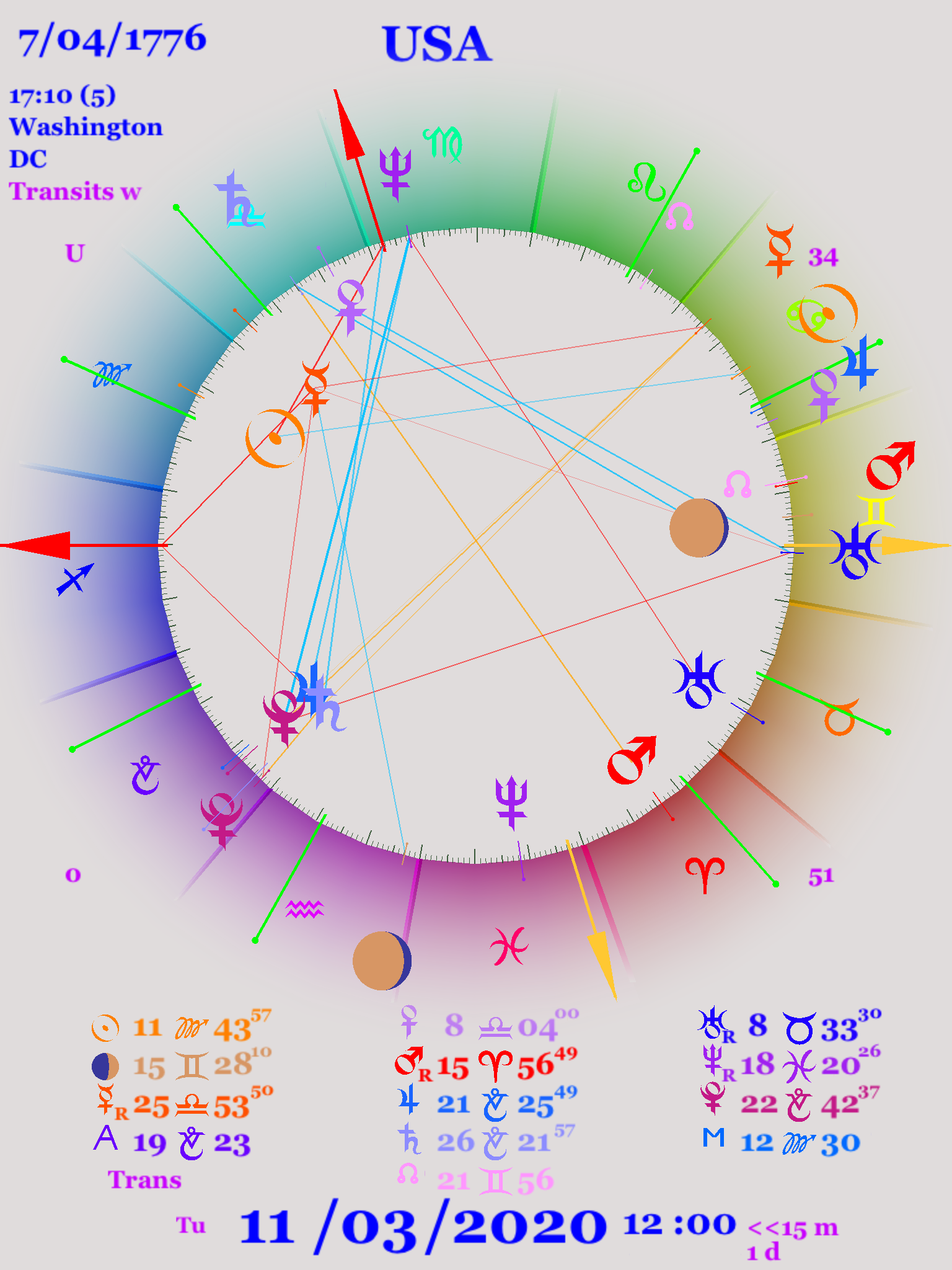
And for future reference, here is the chart for election day.  There is still the conjunction of Jupiter, Saturn, and Pluto opposite the US Mercury.  There are four retrograde planets: Neptune, Uranus, Mars, and Mercury.  Having a national election when Mercury is retrograde (stationary turning direct) suggests that the early elections reports shouldn’t be trusted.  Mars — the least often retrograde planet — retrograde as well as opposite the natal Saturn suggests that the outcome will be delayed or that questions will arise (quelle surprise!!).  And of course that triple conjunction that has been featured above suggests problems in communication.  An election to remember!

Road Trip!

A perfect synecdoche — the part that symbolizes the greater whole — for the crisis of overshoot that is currently bedeviling the world is the popularity of that personal transportation device known as the automobile.  That popularity formed at the beginning of the Twentieth Century because of two developments.  This timing also corespondents with an outer planet midpoint as mentioned previously

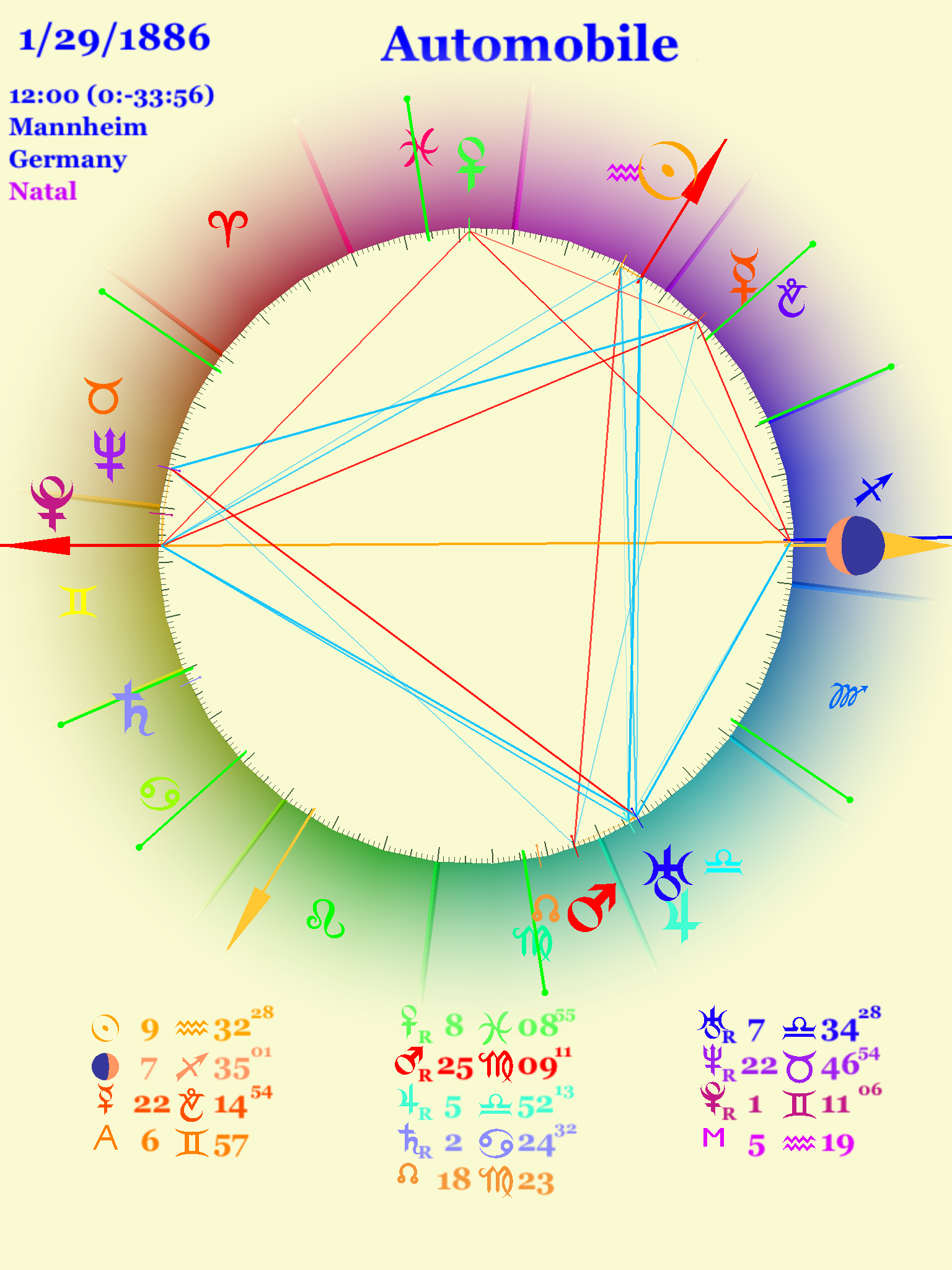
The (internal combustion) automobile was invented — using the date of the patent — on January 29, 1886 by Carl Benz, whose name is still present in the brand Mercedes Benz.  This was after the internal combustion engine, so important to the automobile — even though the early ones were powered by other means, such as electric batteries or external combustion engines more commonly known as steam power, eg the Stanley Steamer — was invented over the previous decades.
 

automobile

Automobile


Looking for the chart of this event, we see it is near the conjunction of the two outer planets Neptune and Pluto which was exact in 1890 and so colored the end of the Nineteenth Century and set the stage of the great change that would happen 100 years later with the conjunctions of Uranus and Pluto and Uranus and Neptune, which would complete the three conjunction of those three outer planets, indicating a 500 year cycle, which has been discussed in this blog many years ago.  The most notable aspect at the time of this invention was the tight Jupiter-Uranus conjunction.  Richard Tarnas calls this aspect one of creativity and expansion, and shows how many inventions have been developed under aspects of these two planets.

The automobile started out as a rich man plaything, because the first automobiles were quite expensive but later were later greatly reduced in price.  This is similar to the development of cell phones, which once were quite expensive (and large) but soon became so inexpensive that almost everyone had one.  But there were two events that changed that all and made automobiles and driving a common phenomena.

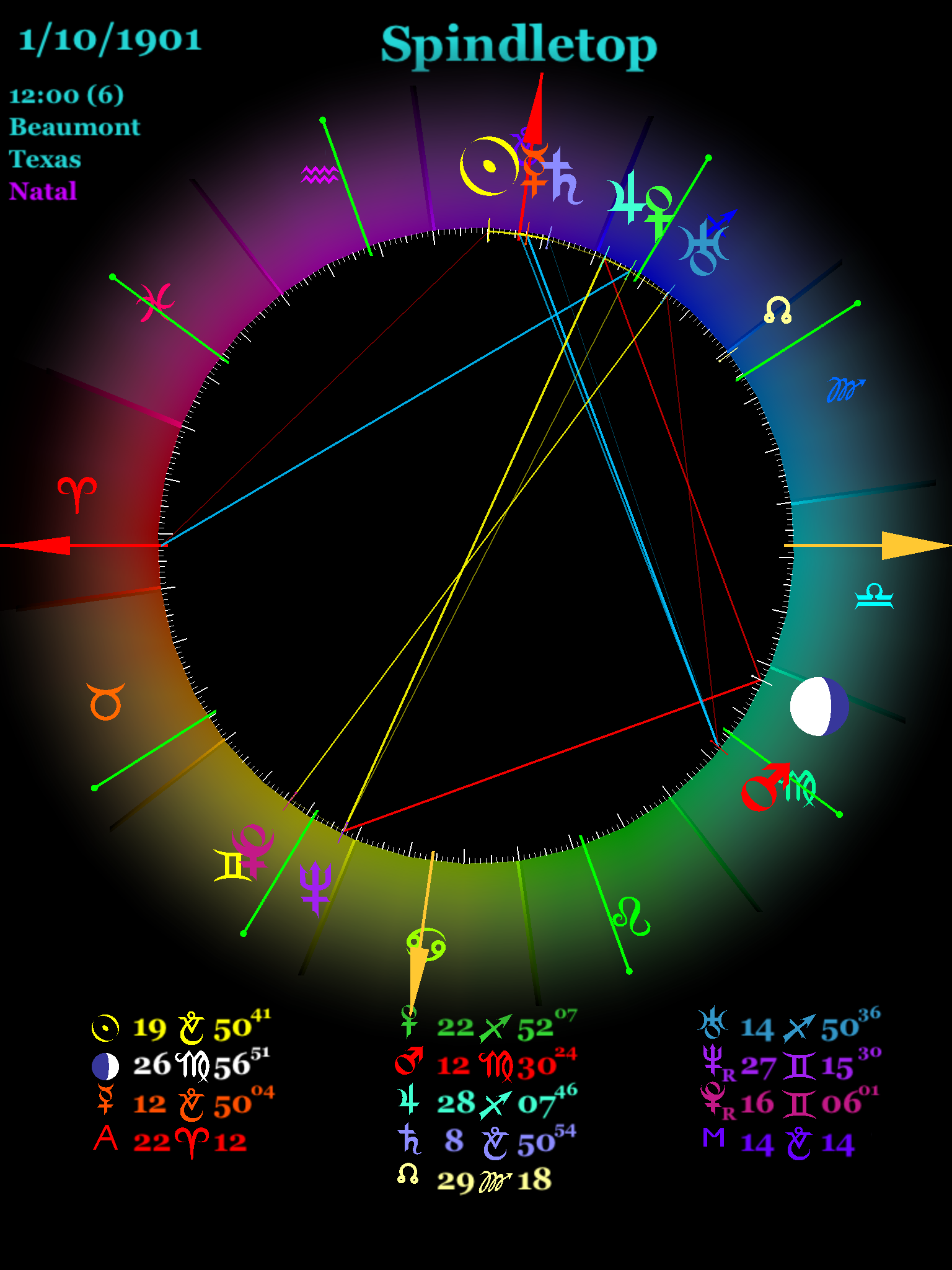
The first was the discovery of oil in Texas.  On January 10, 1901 oil was discovered on Spindletop Hill in southeastern Texas.  Oil had been known for centuries, and oil ls considered to have been discovered in Pennsylvania in 1859, but the discovery at Spindletop was different, it was the first gusher.  The gusher at Spindletop was producing 100,000 barrels a day at the beginning.  Suddenly there was plenty of oil for whatever was needed.  And this led to the discoveries of other gushers also in East Texas and the Permian Basin.
 

spindletop

Spindletop


In the chart for this discovery, one aspect stands out: the opposition between Jupiter and Neptune.  One of the many items that Neptune rules is oil, the very substance that so controls the present world and is an important subject of this essay.  When we combine Jupiter with Neptune, we have a lot of oil, which is exactly what this discovery represents.  The orb is less than one degree.  There is also a Uranus opposition to Pluto, which was one of the astrological highlights of the first decade of the Twentieth Century, and has been discussed before in the Birth of Modernism.

The second development was the Model T Ford.  The first model T was produced on October 1, 1908.  This was the first car for the masses; it was a relatively inexpensive car that real people could afford, and not just the wealthy.  And Henry Ford, who was to become the third most wealthy individual in America in the early Twentieth Century, realized that he needed to pay his employees enough so they could afford the automobiles that they were making.


modelt

Model T


The first Model-T’s were in the first decade of the Twentieth Century, a period which I have previously called the birth of Modernism when many things changed, such as the popularity of movies and the first airplane flight.  In this chart we have Pluto square Mars — transformative energy — and Saturn opposite the Sun — on this day there is some limitation, but of course we would not realize what the limitation was until many decades later.

Automobiles change their environment in so many ways.  There is obvious pollution from first the construction of the vehicle from metals, plastics, and with the increasing addition of electronics to automobiles, certain rare elements such as lithium.  Then there is pollution from car exhaust and wheel dust.  Next consider the number of people and animals killed by these high speed devices, not only people outside the vehicles but also often drivers and passengers are killed or severely injured.  Automobiles extend the range for humans greatly since they travel at high speeds, allowing the colonization of areas previously unavailable to human exploitation.  This has caused the limitation of habitat for wild animals; also, the increasing spread of roadways necessary to deliver the humans to their new dwellings make travel for animals increasingly precarious.  The term ” road-kill” is now a common one and that term came in to existence only because of the deaths caused automobile and the highways on which they travel.

There are several events that can be considered the first death due to an automobile: the death of a diver, the death of a passenger, the death of a pedestrian.


cardeath

First Car Death – Mary Ward


The first death from an automobile happened long before the first internal combustion automobile was patented.  Mary Ward was a Irish woman — astronomer, artist, author — who was killed when she was tossed from a home-made steam car built by her cousins and trapped under its wheels.  She is considered the first traffic fatality.  Steam (external combustion) was at the time considered suitable for cars, but it was not until the development of the internal combustion engines that the idea of the automobile took off.

In the chart for this event, the most obvious aspect is the conjunction of Jupiter and Pluto at the Descendant (but note this is a chart set for noon).  Jupiter Pluto aspects are fairly common, and I haven’t gotten a handle on them.  From the symbolism, one would expect a plenitude of transformation.


peddeath

First Pedestrian Death – Henry Bliss


The first death of a pedestrian occurred when Henry Bliss was hit by an automobile on September 14, 1899.  Henry Bliss was killed by an electric taxicab, proving that both electric cars and taxicabs existed early on in the development of the automobile, and in fact this happened in the Nineteenth Century.  In this chart the most notable aspect is the opposition between Saturn and Pluto, an aspect that was also prominent in the Spanish-American War chart.  Those two planets — whose conjunction will highlight January 2020 — are always ominous.

One result of our increasing fascination with the automobiles is increased death and destruction.  The more obvious deaths and maiming are of automobile drivers and passengers rather than of pedestrian and cyclists.  There were about 36000 people killed by cars in the last year, which is a slight decrease from the year before, but this was accompanied by an increase in the number of deaths of pedestrians and cyclists.  A recent case in Germany that inflamed the public was a SUV that jumped the curb and killed four people on the sidewalk, prompting demands that SUVs be banned in that country.  SUVs are now among the most popular of vehicles (other than large pickup trucks, which often are built on the same chassis as that of SUVs), driving to extinction the venerable station wagon, even though SUVs are not only more deadly to people outside the vehicle, but also, contrary to popular opinion, more dangerous to drivers because of increased probability of rollover.  But people do like to feel that they are safe in their armoured vehicles high above the common driver.

But usually not taken account of, cars are deadly to wildlife and domestic animals.  Think of the number of dead cats and dogs in any urban environment.  And, if you live in a rural area, you are aware of all the roadkill populating the side of highways where the dead deer end up.  Roadkill provides meat to those of rural areas too impoverished to afford a decent supply of store bought meat, so that can be counted as a plus for the increasing use of cars and the increasing inequality.

But besides all the death from automobiles, think of all the accidents that do not result in death but result in injuries ranging from minor to severe that may change one’s life forever.  Doctors, hospitals, insurance companies and auto repair shops are provided with business by all these accidents, thus helping the economy.  All these events that harm individuals increase the GDP of a country.

Before the popularity of cars, cross-country walking was a thing.  Nowadays, people who walk are called “pedestrians”, a term that also means mundane or commonplace, dull.  With the rise of the automobile, the increasingly few who depend on their feet for travel are considered plebeian or commonplace when compared to those who travel with cars.

The first road trip, that is across the country from one coast of the United States to the other, was a trip from San Francisco, California to New York City.  It started in San Francisco in the afternoon of May 23, 1903 and finished in Manhattan on July 26 at 4:30 in the morning.  Horatio Nelson Jackson, a retired doctor, was bet $50 in an upscale San Francisco bar that a car could not cross the country in less than 90 days (shades of Jules Verne).  He got bicycle mechanic Sewall Crocker to accompany him in a 20 horsepower Winton touring car (certainly appropriate) which they named Vermont.  Since there were no motels, gas stations, or roadside diners along the way, they packed sleeping bags.  Automobiles were considered by many at the time as a fad that would not last and certainly too unreliable to make it across the country.  At times they needed horses to pull the stranded car and blacksmith shops to perform the repairs.  For most of the trip the were accompanied by a dog names Bud who wore motoring goggles to protect his eyes.  The story soon proved popular to the general public, and after they finally reached Chicago they had put the hardest part of the trip behind them, and arrived in Manhattan early in the morning.
roadtripstart

Road Trip Start

roadtripend

Road Trip End


Looking at the two charts representing the start and end of this first road trip shows nothing very spectacular.  The Descendant represents (for charts in the Northern hemisphere) the West, where the trip started, and the Ascendant represents the East, where the trip ended.  In the first chart, the Moon is setting in the West, where the trip began.  In the second chart, the Sun is rising in the East, where the trip ends.  So symbolically these two charts capture that start and end of the first road trip.

The mass usage of automobiles, having enough gasoline because of the discovery at Spindletop, started in the first decade of the Twentieth Century and has grown with each passing year.  This has allowed humankind to expand, covering more and more of the land needed for mammals, insects, birds.  Houses and buildings have been built on more and more land, reducing the area for wild animals.  This expansion has allowed people to live in remote areas previously unavailable to all except the most intrepid explorers.

Automobiles have increasingly polluted the environment.  First because of burning of a petroleum product has added carbon dioxide and aerosols to the atmosphere.  But another major pollutant has been tire dust.  It was recently discovered (recent article in the Los Angeles Times) that one of the major sources of micro-plastic pollution in the San Francisco Bay was particle from the tires of all the automobiles driven in the Bay Area.  The amount produced by tire dust was many orders of magnitude greater that which came from other sources, such as the laundering of synthetic fabrics.

If one were an outside observer of the planet — the prototype is a typical Martian — the dominant life form of the planet Earth would be the automobile.  These creatures would be seen to have a symbiotic relation with small creatures that feed them, clean them, and buy them fuzzy dice as decorations.  In turn the automobiles take their symbiotes to places.  Notice that much of the world is taken up with areas for this dominant life forms: Highways, parking lots, and personal parking lots called driveways with attached small homes called garages that are filled with possessions of their owners and not with the cars that they were originally designed for, have increasingly covered the surface of the planet, changing the climate, breaking up areas of land so that creatures can no longer move as widely as before, and allowing people to occupy more and more land.

The introduction of the automobile, as a recent book (Policing the Open Road: How Cars Transformed American Freedom — Sarah A. Seo) has shown, has allowed the police to intervene in our lives much more often that was previously imaginable.  The idea of police stopping people of a certain race was unusual but now “driving while black” is still a common occurrence.  Being stopped for such a thing as having an outdated sticker on your license plate is an almost normal occurrence.  People think that when police stop them they are allowed to search the vehicle (not true) which causes many to be arrested for something other than a traffic  violation.

With the population increase expected in the upcoming years, and the increasing demand for a car by the impoverished masses who are increasing their wealth, one can expect that the automobile and the trends outlined above will become increasingly dominant in the world, resulting in more and more death and destruction.  That is the future we can look forward to if nothing changes!

1919

This year we are seeing many celebrations of events that happened 50 years ago, such as Woodstock and the Moon Landing (but no celebrations of the Manson murders or the Altamont concert).  This year is also the one hundredth anniversary — a centennial — of the year 1919, and I have yet to hear of any celebration of that remarkable year and I don’t expect to hear any.  But 1919 was a very important year, setting some trends that are still alive today.

To understand all that was happening, we must first reflect on the context for that year.

World War I tore up much of Europe and had countries from all over the world involved, thus the appellation “World War”.  Four empires that had existed for centuries — German, Austro-Hungarian, Ottoman, and Russian — collapsed as a result of the War.  Many new countries were formed that are currently in the news, such as Saudi Arabia, Iraq, and Syria.  There was also a large scale epidemic that killed more than four times the number that died in the War.  America went through many changes, some of which were not directly attributable to the war.


jan1919

1919


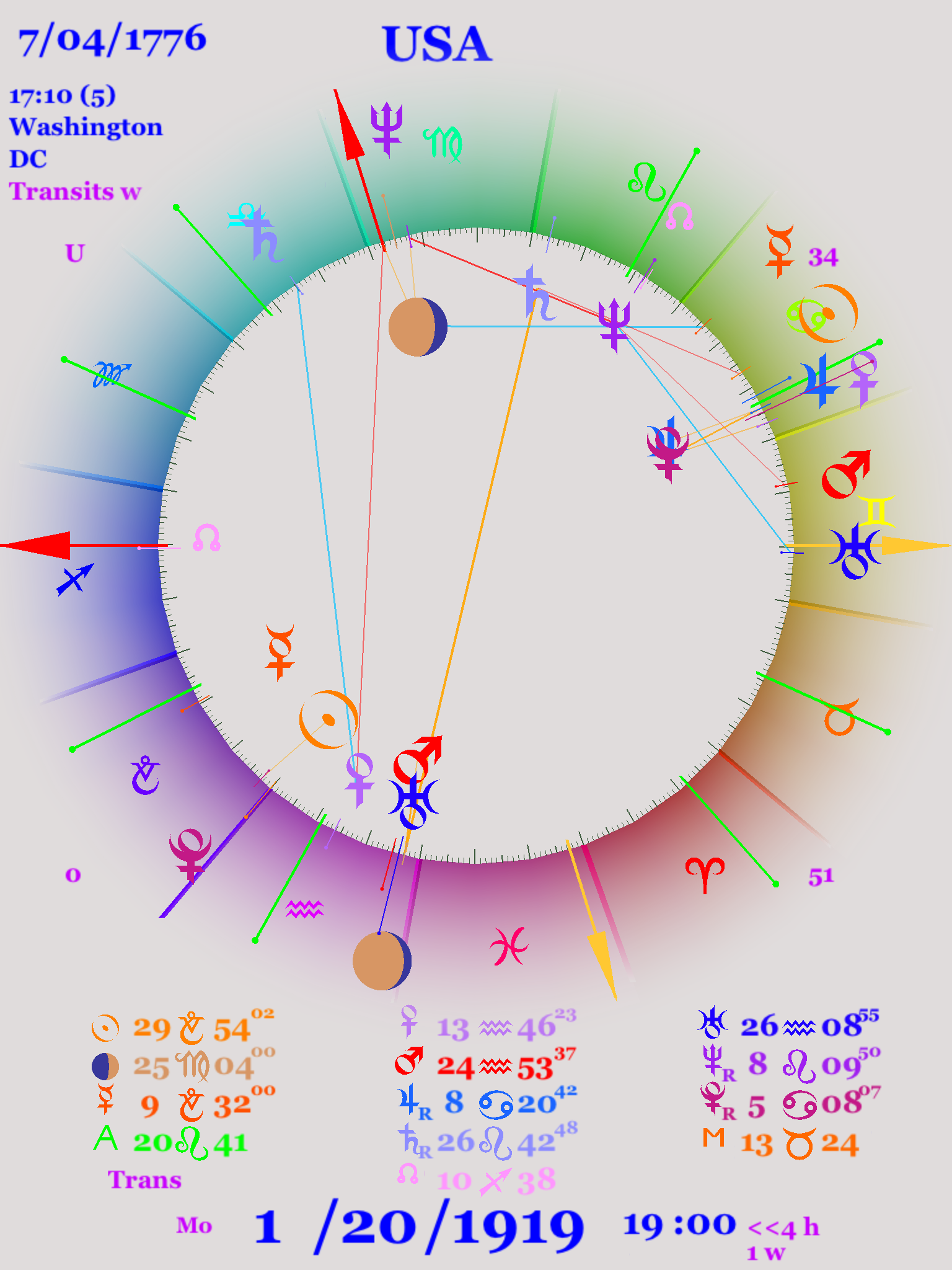
First let’s look at the major aspects of the chart, not only the World transits that affect everyone but also the transits to the US chart.  The most prominent aspect, which colored much that went on in the world, was the opposition of Saturn and Uranus.  As you can guess from the nature of these two planets, that opposition is very combustible.  The two planets, one that was the limit of the known solar system for millennia, and the other the first planet discovered with the aid of a scientific instrument, a discovery that captured the new world people were moving towards, one ruled more and more by science, have distinctly contradictory natures.  Saturn represents limits and conservatism (among other things) while Uranus represents the new and revolutionary, so those two planets can be seen as representing the old established ideas versus the new more modern things that are coming into focus — conservatism against change.  With those two principles in opposition, one can see a very major conflict.  The United States was especially affected by this aspect, because Uranus was on the Moon of the United States, and thus Saturn was opposite the Moon.  The people (represented by the Moon) would be an instrument of this conflict.  Other aspects involving the US chart were Neptune on the North Node and Pluto on Jupiter, which is one of the core planets of the US and thus very important to the self-image of that country.  All of these aspects are slow moving ones that involve the four outer planets Saturn, Uranus, Neptune, and Pluto.
The cinema was becoming increasingly popular by 1919, and so actors finally took the business side of the movies into their own hands.  In what I call an “Astrological Cliche” we have the tight conjunction all year of transiting Neptune and US natal North Node of the Moon.  Neptune is associated with illusion, things that aren’t actually real, and as a result it is connected with artists and especially movies, which by their vary nature are not real.  The North Node has many meanings; the one I like is that of groups or associations.  The famous event of 1919 involving Neptune was the formation of United Artists (read Node-Neptune), a group for production of movies started by some of the most well known people in that field at the time: D. W. Griffith, Charlie Chaplin, Douglas Fairbanks, and Mary Pickford.  The idea originally was to involved those making movies to control things, instead of allowing business owners to control things.  United Artists still exists 100 years later, though it has gone through many owners and purposes.

Starting in 1918 and continuing until 1920 was the largest pandemic of the modern world, a large outbreak of influenza known a the “Spanish flu” though Spain did not have anything to do with its origins.  The month with the most deaths was October of 1918, but there were more deaths after that month than before.  Unlike most influenza which kills mostly infants and the elderly, this flu struck down mostly those in the middle.  And aspirin — which had only been sold for twenty years — was recommended for treating this flu, which made the death toll worse.  Research has found the homeopathic doctors saved more lives than allopathic doctors because of the problems with aspirin.

During this whole period the Versailles peace conference was happening to settle World War I which had ended in November of 1918.  The conference started in January of 1919 and lasted for exactly a year, though parts went on for several more years.  Sections of the German and Ottoman Empires were awarded to the victors, Britain and France, so those counties got possession of among other things, Palestine, Syria and Iraq.  The League of Nations was formed, an idea of American President Woodrow Wilson, even though the US did not join.  Large reparations were demanded of Germany.  The harsh treatment of Germany that resulted did much to upset the German populace and helped lead to World War II.


tg1919

1919

As we can see from the above graphical ephemeris, the opposition of Saturn and Uranus started in late 1918 — far left of the graph — and ended in early 1920 — far right of the graph.

The Summer of 1919 is known as Red Summer (the term from a NAACP leader) because so much blood was shed in various “race riots” which happened around the country.  But it also showed that the black people living in the United States were no longer willing to take hostility — resulting in violence — from the white population, and they fought back.  Remember the context: The Supreme Court decision of Plessy v Ferguson which had happened at the end of the previous century had allowed Separate but Equal laws to take place around the United States, resulting in wide spread sanctioned segregation of the races.  After that was the Great Migration in which a half million black citizens from the South moved north seeking work in industry.  The end of World War I allowed many black soldiers to return to the United States and they began looking for work.  The result of all these were attacks by white mobs in dozens of cities and hundreds of deaths.  As the Ku Klux Klan put it in flyers posted in black neighborhoods: “The war is over, negroes. Stay in your place. If you don’t, we’ll put you there.”

In order to get Americans, who did not want to go to war (Wilson ran the second time on the slogan “He kept us out of war”) to be willing to fight, extreme nationalism/patriotism was promoted by ardent propaganda.  Sauerkraut was renamed liberty cabbage and hamburger was called liberty steak.  One result of this was the fear among many of anyone different.  A. Mitchell Palmer was the Quaker Attorney General under President Wilson, and he (called the “fighting Quaker”) imprisoned and deported many people whom he considered Communists or anarchists.  The Russian Revolution had occurred in 1917, and many government officials (such as the new democracy of Germany as well as in America) were mortally afraid of a Communist Revolution in their own back yards.  There were many foreign born radicals in the United States as well as anarchists.  So Palmer instituted what was called the “Palmer Raids” (also known as the First Red Scare) wherein Palmer organized a round up and deportation of those suspect of left-wings feelings.

The Russian Revolution of November 1917 resulted in the Russian Civil War between the Red (Bolsheviks ) and the White Russians.  There was an invasion of Russia by troops from a dozen countries (such as England, France, United States, Italy, and Japan) on the side of the White Russians in 1918.  Though most troops, except for the Japanese, were withdrawn in 1920, this invasion extended the Russian Civil War and caused hard feelings between the West and the Soviet Union, which extended to the Cold War after World War II and even today.

On January 16, 1919 the Eighteenth Amendment to the United States Constitution was ratified by Congress, which would result in the prohibition of the sales of alcoholic beverages starting at the beginning of the next year, leading to the the folly of Prohibition for the next 13 years, and thus to a widespread lawlessness and an empowerment of criminals.  During the Twenties much alcohol was consumed, but instead of a lot of beer and wine, much more potent distilled spirits were drunk, since those were easier to conceal.  There was also corruption developed among those law officers charged with upholding Prohibition, as is always the case when laws differ from the wishes of people.

Another amendment was passed by both the House and the Senate in the United States, and that was the Nineteenth Amendment which gave women the right to vote.  This amendment was finally ratified by enough states in the middle of 1920.  There had been an active suffragette movement before World War I in several countries of the world, such as Great Britain and the United States. Women were able to vote for President in the United States 1920 election.

Kaiser Wilhelm of Germany (who was related to Queen Victoria of England and Tsar Romanov of Russia), after his country was defeated in World War I, abdicated and moved to the Netherlands, which refused to extradite him for war crimes.  The government of Germany was replaced by the beginnings of a democratic one, and the government of German was called the Weimar Republic from the city where its constitution was drafted.  But there was much upset about the way the government was going, and a strong Communist movement in Germany developed.  In 1919 there was a civil war between the Communist Spartacus League and the newly installed government.  The government crushed the uprising and put some leaders of the Spartacus League to death, including one of its founders, Rosa Luxemburg.

An international Workers Union called the Industrial Workers of the World (IWW – Wobblies) had been formed in the middle of the last decade, and after the Russian Revolution and World War I, there developed much hostility between the established citizens and the Wobblies.  This resulted in the Centralia (Washington) massacre.  In Centralia on November 11, 1919 — exactly one year after the end of World War One — there was an armistice march including veterans from neighboring Chehalis.  There had long been a conflict between the American Legion, prominent in Southern Washington state, and the radicals of the IWW, but with that march these conflicts flared into the open.  There are conflicting stories of who fired the first shot, the American Legion or the Wobblies.  As a result six were killed and more wounded and several Wobblies were convicted of murder in a later trial.
During the just ended war, there was an agreement between industries — especially the steel industry that made something that was extremely important for the war — that there would be no strikes and that the industries would treat the workers decently, unlike before the war.  But after the war ended the agreement was no longer in effect.  So by late 1919 the workers decided to strike the steel industry, in what is called the Great Strike of 1919.  But it did not turn out well for the workers.  The general public was afraid of “Bolsheviks” taking over the country; the atmosphere, as detailed above, was hyper-patriotic.  The heads of the steel industry painted the strikers as possible bolsheviks and thus the strikers lost almost all public support.


genstrike

Seattle General Strike

The General Strike in Seattle started on February 6 and lasted for only six days, but army troops were called in on the second day of the strike by a nervous mayor.  One hundred and one different AFL — American Federation of Labor — unions joined the strike to show solitary with the shipyard workers who were on strike.  There was no violence, the general strike was entirely peaceful.  Many other workers stayed home and the streetcars stopped running.  But police raided some union halls, and there was worry about Bolshevik Revolution in Seattle.  By the time the strike was over, newspapers were cheering the fact that Seattle had been saved from the Reds. But it was a momentous event in the history of labor solidarity, and the University of Washington has a web site dedicated to this event.  In this chart above we see of course the Saturn opposite Uranus, but also a Mars trine Pluto —  a  transformative confrontation, but (trine) not violent —  but also Neptune opposite Mercury, suggesting that the newspapers (Mercury) were somewhat deceptive about the nature of the strike,

Another scandal of note during the year was the fixing of the 1919 World Series by the Chicago White Sox, who came to be known as the Black Sox for their cheating.  In this incident eight members of the Chicago team were accused of losing the World Series on purpose so they would get money from a gambling organization.  There was a movie made about this incident in 1988 called Eight Men Out.

One other incident in 1919 deserves mention.  President Woodrow Wilson had a stroke on October 2, after a grueling tour to promote his League of Nations.  His second wife, Edith, was very protective of him and few knew that Wilson was quite ill.  She even signed his name on some official papers, and in fact many call Edith Wilson the first woman President.  While Wilson’s health did improve he remained paralyzed on one side which reduced his ability to campaign for his League, and any thoughts he had of a third term were dashed.  He died in 1924.

So during the year of 1919 we see many variations of that basic conflict of humanity, the old order versus the new, as represented by the opposition of Saturn and Uranus, and that conflict played out in many different venues. But there was also a formation of a business for the making of movies, something at the time as becoming increasingly popular.  The basic core of America was beginning to be transformed, as symbolized by the transit of Pluto across Jupiter, an important planet conjunct the US Sun.

Guernica

Guernica is the name for one of Spanish artist Pablo Picasso’s most famous paintings, a town in the northern part of the Basque region of Spain, and the name of an important battle of the Spanish Civil War that took place there.


guernica

Guernica


The Spanish Civil War was a conflict between the troops led by Francisco Franco and the recognized Republican government of Spain.  The troops led by Franco, who had been on duty in the Spanish colony of Morocco, attempted to take over the Spanish government.  The Soviet Union (Stalin) backed the existing government and Germany (Hitler) and Italy (Mussolini) backed the Franco faction.  In much the same way that in the present day certain countries back the rump government in Venezuela even though it is not the recognized government, certain countries backed the rump government in Spain in the Thirties.


Franco

Francisco Franco


If we look briefly at the chart of Francisco Franco, the Spanish leader most closely connected with the Spanish Civil War and leader of Spain until his death in 1975, we see he was born under a full moon and under the strong Neptune-Pluto conjunction that so colored the early Twentieth Century.  And in fact his Moon is conjunct those two planets, showing that he was a manifestation of the energies of those two outer planets.  He was a strong man who would leave his mark on the Twentieth Century.

Since the United States did not want to takes sides in the Spanish Civil War, while many members of left wing organizations did, there was formed what was called the Abraham Lincoln Brigade of volunteers from America who fought on the Republican side.  America itself, under President Franklin Roosevelt, remained neutral.  Many who became famous later were involved in covering this war, such as Ernest Hemingway, Martha Gellhorn (who later would marry Hemingway), George Orwell, and Robert Capa.  Martha Gelhorn was such an important journalist of the Twentieth Century that a prize bearing her name has been awarded since 1999.  The winner of the prize in 2011 is someone who is now imprisoned in a prison in Britain for doing journalism, Julian Assange.  That fact alone shows haw the respect for journalists had fallen in this Century.

The Spanish Civil War broke out in the evening of July 17, 1936, after the details of the attempted coup were discovered prematurely.  The coup leader was Francisco Franco, who was associated with the Falange Party of Spain.


SpanCivilWar

Start Spanish Civil War


Here is a chart for the start of the Spanish Civil War that evening.  The time is early evening and it is set in the capital of Spain.  There are a number of interesting aspects.  First it is just before a New Moon, which would happen in less than a day.  That phase of the lunar cycle has been compared (The Vision by W.B.Yeats) to the fool in Tarot, the suggestion of new beginnings.  And the Spanish Civil War is often seen as the true beginning of the Second World War.  The Sun is conjunct Pluto, again emphasizing transformation on this day, though “transformation” is not always in the direction that we would like.  Uranus is at the lowest point, opposite the Midheaven: hidden changes happening now. And there is a triple conjunction of Moon, Mercury and Mars at the Descendant: Violence and publicity at this location.

The most famous battle of the Spanish Civil War was in Guernica in the Basque region of northern Spain.  This took place about nine months after the start of the War — conception to birth in other words.  Guernica was a town at that time of about 5000 people.  Monday, the day of the attack, was a market day in the town so more people would be outside.  There were about 250 people killed in the raid, but what was most notorious was the brutality of the attack.  The air assault was carried out by allies of the Nationalist Party, Germany and Italy.  The planes of those two countries attacked the town starting at about 4:30 in the afternoon of April 26, 1937.  Since it was a civilian town that was attacked, this was considered controversial and a war crime since never before had civilians only been attacked, but it was to become more common in the ensuing World War II.  The first wave of planes dropped 550 pound explosives to destroy the buildings.  After that came planes dropping incendiary devices burring at temperature to 2500 degrees Celsius.


Guernica

Start Attack on Guernica


The chart for the beginning of the assault on Guernica which started at 4:30 in the afternoon shows Pluto elevated in the Tenth house.  Pluto was on the Midheaven about an hour later when the bombing was at its height.  The bombing of Guernica took three hours.  Of course, since Pluto transits the MC in any location once a day, this is not terribly unique.  Saturn had just set as the bombing commenced; the most prominent aspect is the Jupiter opposition Pluto, suggesting a wealth (Jupiter) of transformation (Pluto), though the transformation was not the type that would occur to one.  The Guernica attack on civilians was precedent setting at the time, and that type of attack would set the pace for many of the attacks of the upcoming World War Two, as well as future campaigns up to the present day.  Drone attacks are notorious for the number of civilians who are killed.

Spanish artist Pablo Picasso was well known at the time.  He had been commissioned to paint a mural for the Spanish Pavilion at the 1937 Paris World’s Fair.  Living in Paris, he heard the news of the bombing almost immediately.  He had difficulty deciding on a subject before the horror of Guernica happened, but after the attack he knew immediately what he would paint.  As soon as May 1 he had preliminary sketches of what the final work would look like.


Picasso

Pablo Picasso


Picasso was born about a decade before Franco.  The upcoming Neptune Pluto conjunction is 15 degrees from exact.  Picasso has a close Mercury-Jupiter opposition which suggests a wealth of ideas, demonstrated with the many forms of painting he moved through, most famously cubism which he developed with French artist Georges Barque.  What stood out for me was the close Sun-Pluto triseptile.  Septiles — seventh harmonic aspects – are associated with creativity and inspiration, and Picasso was famous for his creativity.


Picasso_guernica1

Sketch for Guernica


The transits at the time Picasso first conceived of the painting of Guernica — about one week after the bombings — show transiting Mercury opposite his natal Mercury and thus energizing that natal Mercury Jupiter opposition.  There is a transiting Sun-Uranus conjunction, which speaks of sudden insights or flashes of brilliance, and this conjunction falls on Picasso’s natal Saturn, suggesting that there will be a concrete and long-lasting result from this blast of inspiration.  This mural is considered one of the Twentieth Century most profound statement on the destruction and brutality of modern war.

Some have suggested that if European countries and the United States had stood up to Hitler and Mussolini at the time, in what was a precursor to the violence of the upcoming war, then Germany and Italy would have backed down, or at least not felt they had the green light to attack other countries, for example Poland in two and a half years.

Picasso said that he did not want the paining shown in his home country until democracy returned, so it was displayed at the Museum of Modern Art in New York City for a long time.  Unfortunately, Picasso died two years before Franco and so the artist was not able to see Guernica shown in his native Spain.


guernica_tapestry

Guernica Tapestry


In 1955 Nelson Rockefeller commissioned a tapestry of Guernica since he could not buy the original.  It was done under Picasso’s supervision, and has been displayed at the United Nations Building since 1985.  But Guernica made news again in 2003.  During Colin Powell’s justification for the upcoming invasion of Iraq in front of the UN Security Council, the tapestry of Guernica, which would have been visible in the background of his speech, was mysteriously covered by blue curtain.  It would appear that a tapestry depicting the horrors of war would not provide good optics for a speaker justifying an upcoming war, though many excuses were offered for the veiling.  So even in the Twenty-First Century, Guernica shows its power.

The Nineties

The decade of the Nineties is as important as the decade of the Sixties, but it does not get the mythology of that other decade, possibly because the sound track was not as good.  At the time there was even the saying that “The Nineties are the Sixties Upside Down” which was literally true with the shape of the numerals, but also showed some hope among people who said it.  This was the decade between the fall of the Soviet Union and the attacks of 9/11.  Many conservative pundits complained about Americans going soft without the ‘threat” of Communism to goad them forward, and so were happy with the rise of terrorism marked by the attacks on the World Trade Center, itself a synecdoche for the financial capitalism that was ruling the world, and would make its mark felt in another few years.
The Sixties were marked by the conjunction of the two outer planets Uranus and Pluto, and that conjunction certainly indicated the nature of the decade that the august Trilateral Commission called “too much democracy”.  The decade of the Nineties was marked by the conjunction of the two outer planets Uranus and Neptune.  Both conjunctions involved Uranus, but the difference was between Pluto in the Sixties and Neptune in the Nineties.  So in other words the Sixties was a Pluto decade and the Nineties was a Neptune decade.

Pluto is a more dynamic, transformative planet than Neptune.  The previous conjunction of Uranus and Neptune was in the 1820s, thirty years before the conjunction of Uranus and Pluto, so the synodic cycle of Uranus and Neptune is longer than the cycle of Uranus and Pluto at least currently.  Pluto has a longer period — 250 years versus 186 — than Neptune, but sometimes Pluto speeds up as it prepares to go inside the orbit of Neptune.  Just from the difference of Neptune rather than Pluto in these two different conjunctions, you would expect that the Uranus, Neptune conjunct to be less obvious and abrasive.


urne1993

Uranus Conjunct Neptune

There were a few very large changes that happened in the Nineties.

As we’ve seen in the past, hard aspects between Uranus and Neptune can symbolize times of great development of what I call ” electronic drugs”.  These are technological objects that can become addictive to many people, perhaps in certain cases more so than commonly thought addictive drugs, with heroin being the epitome.  In the first decade of the Twentieth century, with an opposition of Uranus and Neptune, the electronic drug in question was the motion picture, which first became widely and wildly popular in that decade.  Then in the decade of the Nineteen Fifties with the Uranus Neptune square the drug was television, which had existed before that decade but became widely and wildly popular during that decade after World War II.  Then in the early Nineties we saw the conjunction of those two planets.

Just as In the Sixties the conjunction of those two outer planets lasted the whole decade and colored it, even though the exact conjunction happened in the middle of the decade, this conjunction happened in the first half of the Nineties and lasted the whole decade and is indeed the keynote to the decade, even though other combinations made their mark.  The graphical ephemeris below show the slow moving conjunction of these two planets.

nineties_tg

Uranus-Neptune Conjunction of Nineties


This was the decade that saw the rise of prominence of the World Wide Web.  Many people conflate the “World Wide Web” with the “Internet” but the Internet has existed for a longer time, and in fact it was a child of the Sixties.  A little history of this dominant technology is in order.

The Internet as a means of communications between two computers was developed during the Sixties, based on progress done during the preceding decades.  The first Internet communications, though it was not called that at the time, was between Los Angeles and Menlo Park, in what is now called Silicon Valley, on October 29, 1969.  This early Internet had basically two protocols (rules governing transfer of data): file transfer protocol (FTP) which was used to move files between two computers in different locations, and which is still widely used, and telenet, which allowed users to log on to a remote computer and do work.  This has been supplanted by secure shell, which allows the same thing but prevents other people from being part of the communication, that is it is secure.  I use both of these myself.  But as the Internet got older, more protocols were developed.  One that was very popular in the Eighties was called gopher, developed at the University of Minnesota whose mascot is the gopher.  Gopher allows hierarchical lists, and you could drill down by selecting an items and see what was hidden below.  Though rudimentary, it was the same function as what you see on a webpage, but text based rather than graphical.

The basics of what we know now as the World Wide Web, or even, using common parlance, as the Internet, originated in the Sixtes by a philosopher named Ted Nelson.  He developed the concept of hypertext.  This concept was invented back in 1963 and published two years later.  The concept was in the air by the Nineties and this important conjunction.  Hypertext was the concept that certain key words should point to a definition and elaborations of those words, that is could be a link.  But at the time it was difficult to successfully implement because of the nature of printed books.  At the time Project Xanadu was developed to show the properties of hypertext, but it was not until the development of the World Wide Web, created by Tim Berners-Lee and others, that hypertext became something that is used daily by a significant proportion of the world’s population.  If you notice the beginning of a address at the top of a browser, you will see “http:” (or https: for secure); this stands for HyperText Transport Protocol.  Berners-Lee laid out his vision in May of 1989, but it wasn’t until August 6, 1991 that he announced the results of his work to a news group.  It developed slowly at first, with there being 50 web servers in the world in January 1993; this increased dramatically so that by October of that year there were 500 web servers.  That number has grown exponentially in in the quarter century since then.

The Fall of the Soviet Union, on December 25, 1991, was one of the major events of the Twentieth Century.  The leader of the Soviet Union at the time, Mikhail Gorbachev, said something to the affect (addressed to the United States) that my country will do something profound to the United States, we will remove your enemy.  And in fact, for a time, the fall of the Soviet Union did just that.  Ever since President Woodrow Wilson sent American troops to intervene in the Russian Civil War after the fall of the czar, America had been guided by a fear of Communism and the Soviet Union.  After World War II and the start of the Cold War, the threat of Communism proved to be a large boost for defense industries which made enormous sums of money by building weapons for the United States, many of which actually worked.  And the Soviet Union and its Communism also served as a warning about the dangers of socialism, which never had the following in the United States that it did in, for example, European countries.  But the Soviet Union also served as a goad to the United States to clean up it acts, for example in the US’s overt racism, so that the country could serve a a better model of third world countries than the Soviet Union.  Historian Gordon Woods suggests that the arrival of the new revolutionary government of the Soviet Union was difficult for the US since it had always considered itself the exemplar of Revolution, and was not happy with an upstart stealing the mantle from them.  But after the disappearance of a country that has been so important in the Twentieth Century, America was a bit lost without enemies.  At first, the scourge of Drugs was seen as a replacement of the missing Communism.  But that did not last long, since drugs weren’t quite as fearsome.  Then, after 9/11, the threat of Terrorism took center stage.  That seemed to be better adversary than drugs, but still the fight against the International Terrorism Conspiracy didn’t require so many big weapons from defense industries as in the old Cold War.  But after the replacement of Washington’s man in Moscow, Boris Yeltsin (resigned December 31, 1999), with the nonalcoholic Vladimir Putin, things changed again.  Putin began to be demonized incessantly by the West, and it was thought that new military weapons needed to be built up for an oncoming war with Russia.

The beginning of this period, “the End of the Cold War” saw a tremendous change in the US government (by which I mean what was once called The Establishment, the people both inside and outside of government and its intelligence agencies, who shape what good people are suppose to think). Now America was indisputably Number One.  And the country was going to take advantage of it . There was a change: NATO — the unofficial arm of American empire — expanded, despite a pledge to Gorbachev that this would never happen, to include a dozen more countries, including those that had been in the Warsaw Pact — the opposite number to NATO — and countries associated with the Soviet Union, and also countries that had been split from the Soviet Union when it fell.  Now the United States and NATO felt confident to take on all comers.
The Eighties – the previous decade — saw the rise of Neoliberalism and the Age of Reagan.  It was a program that was mostly adhered to by the Republicans.  But the Democrats — the other dominant political party in the United States– were not fully on board.  That changed in the decade of the Nineties. President Bill “Slick Willie” Clinton became President as a Democrat in 1992 and influenced the shape of the Democratic Party in the years — and decades — following.  Bill Clinton (along with his “Coequal” president Hillary) became the dominant force of the Democratic Party, and strongly influenced those who came of age as Democrats of the Nineties and the first decade of the next century.  Clinton’s idea was “triangulation” (also know as the third way, again stressing the number three). This concept was that we should have a policy that is neither right nor left (two opposing poles) but rather a third option that is distinct from the two.  One is reminded of the old Texas aphorism that the only thing in the middle of the road is a dead skunk.  But that became the dominant paradigm for the Democratic Party at least through the Obama Administration.


billclinton

Bill Clinton


Bill Clinton was a dominant personality in the Nineties, and a brief glimpse at his chart is warranted.  A most prominent feature of his chart is the triple conjunction of Venus, Mars, and Neptune at the Ascendant.  Venus Mars conjunctions can be read simply as sex, and this President was well associated with sex in the Nineties, as well as before and even now, with his connections with financier Jeffery Epstein.  But the Neptune is there also, making him the perfect representative of a Neptune-soaked decade.  Neptune can also be associated with the word “slick”.

Since the World Wide Web was invented in the early Nineties, commerce followed the lead and took advantage of the Web to start new businesses.  It seemed for awhile there that every new business had “.com” in its name.  At the end of the decade the inevitable shake out occurred with the “Dot com” bust which happened in the year 2000.  This financial meltdown was typical of the financialization that was characteristic of the Nineties.

dsc_0129b


Neptune was involved in this primary conjunction of the Nineties, and Neptune was certainly indicative in the speculative bubble that took place in the financial industries.  During this decade the money made from finances surpassed for the first time in history the money earned from manufacturing.  One could tell that the reign of FIRE – Finance, Insurance, Real Estate — had truly come to ruled the roost.  This allowed some people to became very rich, and as a consequence, many people poor. The graph above illustrates this.

The effects can be seen in these two graphs.


RicherFaster


From this first graph, we can see that the wealth of the top one percent grew fast in the early Nineties, so much so that the share of wealth of the next 9% fell temporarily.  And of course the share held by the lower 90% fell during that period and continues to fall.  The second graph emphasizes what is shown in the first, that the share of wealth owned by the upper one percent took off after the Nineties.  One can see why people in the bottom 90% were increasingly angry.


Wealth_inequality_Top_1_Bottom_50.width-800


Another important event of the Nineties was the Rwandan Genocide, which began in April 7, 1994.  It had been preceded by an exact Saturn-Pluto square in January of that year with Mars at the midpoint of those to planets and semissquare both of them.  This was just as the Uranus-Neptune conjunction was separating for the last time.  Between a half and one million people were killed in 100 days.

reandangenocide

Rwandan Genocide


As a result of this genocide, which the President of the United States and many of his government were upset that they could not prevent, the US intervened in the Serbian civil war at the end of the decade, claiming they were preventing genocide, thus reinvigorating the American need to intervene in the affairs of other countries and also destroying one of the last Communist states in Europe.  This intervention set a good precedence for the upcoming Bush administration of the next century.

By the Nineties the cell phone had been in existence for several years — the first cell phone call was made on April 3, 1973 (under the Uranus-Neptune closing semisquare) and had gained popularity in the Eighties, but were still large and very expensive, not something that most people had.  In the early Nineties the second generation of cell phone technology (2G) was developed, and along with that what could be called the first smartphone, the Simon from IBM, became available.  This was a combination of a cell phone and a Personal Digital Assistant (PDA) which was a small hand held computer.  The Simon sold well, considering its price and size.  The Simon was first announced at the Las Vegas computer trade show COMDEX on November 23, 1992.

As the world entered the Twenty-First Century, it saw that the Soviet Union had broken into several countries none of which were Communist, the World Wide Web had grown increasingly widespread and popular, the smartphone had come into existence, and financial capitalism became the dominant way of making money.