Two Massacres and a Rebellion

The events I will talk about are the killing of nine worshippers at the African Methodist Episcopal (AME) church in Charleston South Carolina, the church bombing which killed four teenage girls at a church in Birmingham, Alabama over 50 years ago, and the Watts Rebellion, one of the most famous of the riots of the Sixties that developed in Black areas of major United States cities.  I’ll look at the events on the US chart — since they all affected the United States, and also the charts of the respective cities.  The charts are from Carolyn Dodson Horoscopes of the U.S. States & Cities (AFA)  and are drawn for 12 noon local mean time if time zones weren’t observed on the date for the city.  Mars, the planet symbolizing violence and gunfire, will be prominent.

The shooting of many people and the killing of nine at the AME church in Charleston. South Carolina was recently in the news, and the current removal fo the Confederate flag from the capitol grounds in Columbia is well covered.  But South Carolina has a history that led it to this point.  South Carolina was settled by British colonists from the Caribbean, who  were quite devoted to slavery and whose behavior made the English colonists of Virginia look like abolitionists in comparison.  Virginia was settled by colonists from England who had been on the wrong side of the English Civil War (Cavaliers)  as  opposed to those colonists in the sugar colonies who had been away from England for some time.  South Carolina was famous for getting Jefferson to withdraw the condemnation of slavery from the Declaration of Independence, for starting nullification (a forerunner of actual succession) in 1833, as led by Senator (and vice president during Andrew Jackson’s  first term) John Calhoun, considered one of the three most influential senators (along with Daniel Webster from Massachusetts and Henry Clay of Kentucky) of antebellum America.  It was the first to start withdraw from the Union, and the first shot of the Civil War was fired at Fort Sumter in South Carolina.  So South Carolina has a long reputation of being recalcitrant.

Whites had long tried to get freed blacks into churches, and the Methodist church was particularly successful at this endeavor.  However, there was a major contradiction with the fact that many whites in those churches shunned the black members.  In 1816 a wholly-run black church was formed for black parishioners, and this was the African Methodist Episcopalian or AME church.  The first one was in Philadelphia, but the movement rapidly spread, one of the first AME churches established was in Charleston, South Carolina.  In 1822 it was accused of involvement with the slave rebellion led  by Denmark Vesey, which was discussed previously.  This particular potential slave  rebellion frightened all of the South, and led to the burning of this Emanual AME church.  Finally, in 1834 all black  churches were made illegal.  So this particular church has a long history in the South, being the first AME church established in the South, and so was a apt target for this terrorist activity.
charl_usa

Massacre in Charleston

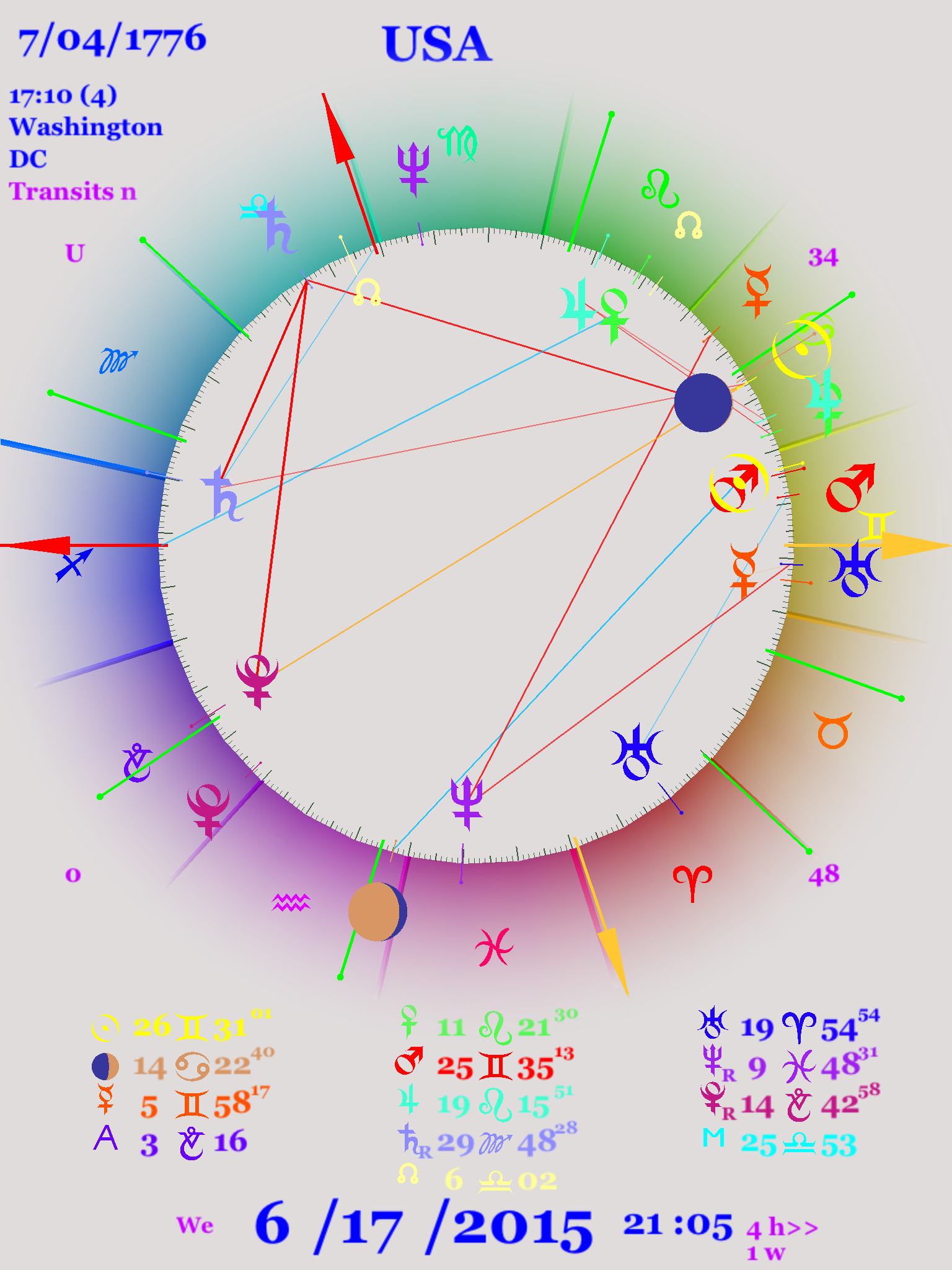
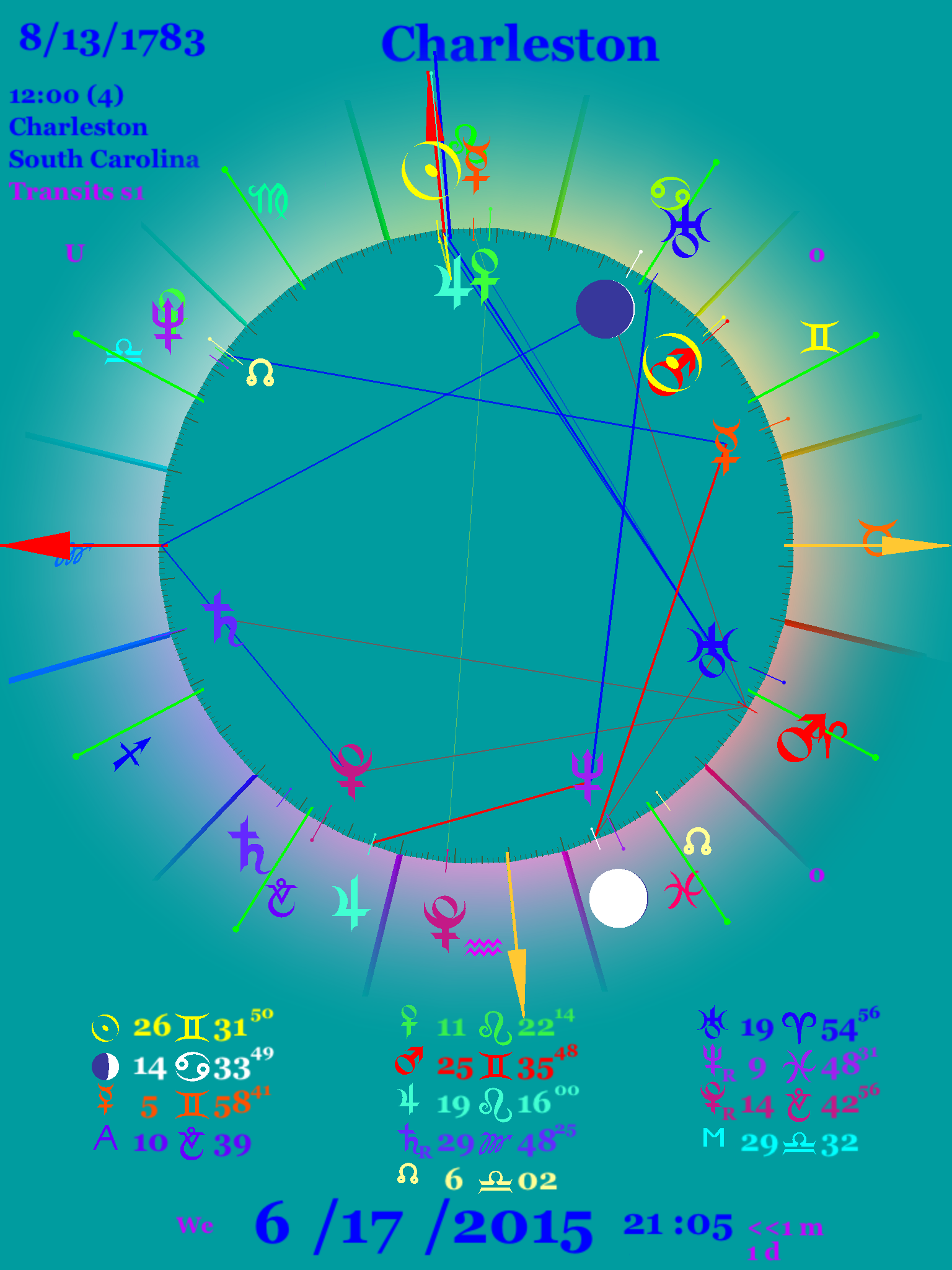
Some of the same conditions we mentioned previously when talking about the Summer Solstice chart also apply to this event, which took place just four days earlier.  The Sun was conjunct Mars and Saturn in hard aspect to Pluto, both signs of potential violence.  Neptune makes hard aspects to both Mercury and Uranus of the US (see below)  which suggest the initial confusion about the incident.  But in addition to the hard aspect between the transiting Saturn and the transiting Pluto, both make  hard aspects to the natal US Saturn, accentuating the Saturn Pluto difficulties.
charl_charl3

Massacre in Charleston

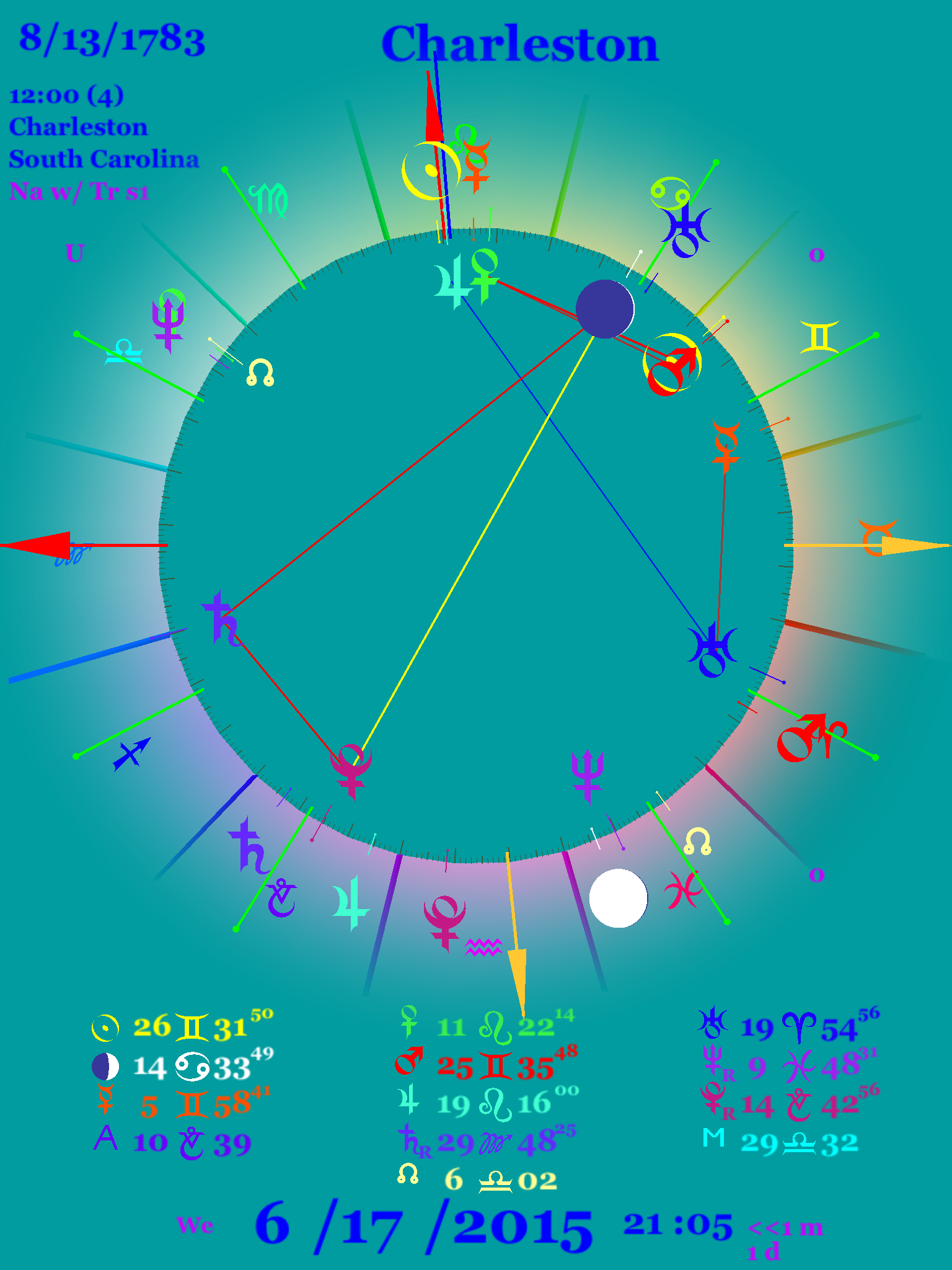
In  the chart of transits to the Charleston natal, we notice immediately that Jupiter is at the MC.  Amongst the outcomes of this shooting was country-wide talk about the confederate flag and its meaning, and the lowering of that flag from the grounds of the State Capitol of South Carolina.  Transiting Saturn and Pluto make hard aspects to the Charleston Mars, reiterating the possibility of violence.
charl_charltr

Massacr ib Charleston

But look at the current  transits  within this cart.  We see that transiting Moon is tightly opposite Pluto and makes a sesquiquadrate to Saturn.  While we don’t know how long the shooting lasted, it was certainly several minutes after the given time.  The opposition between the fast-moving Moon and Pluto was so tight that  it became exact in 17 minutes, at 9:22 that evening, and this opposition was loosely on the natal Uranus of Charleston.

Another incident of a terrorist incident at a church occurred in 1963, at the 16th Street Baptist Church in Birmingham, Alabama.  In this case, members of the Ku Klux Klan blew up a church with dynamite.  The bombing was set to go off when church service was happening on a Sunday, and as a result four teenage girls were killed.  Even though soon after it was  known who did the bombing, no prosecutions happened until 1977.  Supposedly the intent of the bombing was to intimate the people in the Civil Rights Movement in the Southern United States, but if that was the purpose it went completely wrong and the Movement was strengthened and one result was the passage of the Civil Rights Act of 1964.
bir_bomb_usa1

Bombing in Birmingham

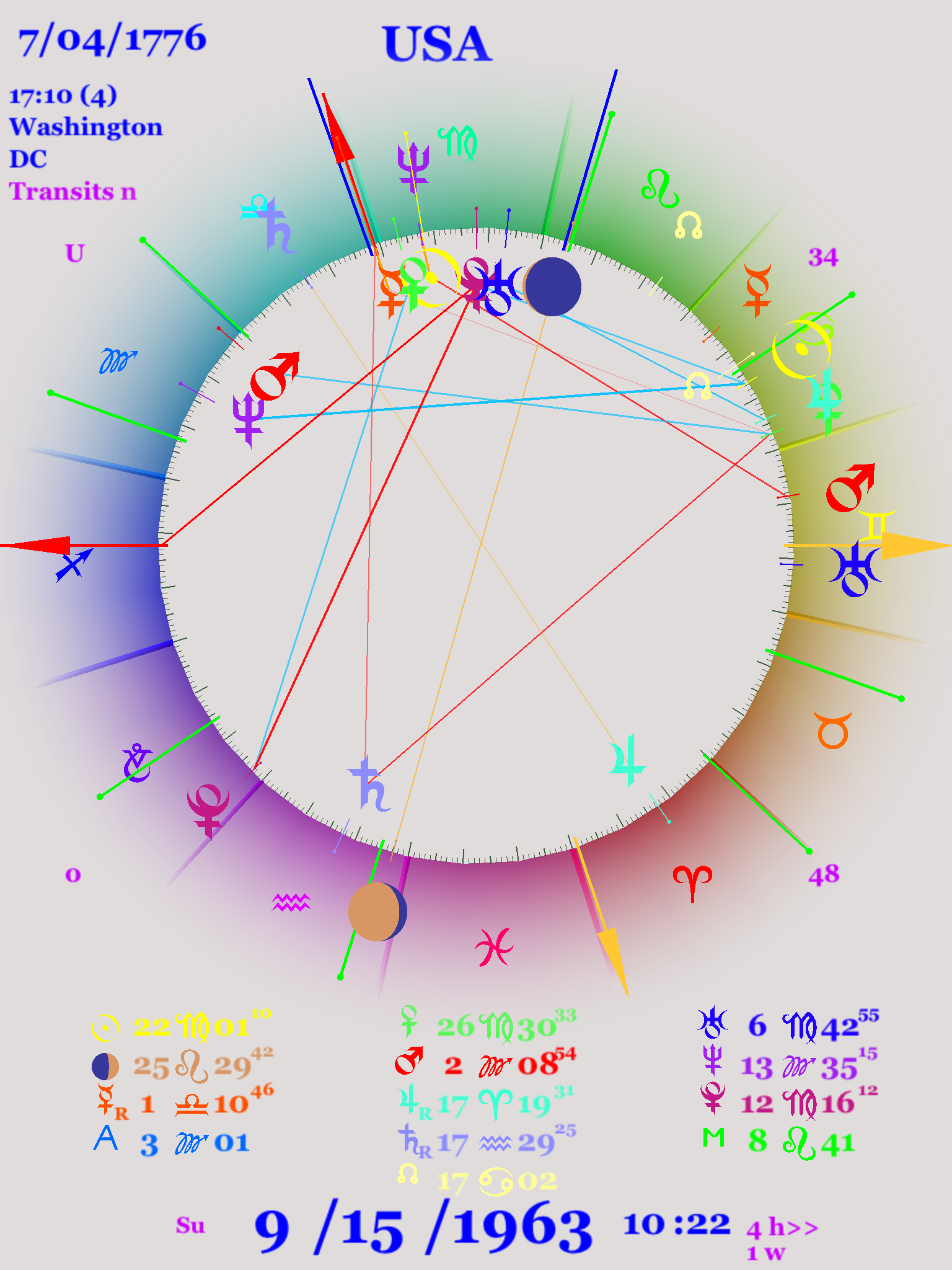
The first thing I notice in the transits for the time of the bombing — which is exact — to the US natal chart is that transiting Mercury is  on the US  MC — this event was communicated to the whole world and had (unexpected by the perpetrators) many repercussions.  The Uranus Pluto conjunction of the Sixties is just forming, the decade is just under way.  Pluto is sexquiquadrate the natal Pluto, emphasising the unfortunate consequences of the US natal Pluto, which has been often explored here.  Transiting Moon is opposite the natal Moon, significant because of the exact time,  indicating that the people of the US were effected  by this event.  Finally, transiting Saturn is sesquiqadrate the Midheaven and natal Venus.  There was much worry expressed at the time that this event would reflect badly on the US in its cold-war rivalry with the Soviet Union.

bir_bomb_birm

Birmingham Church Bombing

In the transits to the Birmingham chart, transiting Mars is square natal Mars, suggesting the violence of this act. Mercury is square the MC — news of this event was quickly spread — but Neptune is semisquare the MC, and as indicated it took over a decade for convictions in  this case, something was causing illusions of who was the guilty party.

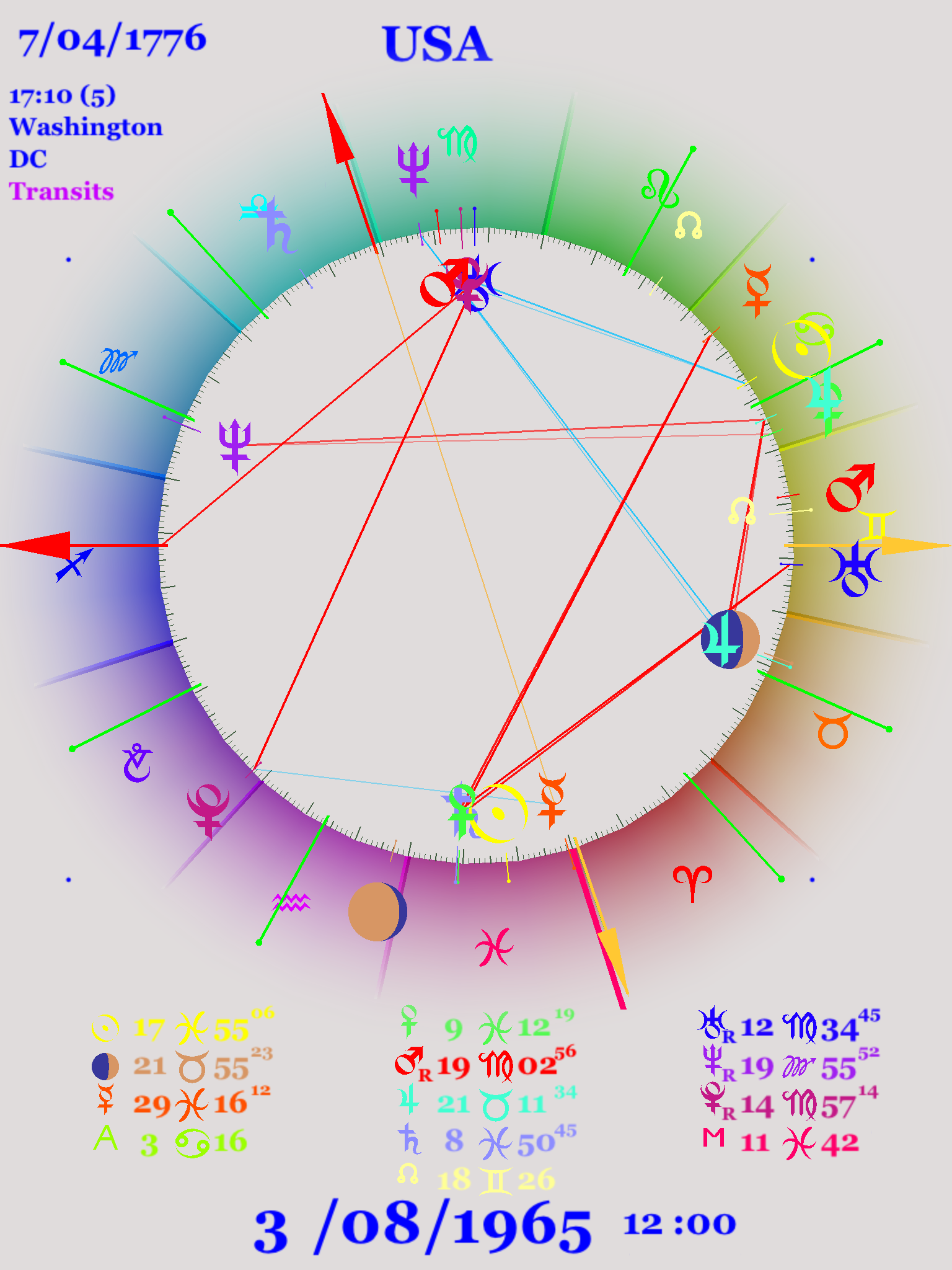
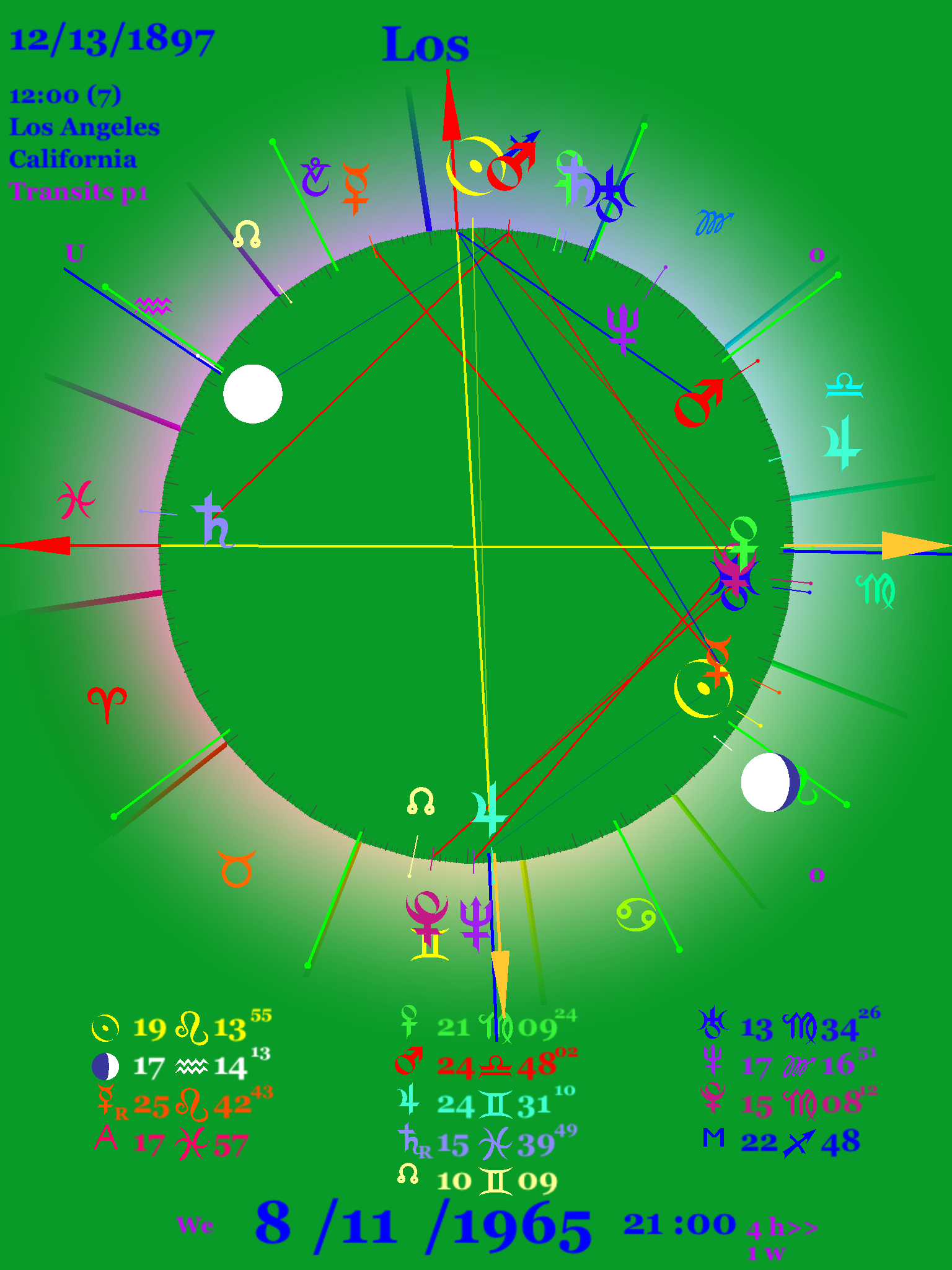
The third incident was the Watts Riot of 1965, thought by many to be a rebellion.  Summers of the decade of the Nineteen Sixties saw many riots in Black communities around the country, and one of the best known, but not the first, happened in the Watts section of Los Angeles , California.  It started on the evening of August 11, 1965  and spread over most of the following week.  A drunken motorist, only  21, was stopped in his mother’s Buick by a white Highway Patrol officer and the arrest got  out of hand. Fires and looting continued for several days.  The black citizens of Los Angeles suffered from unemployment, and later the police were found to be guilty of racism to minority citizens.  This does not sound very different from current situations that are inflaming people around the country, and the news reports on a daily basic.  This riot was well covered by the news media since in occurred in a major media center of the country.
watts_usa

Watts Riot

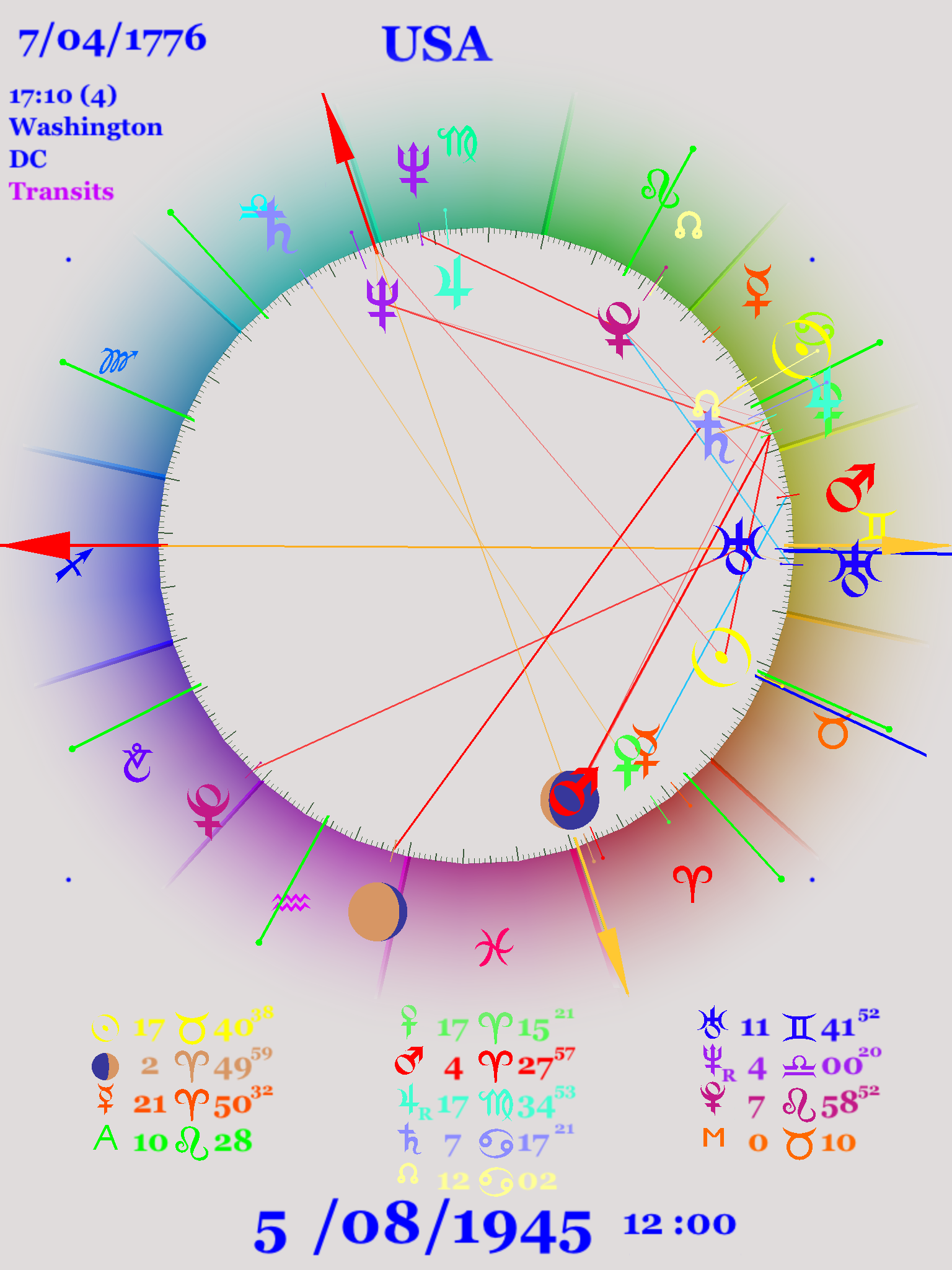
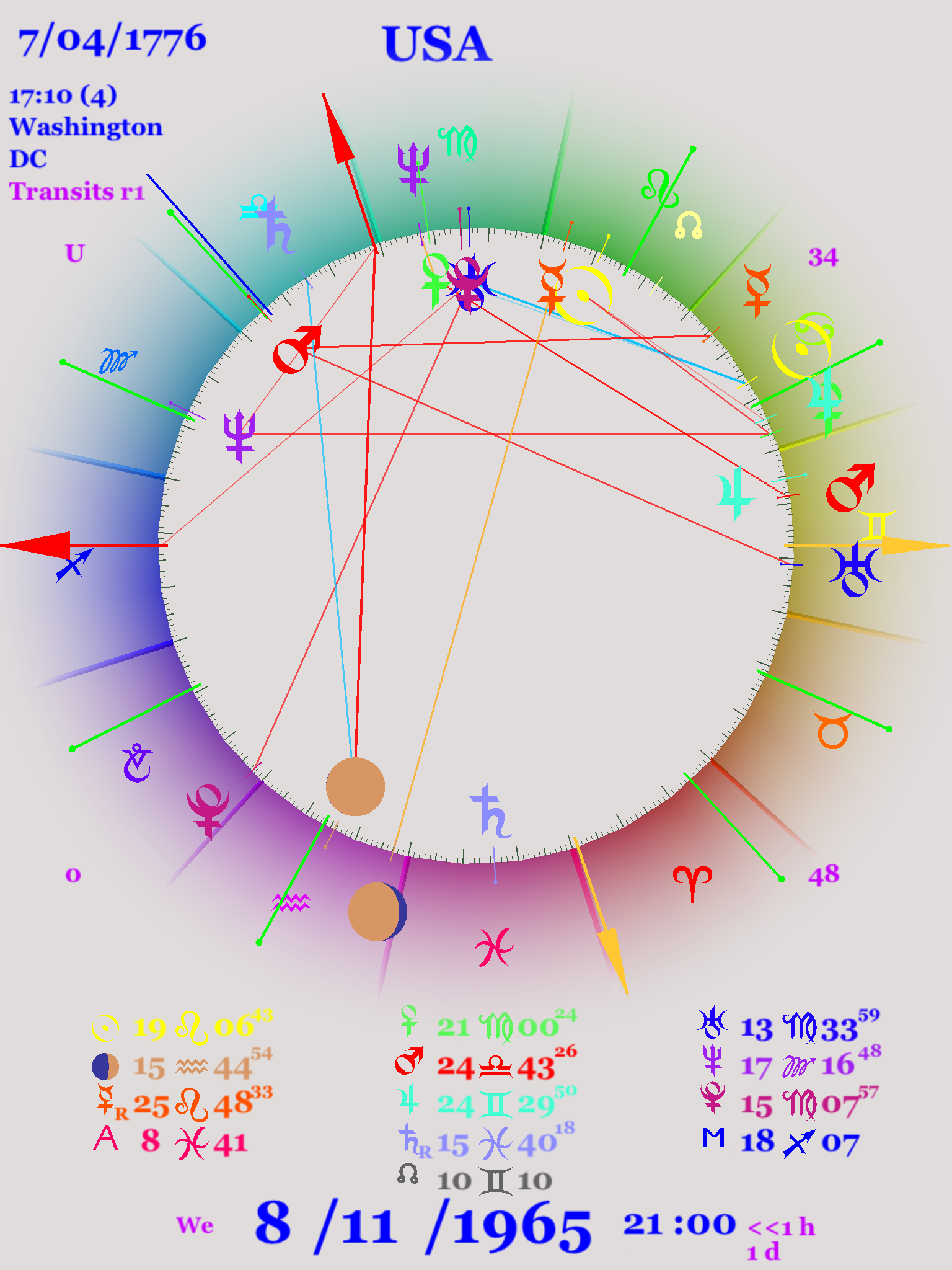
In the chart of the US  for the time of the Watts riot, the first aspect to notice is the tight conjunction of Uranus and Pluto.  The event did occur in the Sixties, and the significator of the Sixties is clear since this was the time of the  exact conjunction of 1964 and 1965.  The transiting Mercury is opposite the Moon, and this indicates that this crises was communicated to the people of the US. But most important is Mars, planet of violence.  It squares Mercury  (communications again) and sesquiquadrates Uranus.  Mars-Uranus hard aspects are notorious for unexpected violence.  But this position of Mars also accentuates the tight natal Uranus-Mercury semisquare, which is fundamental in the self image of the United States.   Perhaps the rioters at Watts were  angry that this promise of the US as suggested by this natal aspect was not given to them.  We also saw this in  the Charleston massacre to US chart above.
watts_la

Watts Rebellion

In  the chart for this Event in the Los Angles chart, we see Venus — peace — setting on the Descendant of the LA chart, and Jupiter — fortune — at the lowest point in the chart, the IC, and thus opposite the Midheaven.  Both peace and fortune were sadly missing from the Watts riot.  Transiting Mercury is sesquiquadrate the naatal Mercury, communication again, and transiting Saturn was square the natal Mars — frustration, difficulties in expression of energy.

The Fifties

The Fifties are an unfortunate decade, located between the Forties, which is known for World War II, and the Sixties, which is known for the Sixties.  The Fifties is almost the decade that time forgot.  Even people who were adult then are called the forgotten generation, too young to serve in World War II, they served in the Korean War, which is also pretty much forgotten, not nearly as notorious as was the Vietnam War, that, naturally, occurred in the Sixties.

But of course the decade of the Nineteen Fifties is just as important as any other time, and perhaps more so since it set the ground for what was to come after, and that includes now.  A book  has been written about this decade, called The Fifties, but David Halberstam, who also wrote a definite book about the Vietnam War.

The decade was dominated by one aspect, the closing square between Uranus and Neptune; the conjunction of the two, and thus the culmination of the cycle that started in 1820, was in the 1990s.

ursqr54

Uranus Square Neptune

There are several meanings that can be attached  to this square, and most of them involve the word “drugs” because Neptune is part of the aspect, but not always “drugs” as commonly thought of.

The Fifties was the decade for the introduction of the first, very popular tranquilizer drug called Miltown, whose scientific name was meprobamate.  This was an anti-anxiety drug that became very popular with bored housewives (eg. Betty Friedan The Feminine Mystique) and business  executives.  This started the psychoactive drug craze — treat mental problems with drugs not counseling — that led to Valium and Prozac in later years.  This decade also saw the publication of the first DSM – –Diagnostic and Statistical Manual of Mental Disorders — that prescribed all sorts of drugs for what ailed you in the psychological realm.  It was a bible for psychiatrists. Ever since that point — the Fifties — drugs have been prescribed more and more for more and more conditions, many of which did not exist when the first DSM came out.  Some psychiatrists have worried that the use of these drugs make the underlying conditions worse,  see for example, the book Anatomy of an Epidemic by Robert Whitaker.

Another activity that also became addictive was one that first became important to the world under the Uranus-Neptune opposition of the first decade of the Twentieth Century, and that was driving.  The Interstate Highway system was built, spanning the United States.  This  allowed people to drive coast to coast much more easily than in the days of Route 66.  It now became a tradition in many families for the males to go inspect the new model cars when they were introduced every year like clockwork, with major changes happening every three years.  American car manufacturers, especially General Motors, became huge industries, and the head of GM was even in the Eisenhower administration.   American families would  get a new car often — it was a point of pride — and automobiles played a part in many American movies.  A teenager — a concept that became important in the Fifties — was expected to learn to drive early and get his (more often that her) own car, it was a sign of adulthood.

ursqrne56

Electronic Drug

But the most important drug of this decades, what I call an electronic  drug, was television. Halberstam, in the book mention above, discusses the important place television held in American life in the Fifties.  While television had existed before the decade began, through the decade it became more and more popular.  In 1950 relatively few people owned television sets, and crowds were often found around store windows that displayed sets whenever an important show was on, while by the end of the decade many, many people owned television sets, so that it made sense to have the first televised debate between Presidential candidate John Kennedy and Richard Nixon in 1960.  The powerful effect of television was shown by the fact that listeners to the debate on radio thought that Nixon had won, where viewers of the debate on television were convinced that the handsome Kennedy had won over the recovering-from-illness Nixon.

There was another reference to drugs during this decade in a more conventional sense.

In the early Fifties the Beat poet and novelist  William Burroughs went to South America to explore the psychedelic substance known as yage or ayahuasca.  The active component of this substance is DMT — dimethyltryptamine — which later became popular in the Sixties –the band known as the Grateful Dead is rumoured  to have come up with their name while on a DMT trip — and is found in the common road side plant known as reed canary grass.  Burroughs wrote a series of letters to the then unknown poet Allen Ginsberg  describing his experience.  The book was finally published in another ten years.  But this was one one the first accounts of a Western writer exploring mind-altering substances in a third world country.

Later that decade the ethnomycologists and vice president of the investment bank J. P. Morgan  R. Gordon Wasson explored “magic mushroons” in Mexico.  He was married to a Russian woman, and the Russians have always been interested in mushrooms, hence his interest.  He discovered a dying cult in Mexico that use psilocybin mushrooms to  alter their state of consciousness.  These mushrooms would also become popular in the next decade, after he rescued them from obscurity.  He  published an article in Life magazine in May of 1957 called “Seeking the Magic Mushroom” that brought the mushroom to world attention, and a few years  later a popular TV show — television now being available for the masses — called One Step Beyond devoted  an episode to the mushrooms.

Then in 1959 a graduate student in creative writing at Stanford University in the Bay Area of California took part in government experiments with psychedelic drugs such as LSD.  The student, who later became a well-known writer, was Ken Kesey, and his  experiments with drugs later led to many developments of the Sixties counter culture and the famous Acid Tests and a group called the Merry Pranksters, who drove a acid-fueled bus across  the United States, as recounted  most famously in Tom Wolfe’s Electric Kool-Aid Acid Test.

But the experiments that Kesey was taking part were sponsored by the  CIA – Central Intelligence Agency — as part of their program called MKULTRA.  MKULTRA was run mostly in the Fifties, and was  finally revealed in the aftermath of the Watergate  crisis in the United States.  It was a  program designed to look at various ways of controlling the human mind, with implications for interrogation.  Various drugs were explored, the most interesting of which was LSD.  Among other things done with this drug, in one experiment prostitutes were instructed to give their customers a liquid dosed with LSD while CIA agents watched their reaction.  Army members were given LSD without their knowledge.  In one case a Canadian jumped from a high building under the influence of MKULTRA-supplied LSD.  The experiments at  Stanford that Kesey took part in were part of this program.

But the CIA was formed by the National Security Act of 1947  (which also renamed the accurately-named  War Department as the Department of Defense)  as  a combination of the OSS (Office of Strategic Services)  and the German intelligence organization during World War  II as headed by Reinhard Gehlen, who was charged with spying on the Soviet Union during the emerging Cold War.  So one can see a trail between the Nazis and the Merry Pranksters.

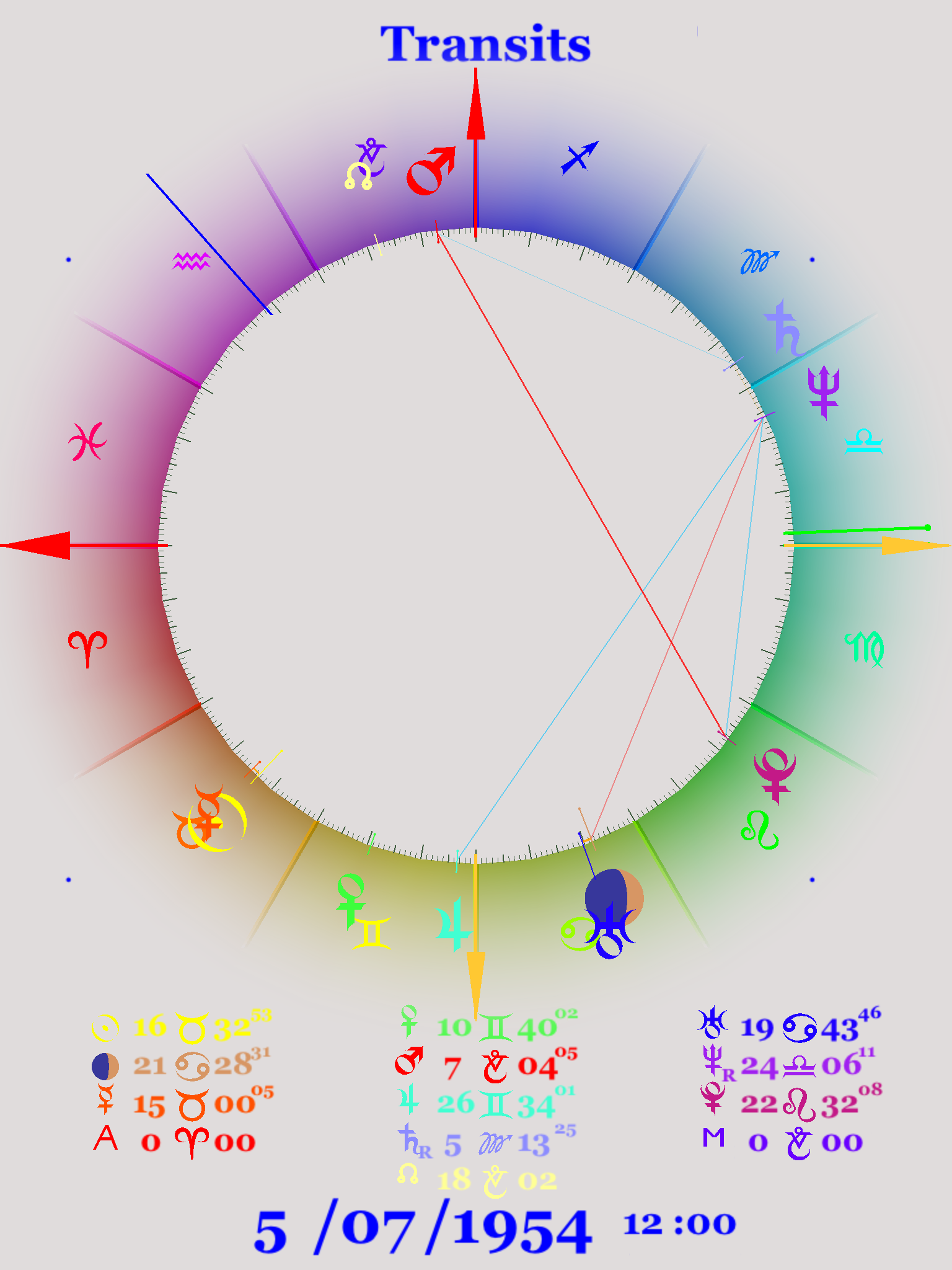
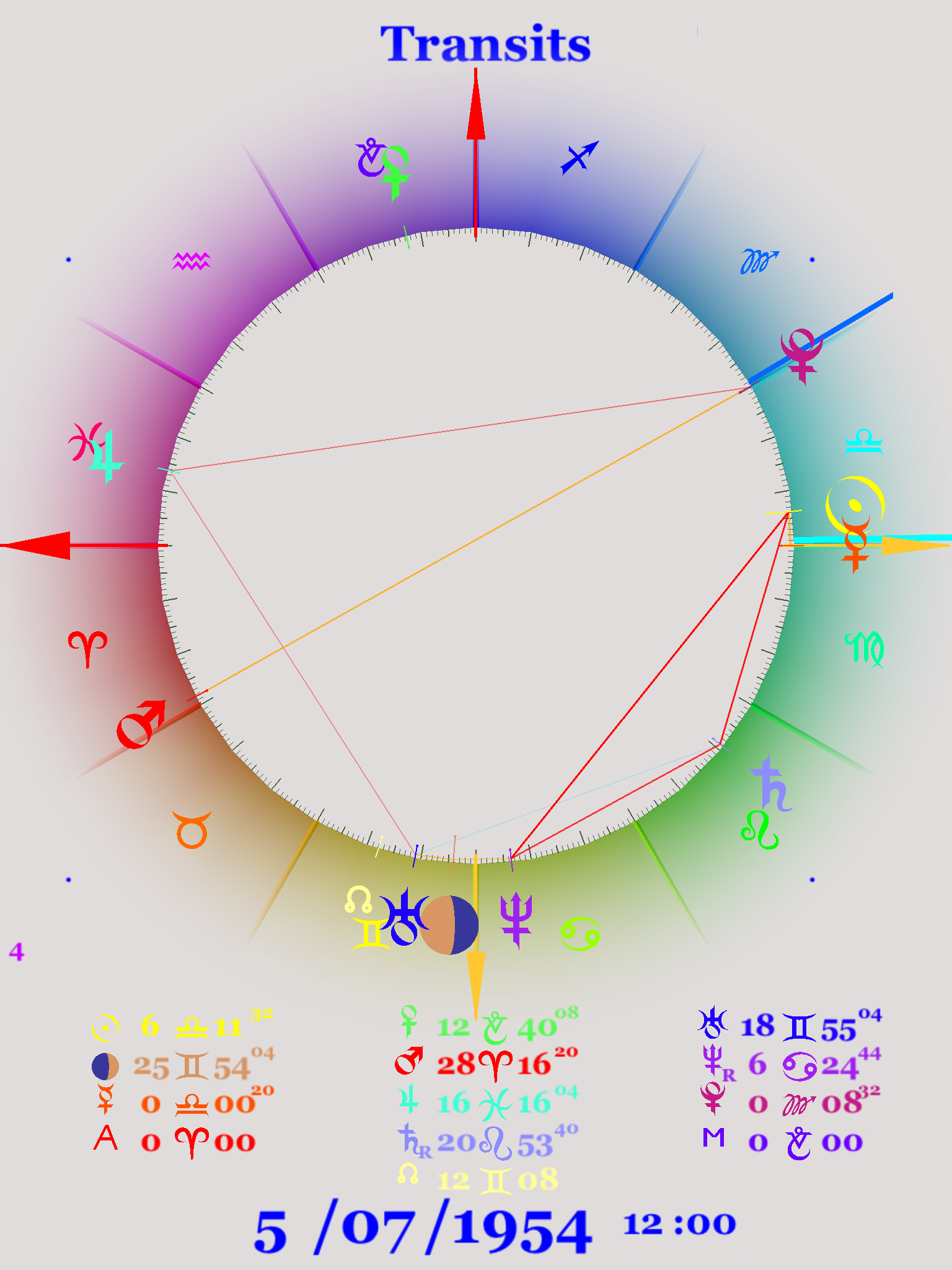
These two charts above show the first and last exact square of Uranus and Neptune during this decade.  But there was one other important transit during this decade that shows why the effects noted were so strong in the United States.  For that country, this decade also saw the transiting Pluto opposite the Moon. This transit only happens once every 250 years, and so this transit had never happened  before in the history of the country.  There was a conjunction in the early days of the  United States, the decade of the 1790s, and that had to do with the formation of the first political parties, among other things, and  will be discussed at a later date.  Since the Moon represents the people of the country, as opposed to the government, it was in  this transit that the people of the country that were most affected.  Again, the Halberstam book  mentioned above details this connection.  During this decade citizens went from being those who would  catch Your Show of Shows at the house of someone who had a television set to citizens who stayed home Monday nights to watch I Love Lucy.  The next chart shows one instance of this opposition, but since  Pluto is a slow moving planet, this transit and its effects lasted for many  years.

ploppmo_usa

Pluto Opposite US Moon

This graphical ephemeris show the ten year period of the Fifties and  gives an overview of the astrological influences  discussed.  We can see the square approaches exact (black arrow)  and leaves exact (red arrow) over a period of years.  For a square I would give an orb  of three degrees before and after exactitude.  To  give  you a sense of this, each gray or white band in the graphical ephemeris represents 7.5  degrees.  The only natal planet illustrated is the US Moon, so you can see where the conjunction with Pluto takes place (green arrow).  With the orb I give for an opposition of six degrees, you can see that this  opposition lasts for much of the decade.

fifties_tg

The Fifties

World War Two

World War Two is one of the major events of the Twentieth Century.  The official date for the start of this war is September 1, 1939 when Hitler invaded Poland.  But many events occurred before that date that could be considered part of World War II.  Some of these events are discussed below.

ww2starts

Germany Invades Poland

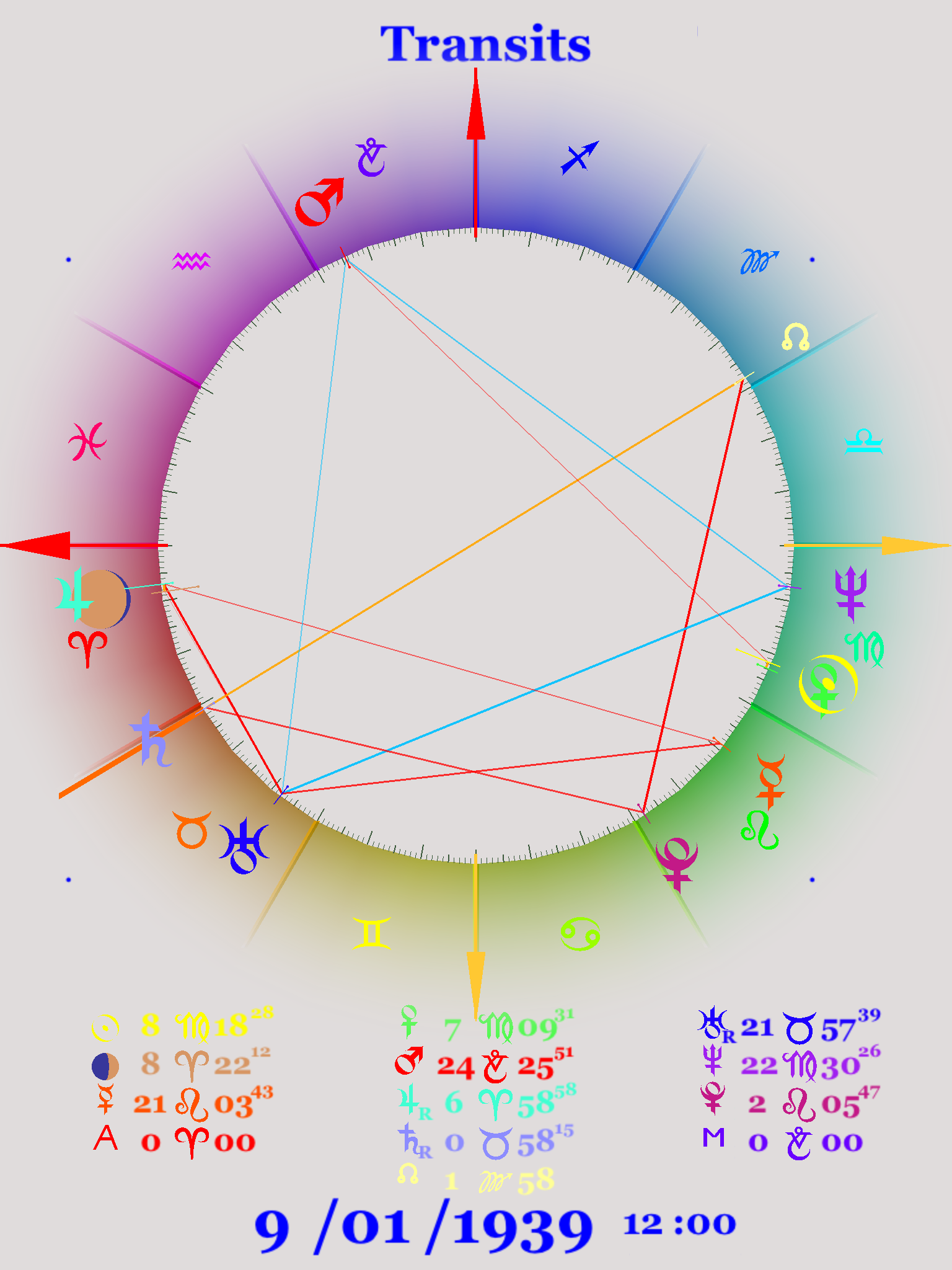
In the chart for the start of World War Two, when Germany invaded Poland,  we see the typical Saturn square Pluto.  Saturn is opposite the North Node of the Moon, and thus conjunct the South Node, suggesting that this conflict will involve the whole world. Uranus is closely trine Neptune, and this is the aspect that will color the whole period of the war, as we will see below.  It is shown most clearly in the graphical ephemeris discussed at the end.

The war involved  countries on both sides of the world, namely Germany and Japan.  Germany had only been its own country a little more than 60 years, and Japan had  begun to adopt Western methods  about the same time.  Germany had already been involved in the First World War (as had been Japan), and Japan had been involved in a war with Russia at the beginning of the Twentieth Century.   Both wanted to expand their power.

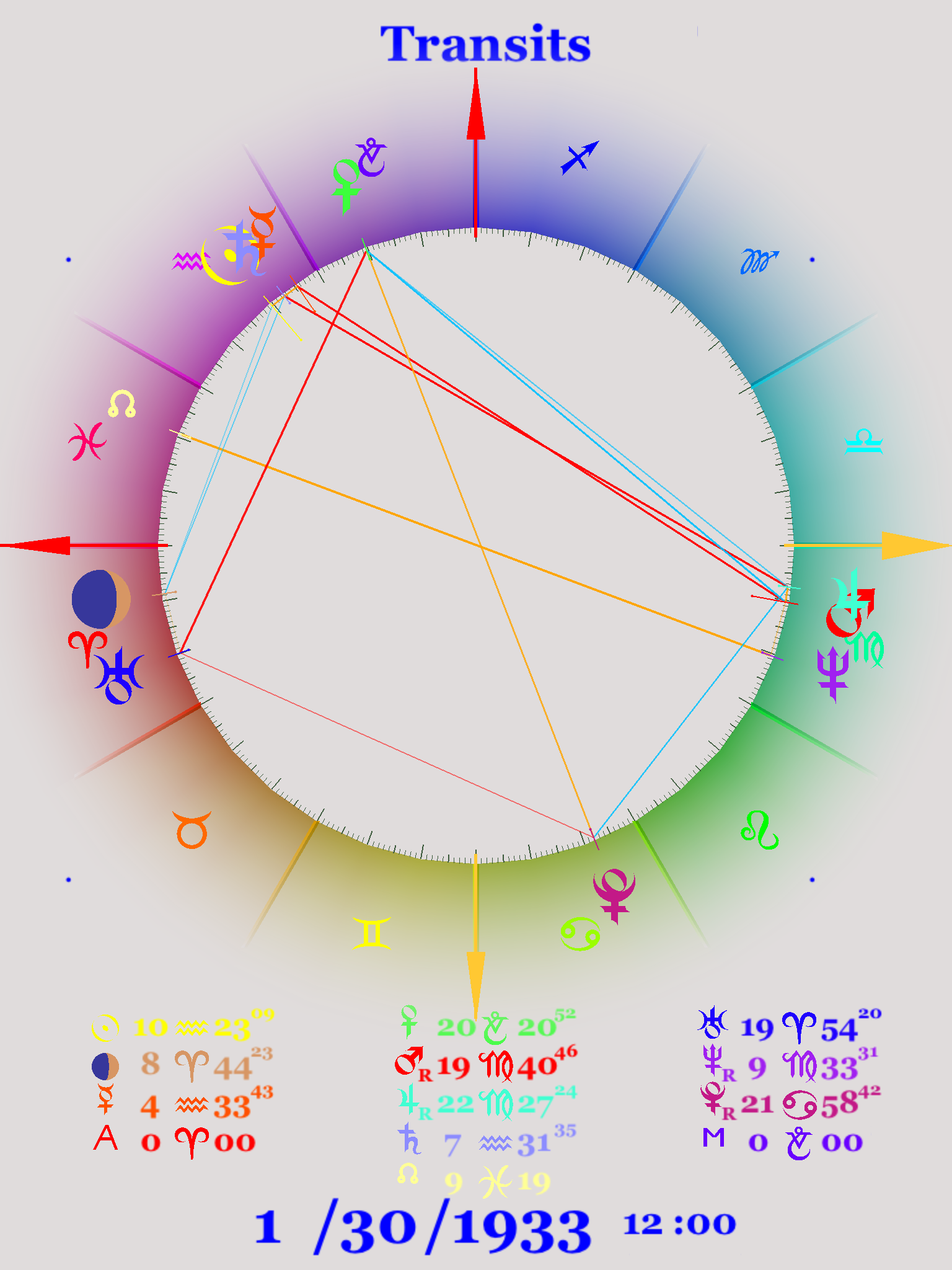
Germany had been a democracy since the end of World War One, but at the beginning of 1933 a soldier from World War I became Chancellor of Germany, and after that things began to change.  In the chart of his assumption of power we see Uranus square Pluto.  This can indicate revolutionary activity, as was the case in  the Depression-era US, but Hitler’s rise to power was also  revolutionary in its own way.

hitler_chan

Hitler Assumes Power

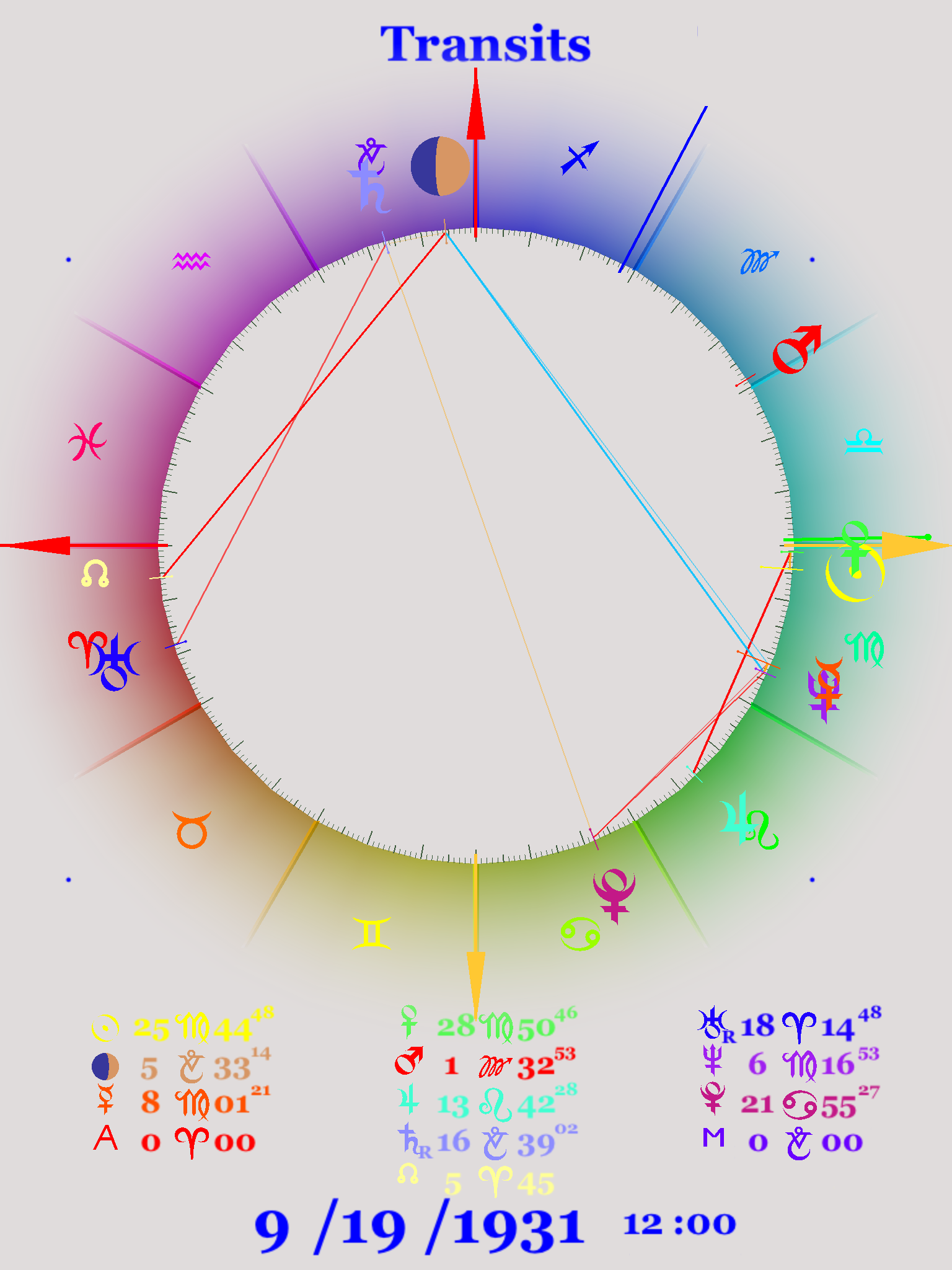
The Japanese were also on the move long before the Second World War officially started.  They had learned from the Chinese that you do not want to be ruled by Western powers, and so they weren’t, but they had desires on  that mainland continent.  In  1931 they invaded the Chinese province of Manchuria and took control.  Here is  the chart for that invasion.  Neptune is semisquare Pluto, the same aspect as we saw in the Depression and indeed this invasion was taking place at the same time as the Great Depression and much of the world was focussed on other things.  At the same time Saturn was square Uranus — this often indicates a conflict between the forces of conservatism and more radical ideas, but of course that can play out on many levels.

jap_inv_man

Japan Invades Manchuria

The Japanese did not treat the Chinese well, and one of the most notorious incidents was called the Rape of Nanking.  In this incident, which started on December 13, 1937  and extended into the next year, the Nazis were the good guys.  At one time during this incident the German embassy in Nanking served as a refuge to the Chinese that were being persecuted by the Japanese.  A good study of this is The Rape of Nanking by Iris Murdock.  In the chart for the start of this event the first thing we notice is that Saturn is at the Aries point, and it will get closer over the next few weeks.  Planets at the Aries point have world wide implications.  The rest of the world was fairly Saturnian at this time  and in China things were about to become even more so. Pluto is opposite Jupiter, and both aspect that Saturn on the Aries point.  Jupiter-Pluto can be seen as a whole lot of Pluto, and  in this case Pluto indicated dark forces that suddenly came into play.  Pluto had been discovered a few years ago, and is said to rule, among other things, the dark conditions around the world in the Thirties.

rape_nak

Rape of Nanking

In Europe, Hitler was not the only fascist — defined originally in an Italian encyclopedia as corporatism — to take power.  In Italy there was  Benito Mussolini, and in Spain the was Francisco Franco, who managed to rule Spain until his death in 975, although he had relinquished some power in the years up to his death.  But Franco was involved in a lead up to the Second Word War called the Spanish Civil War, which lasted from 1936 to 1939.  The Spanish Civil War is seen as a “test-run” for the official war to come, and many “premature antifascists” from Western countries went to Spain to fight against the fascists  whom  the rest of the world either ignored or thought would defeat the Communists.  At one time Harry Truman, who would eventually become President of the United States, declared that if the Fascist were wining we should support the Communists, and if the Communists were winning we should support the Fascists.  Such an attitude did  not endear him to Stalin.  A recent book about the Spanish Civil War and  the well-known people who were there, such as Ernest Hemingway, is Hell and  Good Company by Richard Rhodes.  A group of people from America under the name “Abraham Lincoln Brigade” fought in the war, since they realized that a victory for Franco (backed by Hitler and Mussolini) would bode badly for the future of the world, and they were correct.

spcivwar_start

Spanish Civil War Starts

In the chart for the start of this civil war, we see that again Pluto raises its ugly head, with Sun conjunct Pluto on that day.  Pluto is also widely trine Saturn, another  example of the problems with Saturn/Pluto,  and Mars is approaching a conjunction with Pluto which would only get tighter.  The well-known painting by  the Spanish artist Pablo Picasso, Guernica,  depicts the horror seen during this war. In this massacre, the German air force bombed  a town in the Basque  region of Spain, killing and terrifying many defenseless civilians.

spancivwar_end

Spanish Civil War Ends

The chart for the end of the Spanish Civil War looks completely different.  The only aspect lasting more that a few hours is the Jupiter opposite Neptune.  For these  two planets Ebertin says “apparent happiness”.  There was a happiness because the war had ended, but as we know with hindsight, the big War was about to start, rendering any happiness as only temporary.

ww2_tg10

The Ten Years of World War Two

In this graphical ephemeris overview of the years of the Second World War, we see the prominent aspect is the Uranus-Neptune trine.  Since  this a  third harmonic graphical ephemeris, this aspect looks like a conjunction, with the lines moving in and out of orb.  It slowly came into orb in the middle of the decade of the Thirties, and was first exact in the summer of 1939.  It continued to be exact through 1944 and then started to widen in 1945, just as  the war was drawing to a close.

This graphical ephemeris represents the ten year period from about October 1935 to the end of September 1945.  Some important events are marked on the graph:  the black arrow just to the left of the center line is the official start of the war with Hitler’s invasion of Poland on September 1, 1939.  You  can see that the  trine first became exact just before that time, which is hidden by the white arrow.  The Rape of Nanking is indicated by the green arrow.  The Spanish Civil War extends from the blue arrow to the white arrow.  The German forces invaded  Rhineland at the yellow arrow and invaded the Sudetenland at the  azure arrow.  The Pearl Harbor attack, which was followed closely by the American decision to enter the war, is shown by the brown arrow.  The Battle of Midway, which was a decisive moment in the Pacific War, is indicated  by the dark blue arrow.  The D-Day Battle, June 6, 1944, is shown by the dark green arrow, and was discussed previously.  Finally, the surrender of Germany is indicated by the red arrow to the far right of the graph.  The bombing of Japan at Hiroshima  will be discussed at a later point.

veday

Victory In Europe

In the chart for Victory in Europe — VE – Day, when Germany surrendered, we see Sun trine Jupiter.  Great luck, as can be seen  by photo of the crowds in America reacting to the news.  In the same chart, but as transits to the US  chart, Saturn is conjunct the US Sun and  sesquiquadrate the US  Moon.  What should have been a happy event seems to be tinged with a Saturninan sadness, and in fact President Roosevelt, who had been in that position for over ten years, had died less  than a month previously.

veday_usa

VE Day in the USA

Four Dead in Ohio

We have just seen a couple of more anniversaries in the preceding week, and they are both related.  It all started out in the Nineteenth Century.  Britain showed that the way to be a world  power was  to have colonies in countries that were not European.  For Britain the most notable example was India.  So other European powers thought they needed some colonies of their own — there was still plenty of the world left that Britain had not grabbed, especially in Africa and Asia.  So France captured the countries of Southeast Asia now known as Vietnam, Laos, Cambodia — the region known as Indochina since it is between India and China.  This happened starting in 1887.

The natives of Indochina were not happy with this arrangement, but the colonies endured.  But at the beginning of World War Two, France  fell to the  Germans and it was either occupied by Germany or else the Vichy government controlled part of France, and the Japanese occupied Vietnam.  Shortly before the Japanese attacked Pearl Harbor, an organization called the Viet Minh was formed in Vietnam to fight the Japanese occupation of the country.  The Viet Minh were led by someone who would become well known later in the United States by the name of Ho Chi Minh.  Part of his desire for freedom was based on that founding document of the United States, the Declaration of Independence.  At that time he still though of the United States as a bastion of freedom.  When the Japanese were defeated, he declared Vietnam a free country, but the French, also liberated, but from Germany, decided to regain control of Vietnam.

Since the French had suffered through the Second World War, they did not have the resources to support a war in Indochina (even with money from the US Marshall Plan), so a majority of the money they needed to battle the Viet Minh  was supplied by the United States under the Presidency of Harry Truman.  The final battle of that  first Indochina War was at Dien Bien Phu where the French were surrounded by the Viet Minh.  The United States considered supplying nuclear bombs to defeat the Viet Minh, but fortunately that was  never acted upon since the French soldiers and the Viet Minh were in such close proximity that the French would also have been killed if nuclear weapons had been used.  The Viet Minh overran the French position and that was the end of French colonial ambitions in Vietnam.

dienbienphu2

Battle of Dien Bien Phu

dienbienphu

Dien Bien Phu Fourth Harmonic

Here   is a chart for the fall of Dien Bien Phu to the Viet Minh.  Mars is sesquiquadrat Pluto –explosive violence — and this battle is still important.  In fact, one of the best correspondents of that war, before he died in 1967, was Bernard Fall, and his  history of this battle is called Hell in a Very Small Place.  In the fourth harmonic chart of the same event, we see Saturn half way between the Sun and Neptune — delusions come to a sorry end.

firstusdeath

First US Death in Vietnam

And to show that the United States has been involved in Vietnam for a long time, here is  a chart for the first American killed in Vietnam.  The man killed was a U.S. Army  officer serving with the OSS (Office of Strategic Services — the forerunner of the CIA) and killed  by the Viet Minh, who thought he was French.  In this chart of  the death of the first US soldier in Vietnam — the first of many — transiting Mars is conjunct the  transiting Node (we will see this same configuration at about the same place later in the Gulf of Tonkin Resolution)  and near the Sun of the US  — the country would be involved here for the next 30 years, but that was not suspected at the time.

Emperor Bao Dai (backed  by the French from 1949) was granted control of the Southern part of the country.  A peace agreement was signed in 1954, allowing the withdrawal of the French, with an election to be  held, and the country was temporarily divided at the 17th line of latitude.  Dwight Eisenhower, the President of the United States, thought that Ho Chi Minh would easily win that election.  But the elections were never held, the United States decided to support Bao Dai in the southern part of Vietnam as an anticommunist bulwark against the North.  This was the height of the Cold War, and any threat from the Communists was threat to the  “Free World”.  After all, the United States had recently “lost” China and they were not about to allow that to happen again to Vietnam.

In 1955, the Catholic Ngo Ninh Diem defeated Bao Dia in an election (probably rigged) to become president of South Vietnam.  He ruled a majority Buddhist country and there were continual protests by Buddhists of his discrimination against them, eventually reaching the level of self-immolation.

The United States first began to send troops to Vietnam after the Gulf of Tonkin Resolution was passed by the US Congress.  This was in response to an incident where the North Vietnam fired on a US Cruiser, though  facts about that incident since then have cast doubt on the action, but it was one of many acts that were used to get a nation into war.

gulftonkin

Gulf of Tonkin Resolution

In the chart for the Gulf  of Tonkin resolution there is a tight  Uranus Pluto conjunction, with Mercury there as well.  This action determined much hat was to transpire in the upcoming years and affect the lives of many, many Americans.  Transiting Mars is conjoined transiting North Node (as we saw in the death of the first US soldier), suggesting again that this violence will touch many lives.

firsttroops

First US Troops to Vietnam

In the chart for the arrival of the first troops that were promised by that Resolution, we see the same Uranus Pluto conjunction, but this time joined with Mars — gunfire — instead of Mercury. The same Moon-Jupiter conjunction seen in the Gulf of Tonkin chart is here again.  Many Americans were so optimistic that this would  work out well!

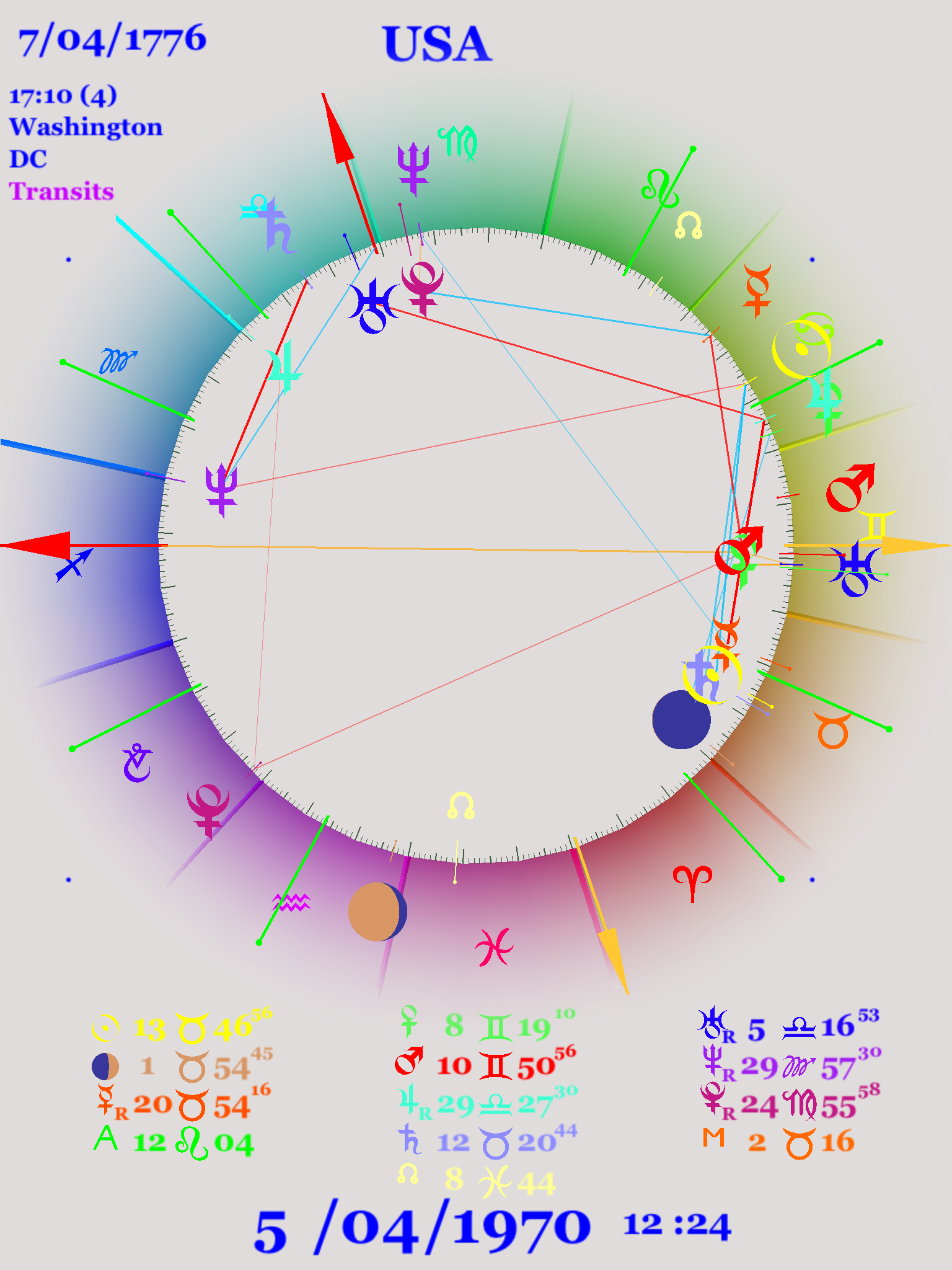
The United States continued to send troops to Vietnam during the Sixties, resulting in wide-spread protest in this country against that.  At that time there  was a draft in the US and all young males had  to appear for a draft physical.  Student deferments while being in college were popular, and upon leaving college ex-students found  themselves receiving draft notifications, which resulted in widespread draft card burnings.  After Johnson resigned  Richard Nixon was elected in 1968 to continue the Vietnam War.  On April 30,  1970 — a date that is celebrated as an anniversary but not for the 1970 decision–  Nixon announced an “incursion” into Cambodia and the college campuses erupted in protest.  On May 4  National Guardsmen at the campus of Kent State in Ohio killed four students and wounded nine others.  More protest and students strikes spread across campuses  in the country, involving even students who  had not protested  the war.   People in Ohio heavily backed the National Guardsmen.  Less than three weeks  later the song “Ohio” was written by Neil Young and recorded by the then “super-group” Crosby, Stills, Nash, and Young, with the haunting line: “Four Dead in Ohio”.  It was released the next month and became an anthem.

kentstate1

Four Dead in Ohio

kentstate4

Kent State Fourth Harmonic

In the event chart for the Kent State shooting, we see that it is just before the New Moon  (about one day)  and the Moon was on the MC at the time of the shooting — it was a very public shooting and the whole world was aware of it.  Saturn is conjunct the Sun, speaking of the depression that resulted, at least among some people.  Jupiter is at the lowest point, opposite the MC, and luck  was certainly not present in this incident — “What if you knew her and found her dead on the ground .”  Pluto is semisquare the Ascendant  and occupies the same relative position that it does in the US chart.   The  fourth harmonic version of this event chart allows us to see the aspects more easily.  In the chart for the event on  the US chart, we see that the midpoint of Uranus and Pluto is the MC of the US and Mars is on  the Descendant  — this was a martial event — “Tin soldiers and Nixon coming … Soldiers are cutting us down”.

kentstateusa

Kent State Killings

Also, less than two weeks later, at Jackson State College in Mississippi, two students were killed by police in a similar protest to that in Ohio.  But this did not get as much notice, partly because it happened later and partly because black students were killed, and  there was nothing unusual then, and there is still nothing unusual, about black people being killed by police, as any number of recent incidents can attest to.    But   killing white students was unheard of, which is partly why it so upset other students.  However, for many Americans, the students got what was coming to them.

But the Vietnam War  was far from over, even though there were withdrawals of American troops from that country.  In 1973 a forgotten peace agreement was signed in Paris.  But the real end of the war, and another anniversary, is the rapid withdrawal of the final American presence from Vietnam on April 30, 1975.  The is Reunification Day, a holiday recognized in the reunited Vietnam and  especially in what is now know as Ho Chi Minh City.

withdraw1

Fall of Saigon

withdraw4

Fall of Saigon Fourth Harmonic

It is hard to place  an exact time for the withdrawal. At 10:24 that morning (Saigon time) there was an unconditional surrender by the leader of South  Vietnam.  But the actual withdrawal of the last US helicopter took place later that day.  At the time Saigon was 8 hours East of Greenwich, and thus 12 hours (Daylight time in East coast) from Washington.  I’m using a chart set for Noon on the East Coast of the  US.  Pluto is just past the MC and very elevated in the chart.  Saturn is  on the Sun of the US  (depressed country!) and Neptune is on the Ascendant of the US, perhaps suggesting the bewilderment of United States citizens at this turn of events.  Uranus and Pluto are far apart, the Sixties have ended.  If we look at the fourth harmonic chart we see that there would be a grand square except that the Mercury-Pluto square is too wide.  However, Mars is square Pluto, suggesting some  of the violence that came at this withdrawal, and the condemnation that followed in the United States regarding a “stab in  the back” of our brave forces.  And notice that Uranus and Pluto are square in the fourth harmonic chart , and  in  fact the two planets are separated by a semi-semisquare of 22.5 degrees.

The Berlin Wall and Saturn-Neptune

The twentieth-fifth anniversary of the fall of the Berlin Wall happened last November;  that was an important event in the history of the modern world; among other things it indicated the end of the Cold War (thought it should be considered the start of the end) which had lasted 45 years or so and was a major event of the Twentieth Century.  The Berlin Wall fell on November 9, 1989, which was also — well-remembered in Germany — the fifty-first anniversary of Kristallnacht, which  was the first big foreshadowing of the Holocaust. The astrological indicator of the fall of the Berlin Wall was a Saturn-Neptune conjunction, and it will be useful to look at hard aspect of those two planets to shed further light on that event, which we did recently.

Kristallnacht is also know, especially in the English-speaking world, as The Night of  the Broken Glass.  It started in Gernany on the night of November 9, 1938 and  extended into the next day, and in places further in time.  The name comes from all the broken glass left in the streets after synagogues were destroyed, the windows of Jewish-owned stores were broken, tens of thousands of Jewish citizens were arrested, and over one hundred — true figures are hard to come by, but the official figure is 91 — people were killed.    German law soon cracked down on Jews, and it became clear that the Nazis were going to make life unbearable for Jewish people.  Concentration camps were enlarged.  The seeds  of the Holocaust were planted that evening.  It is a date of some significance to the German people, and the 75th anniversary was commemorated in 2013.

kristallnacht

Kristallnacht

In  the chart for Kristalnacht we immediately notice two oppositions: Sun and Node opposite Uranus  — unexpected events on this day will  affect the whole world — and Mars opposite Saturn,  which is a push-pull indication  which suggests that energy will be mis-applied.  Another interpretation of Mars-Saturn is disciplined energy, but  unfortunately that is difficult to manifest.

In  human life the Saturn Return is  a common astrological concept.  The first Saturn Return, at ages 28 to 30, marks the coming of real adulthood, unlike the legal adulthood that happens at 21, three -quarters of a Saturn Cycle.  But as one approaches the Saturn Return, one can feel that changes are taking place.  A person might suddenly  decide to move, get married, or get divorced.  It is a significant milestone, and it the basis for Gail Sheehy’s  book Passages and the old saying “Never Trust Anyone Over Thirty”  said by those in the Sixties who were under Thirty.  But clearly something important happens as one nears the age of thirty.  The point is that the Berlin wall that was approaching its thirtieth birthday when it was torn down.

The Berlin Wall — a wall separating East and West Berlin — was constructed starting on August 13, 1961.  The reason, according to Americans, was to keep  the people of East Berlin from escaping to the better jobs available in West Berlin.  East Berlin was at that time under control of the Communists, allied with Nikita Khrushchev, the Premier of the Soviet Union, whereas West Berlin was allied with the United States, Britain, and France,  the three Western powers  that controlled Germany.  That American story of why the Wall was build leaves out the context, as is usually the case with a one-sided view of events.

It all started, obviously, with World War II.  During that war, Germany killed something on the order of twenty million civilians of the Soviet Union as well as some civilians of Britain, which was attacked by air, and France, which was occupied.  The United States lost no civilians, at least in the home country, to the Germans.  After the war Germany was divided between the four powers.  Reparations were suppose to be paid by Germany to the countries that lost people and goods to Germany during the war, but unfortunately this  policy was not really followed.  Then, after John Kennedy won the 1960 Presidential election in America by decrying a fictitious missile gap in favor of the Soviet Union, and otherwise tried to insult the Soviets,  the Cold War took a more negative turn.  After a June 1961 summit in Vienna between the US and the USSR was unable to settle differences, US officials considered a nuclear attack on the Soviet Union for December of 1963.  Such a plan was rejected by the President, but he increased the defense budget and  expanded the draft calls.  East Germany responded by building a wall, first of barbed wire and later replaced with concrete.  Thus the Berlin Wall, a symbol of the Cold War, was born.

berlin_wall_birth

Birth of Berlin Wall

Looking at the chart for the birth of the Berlin Wall, we see Jupiter just past a conjunction with Saturn.  This conjunction takes place every twenty years, and in recent centuries the conjunction happens near the beginning of  even decades (1920, 1940, …).  This  was the beginning of the decade of the Sixties, but notice that the Uranus Pluto conjunction is a long way from exact, it will takes several years for that to manifest.  Note the tight Sun-mercury conjunction: news  of this event rapidly reached the world. These two planets are loosly conjoined with Uranus:  this event was unexpected and, at the time, revolutionary.

The  Berlin Wall lasted the remainder of the Cold War, and it destruction  was a symbol of the end of the Cold War, though few realized it at the time.  The year 1989 saw the overthrow of Communist regimes in many countries, such as the notably one in Poland that year.  Starting that summer East Berliners were travelling to Hungary, who then refused to return to East Berlin.  The long-time leader of East Germany resigned earlier that year.  On November 9 it was announced that the borders between East and West Berlin were open.   People of East Berlin gathered at the Wall.  The demolition of the Wall started that evening and continued  for weeks.

berlin_wall_falls

Fall of Berlin Wall

In the chart for the fall of the Berlin Wall, notice the Saturn-Neptune conjunction, which was also prominent in the discussion of the Korean War and was discussed in much detail a month ago.  As was said then, Saturn Neptune seems to indicate what was once considered a good idea is now seen as something to end as soon as possible.  Again, we have a Sun-Mercury conjunction, and again  news of this event spread widely, but in this case those two planets are conjoined to Pluto, which indicates wide-scale changes or destruction of the old.  And it was.

Korean War

The Korean War was the first “hot” war to come out of the recently formed Cold War, and the first (of many)  wars that the United States would not “win”.  As we will see below, the Korean War was basically Saturn and Neptune.  Those two planets don’t have a terribly good reputations, and together they are not improved.  Saturn and Neptune over the years were explored recently.

The Korean War started  on June 25, 1950 when the North, expecting to be invaded by the South, invaded the South in advance.  The War ended on July 27, 1953, after a couple of years of indecisive combat.  But, strangely enough, the Korean War has never been officially ended.  An armistice was declared, ending the hostilities, but a  peace treaty has never been signed to this day.

But to understand the origins of the Korean War, and the behavior of North Korea even to this day  (as I write, North Korea is accused of hacking the computers of Sony (a Japanese company) because of a movie depicting the assassination of the leader of North Korea, even though the evidence does not really exist and a former employee of Sony Pictures is accused by a company involved with computer security)  we need to look at the history proceeding the division of the Korean Peninsula into two zones.

It  all goes back to the end of World War Two.  Korea had been occupied by Japan since the beginning of the Twentieth Century.  Korean-supplied  “comfort women” for Japanese soldiers during World War II is just one manifestation of this.   The Koreans were not happy with this act and are still trying to get Japan to apologize for this.  After the War the peninsula was split arbitrarily at the 38th degree of latitude and the Northern half was given to those who had been against the Japanese during the War, and some who had fought with the Chinese against Japan, while the South was given to those who had supported the Japanese during the Second World War, and who were also, interestingly enough, friendly with the Americans.  The first leader of North Korea, the grandfather of the current leader, had served with Mao during the civil war in China.  The two parts of Korea did not get along well.  There were also some rebellions in the Southern part from people of South Korea who were not happy with being ruled by supporters of their enemies.  Some of these rebellions were ruthlessly put down by the South Koreans, at times with help from their American allies.

Korean_war_start_better

Start Korean War

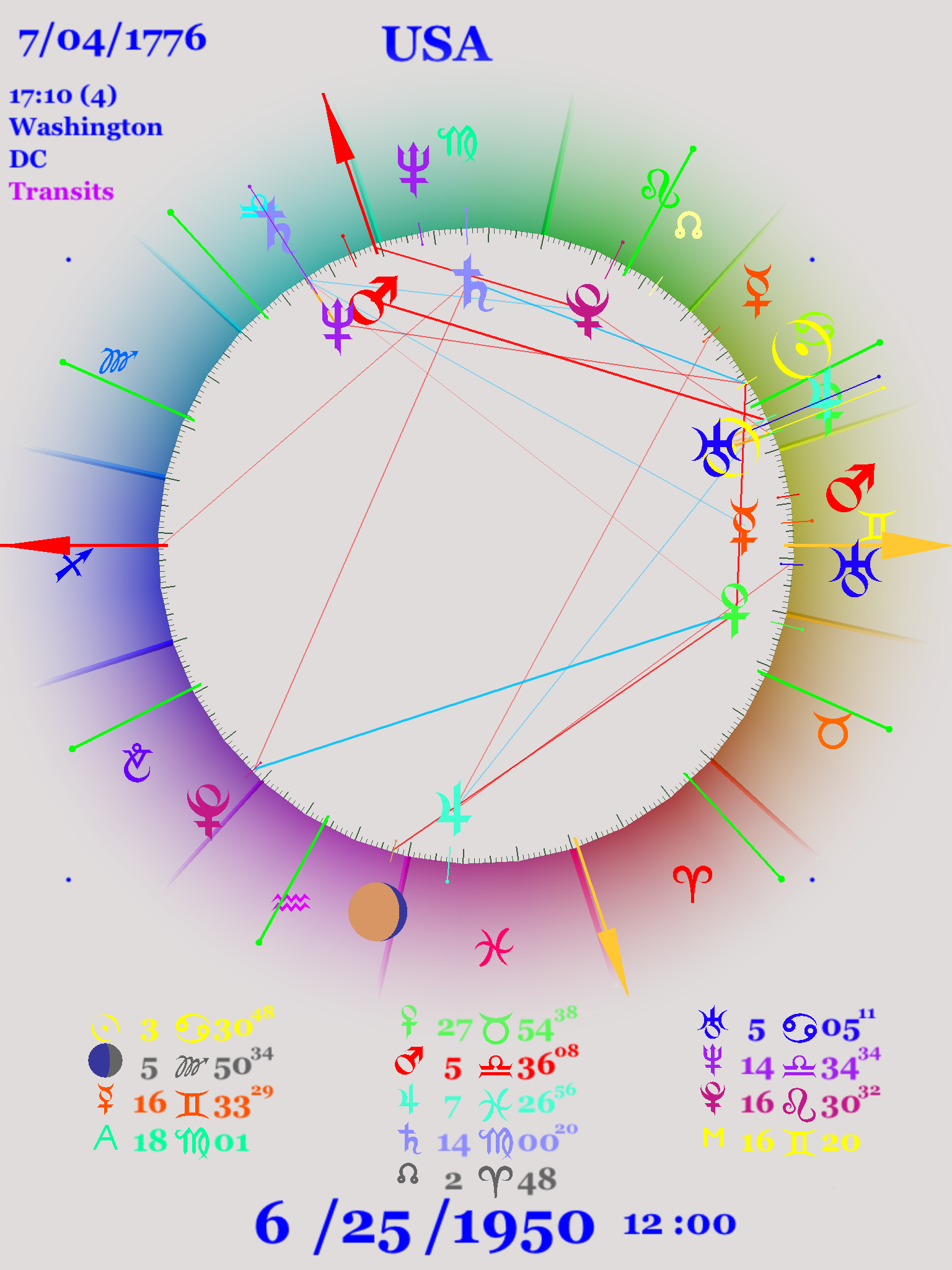
At the start of the Korean War transiting Neptune was on the US Saturn with an orb of 14 minutes.  It was   stationary  direct at the time and had been close to the US Saturn two month before and two months after the start  of the war.  Also on that day the transiting Sun was conjunct  transiting Uranus, suggesting unexpected events, and these two planets were on the Venus-Jupiter conjunction which is part of the core of the United States.  Mars was just past the Midheaven of the US and had crossed it two weeks earlier, at which time the transiting Sun was on the US Mars.

The Cold War was  high in America  at this time, since the Soviet Union had exploded its first atomic bomb in the previous year. The Communists had also defeated the Kuomintang in the Chinese Civil War the previous year, and Joseph McCarthy had made his notorious charge that the State Department was filled with Communists a few months earlier.  The United States was able  to convince the UN to sign on to the War only because the Soviets were boycotting  the General Assembly to protest the exclusion of the new Chinese government from that body.  The Korean War was used  to increase the defense budget of the US for fiscal year 1951 by almost five times from the previous year.   The North Atlantic Treaty Organization (NATO – still in the news after all these years) had been formed the previous year and  was put on a more military basis.  The US had also recently passed NSC-68 — a founding document of the Cold War  — which put forth the policy of containment of the Communist menace.  This policy  was maintained until Nixon started a policy of détente with the Soviets, which was then again changed to a more active policy of rollback when Reagan assumed the Presidency.

The Year of 1950 was a good one for the US in the Korean War.  The American forces (actually called UN forces, with token representations from other countries) were led by a hero of the Pacific battles of World War II, General Douglas MacArthur.  MacArthur invaded Korea at Inchon in what was a questionable move, and it turned out to be a tremendous victory; then he rapidly pushed the North Korean troops back across the 38th parallel that divided the two halves of the Korean Peninsula, thus achieving the status quo before the invasion of the North.  The  war had been won at that point. If only MacArthur had declared victory at that point most of the bloodshed of the war would have been avoided.

Korean_war_incheon

Korean War Inchon Landing

In the chart for the start of the Inchon invasion, we see the Sun-Saturn conjunction of the US Neptune, repeating the Saturn-Neptune that highlights the Korean War.  Transiting Uranus if midway between Jupiter-Venus and Sun  — a good time for America.  And  finally, Neptune is still on the US Saturn; the war has gone on for less than half a year.

Korean_war_cross38

MacArthur Crosses the 38th Parallel

Two  weeks later MacArthur crossed the 38th parallel, thus entering North Korea.  The chart for this shows Venus conjunct Saturn — that does not promise good — midway between Saturn and the MC of the US.  For Venus at the midpoint of Saturn and the Midheavewn Ebertin says “bearing grief or suffering” which describes the rest of the Korean War, that had started  out so well for what was called he UN troops.

But no.  MacArthur wanted to conquer the Northern part of the peninsula and so he pushed forward.  And then, perhaps driven by the anti-Communist fear of his homeland, wanted to use the atomic bomb to replace the new Communist government in China.  This brought China into the war.  MacArthur so infuriated Truman that he was fired by the President.  MacArthur returned to the United States with a hero’s welcome, and many people thought that Truman was wrong.  Much fighting went on for the next two years with nothing resolved.  Dwight David Eisenhower, commander of troops in Europe during World War II and at that time President of Columbia University, then ran  for President of the United States vowing that he would end the Korean War.   The war in fact ended a few months after he took office.

Korean_war_end

End Korean War

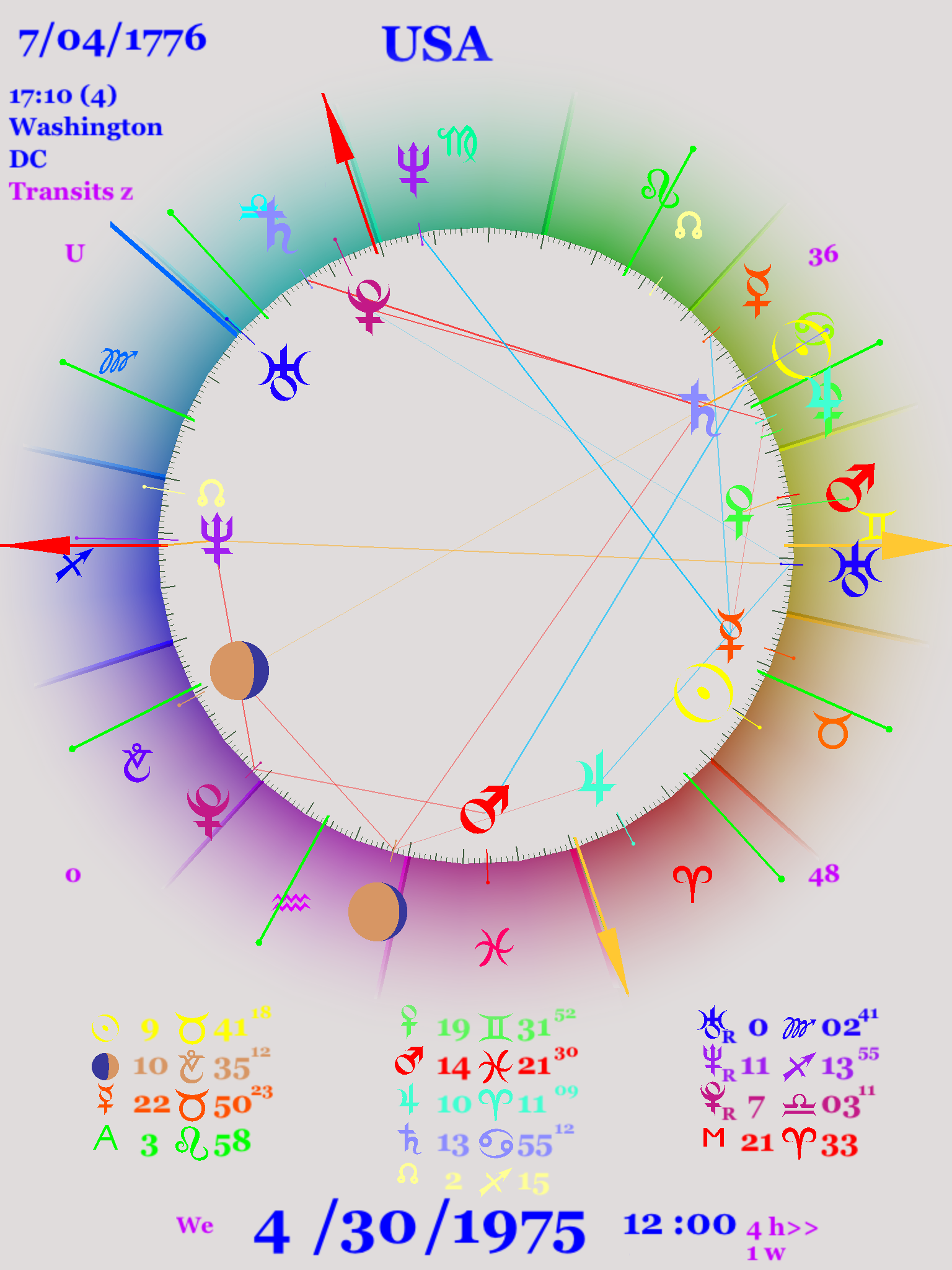
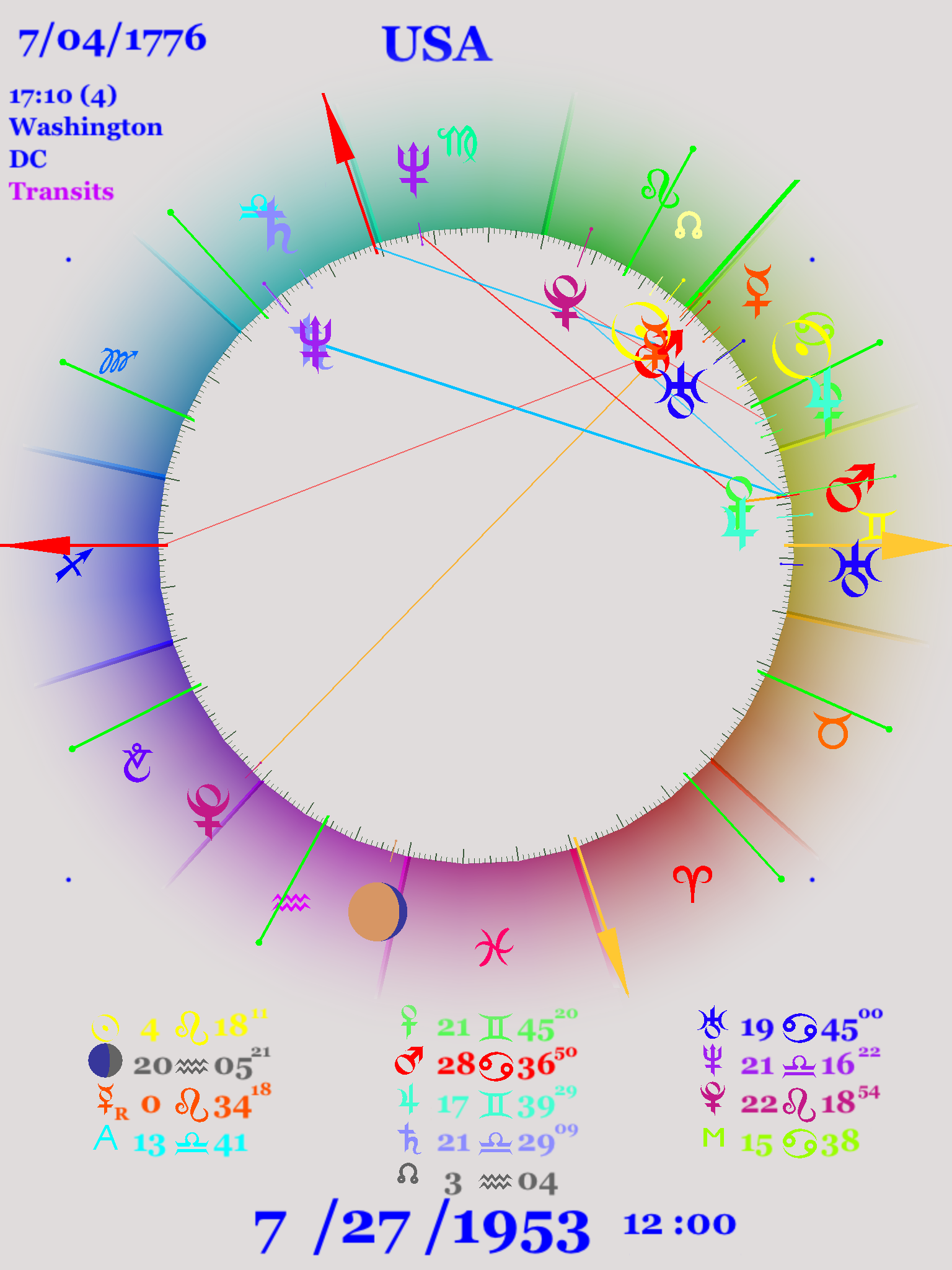
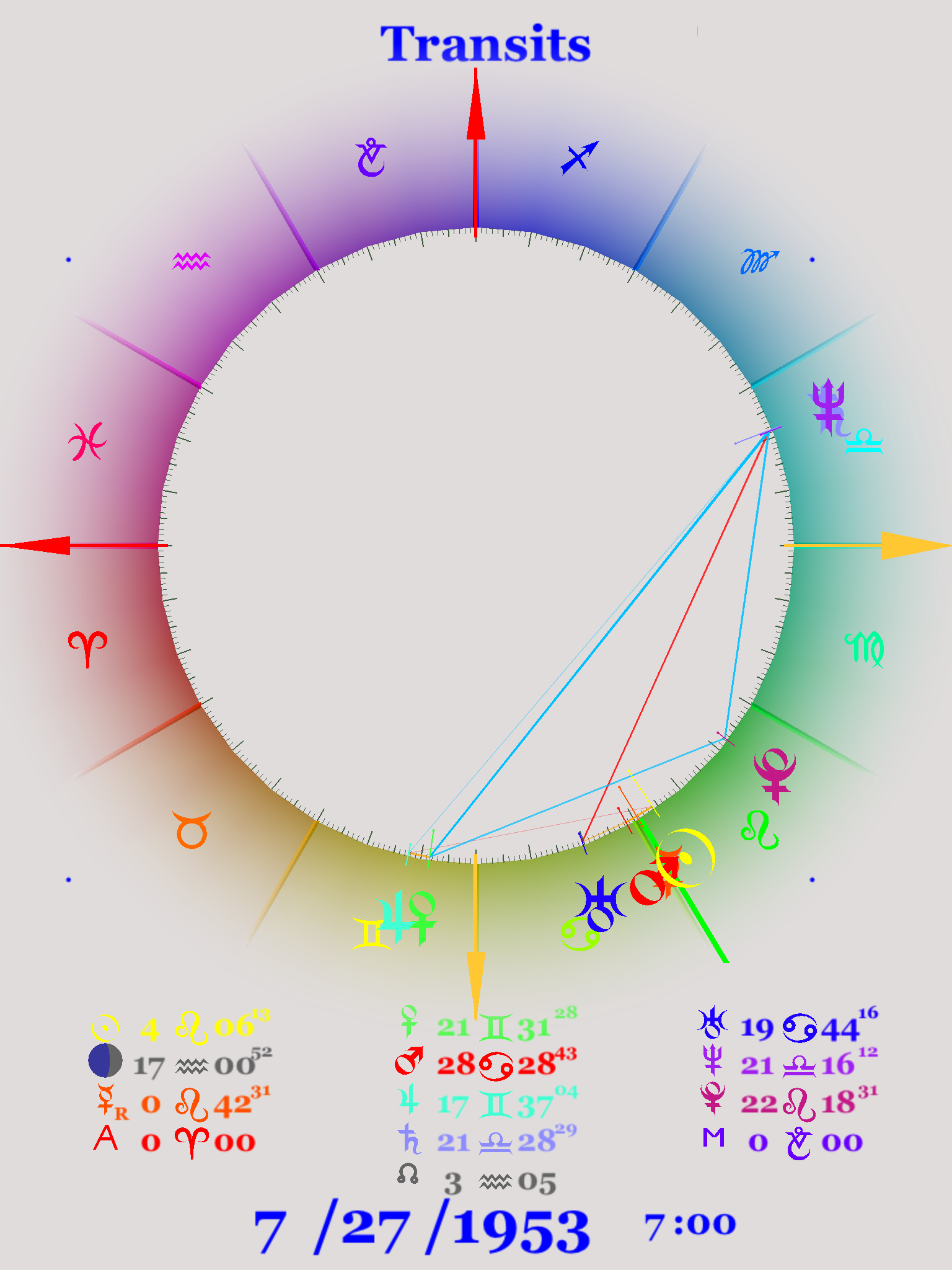
Here are two charts for the end of the Korean War.  In the chart showing transits to the US, the Saturn-Neptune conjunction is trine the US Mars; Jupiter is also conjunct that Mars and thus square the US Neptune.  As discussed previously Saturn-Neptune is important.  In the chart for just the transits at the end of the war, we again see the Saturn-Neptune conjunction trine  transiting Venus with Pluto sextile Neptune-Saturn and Venus.  As  previously indicated, the long sextile of Neptune and Pluto is the marker of the long Cold War.  Also Uranus is square Neptune, a highlight of the Fifties which we will discuss at some other time.

Korean_war_end_whole

Korean War End

Saturn and Neptune: Disillusion

There are many quadrature aspects — square, opposition, conjunction — of Saturn and Neptune: they happen about once a decade.  (Disclosure: The author has Saturn and Neptune configured to a Personal Point.)  Saturn represents discipline, discrimination, restriction; it has a bad reputation but without Saturn things would go wildly out of control.  Neptune represents spirit, imagination, unconscious drives, illusion, deception.  Neptune can be a very transcendent force, but unfortunately many people have a difficulty recognizing it (cf. mental illness)  and there seems to be even more difficulty with the forces represented  by Neptune when people act as a mass.

Richard Tarnas talks about this combinations representing confusion, doubt, alienation, uncertainty, disenchantment, disillusion, sorrow, and conciliation.  Saturn allows you to see through the illusions that Neptune brings, though that is not always comfortable.  Sometimes we are happier with our illusions  and dreams and do not want to awaken  from them and have to face reality.  But sometimes we need to face reality to grow.

Saturn and Neptune combinations are difficult to describe accurately — the hard nosed  reality of Saturn versus the numinous quality of Neptune.  Ebertin gives  the principle for this combination as “suffering, renunciation, asceticism”.  I think it will be more useful to look at examples of this pair of planets from history.

SaNe1953

Korean War

There was a Saturn-Neptune conjunction in the closing years of the Korean War.  The Korean War had started  out with high hopes among the Americans and their allies, but as  it dragged on with no progress but increasing causalities,  the war became less and less popular and people became disillusioned (a Saturn-Neptune word).  It often happens  that after the reality of any war seeps into people’s consciousness, the patriotic  and jingoistic feelings they had at the beginning tend to fade.  For the Korean War this loss of illusion is illustrated by the movie and later television show MASH.

SaNe1945

End of World War I

The closing square of those two planet directly preceding the conjunction of the Korean War was in 1944-45 and indicates the feeling of dread among, most especially the Germans and the Japanese, when people saw that the war started with such high hopes for ruling the word end in such misery.  And  life in the German and Japanese homelands was not very nice after the Allied bombings of such places as Dresden and Tokyo.  For the Allies, even though the end of the war in Europe was clear after D-Day (June 6, 1944) there was still much fighting to do.  In the Pacific theater, there were events like the Bataan Death March and the more  recent Battle of Iwo Jima that were ominous suggestions that the Pacific war would last for a long while, even though Japan’s desire for surrender was known to high officials.

SaNe1936

Roosevelt Depression

The opposition of Saturn and Neptune preceding that was 1936-37.  This is often called the “Roosevelt Depression”.  After  his  re-election with a huge majority, FDR felt that the economy was improving so well that he could cease so much government interference in the economy.  He was wrong, and the employment rate rose again.  The country did not really get out of the Depression until spending for the Second World War started up.  The optimism engendered by the New Deal was tarnished  when unemployment increased.

SaNe1926

Mid-Twenties

The square before that was in 1926.  In the United States this was the year of the Scopes trial, celebrated in the play and movie Inherit the Wind.  It represented the outcome of the conflict between the forces of modernism represented  by Darwin and his theory of evolution, and the fundamentalist who took the Bible literally.  In that case the illusions and beliefs of the fundamentalist had came up against the reality of the modern world, and lost.   But here we are now 90 years later and it appears that the forces arrayed against modernism are stronger that ever.

SaNe1917

World War I

The conjunction before that was in 1917.  The  war people were being disillusioned with was the First World War (“The War To End All Wars”), which was much bloodier than anyone could have  imagined before, and lasted much longer than many had thought.  World War I was the first truly industrial war, with poison gas, machine guns, tanks, and airplanes.  In some battles only a few feet of territory were captured in a day.   The whole generation of people, whether or not they fought in the war , were disillusioned. The escape of the Twenties was one result of a retreat from that war.

SaNe1909

Last Transcontinental Walk

The closing square before this was in 1909.  One of the events of that year, which takes on much more importance  in hindsight, is referred to in a  recent book called The Last Great Walk by Wayne Curtis.  Though it is difficult, if not impossible, to comprehend now that once, a century ago, many people use to walk for recreation and competition.  In 1909 an American Edward Weston (not the photographer) walked from New York to San Francisco and it was covered by the news media.  This turned out to be the last time such a walk was attempted because the automobile was taking over the country for transportation and  even recreation.  This would  have many unintended consequences that could not be guessed of at that time, a little over 100 years ago.  As  a result of the automobile’s increasing dominance of the world, the atmosphere has filled  up with car exhaust resulting in the climate change that is becoming apparent now.   People’s lack of exercise due to being able to drive anywhere has resulted in increased obesity and many physical diseases that were relatively unknown at the time, as well as many traffic accidents that kill tens of thousands of people per year and result in injuries  ranging from minor to crippling to many more people.  And the layout and design of cities, and the birth of suburbs and bedroom communities, have been altered the world in a way that is difficult to erase.

SaNe1899

Dreyfus Affair

The opposition before that took place at the turn of the century.  This time was especially potent as discussed  previously  and we can see from our perspective that it was truly the death of the old society that had existed  up to the Twentieth Century, and Modernism was being born.  But on a more particular level, consider the Dreyfus Affair in France.  A member of the French military had been sentenced for treason in the early part of the last decade of the Nineteenth Century.  Many, perhaps most, at least in France, had initially accepted the verdict.   But as time went on more doubts arose,  and the actual person who had committed the treason,  a relative of Hungarian royalty, was found.  Dreyfus had been brought back from the French penal colony on Devil’s Island off the coast of South America for a second trial in 1899.  While he was expected to be freed, the second trial also found him guilty. The  uproar of such  a miscarriage of justice forced the government of France to pardon him, and Dreyfus was convinced to accepted the pardon.  What has seemed like a good idea at the beginning of the decade turned out to be a large stain on France.

SaNe1863

Civil War

The opposition of Saturn and Neptune before that was 1862-63.  This was the Civil War in America, whose disillusion colored the next forty years.  Now that we are celebrating the 150th anniversary no one remembers just how bloody were the battles and how many people of the country were affected.  This was by far the biggest war ever fought on US soil.   One book that tries to capture the horror of the Civil War is This Republic of Suffering by Drew Gilpin Faust.

SaNe1963

Death of Kennedy

Moving forward after the Korean War, the opening square after that war was 1963.  The young president of the United States,  John Fitzgerald Kennedy, was killed  by assassination.   Many people at the time though this was the end of innocence  of America, that the Dream of Camelot was gone.  Even now there is much nostalgia for this time and Kennedy is considered a great peace maker, even though during his term the world   came  closer to a nuclear war than any time   before or since, though currently we are trying our best to gin up another war with a nuclear power, under a President who has been compared to Kennedy.

SaNe1971

Late Vietnam War

The following opposition was in 1970-71. The Vietnam War had gone on for at least ten years, increasingly bloody, with little possibility of victory just around the corner, even though many government officials always saw a light at the end of the tunnel.  There was increasing dissent in the United States, and things were occasionally turning violent.  It was also the end of that mythical time called “The Sixties” — a killing at the rock concert at the Altamont Speedway in California the previous year was  regarded as the end.  Reality was back.

Sane1980

End of Carter Presidency

The square after that was in 1979-80.  This was near the end of the Carter presidency in the United States, and people were just plain disillusioned.  The hostages from the American embassy in Tehran had been captured by Iranian militants and American were increasingly unhappy with the Revolutionary government in Iran, unaware that the deposed Shah of Iran had been put in place  by the CIA over 35 years previously.  There was increasing anger towards Iran — the slogan “Nuke Iran” was appearing as graffiti in many places.  An attempted rescue of the hostages had gone very bad.  Carter delivered his famous “Maliase” speech which portended  our current crises, but at that time only depressed people further.  Also, an urge for “market solutions” was welling up from the populace, having been propagandize by corporations following the Powell Doctrine, put in place in the early part of the decade by Lewis Powell, who was on the Supreme Court at the time.  This doctrine urged businesses to fight back since they were being out gunned by the forces of democracy from the Sixties.

SaNe1989

Fall of Berlin Wall

The conjunction  in 1989 will be dealt with separately.  This time saw the fall of the Berlin Wall and of many Communist countries such as Poland.  The Communist experiment, which had first successfully taken control of a government 60 years previously was  coming apart at the seams.

SaNe1998

Impeachment of Bill Clinton

The  square after this was in 1998-99.  This  was the closing years of the Clinton Presidency and saw the impeachment of that President.  The long impeachment of the President went on for months and alternatively filled the  news cycle and disgusted much of the American public.  By the end of the impeachment any remaining glow of the Clinton Presidency was gone, and the boom of the Clinton years, due to the “”dot.com”  bubble that had expanded after the World Wide Web and the public awareness of the Internet, which had existed for 30 years by that point, was about to break.  As  is typical in modern times, by the last two  years of a two term Presidency, everyone was ready for something else.

SaNe2007

Iraq War Fatigue

Finally  the opposition after that was in 2006-07.   The War in Iraq had been going on for a few years, and not only were people disillusioned with that war, in America and abroad,  but Americans were also disillusioned with the whole Bush presidency.  There was talk about impeaching him.  This call  was  not taken up by the “loyal opposition”, which did not want to rock the ship of state but to only assume the reins of power. There was also a large housing boom, where many, many people were getting into the market, and very few warned that this would end badly.

The Great Depression

The Great Depression of the decade of the 1930s affected the United States and the rest of the industrial world. It started in the United States with the stock market crash of late 1929.  The two important dates of the crash were Black Thursday — October 24. 1929 — and Black Tuesday — October 29, 1929  —  when the market fell severly.   After these two events, it became clear that a crisis had developed, even though few had an idea of how long it would last.  The Republican President at the time, Herbert Hoover, who had taken office in March of that year, was not very effective at curbing the unemployment resulting from the stock market crash.  The worst years of the Depression were 1932 and 1933.  One of the things that most upset the public about Hoover’s term was his handling of the Bonus March that culminated on July 28, 1932.  Hoover had been considered a boy wonder, earning his first million — he was a mining engineer — by the age of 40.  He had performed miracles in such things as relieving the famine in Belgium after World War I, and was considered a Progressive, even though he was a Republican, as was another Progressive politician Theodore Roosevelt.

In the Bonus March, an army out-of-work veterans of World War I and their families rallied in Washington, D.C. to claim the money that had been promised them for service in the War but wouldn’t come due until 1945.  At that point in the Depression that certainly needed it.  The police forces of Washington at first tried  to control the situation, which resulted in two deaths from shooting.  Then Hoover sent General Douglas McArthur (Army Chief of Staff) to control them, and he was somewhat  harsh, burning down the camps that they had set up, which were probably the first Hoovervilles that dotted the landscape of America after the Great Depression set in, serving as homes to the homeless.  He also  sent in mounted troops and tanks to disperse the residents of the camps, charging that the veterans were infiltrated by Communists.  Accompanying McArthur was a young office by the name of Dwight David Eisenhower, but he was not involved in the bloodshed.  Eisenhower would subsequently rise to commanding officer of all the troops in Europe during World War II, but he never was involved in killing.  Perhaps this was because his mother was a member  of a Peace church.  He  late went on to be President of the United States.  But since Hoover had given the orders, Hoover was the person who got the blame for this catastrophe in dealing with veterans.

After Hoover was so tarnished by the Bonus March catastrophe, the Democrat Franklin Roosevelt was easily elected.  After 1933 unemployment decreased until 1937 and 1938, when what is called the Roosevelt Depression occurred.  After his re-election in 1936, with the largest majority ever for a President, FDR thought the Depression was just about over and he stopped much of the government spending that had helped people.  He was wrong on this.  Full employment did not return until the US got itself involved in World War II, which really heated up the defense industries, which employed many, and also sent many civilians into the military, were they were employed.

blackthursday

Black Thursday

This first chart is for October 24.  What I find most interesting is that the transiting Moon, which travels at about  1 degree every two hours, was exactly opposite natal Pluto, which at the time was unknown  but would be discovered the next year on February 18.  Pluto rules large, transformative events, which certainly fits the Great Depression.  The aspect was exact at 9:08 that evening.

blacktuesday

Black Tuesday

The second charts for is for Tuesday, October 29.  At 11:29 that morning the Moon was directly on the Midheaven.  By this time the public and the world were aware of what was going on,  that a stock market crash had happened.

tg_depression1

Graphical Ephemeris Start of Great Depression

The third chart is a graphical ephemeris for one year starting the middle of 1929.    There were three aspects involved in the Great Depression, involving the three outer planets.   One was a square of Uranus and Pluto, which was the closing square of those two planets before the conjunction of the Sixties.   This accounts for the rebellions of the thirties, and in fact it looked increasingly like there would be a revolution just before Roosevelt was elected.  Then there was a sesquiquadrate between Uranus and Neptune, which also lasted during most of the Thirties.  Finally there was a semisquare between the two outer-most planets, Neptune and Pluto; these were conjunct in the 1890s, and would form a long sextile during the Cold War.  These three planets went in and out of orb during the decade of the Thirties. We can see from this graphical ephemeris that the last aspect (Neptune semisquare Pluto) was within two degrees of exact  at the end of October, and would be exactly semisquare for the first time about two months later.

bonus

End of the Bonus March

Here is a chart for the Bonus March.  The army came at 4:45 that afternoon, but the killing occurred before that time.  This chart is drawn up for 4 pm, just as the Moon was setting on the US chart, and thus on the Descendant.  And indeed, it was setting  for the government of Herbert Hoover. The tightest aspect in this chart is Jupiter opposite the Moon of the US with orb of 2 minutes, almost exact.  One meaning for Jupiter is “bonus” or plenty, what the people of the United States were demanding.  Unfortunately the next tightest aspect, at 5 minutes, is Saturn trine the Midheaven:  The government of the US  was stingy.  But the next President, Franklin Roosevelt, was able to provide Jupiter — optimism —  in spades, it was one of his major accomplishments.  Roosevelt was born when Jupiter had just turned direct, and so it was slowly moving in his natal chart.
tg_depression10

Ten Years of the Great Depression

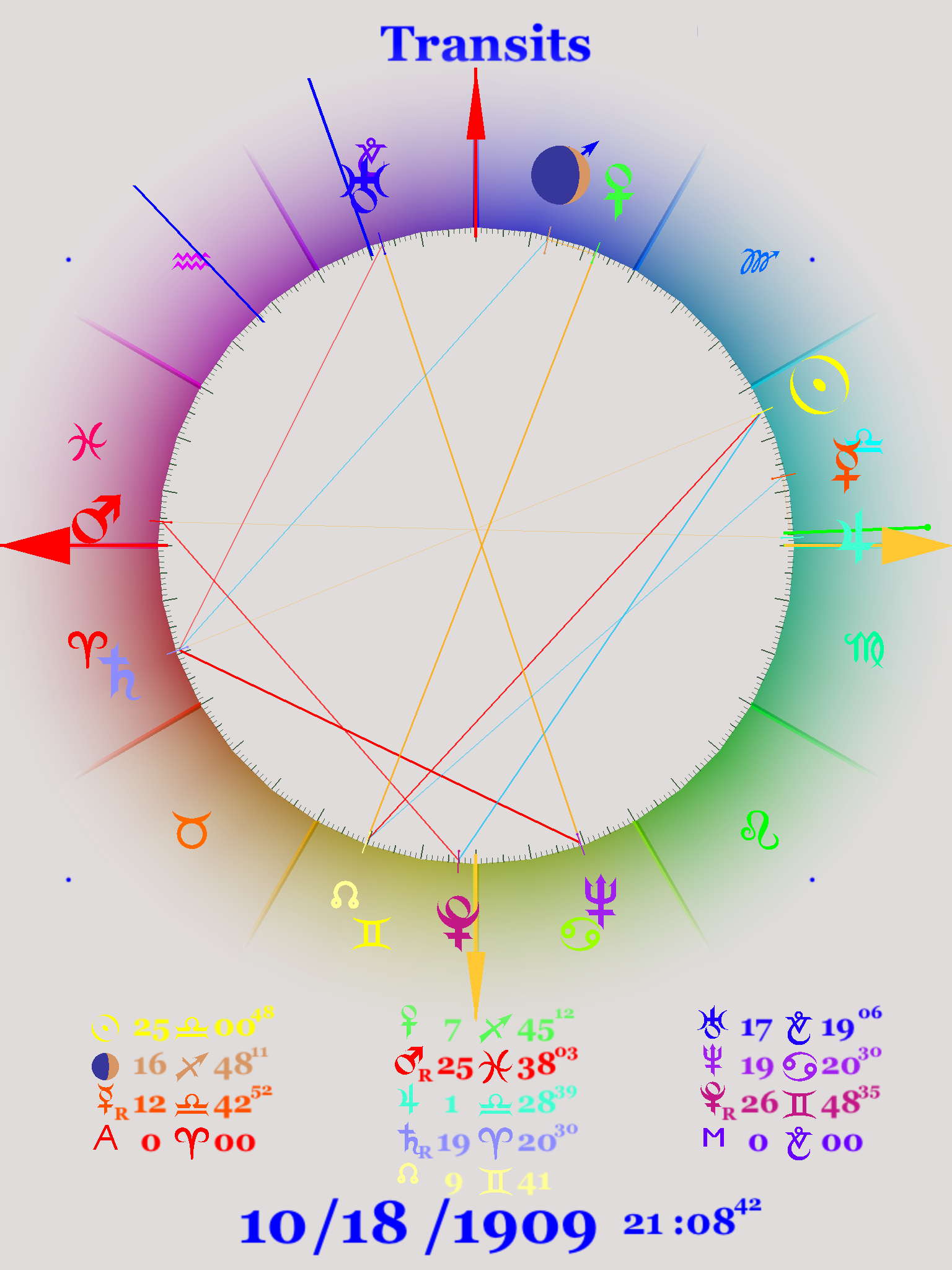
The next chart shows the 10 year period from 1929 to 1939. It is an harmonic 8 chart (as was the previous graphical ephemeris) so that when any of those two outer planets are making an aspect, the lines will come together. You can see how those three outer planets go in an out of aspect during this period   You can also see that the tightest clumping of the three planets occurs in 1932 and 1933 (black arrow), and they slowly drifted apart after that as the depression got less worse.

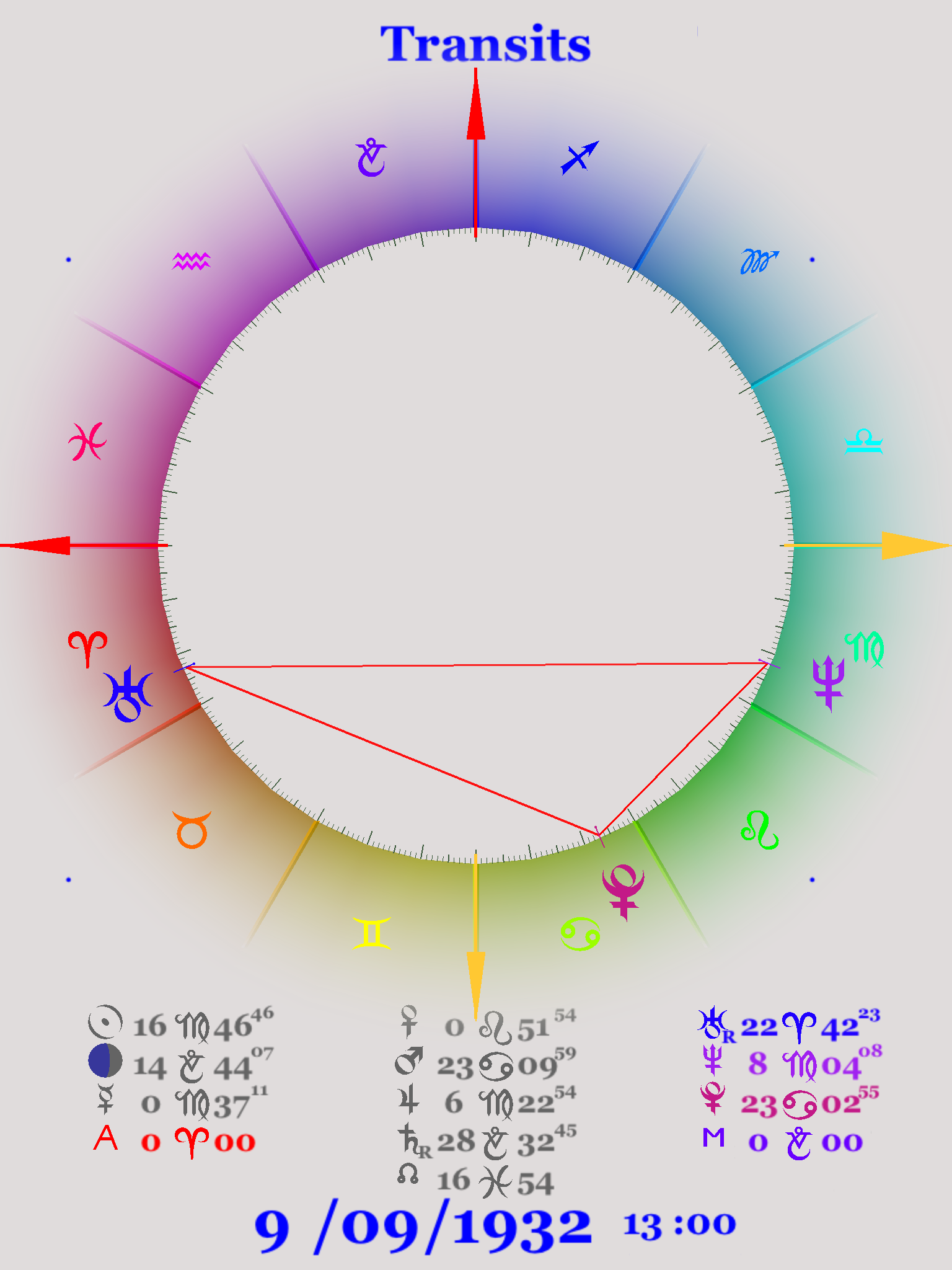
depression_asp

Maximum Depression

This wheel chart is set up for 9/9/1932 showing the three outer planets and the aspects binding them that are most exact:  Uranus square Pluto, Uranus sesquiqadrate Neptune, and Neptune semisquare Pluto.

It is also interesting to note that Pluto was transiting opposite its natal position — US chart — during the time of the New Deal.  Since Pluto is moving faster at this time than it was a century ago, it will complete the circuit and return to its natal position in a few more years, as we will discus later.

Sundays, Bloody Sundays

For  some reasons, large scale bloodshed always occurs on a Sunday.  Or maybe that is the most convenient day for people to meet in a mass grouping.  I recently heard the phrase “Bloody Sunday” used to refer to an event portrayed in a current movie, and realized  that I knew of three Bloody Sundays in the Twentieth Century without doing any research; there may be more, and in fact I found another as mentioned below.  Some are better known than others.  One, as I said, was recently made into a  major motion picture, another was the subject of a popular  rock song by a group from the area where the blood was shed, and the third  may have ultimately led to the Russian Revolution and thus altered the shape of the Twentieth Century.
We talked about a massacre in Paris recently, but that was not called Bloody Wednesday because the agents doing the  violence did not work for the government.  We will see in the examples below that government agents are needed  before the action gets celebrated by Bloody, as well as occurring on on Sunday.  Bloody Sundays involve the shooting of civilians, usually protesting the actions of the government, being  shot by forces of the government.

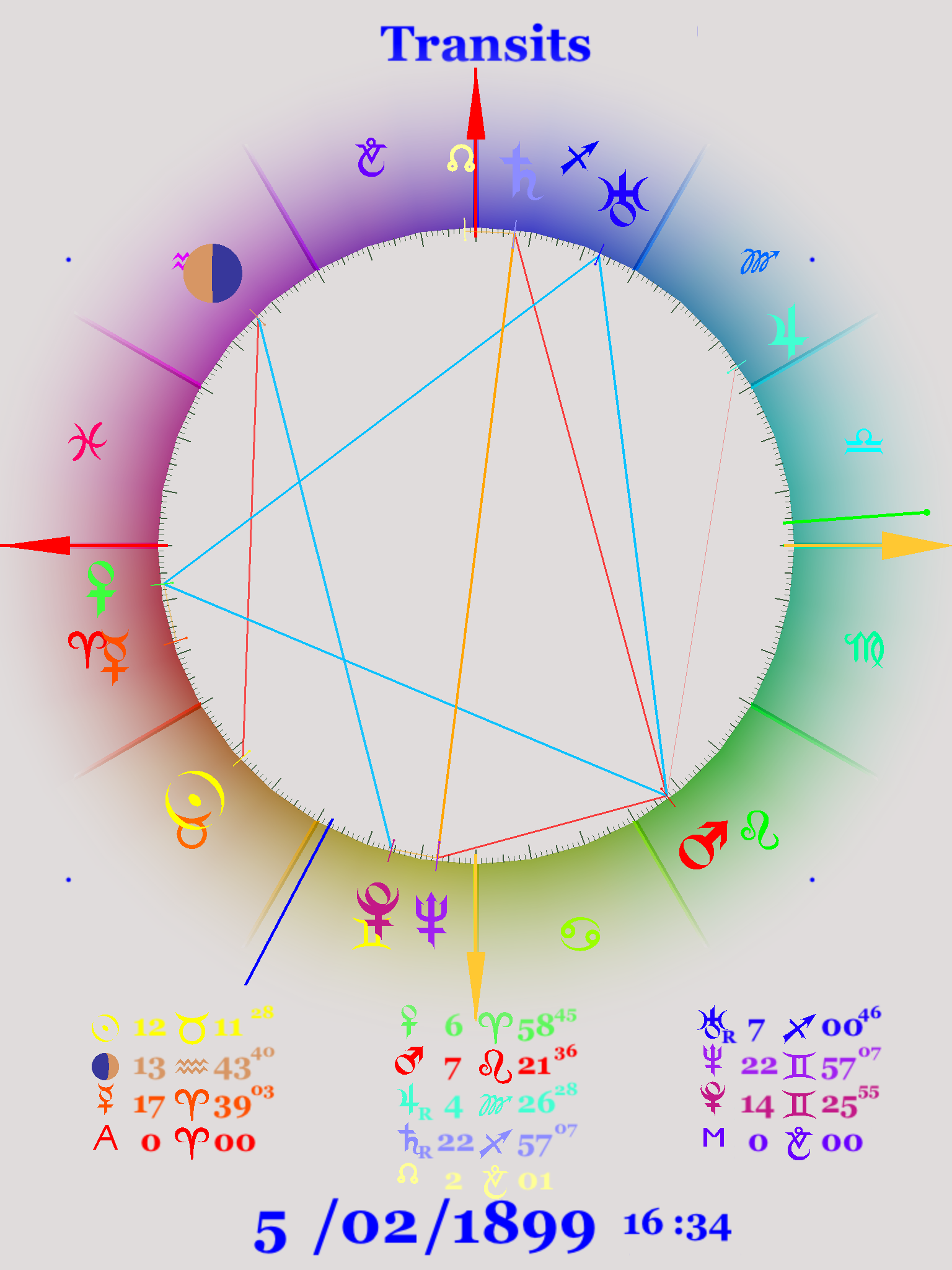
The first one took place in Saint Petersburg, Russia on January 22, 1905 after 2 pm.  A note about the date.  As many astrologers need to know, a change was made between the Julian calendar and the Gregorian calendar on October 15, 1582.  There are ten missing days at that point to adjust to the difference between the two calendars.  But not every nation made that change at that time.  Britain, and thus the United States, did not make the change until 1753, which is why George Washington has two separate birthdays, Old Style (Julian) and New Style (Gregorian).  And the change was not made in Russia until the Russian Revolution, which is why you can find different dates for the so-called first Russian Revolution, of which this first Bloody Sunday was the beginning.

The peasants of Russia were increasingly unhappy with the czar.  Early in the morning of Sunday January 22 (New Style) they began to gather around the Winter Palace in St. Petersburg , the home of the czar, not realizing that he was not there.  Troops were also there to protect order.  A few shootings happened before noon that day, but it appears that most shooting happened after two that afternoon.  Of the thousands of demonstrators presents, hundreds were killed, though exact figures are hard to come by.  This killing by troops  of the government made the peasants stronger, they were no longer in such awe of the czar.  This was the beginning of the first Russian Revolution.  It did not really change the monarchy, and so in another dozen years there was another Russian revolution that did get rid of the czar once and for all.

bs1

Bloody Sunday in Russia

In the chart for this event we see Mars — gunfire — sesquiquadrate Pluto and square Sun.  A combination of Mars and Pluto can indicate mass murder (as well as other things, in case anybody with that combination freaks  out on hearing this).  There is a tight sesquiquadrate between Saturn and Neptune.  Saturn and Neptune are a complex combination, which we will devote a whole article or two to at a later date.   But it can indicate an idea that was once thought of as good is now seen as rotten.

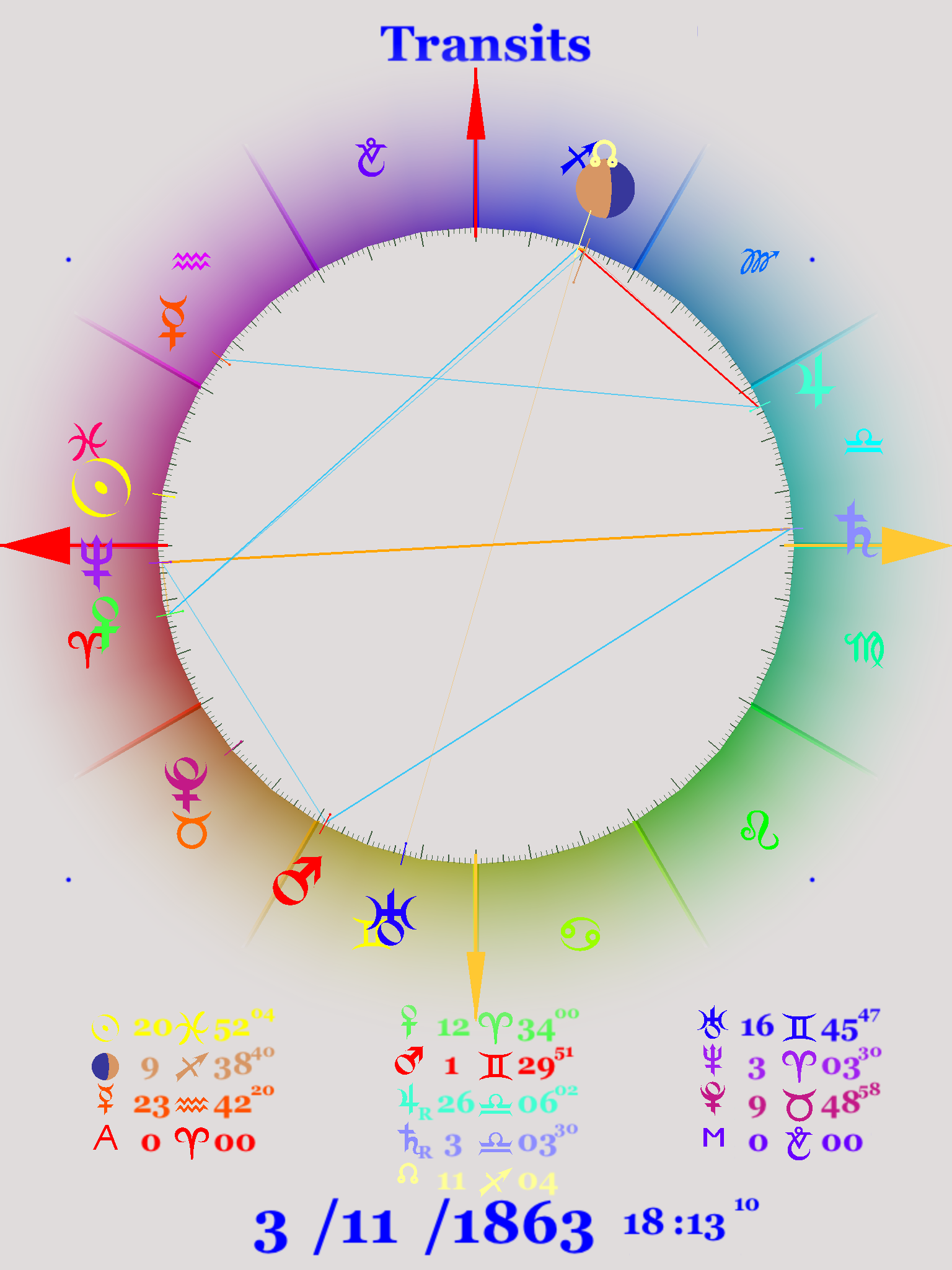
The second Bloody Sunday of the Twentieth Century occurred on a Civil Rights march from Selma, Alabama to the state capital of Montgomery on March 7, 1965.  Many  big names of the Civil Rights movement of the Sixties were present, such as from SCLC (Southern Christian Leadership Conference) were Martin Luther King  and Hosea Williams and from SNCC (Student Nonviolent Coordinating Committee) Stokely Carmichael and John Lewis. A preacher had been  murdered a few days before, and this fed the momentum for the march.  When the 600 marchers approached the Edmund Pettus bridge, they were violently prevented  from crossing by the state police of  Alabama.  This event is the subject of the recent movie, Selma.

bs2

Bloody Sunday in Selma

In the chart for this Bloody Sunday, we see the Uranus Pluto conjunction, which is the hallmark of the Sixties, conjunct Mars, and all three opposite the Sun, indicating on this day there would be a revolutionary and violent — martial — event.  Also during 1965, though not directly related to this event, the US greatly increased the number of troops in Vietnam, thus escalating the war. Also in this month the US started the famous Operation Rolling Thunder which  bombed North Vietnam. This was one of the most intense bombing campaigns in US history.  Mars is also trine Jupiter and sextile Neptune which in turn is opposite Jupiter.  The wide Neptune Pluto sextile — the long sextile discussed previously, shows that the Cold  War was still happening.

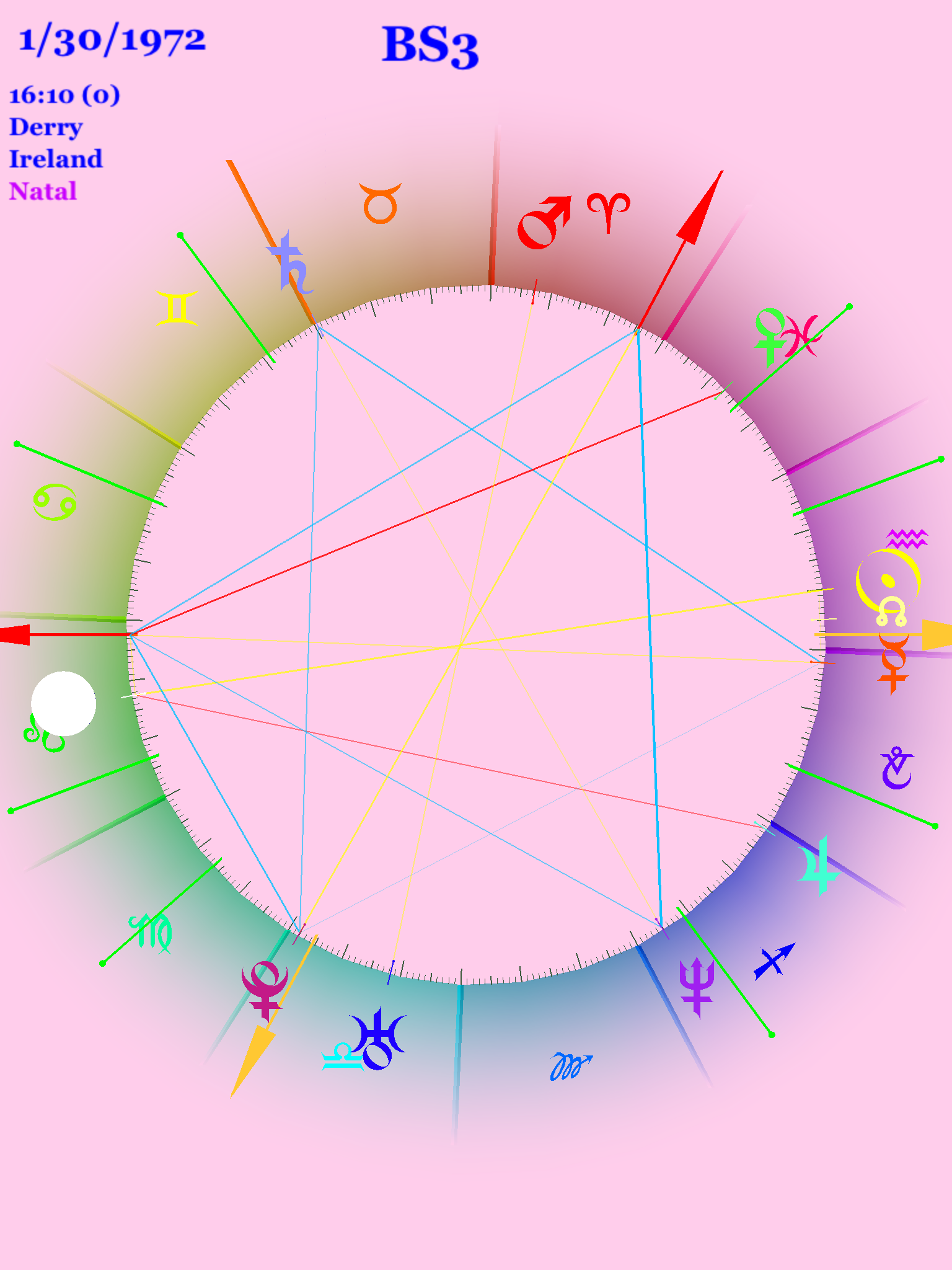
The third Bloody Sunday,and the subject and tile of an early hit by the Irish rock band U2,  occurred on January 30, 1972 in Derry, North Ireland at 4:10 in the afternoon.  In this incidence, 26 civil rights protesters and civilians were shot by the British army; 14 died, most immediately. The marchers were protesting interment,  the British policy of imprisoning Irish citizens without trial.  Many of those shot were fleeing the soldiers. A recently-released investigation has raised   new questions about culpability in  this matter.

bs3

Bloody Sunday in County Derry

In this chart for the third Bloody Sunday, we see Mars elevated and   in Aries, but unaspected.  The Midheaven is also in Aries for this location, suggesting that a violent, Arian, picture would be shown to the world.  Pluto is opposite the Midheaven and thus hidden from  view, and trine Saturn.  This event occurred at a Full Moon and shortly before sunset; sunsets occur early in January in Ireland..  Neptune is trine the MC, suggesting some uncertainty over what the word makes of this event.   An initial investigation essentially gave the British soldiers a free pass.  A more recent investigation, results released in 2010, hints that some soldiers were culpable of the killing.

But some have suggested that the U2 tune refers to an older “Bloody Sunday.”  This  occurred on November 21. 1920 at 15:25 in Dublin, where  the Royal Irish Constabulary opened fire in a football stadium, killing 14 civilians.  This was a “reply” to the assassination earlier in the day of 14   people, mostly British agents, killed by the IRA (Irish Republican Army).  Both these killings took place in Dublin, Ireland which had long been a colony of Great Britain, and the Irish people were none too happy with this state of affairs, which resulted in both Bloody Sundays.

bs4

Bloody Sunday in Dublin

In  the chart for this  older Bloody Sunday  we see Mars again in the Tenth house and trine Saturn, instead of Pluto trine Saturn as in the previous chart.  Saturn is sesquiquadrate the Ascendant of the place of the event — Dublin.  While Pluto is not opposite the MC, it is still at the bottom of the chart and thus — symbolically — hidden from view.

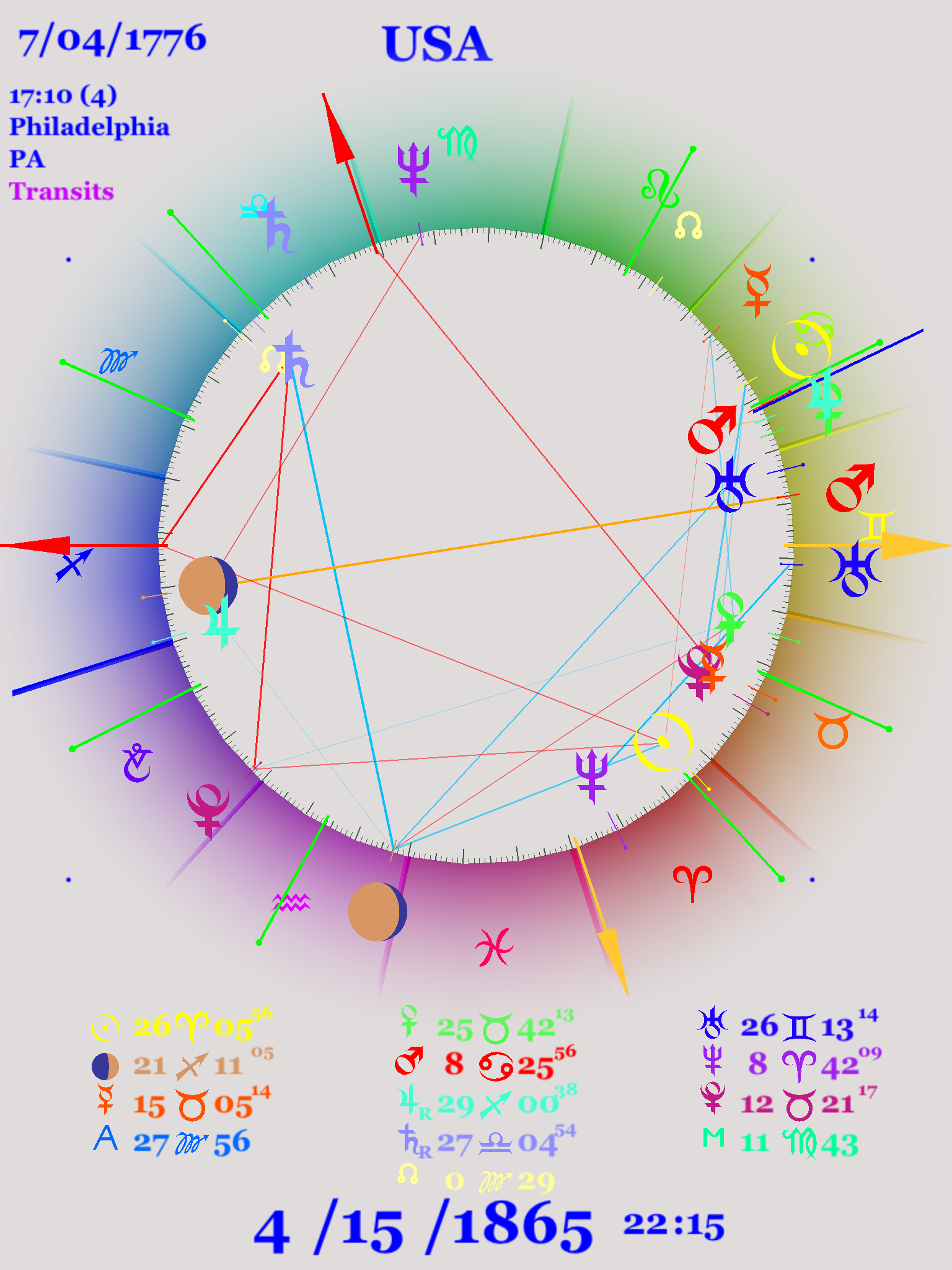
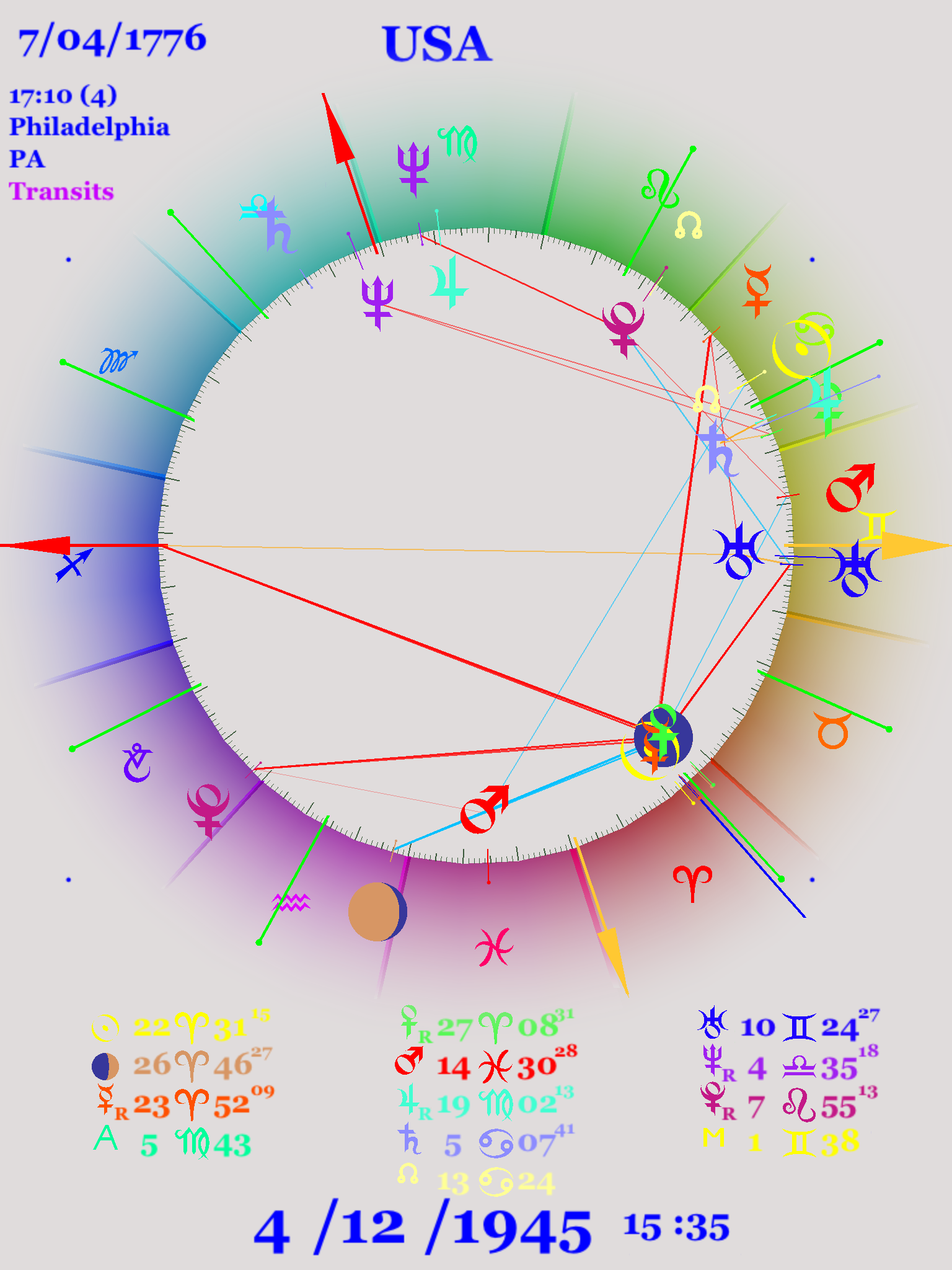
Presidential Mistakes

Picking the best and at times the worst of presidents is an endless contest.  In most lists, the best presidents of the United States are Abraham Lincoln, the sixteenth President, and  Franklin Roosevelt, the thirty second President — both Aquarians.  Both are considered the top two Presidents, in no particular order.  But both made an extremely bad decision,  which no one credits them with, that were among the worst presidential decisions every, and the results of which we still live with.

During his first term, Lincoln’s Vice President was Hannibal Hamlin.  Hamlin was a radical Republican who fully supported the abolishment of slavery.  He was replaced in the second election by a Democrat from the border state of Tennessee and they ran on, instead of the Republican Party ticket, a new party formed for that election only called the National Union Party; the idea was to show that the Democrats and Republicans were united and that the Civil War was a bipartisan effort.  Unfortunately, Lincoln was assassinated shortly after the election of 1864, which the National Union Party won.  Lincoln’s chosen vice president was Andrew Johnson, a Democratic Senator who still  supported  the Union, even though Tennessee had joined the Confederate States.   It was for that reason that Lincoln decided to have him on the ticket of the new  union party that was set up just for the election of 1864. By early 1865 the South had lost the Civil War, and Lincoln had been assassinated, so Johnson was the new President.  Johnson had given a bad impression when he had shown up for his inaugural as vice president drunk, but as Lincoln had explained, that was only because he was so nervous. Johnson was never a friend to black people, either when they were slaves or after the War ended.

The period between the end of the war and 1876 was called Reconstruction; the South was suppose to re-enter the Union and the freed blacks who had formerly been slaves were to have been brought into full-fledged citizens of the United States. To say that Reconstruction was unsuccessful would be an understatement, and we are still living with the consequences of that period.  The so-called Black Codes were soon passed in the South, which restricted the freedom of the newly freed  slaves.  While there were more Blacks elected to the Congress during Reconstruction than ever since, few long lasting changes  were made and after the end of Reconstruction the South tried to revert as closely as possible  to the antebellum ways  of treating their black citizens.  Andrew Johnson did not help Reconstruction, and he so angered the Radical Republicans in Congress that they passed a law so that Johnson would break it and they would have an excuse to impeach him, and they  did.  Johnson goes down in history as the first President to  be impeached; he was not convicted, but after that his frosty relations with Congress did not improve.

Reconstruction ended in 1876, even thought it had not been finished.   What happened was the election of 1876.   That was a interesting year in the United States.  It was the centennial of the founding of the country, and there was much celebration on the Fourth of July, a special birthday.  Just a few days before that party a civil war veteran named George Armstrong Custer had been killed fighting Indians and the news had just reached the East.  The current President, Ulysses Grant, who had accepted the South’s surrender in the Civil War, was very unpopular.   The election that November was disputed, and in fact was more controversial than the recent election of 2000 and Bush v Gore. It was seemingly won by the Democrat Samuel Tilden and the Republican Rutheford Hayes lost.  But in several states both the Republicans and Democrats turned in electoral college votes, which disagreed.  Eventually a committee was formed consisting of members of the Senate, House, and Supreme Court.  The committee was suppose to choose between the disputed electoral votes.  As a result, the Republican was chosen, but the Democrats, who were the party in the South of white people, also got something that they wanted:  a removal of troops in the South and thus an end to Reconstruction.  The whites in the South could go back to interfering with the newly freed slaves with no interference from the Army.   The new President was referred to a Ruthefraud Hayes after that election.

lincoln_assassination

Assassination of Lincoln

The first thing we look at in this assassination chart is the position of Mars, that indicates gunshots.  Since we have a time, the position of the Moon is valid, and it is opposite the US Mars.  Transiting Mars is on the cusp of the eight house (the long dark blue line extending out from that planet indicates this) which in traditional astrology is the house of death.  Mars is within the core of the US chart — Sun, Venus, Jupiter — and approaching an exact conjunction with the Sun.  Mercury is sesquiquadrate the Midheaven, and the news of this event was communicated rapidly, besides taking place within a theater.  Saturn, depression, is aspecting the Moon, Pluto, and the Ascendant of the US chart.

***********
Franklin Delano Roosevelt had an unprecedented four terms.  In fact, the twenty second amendment to the US Constitution was passed to prevent this from happening again.  In his third term, Roosevelt had as Vice President Henry Wallace, who had been Secretary of Agriculture during the first two terms and an important supporter of the New Deal.  Wallace was an American original.  He was a farmer from Iowa whose political beliefs were out of step with the Washington  Establishment.  He was also someone who had esoteric beliefs that were out of place in Washington.  In fact, it was his idea to put the eye on the pyramid on the back of a dollar bill.  This corresponds directly to something in the astrological birth chart of the United States, as we will discuss at some other time.  Not only was he FDR’s Vice President in his third term,  he was also Roosevelt’s choice for the fourth term.  But by that time Roosevelt was noticeably sick, and the Democratic Party officials knew he wouldn’t last for four more years, so they knew that whoever was vice president would become President, and they wanted someone in that position that they could control, and they did not want that person to be someone with the maverick ideas of a Henry Wallace.  They convinced FDR to nominate Harry Truman, who had supported New Deal policies and was also from the  Midwest, but was not an independent thinker and could be trusted to take orders.  Some people called him a hack, and his start in politics was the result of action by a local political organization called the Pendergast machine.  But the convention, which was heavily in favor of Wallace, would have selected him anyway, except the power in the convention hall failed conveniently and the selection was put off to the next day.

While Wallace really supported FDR’s policies, especially in regards to the Soviet Union, and he had been in the Roosevelt cabinet  since the first  election, Truman did not support the Roosevelt foreign policy and was strongly influenced by such people as his Secretary of State, James Byrnes.  As a result, Truman was in charge of ordering the atomic bombs dropped on Japan, and he  took a tough policy towards the Soviet Union after the war ended and ignored the agreements made at Yalta.  He helped bring the policy of anti-communism to America, which led to McCarthyism, and helped bring the Cold War  with his Truman Doctrine.  Conservatives and liberals did not like Wallace at all, and this belief still exists.  I  recently saw an article in the New Yorker from last year defaming Henry Wallace.  But if Wallace had served as President after the war, the Cold War would have had much less chance of happening, and the future of the world   would have been considerably different. Truman brought in the National Security State, which has only gotten stronger after 9/11. As discussed previously the beginnings of the NSS changed America’s path and position in the world.

Even though the Cold War is over, the Cold  War tendencies to mistrust the Russians are still in full force in America, and has led to a second Cold War and the accompanying  danger of nuclear war.

fdr_death

Death of Roosevelt

In   this chart we have a conjunction of four planets in Aries  — Sun, Moon, Mercury, and Venus — and a new Moon had happened  eight hours earlier.  This quadruple conjunction is aspecting much of the chart: Moon, Pluto, Ascendant, Uranus, Mercury, and Mars.  Saturn  is approaching the core planets of the United States: the government will be depressed, and there were many changes to the government in the next three months it took Saturn to cross the Sun.  In fact, Saturn was exactly on the Sun of the US on July 4, 1945.