The Great Recession, The Rise of Britain, and the Reformation

These three events appear to have nothing in common, except that that all shook the foundations of the world.  But they did have something in common in terms of symbolic meaning.   I will discuss these three   events and show the commonality.   It is of course difficult to get exact timing of these  three events, but we only know when they were under way, that is, shortly after they started.

“The Great Recession”  is now commonly used to refer to the economic meltdown, or whatever you want to call it, that happened in the period 2007-2009.  It wasn’t as bad as the Great Depression, but it was, and still is  for many people, worse than anything else they experienced in  their lifetime, thus the term The Great Recession.  The most commonly used event as a marker for the Great Recession, but not the only one, is the fall of the Lehman Brothers Bank on September 15, 2008.  But the housing bubble  that had been growing, in the United States as well as other countries such as Ireland and Spain, burst in the middle of 2007 and the recession is said to have bottomed out in the middle of 2009, so at the very least we can considered the event to have happened 2007 to 2009.  On October 9, 2007  the Dow reached a record high of 14,164  which it would not see again for several years.  The meltdown is considered  to have started on August 9, 2007, but that is only obvious in hindsight.

plucap1

Great Recession

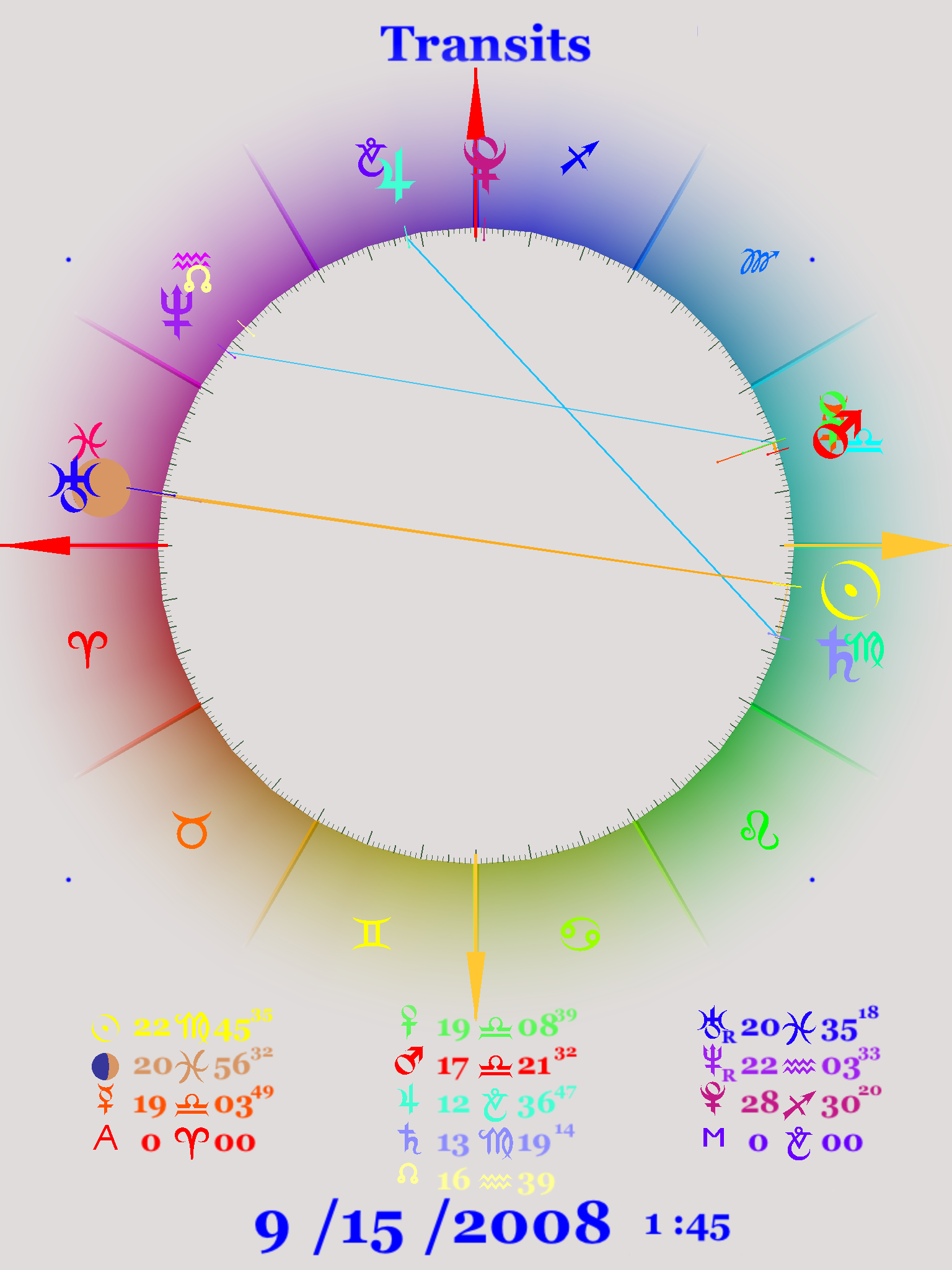
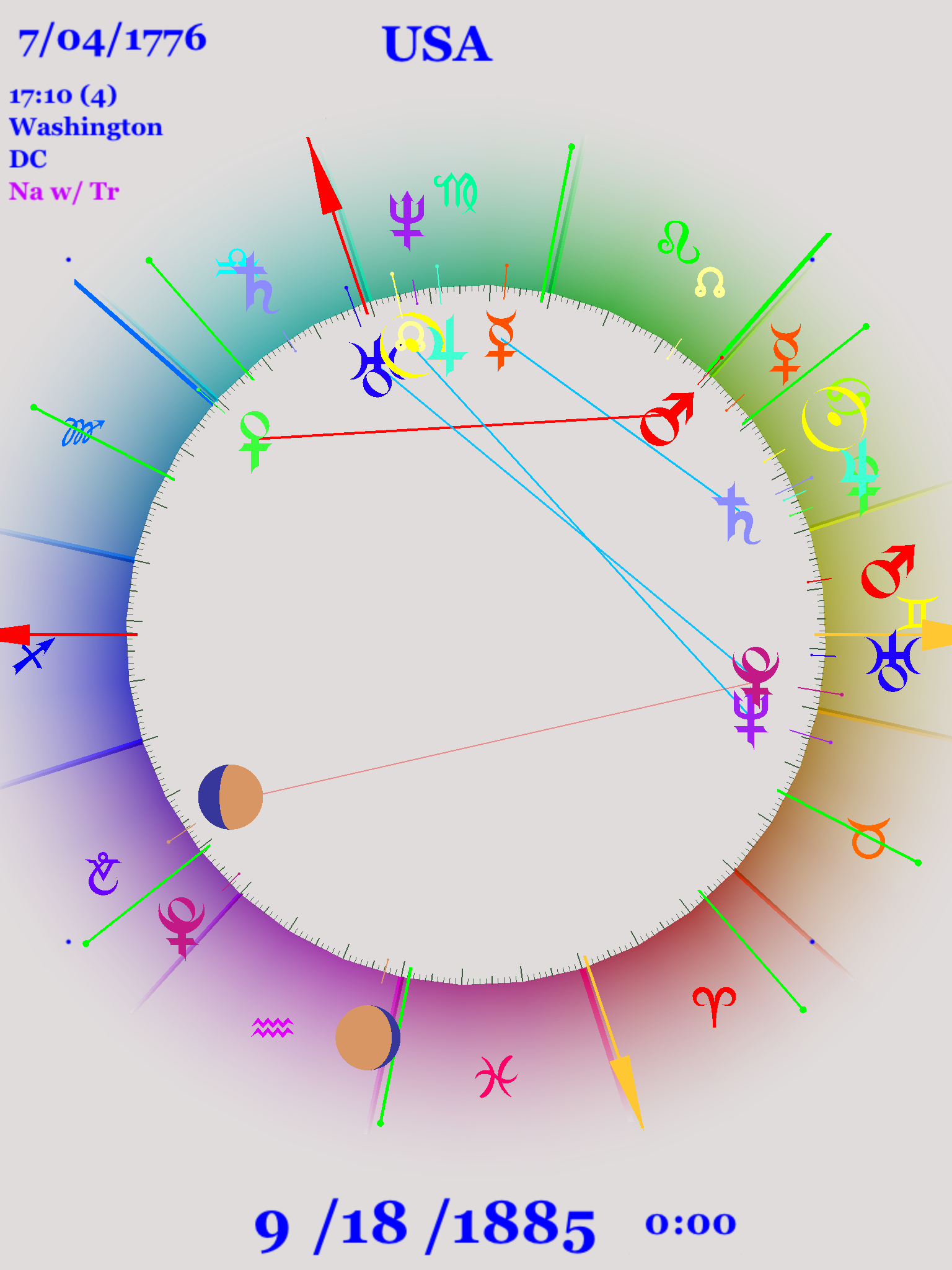
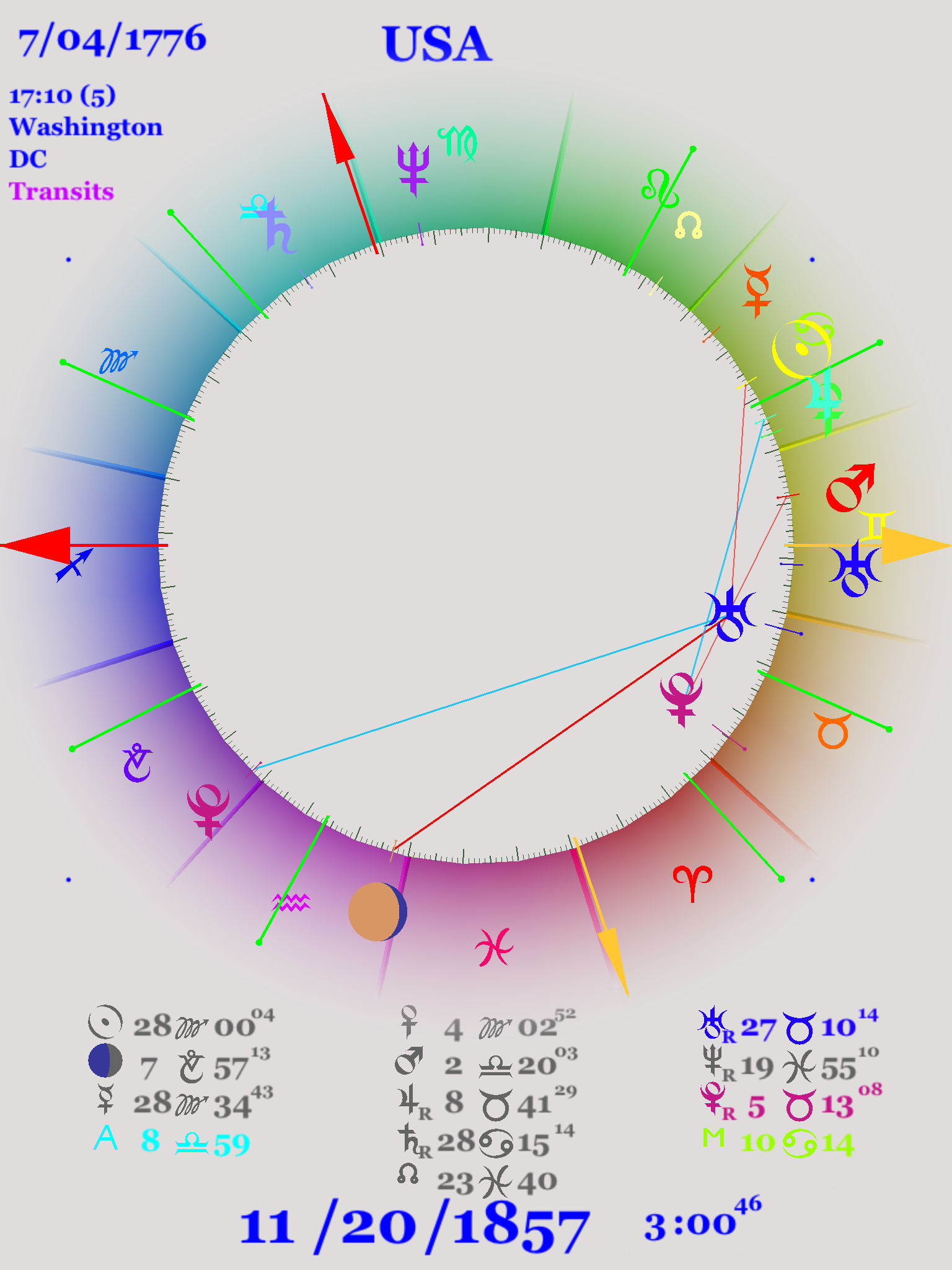
Looking at the first chart for September 15, 2008 we see that Pluto is very near to 0 Capricorn, having crossed it the first time this cycle in January of the same year.  It was near the cardinal point through 2007, 2008, and 2009.

Since this is the crossing of the cardinal axis, I consider it an important event, more important than the Great Depression of the Thirties, which is commonly said to have started in 1929.  We are regaled weekly by now that the Recovery has happened, that the Great Recession is so far removed in time, and that the economy is doing so well, that we should forget about it.  But for the great majority of people, the good times have not returned, if the times before 2007 could be considered “good”   for many people in the United States.  Even though the unemployment rate in the US has fallen,  many people have dropped out of the job market, and thus are not classified as unemployed, and the wages of the new jobs are much less that of the old jobs lost in the Great Recession.  And it appears that Europe  will soon witness its third dip in GDP since  the Great Recession, Japan is having problems, and the economic  news from China is not as rosy as it was a few years ago.  In  the United States one of the main effects of the Great Recession was to transfer more money to the really wealthy, so that now the top one percent of the population makes more than 25% of the national income, a figure that has risen over the last decade.   The effects of this so-called Great Recession will be with the world for a long  time.  And in 2015 many people, but not government officials, are predicting bad economic times ahead.  People are waiting for the other shoe to drop.  The price of a barrel of oil has dropped to almost half of what it was a year ago, and many countries and businesses are expected to take a hit.   The next three months see the last of the Uranus-Pluto square, and the square is tight for the entire period.

It is difficult to find an exact date for the rise of England to be the number one power in the world, replacing  Holland, but many historians maintain that it happened with Britain’s victory in the Seven Years War, known in the colonies as the French and Indian War.  I discussed this a few weeks ago.  Even knowing that, it is difficult to pinpoint the exact date when England won.  Was it the loss by the British at the Battle of Fort William Henry in August 1757?  Was it later, since at that date the war had only started?  Was it with the death of General Wolfe at the Batttle of Quebec, as shown in the famous painting by Benjamin West?   One clear date, though it is surely late, is the Treaty of Paris signed by England, France, and Spain, where France gave up their part of North America to either England (Canada) or Spain (Louisiana).   The Treaty of Paris was signed on February, 10 1763.  But  battles can change the course of history: The fighting in North America that culminated with the battle  that “James Wolfe fought outside the walls of Quebec on 13 September 1759 altered the world in a  dramatic and lasting way.” {Dan Snow Death of Victory 2009]

The rise of England to be the world power changed much for the next 150 years.  England had many colonies in all parts of the world, including one that was lost shortly after they became top dog, and maintained those colonies at least until the end of World War Two, almost 200 years later.  The history of a large and increasingly important country, India, was influenced strongly by England and its policies there, including the dominance of the Hindu people, who  worked well with the British, over the Muslim people.  Winston Churchill, the British Prime Minister during World War Two,  strongly influenced world and United States policy in those years, including the formation of the Cold War, even though Britain was no longer the most powerful nation.  And the list goes on.  The dominance of England after the Seven Years War strongly influenced the  world as we know it now, it ways  great and small.

plucap2

Treaty of Paris

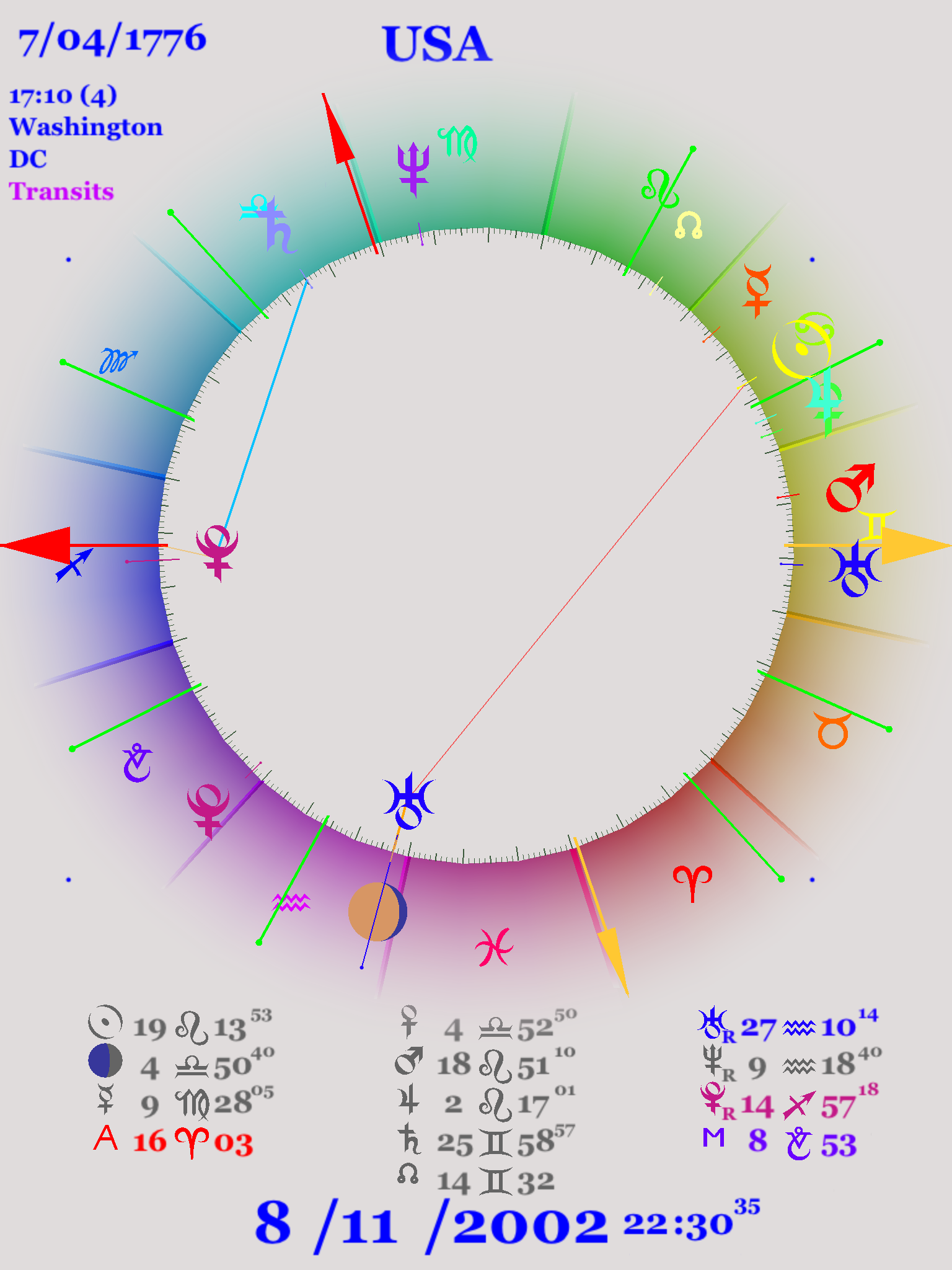
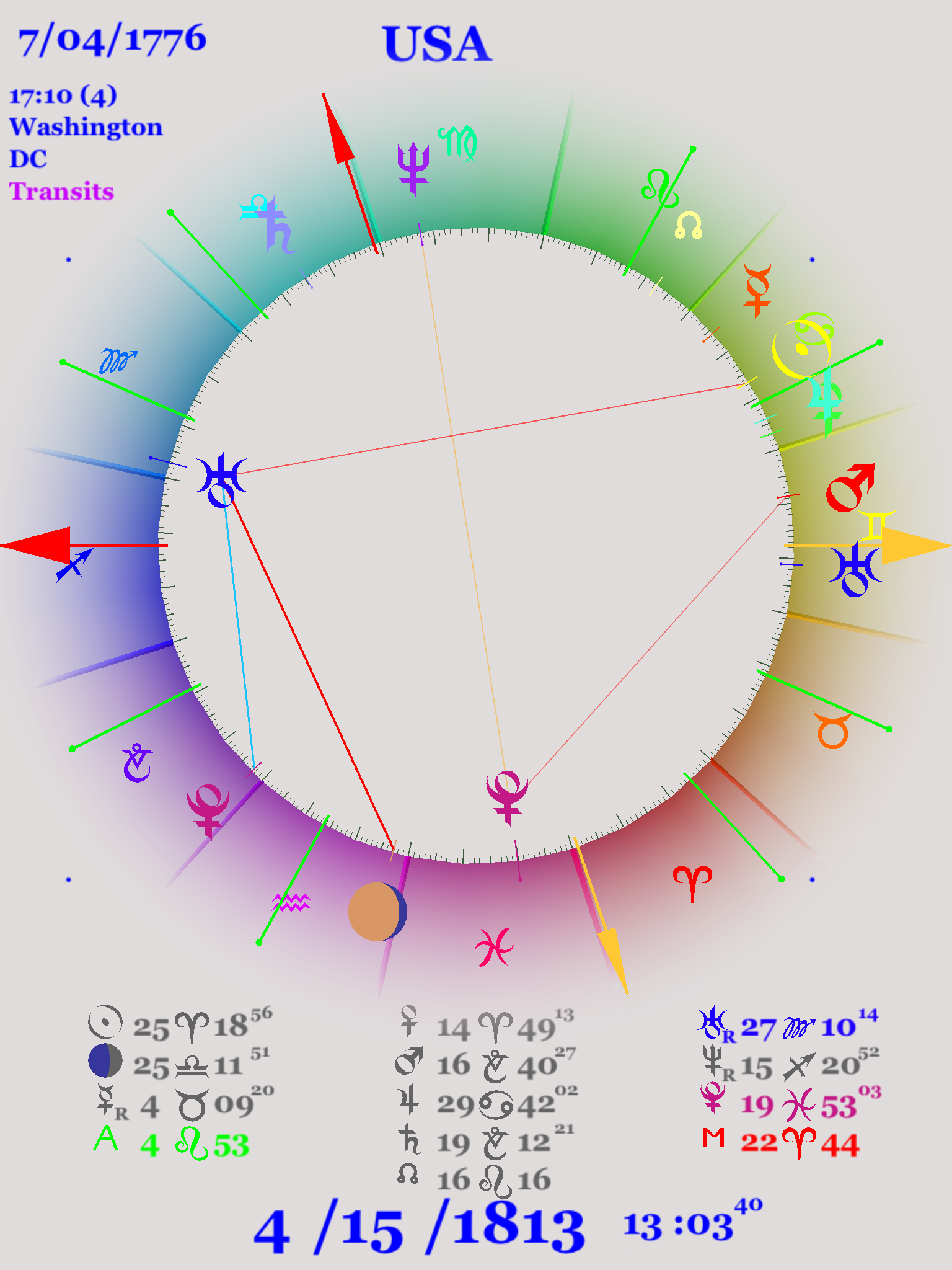
The chart for the signing of the Treaty of Paris show Pluto just three degrees past the 0 Capricorn cardinal axis.  It had been passing back and  forth over 0 Capricorn during the Seven Years War.  This was about 250 years before the Great Recession start, and thus just one Pluto cycle previously.

And what about the Reformation?  There were several movements in that direction earlier, and dissatisfaction with the Roman Church, which at that time was the only type of Christianity known since all apostolic forms had been long banished, but in general the date for the Protestant Reformation is assigned to October 31, 1517, when Martin Luther supposedly nailed his Ninety-Fives  Theses to the door of the All Saints’ Church in Wittenburg, Germany (Prussia).  Of course, the ideas contained in those theses had long been percolating in the mind of Martin Luther.  To say that this is a major  event for the world would be an understatement.  There were battles in Europe between the newly-formed Protestants and the Catholics, culminating in the very bloody Thirty Years War that decimated Germany.  (Some  think the current conflict between the Shias and the Sunnis is the Islamic equivalent of that war.) And of course there is evangelical Protestantism that has spread into parts of the world such as Latin America and Africa and is in competition with Catholicism or Islam in those areas.  America was founded by Protestants and for a long time “Catholic” was a  dirty word in that country.

plucap3

Reformation

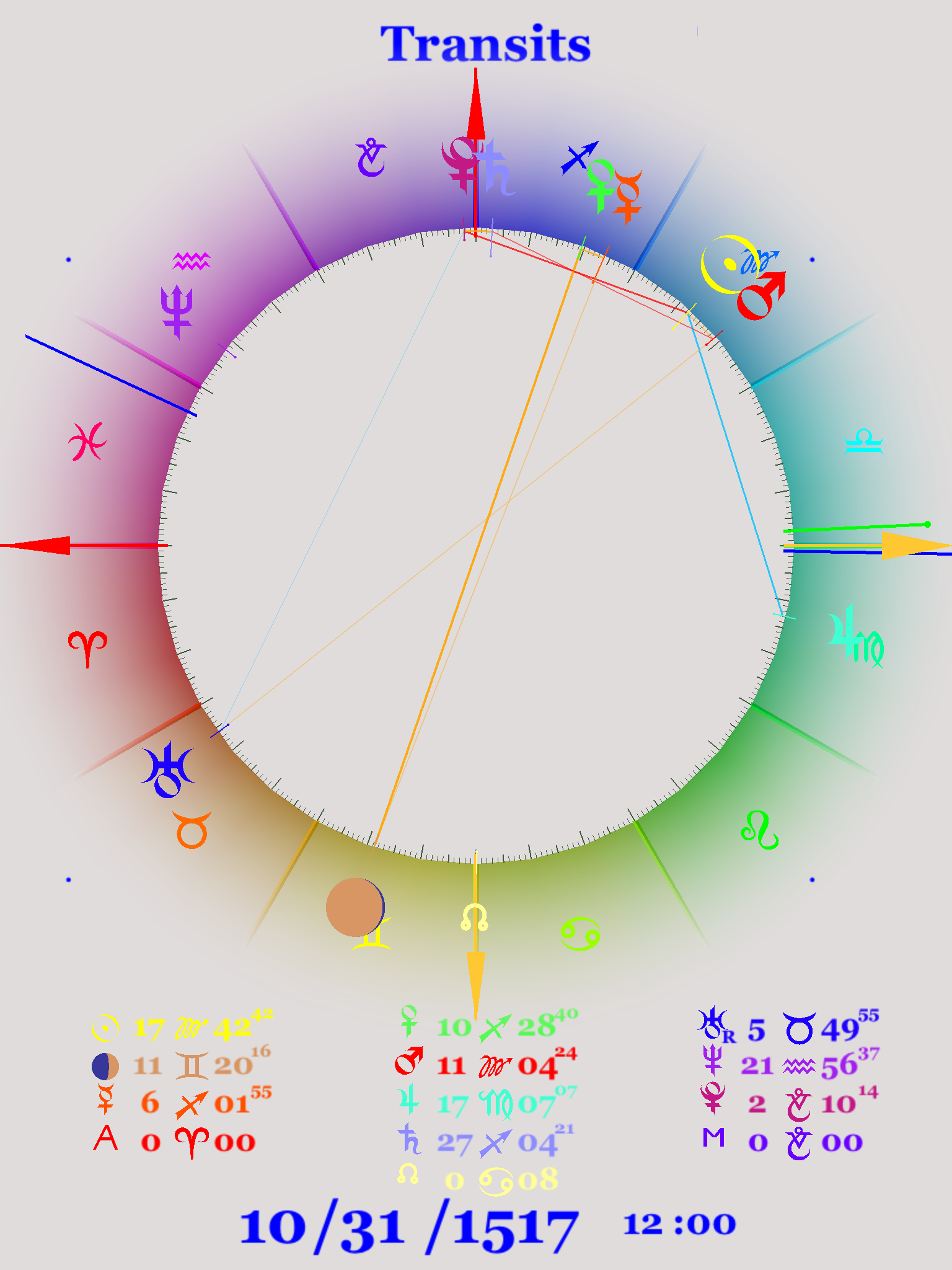
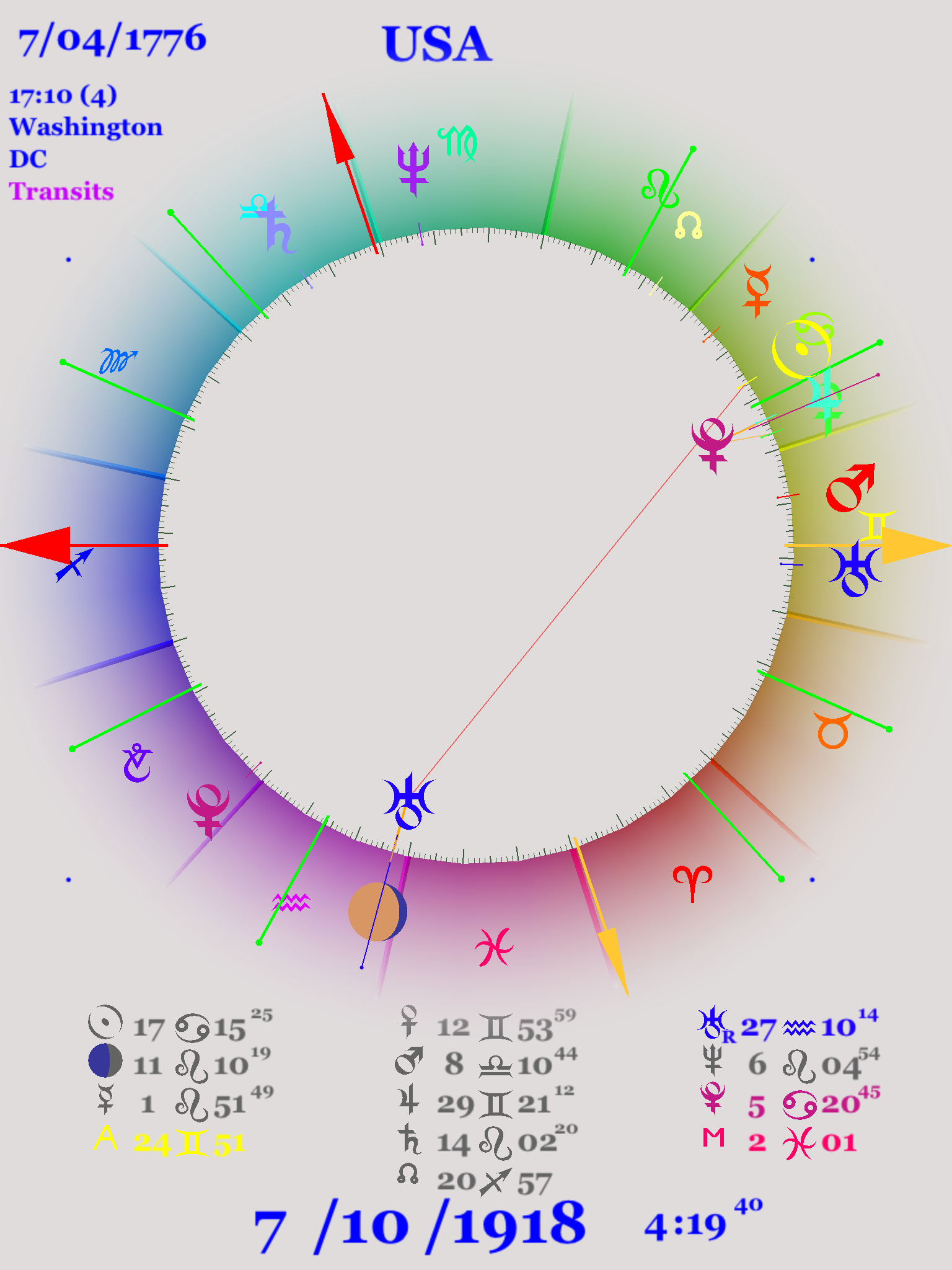
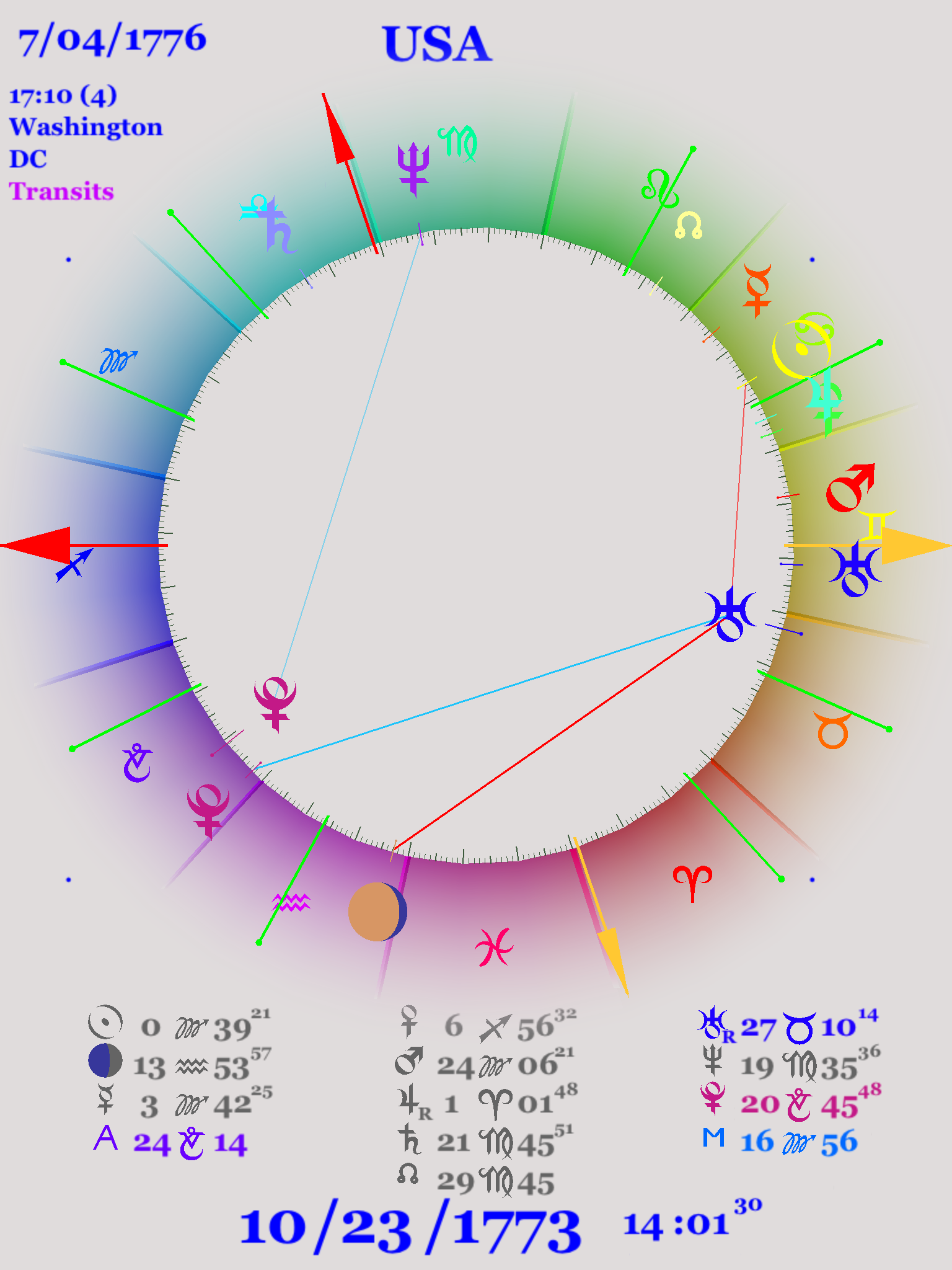
In  the chart for October 31, 1517 we again see Pluto has just crossed the Cardinal axis at 0 Capricorn.  This is again just one Pluto cycle before the previous event, and two Pluto cycles before the Great Recession discussed first.  Again, the state of the world was changed, for good and bad, and we still live with the consequences of that event, the Reformation.

Jacksonian America

Ah, what could be more boring than a discussion of the Age of Jackson?  He was President of the United States between 1829 and 1837.  That was almost 200 years ago  and who cares  about people in antebellum America.  They sure didn’t call it “antebellum”  in those days, for obvious  reasons.  But many important things developed at that time, which of course we take for granted now.  The standard biography about Andrew Jackson is the three volume set by Robert Remini, though many have written biographies about Andrew Jackson, a very interesting President whose character tells us much about America, though that might not be good.  A very good overview of Jacksonian America is The Rise of  American Democracy: Jefferson to Lincoln by Sean Wilentz.   What I am referring to as “Jacksonian America” or the Age of Jackson started before the man  was elected President, and just like Ronald Reagan, he served as a symbol for changes that were sweeping the country.

The Age of Jackson is important now because that was when the country  started  many of the  characteristics that are bedevilling it currently.  With the election of Jackson, as shown below, the country veered off from the path it had followed up to that time.  Many claim that the country became democratic, or at least more democratic, since by that time more could vote than just property holding white males.   Of course, women and Blacks, whether freed or slaves, could not vote.  Women had the vote for a brief time in some places, such as New Jersey.  This is the period in which America became a “hustler” nation (as described in Walter McDougall’s book Freedom Just Around the Corner and Morris Berman’s Why America Failed), a nation devoted to what’s best for Number One, a change from a democracy of fraternity to a democracy of cupidity (Hofstadter) as discussed previously.

Democrats claim that Jackson and Jefferson were the founders of their party, and have a Jefferson-Jackson Day dinner once a year.  While Jackson did pay obeisance to Jefferson,  I think there was a disconnect between the party of Jefferson  and the party of Jackson, which  was called The Democracy.  And while Jackson gets the credit for creating the Democratic Party, the hard organizational  work was done by Martin Van Buren (who according to Gore Vidal in his novel Burr was the illegitimate son of Aaron Burr) who was Jackson’s Vice-President in his second term, and served a single term thereafter, because the Panic of 1837 (partially caused by Jackson’s dispute with Nicholas Biddle and the Bank of the United States)  doomed  him to only one term.  Van Buren, called the Little Magician and Martin Van Ruin, who  was the first of non-British descent to make President, also ran for President in the Free Soil Party  which became  part of the Republican Party twenty years later.

Like other eponymous President Ages, the Age of Jackson started  before Andrew Jackson became president, or even before he first ran for President.  Ages get names for significant Presidents who happened to be in office when major changes were overtaking the country, and they were just one of the changes, and something about their behavior or actions symbolized the changes taking place in the country.  For those who accept the Great Man theory of history, then the President was the person responsible for the changes taking place in the country.

In the United States, the country had as Presidents up until Jackson  either Founding Fathers or relatives of such, and most of those Presidents before Jackson were members of what is called the Virginia Mafia, since they were all from Virginia.  The Presidents of the United States were George Washington, from Virgina, and then John Adams, from Massachusetts, first Washington’s Vice President and then a one-term President, then Thomas Jefferson, from Virginia, the James Madison, from Virginia, then James Monroe, from Virginia, and then John Quincy Adams, from Massachusetts and son of the first Adams.  In the contested election of 1824 Jackson ran against Adams and, even though he had more electoral votes, did not have enough and so the issue was settled in the House of Representatives.   One of the candidates, Henry Clay of Kentucky, withdrew and threw his support to Adams.  Later, when Adams was President he appointed Clay to be Secretary of State.  This was not a politically wise thing to do, but since Clay was obviously the most qualified person for the post, it was natural that he was appointed by Adams.  Jackson was  very upset at what he considered a “corrupt bargain” and began campaigning for the next election.   There was so much ill will towards Adams that not much was accomplished in his term, but his remains the most accomplished post-presidential career.  Jackson beat Adams in the next election and served two terms.

At this point in the early Nineteenth Century the Industrial Revolution, which had began in England over 100 years before, finally spread into the wider world.  The Industrial Revolution is declared to have come to America in 1790 when Samuel Slater, who  was an apprentice in England, brought ideas of the Industrial Revolution to New England.  England had attempted to keep the ideas of the Industrial Revolution within England, but that could only last so long.

By the third decade of the Nineteenth Century  what is called Laissez-Faire Capitalism developed within America.  This had been started by the publication of Adam Smith’s The Wealth of Nations in 1776.  Laissez-Faire implies leaving people alone to follow their own path.  What it amounted to in reality is that businesses could do whatever that wanted, within reason,  to make money.  At the beginning of this revolution, because it was certainly a revolutionary principle, things went along fine. It wasn’t until after the Civil War and the rise of corporations, starting with the railroads which had been empowered by the War, that things began to vary from the ideal.

Along with this was the development of something called the Market Revolution in America.  The cotton gin had been invented at the end of the Eighteenth Century, and it was coming into use in the South, where much cotton was grown.   Before the cotton gin, people wondered if there was a future for slavery, but the cotton gin made possible the  use of a type of cotton that had previously been difficult to use.  This made the need for slaves to harvest the cotton more important than ever.  This cotton was shipped to the many weaving factories in New England that had been automated by the work of Samuel Slater.  Massachusetts especially developed many weaving factories and employed young women from the cities.

At this time, when the Age of Jackson was starting, there was also a Transportation Revolution.    Before this time goods could be slowly transported by horse and wagon over relatively primitive roads or shipped down the Mississippi River to New Orleans.  But in this period many well maintained roads — call  turnpikes — were build by the Federal government, which allowed faster transportation by horse-drawn wagons.  There was also the building of the Eire Canal in upstate New York, joining the Great Lakes to the Hudson River whose outlet was New York City.  This allowed ships to enter the Hudson River at New York and access the many cities bordering the Great Lakes, including Chicago, and from there reach by wagons much of the Midwest.  While the Eire Canal is in much disrepair now, at the time it was revolutionary and allowed the country along the canal to build up, as well as the land of middle America that could now be reached from the Atlantic.  Other canals were built at this time,  connecting, for example, Lake Eire and the Ohio River.  The Cumberland Road, also known as the Nation Road,  was built in this period and extended over 600 miles from Cumberland, Maryland into Illinois.  It became the first road in America surfaced with macadam.  Steamboats became popular on the Mississippi River (think Mark Twain) and allowed relatively easy transport of people and goods up and down the most important river in the country, and helping to unite the Midwest.  Accentuating  this trend to easier transportation, the  railroad was first introduced into the United States in 1828.  By 1830 the Tom Thumb, first common-carrier railroad, was built.  The development of a railroad system in the United  States was helped by much investment from England.

The Communication Revolution is another event that occurred in antebellum America.  America had been a country interested in writing since the early days.  Daniel Boone, when he was out in the country, enjoy being told the tales of Shakespeare.    Bookstores were one of the first establishments to go  into a new town.  In this Jacksonian period the Napier steam-driven press was developed in England  and allowed more books and newspapers to  be printed easily.  This allowed the burgeoning middle classes to more easily find books, magazines, and newspapers, and helped support a literate population.  Schooling increased and eventually public schools became commonplace.  The telegraph was invented at the end of this period by  artist Samuel F. B. Morse in 1835. The telegraph has been called the Victorian Internet and for the first time ever allowed near instantaneous communication.

jackson1

Age of Jackson 1

The most important transit for this period, and one with deep seated meaning, is that of Pluto over the IC of the US chart, and thus opposite the MC (black arrow chart 1).  The IC represents the foundation or base of the entity in question, in this case the Untied States.  Transits over the IC appear to last longer and their meaning less obvious than transits to more visible points.  Since Pluto moves so slow, this transit had never happened in the history of  the country;  it previously happened in the 1570s.  Pluto represent large scale change or transformation, and that is indeed  what the Age of Jackson had to offer.  There was a massive change in the United States, which had only won their war for independence forty or so years previously.  The country had started to become its own person (cf Joyce Appleby, Inheriting the Revolution for a description of the first generation of post-Revolution Americans).  Pluto then went on  to square the Sun of the US in 1832–38 (black arrow chart 4).  This was the time of the development of abolitionism and William LLoyd Garrison’s newspaper The Liberator.    The closing of the Pluto Sun cycle, and of course the beginning of  the next cycle happened with the Pluto conjunct Sun aspect in the  Twenties.

jackson2

Age of Jackson 2

jackson3

Age of Jackson 3

Compounding this situation during these years was the actions of Uranus and Neptune.  These two planets were conjunct in 1820-23 (red arrow in first chart) and square the MC  of the United States.  This conjunction happens three times per 500 years and the next time that conjunction happened was in  the early 1990s and we are still strongly witnessing the effects of that conjunction.  The conjunction of the early Nineteenth Century was opposite two of the core planets of America, Jupiter and Venus.  Uranus went on to oppose the Sun in 1823-24 (black arrow in second chart) and Neptune opposed the Sun 1824-27 (black arrow in third chart).  These aspects just added to the central changes happening in the country, in so many areas.  In this group of aspects the final one was Uranus conjunct the US Moon (chart 4),  which has been discussed before and signified the revolution of Texas, which had been part of Mexico but then split away, hoping to be part of the United States.

jackson4

Age of Jackson 4

Neoliberalism and the Cult of the Market

I am entitling this post “Neoliberalism” even though what happened in this period was much more than the development of neoliberalism (also known as market fundamentalism) in the world, but that by itself is more than enough.  As we’ve seen  before at times of midpoint configuration between the three outer planets, things change in such a  drastic way that it is hard   to remember what life was like before that time.  One could call it a “phase change” in society, a watershed moment, or a Zeitgeist (German for spirit of the time) change.

First we should define neoliberalism. My favorite definition, which I coined myself, is Market Über Alles,  the market above all.  Thus the demands of the market supersede anything else:  We must lower the taxes on markets and those who run them, privatize everything, the government can not do anything right, regulation of markets (by the government) is bad so we must reduce regulation.  These policies have been ascendant since this time; for another look at this phenomena see Merchant, Soldier, Sage:   A History  of the World in Three Castes  by David Priestland.

neol

Neoliberalism: Uranus at the midpoint of Neptune and Pluto

We can see signs of this all around, and it is increasing: privatize the Post Office  (it was partially privatized long ago),  replace public schools with charter (ie., private) schools, replace the government-run military with private contractors, what use to be called in a simpler time mercenaries.  Let the water  system be run by private contractors.  Replace  government-run prisons with private prisons.  How about private roads and bridges?  And don’t forget medicine; trust the (private) insurance companies to provide you with health care.

First we must start with Ronald Reagan.  Many people are upset at the title of Sean Wilentz’s book The Age of Reagan, but I realized that it is certainly true.  Some President have such a wake that the administrations after them take on some of the same characteristics that the eponymous President’s administration had.  Thus  we speak of the Age of Jackson from at least 1829 when Andrew Jackson took office to 1861 when a Republican took office, the Age of Roosevelt, from 1933 when Franklin Roosevelt took office until 1974 when the last New Deal President resigned.  And finally we have the Age of Reagan, starting when the sainted Ronald Reagan took office in 1981 and still going strong, in fact stronger than ever.  Just as I believe those previous two Ages  started before the named President was elected, and his  election was  just a concrete  manifestation of the changes that took place in the country’s psyche, the Age of Reagan, the only one whose start I was able to witness, started before Saint Ronnie was elected.  One can see many signs of the upcoming age under President James Earl Carter.  Among other things, Carter deregulated the airline industry, the trucking industry, railroads, and he started  the process of deregulating the telecommunication industry.  He also got the CIA involved in Afghanistan before the Soviets invaded, a forerunner of Reagan’s  boosting the Cold War.  This is much like Roosevelt carrying forth ideas of Hoover to combat the Great Depression, as a member of FDR’s Brain Trust Rexford Tugwell pointed out. Conservatives who are not blind to Carter realize that just as it took a Republican to recognize Red China — as the expression  Nixon in China well illustrates — it took a Democrat to realize the “miracle of markets” and start the ball rolling for neoliberalism.  In fact, Carter’s final defense budget was greater than Reagan’s first.  And he proclaimed the Carter Doctrine, that any threat to Middle East oil is a threat to America, and even force may be used to stop that threat.

Carter’s Security Advisor, Zbigniew Brzezinski, early in 1979 convinced Carter to allow the CIA to set up operation against the Soviet-backed government in Afghanistan, hoping to embroil the Soviets in what he called “their Vietnam” in that country.  The Soviets took the bait to support the Afghanistan government, and the result was a long and bloody civil war that the next president was more than willing to support.  From that came Osama Bin Landen, the Taliban, 9/11, and the continued involvement of America in Afghanistan still 35 years later.  What may have seemed like a good idea at the time had long-ranging repercussions and the world is worse for that decision.

Another thing that Carter did that helped  get neoliberalism started, even though  it cost him the 1980 election, was to appoint Paul Volker head of the US Federal Reserve in  July 1979  and Volker soon changed the monetary policy of the country, resulting in bad  economic conditions that doomed the Carter presidency.

Half way around the world,  China in 1978 got a new leader in Deng Xiaoping to replace Mao Tse-tung who had died a couple of years earlier.    Deng started a massive change in the economic policy of China; he is reputed  to have said “To be rich is glorious” which certainly could be a motto for neoliberalism.  But the changes that he started in China are well known today in the United States, where it seems that more and more of the products for sale in our stores, whether cheap clothing or expensive computers, are made in China.

And in Great Britain in May of 1979 the shopkeeper’s daughter Margaret Thatcher was elected Prime Minister.  She served as a good partner for Ronald Reagan, elected 18 months later, to remake the world in the vision of neolibreralism.  Her motto was TINA — There Is No Alternative.  And she certainly remade England, with her crushing of a coal miners strike being only the most obvious example.  And  governments after Thatcher, either Tory or Labor, followed the Thatcher formula.  Even now Britain’s National Health Service, a beacon for the world, is being dismantled and replaced by private practice.

But on a more local level, California passed Proposition 13 in the Summer of 1978 to amend the Constitution of that state.  Passage of this had profound implications for the state, and was a trendsetter for the country.  The major effect of this act was to limit property taxes in the State of California, which hampered the construction  of new schools, among other things.  The act also required a two-thirds majority of both houses of the state legislature to change the state taxes.  Since it was difficult to get such a majority in both houses, there became less and less  money for such things as education, both for public schools and the state university system, which had been relatively inexpensive for residents and had been renowned for its quality.  Both those things disappears in the aftermath of the passage of this act.

The National Rifle Association — NRA — is famous  for their strong stand on the supremacy of the Second Amendment  and their equally strong political stand.    Many people forget that the NRA use to be a simple organization devoted to gun safety and teaching young people to handle firearms.  Then, in 1977, there was a right-wing coup in the organization called the Revolt in Cincinnati; the NRA was taken over by a small band of firebrands and the organization was remade into the NRA we know today.

Iran has been ruled by an autocrat who had been put into office by a coup instigated by Kermit  Roosevelt, son of Theodore, working for the CIA in 1954; this was Shah Mohammad  Reza Pahlavi.  His secret police SAVAK were notorious. But in 1979, while the Shah was out of the country, an Islamic revolution occurred which toppled the government that had been strongly backed by the United States. Ever since that time Iran has been ruled by an Islamic government  and has been severely opposed by the United States government, which still does not have diplomats in that country.

neol_tg

Transiting Nepturn/Pluto Midpoint

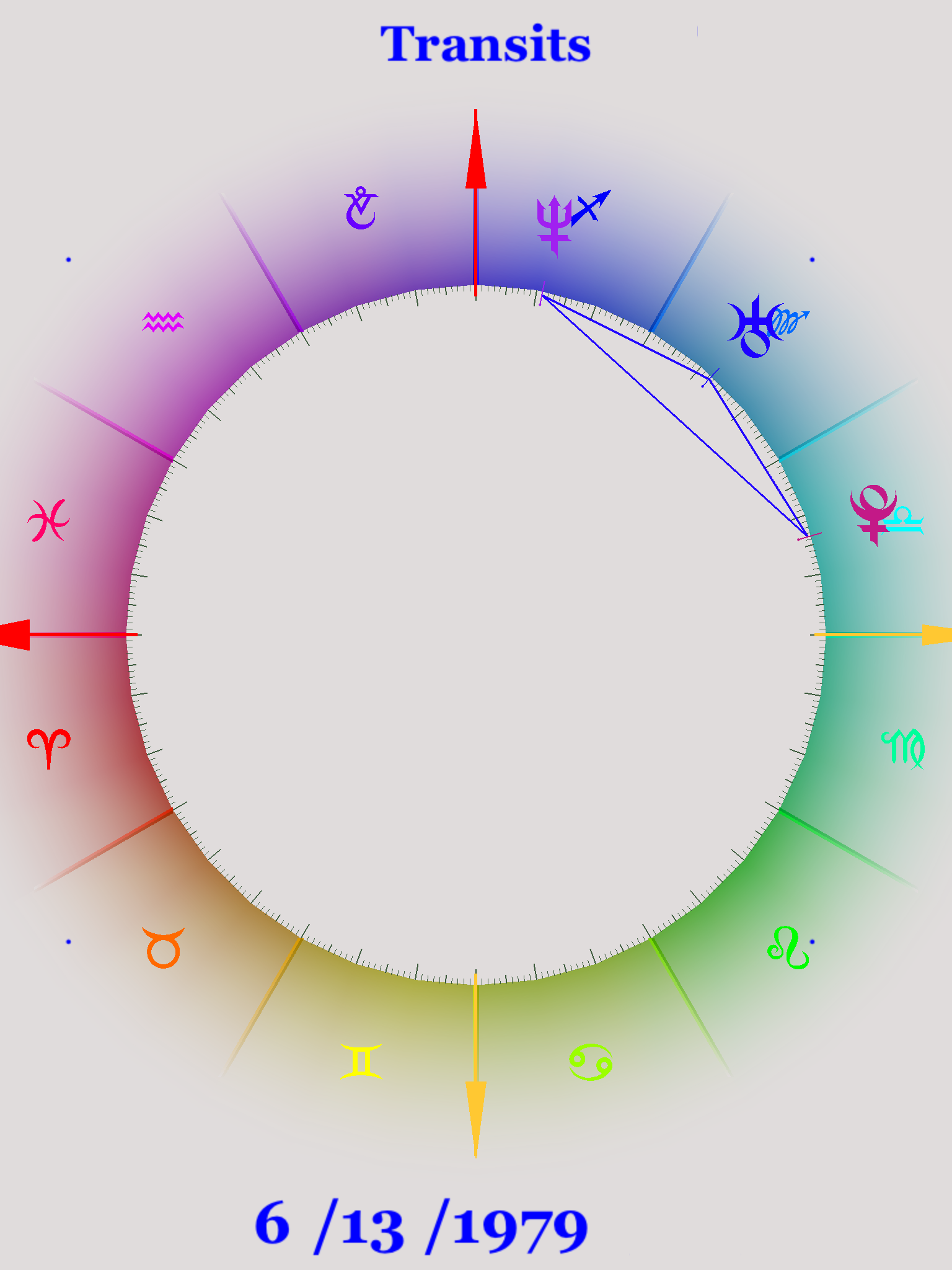
This graphical ephemeris show a period of five years from the middle of 1976 through the middle of 1981, with the center at the start of 1979.  The  blue wavy line is transiting Uranus, and the other wavy line is the transiting Neptune-Pluto midpoint.  You can see they start to get very close at the beginning of  1978, are in contact through 1979, and separate in 1980.  The other chart near the top is a standard wheel for a specific time.  In that you can see clearly Uranus at the midpoint of Neptune-Pluto. This was the third and last midpoint involving the three outer planets this century.   The previous two midpoints, which have already been discussed, were in the first decade of the Twentieth Century  and at the end of World War II.

The Cold War

The Cold War between the United States and its allies  against the Soviet Union and its allies started right after World War II ended — we will deal with the exact start in a later post — and  supposedly ended  with the fall of the Soviet Union on Christmas Day 1991.  Some authorities contend that the Cold War started with the rise to power of the Communist Party in Russia at the end of World War I.  That  was indeed an early version of the Cold War,  which involved the United States, Britain, France, Italy, and Japan sending troops to fight against the Communist government in a Civil War that occurred with the fall of the Czar in Russia.  And near the beginning of the Second World War several leaders, such as Harry Truman, maintained that we should support Germany if it looked like the Soviets would win, and support the Soviet Union if it looked like Germany   would win, in a hope that both countries would destroy each  other.  Nevertheless, the Soviet Union was allied with the United States during World War II and so the Cold War did not start in all its glory until that war ended

coldwar1950

Cold War 1950

The operative aspect during the Cold War was what is called the Long Sextile between Neptune and Pluto.  Pluto is an oddity among the planets since its orbit is very eccentric so that at some times it travels  much faster than at other times, and once every 250 years it goes inside the orbit of Neptune so that it is no longer the outermost planet.  That happens appropriately when, since Pluto is considered to be the ruler of the sign Scorpio, the planet is in the sign Scorpio.  This happened between January 1979 and February 1999, with Pluto closest to the sun (perihelion) half way between those two dates.  As the result of this, the sextile between the two planets lasted a very long time, and it will return in another decade, but that is an important topic for another time.  As a result, this is called the Long Sextile.

coldwar1980

Cold War 1980

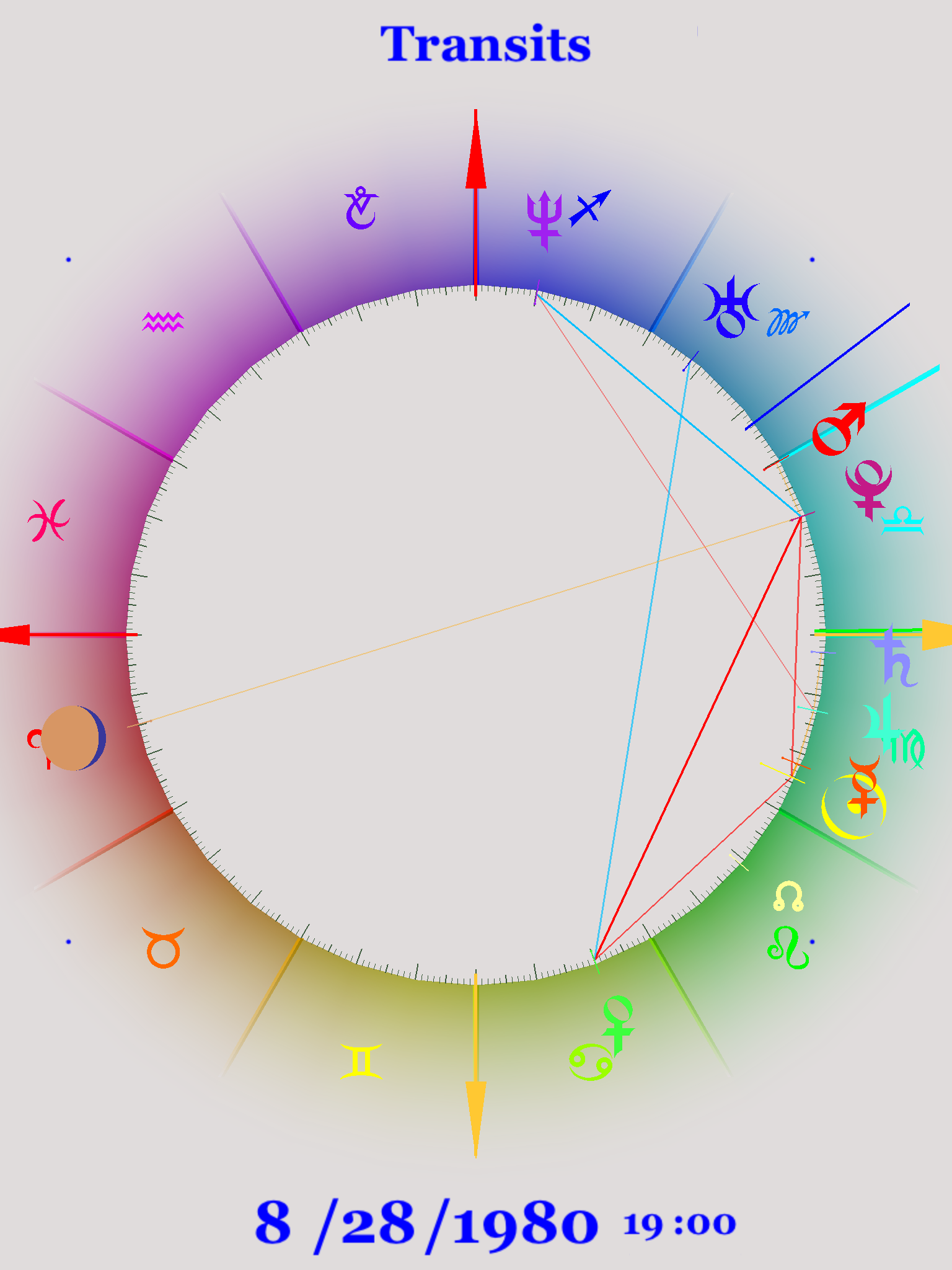
The first two charts illustrate a typical sextile between the two planets , one from 1950 near the beginning of the Cold War,and one for 1980, thirty years later when the Cold War had warmed up again. In both charts notice the blue line representing a sextile between the planets  Neptune and Pluto.  But the real  proof is in the graphical ephemeris shown below. This graphical ephemeris covers a fifty year period, between 1944 and 1994, and shows in the sixth harmonic just two planets, Neptune and Pluto.  We know that in a sixth harmonic chart, planets that are exactly sextile show as conjunctions, or lines that are together in the graphical ephemeris.  From the graph we can see that the two planet first came close together in 1946 or 1947, stay close together until they finally separate in 1991 or 1992, mirroring the extent of the cold war that lasted all those years. We also  notice that the lines get very close together in he early Fifties, just as the Cold War was getting intense with the successful Communist victory in China, the Korean War, the first successful atomic bomb explosion by the Soviets, and in the United States McCarthyism.  The other time the planets are very close together is in the early Eighties with President Ronald Reagan,  when defense spending greatly increased, when he talked  about the military plan called “Star Wars” and helped the fights in El Salvador and Nicaragua.

coldwartg

The Cold War 1945-1991

Also notice that the two lines, representing Neptune — blue– and Pluto — red in the late Sixties, early Seventies are further apart.  This is  when President Richard Nixon was practicing the policy of détente with the Soviet Union.  One important treaty negotiated during this period was called SALT I for Strategic Arms Limitation Treaty.  This was in the works between late 1969 through 1972.  On May 26, 1972 an Anti-Ballistic Missile Treaty was signed between Richard Nixon and Leonid Brezhnev.  Also in this period was the famous “Nixon Goes to China” moment when Richard Nixon when to “Red” China, something that was unheard of before then, and the subsequent recognition of China by the United States and then the admission of mainland China to the United Nations, something that had been blocked (mostly by the United States) since 1949.  In fact, it was because the Soviet Union was not in the United Nations Security Council in 1950 to protest the exclusion of China from that body that allowed the United States to have the United Nations approved the start of the Korean War.

As we’ve seen previously, a midpoint involving the three outer planets represents a watershed moment.  For the midpoint that indicates the start of the Cold War, this is certainly true.  It was a bifurcation point in the flow of time, where the future was radically different that it would have been without the Cold War.  The Cold War has affected the whole world and the way it behaves, in ways unimaginable and not really seen at the time it started.  But by now the “official” Cold War has been over for almost a quarter century.  We are living in a post Cold War world, but the effects of the Cold War has changed the way we response to most everything.

America has always had enemies, someone it could dominate and rail against, someone that the people at home would draw together against.  For much of the early  years of the country the enemy was Great Britain, the country it was a colony of for a long  time, and finally rebelled against.  The US then had another war against that country a quarter century later.  But by the time of the Spanish-American War, the enemy was that by then decrepit empire Spain.  This served as an enemy until the Huns in World War One intervened.  But at the end of that war there was the Russian Revolution  and they became the official enemy, a status that has endured even though the official Cold War has supposedly ended.  One historian (Gordon Wood, The Idea of America) has an interesting theory as to why the Russians were so hated  after their Revolution.  For over a century after the American Revolution, America is where  anyone considering a more democratic country would look.  It was almost as if the definition of revolution was illustrated with a map of America.  But after the Russian Revolution, this  was no longer the case.   After that act,  when people though of revolution, they thought of Russia.  We  were no longer the top dog in the Revolution-definition business.  Russia had stolen America’s thunder, and America was not about to allow that to happen.

After the Soviet Union ceased to exist, America searched for another enemy to take its place.  The first choice  was the menace of drugs, come to steal out precisions bodily fluids.   That audition did not go over too well, and fortunately 9/11 allowed America to bring back a bogeyman that Ronald Reagan declared war on 20 years earlier, but this time it seemed more real and was brought  home to Americans on their television screens,  the window to reality. This new threat was terrorism, and so a  War on Terrorism was declared.  Some people pointed out the difficulty in declaring war on a noun, and that terrorism was a tactic, and some  even pointed out that America was the largest purveyor of terrorism, but none of those  arguments held much sway with the American people.  In fact, the argument became are you for the country or for the terrorist, just like in previous times the question  was are you for us or the Communist.  It was a black and white world.

It won’t be for several hundred years, when we are able to look back at the Cold War as a historical period and  not as a entity which has just recently passed, and maybe not really, that we can see this period is one of insanity.  It changed drastically where money was spent, so that trillions were sent to defense companies, making their owners very wealthy, which reduced the amount of money  available for most of the people.  As President Eisenhower said “Every gun that is made, every warship launched, every rocket fired signifies, in the final sense, a theft from those who hunger and not fed, those who are cold and are not clothed.”  These  days that certainly sounds like Communist propaganda, and the person who said is not fit to be allowed in society, but Eisenhower was a Republican President  and a war hero of the Second World War.  That one quote shows how much things have changed in the last sixty years.

We are now in the post Cold War world, but having the Cold War as such a prominent feature of the world for so long — 45 years — has changed the way people think.  Our first response to any problem is to send in the weapons, if not “boots on the ground” then at the very least a few bombs, missiles, or drones. The  world has developed so that the killing of strangers because they happen to be in the wrong place at the wrong time does not seem worthy of comment, and the interception of all personal messages seems perfectly normal.  In fact, supporters will often give praise, or at least find an excuse, when their leader does any of that.

Death of the Uni-polar World

One of the phenomena of the last 500 years — the Party Time — was the rise of the uni-polar World.  This is a world that has one dominant player.  Before that time, the concept did not really exist, since the world was not globalized, and the large scale empires of the time, such as the Roman, Chinese, or Persian, only held sway over a  limited part of the whole world.  Once the New World was known by the Europeans (and I ignore those  who criticize the term since it was obviously known by the natives, as a case of semantic confusion) the uni-polar world became possible.  We are now moving into a multi-polar world where there is more than one power center.   But the unfortunate situation is that the uni-polar power at this time does not recognize that a multi-polar world is possible or desirable.  When the previous uni-polar champ, Britain, was replaced in the early years of the Twentieth Century, it was able to resign with some grace  and did not make a scene.  This is often held up as a example that superpowers  should follow.  But perhaps Britain was an exception to the rule that a superpower does not go gently.  For the next 500 years, there will be several dominant powers in the world, including, one hopes, the people of the world, as was predicted by the New York Times (“world public opinion was a second superpower”) after  the large marches on  February 15, 2003 to prevent the invasion of Iraq.

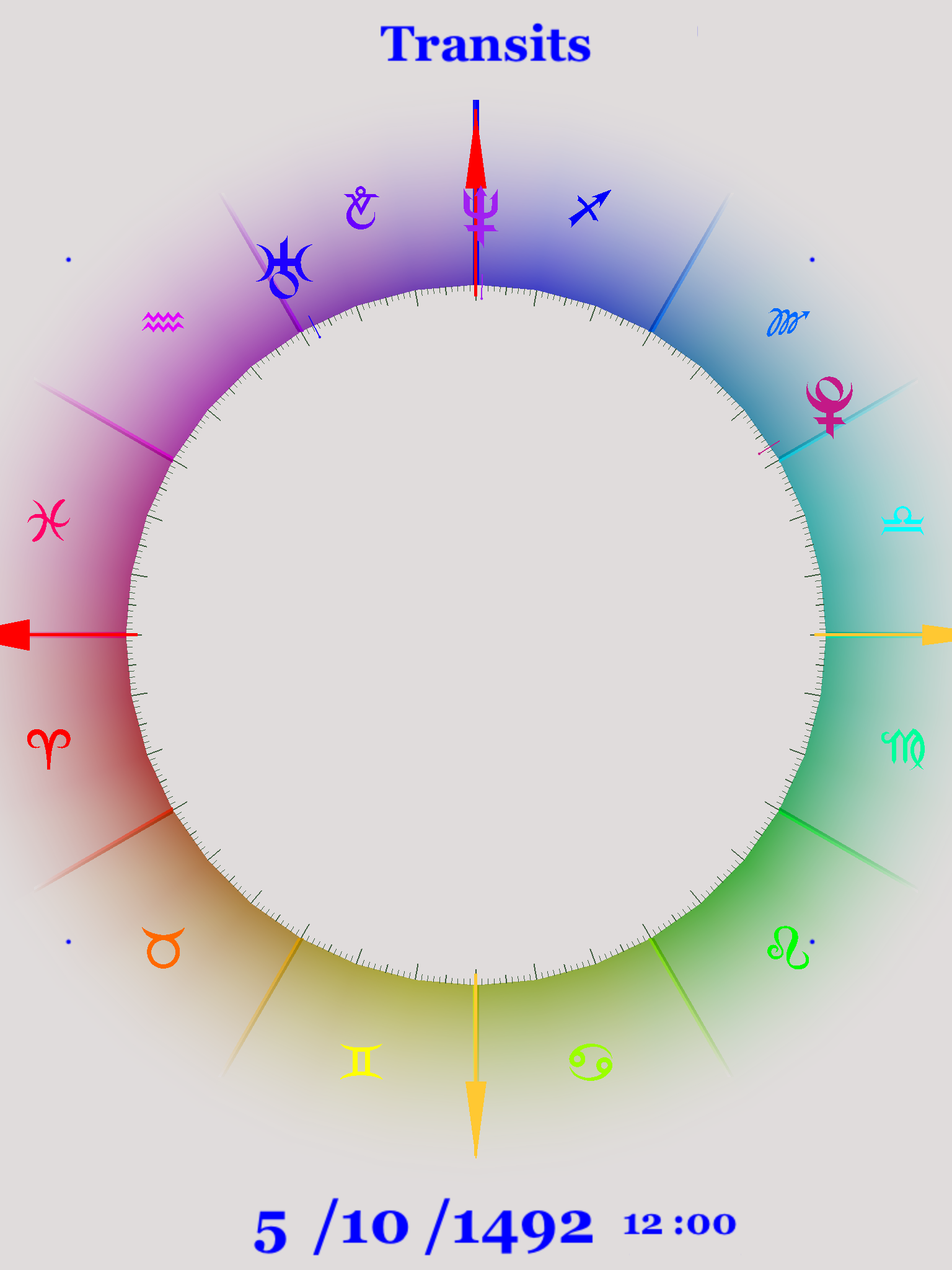
For the purpose of this entry, I am going to talk about four superpowers that dominated the last 500 years, their rise and fall.  These four were, in turn, Spain, Holland, Britain, and the United States.  The important astrological event for these power changes seems to be Pluto crossing the Cardinal Axis — 0 Aries, Cancer, Libra, and Capricorn.  Note that the importance of the cardinal axis is shown by the chart of   1492, which has Neptune, and not Pluto, crossing the cardinal axis.

Spain was the dominant power at the beginning of this 500 year period because the country became unified and they had  several explorers travel to the rest of the world and bring back riches, gold and silver, to the home country.

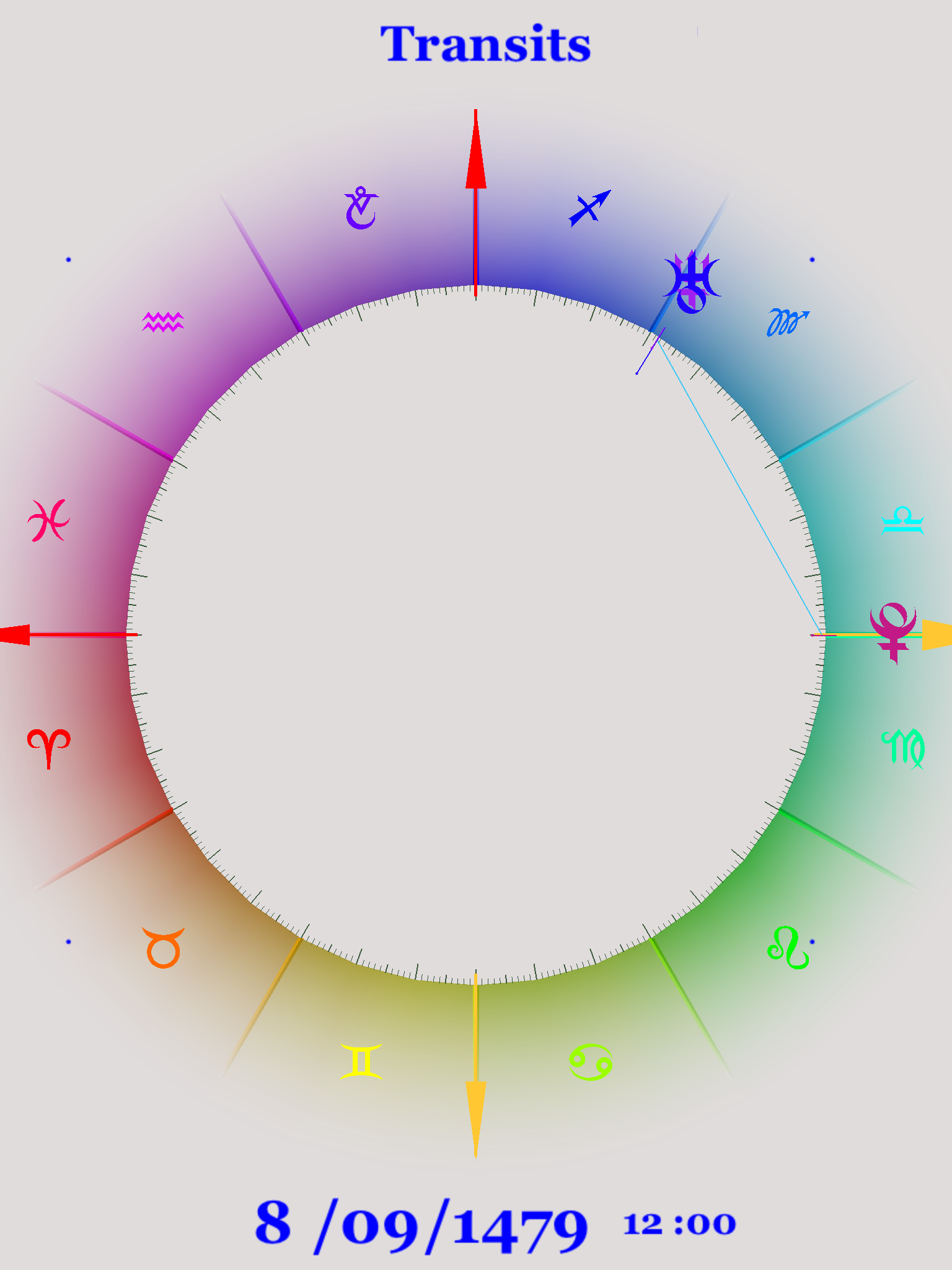
uni1479

Rise of Spain

The important year seems to be 1479:  This was after Isabelle and Ferdinand were married, but Isabelle was still involved in a war    with her sister over control of Castile.  This  war was settled in September of that year with the Treaty of Alcáçovas.  Also that year Ferdinand succeeded his father in Aragon.  This paved the way for Castile and Aragon to join together and   a unified Spain to result.  As we can see from this chart, Pluto crossed the Libra point, and thus crossed the Cardinal Axis.

uni1492

Spain Unified

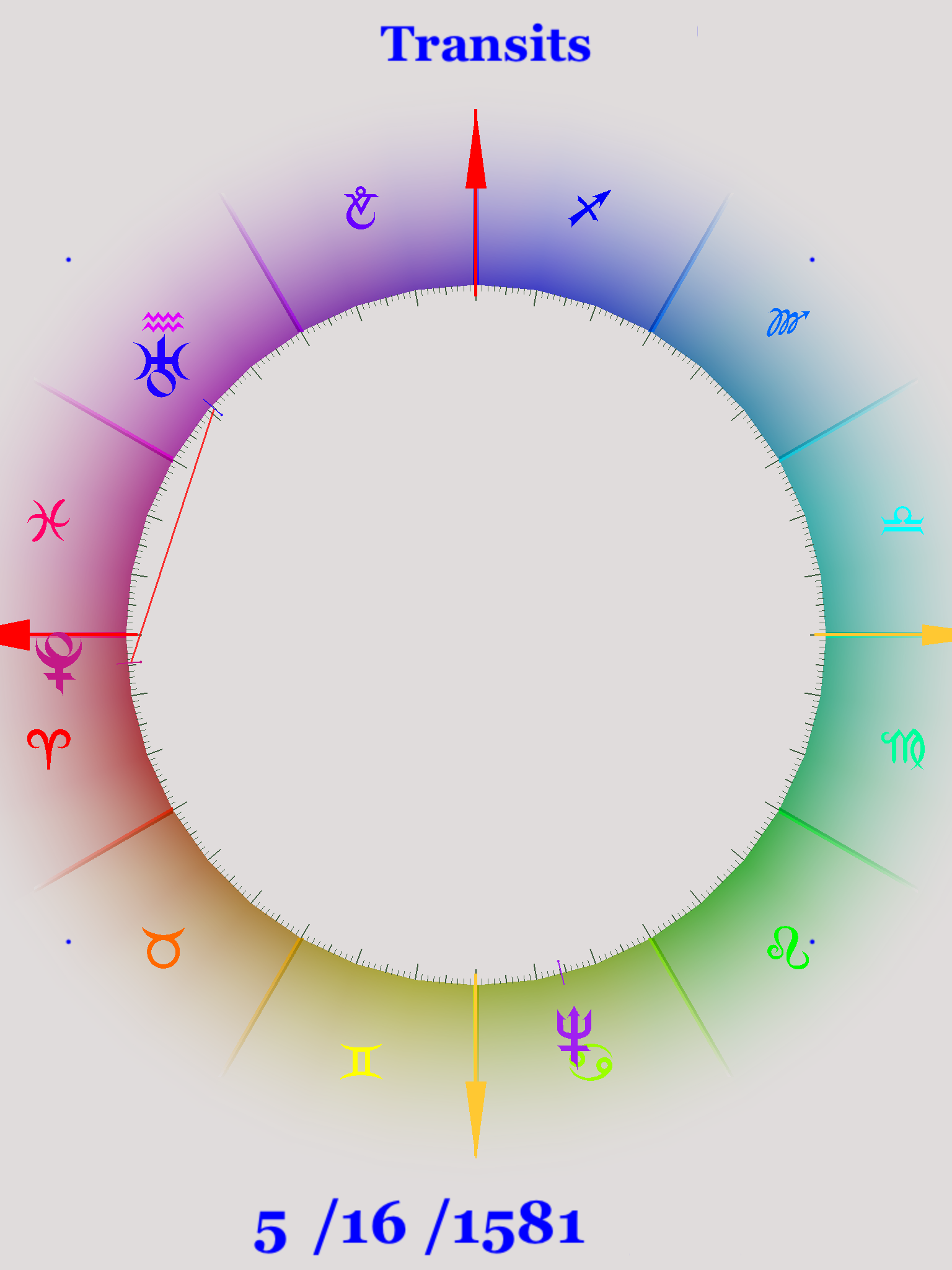
Both these events took place in the same year, but of course  the developments leading up to and following after were important.  Spain had been conquered by the Moors in the Tenth Century, and it was a challenge for the Spanish to drive (or convert) the Moors over the next 500 years.  They were finally successful in 1492 with the Reconquista.  Another ethnic group that upset the Spanish were the many Jews who lived in Spain.  Spain also gave them the choice of converting  to Catholicism or else — see Spanish Inquisition.  This was accomplished pretty much by the same year.  But Spain was still not a unified country:  There was Castile which was in the center and north of the Iberian peninsula, and was controlled at this time by Isabelle, and Aragon in the north of the Iberian peninsula near the Pyrenees Mountains, controlled by Ferdinand.  After the two were married in 1469  the two nations of Castile and Aragon were joined together, and after the Muslims were driven out, Spain became a unified country, bent on establishing its power. After this point Spain was sending explorers around the world, bringing back gold and silver to enrich the home country.  This Spanish Golden Age was also a great one for Spanish arts and literature, with the examples of the painter El Greco, known for his elongated figures, and Miguel Cervantes, whose best known work is Don Quixote. The country began to lose lustre with the defeat of the Spanish Armada by England in 1588 and the loss of the lowland countries.  As we can see from the chart for that date, Pluto came to the Aries point, thus crossing the Cardinal Axis  again.

uni1581

Rise of Netherlands

The Dutch Republic rose with a long war against  the Hapsburg dynasty of Spain.  The Dutch Republic established the Dutch East India Company and the oldest stock market in the world in the early years of the Seventeenth Century.  The Dutch had a large fleet of merchant ships covering  the world.  At one time they were masters of New York, which they lost, won and lost again to the British.  The artists of this Dutch Golden Age are well known, consisting of such as Rembrandt (Night Watch) and Vermeer (Girl with a Pearl Earring).   The Dutch of the Low Countries dominated the world trade that had previously been controlled by the Spanish.

uni1761

Rise of England

Like other Empires, the Dutch enjoyed their time in the sun, but they felt competition with England.  England was involved in the Seven Years War (1756-63) which also involved the other major powers of Europe and was fought at various locations around the world.  The part in North America is called there the French and Indian War.  Winston Churchill thought that this war should be considered a World War.  In North America there was a battle between the French and British over  the control of Canada, and the French lost.  The painting by Benjamin West  called The Death of General Wolfe marks an important point in  this battle, near Quebec.  This marked the rise of Britain to be the dominant power in the world, a position that would last for over a century.  The chart for this transfer of power from the Dutch to the British is marked with Pluto at 0 Capricorn, again crossing the Cardinal Axis.

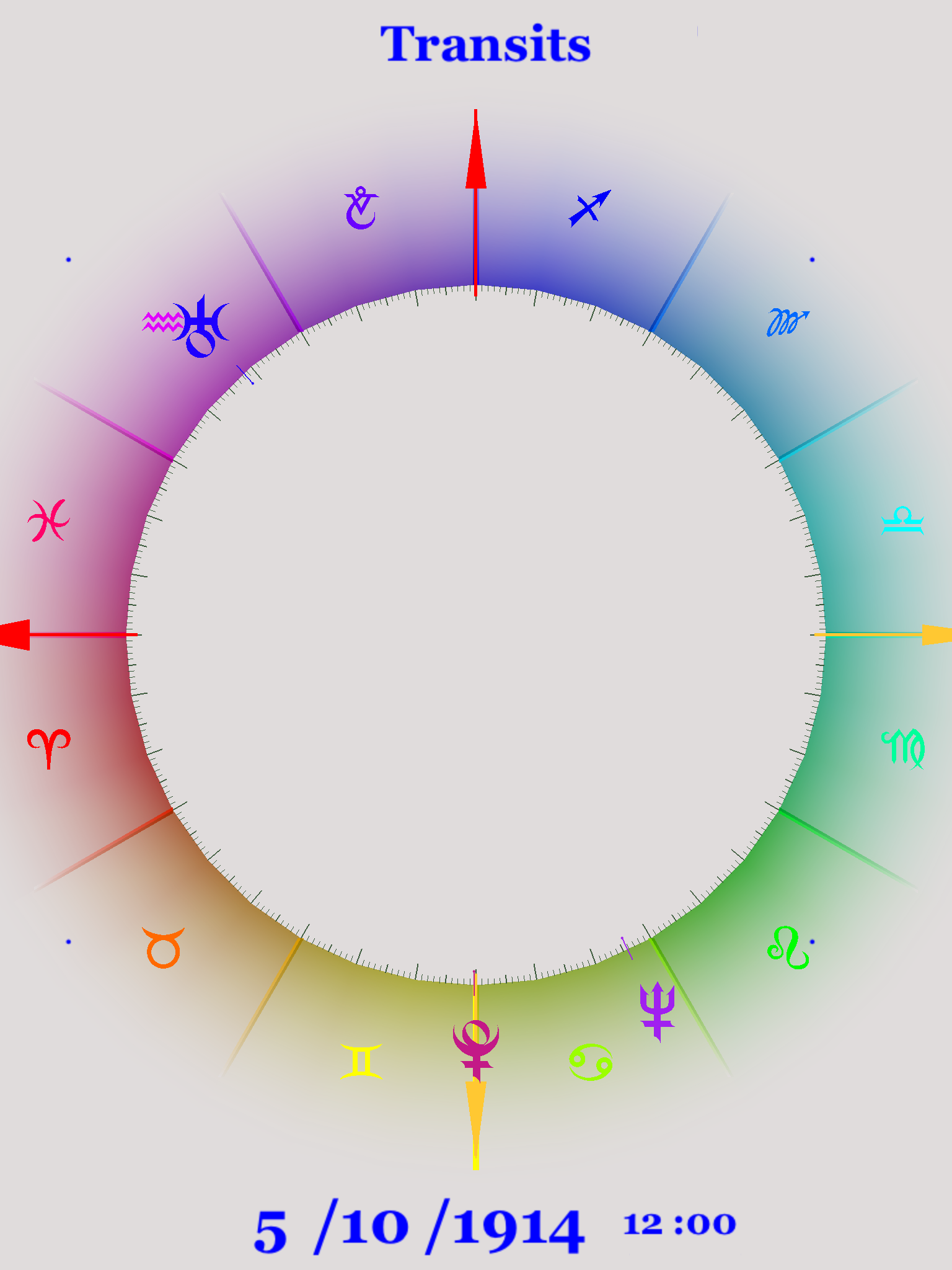
uni1914

Rise of United States

But by World War I, in which Britain defeated Germany, they had lost much power, and going off the gold standard didn’t help.  There was a new powerful country in the world, one that did not exist in  the middle of the Eighteenth Century, and they wereThe Death of General Wolfe able to step into the gap vacated by the British.  The British loss of power is spoken of in almost reverential terms by historians since that are widely credited with handling their loss of world power in a responsible manner.  One can only hope that the last country to give up power will have learned lesson from Britain, but at present that outlook is  doubtful.

uni2008

Death of the Uni-polar World

The United States was the country to become dominant after the British lost their pole position after World War I.  The Twentieth Century was indeed the American Century as Time Magazine publisher Henry Luce predicted in the Thirties.    With the 9/11 attacks and the Great Depression America is no longer the dominant power of the world.  A single dominant world power was a  phenomena of the previous 500 years and now the world must adapt to something new in this area, as in many, many others.   As H. G. Wells said, “Human history becomes more and more a race  between education and catastrophe.”

Revolution At The Top

The planet Uranus has transited over the Midheaven of the United States three times since the country was born.  Uranus is the planet of revolution and the Midheaven represents our public position in the world, so one would  expect just by combining those two symbols that this transit would suggest a  revolution in the way we are seen or present ourselves to the world, in our public persona.  Let’s see how that plays in in reality.  Unlike Uranus transiting the IC, where the effects will be hidden from public view, transits to the MC will be public and apparent to all the world.

The first  time Uranus reached the MC of the United States was 1799-1801.  This time represented an important Presidential election for the country, its fourth.  In the first two elections, George Washington was easily elected.  He represented the Federalist Party which was all there was at the beginning, since initially it was thought that there was no need for political parties, that the president would represent everyone.  In the first two elections Washington was unopposed.  Washington chose not to run for a third term, which amazed outside observers since it was thought that he would continue to be president for his life, or in other words a king, much like what European countries were use to.  By the time of the third election in 1796 there was a party other than the Federalist, the Republican Party of Thomas Jefferson, and he ran against the Federalist candidate, John Adams, who had been Washington’s Vice-President, and who won the election.  This was the first contested election, with Thomas Jefferson serving as vice president, even though he was from a different party than Adams.

By the time of the fourth election, things got more interesting.  Adams was again running against Jefferson, along with Aaron Burr as Republicans.  But not all the bugs had been worked out of the election process, and there was no separate President and Vice President, a problem that the Twelfth Amendment to the Constitution was passed to fix.  The person receiving the highest votes was suppose to be President, and the person receiving the second highest was to be Vice President.  But both Jefferson and Burr got the same number of votes in the Electoral College.

This was the second contested presidential election in United States history and the first where the power would transfer from one  party to the other;  people were not sure that the transfer would be peaceful.  In France they had had a Revolution ten years previously, it had gotten violent, and now a dictator by the name of Napoleon had taken over the country just a year before, so people were wondering if the United States would go the same way as France.

urmc1

Revolution of 1800

After the Electoral Collage vote tied, the election fell into the House of Representatives, where each state had one vote.  But each ballot was the same, with both Jefferson and Burr getting the same number of votes.  This   process stretched out towards Inauguration Day in late March, and tempers were rising.  There was even talk of a civil war.  It began to look like America   would be another failed state.  The balloting had gone on 35 times and still there was no winner.  If it hadn’t been for the three-fifths clause of the Constitution, which gave states extra electoral votes based on three-fifths of their slave population, Adams would have won and the election would not have been thrown into the House.  Finally, on the thirty-sixth ballot, one person changed his vote and  Jefferson was elected as President and Burr became Vice-President.  Jefferson later called this the “Revolution of 1800.”  The United States survived its first election where the office  of the President changed hands to a different faction.

Uranus has a  period of 84 years; the next time Uranus went over the Midheaven of the United States was the middle of the 1880s.  Important activities were  happening regarding labor relations — the May Day celebration in Chicago comes to mind, most notably the Haymarket Massacre on May 4, 1886.  This was a rally to support the eight hour work day.  A bomb was thrown into the rally resulting in gunfire, chaos, and the death of seven police and at last four civilians.  Some anarchists were convicted on little evidence.  Four were executed as a result of the trial, while another killed himself just before his execution. Others were pardoned. This  was a very important milestone for labor relations in the United States, and it resulted in the annual observation of May Day as a labor celebration.  It also  served as a warning to the middle and upper classes that the workers below them  were unhappy with the state of labor.

urmc2

Santa Clara County v Southern Pacific Railroad

But I believe the most important event at the time, which has  even more meaning now than then, took place initially in California and eventually ended up in the Supreme Court of the United States where a decision was handed down that changed the real rulers of the country.  This was the decision known as Santa Clara County v Southern Pacific Railroad.  The argument before the Supreme Count and the decision took place in the first half of 1886, but it had been in process for years.  That county in California wanted to tax that railroad, but the railroad did not want to be taxed.  Th upshot of the decision, the one that is still with us today, came from  a headnote to the decision and not the decision itself.  Interestingly, the headnote was not written by any Justice but by a court reporter who had been the president of another railroad.  Basically, the headnote said that corporations were  persons as far as the Fourteenth Amendment to the Constitution was concerned.  At the time of this decision this Amendment had been passed only 18 years previously.  The Fourteenth Amendment has been applied more often to corporations than the freed   slaves it was intended for.  Some think that this assumption of corporations as people was possible because that amendment uses the term “persons” instead of “natural persons” which is legally more applicable to flesh-and-blood people.  In any case, recent Supreme Court decisions such as the infamous Citizens United have only built on the structure of that earlier Supreme Court decision that took place over 125 years ago.

urmc3

1968

The third passage of Uranus over the Midheaven of the United States, and one that happened relatively recently, needs no introduction, since the year in question has many books with the year as a title.  This transit was in 1968 and 1969.   The listing of “revolutionary” events of these years almost becomes repetitious. This was near the end of the Sixties, and passions had built up over the years.  A brief mention of the events of 1968 in America includes the assassination of Martin Luther King in  April, the assassination of Robert Kennedy in June, and the police riots at the Democratic Convention in Chicago in August.  1969  saw the Woodstock Music and Arts Festival  in August, the  Moon Landing in July, and the Concert  at the Altamont Speedway in California in December, which was declared the death of the Sixties.  (For a take on that concert from a group that was there, check out “New Speedway Boogie” by the Grateful Dead from their album Workingman’s Dead released the next year.)  Also in  December the followers of Charles Manson, inspired by another rock song  “Helter Skelter” from the album The Beatles (called the “White Album”) brutally murdered five people  at a Hollywood home, and two more the next day.  Another important but rarely mentioned event of 1969 was the assassination of Black Panther leader Fred Hampton by the FBI in December.  This is one of the events that helped radicalize even more the Weathermen (“You don’t need a weatherman to know which way the wind blows” Bob  Dylan sang in the song “Subterranean Homesick Blues” from the album Bringing It All Back Home) a splinter from the New Left group Students for a Democratic Society (SDS) that was  widespread in the Sixties.  The Weathermen would go on in the next couple of years to make waves in society with their violence.

The Twenties

There were several aspects that define the decade that is call the Twenties in the United States. This decade also  had a meaning in Europe, which  had recently been ravaged by the Great War and   was slowly recovering.  In Germany the Weimar Republic was an attempt to have a functioning democracy in that country after the previous regime was so tarnished by World War I.  England and France were also recovering from the effects of the War, and  Russia just saw a new Communist government take the reigns of power after the previous one had been overthrown by the Communists and a civil war between the Red and White Russians — supported by Western Powers England, France, and the United States — had been won.  As is often the case after a major war, new governments and new ways of life take over.  There  had also been a major influenza epidemic that had swept the world in the closing years of the previous decade, killing millions, and that of course also changed the world.

Even though the United States had witnessed little of the war, and then only from a great distance, they also had many changes, often self-induced.  The Prohibition of Alcohol took place on January 17, 1920, designed to coordinate with the beginning of a new decade.  America was also coming off a  previous period that had seen the passage of the Espionage and Sedition Acts under Woodrow Wilson, which allowed such dissents as Eugene Debs to be jailed.  It is noteworthy that this same act is being currently used by President Obama to jail whistleblowers.  There was a great fear of foreigners after World War I, and a distrust of the Russians  (the country was not recognized until 1933), which led to much fear of communist/alien/anarchist presence in the country.

But in the United States the “Return to Normalcy” (the phrase of the first president of the new decade, Warren Gamallel Harding) continued until the stock market crash of 1929.  The decade of the Thirties was to be much different, not only in  the United States, but throughout the world.

twenties_tg

Uranus trine Pluto Early Twenties

The first aspect of note is a trine between Uranus and Pluto that lasted from 1920 to 1923.  This affected the entire world, not just America, and indicates the changes that took place after the end of World War I and the influenza epidemic. The US had three important aspects to its natal chart, which had different effects (or rather symbolized different things) but their combinations was the profound changes that took place in America during the Twenties. This trine is shown above in a third harmonic graphical ephemeris.

In Germany, which had been ruled by the Hohenzollern family since the Eleventh Century (long before Germany existed as a country) which included their leader during World War I, Kaiser Wilhelm II, the rulership came to an end with the Germany Revolution after the War.  This was  followed by what is called the Weimar Republic. This  was Germany’s first attempt at democracy, and it was a period of great interest in such things as astrology and “New Age” ideas.  This of course came to an end with the rise of Adolf Hitler in 1933.

twenties_mo

Neptune Opposite US Moon

One aspect, that has been mentioned before is transiting Neptune opposite the Moon of the United States.  The peak of this was  1926-29.  Since Neptune moves so slowly, this was the first time that this aspect has happened since the planet was discovered.   Neptune Moon can be read as the people are deluded, which can refer to the stock market mania that swept the country during the Twenties, and it could speak to the great interest in sports during the Twenties, witness Babe Ruth and Red Grange in baseball and football, respectively; and that golf became a middle-class sport.  After the horrible war people just wanted to forget the past decade and have fun.  But the most obvious association is Prohibition that took place, in the United States and some  other countries, during this decade.  While other countries, such as Canada, gave up Prohibition earlier than the United States, the US maintained it until 1933 when the Depression, marking the next decade, was fully ensconced.

It is still debated whether drinking increased or not in the Twenties, especially later into the decade when the corruptness of the Prohibition agents was revealed.  But one of the things that caused Prohibition to be repealed is that many school children were showing up to school drunk; these were children who did not drink before.  There was much deceit involved in getting alcohol, not only in bootleggers and speakeasies, but also in the large demand for sacramental wine, only (of course) used for religious purposes, and also in doctors recommendations for alcohol, only (of course) for medical reasons.  The nation became, because of Prohibition, a less law-abiding country, with many people willing to look the other way.  Unfortunately, this attitude did not change after  Prohibition was repealed, because once those attitudes take root it is hard to turn them off.

twenties_ic

Uranus Transits IC of US

The transit of Uranus over  the IC of the United States, and thus opposite the Midheaven, is a bit harder to describe.  The peak of this was 1926-28.  The IC — Imum Coeli or Bottom of the Sky — is the most hidden point of the chart, the foundation or base of the country.  Transits over that point represent deep seated changes.  I’ve notice that transits over the IC start earlier and last longer than more obvious changes. Transits over the IC seem to represents changes in how the country see itself.  With this transit the people of the country began to feel comfortable with credit.  Before this decade, most people were uncomfortable with buying on time.  Starting with the Twenties,  people bought consumer items with credit and paid them off over time.  This  allowed the middle class, which was growing in this decade, to purchase more of the items they needed for their lifestyle, a trend that has really never stopped  since that time, though the Great Depression and the Second World War put a damper on things for a period.  The United States recently went through a similar  aspect, and the results have been described as the “New Normal.”

The overriding aspect of this decade was Pluto conjunct the Sun of the US, lasting the whole decade but with a peak 1923-27.  One of the meanings given for Pluto is organized crime, and the Twenties was certainly a highpoint for crime, when, because of Prohibition, organized crime  really took off and gained a foothold in America  that of course did not lessen once Prohibition was repealed in 1933.   This is something lawmakers seem not to know, or forget as soon as the current crisis passes, but a failed policy often (always?) has unintended consequences and even though the failed policy can be ended, the unintended consequences often will not go away.  That is certainly something that current lawmakers  would be well to understand.

twenties_su

Pluto Conjunct US Sun

Probably one of the most vivid image of the Twenties is the Saint Valentine’s Day Massacre, where  seven people (but  not the intended target) were killed in Chicago in February of 1929, but that was only symptomatic of gangland killings that took place in the Twenties as businessmen attempted to protect their turf since the courts were unavailable to them.  The story of Al Capone is still popular since he epitomize the rise of gangsters in that era.

A more far-reaching symbol for Pluto is transformation,  and  this happened to the country, if not to its government.  Pluto also represents large-scale enterprises. During the whole decade a series of Republicans served in the Presidency, and one Secretary of the Treasury served the whole  period, Andrew Mellon, the third richest person in the United States.   During this decade the cult of the market grew strong, sort of a preview of what would happen in our own time after another Republican was elected President,  and worship of the stock market reached new heights.

In  the decade of the Twenties, America was transformed from a rural country to an urban country.  This  was the  decade in which a majority of the people started living in cities and no longer were farm dwellers.  As more people were in cities, automobiles really became popular.  There were many manufacturers of automobiles, especially General Motors, and they gave competition to Ford, who had ruled the roost since the introduction of the Model T before the Great War.  In the late Twenties Ford introduced the Model A to compete with the other manufacturers and it proved to be a great success, becoming one of the more popular models of the period.  By this time the infrastructure for automobiles — roads, gas stations, mechanics — had been developed and so America became a driving society.

There was also a sexual revolution in the decade, despite what people want to think of the Sixties.   Margaret Sanger had popularize  birth control and founded the Planned Parenthood Federation, though it was initially called something else. Women started smoking, something that had been relatively unknown in decades before, and drinking openly.  The image of the flapper is well know, and women began to bob their hair, something that had  previously been connected to prostitutes.

This decade was also the time that movies started to talk. The first talking movie is considered to be The Jazz Singer  starring Al Jolson and released in 1927.  This sounded the death knell for silent movies, and made the cinema even more entrancing. This movie was a full 90 minutes long, similar to what is found today.  Also in the Twenties commercial radio got started with news, entertainment, live performances and, of course, sports.  Just as the Fifties was the decade of television, the Twenties was the decade of radio.

The People Are Disturbed: Uranus-Moon

The symbolic meaning of the planet Uranus transiting over (conjunction, square, opposition) the Moon in the United States chart is that the people of the country (symbolized by the Moon) become upset, disturbed, shocked, perhaps even revolutionary.  If we look back through the history of the United States we can see this pattern in play; usually it results in the country going to war.

Now some may argue that the United States goes to war so often, at the drop of a hat, that any cycle could point to an agitation of the people.  And in fact I notice an agitation half-way between each of these points to be discussed, which hints at an eighth harmonic cycle.  But on reflection, each of these occurrences seem to be a really important incident.

After looking at these cycles through the history of the United States, the next obvious  question is when does the next one occur.  We will discuss that at the end.

urmo2002

Afghanistan 2002-03

The United States had been attacked in September of 2001 and people were very agitated.  They wanted revenge.  The President of the United States, his Secretary of State, and many news outlets were helping to get the populace of the country riled up for war. Many compared the attack on the World Trade Center to the attack on Pearl Harbor, and were hoping for the same response.

urmo1981

New Cold War 1980-81

People were unhappy with the “lack” of militancy of the Carter administration, especially after the  hostages were captured in Iran after their revolution, and especially after an attempt to rescue those hostages failed but resulted in the deaths of eight men sent to rescue the hostages.  So people were  primed for the new militancy of the incoming Reagan administration, and he did not disappoint.  Defense spending greatly increased under the new administration and a new Cold War was born, with increased hostility towards the Soviet Union.

urmo1962

Cuban Missile Crisis 1961-62

This  was a peak in the Cold War.  Cuba had been invaded by a group financed by the United States in April of 1961 that had resulted in their capture, so passions on both sides  were inflamed.  Then in October of 1962 the Soviets attempted to put missiles in Cuba to protect it from another invasion by the United States.  The US then blockaded Cuba to prevent the missiles from arriving and the world was  on the brink of a nuclear war. Records released at a much later date showed that we were closer to war than anyone had known at the time, and one Soviet torpedoman who said “no” at a critical juncture was all that prevented nuclear missiles from being launched.

urmo1941

World War II 1941-42

The  attack by Japanese planes on the Pearl Harbor naval station in Hawaii on December 7, 1941 really got the American upset at the Japanese and ready to go to war.  Previously to that attack the US was largely isolationist and did not want to have anything to do with the European War,  let alone an Asian one.  Of the three  exact squares of these two planets the second was on December 20, 1941, two weeks after Pearl Harbor.

urmo1918

World War I 1918-19

Initially the Americans did not want to enter the war, but through clever propaganda from the Wilson administration the Americans became extremely pro-war, even replacing the name hamburger (named for a town in Germany) with Salisbury steak and sauerkraut with Liberty cabbage.  After the War some people were still agitated (the Revolution in Russia had just taken place) and there were bombings of public buildings, increased anarchist activity, and many raids of dissidents by Attorney General Palmer.

urmo1897

Spanish American War 1896-97

As  discussed previously Americans were itching for a War with the Spanish over Cuba for several years,  not only to relieve the Cubans from their hideous Spanish overlords, but also to provide a boost to what was thought to be the falling manhood of Americans since the Civil War was in the distant past.  This buildup came to a climax with the explosion on the battleship Maine in the Havana harbor in February of 1898.

urmo1878

Railroad Strike 1877-78

Eighteen Seventy-Six had seen the Centennial of the country, Custer’s Last Stand, and a contested presidential election that made Bush v Gore look mild.  The Panic  of 1873, which extended more-or-less for the next quarter century, resulted in some railroads lowering their pay for workers in the summer of 1877, while stockholders got bonuses.  As a result there was a nation-wide strike of workers called the Great Labor Uprising that saw scores killed by local, state, and federal militias.   The strike ended with no raise for the workers, but it resulted in increased labor solidarity and increased class consciousness among both workers and the burgeoning middle class, as well as increased animosity towards strikes among the owning class. There was also an opening Uranus-Pluto square that year, such as the one we are having this decade.

urmo1857

Civil War 1857-58

The Fugitive Slave Law of 1850, which  required run-away slaves to be returned to their owners, the Kansas- Nebraska Acts in 1854, which essentially overturned the Missouri Compromise of 1820 and allowed all new states to determine if they wanted slavery within their borders, and the Dred Scott Decision in 1857 had  all occurred recently.  Because of all of these, abolitionist sentiment was running high in the North when John Brown made a raid on slaveholders in Kansas, killing five, and then made his raid on Harper’s Ferry in 1859.  Some think he was insane and some think he was a hero, but this act helped bring the Civil War.  John Brown was financed by a group of prominent New England abolitionists known as the Secret Six and supported by such people as Henry Ward Beecher, brother of the author of Uncle Tom’s Cabin and a prominent preacher in Brooklyn.  In  fact, many Southerners blamed the Civil War on Lincoln and the two Beecher children.

urmo1835

Texas Revolution 1835

This was near the end of Andrew Jackson’s second term, and he was called by his opponents “King Andrew”.  Someone was really agitated about him since the first attempted presidential assassination occurred this year.  In Florida white settlers wanted  the land that the Seminoles had moved  to after losing the First Seminole War, one that was started by Jackson and which involved the murder of two English subjects and could have resulted in an international incident.  In this, the start of the expensive Second Seminole War, Jackson asked the Seminoles to move.  Meanwhile, gold was discovered on Cherokee land and they were forced to move so that the whites could get the gold. Meanwhile, down in Texas, at the time not a state of the US, Mexico had rebuffed an attempt by Texas to become part of Mexico, and so the Texans were in rebellion against Mexico.  The Battle of the Alamo took place the following year.

urmo1813

War of 1812

Hints of the war started almost two decades earlier.  The French Revolution and the Napoleonic Wars  were happening, and the British, who were fighting the French, were keeping the Americans from trading with the French.  Americans were getting increasingly upset with  this, and Western voters elected a group of “War Hawks” to Congress to push for a  war with Britain.  The resulting war did not turn out  well for America, with Washington, D.C. burned, but  it did result in the National Anthem for the country.  The greatest victory of the war, by Andrew Jackson in the Battle of New Orleans, happened after the war had ended, but propelled Jackson  to become a war hero which resulted in his running for President in ten years.

urmo1794

Whiskey Rebellion 1893-94

The farmers of the Western Frontier, which in the late Eighteenth Century meant Western Pennsylvania, were upset at a tax on distilled liquor, which meant mostly whiskey.  They were also upset that small distillers were taxed at a higher rate than large distillers. This was the first major rebellion against the federal government after the Constitution was adopted. President Washington and Alexander Hamilton led federal troops to put down the  rebellion, the first demonstration that the federal government would act to quash revolution.  But this activity of the Federalist govenment paved the way to a more democratically-oriented Jefferson Presidency.

urmo1773

Revolutionary War 1773-74

The British had imposed  various levies on products that the colonists used, and many people were upset at this.   Agitations resulted in the Boston Massacre, where colonists were killed by British soldiers, and the Boston Tea party.  War broke out with Britain in the next year, 1775.

urmo2025

The Next War? 2024-25

The next Uranus aspect to the US Moon comes up in 2024-26.  We have looked at this period before  and we will look at it again, since it is a very important time that we are rapidly moving towards, now only a decade away.  In the previous entry, I said this period — 2028 — would see the “nations of the world … finally decide that the global crises are so ominous that they need to band together in a  World War II-scale attempt to fight for the survival of the planet.”  This Uranus square Moon is the years just preceding this date of 2028.  It suggests that the people of the United States (not to mention the other people in the world) will be getting very upset at what has been  done to their planet by the forces of capitalism over the last 500 years.

World War One

This war started 100 years ago, and there is still controversy about the causes.  The proximate cause, which set the official date for the start of the war, is the assassination of Archduke Franz Ferdinand of Austria and his wife in Sarajevo by the anarchist Gravilo Princip on June 28, 1914.  But there was much buildup  of armed forces in preparation for war at that time, as  well as much hope for peace.  As an example of the latter is the opening of the Peace Palace in The Hague in 1913.  Another question hovering around the edge of the debate is “was the  war inevitable?”  At this point most historians answer that question in the negative.

The world before the outbreak of World War I  was, in many ways, modern, as has been discussed previously.  At the time some people thought that war was possible, some people thought that war was not possible, and some thought that if war came it would last but a few months.  Perhaps the most accurate prediction was from a German general who said that the war would be as violent as the Thirty Years War (1618-48) but would last four years.  Since the Thirty Years War killed at least a third of the German population and laid waste to their territory, this German knew of what he spoke.

The major players in this war showed how incestuous European royalty was.  The leader of England was King George V (grandson of Queen Victoria); of Russia Tsar Nicolas II; and of Germany Kaiser Wilhelm II.  All were cousins, descended from Queen Victoria. Perhaps we should call this the Cousins’ War.  King George  and Tsar Nicolas looked so much alike they could have been mistaken for twin brothers.  By the end of the War, one of those cousins had died, one was no longer in power, and one had changed his name to Windsor, since anti-German feeling was high in Britain during World War I.  After King George V  died he was followed by his son George VI (after another son Edward VIII abdicated to marry the divorcee Wallis Simpson)   who was king during World War II. He was succeeded by his eldest daughter Elizabeth II.  So when you look at the Queen of England  you see a relative of the rulers of the World War I participants.  The year before the start of the war there was a big event — the social happening of the year — which was the wedding  of the daughter of Kaiser Wilhelm II in Germany.  All of the cousins   attended  the event, and people believed that with all the royalty of Europe together war could not possibly happen.

As we saw previously, the first decade of the Twentieth Century saw the growth of Modernism with cars, planes and movies, new types of painting and music.   This was abruptly altered when Pluto crossed the cardinal axis  and went  into the sign of Cancer.  Also, as mentioned previously, the start of the War saw a conjunction of Saturn and Pluto, never a good sign.

worldwar1

World War One

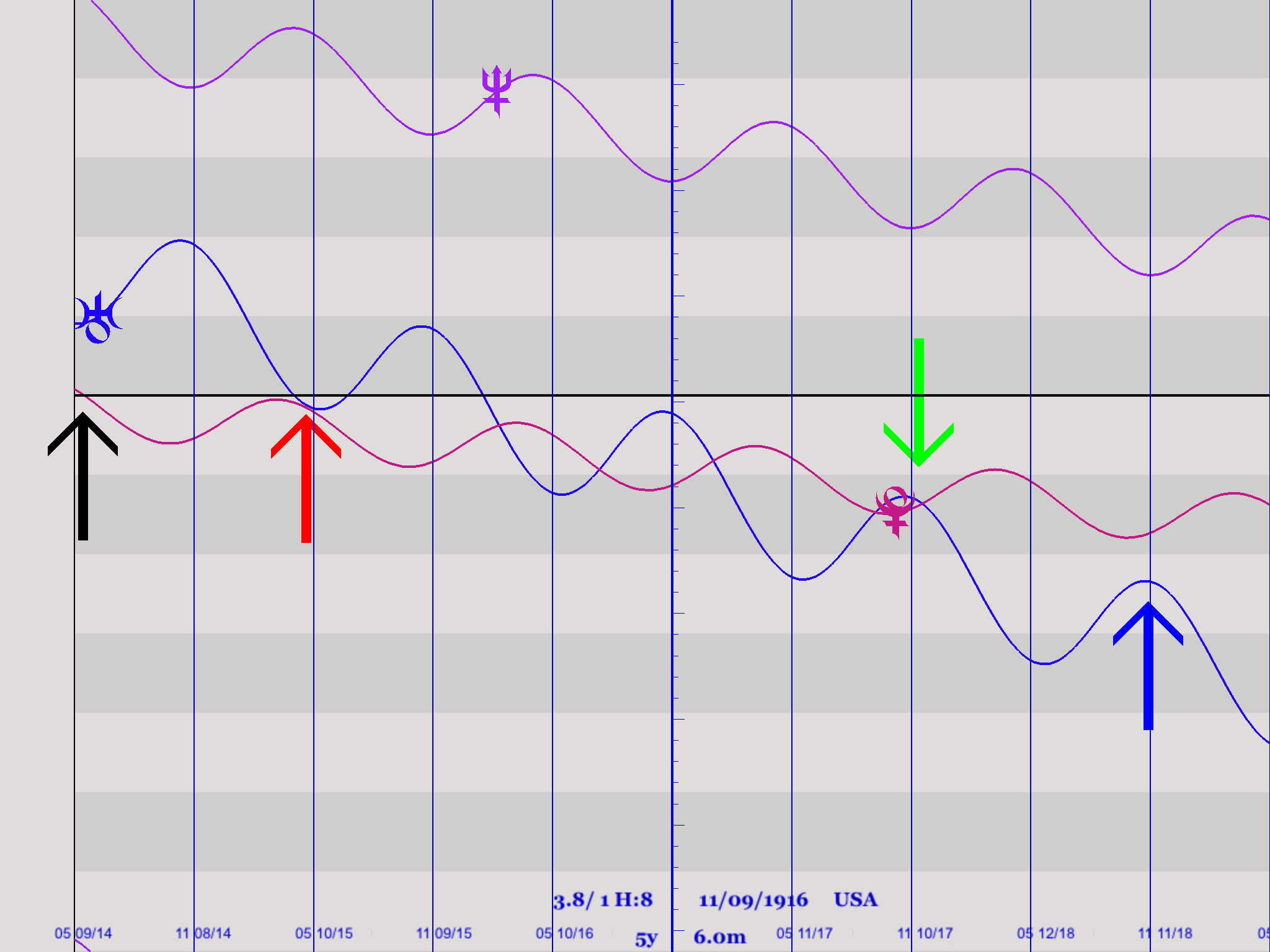
The defining aspect for World War I  was the sesquiquadrate between Uranus and Pluto. If we look at the graphical ephemeris (harmonic eight) we will see that this aspect lasted the length for the war, going in and out of orb during the whole war. From the graphical ephemeris we see that the last time the aspect was close was shortly before the  war ended.  When the War started, Uranus and Pluto were within three degree of a sesquiquadrate and Pluto had just gone over the Cardinal axis (black arrow).    Then, about 10 month later was the first exact Uranus sesquiquadrate Pluto (red arrow); we will look at this chart later.  The last  exact Uranus Pluto sesquiquadrate took place at the end of 1917  (green arrow). Finally, the last close approach of the two planets (blue arrow) happened at the end of the War, reflecting the first close approach at the  start of the War.

The official end — the Armistice — was the eleventh hour of the eleventh day of the eleventh month in 1918.  This brought to an end the fighting , but the justice brought was so harsh  that it helped set the stage for World War II.

The old world — before the War — was no longer. Many things happened to change the world in ways that we are still dealing with.  The end of the War saw the end of a long lasting empire, the Ottoman Empire (started in the Fourteenth Century but it really took off with the fall of Constantinople at the Uranus Pluto conjunction of 1453) which fought on the losing side and was broken up to form the modern Middle East –Syria, Iraq, Lebanon, Jordan — which was created through the Sykes-Picot agreement.  Palestine was promised to the Zionist and, unfortunately  promised to the native people of Palestine as well.

Even though Britain was  on the winning side of the war, and still the major Empire at the time, the position of Britain as the number one power in the world was  over, and the baton was passed to the United States, even though neither realized it at  the time.

After delaying entry to the war for several years — President Woodrow Wilson campaigned in 1916 on “He kept us out of war” — the US entered the War in 1917. Also an influenza epidemic began in the military camps of the US and eventually spread around the world.  There is even some evidence that the outbreak of the epidemic in Germany  hastened the end of the War.  Either through the epidemic from America or the new force of Americans in the War, America helped to bring the end of the War.

After  his successful election in 1916, Wilson assembled a group of people, such as George Creel, Walter Lippmann, Edward Benays, and Harold Lasswell, to create propaganda to convince citizens that entering the war was necessary.  This set the template for  all future war campaigns and today we can witness the successful propaganda to goad us into war.  The public  relations industry was an outgrowth of the pro-war campaign.  One of the notable  achievements of this campaign was the Four Minute Men, who gave a pro-war speech from the stage before cinema performances.

Another event that helped prepare the United States to enter the War was the sinking of the cruise ship Lusitania on May 7, 1915.  At one time the biggest cruise ship, it was torpedoed by a German submarine off the coast of Ireland. The British claimed in was carrying no war supplies, but later it was revealed that it was and thus considered by the Germans as fair game.   The British, who were anxious to get the Americans into the War, used the sinking to inflame American passions.  America did not enter at that time — Wilson still had to  run on his anti-war platform — but this incident did have an effect when  it came to going to war after the election.

lusitania

Sinking of the Lusitania

In this chart, set for the same date as indicated by the red arrow in the graphical ephemeris, we see that the Saturn Pluto conjunction is almost exact at  0 Cancer.  The conjunction of Saturn and Pluto was exact 11 days later.  Also in this chart for the sinking of the Lusitania the Uranus-Pluto sesquiquadrate is exact within 4 minutes.

lusitania_us

Sinking of the Lusitania within US chart

But this event had special repercussions in the United States.   This next chart is for the same event, but as transits to the US chart.  Uranus is sesquiquadrate the Midheaven of the US (black arrow) and Pluto and Saturn are square the Midheaven (red arrow) so  the two transiting planets which are in an almost exact aspect to each other are also aspecting the MC of the US, and there was much public clamor about the event. In addition, transiting Neptune is sesquiquadrate the US Ascendant (green arrow)  and opposite the US Pluto (blue arrow), again pointing to the natal Pluto semisquare Ascendant that we have talked about before.  This aspect suggests some of the uncertainty and confusion about the sinking, which I pointed out previously in terms of the doubt about whether the ship was carrying war implements.  Finally we have Jupiter opposite Neptune and square Mars (yellow arrow) again emphasizing the confusion, the warfare, and the Mars Neptune square in the US chart.  So the US was strongly connected to the sinking of the Lusitania.

The predictions of the German general were borne out  — World War I was the bloodiest yet seen.   The introduction of the Industrial Revolution  into warfare  — which happened to a small  extent  with the Crimean and US Civil Wars — was fully incorporated into World War I.  About 16 million people were killed, with Austria-Hungry, France, Germany, and Russia suffering the most, with over one  million deaths each.   The sheer pointlessness of it all affected many of the poets and writers who survived the War to End All Wars.  Several imperial powers, the Ottoman, German, Austro-Hungarian, and Russian, fell as a result of the War.  This changed the map of Europe and we are still living with the consequences.

Birth of the National Security State

The end of World War II saw a great many changes in the way the world is today,  so many that people born after this watershed moment cannot remember or imagine a world different than what they have always lived in. This world is radically different from what was before. There were many changes throughout the world. Most were in the developed countries which would affect the developing countries as time went on.  One of the biggest changes, which would affect the whole world  rather quickly, was the development of the National Security State within the United States  and the subsequent development of the Cold War between the United States  and its allies and the Soviet Union and its allies. This Cold War would be played out around the world and not just, or even mostly, in those two countries.

The world changed after the Second World War in so many ways.  Many so-called third world countries that were colonies  of major powers, such as India as a colony of Great Britain, were allowed to choose their own government.  This allowed a great many countries, mostly in Asia and Africa, to become independent and to try and choose their own government.  There was even a movement of the non-aligned countries that tried  to place themselves outside the orbit of either the United States or the Soviet Union.

The industries that developed during the Second World War — especially in the United States since it had not been invaded or directly attacked — subsequently released many consumer products  based on the developments to  support the war.  People had been starved  for new consumer products during the war, so that after the war the bought the new offerings willingly.  Not only were consumers the recipients of these new products, but also industries, such as agriculture, were willing purchasers of these new offerings.

While a couple of plastics, such as Bakelite, existed before World War II, the real explosion of plastics and other artificial materials – the pictures of women trying on nylon stockings right after the War are famous –  came right after the War, encouraged by all the development that happened to support the war effort.  Plastics of all forms  have begun to dominate our society, including the  computer you are viewing this on, and all of the plastic garbage has now begun to accumulate in five zones in our oceans  as well as mount up in our “sanitary” landfills.  We do not realize that there was a  time before plastics were an omnipresent feature of all our landscapes. As the Dustin Hoffman character was told in the 1967 movie The Graduate, plastics are indeed the future.

While fertilizers for crops existed for a long time, the real use of inorganic chemically-created fertilizers took off after World War II, for much the same reason that plastics became increasingly popular.  Chemical industries, some of whom had been active with the Nazis in Germany,  gained a lot of power and strength during the war.  But of course during the War most of the demand on these  industries was to support the war effort, on either side; after the War, all the energy that had driven the chemical industries was available of peacetime use.

What has been said about plastics and fertilizers can apply to many other created compounds.  The period after World War II became the world of “Better Living Through Chemistry” as the modified motto of the DuPont Corporation had it. And that is what the post-war world was all about.  Many, many things were created in the laboratory and sold to the public,  plastics of all types, pesticides and insecticides of all types, and weed killers.  All homes now have many toxic chemical compounds that are used for things from cleaning the toilet to ridding the house of ants.  One can take a tour of any modern house to get an idea of the full extent of artificial chemical compounds everywhere.

Before the Second Word War, most food was organic.  The concept of “conventional” or “non-organic” food did not exist, even though there were a few artificial chemicals used in agriculture.  In the Twenties, there were no ”Organic” sections  of supermarkets;  in fact, there were relatively few supermarkets in existence before World War II.  But soon after the war, chemicals were used to create a faster growth of vegetables  or to kill weeds.  Foods grown without the use of chemicals became more and more rare.

Along with this process was the creation of industrial agriculture. This was  was a case of driving the small, family farmer into the city and the rise of large scale farming  and industrial feedlots for cattle.  As a consequence there was no more grazing in the field, small cramped warrens for chickens, and large scale disposal of the wastes of a massive number of pigs confined to a small space.  The introduction of genetically modified organisms (GMO) was just another step along the path that was set out in the years following World War II.

Television was another phenomena that existed before the War, but came into prominence after the War.  During the late Forties and early Fifties  few people owned television sets, but groups of people would gather in front of shop widows displaying large televisions to catch the latest shows or breaking news events. The effect of television, and not just television advertising, on the development of “culture” is far reaching, and has not stopped yet.  One can notice that the whole of political campaigns changed considerably after enough people had television sets that they could watch national political conventions.  The first television president debate, now a fixture, was inaugurated in 1960 for Kennedy and Nixon after there were enough television viewers.  And the difference that television made is illustrated by the fact that radio listeners thought Nixon had  won the debate, while television views, who could see the haggard face of Nixon (recovering from an illness) thought that Kennedy had won.

I  will  mention one further change in this period before we move on to the mammoth event that dominated the world for the next 45 years.  Along with the industrialisation of agriculture practices, ocean fishing received a big boost.  Larger and larger ships were launched, harvesting more and more fish, to feed a  growing populace.  This fishing was so huge that,  over time, it decimated the stock of fish in the ocean, which people somehow seemed to believe was limitless.  This occurred at  the same time that runoff from the factory farms sent pesticide residue into the oceans, creating dead zone devoid of oxygen and fish, and remnants of all the plastic being used on land were also ending up in the oceans

One big event that happened  in this period, whose significance can not be overstated, was the dropping of two atomic bombs on the country of Japan.   This was something that had never happened,   or really even been contemplated (except for a  few science fiction writers such as H. G. Wells or Cleve Cartmill ) before, and  it changed the way the world  looked at the future.  Almost overnight, it became possible to believe that the entire world could be destroyed in a short period.  As some scientists and writers realized at the time, the world  had changed for good.  We can not begin to imagine the effect of this since most of us have lived with the threat of nuclear war all our lives.  I think that when we look back at this period from the future, we will see that a mass insanity gripped the world because of the knowledge that we could  literally destroy humanity.

nss

Midpoint when Atomic Bomb Dropped

The  significant astrological event happening at the end of World War was the midpoint between the three outer planets: Pluto at the midpoint of Uranus and Neptune. This was only the second time this century that such a configuration had  happened, and note that in the midpoint shown, Pluto is at the apex of the midpoint.  This is not common; most often Uranus is at the apex as was the case for the first midpoint of the century as discussed  on August 22.  This is significant since Pluto rules nuclear bombs, which were of course unknown before this midpoint happened.  Pluto is also prominent in the aspect representing the shadow side of the USA, Pluto semisquare Ascendant, as has been discussed before.

As I have said, these midpoints, at most three a century, indicate a sea change in society so that the future is entirely different from the past.  And that was certainly the case with this one.  For example, almost everyone believes that high defense spending of the US has always gone on, but it is a rather recent development; essentially the high defense spending  needed for World War II never decreased by that much after the war, though our lifestyle certainly did.
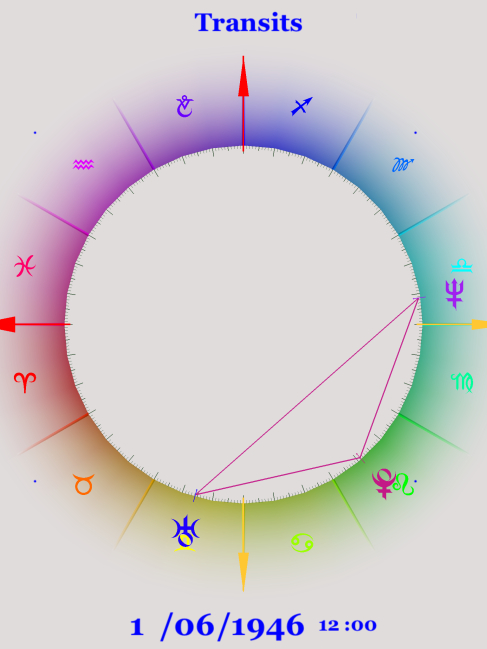
nss1

Midpoint at Beginning of Cold War

In   1945, right after the Yalta Conference, Franklin Roosevelt went to Saudi Arabia for a meeting with the King of that country.  As a result of that the world  has gotten oil from that country and  the rest of the world has looked the other way.  Saudi Arabia has backed very reactionary elements, such as Osama Bin Laden, and nothing has  really been said  to them,  while other countries which do not provide the large quantities of oil are subject to much pressure from the United States.  As a result of this meeting the world has had much access to oil but a whole host of problems — see the current Middle East crises for an example — are the result.

During the war, companies were not allowed to increase the wages of their employees, so instead they gave them health care plans.  That decision, made to skirt the law, has had enormous repercussions into the present time.  Company-provided health care has been seen as normal, giving rise to health insurance companies that exist to this degree nowhere else.

But perhaps the most significant  event of this period, and the one that gave its name as title to this article, was the formation of the National Security State (NSS).  Few  people realize  what a change in our military expenditures has happened  since this critical turning point.  Before the Second World War  the United States spent relatively little money on “defense”.  In fact, before the NSS there was no Department of Defense but rather more more accurately named Department of War.  Gore Vidal calls  this inception of the National Security State a coup d’etat;  I’m not sure if this is a metaphor but it certainly an apt description to what has happened in this period.  This led to increased spending for “defense” after the war and the Pentagon, which was built during the War, become a very public symbol of the United States’ fascination with the military, something I’m sure would have alarmed the Founders,  who always warned about foreign entanglements and a standing army.

There are at least two ways of measuring the amount of money spent on defense: percentage of GDP or adjusted dollars.  The graphs below show both.  Since the GDP has increased faster than the defense budget, the actual dollars figure is a more accurate way of showing money spent.

The final way of looking at our defense expenditures is as a percentage of the budget.  In other words, how much of the money that the federal government collects in taxes is spent on military-related items.  But there are  several ways of answering this question that are deceptive, to say the least.    The first is to include income that the government has no control over spending, most obviously Social Security, as part of the budget. Social Security taxes — FICA — are something that most people have seen as a separate tax on their income checks.  This money goes to a trust fund and must be spent for Social Security payments, it is not discretionary.  But often the SS  expenses are included as part of where the government money goes.  This is as deceptive as, for example, if someone gives you $5000 for safekeeping while they are out of the country, only to expect it back when they return.  It would be deceptive to consider the $5000 as part of your money when you consider how much of your money is spent for rent, since it is not really your money but you have it only for a short time.  In the  same way, it is deceptive to consider money collected as Social Security taxes as part of the money the government can spend as it wishes.

Another problem is neglecting the military related expenses that are not in the defense budget.  The could be separate money for wars that are not part of  the initial budget, money for the many covert services, money in the space and nuclear programs that are military related, but the two biggest items that are often not considered are veterans healthcare and pensions  for ex-military personnel, which can go on for many, many years  after the initial war they served in is over, and interest on the debt, much of which  was borrowed to pay for a given war.

When you make the adjustments, the percentage of the budget spent for military purposes  — past, present, and future wars — is much higher than commonly assumed.  The amount these days is 62%, which tells us that the main purpose of our government to to conduct military operations.  This is something most people would rather avoid knowing.

Most of the graphs are from the Washington Post.

defense_adjdol

This first graph indicates the national defense budget in 2013 dollars.  Since there has been much   inflation since 1945, it is    necessary to adjust the dollar amount to get an accurate comparison with past expenses.  We can see that the defense budget   ballooned in the late Forties and early Fifties because of the new Cold War and the Korean War.  There is a bump in the late Sixties and early Seventies because of the Vietnam War.   Then there is the huge bump in the Eighties because of the Reagan defense buildup; during this period the defense budget got to be greater than the Cold War beginnings of the early Fifties.  Finally we can see that about 2010 the defense budget rose to another peak, and this is   without counting the expenses of the wars in Iraq and Afghanistan, which were separate.  When these are added in — red peak — the defense expense are 50% higher than in  the beginning of the Cold War, even though the Cold War supposedly ended in  1991.  Note that these figures do not include items mentioned above such as veteran’s benefits.
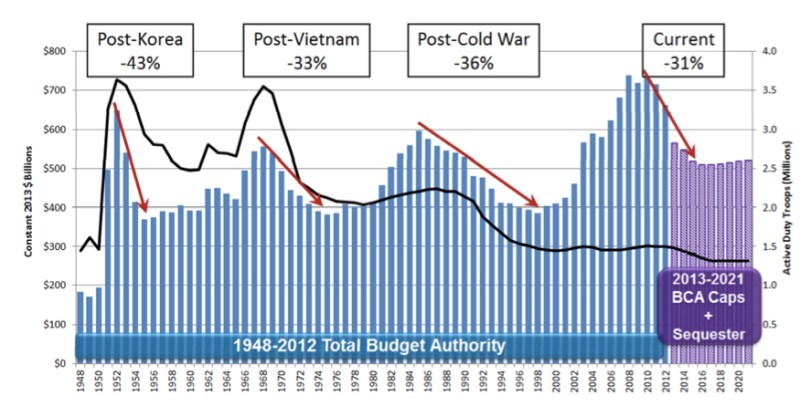
defense_adjdol2The next graph shows the expenditures again, from 1948  to 2012.  You can see the fall-off after Korean, Vietnam, and Cold Wars ended.  It also shows the fall off after  the current wars are ended.  As I write this we have sworn a “bombing campaign” on what is called ISIL or ISIS or IS in Syria and Iraq, so the expenditures will probably go up again.
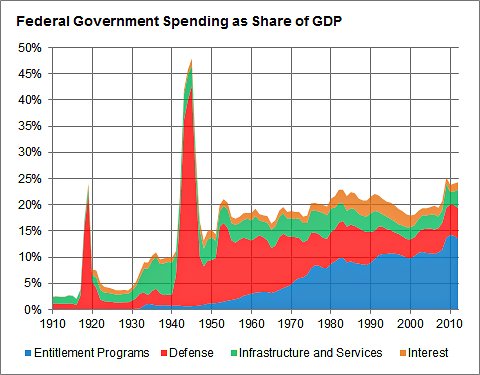
defense_gdp

The third graph shows  expenses as a percentage of GDP.  Note that the bottom blue section is labelled “Entitlement” and remember what I said above that these are not part of the discretionary expenses, since most entitlements are from a separate part of the money collected from taxes; they are from FICA and not income taxes.  The part we are interested  in is the red second band.  The defense expenses went way up during World War I, just before 1920 and them returned to almost the same level, about 1 to 1.5%.  They went up again  during World War II in the Forties, but in this case after the War  the defense expenditures did not go back to what they were before the war, but only fell to 8%, at least four times greater than what it was before the war.  These defense expenditures decreased as a percentage of GDP over time, but only because the GDP increased at a faster rate.  The true increase is shown in the first two graphs.

To sum up, spending by the United States for defense increase greatly after World War II, and  has  remained at elevated levels ever since.  One can argue that this increased defense spending was necessitated by the threat of he Soviet Union, even though we were allies with them and they suffered the lion’s share of causalities during that war, but the defense spending did not fall after the Soviet Union did, and in fact the spending now has increased to  almost double what it was at the end of the Twentieth Century.  The question remains whether the defense spending increased after the war because of the threat poised by our erstwhile allies or if the threat of a greatly reduced spending for the military caused the danger of the Soviet Union to be seen.  The Great Depression before World War II never really ended until the increased spending for weapons needed for the War; perhaps after the War some were afraid that the depression would return unless the defense spending remained at high levels.  This is called Military Keynesianism.

Another big event of the period, which was to influence the post-war world and   still has repercussion today, is the Bretton Woods Conference of July 1944.  Delegates from many countries met in New Hampshire to plan out the world economy after the War was over.  The International Monetary Fund (IMF) and the World Bank were both formed during that meeting.  It also resulted in an agreement among the countries of the world to maintain a certain type of order in the world’s financial system.  That agreement was broken when Richard Nixon, in August of 1971, took us out of the Bretton Woods system.  While the system was working, it was a financial golden age for American workers.  The rate of unionism was at a high level,  and many of these same workers joined the middle class.  College education was relatively inexpensive  and many people poured into colleges, resulting in an educated workforce and the many student protests that marked the decade of the Sixties.  Government intervention to assure the financial well being of the nation’s populace  became more used.

spending_2013

This final graph shows the true cost of defense after the end of the Cold War.  Very few people make this knowledge available because America wants you to believe that it is not a war-based economy, but if you remove “entitlements” (as mentioned above) you see the real figure, that 62.5% of the budget — Military and Veteran’s Benefits — goes to past, present, and future wars.  This data is  from the American Friends Service Committee.  It is clear that our country is dominated by defense spending, much, much more that any time in our history before this period when the National Security State took   power in the United States, something that President Eisenhower warned of: the Military-Industrial Complex.