The First Red Scare

Red Scares are a prominent feature of American life that have happened before there was a Communist Party in the United States.  But the first full-scale red scare took place in the aftermath of World War I, under a Democratic Administration. This happened with Attorney General A. Mitchell Palmer, who was Quaker and had great concern for the underprivileged in keeping with the progressive Democrat under whom he served, Woodrow Wilson.  The Palmer raids of 1919 and 1920 were notorious, but their longest lasting legacy was that Palmer’s young assistant, J. Edgar Hoover,  learned the basics of Communist perfidy at the time.

By 1920 the Communist Revolution in Russia was only a couple of years old, and anarchists and radicals, many from foreign lands, were especially taken with the revolution in that backwards country, Russia, and hoped that such a revolution could happen in more developed countries.  They were extremely enthusiastic with the Revolution that had taken place, and their beliefs had not yet been tempered by the passage of time and experience.


palmer_raid

First Palmer Raid

 
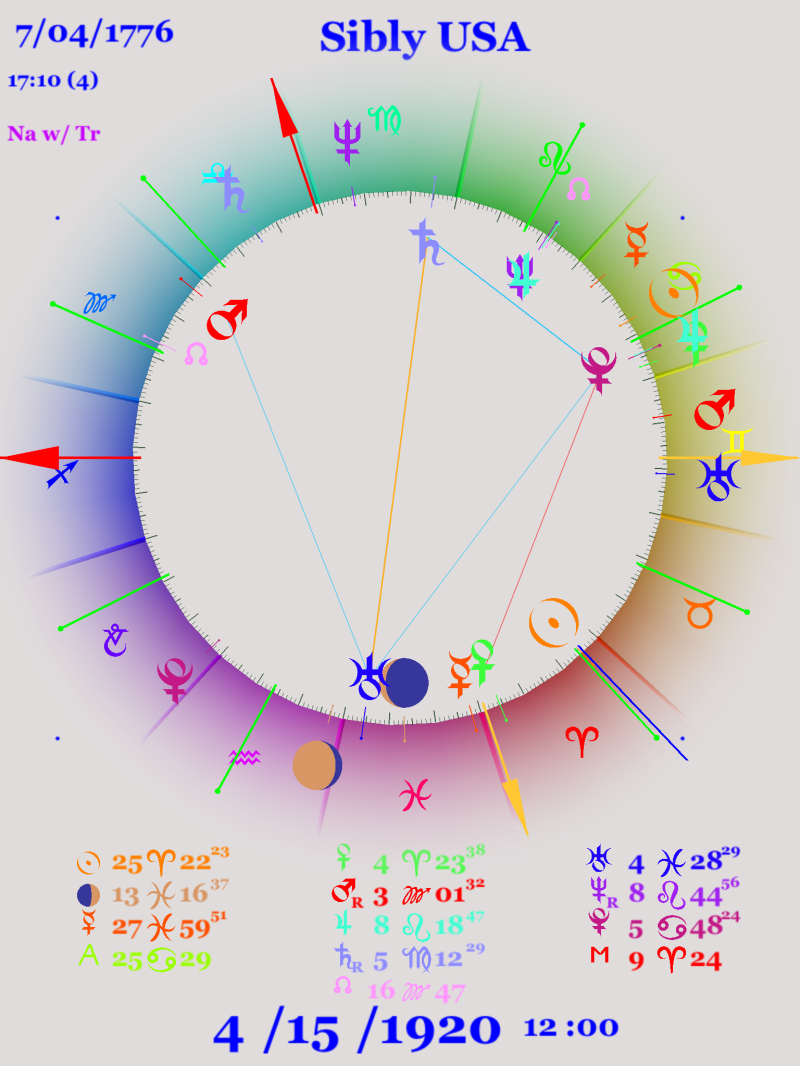
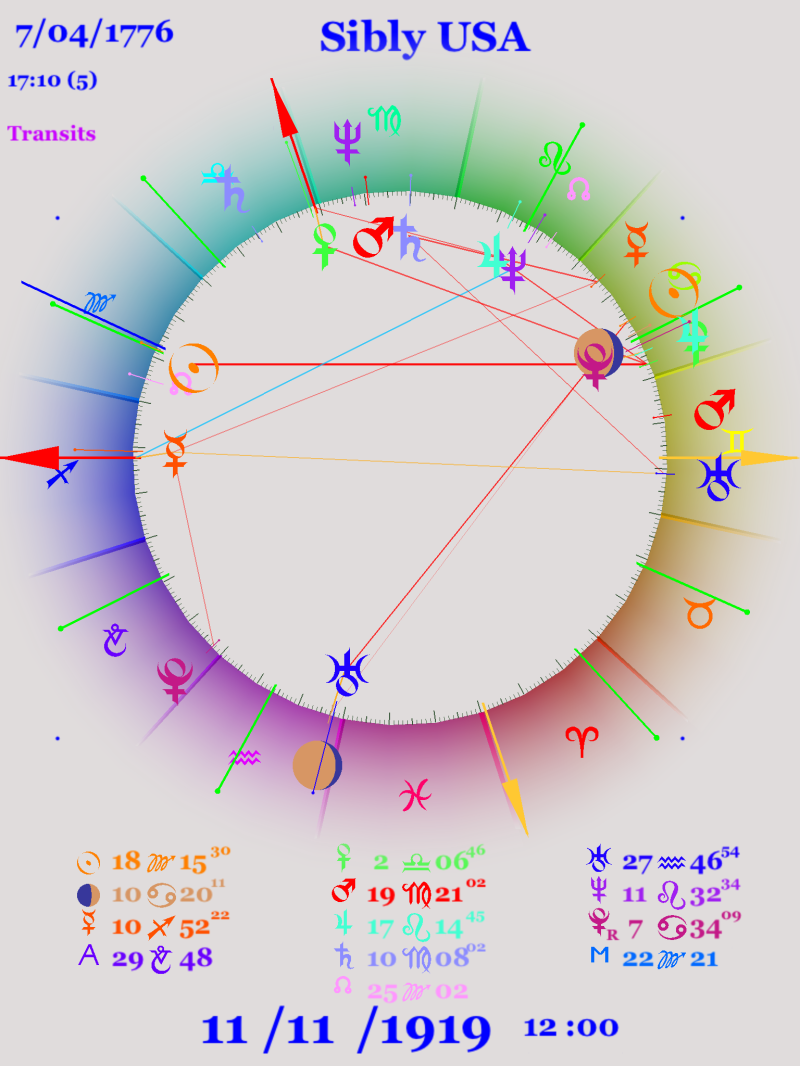
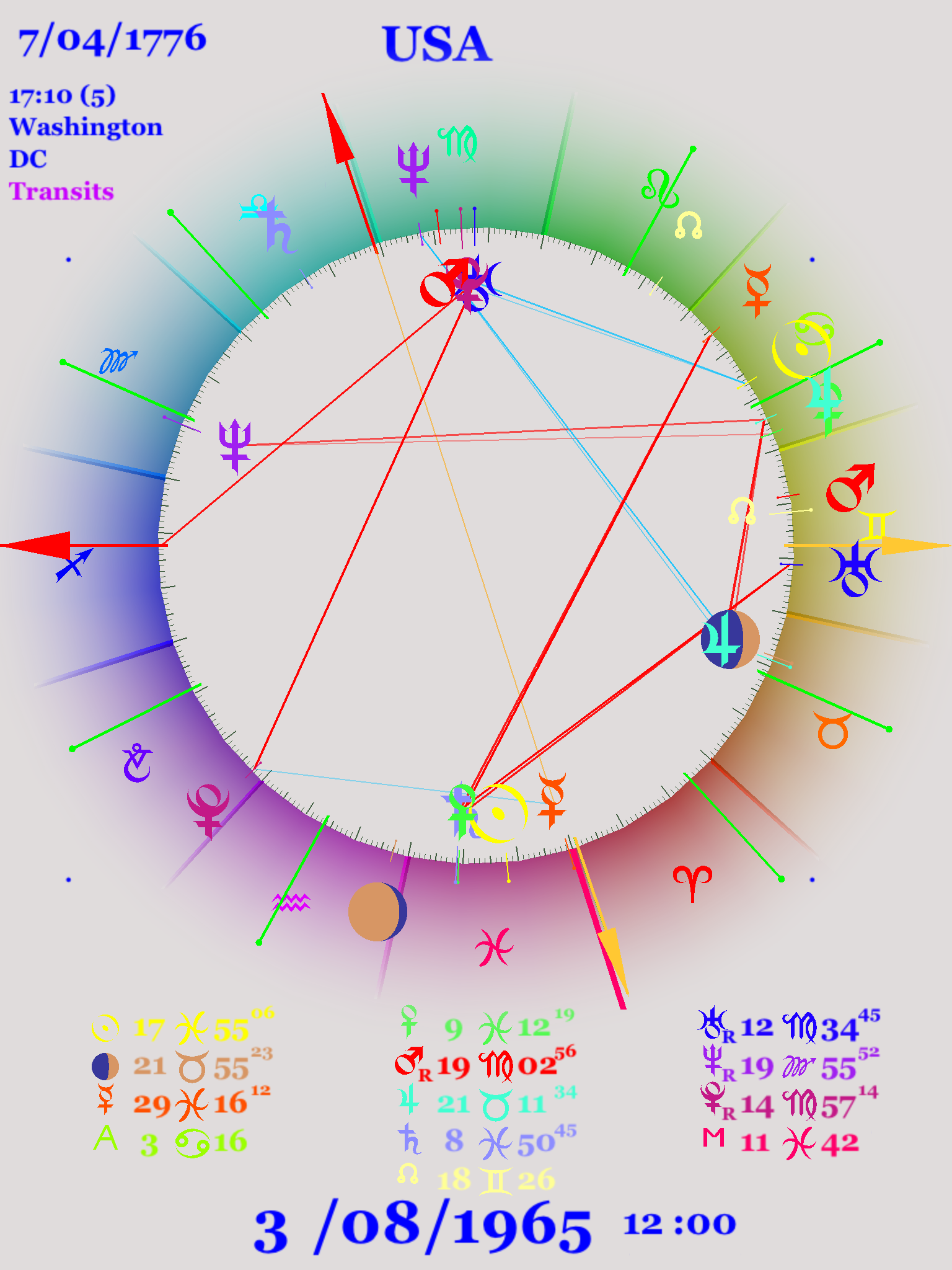
The first Palmer Raid took place on November 7,  1919, two years to the day from the Russian Revolution.  This raid set the pattern for others to come, not only in that period but also after World War II.  In the chart for that event, we see the transiting Uranus squarely on the natal Moon; as we have explained before, such a combination indicates that the people are disturbed, upset.  Such a conjunction happened just before the United States went into Afghanistan earlier this century.  We see that Pluto is conjunct natal Jupiter and thus moving through the core of the United States.  But also notice that transiting Saturn is opposite transiting Uranus;  This opposition, as can be seen by the graphical ephemeris below, was exact in early August (black arrow) and would be exact again in late Spring and early Summer of 1920 (red arrow).   This opposition sets two forces in conflict:  Saturn represents law and order, stability, conventional thinking, whereas Uranus represents unconventional ideas and actions, the promise of the new.  This describes the conflict that was going on then, in the conservative times after World War I.  The Amendment to the Constitution requiring Prohibition had just been passed and was to go into effect on January 17, 1920.  Republicans would replace Democrats as President during the decade of the Twenties, lasting until Democrat Franklin Roosevelt took over after the Great Depression had already started.  Another example of the Saturn Uranus opposition took place in 1965 and 1966, when newly elected, as President, Lyndon Johnson faced a “credibility gap” over the increasing involvement of American soldiers in the Vietnam War.


1919tg

Saturn Opposite Uranus

 
As a result of the First Palmer Raid, a converted troopship left the United States with famous anarchist Emma Goldman and almost 250 others.   This so-called  “Soviet Ark”  was cheered by patriotic Americans, though the massive violations of civil liberties involved in gathering the deportees was ignored by the masses.  The ship left New York harbor on December 21,1919, and arrived in Finland on January 17, 1920.  The deportees were then conducted to the Russian border where they would hopefully be taken, because America certainly did not want them.

Another famous case from this time involved Italian anarchists Nicola Sacco and Bartolomeo Vanzetti who were eventually executed for the murder of a guard during the robbery of a shoe company in Massachusetts on April 15, 1920.   This case was a cause célèbre for many years, involving letters from all over the world and many famous jurists and lawyers.  Eventually Michael Dukakis, then governor of Massachusetts, declared in 1977 that the two men had not received a fair trial.


socco_v

Sacco-Vanaetti

 
In he chart for this murder,  we see clearly the opposition of Saturn and Uranus;  Uranus is no longer on the Moon of the U. S., but Pluto remains in the same position. There is a close conjunction between Jupiter and Neptune, which Ebertin links to idealism, and indeed there was much idealism and hope for a better world among the radicals that were so active in this period.

Another powerful movement at this time was the International Workers of the World, called the Wobblies, who had grown in the first decade of the new Century.   There was much persecution of them at this time, the most glaring happened in Centralia, Washington on November 11,  1919, which involved the hanging of a Wobblie who had been removed  from his prison cell  and the deaths of five others.  This happened during a parade celebrating the first anniversary of Armistice Day, the end of World War I.  The  newly-formed American Legion was not happy with the presence of the Wobblies.  The chart for this riot shows many of the same planetary placements we’ve  seen before with Pluto and Uranus and  the Saturn-Uranus opposition.   What is new is the position of the two fast-moving inner planets:  Venus,  the patriotic gathering for the parade, is at the Midheaven, and Mercury is at the Ascendant, and indeed this event is one of the more famous and well-communicated incidents of the First Red Scare.


arm_riot

Armistice Day Riot

There was much labor unrest during this period, which further worried the owners of industry.  It has been estimated that 20% of the workers had gone on strike by the end of 1919.  After the war was over, many workers wanted the back pay and raises that they had not received during the war.

Wilson, who had run on the campaign slogan “he kept us out of war” when he ran for re-election in 1916, and then promptly got the United States involved in World War I, did not want dissenters from the war effort, so he got passed the Espionage Act shortly before America entered the War; this Act was designed to prevent talk against the war.  This Act was used to send Socialist Eugene Debs to prison for speaking against the war, and that is where he campaigned for President in 1920.  While the Act has mostly  been against people giving aid to enemies of the United States, this is the same Espionage Act that has been used most against Americans who were not dealing with enemies by our current President to sentence whistle blowers to prison.


espionage_act

Espionage Act

 
In the chart for the Espionage Act, we see that not much had changed in the two years between this  chart and the one for the Palmer Raid.  Saturn is approaching a conjunction with Neptune, signifying the remorse many Americans would feel for the involvement of the country with a European War.  There is also transiting Saturn opposite natal Pluto, always a bad combination which has been discussed before.   A transiting Saturn transiting Pluto conjunction had occurred at the start of this very war.

There was strong dissent among the judiciary to these attempts against free speech. One of the better known was Schenek v United States (Charles Schenek was in the Socialist Party in Philladelphia) in 1919  (where the Court unanimously declared that the Act did not violate the Constitutional protection for free speech), and where Supreme Court Justice Oliver Wendell Holmes famously declared, regarding other cases, that free speech would not allow a man to shout fire in a crowded theater,  but also declared that the government must show that any speech presents a “clear and present danger” to bring about evil that the government must prevent  before it could be limited.   This decision was handed down March 3, 1919.

Change At The Top: Uranus at the Midheaven

The planet Uranus has transited across the Midheaven of the United States chart three times since the country was founded. From the symbolism of the planet — Uranus — involved and the point of the chart — Midheaven — one would would expect a, possibly revolutionary, change happening to the United States, something that would effect its basic manifest principles and be obvious to outside observers.


urmc1800

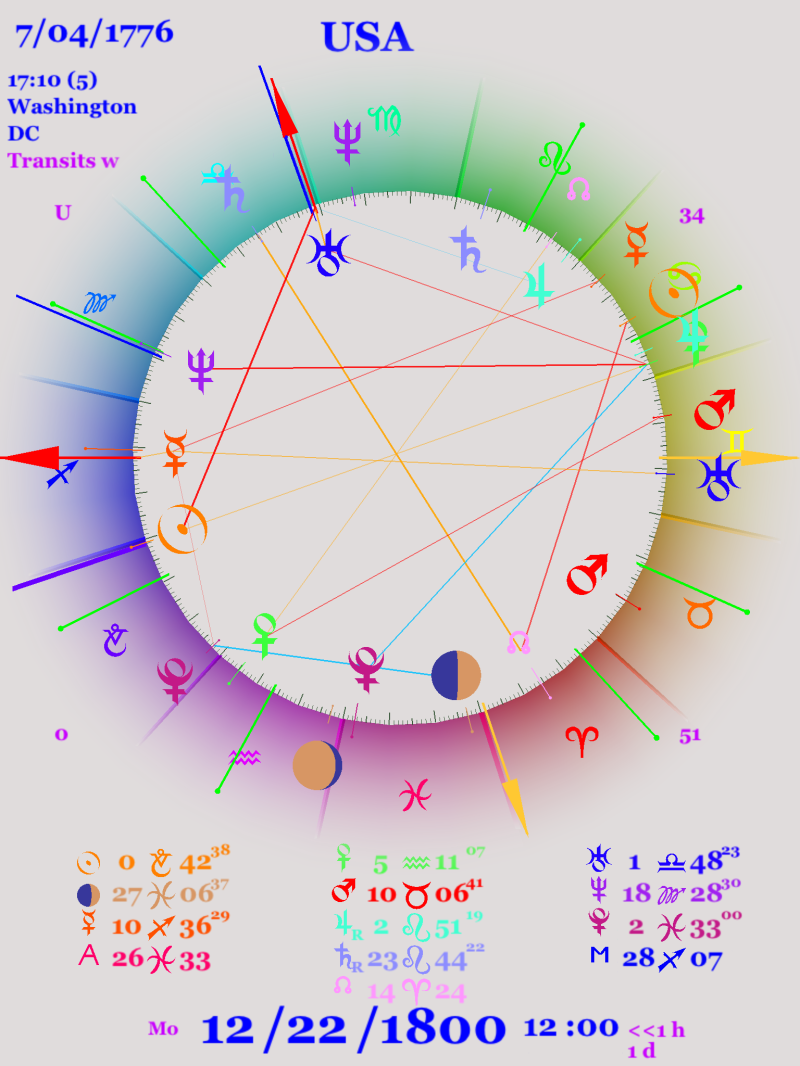
Revolution of 1800


Here is a chart for the first time Uranus transited the MC. This date was when the election was taking place – remember that at that time there was no single election day.  The important event that happened at this time was called by Thomas Jefferson, who was intimately involved, the Revolution of 1800. The story of what this revolution was takes us back to those early years of the Republic. The bugs weren’t totally worked out of the Constitution, and there had been only three elections for President, and only two Presidents. The concept of “political parties” had only formed in the last few years, and the concept had not yet fully jelled.

The Constitution required that, after the Electoral College voted for President, that the top vote getter would be President and the second highest vote getter would be Vice-President. In the previous election of 1796, this had resulted in the candidates of two different parties being elected.  Remember at the time the concept of parties was not very well formed. In that election John Adams, who had been Washington’s Vice-President, was elected President; he represented the Federalist Party.  His Vice-President was Thomas Jefferson, the candidate of the Democratic (or Republican or Democrat-Republican ) party.  He had been Secretary of State under George Washington. This was most unusual, since the two parties had the two different top Federal offices. Adams and Jefferson had been close friends, but they drifted apart (they would later get back together). In fact, they both died on the same day, July 4 (!) , 1826. The rumor has it that the messenger reporting Jefferson’s death, on his way to Quincy to John Adams house, passed the messenger to report Adams’ death on the highway.

Next came the Election of 1800. John Adams, who had served one term, was running again, on the Federalist Party, and his Vice-President, Thomas Jefferson, was running against him as a Democrat. Also running was Aaron Burr, also a Democrat, and Charles Pinckney, also a Federalist. Though it was thought that Jefferson and Adams were Presidential candidates, it was never specified. There was no winner of the Electoral vote, so, as specified in the Constitution, the election result was determined by the vote in the House of Representatives, with each state getting one vote.

This was the last gasp of the Federalist party — they never won another presidential election, and within a decade they would be gone from the political scene — and so perhaps they wanted to make it difficult for the upcoming Democratic Party. In the House the vote for President was 36 votes for Jefferson and 36 votes for Burr, the two highest vote getters. Since it was a tie the House needed to vote again. So for several months during the long winter of 1800-01 — the Inauguration was scheduled for March 20, according to the Constitution until it was amended to move Inauguration Day two months earlier — each vote for President resulted in the same tie between Jefferson and Burr. Things were getting desperate and there was talk of a civil war. Here was the first disputed election in the new country, and it wasn’t turning out well at all.

One needs to look at the political situation at the beginning of the Nineteenth Century to get an appreciation of what was going through people’s minds not only in the United States but in Europe as well. There had also recently been a revolution in France , less than 20 years after the American Revolution, and that had devolved into the Time of Terrors with much use of the guillotine; finally there had been the coup of the Eighteenth of Brumaire a little over a year before by Napoleon Bonaparte. The French had established a Revolutionary calendar, with months corresponding to astrological signs, so that eighteenth of Burmaire (Scorpio) corresponds to November 9, 1799. Since things had gone so wrong with the French Revolution, it was normal to expect things to go wrong with the American Revolution, and this seemed to be an example. People wondered if the American experiment would survived the Election of 1800.

Finally on the thirty-sixth ballot, one state changed its vote so that Jefferson had one more vote than Burr and so there was a new President, selected before Inauguration Day. The country was saved. As I mentioned before, this kerfuffle was due to a bug in the initial Constitution, and the matter was changed with the Twelfth Amendment.

This was “The Revolution of 1800”. At the time it was possibly the end of the United States as whole entity. But the country pulled through, electing the third President of the United States. But it was very appropriate to the first pass of Uranus over the Midheaven of the United States.

Currently, a Supreme Court decision called Citizens United (Citizens United v Federal Election Commission) is considered what made corporation people. But corporations have long been recognized as people by the Supreme Court, using the Fourteenth Amendment to the United States Constitution. The Fourteenth Amendment was passed in 1868 to recognize that the recently freed slaves had due process and equal protection under the law, but it spoke of this as applying to “people” rather than “natural people”. Some have suggested that this wording was due to Roscoe Conkling, a Republican Senator from New York who was member of the Stalwart faction of the Republicans and, incidentally, a Scorpio.  Conkling was a major fixer in the State of New York and a power behind Chester A. Arthur, who became the 21st President of the United States. In any case, the 14th Amendment has been applied to corporations more often that flesh and blood human being since it was first added to the Constitution.

But this all started with a Supreme Court decision called Santa Clara County v Southern Pacific Railroad Co. The decision was the result of several attempt by counties in California to tax railroads. The State had lost the decision. But of much more consequence was something the decision did not say. A note added to the decision by a clerk (who had been president of a railroad) said that the Fourteenth Amendment applied to Corporations; this became accepted as part of the decision ever since, even though it wasn’t. This was the first time that corporations were declared as people under the Fourteenth Amendment, and that decision has had great influence ever since. In fact, the Fourteenth Amendment has been applied more often to Corporations than to the Freedmen for whom it was intended. From the beginning of the country corporations had been intended to be limited businesses chartered by the State for a specific purpose, but especially after this Supreme Court decision, that changed drastically. In the intervening 130 years, corporations have transformed to become the dominant social form in the United States, if not the World. This was certainly a major change in the rulers of the country, as signified by he transit of Uranus over the Midheaven of the United States, even if few have realized the immensity of the change. There are now some people agitating to overturn the Citizens United decision, but the cat was out of the bag long before that decision.


urmc1886

Santa Clara County v Southern Pacific Railroad Co.

This is the chart set for the day the decision was handed down – May 10, 1886 – but the case was argued in January of that year and had wound its way to the Supreme Court, originally as three cases, over the preceding years.

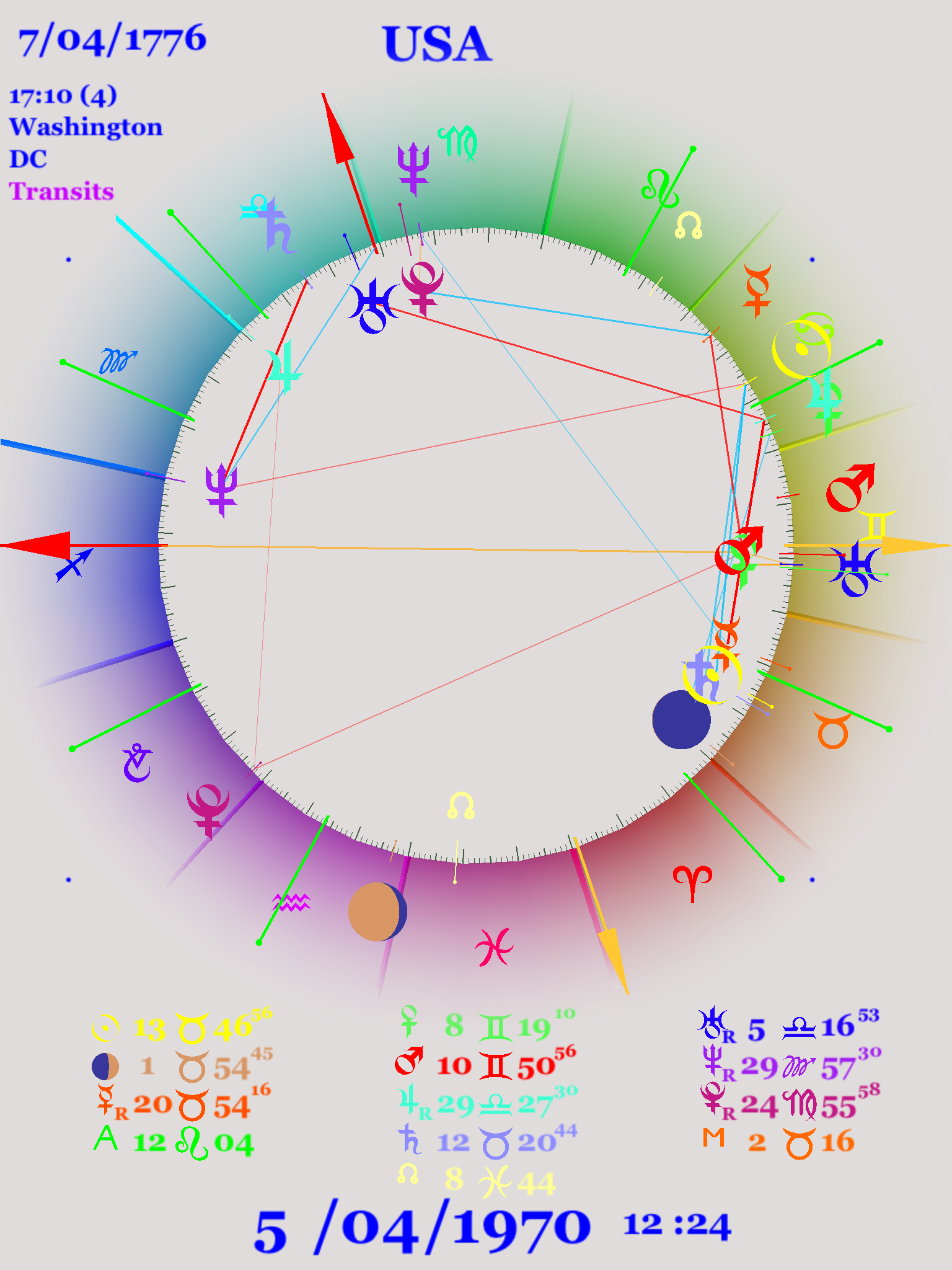
The significance of the third transit of Uranus over the Midheaven of he United States will be immediately recognized by most people after the year of that transit is mentioned: 1968 (and 1969). There are probably more books with the year “1968” in their title than any other year, as many recognize it as a truly revolutionary year in the United States. At least many felt that way at the time.  A brief mention of some events of those years will indicate the character: A second place result of Eugene McCarthy in New Hampshire primary on January led to announcement by sitting president Lyndon Johnson that he would not seek another term in office in March.  The assassination of Martin Luther King in April.  The assassination of Robert Kennedy in June.  A police riot around the Democratic Convention in Chicago in August.  The election of Richard Nixon (who has been called the last liberal President by Noam Chomsky and also the last New Deal President) in November.  1968 was an election year in the US, and that always leads to more action and reaction. The next year saw the Woodstock Music and Arts Festival, which was made even bigger by the movie about it the next year in August; that festival followed closely the Moon landing in July.  Also in August of that year a group of people directed by Charles Manson killed pregnant actress Sharon Tate (wife of director Roman Polanski) and others in her group in her house in Hollywood, creating a major uproar. Then there was the little noticed assassination of Black Panther leader Fred Hampton by the FBI in December and the Altamont Speedway Music Festival that resulted in a stabbing that was often called “the end of the Sixties”, also in December.

After 1968 and 1969, the country had changed the Sixties had died, and the Seventies were all set to roll out. This third transit of Uranus had changed the United States for good, and people still recall those years, for better or worse.


urmc1968

1968


This third chart is set for the first exact pass of Uranus over the MC in 1968. It also corresponds to the Sun at the Midheaven.

The Trump Phenomenon

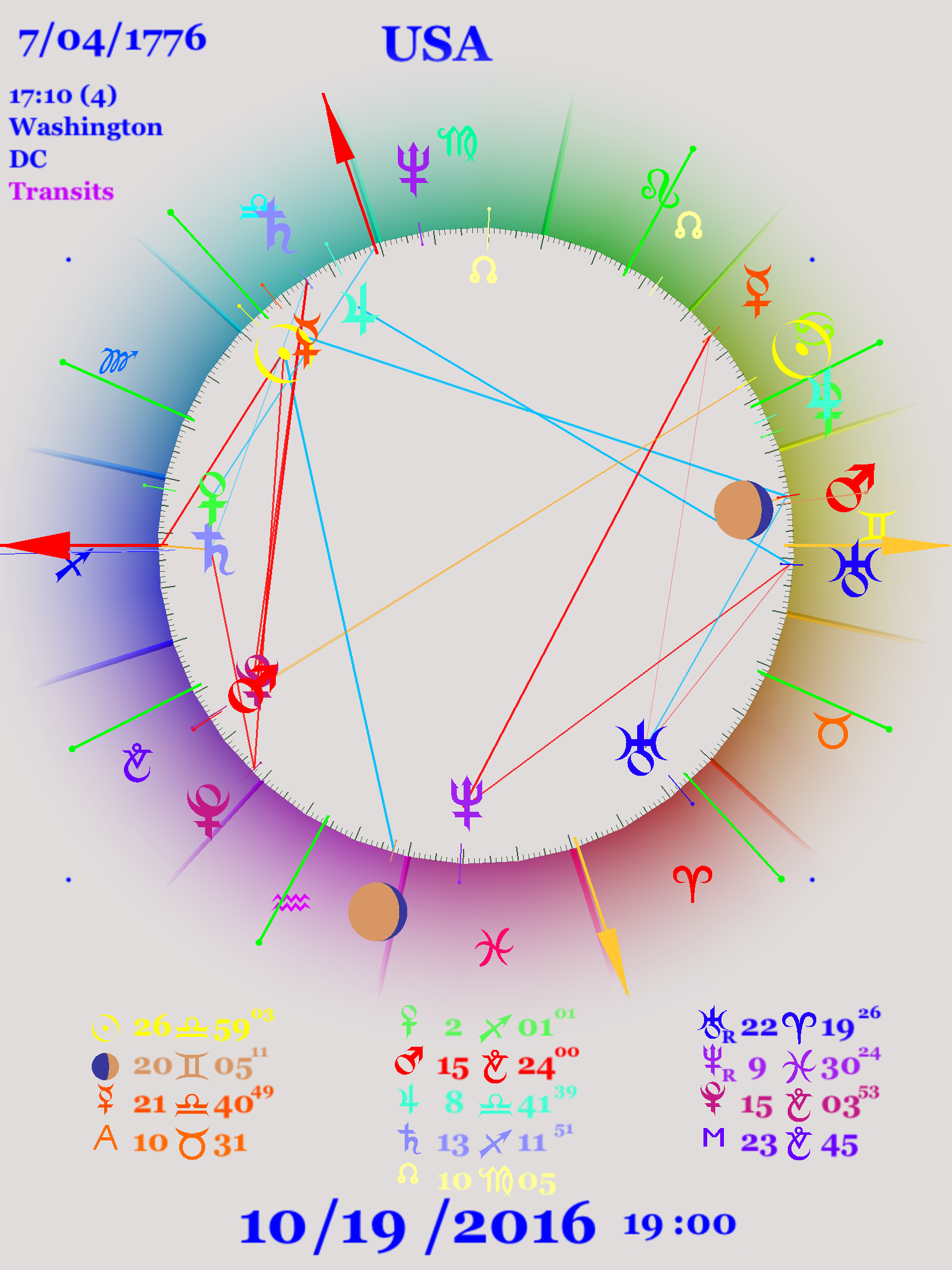
Election years in the United States are often more eventful that other years, and even though 2016 is not a “watershed” year like 1960, 1980, 2000, it is still proving to be quite interesting.  Interest, excitement, and constant news about the election keep people’s minds away from what is actually happening in the real world, serving as a good cover.

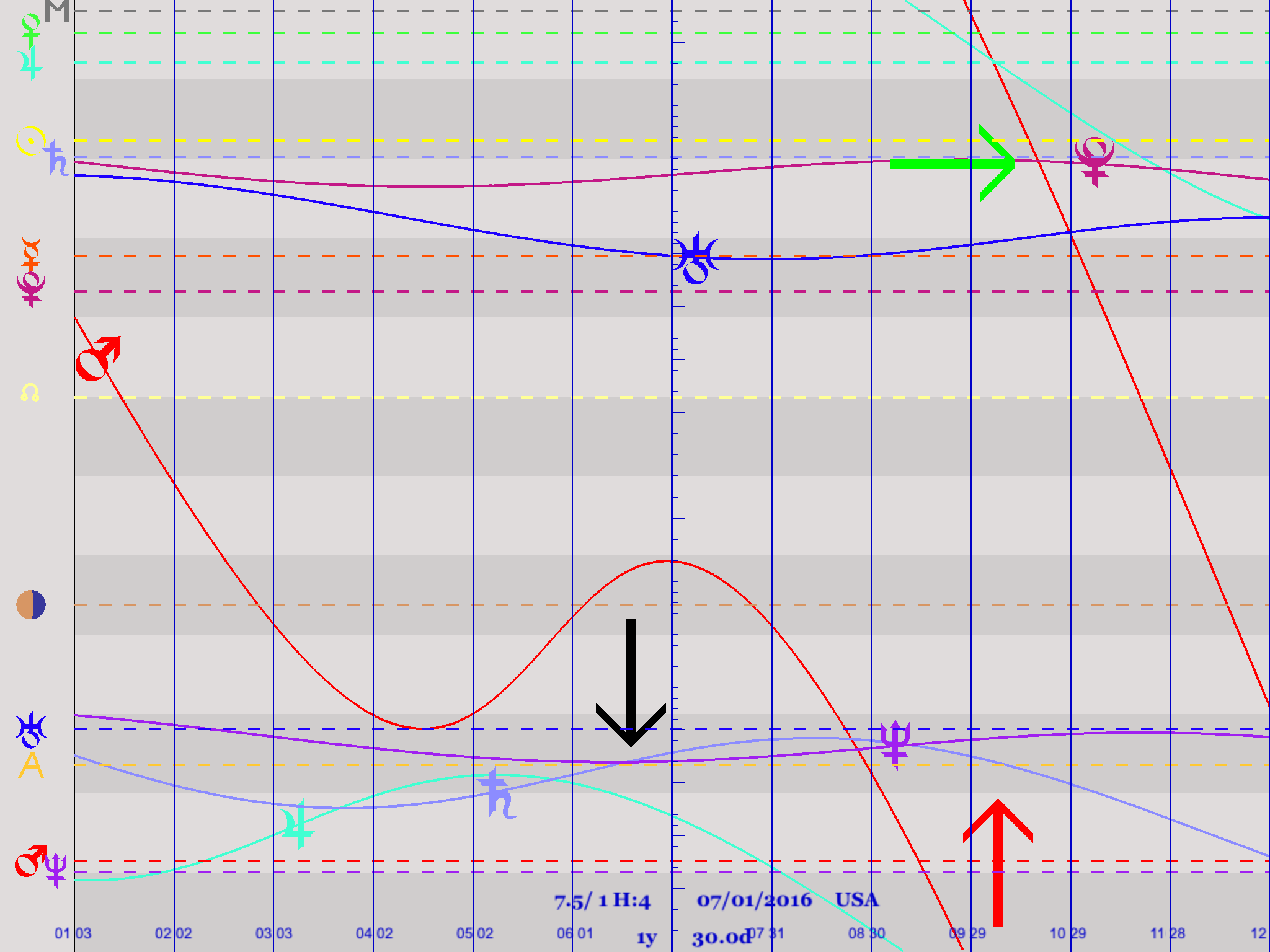
The first thing to consider is the major transit over the last several years, as illustrated in the graphical ephemeris below.  That was Pluto transiting opposite the Sun of the United States.  Since Pluto travels so slowly, taking about 250 years to go around the sun, this transit has never happened before in the history of the United States; the last time this happened was 1767-1770, when America was being hit by such measures from Britain as the Townsend Act, the Stamp Act, and the Tea Act, that were causing many Americans to become increasingly disgusted with the British.  In that case, the Sun represented Britain. Now the Sun represents the President and the government of the United States. This transit represents the extreme displeasure the citizens are displaying toward their elected government and President; many realize that after the Great Recession at the beginning of the current President’s term, their lives have only gotten worse, even though the lives of the wealthy, especially the bankers that caused the problem, have only gotten better, much better. During the last seven years the amount of income and more importantly wealth possessed by the top 1% of the population has increased to a level unseen since the first Gilded Age of the Nineteenth Century, and perhaps not even then. Meanwhile, the government tries to convince people that things are getting better, through speeches and bogus statistics. People are angry. This transit will be within two degrees of exact during this presidential year.

plsutg

Pluto Transiting Opposite US Sun

This transit of Pluto “explains” the extreme animosity to the President’s ideas in Congress, and the rise of “insurgent” and “anti-establishment” candidates in the primary contests that so many commentators have mentioned. It is also why I believe that any candidate from the Party of the President can not be elected unless he or she strongly attacks the current President, which of course will not happen.

But first a disclaimer. When I write this, the first primary has yet to be held. Since these are primaries, candidates appeal (pander?) to their base so you can not believe anything they say. The candidates for the Reactionary Party (Republicans) try to be appear more conservative, and the candidates for the Conservative Party (Democrats) try to appear more liberal. We assume for this discussion that America is still a democracy, which is a very dubious assumption.

When Donald Trump initially announced his run for President of the United States I immediately discounted it as a publicity stunt by the host of a television reality show, one that only served to advance the agenda of comics such as Jon Stewart, who was still on the air at the time. But then I took a look at his birth chart.

I think that it should be a requirement that if you want to run for public office you need to provide an accurate birth time. But I expect that I’m in the minority in that view. Surprisingly enough, we only have two good birth times for all the presidential candidates this year (the other is Jeb!), including those who have dropped out. Even Hillary Clinton, who has been in the public eye for a quarter century, has two birth times twelve hours apart, which is of little use. Fortunately Donald Trump was well known long before the current election and has an accurate birth time.

trump

Donald Trump

The first thing I noticed about the chart is that it is a full moon birth, with the North Node of the Moon conjunct the Sun. This immediately told me that this was a eclipse, and in fact there was a full lunar eclipse on June 14, 1946. So Mr. Trump is an example of an eclipse birth. I recently had an eclipse in a solar return, and the effects were quite spectacular, so I started to pay more attention to his candidacy.

Three things stand out in his chart: Uranus conjunct the Sun. This suggests someone who is a maverick, revolutionary, eccentric, does not like the rules, a progressive mind (Ebertin);. Venus conjunct Saturn: difficulties with women, restrictions in love, a sense of duty (Ebertin). And lastly Mars at the Ascendant: Angry, a temper, displays violence, a fighting spirit (Ebertin). Because the Sun is quite important, I think his Uranian tendencies would be the strongest feature of this person, but most people would pay attention to his anger, since the Ascendant is what people notice, the persona as it were, and not the basic character of the individual, which in this case is more Uranian than martial. Most of his planets are in the East, nearer the Ascendant, and as was said before, this indicates someone who is more in charge of his own destiny.

It is also valuable to see how Donald Trump connects to the United States chart, since he is being seen and judged by the people of the Unites States. Here are two charts, the first with the US planets within the Trump natal chart, showing how Trump responds to the US, and the second with the planets of Trump within the chart of the US, showing how the US responds to Trump.
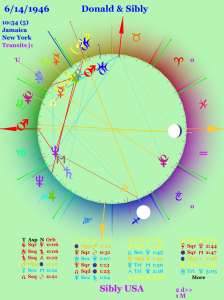
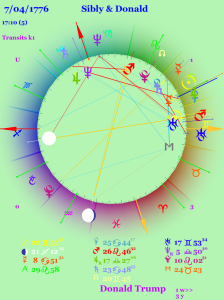
trump_usa

usa_trump

Most interesting is the Mars exchange in both charts. Trump’s Full Moon falls on the Mars of the United States (right), with his Sun conjunct the US Mars. Furthermore, Trump’s Mars (left) is opposite the US Moon. He definitely connects with the martial spirit of America – they love the angry part of him.  Some might suggest that this is sure to lead to war if he is President (of course, since the current President has gotten us involved in seven wars it will be tough to top him) but the most enduring trait of of a President is found in the planet most closely aspecting the MC.  For example, George W. Bush had Mars most closely aspecting his MC, and he is most known for his Iraq War. For Trump this planet is Mercury, with the Saturn aspect almost as close.  Does this mean he would be seen as an intellectual or communicator (I can hear the laughter now) or someone who reins in the country?

Another interesting connection is through Mercury.  Trump’s Venus-Saturn conjunction – the importance of which was pointed out earlier – is on the US Mercury (left), and Trump’s Mercury (right) is conjunct the very important US Sun-Jupiter-Venus. His way of thinking really reverberates with what America is at its core. And this to me explains why he has drawn such vociferous criticism –- Trump is America, and it is frightening to look in a mirror if you don’t like what you see.

Most interesting is how Trump’ Moon falls into the first house of the US: The US feels that this is a man that fits well with the country, that he is at home. This may explain his popularity over the years with America.

He has made some outrageous statements about Muslims, and this gives everyone a chance to decry that terrible man Donald Trump who we are certainly not like. He must represent the end of Western civilization, they proclaim , and though I have yet to hear anyone compare him to Hitler using that dictator’s name  (I stand corrected, I just saw one) , several have called him fascist. And the mass media certainly takes part in the pile-on, breezily reporting any statement that might offend the liberal readership . But some things puzzle me.  Trump has made several statements that are to the left of putative socialist Bernie Sanders, but these are never reported. One of the closest allies of America has a religious test for immigrants and no Muslims are allowed in, but this is never brought up. That same nation, while very close to Syria, has not accepted even one Syrian refugee but no one mentions this as some abomination. It’s enough to make one’s head explode.

It is interesting that statements suggesting there should be no Muslim immigration at present are considered a prime example of blatant Islamophobia, but the killing of many, many thousands of Muslims in several countries, the investigation of mosques in the United States, and the setting up up Muslims because they are Muslims for bomb plots is consider perfectly fine. I recently saw the figures that 23,000 bombs have been dropped on Muslim countries in 2015. It seems like the old adage that many of us learned as children has been turned on its head: Sticks and stones may break my bones but names will never hurt me. The major hypocrisy is mind blowing.

The most similar previous President to Donald Trump, in my opinion, is Andrew Jackson, the seventh President.

Andrew Jackson definitely had a temper. He was involved in some 100 duels during his lifetime, and carried a lead shot in his body until he died, since it was too close to his heart to remove. He killed at least one person in a duel.  Less that decade before he first ran for President he invaded Florida — at the time owned by the Spanish and a refuge of escaped slaves — and killed two British subjects. This could have been an international incident. Most of the cabinet of James Monroe were aghast at this, but his actions were defended by the Secretary of State, John Quincy Adams, who would later be involved more directly with Jackson.

Jackson became a war hero in the Battle of New Orleans when he defeated the British with a very small loss of his own men. Unfortunately, the peace treaty ending the War of 1812 had been signed a few days earlier. But this victory raised Jackson stature in the public eye.

When he first ran for the Presidency in 1824 it was against three other candidates, including John Quincy Adams, his old defender. Jackson won the popular vote, but not a majority of the electoral vote, and so the election was thrown into the House of Representatives. One of the candidates, Henry Clay, threw his votes to Adams, who thus won the election. Later, Adams appointed Clay to be his Secretary of State, and Jackson charged a “corrupt bargain” had occurred between the two men. Clay was probably the best choice for Secretary of State, but Adams’ appointment of him was tone deaf.  Jackson began campaigning for the 1828 election then, and Adams was unable to pass any meaningful legislation because of all the controversy. As result, John Quincy Adams, who has recently been estimated to have the highest IQ of any President, was not able to accomplish anything in his four years in office.

The campaign between Jackson and Adams was marked by several lurid charges that may very well be beyond the pale today. Jackson charged that Adams was a pimp, and Adams charged the Jackson was a bigamist. Adams may have arranged some dates for Russians when he was a minister to Moscow, and Jackson thought his wife was divorced (she did also) when he married her.

Jackson won the election in 1828, and people began to call him King Andrew. Many people were opposed to his Presidency, and those who were against him formed a new political party called the Whigs. At his inauguration many people crushed into the White House, common people who he was supposedly a representative of, and trashed the place, leading to upset among the good people of Washington.

kingandrew

Jackson hated paper money; he was proud that he carried gold and silver dust in a leather pouch that he could use to pay for things, that he thought was real money. He hated the Bank of the United States, an idea of the first Secretary of the Treasury Alexander Hamilton, and his battles with the BUS president Nicholas Biddle led the way to the Panic of 1837.  I’m sure Jackson would be most upset to find that his portrait is now on paper money — the Twenty Dollar bill.

When the Supreme Court ruled in favor of the Cherokee Indians of Georgia when the white settles wanted to take their land, Jackson essentially told the Supreme Court to “stuff it” and the Cherokees were overwhelmed. His solution to the Indian problem resulted in the Trail of Tears and similar excursions that sent Native Americans thousands of miles and killed many (see Jacksonland by NPR host Steve Inskeep).

But Jackson was a break from the “Virginia Dynasty” that had controlled the Presidency up until that time. All the previous presidents had been from Virginia if their name wasn’t Adams, and all had been Founding Fathers or their relatives.  Jackson was so important to setting a changed tone to the country that his period is called the Age of Jackson. He is celebrated annually by the Democratic party as one of their founders (along with Jefferson) but it was really his second Vice President, Martin Van Buren, who laid the foundation for the modern Democratic Party.

Andrew Jackson has been a popular subject for biographers, with many people writing about him such as Jon Meacham, H. W. Brands, and of course Arthur Schlesinger, Jr. The standard biography of Jackson is the three volume set by Robert V. Remini, which is also available in a condensed one volume.

jackson

Andrew Jackson

Here is a chart for Andrew Jackson.  Remember that birth times for Presidents born in the Eighteenth Century are necessarily suspect. His was a Full Moon birth, and in this chart he has Pluto at his Midheaven and Uranus at his Ascendant. Both planets were unknown at the time of his birth, Uranus being discovered a few years later. As we’ve explored often, the combination of Pluto and Uranus shakes things up.  Also of note is his Venus square Pluto — intense love.  He took offense at anyone who would say bad things about his wife Rachael, and even fought a duel over this.  He was crushed when she died right after his election in 1828.

One way of determining who will be president among the two candidates is to look at transits to their chart right after the election. Look for hard transits of Saturn to Sun or Moon. This indicates the responsibly that comes upon a person when they assume the role of President. It could also indicate the despondency they have after losing the presidency.

trumptr2

trumptr1

trumptr3

Here are three charts for Donald Trump right after the election of November 8, 2016. We see that Saturn is near his Moon and thus opposite his Sun shortly after the election on December 30, and it stays close until it turns retrograde and then approaches his Moon once again on April 23, 2017; it then turns retrograde directly on top of his Moon in August and moves away. The whole process takes many months in 2017; either Trump is very despondent at losing the election or it takes him most of the year to learn the responsibilities that come with being president.

Another relevant question is how often has a candidate replaced a two term candidate of the same party if he were not a Vice President who was put into office by the death of the President before him. For the Republicans this happened last when George H. W. Bush replaced Ronald Reagan, who then served one term. The other time was in 1876 when Rutherford Hayes succeeded two term Ulysses Grant.  That election was so marked with irregularities that it made the 2000 Bush v Gore contest seem non-controversial.  For the “Democrats” this happened three times: first when James Madison replaced two terms of Thomas Jefferson in 1808, then when James Monroe replaced two terms of James Madison in 1816 – he also served two terms; and finally when he was succeeded by John Quincy Adams. But all these men were running under a party that is called Democratic-Republican; the real Democratic Party was started by Andrew Jackson, who ran against Adams twice. For the new Democratic party, the only time this happened was when Martin Van Buren (the first non-English background President) succeeded Andrew Jackson.

Manifest Destiny and the Mexican-American War

The term Manifest Destiny was first used by John O’Sullivan in his magazine American Review, but it described a feeling that was  common among many Americans, especially members of the Democratic Party.  This was the belief that some higher power such as God  wanted Americans  (His chosen  people)  to expand over the North American continent.  People thought of taking  both Mexico and Canada. The feeling described by the term Manifest Destiny had spread across America in the early Forties of the Nineteenth Century.   In today’s parlance we would say that Manifest Destiny was a meme, that the idea had gone viral.

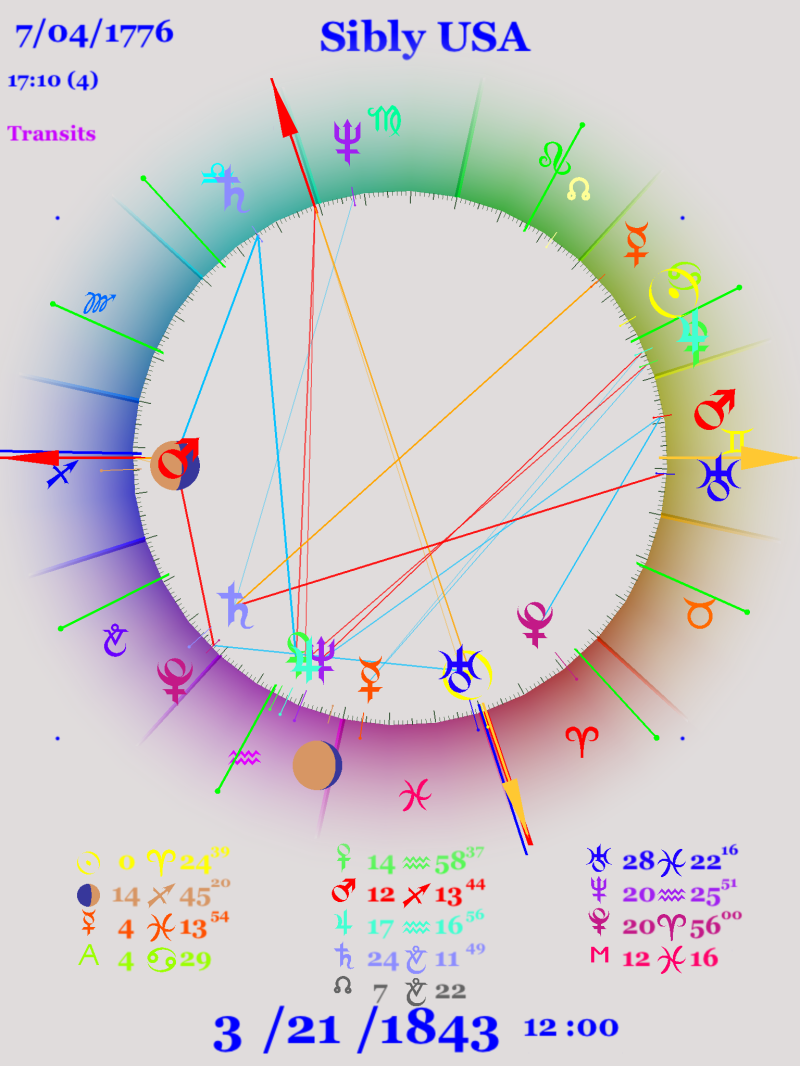
uric1843

Manifest Destiny

Here  is a chart for Spring Equinox of 1843 showing the  outer planet Uranus  beginning the transit of the IC of the United States chart, a position  that it would  occupy for  the next couple of years. The IC represents the base or foundation of the person  represented by the  chart, in this case the United  States.  This point is the furthest submerged, and transits to this point are long lasting and not easily recognized, the  effects seem almost to come out of  nowhere.  In this case, after the crisis represented by the transit of Uranus  over the MC 42 years earlier, to be discussed later, America was beginning to feel sure of itself,  and this urge to expand was just a manifestation of this new found feeling of being a unified country.

In the  election of 1844, the original dark horse candidate James Polk,  a protégé  of Andrew Jackson, was finally nominated to head  the Democratic ticket for President, opposing Henry Clay of the Whig   Party; that party had  won the previous election  but that President had died immediately upon taking office.  Clay ran on the expansion of  American infrastructure whereas Polk ran on  expansionism, to  bring Texas and  Oregon into the  Union.  He also wanted to bring California into the United States, but this  was not mentioned at the time. Polk  won.

Three future presidents served in the Mexican American war: Ulysses S. Grant,  Franklin Pierce, and the next president, Zachary Taylor.  James Buchanan, the President after Pierce and before Lincoln, was Secretary  of State under Polk, and Abraham Lincoln was a Whig Congressman under Polk.

The war with Mexico was unique up to that point.  America had fought wars before, with Great Britain and mostly with Indians, but this was different.  The Indians were somehow already living on land that was considered United States, and they just had to be convinced to allow US settlers to live on the land that they somehow occupied.  And the British were the former masters of the United States and they had to be prevented from continuing to tell the country how to behave.  But Mexico was a separate republic, an the US had no right to their land.

After his election, Polk  sent Taylor and United States troops to a position just north of the  Rio Grande river, which he considered the northern border of Mexico and thus the southern border of Texas.  However, most people in the United States who were not Democrats as well as the Mexicans and Texians  (their preferred name) thought the border to be the Nueces River many miles north of the Rio Grande.


mexwareal

Taylor to Rio Grande

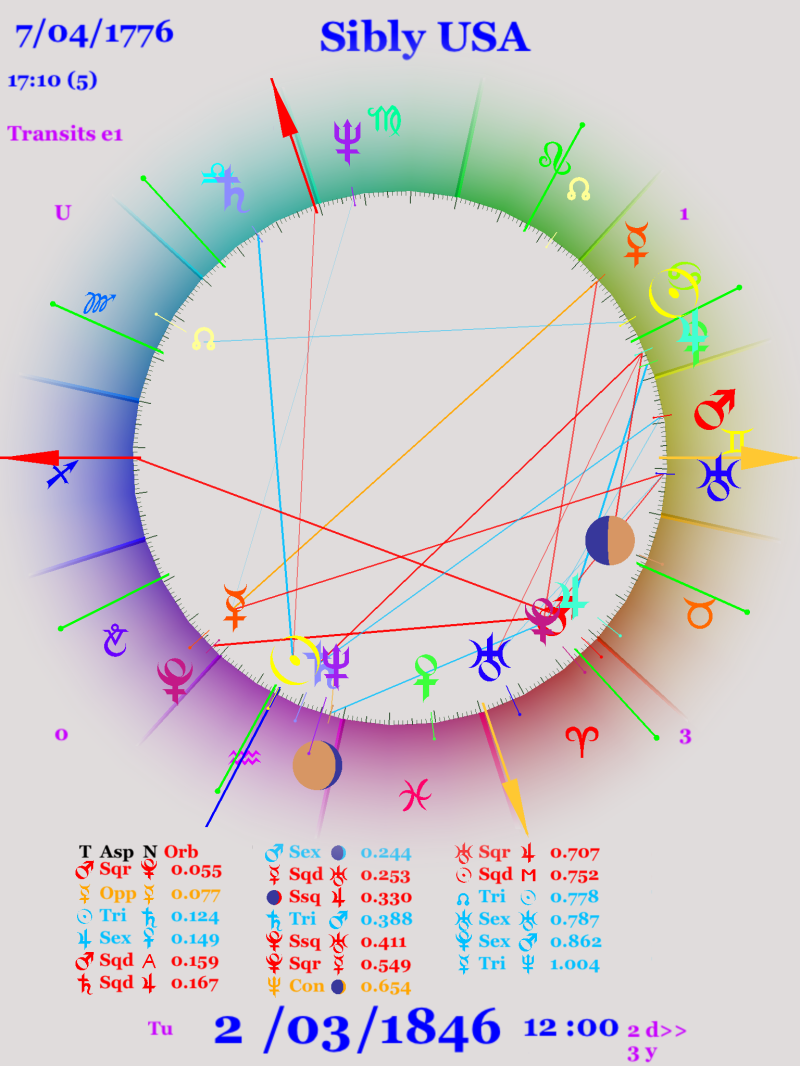
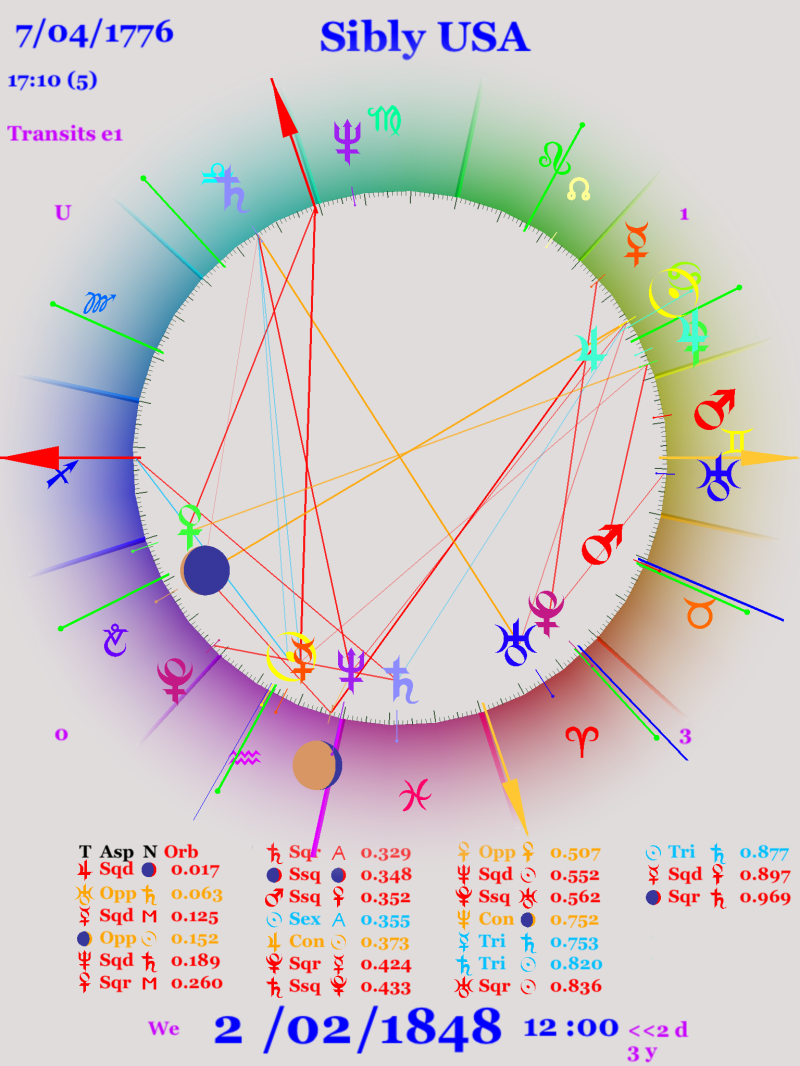
Here is a chart for Taylor’s advance over the Nueces River on February 3, 1946.  This was an act of aggression that many recognized at the time.  The tightest aspect is Pluto sesquiquadrate the US Ascendant, recalling the tight Pluto semisquare Ascendant in the natal chart.  Pluto can be seen as aggression and urge to dominance.  But notice also the approaching Saturn Neptune conjunction of the US Moon.  This is not a good sign for a positive reaction at home, as we’ve explored before.  Presidents should know better than to schedule a war any time a Saturn Neptune hard aspect is coming up.

This action was not well received by the Mexicans or Zachary Taylor either.  Taylor was a Whig and like most Whigs was against the war with Mexico, which he thought was patently illegal. But he had his orders.   The Mexican army attacked Taylor’s troops,which they saw as invaders, and Polk had his casus belli.  The war lasted for two years, and proved to be longer and more bloody than anyone had imagined.  Does that remind you of a more recent war?  As an outcome, Polk was able to get the state of California, which had long been his goal, as well as most of the new states of Arizona, New Mexico, and Nevada  well as small parts of other states.  And the United States got Utah, which had been settled by the Mormons after they were chased out of Indiana. In fact, to help the war effort Mormon troops fought with the enlisted men and the volunteers


mexwaroff

Official Start of War

Here is the chart when the Mexicans attacked the Americans, which is the putative start of the war, even though it had really stated with the previous action.  We see that this is close to the Mars Return of the United States, when Mars returns to its natal position.   A Mars Return would indicate a time when one is especially martial.  But note that that Saturn-Neptune conjunction is on the US Moon quite tightly.  Saturn Neptune indicate that what was once thought to be a good idea is no longer believed to be, and since it is on the US Moon, the people of that country deeply felt that.  And in fact by the fall of 1846 enthusiasm with the war was already waning, as news of the atrocities committed by the US troops reached the Americans.

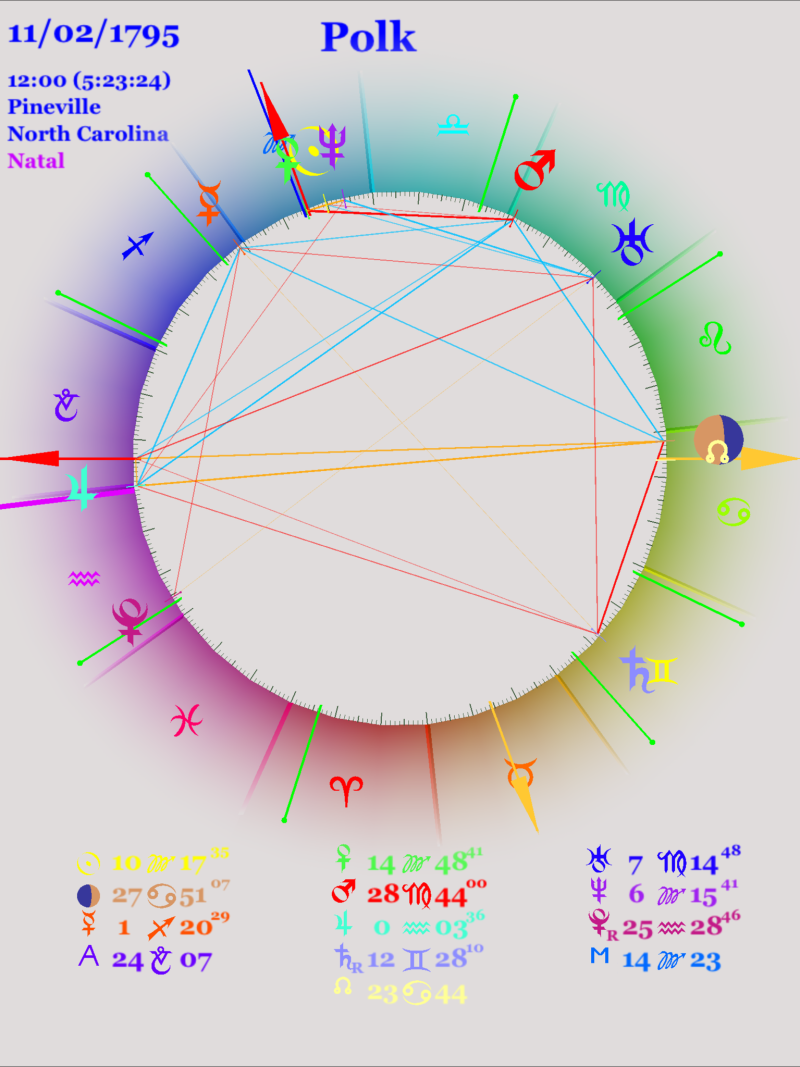
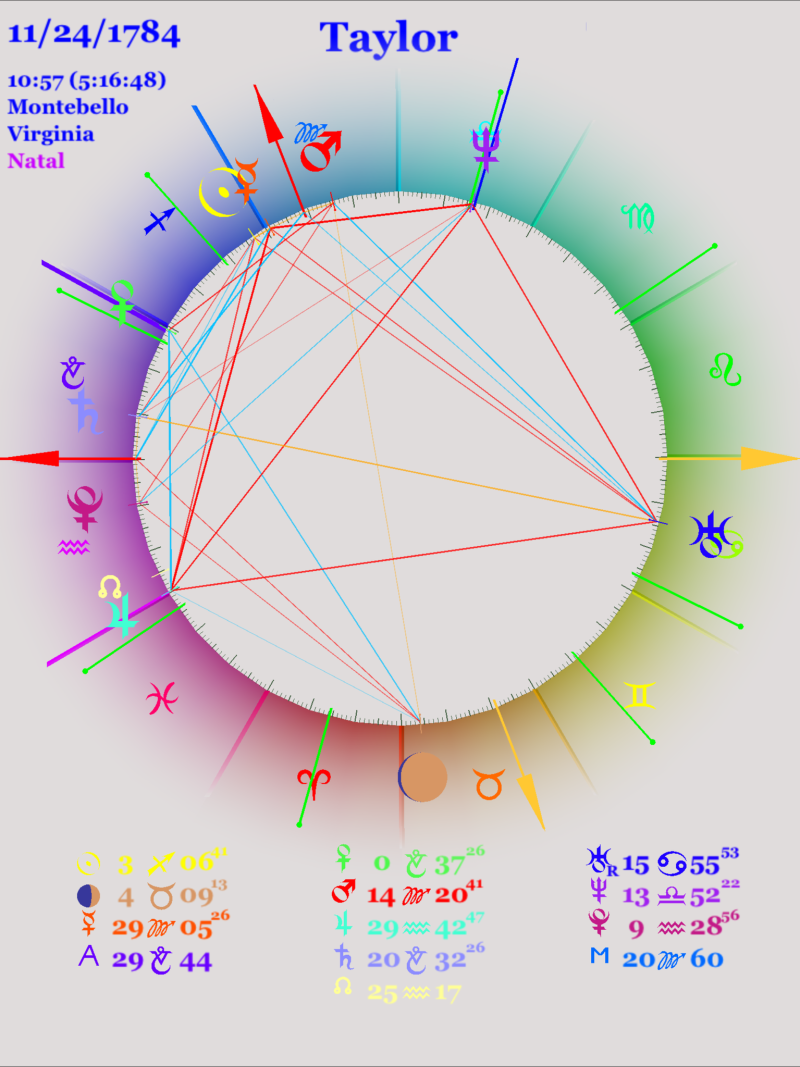
Here are the charts of both James Polk and  Zachary Taylor, who succeeded him as President of the United States.


polk

James Polk

The time of Polk’s birth is supposedly from his diary, so it should be accurate.  He has Jupiter rising, suggesting that he gives a lot of his energy to the world, that he is optimistic.  And in fact he had a great difficulty in delegating tasks to others when he was President and would not take vacations though many, including his wife, begged him to do so.  On nomination he assured his followers that he would serve only one term, which was fortunate since he died a few  months after leaving office.  He was also a  Scorpio president, Scorpio  being ruled by Pluto (an unknown planet at the time).  Another well-known Scorpio President was Theodore Roosevelt, also known for his aggressive  behavior.

taylor

Zachary Taylor

In the chart for Zachary Taylor, “Old Rough and Ready” (he did not like to “dress up”), the second and last elected Whig President, shows Pluto rising and Mars at the Midheaven, with most of his planets in the East, that is the left hand side of the chart.  The positions of Pluto and Mars are most appropriate for a military commander.  Planets in that hemisphere indicate a person largely in control of their own destiny, someone whose own actions determine their outcome in life.

The troops sent into Mexico were composed of regular US  troops, mostly lower class people who needed a job the military could provide, and volunteers, who were generally of a higher class.  About two-thirds of the troops were volunteers, and there was much ill-feeling between the two groups.   Many of the volunteers brought “servants” with them, mostly slaves. The volunteers were  also not nearly as well trained  as the regular army troops.  There were also many atrocities committed by the volunteers against the Mexicans, and as Fall of 1846 approached, people in the United States, and then in London,  began to hear about these atrocities .  General Taylor did not like the volunteers, but Polk sidelined him by sending in another military commander who got two-thirds of the troops.  Polk was afraid that Taylor was getting too popular as a military leader and might run for President (which he did) as a Whig, which Democrat Polk did not like.

A majority of the volunteers came from slave states,  but the largest source of volunteers was Illinois.  While technically Illinois  was  free state, southern Illinois bordered on the slave state of Kentucky and Illinois citizens owned many  slaves.  Also, Illinois citizens were in general great believers in Manifest Destiny.

Originally Polk, and many of the troops serving in this war, were for taking more of Mexico that they actually did.  Once the troops entered Mexico, they saw how barren the country was, and were upset at the backwardness of the Mexicans, who they considered to be barely  above Indians  or slaves.

When the vote to authorize the invasion took place in Congress — this was still a primitive time when they actually followed the Constitution’s requirement that the Congress declare war —  although the Whigs were against the war, many of them voted for it.  They remembered that once there had been the Federalist Party that had strongly opposed the War of 1812, and as a result that party was no longer in existence.  The Whigs did not want to follow the same path. However, some Whigs followed their conscience and voted against the war;  these were called the “Immortal Fourteen”, amongst whose members was John Quincy Adams, who had been a President twenty years before and was a strong abolitionist voice in  the Congress.  But the war resolution passed.

After the War, most people expected the new territories acquired to be settled by slave owners, thus making slave states the majority in the country.   Certainly Polk, a slave owner from Tennessee, expected this.  But an abolitionist congressman  from Pennsylvania by the name of David Wilmot introduced what was called the Wilmot Priviso, that prohibited slave owners from making any states from the new territories slave states. This controversial bill  was introduced into many sessions of Congress, and the controversy about the status of these new states was one of the things that led to the Civil War.


mexwarwilmot

Wilmot Proviso


Here is a chart for the first introduction of the Wilmot Proviso.  Again there is the Saturn-Neptune conjunction on the US moon, but now is is opposed by Mars (War).  Venus (Peace) is conjunct the US Sun (Government)  and Jupiter (Expansion) is opposite the US Ascendant.

There were embedded US reporters with the troops in Mexico, and often their reports reached Polk before diplomatic reports did.  These embedded reporters were uniformly for the war  until they began to see the atrocities committed by the American volunteers against the Mexican people.


mexwarmassacre

Agua Neuva Massacre

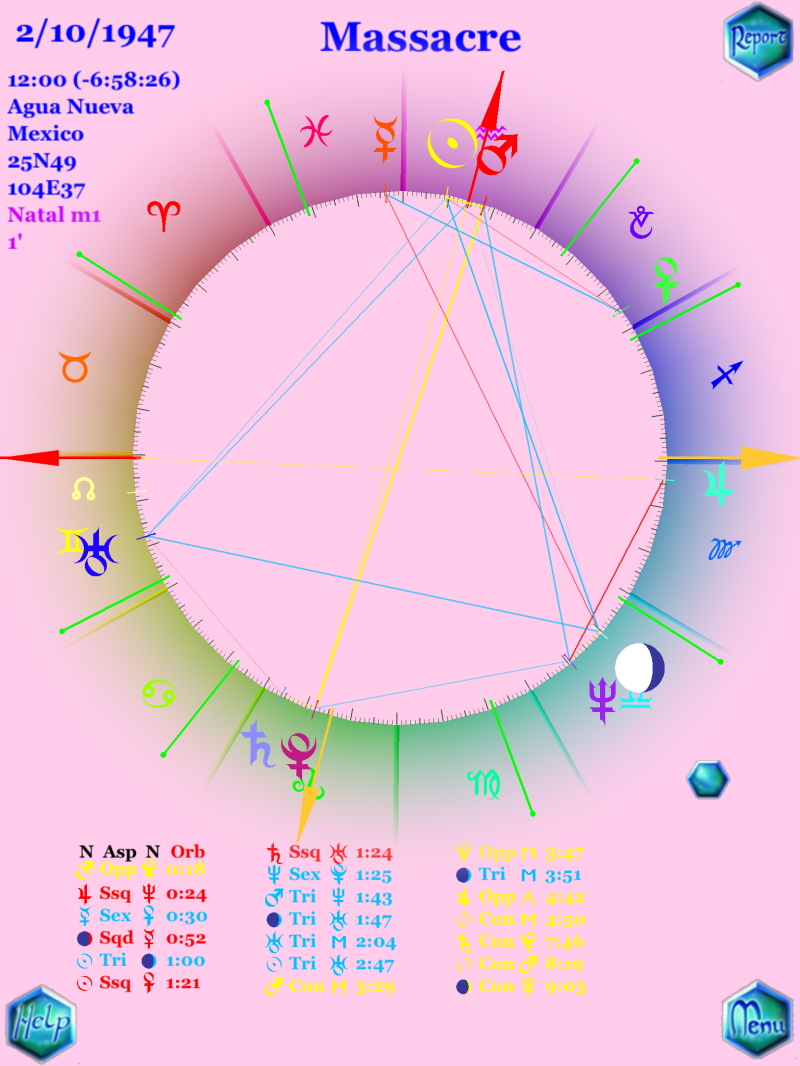
The biggest massacre was at a cave in Agua Neuva.  Here is an event chart for that massacre.  Over two dozen Mexican men were butchered in front of their wives and children, and many were scalped.  American soldiers had learned from their wars with Indians. In this chart the tightest aspect is the opposition between Mars and Pluto – Pluto again playing a dominant role – and this aspect was tight no matter the time of day, and there is a waning Sun-Mars conjunction.  Ebertin says of Mars-Pluto “Superhuman power, force, brutality.”  I call it, somewhat jocularly, as the aspect of the mass murderer, and in fact the killer at Virginia Tech had these two planets in conjunction.


mexwarflag

US Flag Raised over Mexico City

After a long battle in Mexico City, General Scott won and the American flag was raised over the city.  Here is the chart for that flag raising.  Venus rising is a significator of peace, but peace was not forthcoming since the US troops were wrecking the city and raping the women, so the citizens of that city were not too happy with the America presence and continued to battle them.  This was America’s first experience at occupying a foreign country, and it was not popular with the Mexicans who fought back with stones, result in mass killings by the Americans.

Many in the Northeast were opposed to  the war, such as Ralph Waldo Emerson and Henry David Thoreau; in fact the famous confrontation between the two men happened during the war.  Thoreau was in jail for refusing to pay his poll taxes to support the war.  But many Americans were for the war, at least initially.  For example Walt  Whitman, then a newspaper editor in Brooklyn, did not come out against the war until he realized that it was meant to increase the number of slave states. That change of opinion got him fired from his job.

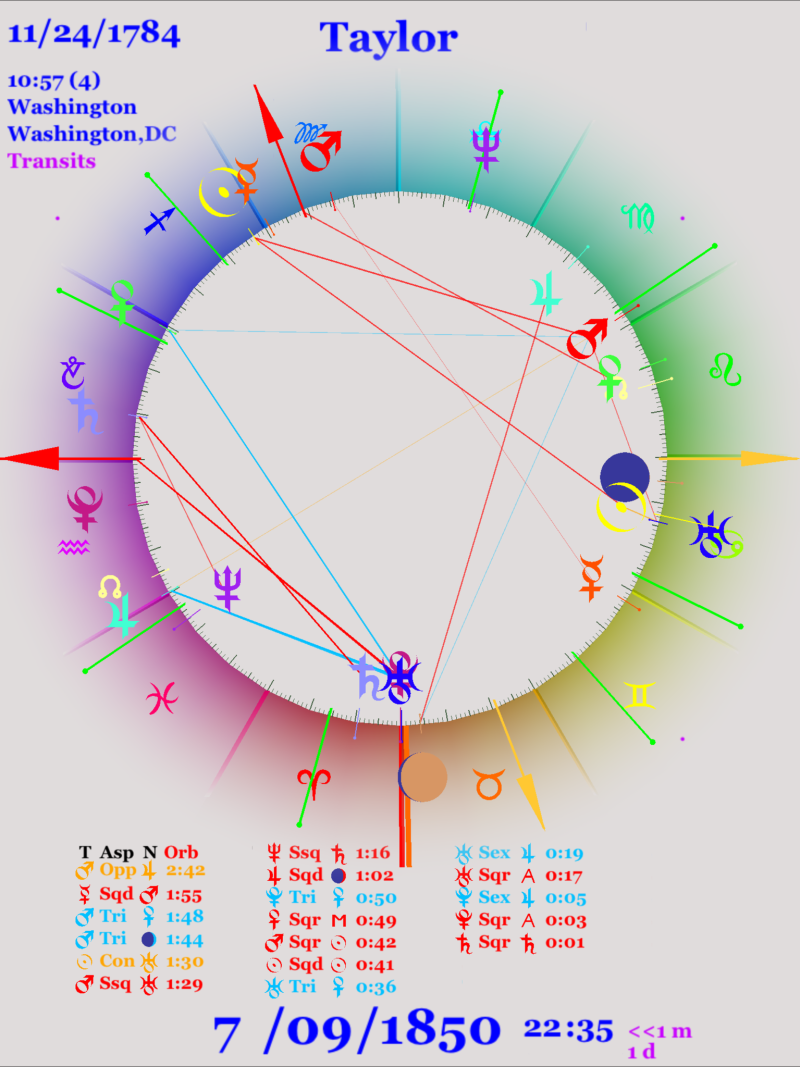
Zachary was elected a a Whig President in 1848, following Polk who died months after leaving office.  The story has it that Taylor died after eating cherries and milk on the Fourth of July while raising money for the Washington Monument which was then being constructed.  But some think that he was assassinated by Southerners, who were not happy that he wanted slavery outlawed in the new states gotten from Mexico.  This theory was propounded by Michael Parenti in his book History as Mystery, and details of this theory can be searched for on the Web.  In 1850 there was a Uranus-Pluto conjunction and many Southerners wanted to leave the Union.  This crisis was defused by the passage of Henry Clay’s Compromise of 1850, but it was a forerunner to the final act of succession ten years later.  This Comprise had been opposed by Taylor, but his death allowed the Compromise to pass, in several bills, which included the hated (by Abolitionists) Fugitive Slave Act, which required runaway slaves to be returned to their “owners” no matter where they were captured.


taylordeath

Death of Taylor

In this chart for the death of Taylor – it took him several days to finally succumb to his mysterious aliment – we see the  Uranus-Pluto conjunction that marked 1850 square his Ascendant and in this Third House, along with Saturn.

The Treaty of Guadalupe-Hidalgo finally ended the War long after Mexico City had been captured.  While many Americans wanted to take all of Mexico, Polk’s negotiator did not think this was a good idea, and because of the distance involved and the lack of good communications – the telegraph had only recently been introduced – a compromise was reached in which the US government paid money to the Mexican government in exchange for most of everything that is now the Southwest United States.  This is called the “Mexican Cession” but as we have seen it was far from voluntary.


mexwarend

Treaty of Guadalupe-Hidalgo

In the chart for this peace treaty, we can see that the Saturn-Neptune conjunction has long passed. Saturn now squares the US  Ascendant and Uranus opposes the US Saturn.  The country did not get all  that they wanted from Mexico,  and further difficulties were in store for the country as the issue of slavery became more pronounced over the following decade. The tightest aspect is Jupiter sesquiquadrate the US Moon, and it is also conjunct the US Sun.  The expansion (Jupiter) of the US  was mostly complete with this treaty (a compromise with Great Britain previously in the Polk term had resulted in the Oregon  territory south of the 49th parallel being included in the United States) and the present day continental US took shape.

The Dance of the Decades

Many years ago I was researching astrology in a college library, and came across a Persian book about astrological cycles.  In most college libraries, only a historical treatise on astrology would be allowed in, though I knew the librarian at a different college library and she ordered some books by Dane Rudhyar and Marc Edmund Jones for the college library she worked in so there are differences.   This Persian  book described the Jupiter-Saturn cycle, from conjunction to the next conjunction, and associated that cycle with the rise and fall of kings.

That Jupiter-Saturn cycle is still considered important, with the phenomena known as “Tecumseh’s Curse” that bedeviled Presidents.   Supposedly this “Curse” says that every president elected during a Jupiter-Saturn conjunction would die while in office.

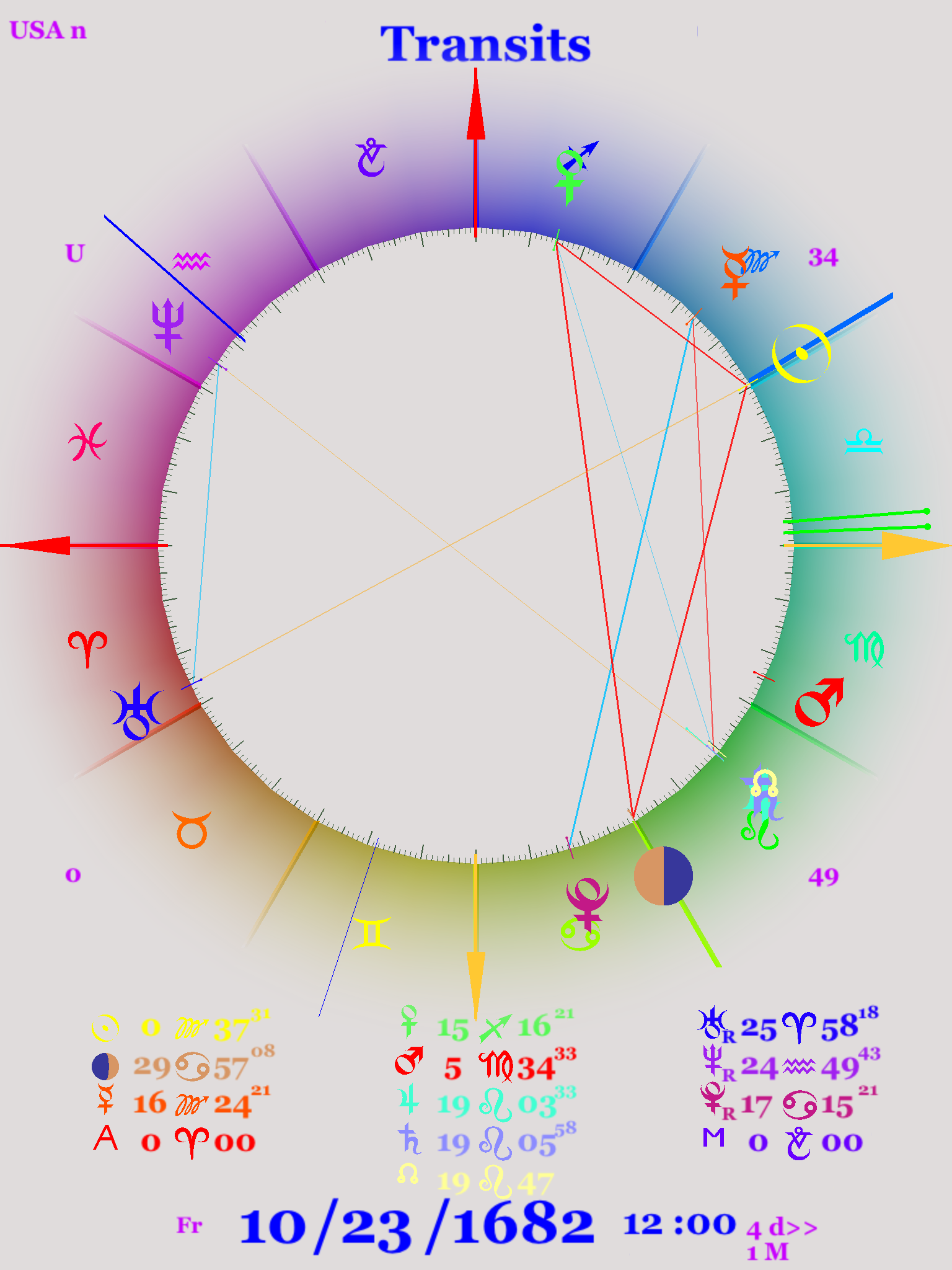
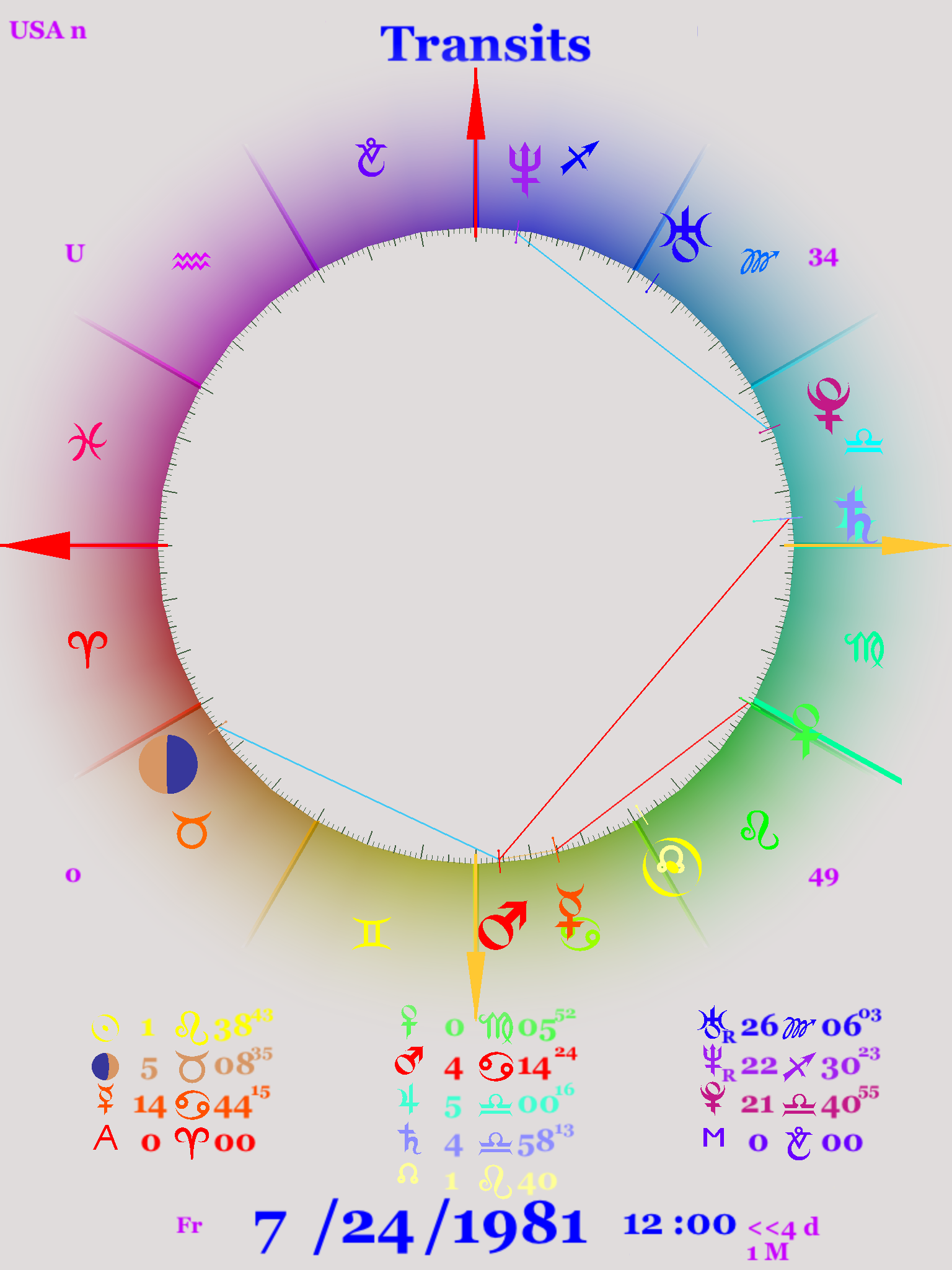
Jupiter take twelve years  to orbit the Sun, spending about one year in each sign, and Saturn takes almost 30 years for its cycle.  But what we are talking about is called the synodic cycle, that is the period from conjunction of two planets to the next conjunction.  This is similar to the period between a New Moon, which is a conjunction of the Moon and the Sun, until the next New Moon.  This period is different that the time it takes the Moon to revolve around the Earth, because in that time  the Sun has moved about one-twelfth of the distance along its orbit.   The period between the conjunction of Jupiter and Saturn are about twenty years, and it recent times  this conjunction has occurred approximately with the start of an even decade, which starts in a years either ending with zero or one, depending on your view of the beginning of a century and the fact that there is no year zero.

ju1sa1682ju1sa1981
Here are two chart for the first Jupiter-Saturn conjunction of a cycle.  In one case this occurs in 1682  and the next  case in 1981.  Even though these two charts are 300 years apart, the both occur at the beginning of their respective decades.   The third  example is the Jupiter-Saturn opposition (shown below) following the last conjunction shown.  This opposition occurs in 1990, the beginning of the “odd” decade.

Thus the Curse of Tecumseh applied to the Presidents elected in 1840 — William Henry Harrison,  who got sick  at his very long inaugural — it was a cold March in Washington and he wore no head covering, feeling it would make him look old — address and died a month later — 1860 — Abraham Lincoln  who was killed at the beginning of his second term — 1880 — James Garfield, assassinated by a “deranged office seeker” — 1900 — William McKinley, who was shot by a “anarchist”  — 1920, Warren Harding who died of “cerebral hemorrhage” three years into his term — 1940, Franklin Roosevelt who died of a cerebral hemorrhage at the beginning of his fourth term — 1960, John Kennedy, who was shot by a lone gunman — 1980, Ronald Reagan,  who  was shot by a deranged gunman again.  But wait, Reagan did not die of his wounds.  I’ve expressed earlier that I think that John Lennon took the bullet for Ronald Reagan.  Astrologers have a theory to explain why the conjunction of 1980 was different, such as that it occurred in a different element than all other conjunctions that resulted in deaths.  Then there is the non-death of George Bush elected in 2000.  But was he really elected?  Maybe Al Gore should have died.   But this trip through the past is merely to illustrated the notoriety given to the Jupiter Saturn conjunction.

In this scheme the Jupiter-Saturn synodic cycle can be compared to the Sun-Moon cycle.  That cycles starts at the New Moon, and then there is the waxing moon until it is Full, and then the  Sun is opposite the Moon (as seen from the earth, of course) and that is followed by the waning Moon, until the next New Moon and the process starts all over again.  The waxing moon, symbolically the growth of a cycle, reaching its culmination at the  Full Moon, and then under the waning moon the loose ends of the previous waxing moon are gathered together in preparation of a new cycle to start at the next New Moon.  The cycle is described completely in Dane Runhyar’s The Lunation Cycle.

We can see the Jupiter-Saturn synodic cycle in the same way, but applying to mundane affairs.  The cycle starts with the Jupiter-Saturn conjunction, which starts near the beginning of an even decade, the waxing period occurs during that decade, and the “Full Moon” happens at the Jupiter-Saturn opposition at the start of an odd decade, and then the waning period goes on during that decade in preparation of the next Jupiter-Saturn conjunction at the start of the next even decade.  The various happenings of each decade are influenced by other things that happen during that decade, obviously, but looking at the waxing waning cycle gives us an overview of that decade.  Below I will discuss examples of decades starting with the turn of the Twentieth Century.    Notice that that are also other thing that happen:  The Uranus-Pluto conjunction was during an waxing decade, while the equally important Uranus-Neptune conjunction  happened in an waning decade, which may be one reason that that decade is not as highly considered.  Also World War one was in an waning decade but World War Two was in an waxing decade. So this Jupiter-Saturn cycle just sets the tone for a given decade.

As discussed previously the decade of the 1900s was filled with much change.  This decade was the beginnings of the modern world.  Many important astrological  events happened, including two cardinal crossings by outer planets, Uranus and Neptune; Pluto would make a Cardinal crossing in the next decade.  The was also the midpoint configuration — Uranus = Neptune/Pluto — in that decade, with at one point Uranus at 0 Capricorn.  In the United States this was the Progressive Decade, and there were many anarchists movements throughout the world.

The beginning of the next decade contained much of he change from the first decade, but there was also buildup for war.  One forerunner of this was the two Balkan Wars of 1912 and 1913.  The Ottoman Empire — the Empire of  Turkey —  which had existed for 600 years, was slowly unraveling  and these wars were attempts by various Balkan counties to break away and defeat the crumbling Ottoman Empire.  This was a prelude to the First World War that dominated the second decade of the Twentieth Century and shaped the upcoming history,

The third decade, the decade of the 1920s, happened directly after the end of Word War I, which saw the breakup of the Ottoman Empire, forming many countries of the Middle East, such as Syria, Iraq, Turkey, and  Israel, which are so much in the news today.  Germany had its first democratic government.  In the United States the Twenties are well known for prohibition  and the rise of the bootleggers (leading to organized crime)  and stock market rise.

The  Thirties, on the other hand, saw world wide depression – called the Great Depression because it was beyond what the world  had  witnessed the past few hundred years, and the rise of fascist movements, mentioned here in Germany, Italy, Spain, Japan.  Wars were breaking out as Japan invaded China and Germany invaded Czechoslovakia.  The harsh behavior of  Japan in China gave rise to a nascent Communist Revolution.

The decade of the Forties saw the outbreak of World War II, which would prove to be much  more  deadly than the first one.  Like the first one, this  world war would ultimately change the shape of the world.  The war ended  half way through the decade, and the remainder of the decade was spent sorting out the changes to the world made by the war.  This saw the first change of the GDP per capita rate of growth of the world in 120 years.

The Fifties  were the waning decade of the Forties, and they are known as “boring”.   Nothing much is considered as happening during this decade, which of course  is very untrue, but the reputation  remains.  There were  no big wars, as in the previous decade. And there was much recovery in many countries that had been ravished by the long war.  In the United States, however, there had been no destruction since the war had conveniently been fought elsewhere, and so that the country embarked on a Cold War against one of its allies during the previous war, which served as a major boost to the defense industries that had seen great promotion during the war of the previous decade.

Next comes the seventh decade of the Twentieth Century, that mythical time known as the Sixties.  This  decade was both a waxing decade and saw  the first outer planet conjunction of the century, so  it was doubly  blessed or cursed.  It also followed the decade of the Fifties, which had an unfortunate reputation, so it couldn’t help but be different.  Also  there was a big demographic shift.  Many people were born after men returned from the Second World War, and by this decade they started to be old enough they they could influence society just by their numbers.  This was the so-called Baby Boom generation.

The Seventies were a waning decade, and so bound to  be a let down form the previous waxing decade.  This decade saw the first warning — with the oil shocks — that everything wasn’t hunky dory and that natural resources that we expected to last forever were indeed finite.  To accentuate this idea, the book Limits of Growth was published in 1973 in an attempt to cause a change in our thinking.

At the end of the Seventies we saw another midpoint complex, this was Uranus = Neptune/Pluto, and the responses  to that midpoint colored the decade of the Eighties.  The world saw leaders Margret Thatcher and Ronald Reagan brought to power and dominate the world scene, even though a reformer by the name of Mikhail Gorbachev  rose to  power in the Soviet Union, and, as the only one of those three still alive, could have brought some needed changes to his country and the world, but it was not to be.

The Nineties, which will be discussed in more details later, was a  waning decade but it had the second outer planet conjunction of the Twentieth Century. The  big event of this decade was the rise of the World Wide Web, which ultimately lead  to the Dot Com Bust that marked the end of the decade.

The first decade of the Twenty-First Century, and also the first decade of a new millennium, was marked by the rise of terrorism, which was never seen as a response  by third  world countries, so long under the thumb of first world countries, to the actions of those first world counties.  The book Blowback by Chalmers Johnson, published in 1999, discusses this idea in great detail

The second decade of this new century, the decade we are in now, saw further responses and aftermaths to the War on Terror that had highlighted the previous decade.  People also came to realize that the climate was changing in ways not helpful for human life, but for the most part the world’s leaders just talked about the problems.   Solutions were suggested that may have worked if proposed in 1980, when the first hints of the problems of growth were suggested, but that had  been decades previous.

The next decade is a waxing decade, and we will see changes, either positive or negative, happen at a greatly increasing rate, as discussed previously.

Let’s look at some charts for the recent Jupiter-Saturn conjunctions/opposition.  Do they suggest anything about the upcoming decade?  Perhaps.

ju1sa1960

The Sixties

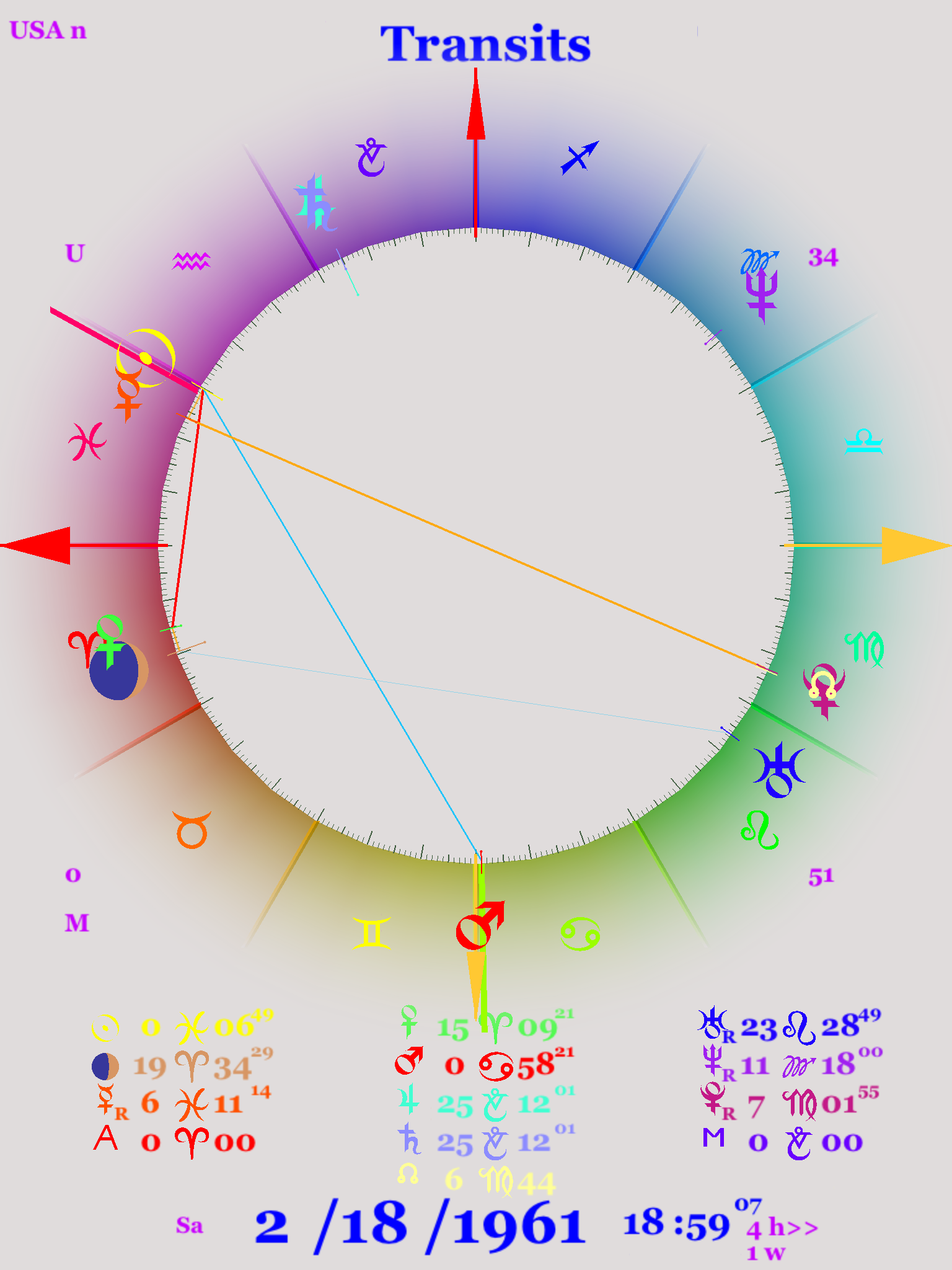
In the chart for the decade of the Sixties — February 18, 1961 — we see Pluto-Node opposite Mercury.  Could this opposition suggest the Plutonian  upheavals that would mark the upcoming decade, and that would be widely communicated so that hardly anyone would not notice it?

ju1sa1980

The Eighties

In the conjunction chart for the Eighties, December 31, 1980, we see that conjunction square the Sun-Mercury conjunction. During the decade of the Eighties, the iron law of the market became more dominant in the world.  Perhaps the Saturn square the Sun presages this.

ju2sa1989

The Nineties

The opposition chart for the Nineties — September 19, 1989, just two months before the fall of the Berlin Wall — has the Saturn-Neptune conjunction opposite Jupiter, highlighting that conjunction that we have discussed previously.

ju1sa2000

The Aughts

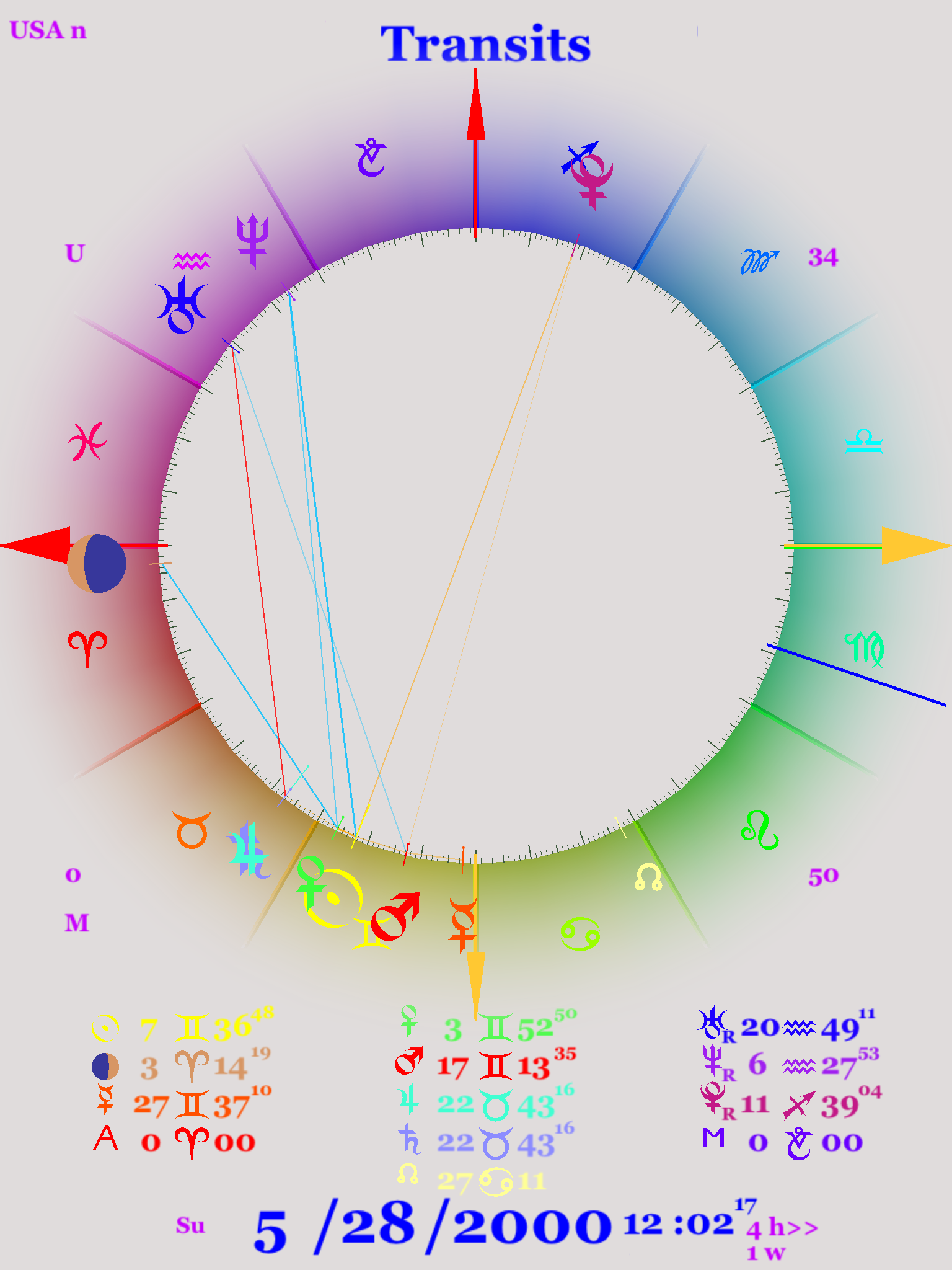
The conjunction chart for the first decade of this century, on May 28. 2000 is most suggestive: The sun is opposite Pluto.  The next decade would be most Plutonian, with the US  approved “War on Terror”  making terror the watchword around the world, with many repressive regimes using the excuse of fighting terrorism — if it’s good for the US it is good for us may be their motto — allowing them to repress those considered undesirable.

ju2sa2010

The Teens

The Jupiter- Saturn opposition chart for this decade — May 23, 2010 — shows Jupiter and Uranus at the Aries point, opposite Saturn and the Moon, and Pluto is opposite Venus. For Jupiter-Uranus Ebertin says optimism, a lucky chance.  And  despite some depressing news of the day, in general many people, especially politicians in the United States, seem to be optimistic that we can escape the onrushing juggernaut that is known by the moniker “climate change” and that our lucky chance will allow us to avoid the unpleasant consequences of our own behavior.  But the opposition to Saturn should temper that optimism.  The next decade will show our folly.

ju1sa2020

The Twenties

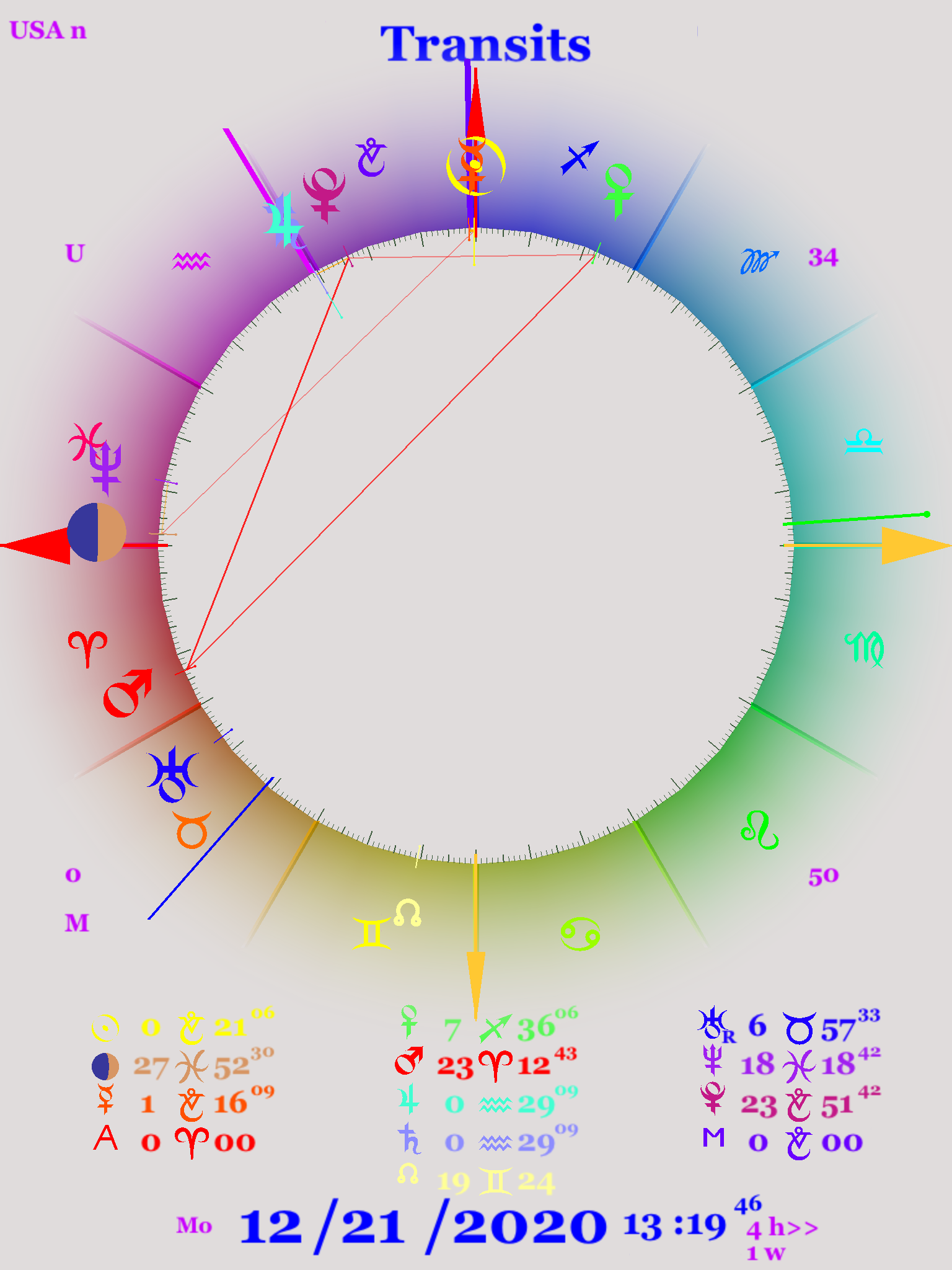
The chart for the next decade — December 21, 2020 — occurs at the Winter Solstice, when the Sun is at zero Capricorn.  The other most obvious aspect is Mars  square Pluto with only a one degree orb.   This does not suggest a peaceful decade.  Many of the recent decade charts have had Pluto aspects.  Perhaps this suggests that this century will be very Plutonian, full of transformation.

Two Massacres and a Rebellion

The events I will talk about are the killing of nine worshippers at the African Methodist Episcopal (AME) church in Charleston South Carolina, the church bombing which killed four teenage girls at a church in Birmingham, Alabama over 50 years ago, and the Watts Rebellion, one of the most famous of the riots of the Sixties that developed in Black areas of major United States cities.  I’ll look at the events on the US chart — since they all affected the United States, and also the charts of the respective cities.  The charts are from Carolyn Dodson Horoscopes of the U.S. States & Cities (AFA)  and are drawn for 12 noon local mean time if time zones weren’t observed on the date for the city.  Mars, the planet symbolizing violence and gunfire, will be prominent.

The shooting of many people and the killing of nine at the AME church in Charleston. South Carolina was recently in the news, and the current removal fo the Confederate flag from the capitol grounds in Columbia is well covered.  But South Carolina has a history that led it to this point.  South Carolina was settled by British colonists from the Caribbean, who  were quite devoted to slavery and whose behavior made the English colonists of Virginia look like abolitionists in comparison.  Virginia was settled by colonists from England who had been on the wrong side of the English Civil War (Cavaliers)  as  opposed to those colonists in the sugar colonies who had been away from England for some time.  South Carolina was famous for getting Jefferson to withdraw the condemnation of slavery from the Declaration of Independence, for starting nullification (a forerunner of actual succession) in 1833, as led by Senator (and vice president during Andrew Jackson’s  first term) John Calhoun, considered one of the three most influential senators (along with Daniel Webster from Massachusetts and Henry Clay of Kentucky) of antebellum America.  It was the first to start withdraw from the Union, and the first shot of the Civil War was fired at Fort Sumter in South Carolina.  So South Carolina has a long reputation of being recalcitrant.

Whites had long tried to get freed blacks into churches, and the Methodist church was particularly successful at this endeavor.  However, there was a major contradiction with the fact that many whites in those churches shunned the black members.  In 1816 a wholly-run black church was formed for black parishioners, and this was the African Methodist Episcopalian or AME church.  The first one was in Philadelphia, but the movement rapidly spread, one of the first AME churches established was in Charleston, South Carolina.  In 1822 it was accused of involvement with the slave rebellion led  by Denmark Vesey, which was discussed previously.  This particular potential slave  rebellion frightened all of the South, and led to the burning of this Emanual AME church.  Finally, in 1834 all black  churches were made illegal.  So this particular church has a long history in the South, being the first AME church established in the South, and so was a apt target for this terrorist activity.

charl_usa

Massacre in Charleston

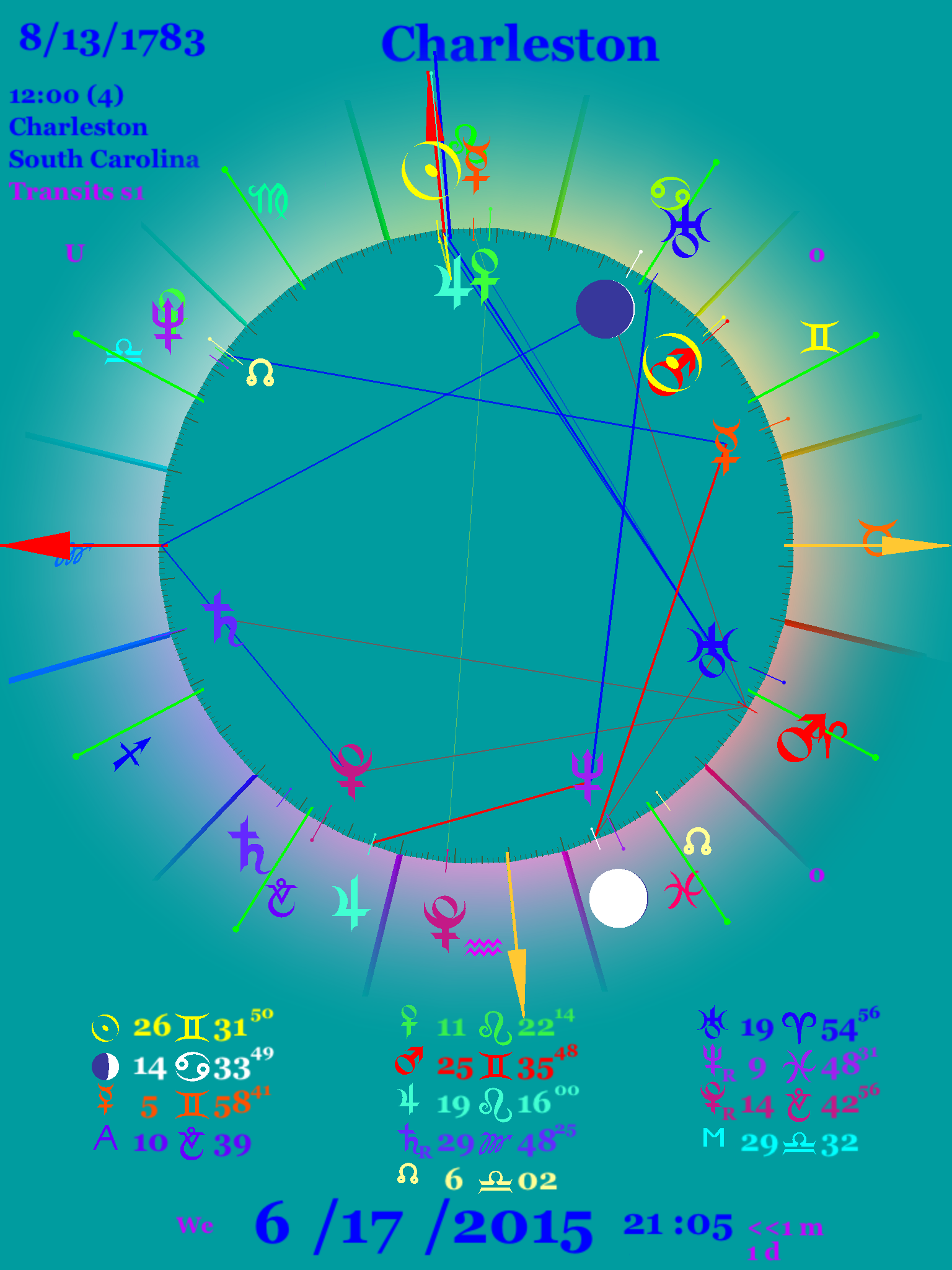
Some of the same conditions we mentioned previously when talking about the Summer Solstice chart also apply to this event, which took place just four days earlier.  The Sun was conjunct Mars and Saturn in hard aspect to Pluto, both signs of potential violence.  Neptune makes hard aspects to both Mercury and Uranus of the US (see below)  which suggest the initial confusion about the incident.  But in addition to the hard aspect between the transiting Saturn and the transiting Pluto, both make  hard aspects to the natal US Saturn, accentuating the Saturn Pluto difficulties.

charl_charl3

Massacre in Charleston

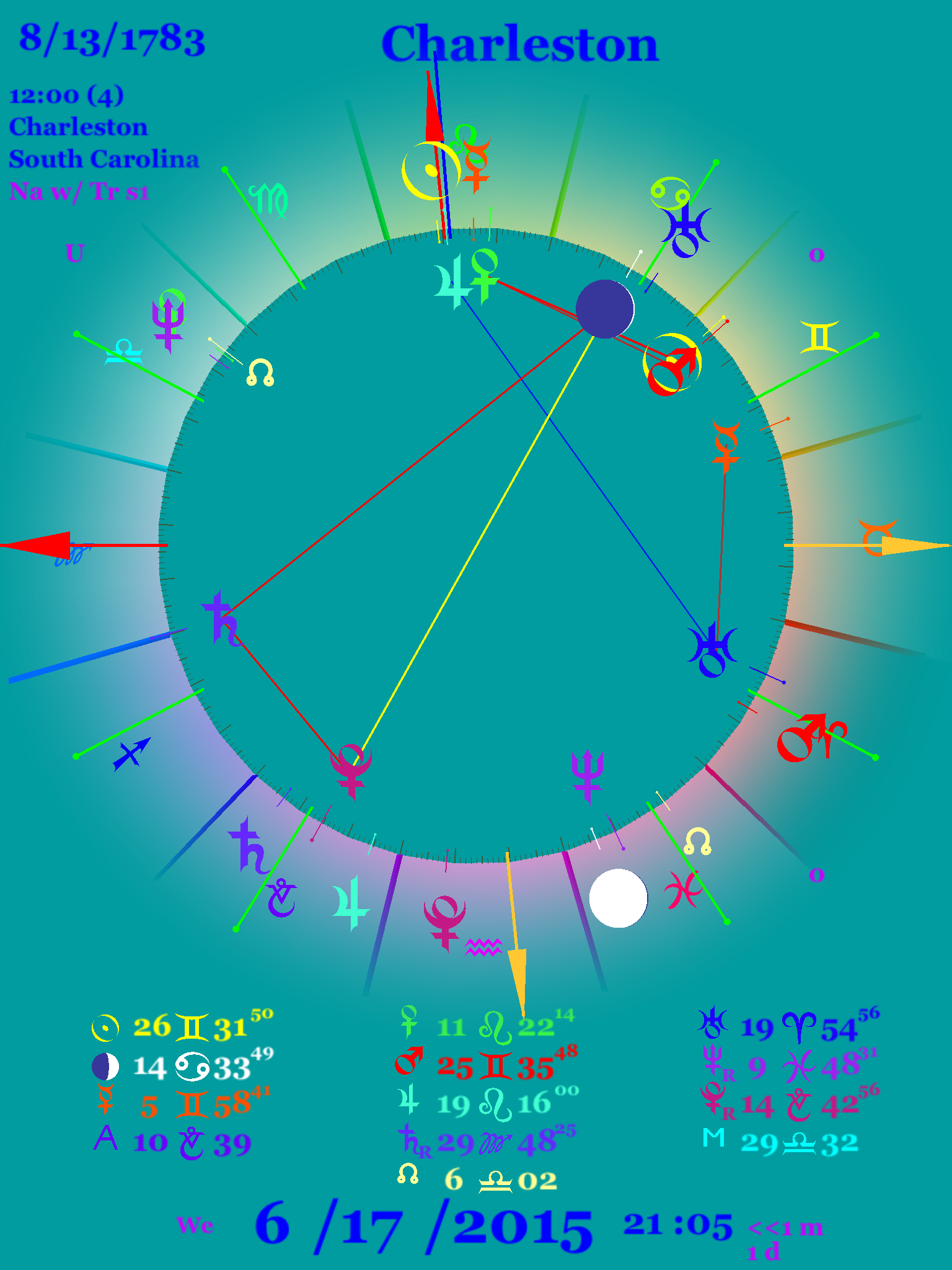
In  the chart of transits to the Charleston natal, we notice immediately that Jupiter is at the MC.  Amongst the outcomes of this shooting was country-wide talk about the confederate flag and its meaning, and the lowering of that flag from the grounds of the State Capitol of South Carolina.  Transiting Saturn and Pluto make hard aspects to the Charleston Mars, reiterating the possibility of violence.

charl_charltr

Massacr ib Charleston

But look at the current  transits  within this cart.  We see that transiting Moon is tightly opposite Pluto and makes a sesquiquadrate to Saturn.  While we don’t know how long the shooting lasted, it was certainly several minutes after the given time.  The opposition between the fast-moving Moon and Pluto was so tight that  it became exact in 17 minutes, at 9:22 that evening, and this opposition was loosely on the natal Uranus of Charleston.

Another incident of a terrorist incident at a church occurred in 1963, at the 16th Street Baptist Church in Birmingham, Alabama.  In this case, members of the Ku Klux Klan blew up a church with dynamite.  The bombing was set to go off when church service was happening on a Sunday, and as a result four teenage girls were killed.  Even though soon after it was  known who did the bombing, no prosecutions happened until 1977.  Supposedly the intent of the bombing was to intimate the people in the Civil Rights Movement in the Southern United States, but if that was the purpose it went completely wrong and the Movement was strengthened and one result was the passage of the Civil Rights Act of 1964.

bir_bomb_usa1

Bombing in Birmingham

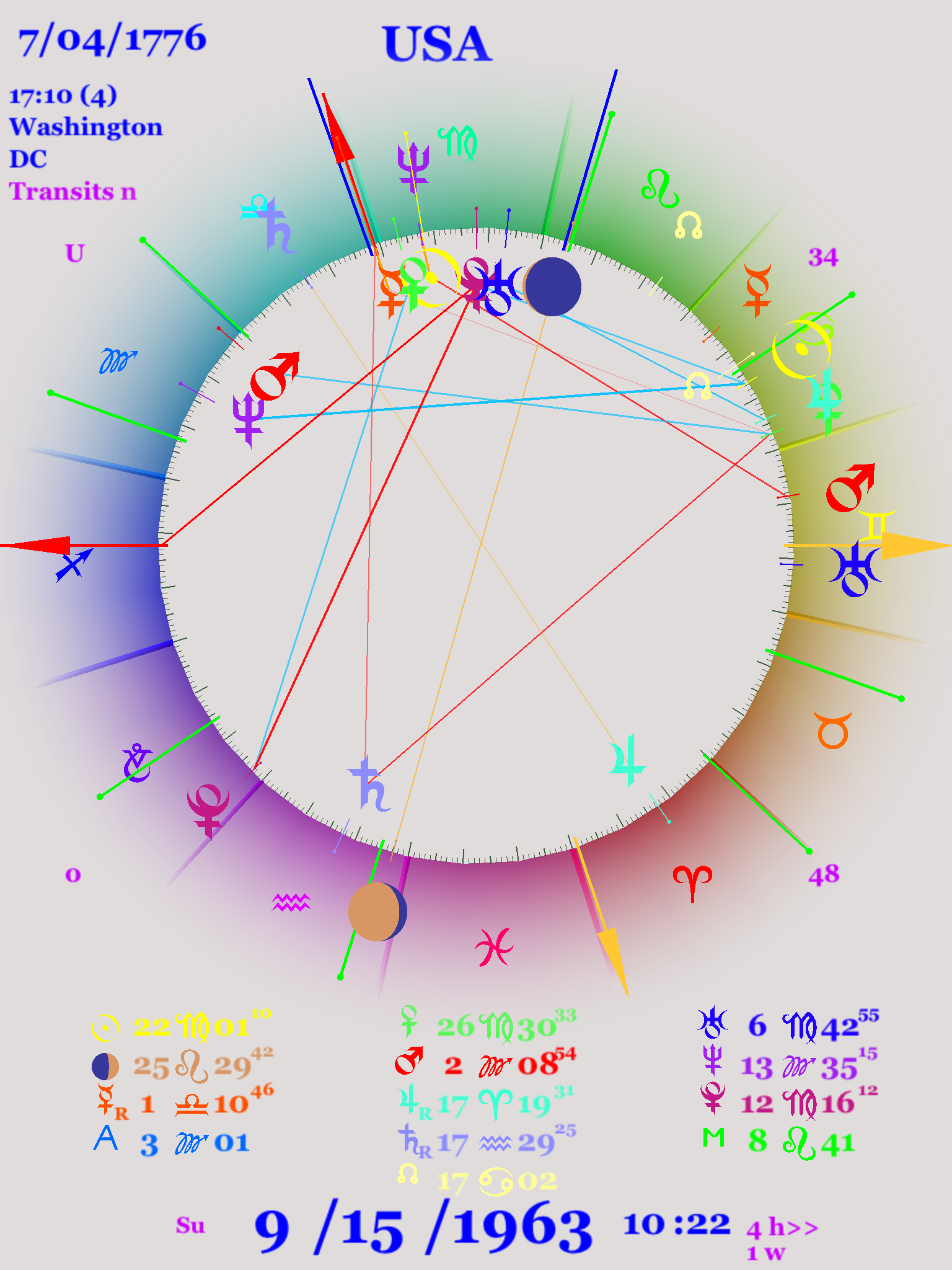
The first thing I notice in the transits for the time of the bombing — which is exact — to the US natal chart is that transiting Mercury is  on the US  MC — this event was communicated to the whole world and had (unexpected by the perpetrators) many repercussions.  The Uranus Pluto conjunction of the Sixties is just forming, the decade is just under way.  Pluto is sexquiquadrate the natal Pluto, emphasising the unfortunate consequences of the US natal Pluto, which has been often explored here.  Transiting Moon is opposite the natal Moon, significant because of the exact time,  indicating that the people of the US were effected  by this event.  Finally, transiting Saturn is sesquiqadrate the Midheaven and natal Venus.  There was much worry expressed at the time that this event would reflect badly on the US in its cold-war rivalry with the Soviet Union.

bir_bomb_birm

Birmingham Church Bombing

In the transits to the Birmingham chart, transiting Mars is square natal Mars, suggesting the violence of this act. Mercury is square the MC — news of this event was quickly spread — but Neptune is semisquare the MC, and as indicated it took over a decade for convictions in  this case, something was causing illusions of who was the guilty party.
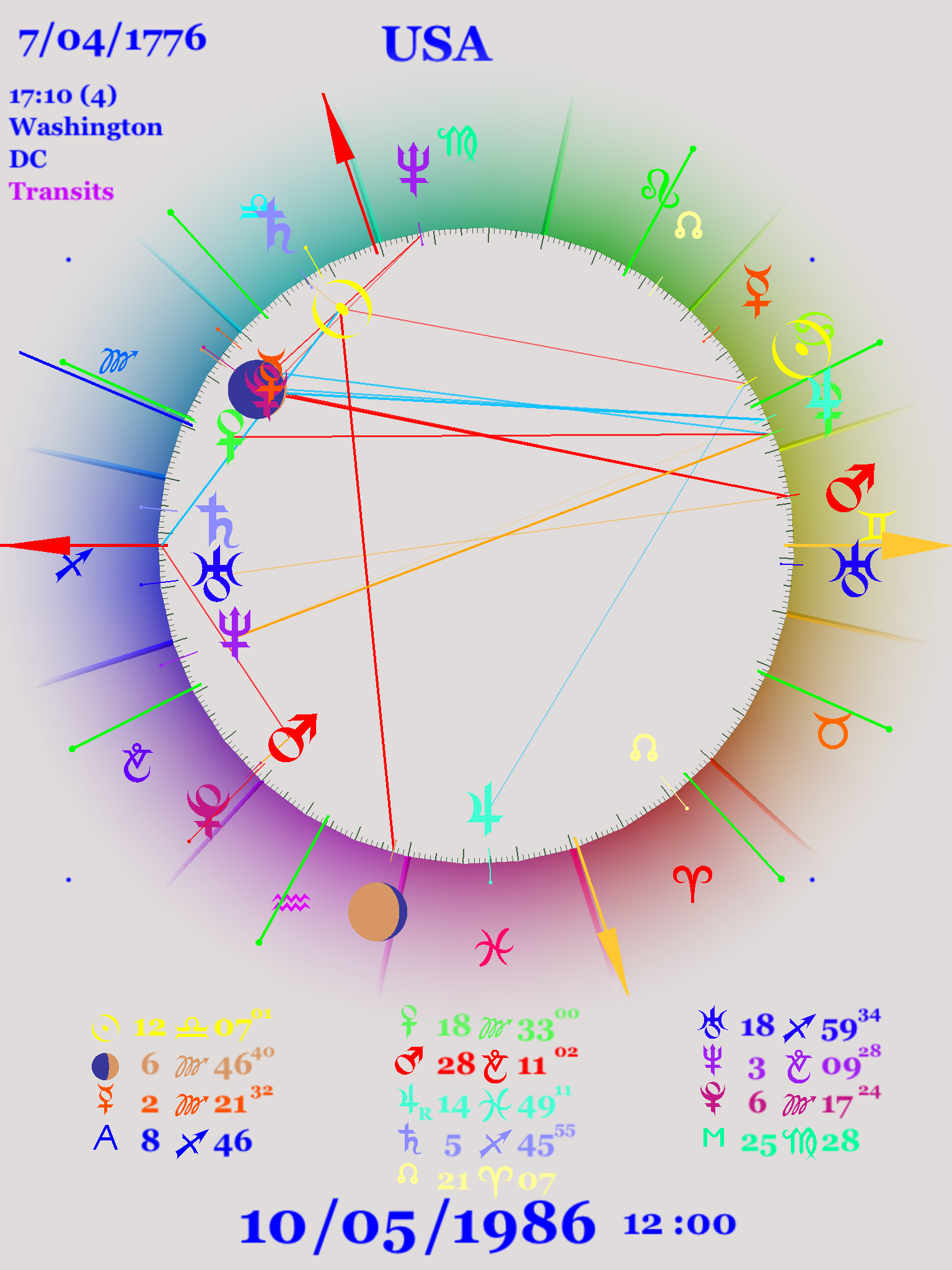
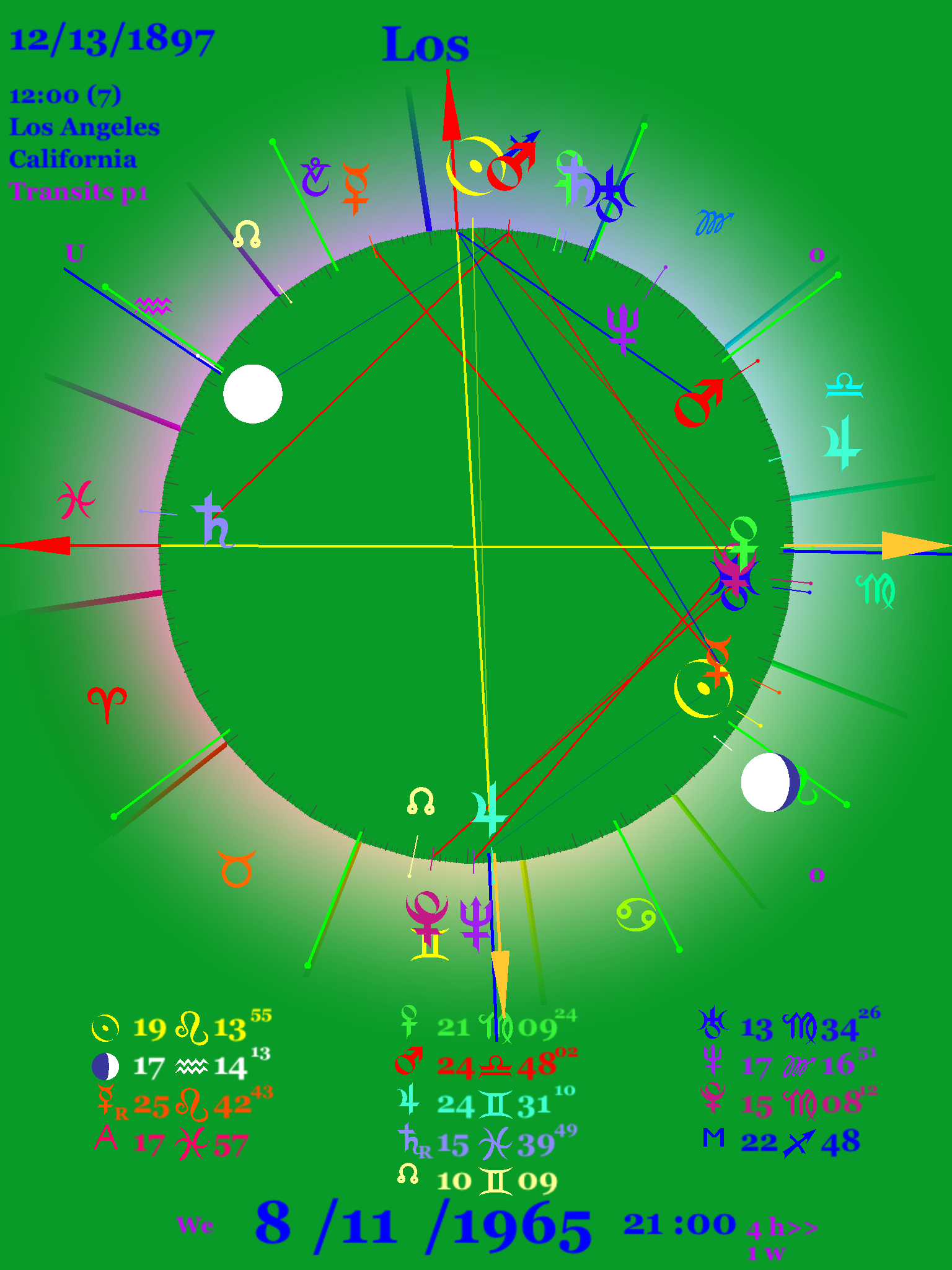
The third incident was the Watts Riot of 1965, thought by many to be a rebellion.  Summers of the decade of the Nineteen Sixties saw many riots in Black communities around the country, and one of the best known, but not the first, happened in the Watts section of Los Angeles , California.  It started on the evening of August 11, 1965  and spread over most of the following week.  A drunken motorist, only  21, was stopped in his mother’s Buick by a white Highway Patrol officer and the arrest got  out of hand. Fires and looting continued for several days.  The black citizens of Los Angeles suffered from unemployment, and later the police were found to be guilty of racism to minority citizens.  This does not sound very different from current situations that are inflaming people around the country, and the news reports on a daily basic.  This riot was well covered by the news media since in occurred in a major media center of the country.

watts_usa

Watts Riot

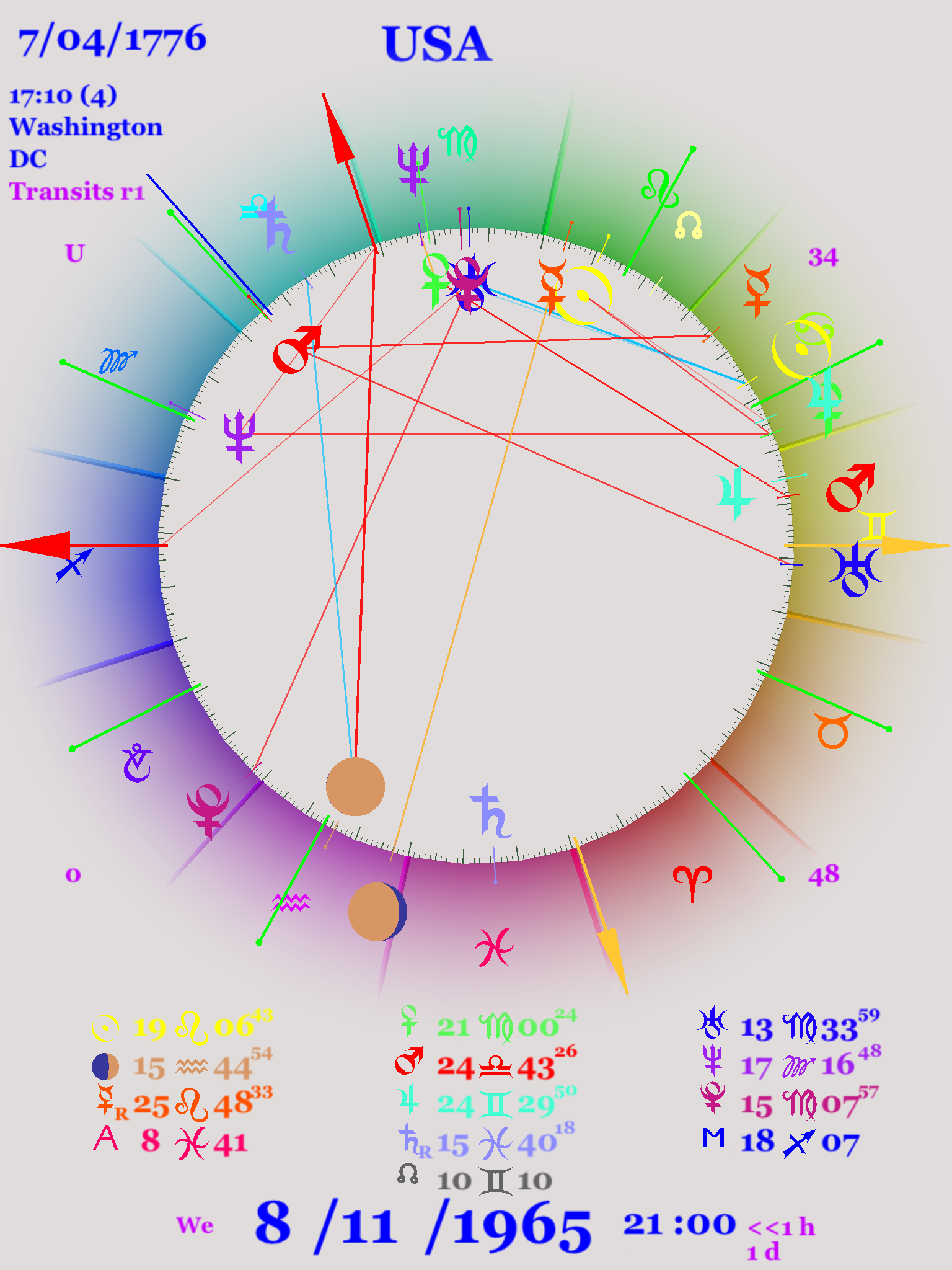
In the chart of the US  for the time of the Watts riot, the first aspect to notice is the tight conjunction of Uranus and Pluto.  The event did occur in the Sixties, and the significator of the Sixties is clear since this was the time of the  exact conjunction of 1964 and 1965.  The transiting Mercury is opposite the Moon, and this indicates that this crises was communicated to the people of the US. But most important is Mars, planet of violence.  It squares Mercury  (communications again) and sesquiquadrates Uranus.  Mars-Uranus hard aspects are notorious for unexpected violence.  But this position of Mars also accentuates the tight natal Uranus-Mercury semisquare, which is fundamental in the self image of the United States.   Perhaps the rioters at Watts were  angry that this promise of the US as suggested by this natal aspect was not given to them.  We also saw this in  the Charleston massacre to US chart above.

watts_la

Watts Rebellion

In  the chart for this Event in the Los Angles chart, we see Venus — peace — setting on the Descendant of the LA chart, and Jupiter — fortune — at the lowest point in the chart, the IC, and thus opposite the Midheaven.  Both peace and fortune were sadly missing from the Watts riot.  Transiting Mercury is sesquiquadrate the naatal Mercury, communication again, and transiting Saturn was square the natal Mars — frustration, difficulties in expression of energy.

The Fifties

The Fifties are an unfortunate decade, located between the Forties, which is known for World War II, and the Sixties, which is known for the Sixties.  The Fifties is almost the decade that time forgot.  Even people who were adult then are called the forgotten generation, too young to serve in World War II, they served in the Korean War, which is also pretty much forgotten, not nearly as notorious as was the Vietnam War, that, naturally, occurred in the Sixties.

But of course the decade of the Nineteen Fifties is just as important as any other time, and perhaps more so since it set the ground for what was to come after, and that includes now.  A book  has been written about this decade, called The Fifties, but David Halberstam, who also wrote a definite book about the Vietnam War.

The decade was dominated by one aspect, the closing square between Uranus and Neptune; the conjunction of the two, and thus the culmination of the cycle that started in 1820, was in the 1990s.

ursqr54

Uranus Square Neptune

There are several meanings that can be attached  to this square, and most of them involve the word “drugs” because Neptune is part of the aspect, but not always “drugs” as commonly thought of.

The Fifties was the decade for the introduction of the first, very popular tranquilizer drug called Miltown, whose scientific name was meprobamate.  This was an anti-anxiety drug that became very popular with bored housewives (eg. Betty Friedan The Feminine Mystique) and business  executives.  This started the psychoactive drug craze — treat mental problems with drugs not counseling — that led to Valium and Prozac in later years.  This decade also saw the publication of the first DSM – –Diagnostic and Statistical Manual of Mental Disorders — that prescribed all sorts of drugs for what ailed you in the psychological realm.  It was a bible for psychiatrists. Ever since that point — the Fifties — drugs have been prescribed more and more for more and more conditions, many of which did not exist when the first DSM came out.  Some psychiatrists have worried that the use of these drugs make the underlying conditions worse,  see for example, the book Anatomy of an Epidemic by Robert Whitaker.

Another activity that also became addictive was one that first became important to the world under the Uranus-Neptune opposition of the first decade of the Twentieth Century, and that was driving.  The Interstate Highway system was built, spanning the United States.  This  allowed people to drive coast to coast much more easily than in the days of Route 66.  It now became a tradition in many families for the males to go inspect the new model cars when they were introduced every year like clockwork, with major changes happening every three years.  American car manufacturers, especially General Motors, became huge industries, and the head of GM was even in the Eisenhower administration.   American families would  get a new car often — it was a point of pride — and automobiles played a part in many American movies.  A teenager — a concept that became important in the Fifties — was expected to learn to drive early and get his (more often that her) own car, it was a sign of adulthood.

ursqrne56

Electronic Drug

But the most important drug of this decades, what I call an electronic  drug, was television. Halberstam, in the book mention above, discusses the important place television held in American life in the Fifties.  While television had existed before the decade began, through the decade it became more and more popular.  In 1950 relatively few people owned television sets, and crowds were often found around store windows that displayed sets whenever an important show was on, while by the end of the decade many, many people owned television sets, so that it made sense to have the first televised debate between Presidential candidate John Kennedy and Richard Nixon in 1960.  The powerful effect of television was shown by the fact that listeners to the debate on radio thought that Nixon had won, where viewers of the debate on television were convinced that the handsome Kennedy had won over the recovering-from-illness Nixon.

There was another reference to drugs during this decade in a more conventional sense.

In the early Fifties the Beat poet and novelist  William Burroughs went to South America to explore the psychedelic substance known as yage or ayahuasca.  The active component of this substance is DMT — dimethyltryptamine — which later became popular in the Sixties –the band known as the Grateful Dead is rumoured  to have come up with their name while on a DMT trip — and is found in the common road side plant known as reed canary grass.  Burroughs wrote a series of letters to the then unknown poet Allen Ginsberg  describing his experience.  The book was finally published in another ten years.  But this was one one the first accounts of a Western writer exploring mind-altering substances in a third world country.

Later that decade the ethnomycologists and vice president of the investment bank J. P. Morgan  R. Gordon Wasson explored “magic mushroons” in Mexico.  He was married to a Russian woman, and the Russians have always been interested in mushrooms, hence his interest.  He discovered a dying cult in Mexico that use psilocybin mushrooms to  alter their state of consciousness.  These mushrooms would also become popular in the next decade, after he rescued them from obscurity.  He  published an article in Life magazine in May of 1957 called “Seeking the Magic Mushroom” that brought the mushroom to world attention, and a few years  later a popular TV show — television now being available for the masses — called One Step Beyond devoted  an episode to the mushrooms.

Then in 1959 a graduate student in creative writing at Stanford University in the Bay Area of California took part in government experiments with psychedelic drugs such as LSD.  The student, who later became a well-known writer, was Ken Kesey, and his  experiments with drugs later led to many developments of the Sixties counter culture and the famous Acid Tests and a group called the Merry Pranksters, who drove a acid-fueled bus across  the United States, as recounted  most famously in Tom Wolfe’s Electric Kool-Aid Acid Test.

But the experiments that Kesey was taking part were sponsored by the  CIA – Central Intelligence Agency — as part of their program called MKULTRA.  MKULTRA was run mostly in the Fifties, and was  finally revealed in the aftermath of the Watergate  crisis in the United States.  It was a  program designed to look at various ways of controlling the human mind, with implications for interrogation.  Various drugs were explored, the most interesting of which was LSD.  Among other things done with this drug, in one experiment prostitutes were instructed to give their customers a liquid dosed with LSD while CIA agents watched their reaction.  Army members were given LSD without their knowledge.  In one case a Canadian jumped from a high building under the influence of MKULTRA-supplied LSD.  The experiments at  Stanford that Kesey took part in were part of this program.

But the CIA was formed by the National Security Act of 1947  (which also renamed the accurately-named  War Department as the Department of Defense)  as  a combination of the OSS (Office of Strategic Services)  and the German intelligence organization during World War  II as headed by Reinhard Gehlen, who was charged with spying on the Soviet Union during the emerging Cold War.  So one can see a trail between the Nazis and the Merry Pranksters.

These two charts above show the first and last exact square of Uranus and Neptune during this decade.  But there was one other important transit during this decade that shows why the effects noted were so strong in the United States.  For that country, this decade also saw the transiting Pluto opposite the Moon. This transit only happens once every 250 years, and so this transit had never happened  before in the history of the country.  There was a conjunction in the early days of the  United States, the decade of the 1790s, and that had to do with the formation of the first political parties, among other things, and  will be discussed at a later date.  Since the Moon represents the people of the country, as opposed to the government, it was in  this transit that the people of the country that were most affected.  Again, the Halberstam book  mentioned above details this connection.  During this decade citizens went from being those who would  catch Your Show of Shows at the house of someone who had a television set to citizens who stayed home Monday nights to watch I Love Lucy.  The next chart shows one instance of this opposition, but since  Pluto is a slow moving planet, this transit and its effects lasted for many  years.

ploppmo_usa

Pluto Opposite US Moon

This graphical ephemeris show the ten year period of the Fifties and  gives an overview of the astrological influences  discussed.  We can see the square approaches exact (black arrow)  and leaves exact (red arrow) over a period of years.  For a square I would give an orb  of three degrees before and after exactitude.  To  give  you a sense of this, each gray or white band in the graphical ephemeris represents 7.5  degrees.  The only natal planet illustrated is the US Moon, so you can see where the conjunction with Pluto takes place (green arrow).  With the orb I give for an opposition of six degrees, you can see that this  opposition lasts for much of the decade.

fifties_tg

The Fifties

A Brief Look At 2016

The year 2016 is just a few months away, and I thought I’d take a look at the prominent astrological trends happening that year, especially as regards the United States.  2016 is the year we must pass through to reach the  end of the decade, and for the US it is important since it is an  election year, with no incumbents.

We have seen three elections recently that could shed light on how the populace feels about the state of their government.  In Greece, a election recently put the maverick Syriza party in power, and expressed the disgust of Greek citizens at the austerity that had been imposed upon their country by the European Union, and especially by Germany, the strongest country in the EU.  Then there was a recent election in  Alberta, a province in  Canada.  There, the New Democratic Party (NDP) was elected to full majority of seats, defying the Conservative Party that had always been the strongest in that province and also rules Canada.  Even more recently the election in Great Britain showed  a large majority (only in Scotland) voted for the Scottish National Party (SNP) which deprived the Labor Party of almost half the seats from Scotland and greatly reduced its strength in Great Britain.  In all these cases a third, and progressive-leaning, party took votes from the more established two parties in their respective countries.  Do these elections results cast any light on the upcoming US  Presidential election?   The  state of democracy is different in the United States.  There the political landscape is controlled by two dominant right wing parties (but of course the same could be more or less said about those other countries, though in no other country is the right so all-powerful as it is in the United States), though some believe that these two political parties are just two branches of the dominant Business Party, and third progressive parties have a difficult time since a vote for them and not a vote against one of the two dominant factions involves a leap of faith,  and needs large numbers of people to make the same choice at the same time, which requires trusting other people.  But that is unlikely to happened in the atomized society of the US.  So while the  election results in these three other countries may shed some light on the US  elections, that things won’t turn out nearly the same way seems more likely.

Note that I am ignoring the recent election results in the country of Israel since they are seemingly different.  In that country there was a concern with growing inequality, something that is felt in many other countries, but it was overruled by national security issues, they same as may be the case in the United States, since US citizens still  have a year for events to play out.

election2016

US Election 2016

One notably transit to the US chart is Saturn over the Ascendant of the US, lasting in the whole year and being exact three times during the year.  The symbolic  meaning of this would be depression in showing ones true self or possibly feeling inhibited.  To get a better idea,  let us look at the two previous conjunctions.

The last time Saturn was on the Ascendant of the United States was in 1986.  This was the second  half of President Ronald Reagan’s second term , and people we becoming disillusioned with “The Gippper” as he was affectionately called for his role as football player George Gipp in the movie Knute Rockne, All American about the famous football coach of Notre Dame University. A  secret operation now known as the Iran-Contra Scandal, was being played out from the White House.  This should have led to Reagan’s impeachment, but of course it was unknown to  the general public.  Then, on October 5 of that year the pilot Eugene Hasenfus was shot down over Nicaragua and the whole scheme came out.  Briefly, the US  was selling weapons to the embargoed country of Iran, that had released  its captured US embassy officials just as Reagan was being inaugurated,  and using the money raised to supply  arms for the CIA-backed paramilitary army trying to overthrow the government of Nicaragua against the will of Congress.  As a result of all this Americans belief in the sanctity of their country fell greatly.

hausenfus

Iran-Contra Revealed

In the chart for this shootdown we see that Saturn is approaching the Ascendant of the United States, and in fact  would reach that point by December.  Sun is conjunction Saturn — not a good time for US propaganda — and  Pluto is tightly sesquiquadrate Mars — war — as it had been for much of the year, and in fact America was engaged in a large scale war in Central America, though the public was kept in the dark about this fact.

The previous Saturn conjunct the Ascendant was in 1957.  This was in the midst of the Cold War and the President was World War II hero Dwight Eisenhower.  Americans believed their country was  far superior to the Soviet Union, even though the Soviets had tested an atomic bomb back in 1949.  Then, in August of that year, the Soviets tested the world’s first ICBM — Intercontinental Ballistic Missile — and suddenly it seemed that the Soviets could reach US shores with their atomic bombs despite US overwhelming superiority in submarine launched missiles and the many US bases surrounding the Soviet Union.   Then, on October 4 the world’s first artificial satellite was launched by the Soviet Union.  This again cast doubt on US superiority.  A few months later an attempted launch of a US  satellite failed to much embarrassment.  As a result of this, United States schools  were swept up in a huge urge to teach more science and math so US students could be competitive.  This  was an early preview of the current desire to teach the STEM — science, technology, engineering, math — in all the schools.

sputnik

Sputnik I

In  the chart for the launch of Sputnik, set for the proper time in the East coast (DST), we see Saturn is again approaching the Ascendant, and Sun is again near Saturn, which makes sense  since it was the same time of the year.  Transiting Jupiter is conjunct transiting Sun — Americans were optimistic about the future and their superiority to the Russkies, but this was about to  change.

Another important aspect is Neptune square the Ascendant of the US, which is  part  of a bigger complex that will come into play in the following years.  This Neptune square stars in the early spring of 2016, and by late spring we have  Saturn on the Ascendant and Neptune square the Ascendant, as   we can see in the next chart.  The Neptune square continues  through the summer, as Saturn crisscrosses the Ascendant, for the last time in early October.  As  we can see  for the Election Day chart below, Saturn is still close  to the Ascendant.  Perhaps the outcome of the election will not make Americans feel good about their country or themselves, unlike the election of 2008.  Also in late summer and early fall Pluto retrogrades so it is widely opposite the Sun of the United States,  a position it has occupies for much of the last few  years, as there has been increasing criticism of the President and the Congress is held at record low esteem.

Besides  the square of Neptune to the Ascendant 2016 will also see the trine of Neptune to the US Sun.  These three factors will be influence  the mood of the country during 2016.

The important Neptune aspects suggests, and from reading the news this is obvious, that the US will become  weed crazy in the following years.  The capitalists have begun to be interested in marijuana, and once the capitalists are involved it is difficult to  hold back.  Lenny Bruce, the acerbic comedian of the 1950s and 1960s, and a forerunner of many comedians today, once said that marijuana will become legal once the lawyers started smoking it.  In this he was wrong.  It now appears what pushed the envelope was some Baby Boomers started turning 65 and they realized they needed the aid of a plant they were familiar with when younger to help with the aches and pains they felt as the  grew older.  This coupled with a younger generation that was influenced by the drug war propaganda (but not in a positive direction) they got as young people tipped the balance, as  was mentioned by an earlier post.

The last time Neptune was in a similar position  was in 1853 and  1854, shortly after a Uranus-Pluto conjunction.  This   was a few years after Prohibition has been passed in the state of Maine (same link as above) and in began to spread to other states, ultimately culminating in the passage of  National Prohibition in 1919, which took place the next year.  This had a large affect on  the country, though I don’t know if everyone would consider it positive.  Among the many changers to the country was a widespread ignoring of the law, much corruption, and the rise a criminal gangs.

sane2016_2

Saturn and Neptune in the US Chart

But these two aspects occur at the same time, as this next chart illustrates.  Here is one with Saturn square Neptune, with Saturn quite exactly on the Ascendant of the US and Neptune closely square the Ascendant of the US. We have discussed in the past the hard aspects of Saturn and Neptune, and here is yet another one.  This hard aspect is also closely connected to the US.  In this case this aspect suggests  that America   will realize that some policies or beliefs it has followed  are no longer serving the country.  We can already see this happening;  there are so many beliefs that are coming under scrutiny now, the list is long.  The  war on Drugs and  how the police interact with communities  is coming under increasing criticism as  people ask more and more questions.  These are even  spreading to the presidential campaigns of both Democrats and Republicans, while it has been a major topic of third parties for a long time.

mapl2016

Mars_Pluto Opposite Sun

A long term aspects, over the last few years, has been Pluto opposite the Sun of the United States.   This has lasted so long since Pluto moves so slowly.  The last exact pass  will be in the fall of this  year as goes stationary on the US Sun.  But there is one further close pass in October of next  year and, as  you can see from the  next chart, at this point Mars conjuncts Pluto.  While the opposition with the Sun is not exact, the square with the US  Saturn is very close.  This also accentuates the natal Sun square Saturn of the US.   As one can imagine, Sun-Mars combinations are not very pacific  — Ebertin gives the phrase “force, brutality”.  Pluto opposite the Sun has seen intense opposition to the President, and the government in general, over the last few years.  As evidence, if any is needed, just look at the low esteem those institutions are held by the populace, as shown in many polls.   With this final Mars-Pluto opposite the Sun in the  weeks before the election, one can  expect to see fervent opposition displayed in the country.

2016_tg

2016

Finally we have a graphical ephemeris for the entire year.  In this we can see  Saturn first crossing the Ascendant at the  beginning of the year, and then crossing it again in  June just as Neptune also squares the Ascendant (black  arrow) and then crossing it a third time in October (red arrow).  Meanwhile, we see the Uranus-Pluto square close at the beginning of the year and the Pluto and Mars conjunct near the US Sun later in October (green arrow).

Four Dead in Ohio

We have just seen a couple of more anniversaries in the preceding week, and they are both related.  It all started out in the Nineteenth Century.  Britain showed that the way to be a world  power was  to have colonies in countries that were not European.  For Britain the most notable example was India.  So other European powers thought they needed some colonies of their own — there was still plenty of the world left that Britain had not grabbed, especially in Africa and Asia.  So France captured the countries of Southeast Asia now known as Vietnam, Laos, Cambodia — the region known as Indochina since it is between India and China.  This happened starting in 1887.

The natives of Indochina were not happy with this arrangement, but the colonies endured.  But at the beginning of World War Two, France  fell to the  Germans and it was either occupied by Germany or else the Vichy government controlled part of France, and the Japanese occupied Vietnam.  Shortly before the Japanese attacked Pearl Harbor, an organization called the Viet Minh was formed in Vietnam to fight the Japanese occupation of the country.  The Viet Minh were led by someone who would become well known later in the United States by the name of Ho Chi Minh.  Part of his desire for freedom was based on that founding document of the United States, the Declaration of Independence.  At that time he still though of the United States as a bastion of freedom.  When the Japanese were defeated, he declared Vietnam a free country, but the French, also liberated, but from Germany, decided to regain control of Vietnam.

Since the French had suffered through the Second World War, they did not have the resources to support a war in Indochina (even with money from the US Marshall Plan), so a majority of the money they needed to battle the Viet Minh  was supplied by the United States under the Presidency of Harry Truman.  The final battle of that  first Indochina War was at Dien Bien Phu where the French were surrounded by the Viet Minh.  The United States considered supplying nuclear bombs to defeat the Viet Minh, but fortunately that was  never acted upon since the French soldiers and the Viet Minh were in such close proximity that the French would also have been killed if nuclear weapons had been used.  The Viet Minh overran the French position and that was the end of French colonial ambitions in Vietnam.

dienbienphu2

Battle of Dien Bien Phu

dienbienphu

Dien Bien Phu Fourth Harmonic

Here   is a chart for the fall of Dien Bien Phu to the Viet Minh.  Mars is sesquiquadrat Pluto –explosive violence — and this battle is still important.  In fact, one of the best correspondents of that war, before he died in 1967, was Bernard Fall, and his  history of this battle is called Hell in a Very Small Place.  In the fourth harmonic chart of the same event, we see Saturn half way between the Sun and Neptune — delusions come to a sorry end.

firstusdeath

First US Death in Vietnam

And to show that the United States has been involved in Vietnam for a long time, here is  a chart for the first American killed in Vietnam.  The man killed was a U.S. Army  officer serving with the OSS (Office of Strategic Services — the forerunner of the CIA) and killed  by the Viet Minh, who thought he was French.  In this chart of  the death of the first US soldier in Vietnam — the first of many — transiting Mars is conjunct the  transiting Node (we will see this same configuration at about the same place later in the Gulf of Tonkin Resolution)  and near the Sun of the US  — the country would be involved here for the next 30 years, but that was not suspected at the time.

Emperor Bao Dai (backed  by the French from 1949) was granted control of the Southern part of the country.  A peace agreement was signed in 1954, allowing the withdrawal of the French, with an election to be  held, and the country was temporarily divided at the 17th line of latitude.  Dwight Eisenhower, the President of the United States, thought that Ho Chi Minh would easily win that election.  But the elections were never held, the United States decided to support Bao Dai in the southern part of Vietnam as an anticommunist bulwark against the North.  This was the height of the Cold War, and any threat from the Communists was threat to the  “Free World”.  After all, the United States had recently “lost” China and they were not about to allow that to happen again to Vietnam.

In 1955, the Catholic Ngo Ninh Diem defeated Bao Dia in an election (probably rigged) to become president of South Vietnam.  He ruled a majority Buddhist country and there were continual protests by Buddhists of his discrimination against them, eventually reaching the level of self-immolation.

The United States first began to send troops to Vietnam after the Gulf of Tonkin Resolution was passed by the US Congress.  This was in response to an incident where the North Vietnam fired on a US Cruiser, though  facts about that incident since then have cast doubt on the action, but it was one of many acts that were used to get a nation into war.

gulftonkin

Gulf of Tonkin Resolution

In the chart for the Gulf  of Tonkin resolution there is a tight  Uranus Pluto conjunction, with Mercury there as well.  This action determined much hat was to transpire in the upcoming years and affect the lives of many, many Americans.  Transiting Mars is conjoined transiting North Node (as we saw in the death of the first US soldier), suggesting again that this violence will touch many lives.

firsttroops

First US Troops to Vietnam

In the chart for the arrival of the first troops that were promised by that Resolution, we see the same Uranus Pluto conjunction, but this time joined with Mars — gunfire — instead of Mercury. The same Moon-Jupiter conjunction seen in the Gulf of Tonkin chart is here again.  Many Americans were so optimistic that this would  work out well!

The United States continued to send troops to Vietnam during the Sixties, resulting in wide-spread protest in this country against that.  At that time there  was a draft in the US and all young males had  to appear for a draft physical.  Student deferments while being in college were popular, and upon leaving college ex-students found  themselves receiving draft notifications, which resulted in widespread draft card burnings.  After Johnson resigned  Richard Nixon was elected in 1968 to continue the Vietnam War.  On April 30,  1970 — a date that is celebrated as an anniversary but not for the 1970 decision–  Nixon announced an “incursion” into Cambodia and the college campuses erupted in protest.  On May 4  National Guardsmen at the campus of Kent State in Ohio killed four students and wounded nine others.  More protest and students strikes spread across campuses  in the country, involving even students who  had not protested  the war.   People in Ohio heavily backed the National Guardsmen.  Less than three weeks  later the song “Ohio” was written by Neil Young and recorded by the then “super-group” Crosby, Stills, Nash, and Young, with the haunting line: “Four Dead in Ohio”.  It was released the next month and became an anthem.

kentstate1

Four Dead in Ohio

kentstate4

Kent State Fourth Harmonic

In the event chart for the Kent State shooting, we see that it is just before the New Moon  (about one day)  and the Moon was on the MC at the time of the shooting — it was a very public shooting and the whole world was aware of it.  Saturn is conjunct the Sun, speaking of the depression that resulted, at least among some people.  Jupiter is at the lowest point, opposite the MC, and luck  was certainly not present in this incident — “What if you knew her and found her dead on the ground .”  Pluto is semisquare the Ascendant  and occupies the same relative position that it does in the US chart.   The  fourth harmonic version of this event chart allows us to see the aspects more easily.  In the chart for the event on  the US chart, we see that the midpoint of Uranus and Pluto is the MC of the US and Mars is on  the Descendant  — this was a martial event — “Tin soldiers and Nixon coming … Soldiers are cutting us down”.

kentstateusa

Kent State Killings

Also, less than two weeks later, at Jackson State College in Mississippi, two students were killed by police in a similar protest to that in Ohio.  But this did not get as much notice, partly because it happened later and partly because black students were killed, and  there was nothing unusual then, and there is still nothing unusual, about black people being killed by police, as any number of recent incidents can attest to.    But   killing white students was unheard of, which is partly why it so upset other students.  However, for many Americans, the students got what was coming to them.

But the Vietnam War  was far from over, even though there were withdrawals of American troops from that country.  In 1973 a forgotten peace agreement was signed in Paris.  But the real end of the war, and another anniversary, is the rapid withdrawal of the final American presence from Vietnam on April 30, 1975.  The is Reunification Day, a holiday recognized in the reunited Vietnam and  especially in what is now know as Ho Chi Minh City.

withdraw1

Fall of Saigon

withdraw4

Fall of Saigon Fourth Harmonic

It is hard to place  an exact time for the withdrawal. At 10:24 that morning (Saigon time) there was an unconditional surrender by the leader of South  Vietnam.  But the actual withdrawal of the last US helicopter took place later that day.  At the time Saigon was 8 hours East of Greenwich, and thus 12 hours (Daylight time in East coast) from Washington.  I’m using a chart set for Noon on the East Coast of the  US.  Pluto is just past the MC and very elevated in the chart.  Saturn is  on the Sun of the US  (depressed country!) and Neptune is on the Ascendant of the US, perhaps suggesting the bewilderment of United States citizens at this turn of events.  Uranus and Pluto are far apart, the Sixties have ended.  If we look at the fourth harmonic chart we see that there would be a grand square except that the Mercury-Pluto square is too wide.  However, Mars is square Pluto, suggesting some  of the violence that came at this withdrawal, and the condemnation that followed in the United States regarding a “stab in  the back” of our brave forces.  And notice that Uranus and Pluto are square in the fourth harmonic chart , and  in  fact the two planets are separated by a semi-semisquare of 22.5 degrees.

Korean War

The Korean War was the first “hot” war to come out of the recently formed Cold War, and the first (of many)  wars that the United States would not “win”.  As we will see below, the Korean War was basically Saturn and Neptune.  Those two planets don’t have a terribly good reputations, and together they are not improved.  Saturn and Neptune over the years were explored recently.

The Korean War started  on June 25, 1950 when the North, expecting to be invaded by the South, invaded the South in advance.  The War ended on July 27, 1953, after a couple of years of indecisive combat.  But, strangely enough, the Korean War has never been officially ended.  An armistice was declared, ending the hostilities, but a  peace treaty has never been signed to this day.

But to understand the origins of the Korean War, and the behavior of North Korea even to this day  (as I write, North Korea is accused of hacking the computers of Sony (a Japanese company) because of a movie depicting the assassination of the leader of North Korea, even though the evidence does not really exist and a former employee of Sony Pictures is accused by a company involved with computer security)  we need to look at the history proceeding the division of the Korean Peninsula into two zones.

It  all goes back to the end of World War Two.  Korea had been occupied by Japan since the beginning of the Twentieth Century.  Korean-supplied  “comfort women” for Japanese soldiers during World War II is just one manifestation of this.   The Koreans were not happy with this act and are still trying to get Japan to apologize for this.  After the War the peninsula was split arbitrarily at the 38th degree of latitude and the Northern half was given to those who had been against the Japanese during the War, and some who had fought with the Chinese against Japan, while the South was given to those who had supported the Japanese during the Second World War, and who were also, interestingly enough, friendly with the Americans.  The first leader of North Korea, the grandfather of the current leader, had served with Mao during the civil war in China.  The two parts of Korea did not get along well.  There were also some rebellions in the Southern part from people of South Korea who were not happy with being ruled by supporters of their enemies.  Some of these rebellions were ruthlessly put down by the South Koreans, at times with help from their American allies.

Korean_war_start_better

Start Korean War

At the start of the Korean War transiting Neptune was on the US Saturn with an orb of 14 minutes.  It was   stationary  direct at the time and had been close to the US Saturn two month before and two months after the start  of the war.  Also on that day the transiting Sun was conjunct  transiting Uranus, suggesting unexpected events, and these two planets were on the Venus-Jupiter conjunction which is part of the core of the United States.  Mars was just past the Midheaven of the US and had crossed it two weeks earlier, at which time the transiting Sun was on the US Mars.

The Cold War was  high in America  at this time, since the Soviet Union had exploded its first atomic bomb in the previous year. The Communists had also defeated the Kuomintang in the Chinese Civil War the previous year, and Joseph McCarthy had made his notorious charge that the State Department was filled with Communists a few months earlier.  The United States was able  to convince the UN to sign on to the War only because the Soviets were boycotting  the General Assembly to protest the exclusion of the new Chinese government from that body.  The Korean War was used  to increase the defense budget of the US for fiscal year 1951 by almost five times from the previous year.   The North Atlantic Treaty Organization (NATO – still in the news after all these years) had been formed the previous year and  was put on a more military basis.  The US had also recently passed NSC-68 — a founding document of the Cold War  — which put forth the policy of containment of the Communist menace.  This policy  was maintained until Nixon started a policy of détente with the Soviets, which was then again changed to a more active policy of rollback when Reagan assumed the Presidency.

The Year of 1950 was a good one for the US in the Korean War.  The American forces (actually called UN forces, with token representations from other countries) were led by a hero of the Pacific battles of World War II, General Douglas MacArthur.  MacArthur invaded Korea at Inchon in what was a questionable move, and it turned out to be a tremendous victory; then he rapidly pushed the North Korean troops back across the 38th parallel that divided the two halves of the Korean Peninsula, thus achieving the status quo before the invasion of the North.  The  war had been won at that point. If only MacArthur had declared victory at that point most of the bloodshed of the war would have been avoided.

Korean_war_incheon

Korean War Inchon Landing

In the chart for the start of the Inchon invasion, we see the Sun-Saturn conjunction of the US Neptune, repeating the Saturn-Neptune that highlights the Korean War.  Transiting Uranus if midway between Jupiter-Venus and Sun  — a good time for America.  And  finally, Neptune is still on the US Saturn; the war has gone on for less than half a year.

Korean_war_cross38

MacArthur Crosses the 38th Parallel

Two  weeks later MacArthur crossed the 38th parallel, thus entering North Korea.  The chart for this shows Venus conjunct Saturn — that does not promise good — midway between Saturn and the MC of the US.  For Venus at the midpoint of Saturn and the Midheavewn Ebertin says “bearing grief or suffering” which describes the rest of the Korean War, that had started  out so well for what was called he UN troops.

But no.  MacArthur wanted to conquer the Northern part of the peninsula and so he pushed forward.  And then, perhaps driven by the anti-Communist fear of his homeland, wanted to use the atomic bomb to replace the new Communist government in China.  This brought China into the war.  MacArthur so infuriated Truman that he was fired by the President.  MacArthur returned to the United States with a hero’s welcome, and many people thought that Truman was wrong.  Much fighting went on for the next two years with nothing resolved.  Dwight David Eisenhower, commander of troops in Europe during World War II and at that time President of Columbia University, then ran  for President of the United States vowing that he would end the Korean War.   The war in fact ended a few months after he took office.

Korean_war_end

End Korean War

Here are two charts for the end of the Korean War.  In the chart showing transits to the US, the Saturn-Neptune conjunction is trine the US Mars; Jupiter is also conjunct that Mars and thus square the US Neptune.  As discussed previously Saturn-Neptune is important.  In the chart for just the transits at the end of the war, we again see the Saturn-Neptune conjunction trine  transiting Venus with Pluto sextile Neptune-Saturn and Venus.  As  previously indicated, the long sextile of Neptune and Pluto is the marker of the long Cold War.  Also Uranus is square Neptune, a highlight of the Fifties which we will discuss at some other time.

Korean_war_end_whole

Korean War End