Jupiter conjunct Sun
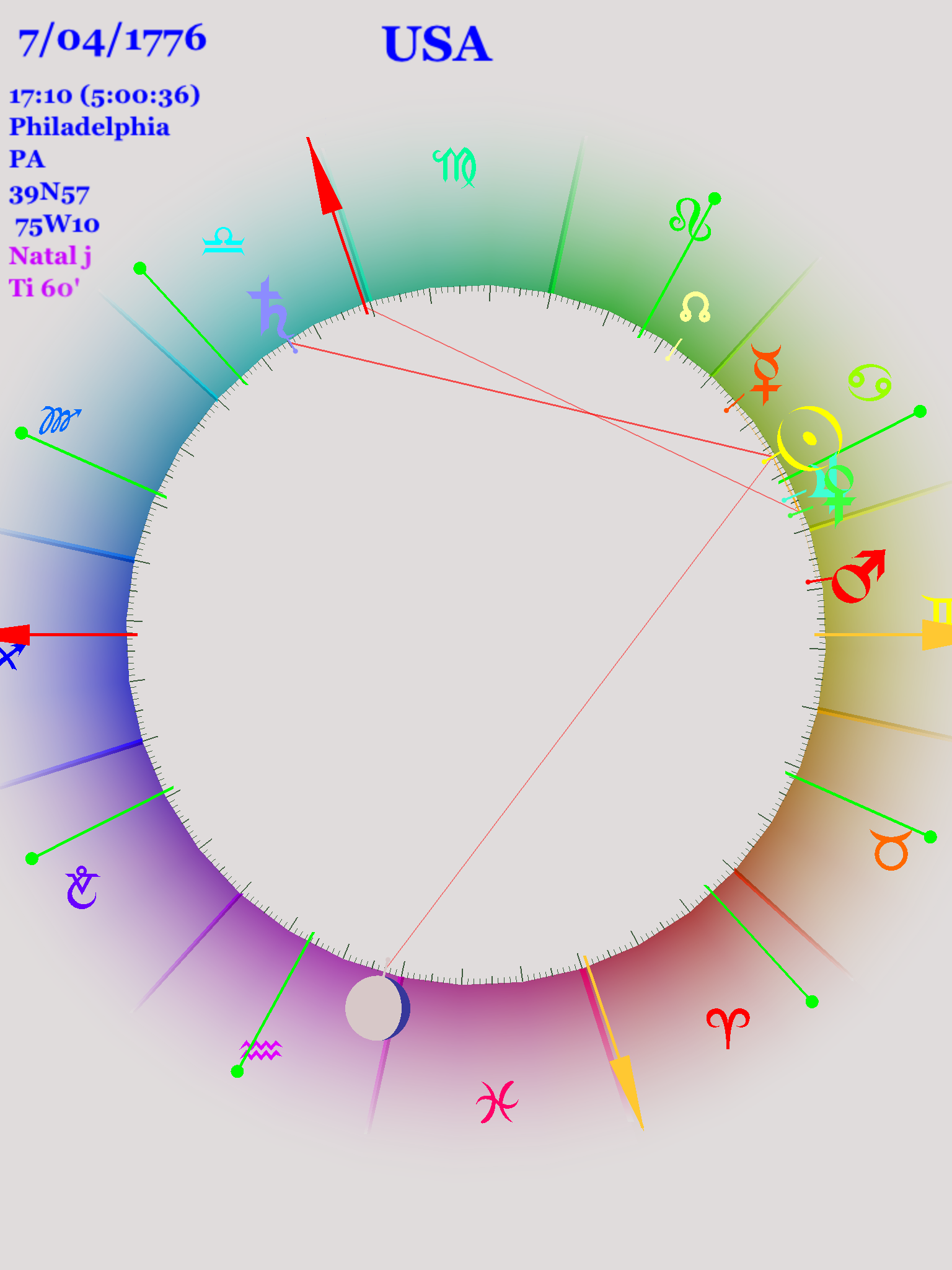
Jupiter is conjunct the Sun on July 4, 1776, and several of the meanings of Jupiter are closely associated with the United States. Jupiter is the largest planet in the solar system, and Jupiter, by itself, would like to expand until it takes up the universe. Jupiter also loves freedom, and does not handle restrictions well. One motto of Jupiter could be “Don’t Fence Me In.” This conjunction illustrates well several standard meanings for Jupiter and the Sun.
Expansion
One keyword for Jupiter is Expansion. And the United States certainly believe in expansion, in all its many meanings. The motto of the United States could be “Super-Size”.
Statistics on American usage change from year to year, and in some case can change as soon as they are published. The following are current, but more importantly they will give an idea of what the trend is like in the early Twenty-First Century.
The United States consumes more oil than the next five largest consumers – China, Japan, Russia, Germany, India – combined, and is the biggest importer of oil in the world, more than the total of the next three– Japan, China, Germany. This is 23% of the world’s total usage. It correspondingly emits more CO2 per capita, and until very recently more in absolute terms, than any other country in the world [China just recently surpassed the United States in the production of this greenhouse gas. But since the population of China is several times that of the United States, America holds the per-capita record.], close to a quarter. The external debt of the United is also 23% of the world total. The defense expenditures of the United States are almost half of the world total.
Another area where the United States is Number One is in prisoners. America has 4.5% of the world’s population but has 25% of the world’s prisoners, some 2.2 million people. While other countries, such as the Soviet Union and South Africa use to surpass America in this area, recent changes in the governments of those countries, and much more punitive policies in this country, have allowed the United States to claim the top position. The United States has the highest incarceration rate of any country in the world, at 737 per 100,000 – that is 1 in every 136 people. The next highest is Russia, at 611. Most countries have a rate below 200.
America has not always been first in so many things, and some things that it used to be first in it no longer is, as more and more of the world attempt to emulate America. And while others countries don’t have the birth chart of America, they can still try. The automobile, although invented in Germany and first popularize in France, was mostly produced in the United States until fairly recently. General Motors was the largest automobile producer for 76 years, but in the first quarter of 2007 it was surpassed by the Japanese manufacturer Toyota, though until 2008 and official 2007 figures are available we can’t be sure. Likewise, Americans were the tallest people in the world since records were kept starting in the middle of the Nineteenth Century through the 1970s, but this has changed since then. The Dutch now average three inches taller than Americans.
Americans also work more than those in other industrial countries, 500 hours more a year than the Germans, 250 hours more than the British. This is increasing, as many other Jupiter effects are: The average American man works 100 hours more than he did in he 1970s, and the average woman 200 hours more [ Erza Klein, “Land of the overworked and tired”, Los Angeles Times, July 16, 2007 ]. Jupiter is the planet that drives workaholics.
The expansion can even be seen in the increasing girth of Americans. Americans seem to have taken the Jupiter principle to heart, or to stomach. According to recent figures, the obesity rate (people over 15 with BMI greater than 30) is 31% for America, compared to second place for Mexico at 24%.
However, America was not always big in the ways indicated above, throughout its history. It was something that had to be worked towards. Through the end of the Nineteenth Century, America expanded in a different sense, as indicated below.
American is also an expansionist nation. This is exactly what Jupiter would want. Up until this century the term “empire” was not often used by scholars, even though the expansion of the United States started shortly after its founding. But recently the term empire is back in vogue, and is used by many people who now find it positive. America expanded within the borders of North America starting with the Louisiana Purchase of 1803, and continued on until the Pacific Coast was reached before the Civil War. These various accretions are given names such as the Mexican Cession and the Florida Purchase, though they usually involved more than a simple monetary exchange. 1890 was declared by the government to be the date the frontier ceased to exist, and so after that date, starting with the Spanish-American War of 1898, America started to expand overseas, but not often in ways that traditional colonial powers, such as Great Britain, did.
America is one of the few countries in the world that has military bases outside of its own borders. According to government documents, there are 737 bases in foreign countries, but this number is an undercount, since many bases are not listed, such as those in Iraq [Chalmers Johnston,Nemesis, Metropolitan Books, 2006, p 138-40]. This is not a new trend due to the War on Terror, but has been developing since the end of World War II, when many of these bases were first inserted into other countries. It has been estimated that we have about 1000 overseas bases, and this figure is orders of magnitude greater than any other country.
Enthusiasm
Another keyword is Enthusiasm: Enthusiasm, when carried to an extreme, can be self-righteousness; self-righteousness can become arrogance, which will offend other people. All these three words are associated with Jupiter which, among other things, represents freedom – Jupiter does not like to be tied down or hindered in any way, it wants to be free to expand. Freedom can be thought of as the ultimate good. This can be seen in such slogans as “Don’t Tread on Me” or “Live Free or Die” (both dating back to the Revolutionary Era). This can become a boundless optimism and the “Can-Do” spirit that America is famous for, the feeling that anything can be accomplished. This aggressive independence is part of what has been called the American Dream. But this militant freedom can also ignore the rights of others; it realizes no responsibility but the responsibility to oneself.
But enthusiasm can also become the love of, and indeed the worship of, private wealth. The current heroes of popular culture are the richest men, such as Bill Gates and Warren Buffet. But this has often been the case: Henry Ford was a folk hero to the common men of the Twenties [Geoffrey Perrett, The Twenties, Simon and Schuster, 1982, p256]. A magazine even publishes a list of the wealthiest people yearly. Close to 40% of the billionaires in the world live in America, according to the 2007 Forbes Magazine listing. The dark side is also what has been called “the hustle”, that asks “what’s in it for me” and is always looking for more [This is discussed in great detail in Walter A. McDougall, Freedom Just Around the Corner, HarperCollins 2004], another Jupiter word. This is one thing that early visitors to this country from Europe noticed, and found disgraceful.
Another side of this enthusiasm is American Exceptionalism, which was touched on before. This manifests itself not just in the belief that Americans are special people, based on our history, ethnicity, climate, or religion, but also in the belief that the rules that apply to other people, for example the rules against torture, do not apply to Americans. With this mindset, one begins to believe that one is better than anyone else, that things that happen to you have never happened to other people. This is when arrogance begins to annoy the people in other countries.
Abundance
In the early years of this country, America was described as “the poor man’s best country”[Sean Wilentz, The Rise of American Democracy, W. W. Norton & Company, 2005, p 16]. Perhaps we forget now how unique early America was. Whereas all of old Europe suffered under layers of aristocracy, America, being a new country, was free of the stultifying hand of aristocracy. There was plenty of land for the taking [And they took it from the Indians. One of the forces for “Indian Removal” was the desire of farmers for new land to settle.] and so even recent arrivals could settle a homestead and raise enough food to feed their family. A father could easily expect to have land to leave to his sons. This was completely different from Europe, where the land had been divided so many times there was none left to give.
And the land was so fertile! While much of the land in Europe was warn out from having been planted and harvested for many, many generations, and marginal land was beginning to be brought into production to meet the demand, most of the land in America was extremely rich, and American colonists found it easy to raise large crops. In fact, since a population boom had taken place in Europe during the Eighteenth Century, Americans found their grain much in demand in the old world.[Joyce Appleby, Capitalism and a New Social Order: The Republican Vision of the 1790s, New York University Press, 1984, p 98-99] There was a belief at the time that America should emphasize crops while Europe could export luxuries to America which they could easily afford since their grain was in such demand.
And America has always been known as “the Land of Opportunity” up until the present time. It is certainly one reason it is so attractive to those in foreign lands. No matter what one’s position in the country of origin, in America an immigrant could make a new start, free from the restrictions of the past, with the expectation of material abundance. This was part of the American Dream.
America has always been know as a land of abundance, and this has shaped the way Americans look at themselves and their relationship with the rest of the world. In a British play written in 1605, Virginia was described as having gold chamber pots [George Chapman, Ben Jonson, John Marston, Eastward Ho, William Aspey, 1605. Act III, Scene 3]. Abundance is clearly a characteristic of Jupiter, and when conjunct the sun increases the wealth of the individual involved. One can trace through the history of America numerous mentions of the wealth and abundance of the country.
And the productivity of America was not just due to the rich soil or the labor of slaves. There was something about the laissez-faire economic system that was dominant in Nineteenth Century America that also accounted for this great abundance of material goods, of new and improved products[David M. Potter, People of Plenty, University of Chicago Press, 1954, p 88-90]. Individual entrepreneurs were encouraged to expand America’s abundance, but the ultimate bill wouldn’t be realized for some time.
 500 Year Party