Nixon Resigns

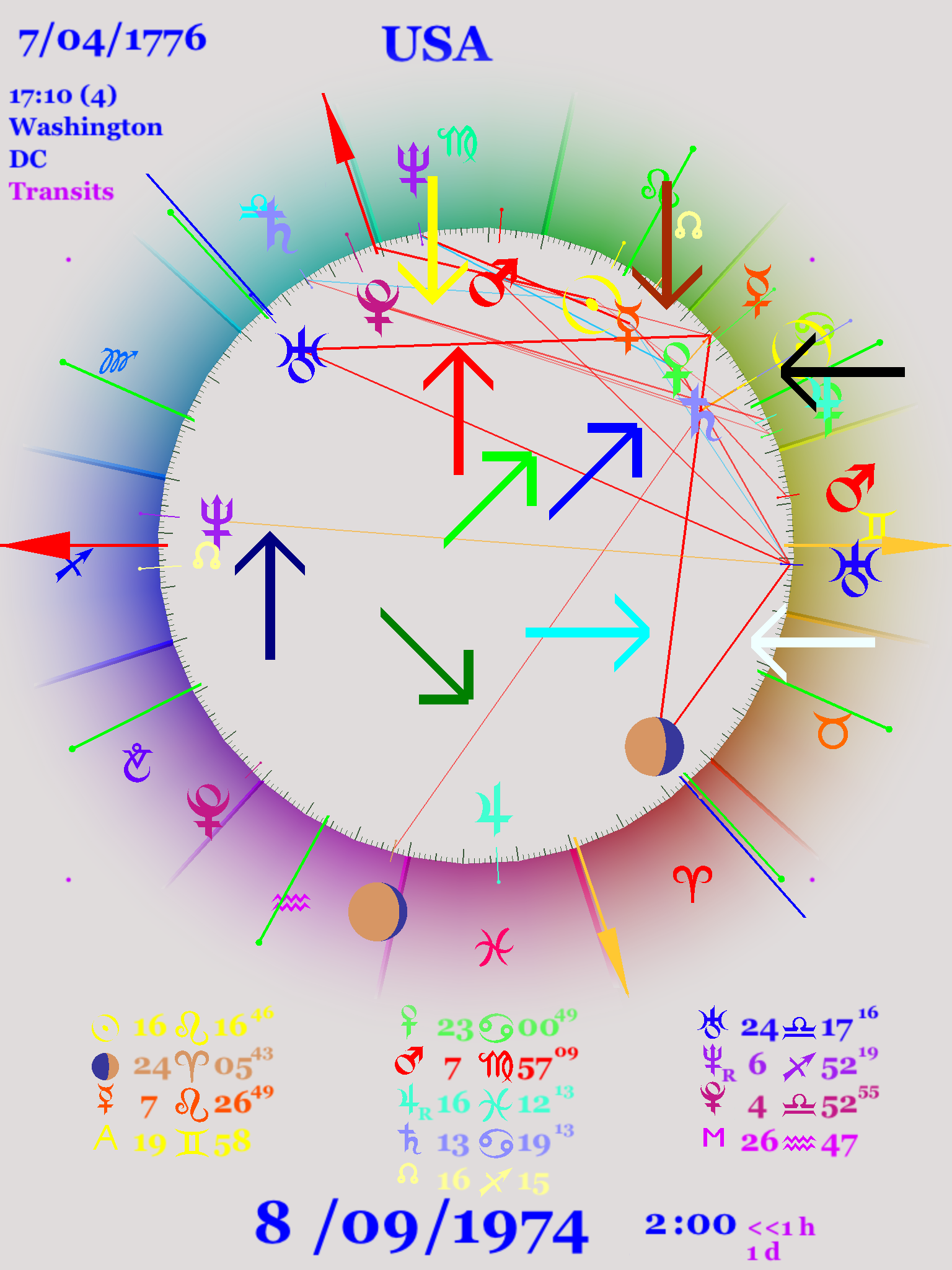
Coming up, the fortieth anniversary of the only resignation of a US President in history, Richard Nixon, on August 9, 1974. Sure to be a jubilant time! I’ve used this chart for a long time to show that the Sun of the United States chart represents the President – the head of the government. But looking at it again recently showed that it also illustrates a theme that we have seen pop up before.

Richard Nixon has been called the last liberal President (Noam Chomsky, Michael Moore) and the last New Deal President (Douglas Brinkley, Michael Lind). He went to small college in Whittier, California and did not go to Harvard or Yale. But his paranoia got the best of him in the Watergate scandal which erupted after he was elected to a second term in 1972.


nixon_resigns

US Chart on Nixon Resignation


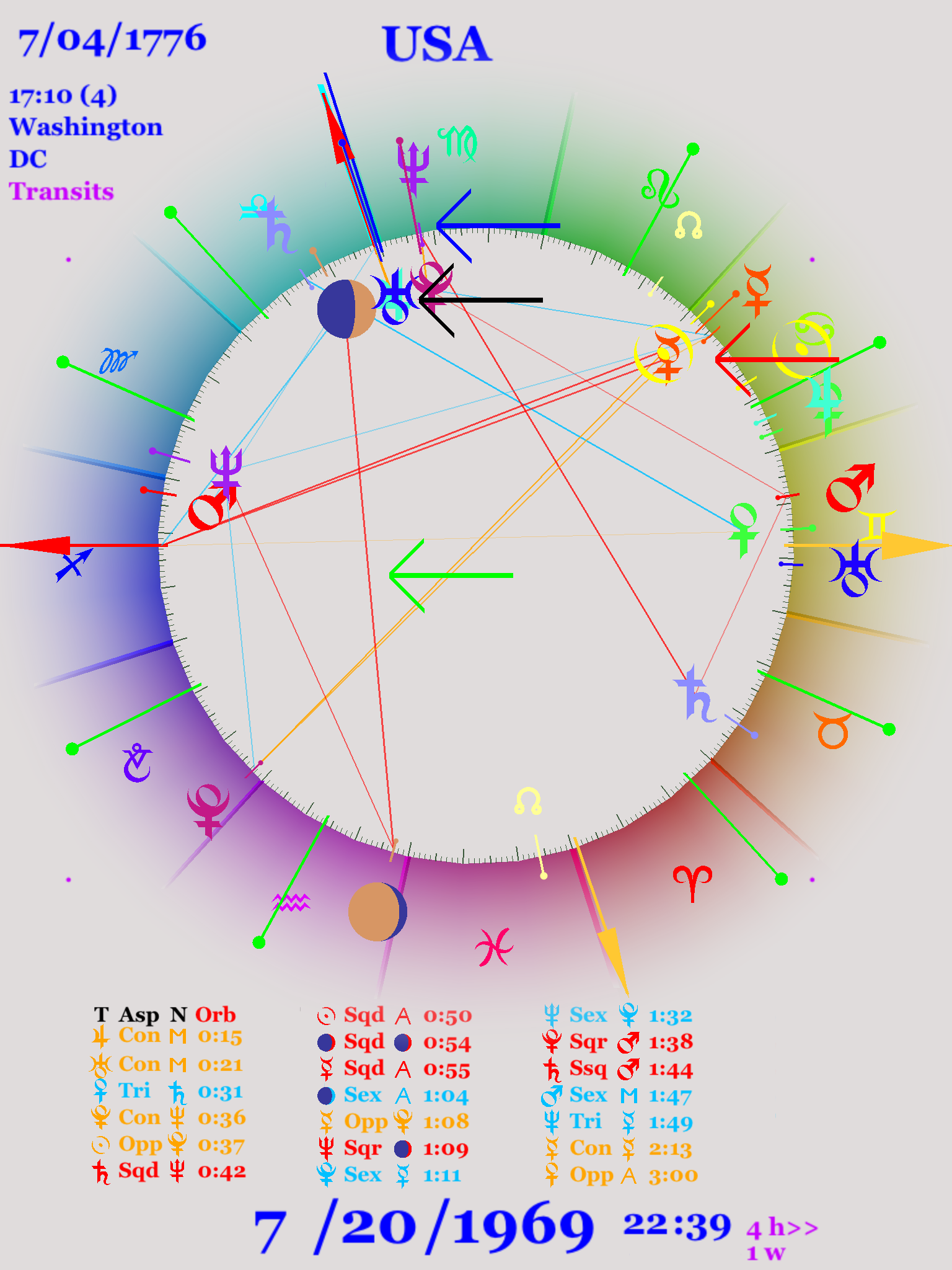
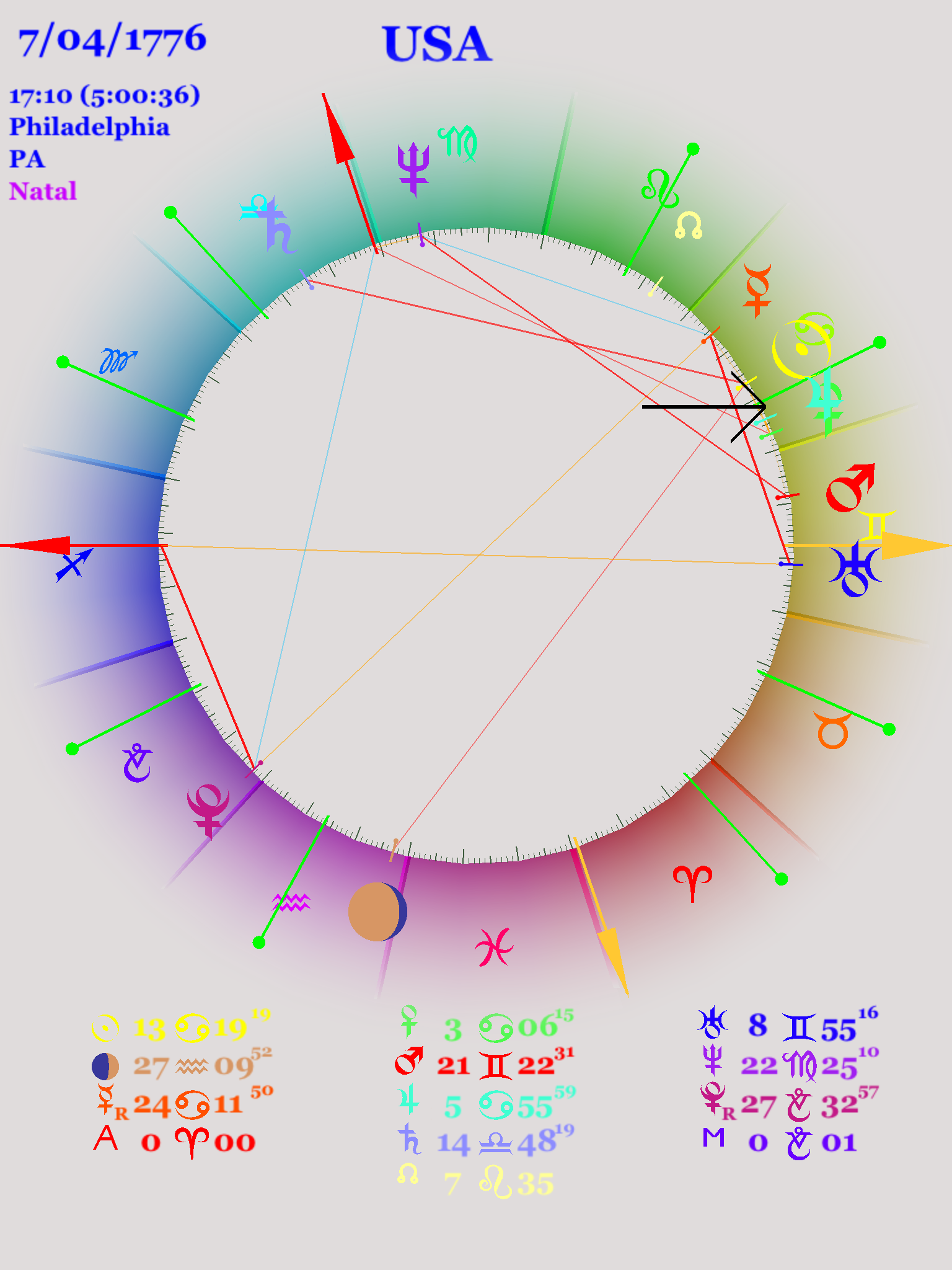
Nixon gave a speech announcing his resignation the evening of August 8, but didn’t actually leave office until the next day, when his Vice President Gerald Ford was sworn in. The time I chose for the chart is two in the morning. Not only does this split the difference between the time of the speech and the actual leaving of office, but it is also the time Saturn was exactly conjunct the Sun in the United States chart (black arrow). This is the first time in this cycle that Saturn was on the Sun of the US; it later went retrograde and was again on the Sun in five months. It had previously been conjunct the Sun – only one time – in late June of 1945 two weeks before the Potsdam Conference took place at the end of World War II.

Notice that Uranus is in the same spot as Neptune in the Brown v Board of Education chart. It squares Mercury (red arrow) and sesquiquadrates Uranus (green arrow) once again accentuating the Mercury-Uranus semisquare that epitomizes the positive side of America – see discussion under the Brown v Board of Education entry for more detail. And indeed, the resignation, to avoid a certain impeachment, proved the glories of America. Many people said that this action again proves that the system works. People even lauded his resignation speech.

But the natal Mercury-Uranus semisquare was further highlighted: Mars is semisquare Mercury (brown arrow) and square Uranus (blue arrow), and even the Moon at this time is square Mercury (aqua arrow) and semisquare Uranus (white arrow). Even Neptune tries to make a match with it opposite Uranus (dark blue arrow) and a loose sesquiquadrate (too wide to be shown) with Mercury. Many of the planets are lining up to emphasize that Mercuty-Uranus semisquare which is so fundamental to the United States self-image.

Pluto is now beyond the Midheaven, but it had been going back and forth over the Midheaven of the US chart during the whole Watergate incident. The Watergate scandal was one of the largest tests of the United States government in its history But Pluto is in square aspect to both Venus and Jupiter (yellow arrow) which are core components of the US belief system, as we’ve discussed in a series of posts called The Virtuous Nation. This suggests some of the fundamental tensions engendered in America by the Watergate scandal. It was so important that now the suffix “-gate” is attached to any potential scandal in the US government.

Finally, the Moon of the United States, representing the People as opposed to the Government, is receiving sesquiquadrate from Saturn (olive arrow) indicating that the people are being stressed by this scandal. In fact, Americans were rooted to their television sets during what was called “Watergate Summer” (Summer of 1973) when the Congressional Hearings about Watergate were taking place. Interestingly, it was an event that helped bring Americans together. There were many repercussions from the whole Watergate imbroglio, such as the Church Hearings starting the next year which investigated the activities of the CIA, NSA, and FBI. Back in those days the Congress was much more daring than the current Congress.


nixon

Nixon Resigns


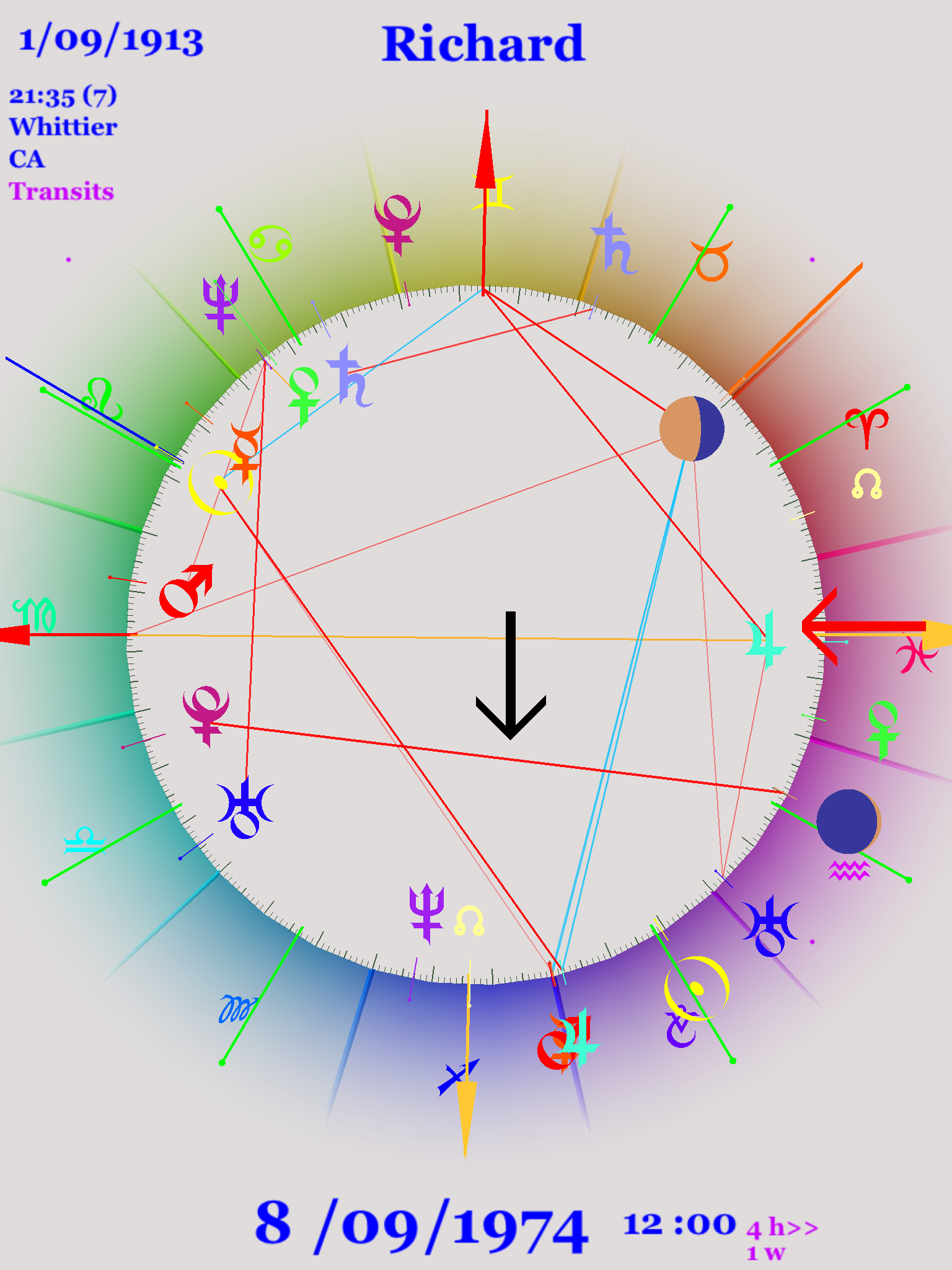
It is only fair to also look at the chart of the man in question, Richard Nixon. Nothing spectacular here. Jupiter had been hanging out – it had gone retrograde – opposite his Ascendant and square his Midheaven (red arrow) for the last two and a half months, and after the resignation Jupiter had rapidly sped away from any connection to the two angles. I’m sure Richard Nixon felt a lot of relief after this whole ordeal was over, that the resignation was a relief. Pluto is a very important planet in Nixon’s chart, up near the Midheaven natally and opposite his Mercury-Mars-Jupiter conjunction, that attests to his skill as a lawyer and his paranoia. At the time of the resignation transiting Pluto is closely sesquiquadrate (14 minutes – black arrow) to his natal moon. Because Pluto had been retrograde and went direct on (sesquiquadrate) his Moon, this aspect had lasted for over four months and was almost exact on the day of his resignation.

Election 2014

Since everyone else is weighing in on the upcoming election in the United States in November, I thought I might as well too, using the lens of astrology. There appear to be two contradictory messages from the election day chart; I think it should be a very interesting election.

election_14_tg1

Pluto-Uranus on US Sun

The major thing that colors this whole period is shown in the first chart, a graphical ephemeris for 2012 the 2017. It shows the transiting Pluto going back and forth over the natal Sun (yellow dashed horizontal line near the top) of the United States. The last time this happened was before the US birth, that is before the Declaration of Independence. This was a time about 1766 to 1771 when the British were trying to get money from the colonists through such measures as th Townsend Act (1767) and the Stamp Act (1765) that led to such things as the Boston Massacre (March 1770) and ultimately to the American Revolution, as shown in the second chart.

election_14_tg0

Before the Revolutionary War – Pluto opposite Sun of US

While I am not suggesting that there will be another American revolution, I am saying there wlll be a lot of animosity towards those institutions represented by the Sun. When the country was a colony of England, the Sun represented the King of England and the British government. Now that the US has “self-rule” the Sun represents the President and the government. And right now, those institutions are not very popular with the people, as many polls show. I saw recently that the imaginary character Darth Vader is more popular than any potential or real President, as well as the Congress.

election_14_1

The election chart is set for election day, but I chose the time of 12:29 since at that time the transiting Moon is exactly conjunct transiting Uranus (black arrow), suggesting a time of upset or of “revolution”.

In this chart not only is Pluto opposite the US Sun (green arrow), but Pluto is conjunct transiting Mars (red arrow), which is opposite the US Jupiter. Pluto Mars conjunctions are connected with, to put it mildly, extreme anger. This conjunction will be building up in the week following the election.

Of course, there is the transiting Uranus square transiting Pluto which has been going on for several years now; this aspect has marked this as a decade of upset, unrest, and violence, and you can see it in the daily headlines from Iraq to Israel to Ukraine and of course in the US to a lesser extent.

And since Pluto is opposite the Sun then we have Uranus square the Sun (blue arrow), putting even more pressure on the central government. But notice the both Uranus and Pluto are semisquare the Moon (yellow, aqua arrows) of the United States, and also, self evidently, the Moon is at the Midpoint of Uranus/Pluto. We have a whole lot of Uranus Pluto happening. This suggests sudden revolt. People are angry at what has been done to them by forces beyond their control, and here is a chance for them to express that anger. In the United States people don’t so much vote for a candidate as vote against a candidate by voting for the other candidate, and in the two-party system of the United States, this leaves few choices.

To further suggest the rebellious nature of the election, the Moon-Uranus conjunction is trine the Ascendant and opposite the natal Saturn. Saturn and Uranus have two opposing principles: Saturn represents conformity and the safe path, while Uranus represents rebellion and the more risky path. Thus the opposition is conflict between the old and the new. When these two planets/principles are opposed in the sky, we get conflict between rebellion and safety. Two examples: this opposition happened in 1919 when the Palmer raids (fighting Quaker Attorney General Mitchell Palmer) started. This period in the United States is often called the First Red Scare; just after World War I there was a series of bombing supposedly by foreign anarchists, there were a lot of deportation, such as Emma Goldman, the Sacco-Vanzetti event and trial occurred, and Eugene Debs, who was jailed under the Espionage Act (yes, the same one being used today to jail whistle-blowers) ran for President from his cell. Another example was the “Credibility gap” of 1966 where many voters got upset with the current President Lyndon Johnson and the true depth of the Vietnam war was realized. Based on these ideas, I’m guessing that this opposition, even though one planet is natal, will be similar. We already have a new “Red Scare”; even though the Communist party does not rule in Russia these days we have their leader – Vladimir Putin – which we can demonize as much, and possibly more, that any of the former leaders of the Soviet Union.

But then there is another theme shown in this chart. There is a transiting Sun-Venus (white arrow) conjunction, which is not bad at all, trine the natal Sun, and the transiting Mercury square (brown arrow) the natal Mercury and sesquiquadrate (crimson arrow) the natal Uranus. In the entry about the Brown v Board of Education Supreme Court ruling, we said that the Mercury semisquare Uranus is part of a very pervasive belief that the US is a innovative, revolutionary country, and we showed how Neptune, at the same place Mercury is in this chart, accentuated that belief. The presence of Mercury for the elections in the same place as Neptune for the Supreme Court decision suggests that that this elections will also be about reaffirming the essential progressive nature of the US.

Thus there are two, very different themes expressed in this chart for the US election on November 4, 2014. One suggests rebellion and the other suggests that American is an exceptional country. Again, I think that the election will be interesting. One way of combining the two themes that I thought of is that America will be rebellious in this election, there will be some upsets, but finally people will conclude that this behavior shows that America is still a rebellious country, and this election shows the best in America, though the initial take will not be that generous.

First Man on the Moon

Since this week has seen a celebration of the 45th anniversary of the landing on the moon, I thought  it fitting to look at the chart for that event.  It must be stressed that this is a geocentric chart for the event, which took place on the moon.  Perhaps we should be looking at a selenocentric chart for the event, that is one based on the moon.  Such a chart was published in a British journal in the Fall of 1969.  But since most of the people involved were here on Earth, and the ramification of the event were here on Earth, I’m going to look at a standard geocentric, that is to say earth-centered rather than moon-centered, chart.

lunarlanding

Touchdown on theMoon

At second glance, we notice that there is still a loose conjunction of Uranus and Pluto, but Uranus is separating from Pluto and is now  almost 8 degrees away.  The Sixties are just about over.  But what does stand out is the tight Jupiter-Uranus conjunction (black arrow), at about 6 minutes of arc.  Richard  Tarnas describes Jupiter-Uranus cycles as involved with “Creativity and Expansion”, see Cosmos and Psyche Section VI for a full description.  Also note that the fabled Woodstock Music and Arts Festival took place some three weeks later under the same conjunction, though it was wider by that time.  The tight Jupiter-Uranus conjunction was also loosely conjoined with Pluto — this was sort of an expansion (with Jupiter there) of the Uranus-Pluto principle.

But this conjunction is at the Midheaven of the United States chart, representing a culmination of the dream to put a man on the moon by the end of the decade as announced by President Kennedy at the beginning of the decade, perhaps to highlight America in the world – the country had lost a little glamour with the Soviets being the first into space back in 1957  while the Americans could not launch a successful satellite into orbit.  This event certainly was a highlight to America’s image in the world. And during the Cold War image was  everything, in an attempt by both sides to influence nonaligned nations to join their side.

Since this is a timed chart, we can look at the position of the moon, which is near the top of the chart and passed over the MC early in the morning. (For the selenocentric chart, the Ascendant is 8 Leo and the Earth is at 8 Aries.)  This was an  event listened and  watched by many people around the world, one of the reason we are celebrating the anniversary this year.  At the time of this event, the transiting Moon was making an aspect — a sesquiquadrate — to the natal moon (green arrow), reinforcing the idea that the people of America were paying attention and being effected.

Next notice that the transiting Sun — representing the day — is conjunct Mercury (red arrow) and both are aspecting the Ascendant.  This speaks to the massive communication and attention paid to this event in, at the very least, the United States,  and that again this affected the nation’s feeling about itself (Ascendant).  As   we’ve seen before, communication is highlighted, and many networks carried live pictures of the first steps onto the Moon by Neil Armstrong.  It was probably the most universally covered event up until the 9/11 attacks 32 years later.  But of course at the time there were not the multiplicity of cable networks, but only the big three television networks, not even Fox existed.

Finally notice (blue arrow) the Pluto is conjunct the natal Neptune with an orb of 36 minutes.  At the same  time,    transiting Neptune is square the natal Moon. Both these aspects highlight the Neptunian nature of this event, and in this case I don’t mean illusion (though some still think that the Moon Landing was staged on some Hollywood set)  but rather dream.  In the Sixties, especially after Kennedy’s speech announcing the intention of putting a man on the Moon before the end of the decade, the dream of space flight and humans on the moon was quite real. Since so many things have happened since them, most forget the sense of dream of space flight had on people, such as when Life magazine, long forgotten, had major stories whenever a satellite was put into space.

lunarlanding4

Lunar Landing — Fourth Harmonic

The  fourth harmonic chart reveals how close the main conjunction is.  Notice how tight the Jupiter-Uranus conjunction is  to the MC, and how also this conjunction is sesquiquadrate (black arrow — in fourth harmonic, this is a hard aspect which is a   multiple of 11 1/4 degrees) to the Moon with orb of 31 and 52 minutes.  There is also a transiting Mercury sesquiquadrate natel Neptune again emphasizing the element of imagination and the use of science fiction (Mercury-Neptune) which informed many space scientists.


The Virtuous Nation — Part III

usa_ju

Sun-Jupiter-Venus

Venus conjunct Sun

The United States also has Venus conjunct its Sun. This clearly manifests itself in two ways, illustrating two keywords for Venus and the Sun.

Popular

Not only is the United States a popular country, but its products are popular also. This popularity is so strong, as suggested by this natal conjunction, that it will take some special actions to harm this popularity.

In the decades before the Civil War, the United States exported about 80% of the cotton in the world, and tobacco was also a major export from this country. These crops, grown largely by slave labor, were extremely popular around the world, and led to the growth of the American economy. At one time, cotton exporters were in general the second wealthiest people in the world, the wealthiest being the owners in England whose factories made clothing from the Southern cotton.

American movies, television programs, music, and celebrities, are extremely popular around the world. All these things are ruled by Venus. People may know nothing else about America, and in fact they may hate America, as many citizens of Arab countries do now, but they still love American culture. Action movies are especially popular overseas, because no translation is needed for a car chase or a gun fight. This causes a tendency in Hollywood to make movies that will be popular overseas, despite what an American market might want.

During the Cold War, blue jeans were neither manufactured nor imported by the Soviet Union, but nevertheless, or perhaps because of this, they were very popular in the Soviet Union. While some were brought in by diplomats, blue jeans were long considered a valuable commodity that could be traded for much by visitors to the Soviet Union.

America has always been popular to immigrants and attempted immigrants. Currently in the United States there is much debate about immigration, since millions of people from south of the Rio Grande River have come to this country illegally. The country is so attractive to them that they would risk their life to enter. And hundreds die a year attempting to come to this country.

And America has always been attractive to immigrants from foreign lands. It has, after all, been considered the land of opportunity, where the “streets are paved in gold.” As we’ve seen above, there were reasons for this belief. The only native people here were the Indians, and they had merely immigrated a much longer time before the rest of the settlers. And America has always gone through periodic attempts to curb immigration.

Comfort-Loving

Americans also love their comfort. Americans are notorious for their lifestyle, which is more expensive and excessive than what almost everyone else in the world would consider. Americans are famous for their lack of physical exercise, and stories are often told of an American driving a block or less to go to a store. Interestingly enough, when skinny families from other countries move to America, they or their children find themselves adopting this love of comfort and putting on weight. But of course, as other countries get wealthier, they also adopt the American lifestyle which they see as the hallmark of a civilized people. Notice how China, as it gets a bigger middle class, replaces the bicycles on its streets with automobiles, and American automobiles are most popular because they suggest that the owner has “arrived”.

Another way of observing the excessive lifestyle of Americans, or the dream that such a lifestyle has on those Americans – the vast majority – who don’t have lives of such excess, is to note the popularity of the television series “Lifestyles of the Rich and Famous”. The show is gone, but we still pay extraordinary attention to the lives of celebrities, who almost by definition are wealthier that we are, as picking up an issue of People magazine or a brief scan of the cable news shows at almost any time will reveal. But of course the people that make up these video encounters aren’t the really wealthy: those people, in the top one-half of one percent of the population, prefer not to be well known, and usually live behind gated walls. They are the people whose wealth is really beyond sight, but they still serve as an inspiration to those who aren’t nearly as rich. Thus the American Dream survives [This is discussed in great detail in Richistan: A Journey Through the American Wealth Boom and the Lives of the New Rich, Robert Frank, Crown 2007].

Consider the ratio of pay for the CEOs of companies to the pay of the workers of those companies. The figures increases from year to year, but what is most interesting is that this ratio has increased drastically in recent years. A current study shows that executive pay is more than 400 times as high as that of the average worker, nationwide; this ratio was only 42 as recently as 1980. Obviously, excess has gotten more excessive over the last few decades.

But this is not the first time that such excess has been prominent in the United States. In the decade of the Twenties, the rich were famously wealthy. The Twenties were notorious for the great spread between the income of the extremely wealthy – such as Henry Ford, the second richest man at the time – and the average worker. Partly this great imbalance of wealth was due to the monetary policies of Andrew Mellon – the third richest man – who was Secretary of the Treasury between 1921 and 1933, under three presidents [Or as the contemporary joke had it, those three president served under Andrew Mellon]. By present day standards, Henry Ford was earning $345 million a year. These extremities of wealth of the Twenties are often compared to the situation today.

But the Twenties was not the only time in American where the wealthy were so extreme. Another period was the Gilded Age – -whose name betokens tawdry excess – in the last third of the Nineteenth Century.[Jack Beatty, Age of Betrayal: The Triumph of Money in America, 1865-1900, Knopf, 2007. The subtitle says it all.] At one time during this era, the extremely wealthy J.P. Morgan had to loan money to the United States for it to survive during what was called the Panic of 1893. This was the era of the Robber Barons, whose great wealth was legendary.

But excess and love of comfort is not reserved just for those in the upper incomes. The incidence of type 2 diabetes has increased greatly in this country recently, and some are even calling this a diabetes epidemic. Diabetes was previously a disease of middle age, but is now being seen more and more in young people. Diabetes is a disease ruled by Venus, and one of the main causes of diabetes is excess weight, the Jupiter principle. The diabetes rate in the United States is 6.3%, and the country has the third largest number of diabetics in the world, only surpassed by India and China. The rate is only surpassed by Russia, at 6.8%, and that country has seen its standard of living and health care plunge drastically in the last 15 years. The number of diabetics is expected to increase worldwide as American diets and automobiles become increasingly popular overseas.

There is one more example of the excess of America that needs to be told. Recently it was reported [New York Times, p A1 4/24/2007] that the income of the top 25 hedge fund managers totalled $14 billion, with the top three earning an annual compensation of over one billion dollars each, and the top earner getting $1.7 billion. These incomes dwarfs Henry Ford’s adjusted annual income of $345 million. This is certainly Venus excess carried to a high level.

The Summit Crisis of 1960

The summit crisis of 1960, caused by the Soviet shoot-down of a U-2 plane carrying Gary Powers on May 1, 1960 had important ramifications for the progression of the Cold War, but is little know these days. Recent events in the Ukraine possibly leading to a new Cold War give us more perspective on how governments and media operate in times where the Official Enemy can be blamed.

In the last quarter of 1957 the Soviets launched two satellites into space, the first time in history that this had happened, and that act caused much fear and changes in the United States. Shortly thereafter NATO met and decided to put offensive missiles into Europe, after which the Soviets called for a summit meeting between the Soviets and the NATO countries. They followed this up with visits to the United States by two high-ranking Soviet officials. At this time President Eisenhower visited India where he was hailed as the “Prince of Peace” and there made a conciliatory speech laying out the problems in the Cold War. The Soviets announced they were reducing their armed forces by one-third. Things in the world were looking positive for peace, after 15 years of the Cold War.

The summit was scheduled for early 1960. Though well-meaning, Eisenhower (a Libra whose mother was a member of a pacifist church) seemed to have little control over his subordinates, especially the new Secretary of State. His administration seemed to be sending mixed signals about the desirability of the upcoming summit, though the people of the United States were in favor of it. This had been pointed out by no less than Adlai Stevenson, who Eisenhower had defeated in the last two elections. He pointed out that the United States always insists on unconditional surrender from the Soviet Union, which is not very popular with that country.

A high-altitude U-2 spy plane took off on May 1 to surveil the Soviet Union, flown by Francis Gary Powers. It was shot down. Some at the time thought that the overflight so close to the summit was an attempt to sabotage of the summit by the CIA, and considering what we have learned about the CIA in the half-century since this would not surprise me in the least.  In any case it was extremely bad timing.  Before the United States knew that Powers was captured (he had a suicide pill), several government officials, including the President, lied and said it was a NASA experimental plane. When it was revealed that Powers was alive, America had egg on its face. The Soviets then gave Eisenhower a chance to back down gracefully and say it was a mistake by his subordinates. But Eisenhower, instead of admitting that it was a mistake, doubled down and claimed that America had a right to fly planes over the Soviet Union, something in violation of international law, and if it happened to America one can imagine that we would seek revenge. At this point, since it was rubbed in their face, the Soviets had no choice but to make a big deal of this incident.

As a result, the summit did not happen, and both sides grew more hostile in the coming years. This was right before John F. Kennedy was elected President on the basis of a fictitious “missile gap” . The Bay of Pigs and the Cuban missile crisis both happened in the next two years, and Vietnam escalation was a short way off. The hopes of the people of the world, who had been subject to the Cold War and threat of nuclear Armageddon for over a decade, were crushed.

So this event was quite important to the formation of the Sixties. For a bit there it seemed that the Cold War could be modified or perhaps even eliminated, but after a shoot down of the U-2 the Cold War only increased in intensity, with the problems in Cuba, Berlin, and Vietnam a result.


U-2 Shoot Down

U-2 Shoot Down


The first chart is for that day as transits to the US chart. Notice that Mars is opposite the Natal Neptune and square natal Mars, and transiting Neptune is semisquare natal Neptune and sesquiquadrate natal Mars, and, as we will see later, transiting Neptune is sesquiquadrate transiting Mars. So what we have is a lot of Mars/Neptune, which emphasizes the Mars square Neptune in the United States. Mars-Neptune hard aspects indicate that it is difficult to handle ones energies cleanly. Perhaps one may want to do good, but it is easy to delude oneself about ones actions. There is something hinky about the use of energy. This message comes across clearly in this situation.

Then there is the tight conjunction between the transiting Node and the Neptune of the United States. This further emphasizes the Neptunian side of this event. Ebertin talks about a lack of community-sense. Next notice Venus, the planet of diplomacy – this was a summit meeting – is sesquiquadrate, exact at noon, to the Ascendant and square to Pluto. This emphasizes the Pluto-Ascendant semisquare in the US natal chart that we’ve talked about before. This aspect represents the shadow side of America, the US tendency to demand unconditional surrender from our enemies. Then there is Uranus semisaquarte both the Midheaven and Venus, and thus at the midpoint of the two natal planets – there will be upset in our international diplomacy. Finally transiting Jupiter is opposite natal Jupiter: the United States may be over-confident, will push things too far without considering the consequences. All these transits work together to reinforce a picture of what happened that day.


Summit — World Transits


Summit Harmonic 8


If we look at the transits for the day we see two hard aspect, Mars sesquiquadrate Neptune and Saturn sesquiquadrate Pluto. To see how tight these two aspects are, look at the eighth-harmonic of the same chart, in which sesquiquadrates are reduced to conjunctions. Both of these conjunctions are very close, showing they are very powerful at this time. We’ve shown several examples of the bad consequences that happen when there is a hard aspect between Saturn and Pluto; this is also a hard aspect, only not a square, opposition, or conjunction. But it is so tight, almost exact, that the harmful effects are shown as in the start of various wars.

Here was an occasion where the Cold War, that had gone on for 15 years, could have been modified or even ended, to the great support of many people in the world. This, however, would not have been good for the defense industries or the politicians who wanted the Cold War to continue, as Eisenhower warned about in his Farewell Address as the Military-Industrial Complex. But because an illegal flight was discovered in a most embarrassing way, this attempt was thwarted and the Cold War continued for another decade before a successful attempt to modify it actually happened. Then, a decade after that, the Cold War was given renewed energy, which was called at the time the New Cold War, not to be confused with the Cold War II which is happening now, at the same time as we have another Mars sesquiquadrate Neptune for the first half of this year.

Mush of this information is from chapter 20 of The Free World Colossus, David Horowitz (yes, that David Horowitz! He use to be a good historian.) 1965.

The Virtuous Nation — Part II

Jupiter conjunct Sun

Jupiter is conjunct the Sun on July 4, 1776, and several of the meanings of Jupiter are closely associated with the United States. Jupiter is the largest planet in the solar system, and Jupiter, by itself, would like to expand until it takes up the universe. Jupiter also loves freedom, and does not handle restrictions well. One motto of Jupiter could be “Don’t Fence Me In.” This conjunction illustrates well several standard meanings for Jupiter and the Sun.

Expansion

One keyword for Jupiter is Expansion. And the United States certainly believe in expansion, in all its many meanings. The motto of the United States could be “Super-Size”.

Statistics on American usage change from year to year, and in some case can change as soon as they are published. The following are current, but more importantly they will give an idea of what the trend is like in the early Twenty-First Century.

The United States consumes more oil than the next five largest consumers – China, Japan, Russia, Germany, India – combined, and is the biggest importer of oil in the world, more than the total of the next three– Japan, China, Germany. This is 23% of the world’s total usage. It correspondingly emits more CO2 per capita, and until very recently more in absolute terms, than any other country in the world [China just recently surpassed the United States in the production of this greenhouse gas. But since the population of China is several times that of the United States, America holds the per-capita record.], close to a quarter. The external debt of the United is also 23% of the world total. The defense expenditures of the United States are almost half of the world total.

Another area where the United States is Number One is in prisoners. America has 4.5% of the world’s population but has 25% of the world’s prisoners, some 2.2 million people. While other countries, such as the Soviet Union and South Africa use to surpass America in this area, recent changes in the governments of those countries, and much more punitive policies in this country, have allowed the United States to claim the top position. The United States has the highest incarceration rate of any country in the world, at 737 per 100,000 – that is 1 in every 136 people. The next highest is Russia, at 611. Most countries have a rate below 200.

America has not always been first in so many things, and some things that it used to be first in it no longer is, as more and more of the world attempt to emulate America. And while others countries don’t have the birth chart of America, they can still try. The automobile, although invented in Germany and first popularize in France, was mostly produced in the United States until fairly recently. General Motors was the largest automobile producer for 76 years, but in the first quarter of 2007 it was surpassed by the Japanese manufacturer Toyota, though until 2008 and official 2007 figures are available we can’t be sure. Likewise, Americans were the tallest people in the world since records were kept starting in the middle of the Nineteenth Century through the 1970s, but this has changed since then. The Dutch now average three inches taller than Americans.

Americans also work more than those in other industrial countries, 500 hours more a year than the Germans, 250 hours more than the British. This is increasing, as many other Jupiter effects are: The average American man works 100 hours more than he did in he 1970s, and the average woman 200 hours more [ Erza Klein, “Land of the overworked and tired”, Los Angeles Times, July 16, 2007 ]. Jupiter is the planet that drives workaholics.

The expansion can even be seen in the increasing girth of Americans. Americans seem to have taken the Jupiter principle to heart, or to stomach. According to recent figures, the obesity rate (people over 15 with BMI greater than 30) is 31% for America, compared to second place for Mexico at 24%.

However, America was not always big in the ways indicated above, throughout its history. It was something that had to be worked towards. Through the end of the Nineteenth Century, America expanded in a different sense, as indicated below.

American is also an expansionist nation. This is exactly what Jupiter would want. Up until this century the term “empire” was not often used by scholars, even though the expansion of the United States started shortly after its founding. But recently the term empire is back in vogue, and is used by many people who now find it positive. America expanded within the borders of North America starting with the Louisiana Purchase of 1803, and continued on until the Pacific Coast was reached before the Civil War. These various accretions are given names such as the Mexican Cession and the Florida Purchase, though they usually involved more than a simple monetary exchange. 1890 was declared by the government to be the date the frontier ceased to exist, and so after that date, starting with the Spanish-American War of 1898, America started to expand overseas, but not often in ways that traditional colonial powers, such as Great Britain, did.

America is one of the few countries in the world that has military bases outside of its own borders. According to government documents, there are 737 bases in foreign countries, but this number is an undercount, since many bases are not listed, such as those in Iraq [Chalmers Johnston,Nemesis, Metropolitan Books, 2006, p 138-40]. This is not a new trend due to the War on Terror, but has been developing since the end of World War II, when many of these bases were first inserted into other countries. It has been estimated that we have about 1000 overseas bases, and this figure is orders of magnitude greater than any other country.

Enthusiasm

Another keyword is Enthusiasm: Enthusiasm, when carried to an extreme, can be self-righteousness; self-righteousness can become arrogance, which will offend other people. All these three words are associated with Jupiter which, among other things, represents freedom – Jupiter does not like to be tied down or hindered in any way, it wants to be free to expand. Freedom can be thought of as the ultimate good. This can be seen in such slogans as “Don’t Tread on Me” or “Live Free or Die” (both dating back to the Revolutionary Era). This can become a boundless optimism and the “Can-Do” spirit that America is famous for, the feeling that anything can be accomplished. This aggressive independence is part of what has been called the American Dream. But this militant freedom can also ignore the rights of others; it realizes no responsibility but the responsibility to oneself.

But enthusiasm can also become the love of, and indeed the worship of, private wealth. The current heroes of popular culture are the richest men, such as Bill Gates and Warren Buffet. But this has often been the case: Henry Ford was a folk hero to the common men of the Twenties [Geoffrey Perrett, The Twenties, Simon and Schuster, 1982, p256]. A magazine even publishes a list of the wealthiest people yearly. Close to 40% of the billionaires in the world live in America, according to the 2007 Forbes Magazine listing. The dark side is also what has been called “the hustle”, that asks “what’s in it for me” and is always looking for more [This is discussed in great detail in Walter A. McDougall, Freedom Just Around the Corner, HarperCollins 2004], another Jupiter word. This is one thing that early visitors to this country from Europe noticed, and found disgraceful.

Another side of this enthusiasm is American Exceptionalism, which was touched on before. This manifests itself not just in the belief that Americans are special people, based on our history, ethnicity, climate, or religion, but also in the belief that the rules that apply to other people, for example the rules against torture, do not apply to Americans. With this mindset, one begins to believe that one is better than anyone else, that things that happen to you have never happened to other people. This is when arrogance begins to annoy the people in other countries.

Abundance

In the early years of this country, America was described as “the poor man’s best country”[Sean Wilentz, The Rise of American Democracy, W. W. Norton & Company, 2005, p 16]. Perhaps we forget now how unique early America was. Whereas all of old Europe suffered under layers of aristocracy, America, being a new country, was free of the stultifying hand of aristocracy. There was plenty of land for the taking [And they took it from the Indians. One of the forces for “Indian Removal” was the desire of farmers for new land to settle.] and so even recent arrivals could settle a homestead and raise enough food to feed their family. A father could easily expect to have land to leave to his sons. This was completely different from Europe, where the land had been divided so many times there was none left to give.

And the land was so fertile! While much of the land in Europe was warn out from having been planted and harvested for many, many generations, and marginal land was beginning to be brought into production to meet the demand, most of the land in America was extremely rich, and American colonists found it easy to raise large crops. In fact, since a population boom had taken place in Europe during the Eighteenth Century, Americans found their grain much in demand in the old world.[Joyce Appleby, Capitalism and a New Social Order: The Republican Vision of the 1790s, New York University Press, 1984, p 98-99] There was a belief at the time that America should emphasize crops while Europe could export luxuries to America which they could easily afford since their grain was in such demand.

And America has always been known as “the Land of Opportunity” up until the present time. It is certainly one reason it is so attractive to those in foreign lands. No matter what one’s position in the country of origin, in America an immigrant could make a new start, free from the restrictions of the past, with the expectation of material abundance. This was part of the American Dream.

America has always been know as a land of abundance, and this has shaped the way Americans look at themselves and their relationship with the rest of the world. In a British play written in 1605, Virginia was described as having gold chamber pots [George Chapman, Ben Jonson, John Marston, Eastward Ho, William Aspey, 1605. Act III, Scene 3]. Abundance is clearly a characteristic of Jupiter, and when conjunct the sun increases the wealth of the individual involved. One can trace through the history of America numerous mentions of the wealth and abundance of the country.

And the productivity of America was not just due to the rich soil or the labor of slaves. There was something about the laissez-faire economic system that was dominant in Nineteenth Century America that also accounted for this great abundance of material goods, of new and improved products[David M. Potter, People of Plenty, University of Chicago Press, 1954, p 88-90]. Individual entrepreneurs were encouraged to expand America’s abundance, but the ultimate bill wouldn’t be realized for some time.
The Virtuous Nation — Part I

Since we are almost at the birthday of the United States, I thought it appropriate to write about one of the most important configurations in the chart of the United States, the triple conjunction of the Sun, Jupiter, and Venus. This triple conjunction influences the behaviour and beliefs of the United States, including the ever-important American Exceptionalism, which every politician must swear allegiance to. This article was originally written for the magazine The Mountain Astrologer before the Great Recession of 2008, so some of the figures may be slightly out of date, for example China is now clearly the number one emitter of carbon dioxide, but the figures stand  quite well.  Endnotes in the original are now put in brackets.

National character is an idea often used by writers, but never given any definition. Various concepts are suggested as to what the national character of the United States is, but with the tool of astrology one can clearly see the national character of the country through exploring its natal chart.

Venus is conjunct Jupiter, and both are conjunct the Sun of the United States on July 4, 1776. I am looking at the Sibly chart, but obviously that configuration occurs for any time on July 4, which is traditionally celebrated as the birthday of the United States, and has been since 1777. This triple conjunction can be seen as Venus conjunct Jupiter (the closest conjunction), Sun conjunct Jupiter, Sun conjunct Venus, and finally Sun conjunct Jupiter conjunct Venus. These four aspects will be discussed in turn. The nature of a conjunction is such that the separate traits of each planet are so entwined that they cease of have distinct meanings. Since both Venus and Jupiter are somewhat similar, drawing distinctions between the conjunctions is problematic, so while one could argue that a characteristic should occur under that aspect rather than this aspect, nevertheless the distinctions can be made. This triple conjunction, especially considering that the Sun is one of the planets involved, strongly affects how the United States is seen by others, how it sees itself, and how it behaves.

Once you understand the chart of the United States, you will begin to see how the meanings of the planets play out in history and in everyday life. The symbols of the planets cease to be abstractions but rather can be seen all around you. The daily headlines reflect the astrology of the United States: you only need to open your eyes to see astrology at play all the time. We are fortunate that the birth date of the United States is recent, and well established. Everyone who has participated in that summer birthday celebration knows when the country was born.


USnour

The United States in 1776


Venus conjunct Jupiter

Blessed

In astrology, Jupiter is called the “Greater Benefic”, and Venus is called the “Lesser Benefic”. Here we have both of them together, which connotes fortune. America is the Blessed Nation, as Woodrow Wilson, the President of the United States during World War I, called it in a speech in 1915[Eric Rauchway, Blessed Among Nations, Hill and Wang 2006 p. 147]. Blessed seems an apt description for this conjunction, and I think it is safe to state that Wilson was at least fairly unfamiliar with astrology or with the chart of the United States. This conjunction could also be described, as George Orwell might have put it in NewSpeak, as double-plus good, the ne plus ultra of goodness.

America has always been a blessed, lucky, and fortunate nation, at least since its birth. Consider the luck of defeating the greatest military power in the world at that time, Great Britain. After what is called in the Colonies the French and Indian War (1756-63), a war that Winston Churchill considered the first world war, and one that gave an up-and-coming soldier by the name of George Washington his first real experience at war, an experience that was to come in handy later, England emerged as the leading military power in the world, one with large debts that required squeezing the Colonies for more money. All of the best firepower – rifles and muskets — were made in England, whereas America had little industry of this kind[Michael Bellesiles, Arming America, Alfred A. Knopf, 2000, especially chapters 5 and 6]. Nevertheless, America, with help from some European nations, was able to triumph over Great Britain.

After the defeat of Britain, and America was on its own as a new nation, another very fortunate happening occurred. The third President, Thomas Jefferson, sent two ambassador to Napoleon’s France to see if they could secure right of passage on the Mississippi River and landing rights in New Orleans for America, which were strongly needed as Americans were expanding into the Ohio Valley, and used the Mississippi River to market their goods. Instead of just offering them rights to the river, Napoleon was willing to sell America the entire territory of Louisiana, thus doubling the size of the country at one time.

America has also been blessed with a large variety and quantity of natural resources. Oil was first discovered in Pennsylvania, and the country is still the third largest producer of oil. If one drives around parts of Southern California, they can still see oil derricks. And the State of Texas is synonymous with oil; in fact, there are many Texas multimillionaires that started in the oil drilling game, including several that are in the White House.

America has always been called the “Melting Pot”, but many other countries in the New World acted as melting pots also, attracting immigrants from many other nations of the world. But for the United States, this attraction operated somewhat differently than in other New World countries. In most other countries, certain nations would predominately send their immigrants. However, the United States attracted immigrants from almost all countries of the world. America has been called “The Melting Pot of Melting Pots”[Michael Bellesiles, Arming America, Alfred A. Knopf, 2000, especially chapters 5 and 6]. To Americans, this mixture of new culture added to their vitality, and to employers the mixture of languages made unionization more difficult.

Because America has drawn immigrants from so many lands it has become the world’s first truly multicultural nation. This is a real blessing to the United States, and a source of strength that many have either not recognized or actively shunned. This experiment in multiculturalism, while not always successful, has been one of the positive facets of America, and will prove more so in years to come, as it gives America a preview of the future of the planet.

But there is one reflection of this Venus-Jupiter conjunction that has caused America to be different from other modern democracies in a less positive manner. America’s welfare program is much skimpier than in other industrial countries.[Rauchway p 68 has a graph illustrating this] Just consider that other democracies have a universal health plan, and most have had such for many years, while America has still not attempted such a thing, even though it is the richest of all those countries. This may be hard to understand until you examine the astrology of America. America is the blessed country; America is naturally lucky; America is fortunate. If the country is so lucky, people who are unlucky, who are unfortunate, are simply at fault. Since this is a naturally blessed country, if you personally have not gotten your share of blessings then it is your own fault. This seems to be the unconscious (and sometimes not so unconscious) belief in America. Since we are such a fortunate country, there is no need to give any benefits to those who are unfortunate. Good luck will eventually come their way. America is seen as the land of opportunity, and this was thought to make government intervention unnecessary, and in fact it was thought that government intervention would stifle economic freedom.

Another result of this conjunction is that Americans in general feel special, that their country is special. And as we can see in this article, this is true. This gives rise to a condition of America that has long been noted by commentators, a facet of American life called American Exceptionalism. This concept, that Americans are somehow special or exceptional, has a long history, and the meaning is somewhat fluid. The idea is that because of America’s unique geography, history, political and economic origins, this country is different than the other countries of the world. But different somehow morphs into better. It was first used by the French traveler Alexis de Tocqueville when he visited America in the 1830s, but the concept dates back even longer, to Puritan preacher John Winthrop in 1630 and his speech about America being “a city upon the hill”. Madeline Albright, the Secretary of State under Bill Clinton’s second term, called America the “indispensable nation…[W]e see further into the future.” Richard Holbrooke, a diplomat who also served under Clinton, said “the United Nations works best when the US leads.” The city on the hill idea was used in speeches by such varied men as Ronald Reagan and Bill Clinton. The concept of American Exceptionalism really got a boost by the rise of the Whig party in the 1830s[Rauchway p 66 ff], who also believed that what was bad for the wealthy was bad for those who could become wealthy.


Three With Saturn-Pluto

We’ve discussed before the malefic tendency of hard aspects between Saturn and Pluto. We saw two example of this in the 9/11 attack and the Spanish American War. Here are three more examples.


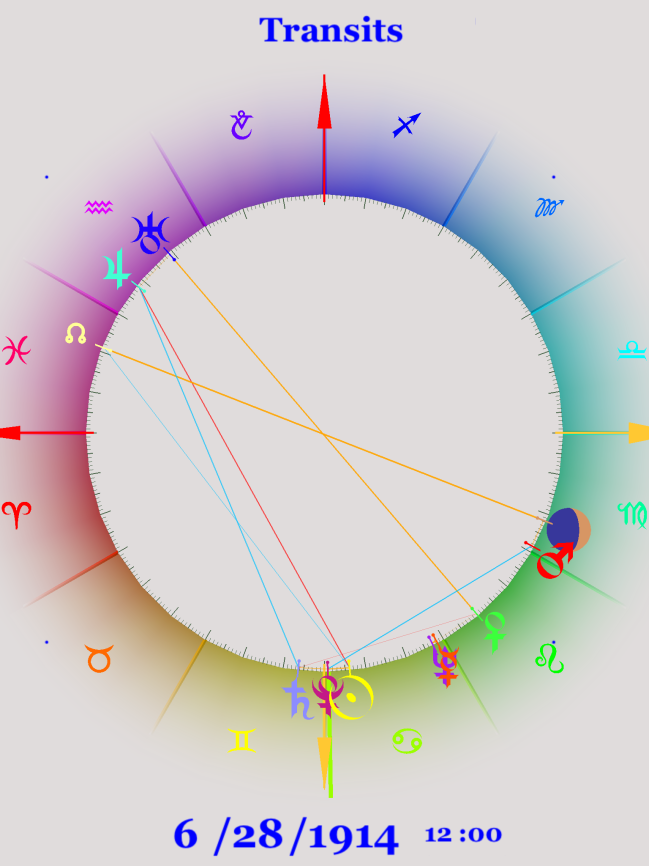
The first one is the start of World War I, exactly 100 years ago this year. Because a number of alliances had been set up in Europe, it only took a spark to set the whole edifice on fire. That spark was the assassination of the Serbian Archduke by a deranged anarchist on June 28, 1914. This assassination allowed the various alliances to take sides, and Russia came to the support of Serbia and then it was all downhill. On this centennial year there have many book s exploring this onset of war, such as The Sleepwalkers, which describes accurately what the world was at the onset of war. For most of the West, the previous 100 years had been a relatively peaceful time, the first in memory. Sure there had been some wars, such as the Civil War in the United States, and the Crimean War, and, though few Americans are aware of it, but you can be sure the Chinese remember it, the Taiping Rebellion in the middle of the Nineteenth Century, which is considered one of the deadliest military conflicts in history, with at least 20 million deaths. But for the West things had been mostly peaceful since the Napoleonic Wars were over. It was considered that peace had broken out and would last forever. Possibly because there had been so little war that many (such as Theodore Roosevelt) worried that men had lost their manliness, and large armies were build up “just in case”.

Image

World War I

In the first chart for the start of World War I, we see that Pluto has just entered the sign of Libra, a Cardinal point. This date, for the assassination, is considered the starting event for the War, but the hostilities didn’t start until at least a month later, and then the war slowly ramped up. The Americans did not enter the war until April of 1917. From the chart you can see that Saturn is conjunct Pluto and the conjunction will get tighter over the next months, as the war starts to build. World War I marked the first time that the developments of the Industrial Revolution could be really applied to warfare. Thanks, submarines, aircraft, automatic weapons, and poison gas could be used. The result was massive bloodshed.

Image

World War II

The standard beginning date for World War II is Germany’s invasion of Poland on September 1, 1939, even though there was a multi-year run-up to the “official” war, including such things as the Spanish Civil War (1936), Japan’s invasion of China (1937), and Germany’s invasion of Czechoslovakia (1938). The chart above is set for the official date. Note that there is a square between Saturn and Pluto; Saturn is retrograde and the square will get weaker before it gets tighter. Note also that Saturn is opposite the North Node of the Moon, and thus conjunct the South Node.

Some consider World War II a continuation of World War I. Certainly the harsh reparation forced on Germany after World War I had an effect. But Germany did enjoy a flowering of culture and democracy, called the Weimar Republic, after the War. This was the “Twenties” in Germany and lasted until the Great Depression started to take effect. We all know what came next.

Image

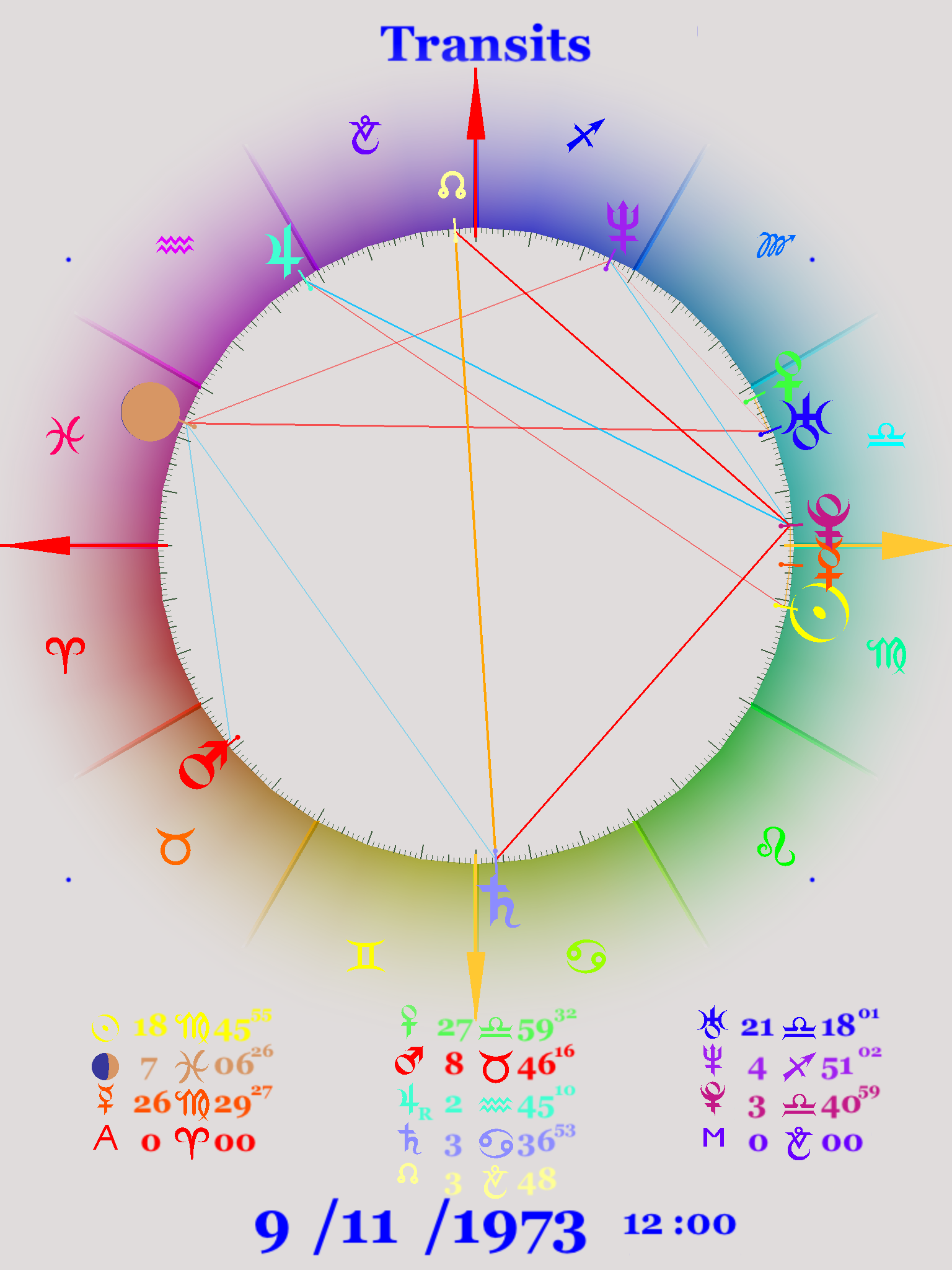
The First 9/11


The third chart is for a event called “The first 9/11” by those in the Western hemisphere. There was also an important event in South Africa on a 9/11/1906 in the history of non-violence, but that is a discussion for elsewhere. The event of 9/11/1973 was the occasion of the death of Salvador Allende of Chile and Augusto Pinochet taking power in that country, leading to a military dictatorship that lasted until 1990. Unlike the start of a war, especially World War I, the start of the Chilean dictatorship was very rapid. On this specific day the government of Chile was overthrown and the current president died, whether by the army or his own hand is still unknown. But there was an immediate change in government.

In the chart for 9/11/1973 we again see the Saturn square Pluto, with a very tight orb that is only four minutes of arc. And notice again that Saturn is opposite the North Node of the Moon and thus conjunct the South Node of the Moon, just as we saw in the chart for the start of World War II.

It is interesting that in two of these cases we see Saturn conjunct the South Node of the Moon as well as square Pluto. How should we interpret this? The South Node of the Moon sometimes has Saturnian connotations, especially in Indian astrology. This would increase the Saturnian influence. It also suggests difficulties in connections with others. It goes without saying that in both these instances, this Saturn-Node meaning played itself out.

For more details of Saturn and Pluto see Section V of Cosmos and Psyche by Richard Tarnas.


D-Day

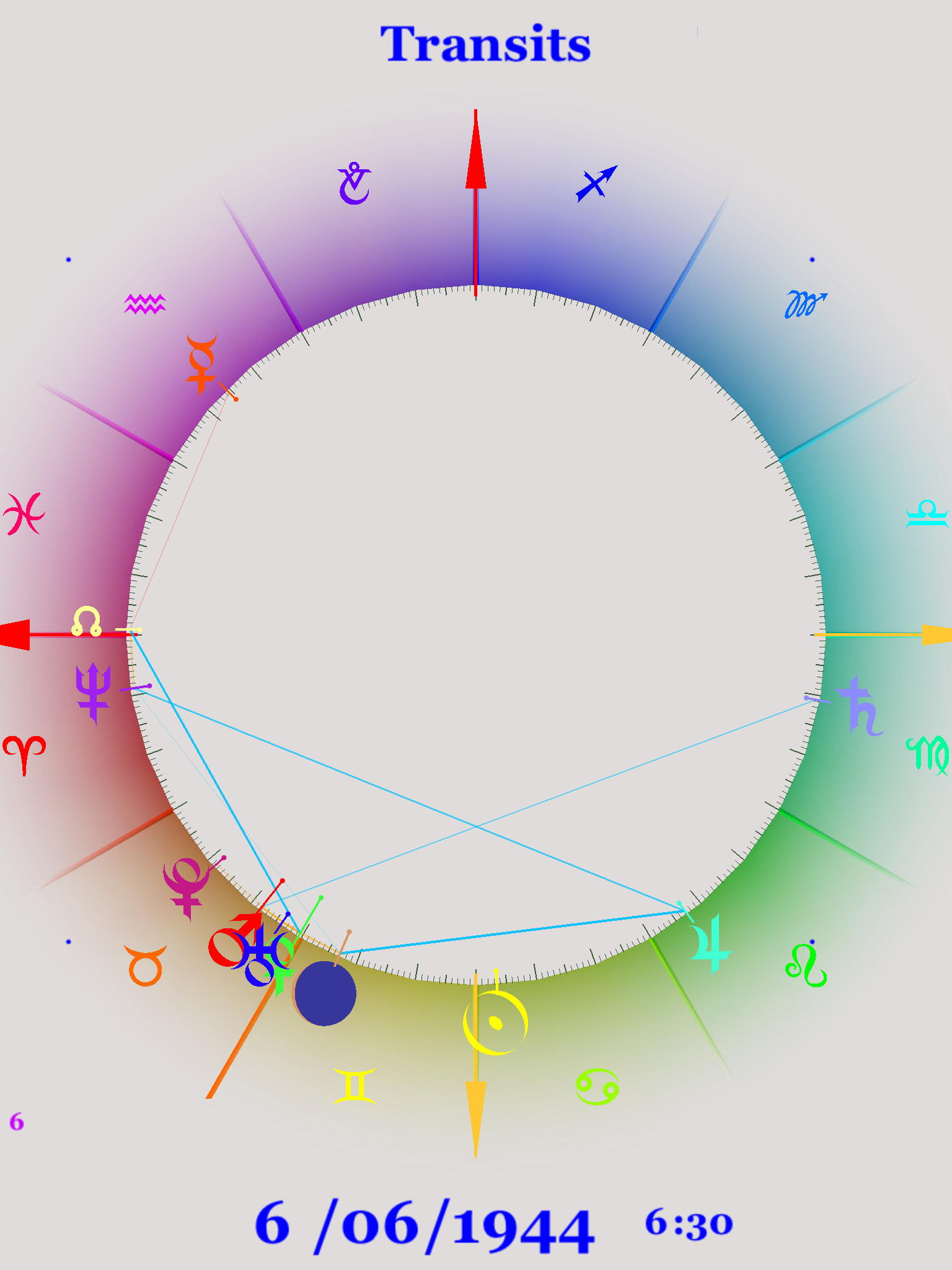
This year seems to be shaping up as a big one for anniversaries ending in zero, and we haven’t even reached to big one this summer. This June has witnessed the seventieth anniversary of the landing of allied troops at Normandy Beach, hastening the end of World War II. This landing started at 6:30 in the morning (time zone two hours East of Greenwich) of June 6, 1944. I really didn’t expect from from looking at the chart of this event, but the most interesting thing was when it was compared to the chart of the United States.

D-Day represented the culmination of long planning for opening a second front in Europe that had been demanded by Stalin years before, since the Soviets were baring the brunt of German war machine. There was an aerial bombardment of the coast earlier in the morning, but the invasion of joint forces from many European and North American countries is considered the D-Day invasion which was recently celebrated. The codename for this was Operation Neptune, and there have been several book published recently with that title. And there are movies about D-Day, the most famous of which is Saving Private Ryan.


D-Day  Event Chart

D-Day Event Chart


This first chart shows the D-Day event at 6:30. You can notice that this is a Full Moon, with the exact Full Moon about 9 hours later. The Full Moon suggests the culmination of some process. In this case it was the culmination of a long process of planning. You can see that the Moon has set and the Sun has just risen, as makes sense at 6:30 in the morning close to the Summer Solstice. There are two conjunction that are noticeable The first one is Mars conjunct Pluto. This conjunction can be read as superhuman strength or brutality. Certainly superhuman strength was needed in the D-Day landing, which taxed the strength of about 150,000 men, half of which were Americans. But not only was great strength needed on the day of the landing, but also much planning which took place before the day; this was necessary to assure a successful invasion. The tightest conjunction – about a quarter of a degree – is Venus and Uranus. At first this did not seem fitting, suggesting sudden love affairs and such. But that is on a personal level. It also suggests dancing and rhythm. In this case the conjunction implies that a great deal of planning and even rehearsal for many months before the final assault. In a way it was like a vary elaborate dance whose moves were planned out well in advance of the exact occasion. This was most necessary.

Then notice that the Moon is almost exactly opposite this Venus-Uranus conjunction. This was the timing indicator, since the Moon travels so fast this tight aspect only last a few hours. It was approaching so it would be exact in another four hours, just as the invasion was reaching it high point.

Another thing to notice is the planet Jupiter down by the IC and opposite the Midheaven. This indicates good luck, fortune at the base of the project, which was the Allied assault at Normandy Beach, and which they certainly needed.

D-Day Sixth Harmonic

D-Day Sixth Harmonic


But there is something else, which we can see most clearly in the sixth harmonic chart of the event. In this we see a wide conjunction of Pluto, Mars, Uranus, Venus, and the Moon, with the three center planets being the tightest. This represents the Mars-Pluto sextile the Venus-Uranus and trine the Moon. All five of these planets which we have talked about were involved in one aspect complex.


D-Day and USA

D-Day and USA


Finally let us look at these planets within the chart of the United States, since the Americans made a large fraction of the soldiers in the invasion. For the United states, which was on Eastern War Time for the D-Day landings, the time was six hours earlier. Notice that the Venus-Uranus conjunction is on the Uranus of the United States and the Mars-Pluto conjunction is on the node of the United States. The United States is definitely connected to this event. Finally notice that the planet Neptune is on the MC of the US. Not only that, but Neptune is opposite the Aries point at about 1 and a half degrees of Libra.; anything connected with the Aries point is connected to the World, since the Aries point is common to the World. That is most appropriate for an operation code-named Neptune. For the United States, the Full Moon has just risen and it is illuminating the chart.


Brown v Board of Education

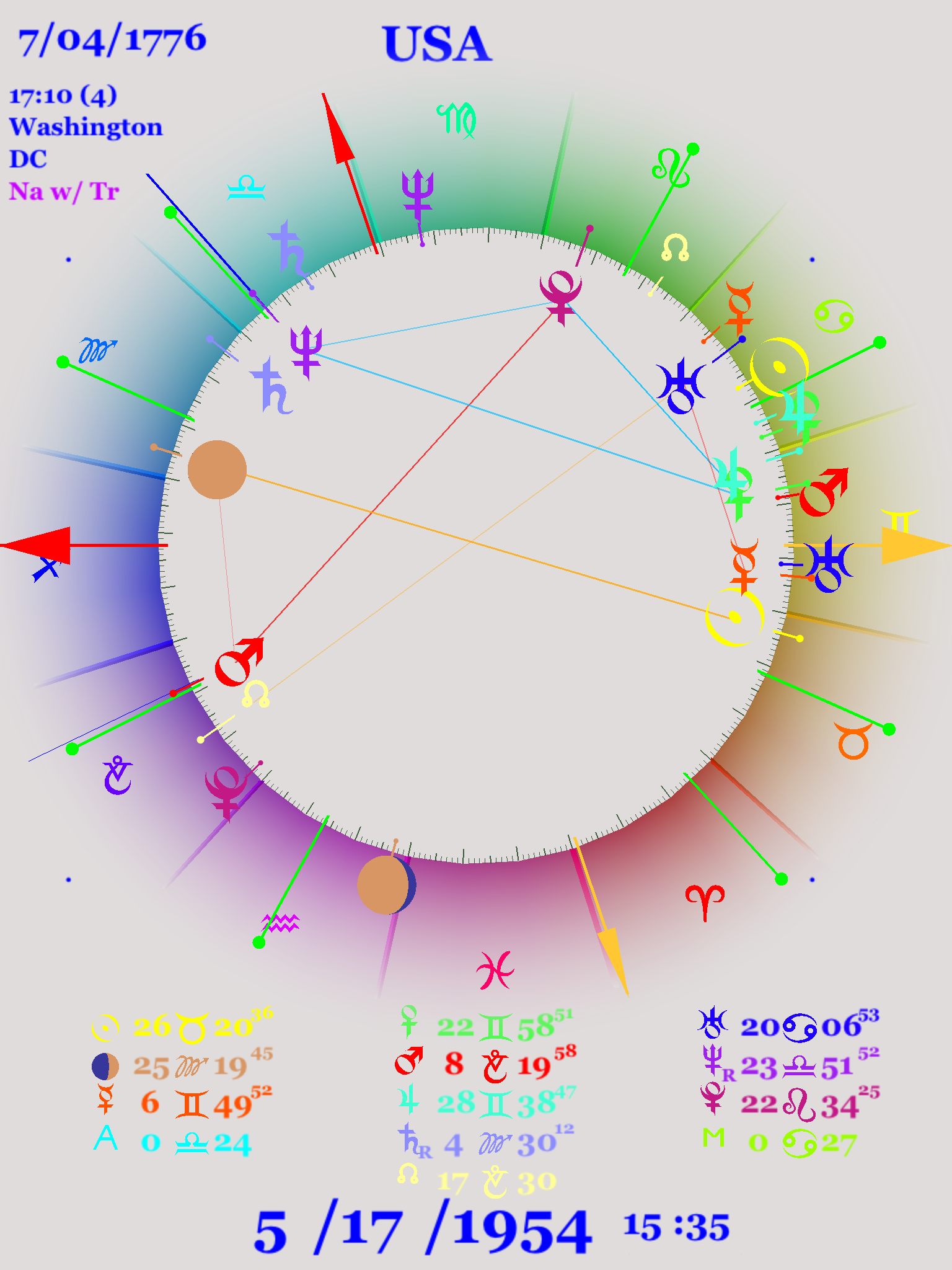
Another anniversary, this time Sixtieth for the Supreme Court decision on May 17, 1954 called Brown vs Board of Education of Topeka, Kansas.

Nations, like people, have their shadow side, the darkness they would rather not admit to. With a person that can sometimes be revealed through introspection or therapy. But for a nation, especially the most powerful nation in the world, such truth is extremely hard to face. We have previously talked about some of the dark side of America, as revealed by its closest aspect, Pluto semisquare Ascendant. This came out, for example, in the Gulf of Tonkin incident and of course the whole Vietnam War. But this side of American behavior is not mentioned in the media, in Fourth of July speeches, or political campaigns. There is a mythic belief of America that is celebrated at such occasions, and much of this is shown by the second tightest aspect in the American chart, Mercury semisquare Uranus.


bbe1

Dark Side vs Bright Side


Before talking about this aspect it is interesting to note its relationship to what I am calling the dark side aspect of American culture, Pluto semisquare Ascendant. These two aspects are opposite one another and connected by two oppositions. Symbolically this is interesting: It shows that the shadow side is the obverse of the more public side. This Uranus semisquare Mercury aspect is above the earth and thus more public, whereas the shadow side is below the earth, and thus more hidden, at least to the Americans. The recipients of our dark side behavior are all too aware of it. Also notice that the bulk of the planets are included in the arc between Uranus and Mercury. This is the core of America – except for the public, the Moon, which is below the horizon and thus out of mind.

Uranus is freedom, revolution, rebels. As a country founded in revolution and that being a revolutionary country is important to our self image, it is not a surprise that Uranus is so prominently placed close to the Descendant. When Uranus is combined with Mercury, it indicates innovative thinking, science, technology. From the beginning science and technology were important to the country, as seen in Benjamin Franklin and his many inventions and John Quincy Adams, who is considered the father of American astronomy. Thomas Jefferson was an architect and scientist. Early America drew rebels such as Thomas Paine and Francis Wright and Robert Dale Owen. Early steam driven printing presses and rotary presses allowed the spread of newspapers and books. Westinghouse, Edison, and Bell are famous inventors from America. And this has continued into the present with the development of computers and the Internet. America is famous for more Nobel Science prize winners, great science teaching in graduates schools, and so forth. Of course, some of this may be changing with the rise of neo-liberalism and the increasing privatization of public education.

The decision on Brown v Board of Education is an example of our better nature. It is considered the most important Supreme Court decision of the Twentieth Century, perhaps of all time in the United States. It can be seen as demonstrating the revolutionary goodness of America, another example of why America is exceptional. This decision, by a 9-0 vote – when is the last time we’ve seen that – overturned Plessy v Ferguson of 1896 that allowed separate by equal. The decision ruled that separate educational facilities for different races were unconstitutional. One of the lead attorneys, from the NAACP, was Thurgood Marshall. a brilliant lawyer. He was later appointed to the Supreme Court by Lyndon Johnson as the first African-American Supreme Court Justice. When he retired he was replace by Clarence Thomas, appointed by George H.W. Bush. I guess he figured that one black justice was the same was another.


Transits

Transits


In the chart of the positions of the planets on this day, we see that there is a transiting Mercury semisquare Uranus also, emphasizing this aspect. But look at the transits to the natal chart of the US. There are strong aspects, among the tightest of the day, of the outer planet Neptune to the planets Uranus and Mercury showing that this aspect was highlighted that day.


bbe3

Emphasis on our Bright Side


While Neptune can represent universal compassion, concern for the helpless, idealism, it also suggests illusion. In this case the promise of Brown v Board of Education, which aligned itself with the positive self-image that America has of itself, was prevented from coming to full fruition by deception. The school boards mostly affected by this decision, from Alabama to Massachusetts, fought against its implementation, It wasn’t until another ten years that the federal government passed a law allowing easier legal redress. Parts of that law have been nullified by the current Supreme Court, the one containing Clarence Thomas. No one noticed the irony. And school segregation, which was supposed to be stopped by this decision, is now more prevalent than before the decision. But Neptune prevents us from fully seeing this.