Adolf Hitler

Adolf Hitler has great name recognition, one of the best of the Twentieth Century.    He has become the epitome of evil, as well as the man by which evil is judged.  Even young, ignorant, wannabe Neo-Nazis knows the name Adolf Hitler.  Recently Hillary Clinton, among others, has compared Vladimir Putin to Hitler, and in the past Saddam Hussein has been compared to Hitler.  These are extremely hyperbolic utterances; I would expect people to be more precise,  Perhaps they could say Putin is only half a Hitler.  I mean, it is hard to live up to Hitler’s reputation.

The mother of the astrologer Reinhold Ebertin  was thrown into prison  when an interpretation she made was not suitable to the Fuhrer.  Supposedly the British used astrologers to send  bad predictions into Germany, thus throwing them off.  Hitler had  the personal astrologer Karl Krafft  — you can find discussion of this on the Web.  Thus Hitler and the Third Reich were aware of astrology, and there was an active  astrological presence in pre-war Germany.  So it seems only fitting to look at the astrology of Adolf Hitler.

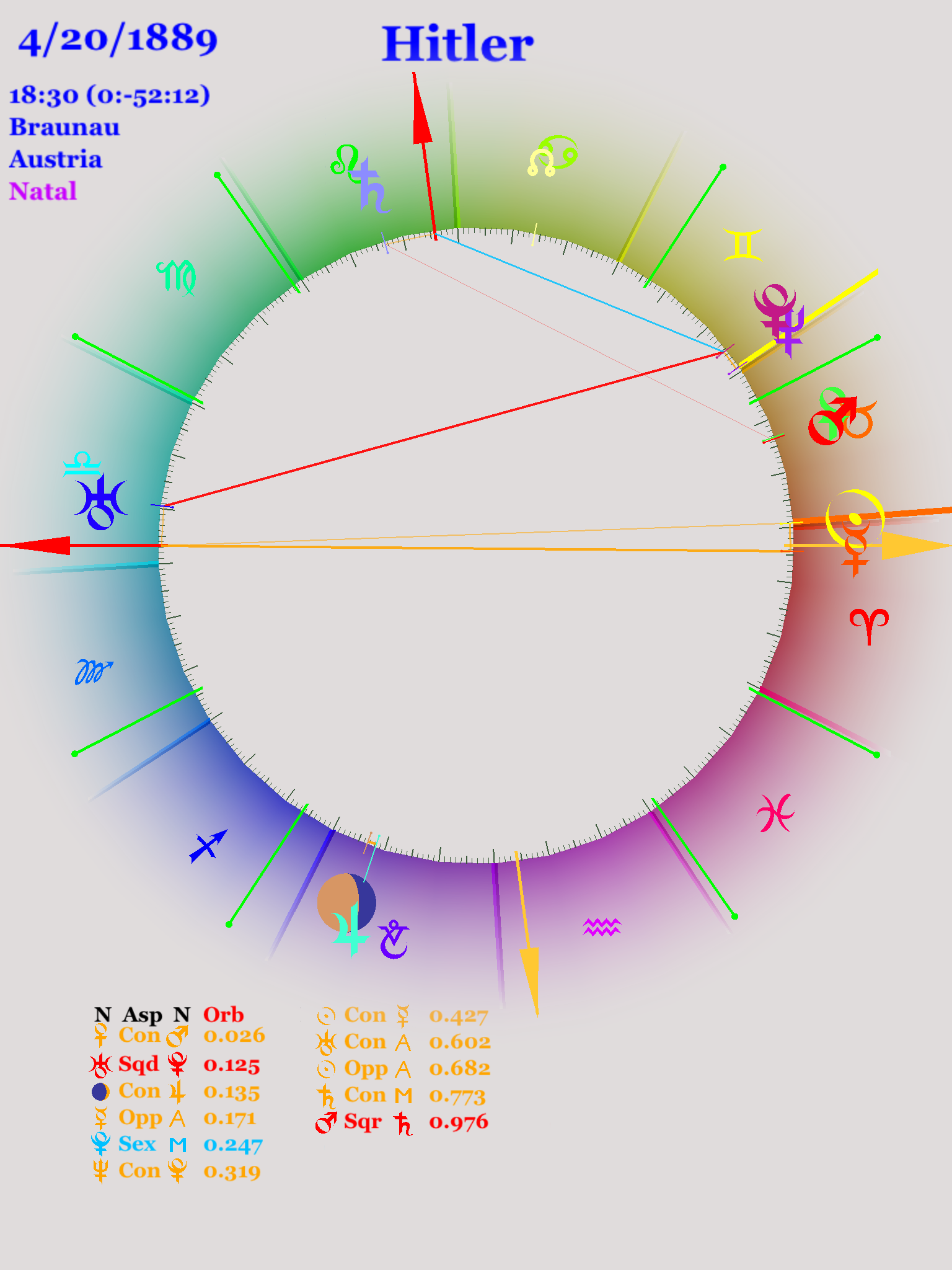
Below is Hitler’s birth chart.  For such a monster as Hitler, one would think that he would have an extraordinary chart.  There should be something that indicates  that he is evil.  Certainly his chart should have something outstanding.  For someone as major and evil as Hitler I would expect at least a prominent Pluto, and it should aspect at least one of the personnel points Sun, Moon, Ascendant or Midheaven.

Hitler

Hitler

When we look at the chart we see a Taurus Sun and Capricorn Moon.  Grounded, down to earth, practical. He has Pluto sesquiquadrate Uranus, which all born at about that time have, and Pluto conjunct Neptune.  We’ve recently talked about that conjunction in the Birth of the Twentieth Century, and thus Hitler can be seen as a Twentieth-Century Man.     Perhaps the Uranus-Pluto aspect indicates that  Hitler is some type of retrograde hippie, and it is known that he tried peyote and was interested in esoteric studies.  He has a Moon-Jupiter conjunction sextile the Ascendant. Of Moon and Jupiter Ebertin says happiness, kindness, a good heart.   I hear he was good with children.  Then there’s Saturn conjunct Midheaven; perhaps he was overly serious, a hard worker, and had trouble advancing it his career.  I understand he wasn’t that successful as a painter.
The most interesting aspect is a  tight conjunction of Venus and Mars, and both are retrograde.  These  are the  two planets least often retrograde.  I’ve read that a young Hitler once stumbled upon his parents (the father was much older than the mother) making love, and that Hitler and Eva had some non-conventional sex habits, but still unless you are a full-blown Freudian, it is hard to make the case that this conjunction results in the Hitler we know.

Another book, (Geoffrey Dean, et al Recent Advances in Natal Astrology)  claims that Hitler’s character is shown by the large number of unaspected planets, though what these  planets are is  unclear unless extremely tight orbs are used.

Some might attribute Hitler’s evil ways to PLuto on the cusp of Hitler’s Eight House, probably the most notorious house that rules death and other people’s money.  But of course that depends on the house system (Koch in this case) and is a pretty thin  reed to base his personality on.

Or maybe there are some unknown planets or asteroids that account for  his notorious ways.  I looked at the eight Uranian planets, originated in a German astrology  group called the Hamburg School,  but Saturn-Appollon and Zeus opposite Moon describe Hitler but only show him to be a cheerful and creative  teacher.

Repeating, none of these standard astrological techniques  suggest that Hitler was Hitler.  Perhaps astrology does not work, perhaps  Hitler  was so beyond our Universe that astrology did not apply to him.  I’m sure there are plenty of excuses, or esoteric interpretations.    But looking at this chart does not indicate anything special, and if you have to depend on some esoteric technique to prove that Hitler was Hitler,   you’ve already lost the argument.

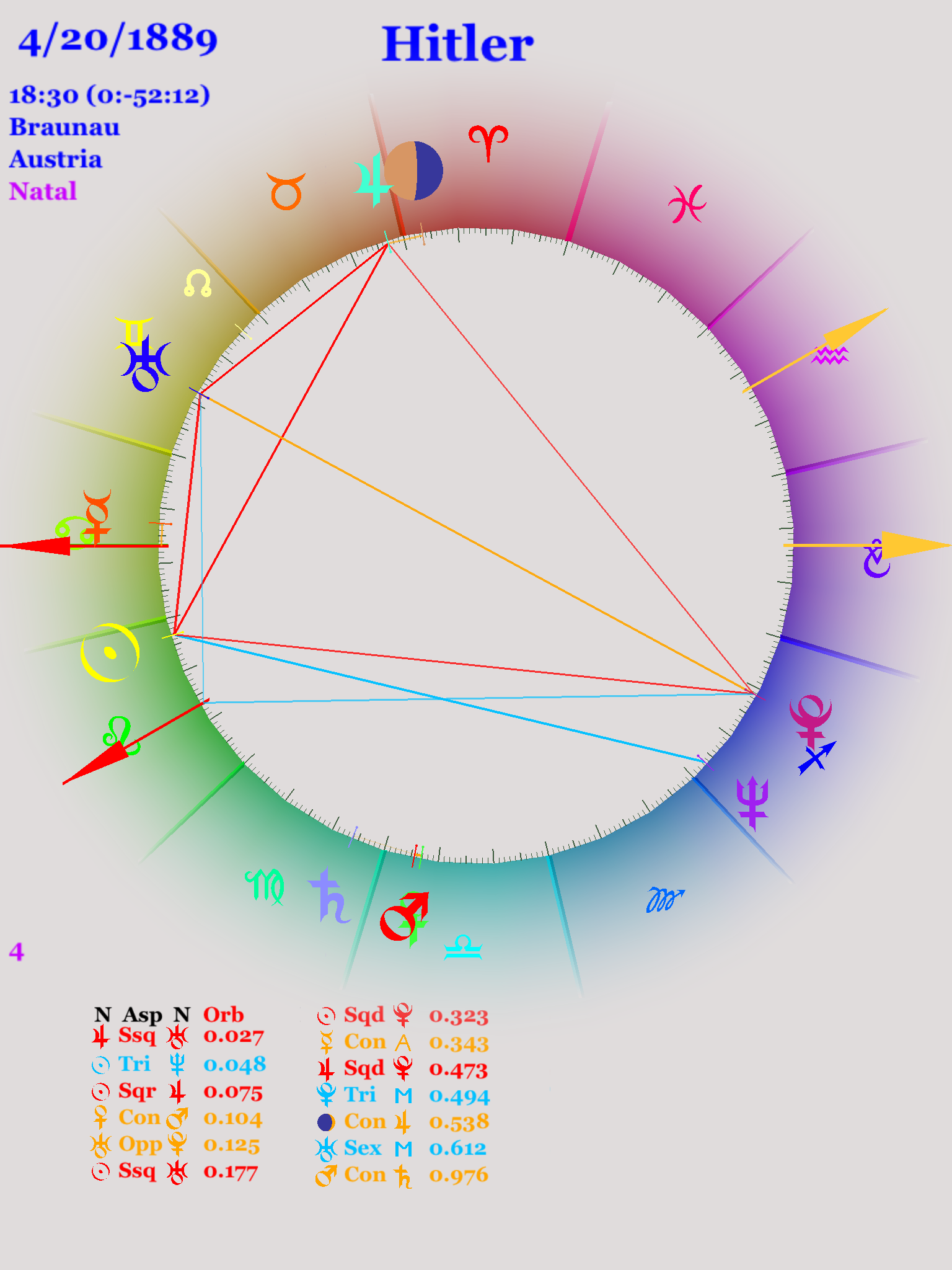
Then lets look at the fourth harmonic chart. A pattern of hard aspects (red lines) jumps out at us immediately.  There is a kite formation with the axis of the kite defined by the Uranus-Pluto opposition (which is a  sesquiquadrate in th first harmonic chart).  It appears that the arrow of this formation points to Pluto, obviously as the important planet.  And the Sun is part of the formation.  Also notice that all the lines are darker red, indicating close aspects.  In fact, looking at the list of sorted relative orbs at the bottom of the chart indicates that all the aspects in the formation are of orb under 50% of maximum.  And we know that all these aspects have a tight orb even in the first harmonic.  See the discussion of Harmonics under the Definitions section for more explanation.  It’s a complex formation, hard to interpret, but the chart is dominated by Pluto.

Hitler4

Hitler — Fourth Harmonic

There are also trines between Pluto and Midheaven and Neptune and Sun.  The Pluto-Midheaven trine is the sextile between those two points in the first harmonic, and the Neptune trine aspects is a quinqunx in the first harmonic.  A quinqunx suggests an incompatibility between the two principles involved; in this case Hitler had trouble between his will (the Leni Reifenstahl movie about Hitler is called Triumph of the Will) and reality.  And the Pluto-Midheaven sextile shows that Pluto not only is involved with the Sun, but also with the Midheaven, two personal points.  This is indeed a Pluto dominated chart.

The lesson I gained  from  this is  that even though it may not be obvious, a chart can contain important aspects that are hidden.  The fourth harmonic is the most useful for seeing these “hidden” aspects.  I want to stress that these hard aspects shown in the fourth harmonic chart are all valid, with very small   orbs, and would appear in the regular first harmonic chart if   we bothered   to show  them.  For example, the    hard  aspect between Hitler’s Sun and Pluto is actually an angle of 33 degrees 45 minutes (which  could be called a demi-semi-octile) with an orb just under 5 minutes, which is the equivalent of a   square with orb of 40 minutes.

Modernism and the Birth of the Twentieth Century

I define Modernism as more than an art form, which was merely the outward manifestation of the changes that were taking place in civilization.  A number of events, both physical and astrological, defined the birth of the XXth Century, and the changes start before the official date.

In this entry I will start the beginning of the “Twentieth Century” at 1886.  This was before the first major aspect, the twice a millennium conjunction of Neptune and Pluto.

The memorable event of 1886, which is stills as relevant  today, if not more so,  was the Supreme Court ruling know as Santa Clara County v. Southern Pacific Railroad.  The upshot of this decision, even though it wasn’t in the actual decision, is that corporations are people as far as the Fourteenth Amendment goes.  In fact, the Fourteenth Amendment was applied more often to corporation than to the freed blacks that it was intended for.
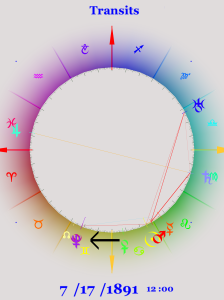
nepl

Neptune-Pluto Conjunction

The 1890s saw the rise of Corporate Capitalism, the third period of that financial system.  (I am indebted to the historian William Appleman Williams and his book Contours of American History for the  terms for the first three stages of capitalism.  Since the book was published in 1968 he missed  the next two stages which will be described at a later time.)  This  was an entirely different beast from laissez  nous faire  (William’s term) capitalism – leave us alone.  Laissez faire is the mythic system of capitalism that grew up in the 1820s  (we’ll look at the astrological signifiers at a later date) after Adam Smith published The Wealth of Nations in 1776. Often when  people refer to the glories  of capitalism they are thinking of this type of capitalism that has long since gone.

Corporations became increasingly powerful in the 1890s, for example (in the United States)  U. S. Steel (Andrew Carnegie) and Standard Oil (John D. Rockefeller).  The “Trusts” that Progressive politician like Theodore Roosevelt wanted to bust grew up on this period.  The Uranus-Neptune conjunction took place near the Descendant of the United States, which is why the United States was so strongly affected by this Corporate Capitalism.

Another important event of this period was that the United States got an  empire, not just in the Caribbean (Cuba, Puerto Rico) but in Asia (Philippines, Guam).  This started with the Spanish-American War of 1898, America’s first major venture into the outside world, after the North American continent had been conquered and the native population successfully  put down.  The Open Door Policy (Secretary of State John Hay)  gave notice to the rest of the world  that America was a world power, and it would soon surpass Great Britain as the dominant power in the world.

In this period the world  was changing rapidly through electric lighting  (Thomas Edison 1879), the telephone (Alexander  Graham Bell 1876), and the box camera (George Eastman 1900).

In this period there were not only crossings of the cardinal axis by all three outer planets, but there were two important oppositions that describe so much of what was going on in the world at the dawn of the Twentieth Century.  The Uranus opposite Pluto was strongest in the first half of the first decade of the new century, and the Neptune opposite Pluto was strongest during the second half of the decade, extending through a few years of the second decade.   This period was filled with all kinds of  changes, which I will briefly outline below.  A good description of this period is found in many books, such as The Vertigo Years by Philip Blom.

A brief list of the important event in this period:

The first Russian Revolution took place in 1905;  it wasn’t successful and made the Russians even angrier.  Then,  after the disastrous World War I, they fought the second  Russian Revolution of 1917, which  was successful.

The  Emperor of China, Puyi, who was the twelfth ruler of the Qing Dynasty, served as a child for a few years.   A film was made about his life in 1987.  Born in 1906, he ruled from 1908 to 1912.  He was not only the last emperor of his dynasty, but in fact the last emperor of China.  The Twentieth Century was encroaching on China.

The NAACP – then called the Niagara Movement, so called because they were not allowed  to eat in a hotel in the United States so they had  to meet on the Canadian side of Niagara Falls  –   was formed in the United States in 1905.

The International Workers of the World, commonly known as the Wobblies, were formed in 1905 with the intent to be One Big Union.  They wanted all workers to join together to  form a union, and were and the forefront of radical labor action, for which they paid a   high price.

An Indian lawyer in South Africa   by the name of Mohandas Gandhi, promulgated his doctrine of non-violent protest, called Satyagraha,  on September 11, 1906.   This is often referred  to as “the first 9/11”  but has a much different meaning in history that what the phrase “9/11” usually refers   to.  He later moved back to India where that doctrine changed the government.   His doctrine was also  adopted by Dr. Martin Luther King in the United States, with far-reaching repercussions.

There were anarchist and syndicalist movements forming all around the world, such as in Korea, China, Japan, Mexico, Puerto Rico, Cuba, Peru, Brazil, Argentina, Egypt, and South Africa.  Details of this international anarchism are found in the book Anarchism and Syndicalism in the Colonial and Postcolonial World 1870-1940 edited by Steven Hirsch and Lucien van der Walt.

In America in 1904 there was one of the biggest ecological disaster that had ever happened  in that country.  In that year started a chestnut bight that destroyed an estimated     3.5 billion chestnut trees  in  the country.  The cause was   a fungus imported from Asia.  By the time the Great Depression hit America in less than 30 years   the people of  especially Appalachia   were hit by this lack of food and lumber.

In the realm of science, two major theories were developed in  this period which revolutionize science and our concept of the Universe, which up until that time had been based on theories of Issac Newton in the Eighteenth Century.  In  the very small quantum mechanics was developed by Max Planck, Niels Bohr, Werner Heisenberg, Albert Einstein, and others.  In the very large  the Special and General Theories of Relativity were developed by Albert Einstein with help by Max Planck and others.  Both these theories  had profound implications and brought science beyond Newtonian physics.  And in 1912  the meteorologist Alfred Wegener developed  theory of continental drift, which was  immediately rejected only to be accepted a quarter of a century later.  The theory was first suggested in the late 16th Century under a Uranus-Pluto conjunction.  Also in the first decade of the Twentieth century scientists like Henri Becquerel, Ernest Rutherford, and Marie Curie made discoveries that laid the foundation for the atomic bomb.

But there were also big changes in our concept of the interior world, lead by  Sigmund Freud and Carl Jung, who first communicated in 1906.  There were many others developing the new fields to explore the mind, such as psychoanalysis and psychotherapy.  The concept of the subconscious  and the interest in analyzing dreams were just two of the ways their ideas changed the world.
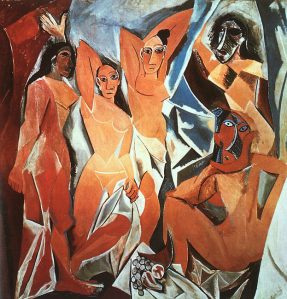
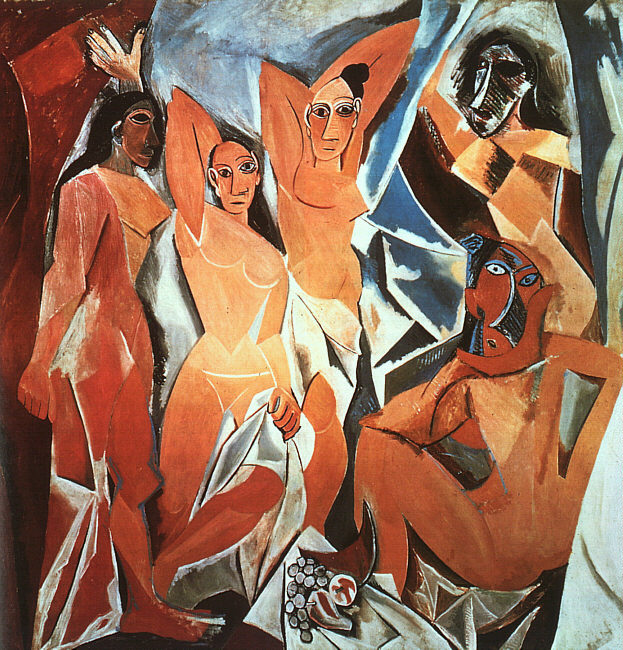
Les Demoiselles d'Avignon

Les Demoiselles d’Avignon

The art world also saw a big burst of change.  The Spanish artist  Pablo Picasso and the   French artist Georges Braque were starting their careers which would lead   to the school of Cubism.  Picasso’s painting  Les Demoiselles d’Avignon from 1907 shocked and scandalized the art world.   Also at this time an artist who is considered one of the best of the Twentieth Century, along with Picasso, was  at  work.  This was Henri Matisse. Marcel Duchamp, who later would be famous in the world of Dada, created the  painting was Nude Descending a Staircase, No. 2, which was shown in 1912.  I  did not see this  clearly until I saw a stroboscopic picture by Gjon Mill of a figure descending.   Duchamp had captured  the idea of strobelights long before they were actually used.
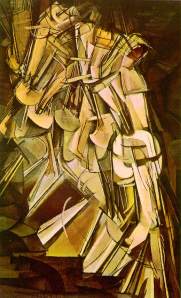
Nude Desdendnig a Staircase No.2

Nude Desdendnig a Staircase No.2

In Italy the movement know as Futurism was developed.  There was recently a show of art from this school at the Guggenheim in New York.  The artists of this school were enchanted by the speed of cars and planes, of the new world forming at the beginning of the century.

Improvisation-x Kandinsky
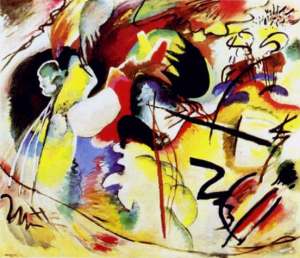
Improvisation-x Kandinsky

Picture With White Form - Kandinsky

Picture With White Form – Kandinsky

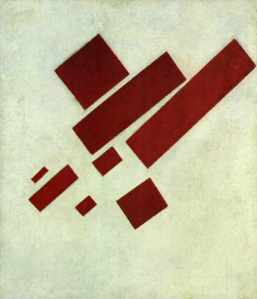
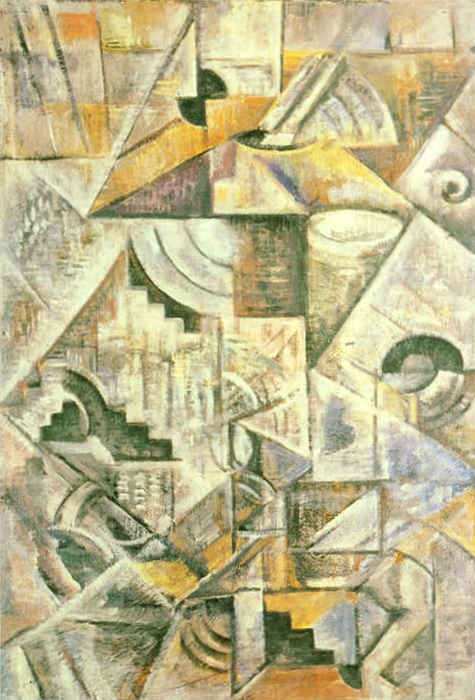
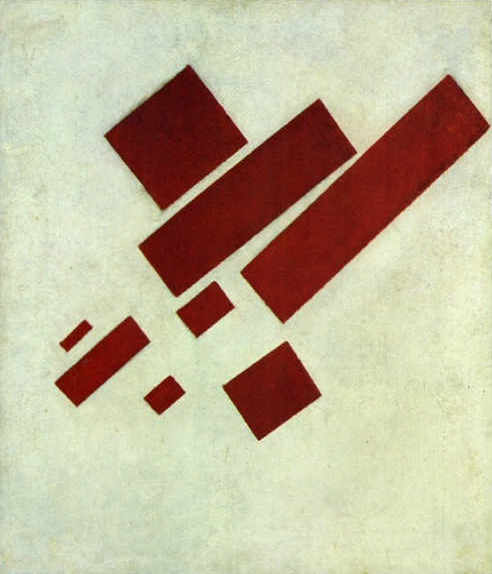
In Russia  what has been called the Russian avant-garde was developing.  The best known  artists of this school  were Wassily Kandinsky and Kazimir Malevich  but there were many others.  They took abstraction far beyond the ideas of Picasso and Duchamp.
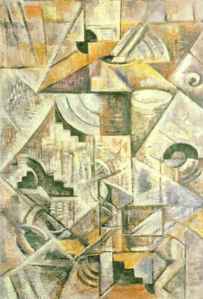
Samovar - Malevich

Samovar – Malevich

Suprematism Eight Rectangles - Malevich

Suprematism Eight Rectangles – Malevich

Among writers there was James Joyce,   who often considered the outstanding author of the Twentieth Century, and Virgina Woolf and the Bloomsbury Group.  Upton Sinclair and Jack London were publishing novels   that shook up the view of the world.  And don’t forget L. Frank Baum and his Wonder Wizard of Oz, rumored  to be a political parody, which is still influential. Theodor Herzl published his idea of Zionism, whose influence is felt strongly 100 years later.

The development of computers took a step forward with the work of Herman Hollerith.   He developed the 80-column punch card that could be used  to tabulate data automatically.  This device was used to automate the 1890 census, speeding up the time it took to finish the count by a factor of eight.  He founded a company which was later merged  to form IBM. The use of 80 columns was popular in the computer field through the Eighties.

Cars were becoming increasingly popular in the first decade of the Twentieth Century.      This popularity was greatly helped by the  introduction of the first affordable automobile,  the Model T Ford in 1908.  This automobile was released by the Ford Motor Company of Detroit Michigan and not only allowed the middle class to afford an automobile, but provided employment to many,  including recent immigrants to the United States    and Blacks fleeing the Jim Crow South.    The implication of the automobile were profound but they weren’t realized  for many years.  All of the gas burned  polluted the atmosphere causing the greenhouse effect, and people stopped moving, leading to many   diseases of inactivity. As a result of the widespread use of the automobile   large stretches of open land has been paved over, for highways, parking lots, and driveways—personal parking lots for each home.  In fact , some homeowners associations require all houses to have driveways, whether of not they are used.  If an alien viewed Earth, the alien might believe that automobiles are  the dominant life-form on the planet.  These automobiles are attended by small symbiotes who feed them and  keep their outsides clean, and buy them fuzzy dice   and dashboard mascots, in exchange for which the small symbiotes  are taken places by the automobiles.

Motion pictures    were developed during this period.  Names like Edison in 1891   and Lumiere in 1895 developed a  way of projecting a picture onto a screen – if this was done often enough the human brain would not see individual frames but rather continuous  motion.  But  by  the early years of the Twentieth Century motion pictures  became wildly popular  as the art of cinema developed and people no longer had to be content with images of simple motion.  By the middle of the first decade of the XXth Century feature films – films longer than one reel –  were being produced.  At the same time actors began to get credit and production companies were organized.

But it was not only motion pictures that became increasingly popular, but still pictures that could be taken by an individual.  Today when many people carry  camera with them on their cell-phones, we forget what a breakthrough this was since before this time photography was a difficult process not suitable for someone not  truly interest in the act.  This change was due to George Eastman and his introduction of the Brownie camera in 1900 with the motto “You push the button, we do the rest”.

The development of the airplane, most famously by the Wright Brothers, in the first decade of the new century,  revolutionize life.  Another person famous in  the history of powered flight, who may also have a claim to the first flight, is Glenn Hammond Curtiss, who made the first officially witnessed powered flight and founded the aircraft industry.  The names of both these pioneers lives in  the name of the current aerospace company Curtiss-Wright Corporation.   The dream of flying like a bird had been a long one for mankind, as the myth of Icarus  suggests.   It was given a boost with the development of hot-air balloons by the Montgolfier brothers in  1783, allowing humans to float over Paris.  But by the Twentieth Century powered  flight came into being, and there were many developments after that in the field.  This allowed humans to move easily from place to place in the world, and also, as an unforeseen consequence, to transfer all types of animals and microbes  from one part of the world, where immunity existed, to other parts of the world were that particular disease had never been seen.  We are living with the consequences.

Music also changed in this period. Igor Stravinsky changed music with his Rite of Spring, first performed in 1913.  The production was shocking, and the use of chords changed the way future composers looked at music. There was also a Futurist movement in music with many of the same origins as in painting.  Charles Ives was one of the first American composers to be known throughout the world.  The French composer Edgard Varese was relatively unknown at the time, but he has influenced many such as the rock artist Frank Zappa. Sergei Prokofiev was another composer who broke away from the Nineteenth Century

Much was happening astrologically at this time – it was very crowded.  The first significant aspect was the once every 492 year conjunction of the two most outer planets Neptune and Pluto in the 1890s.   This conjunction took place close to the Descendant of the United States which is why the United States was so strongly influenced by the changes that took place around the world.

During the first 15 years of the Twentieth Century all three outer planets crossed the Cardinal Axis.  In  1901 and 1902 Neptune crossed the Cardinal Axis  at 0 Cancer, then in  1904 and 1905 Uranus crossed the Cardinal Axis at 0 Capricorn.  The whole thing, the changes of the first decade, were brought to an abrupt close when Pluto crossed the cardinal axis in 1913 and 1914.  It was to be a far different world by  1920 that it had been at the end of the Nineteenth Century.

Uranus Opposite Pluto

Uranus Opposite Pluto

There were two important oppositions of the other planets in this period, in addition to the twice a millennium conjunction of Neptune and Pluto.  The  opposition of Uranus and Pluto   was most intense from 1900 to 1903;  this was the opposition preceding the conjunction of those two planets in the 1960s.
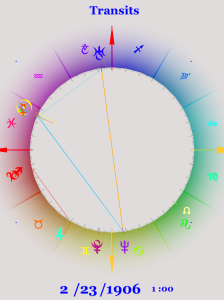
urOppne

Uranus Opposite Pluto

But the most important configuration of this period  was Uranus at the Neptune/Pluto midpoint.  Midpoints involving the three outer planets are quite rare, happening about three times a century, and they represent a zeitgeist change so that people living after the midpoint have trouble remembering what life was  like before the midpoint, the changes they have gone through are so profound.  In this case of the first midpoint we see that Modernism grew up, and people soon forgot what the slower world of the Nineteenth Century was like.  The strongest part of the midpoint was 1903  through 1905, and at one point Uranus  was also crossing the cardinal axis, adding more power to the midpoint.  We can see from the graph that this midpoint was close from early 1902 to late 1906  and both were crossing the cardinal axis  together in late 1904.  The most common type of midpoint involving the three outer planets has Uranus as the apex planet, because Uranus is the fastest moving of the three.   That was the case in    this early Twentieth Century midpoint.  The least common is with Neptune at the apex.  There were two other outer planets midpoints in the Twentieth Century, which we will look at later.    One may want to guess as to which turning points in the last Century corresponded to midpoint configurations.
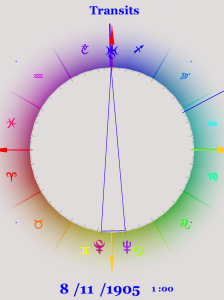
urmpnepl

Uranus = Neptune/Pluto

In this final chart there is a grand overview of all the important configurations taking place in the period we are talking about.  It is a graphical ephemeris for a twenty-year period starting in 1896 on the left. We can see that the Neptune-Pluto conjunction is separating from exact (black arrow).  Then  the Uranus-Pluto opposition takes place (red arrow)  while at the same time Neptune crosses the Aries axis, shown by the horizontal black line.  Next Uranus comes to the Neptune-Pluto midpoint (green arrow) and shortly thereafter both Uranus and the Neptune-Pluto midpoint cross the Aries axis, just before the center of the graph.  Next there is the Uranus opposite Neptune (blue arrow) which lasts longer, five years  exact, than the Uranus-Pluto opposition at two years.      Finally, at the right, we see Pluto cross the Aries axis (yellow arrow) ending the period.  World War I, the War to End All Wars, starts and the world of the Nineteenth Century is totally gone.
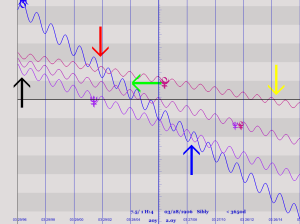
twentieth_century_tg

Graphical Ephemeris – 1896-1916 – The Birth of the Twentieth Century
The Summit Crisis of 1960

The summit crisis of 1960, caused by the Soviet shoot-down of a U-2 plane carrying Gary Powers on May 1, 1960 had important ramifications for the progression of the Cold War, but is little know these days. Recent events in the Ukraine possibly leading to a new Cold War give us more perspective on how governments and media operate in times where the Official Enemy can be blamed.

In the last quarter of 1957 the Soviets launched two satellites into space, the first time in history that this had happened, and that act caused much fear and changes in the United States. Shortly thereafter NATO met and decided to put offensive missiles into Europe, after which the Soviets called for a summit meeting between the Soviets and the NATO countries. They followed this up with visits to the United States by two high-ranking Soviet officials. At this time President Eisenhower visited India where he was hailed as the “Prince of Peace” and there made a conciliatory speech laying out the problems in the Cold War. The Soviets announced they were reducing their armed forces by one-third. Things in the world were looking positive for peace, after 15 years of the Cold War.

The summit was scheduled for early 1960. Though well-meaning, Eisenhower (a Libra whose mother was a member of a pacifist church) seemed to have little control over his subordinates, especially the new Secretary of State. His administration seemed to be sending mixed signals about the desirability of the upcoming summit, though the people of the United States were in favor of it. This had been pointed out by no less than Adlai Stevenson, who Eisenhower had defeated in the last two elections. He pointed out that the United States always insists on unconditional surrender from the Soviet Union, which is not very popular with that country.

A high-altitude U-2 spy plane took off on May 1 to surveil the Soviet Union, flown by Francis Gary Powers. It was shot down. Some at the time thought that the overflight so close to the summit was an attempt to sabotage of the summit by the CIA, and considering what we have learned about the CIA in the half-century since this would not surprise me in the least.  In any case it was extremely bad timing.  Before the United States knew that Powers was captured (he had a suicide pill), several government officials, including the President, lied and said it was a NASA experimental plane. When it was revealed that Powers was alive, America had egg on its face. The Soviets then gave Eisenhower a chance to back down gracefully and say it was a mistake by his subordinates. But Eisenhower, instead of admitting that it was a mistake, doubled down and claimed that America had a right to fly planes over the Soviet Union, something in violation of international law, and if it happened to America one can imagine that we would seek revenge. At this point, since it was rubbed in their face, the Soviets had no choice but to make a big deal of this incident.
As a result, the summit did not happen, and both sides grew more hostile in the coming years. This was right before John F. Kennedy was elected President on the basis of a fictitious “missile gap” . The Bay of Pigs and the Cuban missile crisis both happened in the next two years, and Vietnam escalation was a short way off. The hopes of the people of the world, who had been subject to the Cold War and threat of nuclear Armageddon for over a decade, were crushed.

So this event was quite important to the formation of the Sixties. For a bit there it seemed that the Cold War could be modified or perhaps even eliminated, but after a shoot down of the U-2 the Cold War only increased in intensity, with the problems in Cuba, Berlin, and Vietnam a result.


U-2 Shoot Down

U-2 Shoot Down


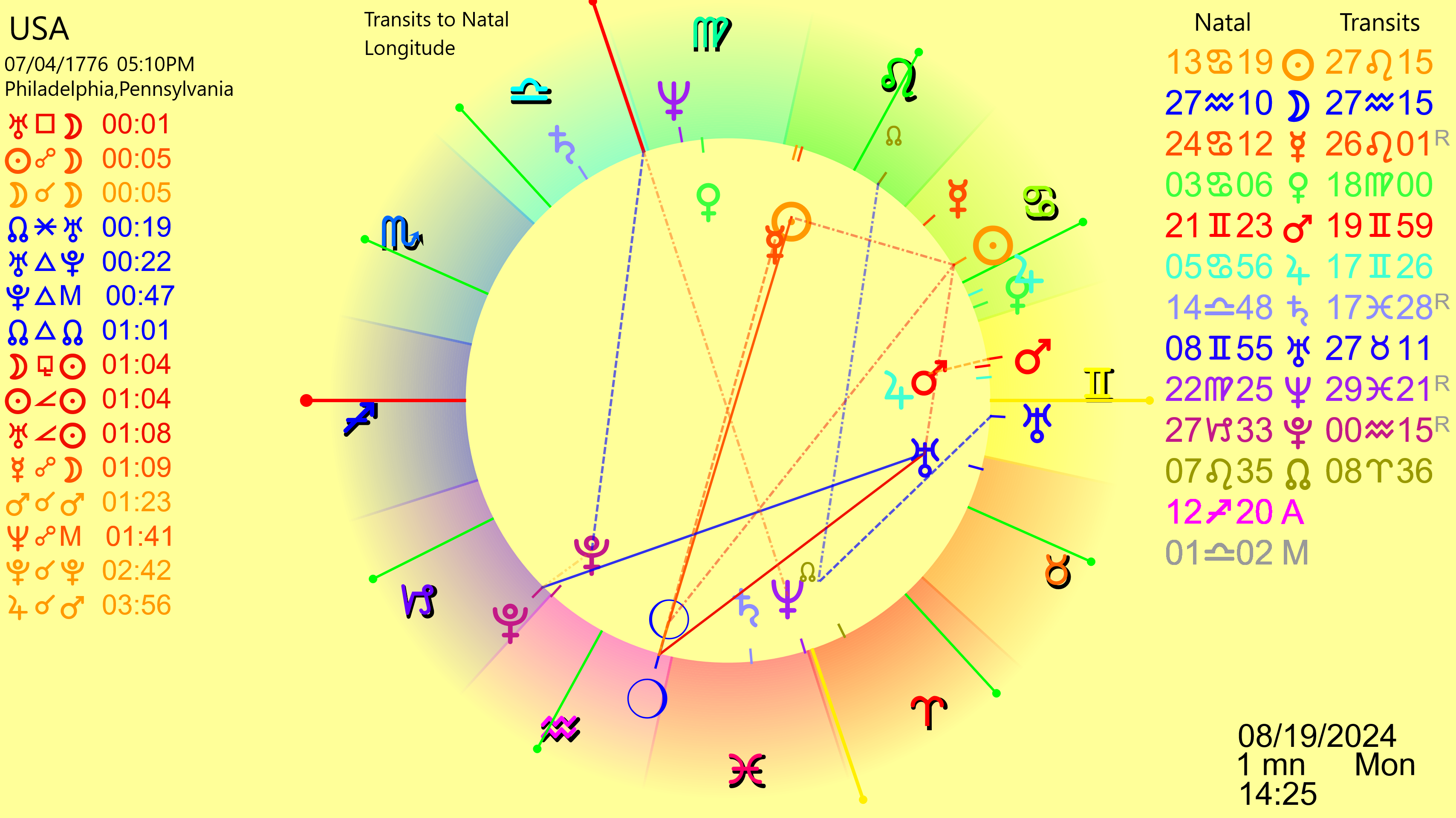
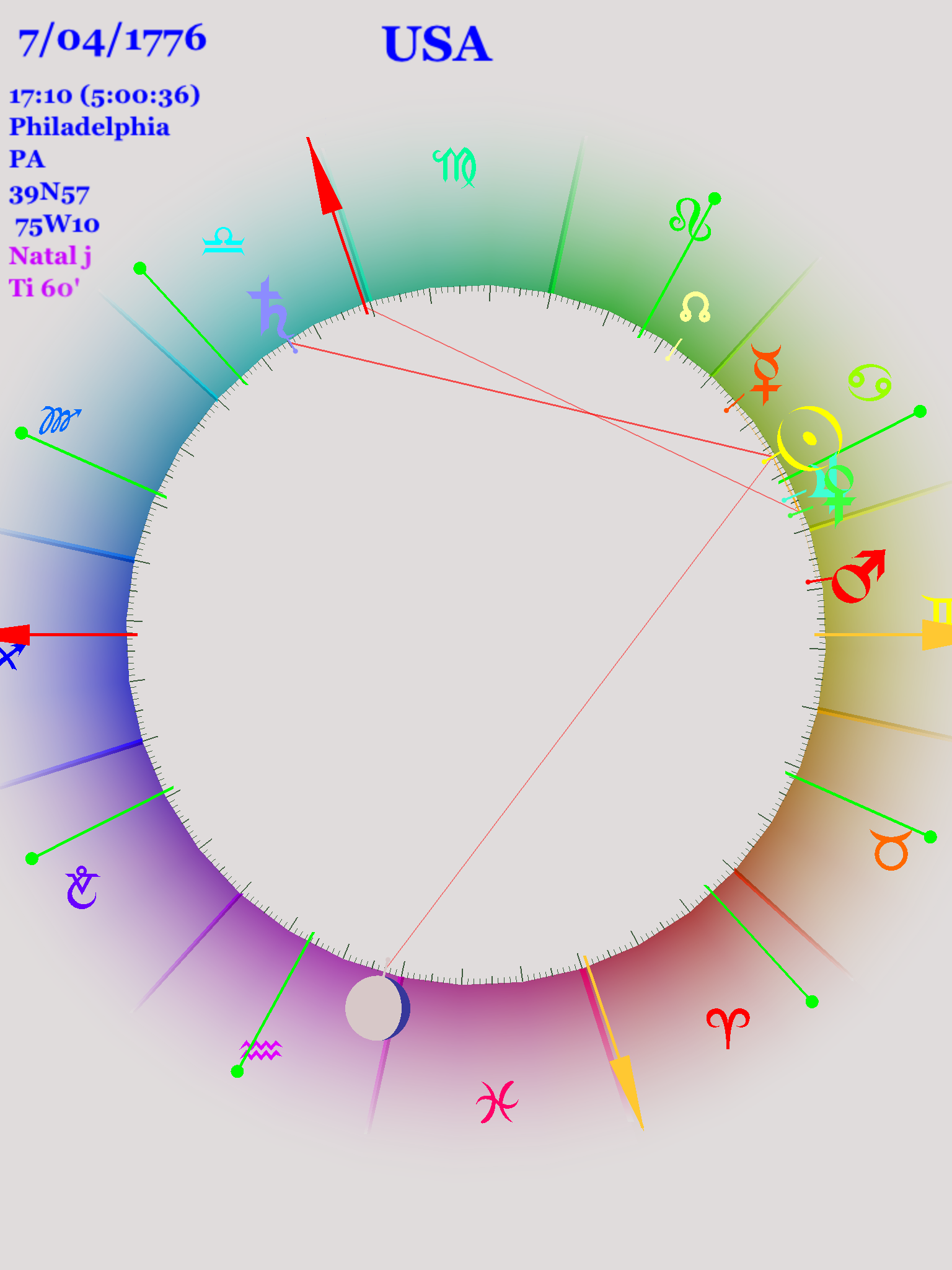
The first chart is for that day as transits to the US chart. Notice that Mars is opposite the Natal Neptune and square natal Mars, and transiting Neptune is semisquare natal Neptune and sesquiquadrate natal Mars, and, as we will see later, transiting Neptune is sesquiquadrate transiting Mars. So what we have is a lot of Mars/Neptune, which emphasizes the Mars square Neptune in the United States. Mars-Neptune hard aspects indicate that it is difficult to handle ones energies cleanly. Perhaps one may want to do good, but it is easy to delude oneself about ones actions. There is something hinky about the use of energy. This message comes across clearly in this situation.

Then there is the tight conjunction between the transiting Node and the Neptune of the United States. This further emphasizes the Neptunian side of this event. Ebertin talks about a lack of community-sense. Next notice Venus, the planet of diplomacy – this was a summit meeting – is sesquiquadrate, exact at noon, to the Ascendant and square to Pluto. This emphasizes the Pluto-Ascendant semisquare in the US natal chart that we’ve talked about before. This aspect represents the shadow side of America, the US tendency to demand unconditional surrender from our enemies. Then there is Uranus semisaquarte both the Midheaven and Venus, and thus at the midpoint of the two natal planets – there will be upset in our international diplomacy. Finally transiting Jupiter is opposite natal Jupiter: the United States may be over-confident, will push things too far without considering the consequences. All these transits work together to reinforce a picture of what happened that day.


Summit — World Transits


Summit Harmonic 8


If we look at the transits for the day we see two hard aspect, Mars sesquiquadrate Neptune and Saturn sesquiquadrate Pluto. To see how tight these two aspects are, look at the eighth-harmonic of the same chart, in which sesquiquadrates are reduced to conjunctions. Both of these conjunctions are very close, showing they are very powerful at this time. We’ve shown several examples of the bad consequences that happen when there is a hard aspect between Saturn and Pluto; this is also a hard aspect, only not a square, opposition, or conjunction. But it is so tight, almost exact, that the harmful effects are shown as in the start of various wars.

Here was an occasion where the Cold War, that had gone on for 15 years, could have been modified or even ended, to the great support of many people in the world. This, however, would not have been good for the defense industries or the politicians who wanted the Cold War to continue, as Eisenhower warned about in his Farewell Address as the Military-Industrial Complex. But because an illegal flight was discovered in a most embarrassing way, this attempt was thwarted and the Cold War continued for another decade before a successful attempt to modify it actually happened. Then, a decade after that, the Cold War was given renewed energy, which was called at the time the New Cold War, not to be confused with the Cold War II which is happening now, at the same time as we have another Mars sesquiquadrate Neptune for the first half of this year.

Mush of this information is from chapter 20 of The Free World Colossus, David Horowitz (yes, that David Horowitz! He use to be a good historian.) 1965.

The Virtuous Nation — Part I

Since we are almost at the birthday of the United States, I thought it appropriate to write about one of the most important configurations in the chart of the United States, the triple conjunction of the Sun, Jupiter, and Venus. This triple conjunction influences the behaviour and beliefs of the United States, including the ever-important American Exceptionalism, which every politician must swear allegiance to. This article was originally written for the magazine The Mountain Astrologer before the Great Recession of 2008, so some of the figures may be slightly out of date, for example China is now clearly the number one emitter of carbon dioxide, but the figures stand  quite well.  Endnotes in the original are now put in brackets.

National character is an idea often used by writers, but never given any definition. Various concepts are suggested as to what the national character of the United States is, but with the tool of astrology one can clearly see the national character of the country through exploring its natal chart.

Venus is conjunct Jupiter, and both are conjunct the Sun of the United States on July 4, 1776. I am looking at the Sibly chart, but obviously that configuration occurs for any time on July 4, which is traditionally celebrated as the birthday of the United States, and has been since 1777. This triple conjunction can be seen as Venus conjunct Jupiter (the closest conjunction), Sun conjunct Jupiter, Sun conjunct Venus, and finally Sun conjunct Jupiter conjunct Venus. These four aspects will be discussed in turn. The nature of a conjunction is such that the separate traits of each planet are so entwined that they cease of have distinct meanings. Since both Venus and Jupiter are somewhat similar, drawing distinctions between the conjunctions is problematic, so while one could argue that a characteristic should occur under that aspect rather than this aspect, nevertheless the distinctions can be made. This triple conjunction, especially considering that the Sun is one of the planets involved, strongly affects how the United States is seen by others, how it sees itself, and how it behaves.

Once you understand the chart of the United States, you will begin to see how the meanings of the planets play out in history and in everyday life. The symbols of the planets cease to be abstractions but rather can be seen all around you. The daily headlines reflect the astrology of the United States: you only need to open your eyes to see astrology at play all the time. We are fortunate that the birth date of the United States is recent, and well established. Everyone who has participated in that summer birthday celebration knows when the country was born.


USnour

The United States in 1776


Venus conjunct Jupiter

Blessed

In astrology, Jupiter is called the “Greater Benefic”, and Venus is called the “Lesser Benefic”. Here we have both of them together, which connotes fortune. America is the Blessed Nation, as Woodrow Wilson, the President of the United States during World War I, called it in a speech in 1915[Eric Rauchway, Blessed Among Nations, Hill and Wang 2006 p. 147]. Blessed seems an apt description for this conjunction, and I think it is safe to state that Wilson was at least fairly unfamiliar with astrology or with the chart of the United States. This conjunction could also be described, as George Orwell might have put it in NewSpeak, as double-plus good, the ne plus ultra of goodness.

America has always been a blessed, lucky, and fortunate nation, at least since its birth. Consider the luck of defeating the greatest military power in the world at that time, Great Britain. After what is called in the Colonies the French and Indian War (1756-63), a war that Winston Churchill considered the first world war, and one that gave an up-and-coming soldier by the name of George Washington his first real experience at war, an experience that was to come in handy later, England emerged as the leading military power in the world, one with large debts that required squeezing the Colonies for more money. All of the best firepower – rifles and muskets — were made in England, whereas America had little industry of this kind[Michael Bellesiles, Arming America, Alfred A. Knopf, 2000, especially chapters 5 and 6]. Nevertheless, America, with help from some European nations, was able to triumph over Great Britain.

After the defeat of Britain, and America was on its own as a new nation, another very fortunate happening occurred. The third President, Thomas Jefferson, sent two ambassador to Napoleon’s France to see if they could secure right of passage on the Mississippi River and landing rights in New Orleans for America, which were strongly needed as Americans were expanding into the Ohio Valley, and used the Mississippi River to market their goods. Instead of just offering them rights to the river, Napoleon was willing to sell America the entire territory of Louisiana, thus doubling the size of the country at one time.

America has also been blessed with a large variety and quantity of natural resources. Oil was first discovered in Pennsylvania, and the country is still the third largest producer of oil. If one drives around parts of Southern California, they can still see oil derricks. And the State of Texas is synonymous with oil; in fact, there are many Texas multimillionaires that started in the oil drilling game, including several that are in the White House.

America has always been called the “Melting Pot”, but many other countries in the New World acted as melting pots also, attracting immigrants from many other nations of the world. But for the United States, this attraction operated somewhat differently than in other New World countries. In most other countries, certain nations would predominately send their immigrants. However, the United States attracted immigrants from almost all countries of the world. America has been called “The Melting Pot of Melting Pots”[Michael Bellesiles, Arming America, Alfred A. Knopf, 2000, especially chapters 5 and 6]. To Americans, this mixture of new culture added to their vitality, and to employers the mixture of languages made unionization more difficult.

Because America has drawn immigrants from so many lands it has become the world’s first truly multicultural nation. This is a real blessing to the United States, and a source of strength that many have either not recognized or actively shunned. This experiment in multiculturalism, while not always successful, has been one of the positive facets of America, and will prove more so in years to come, as it gives America a preview of the future of the planet.

But there is one reflection of this Venus-Jupiter conjunction that has caused America to be different from other modern democracies in a less positive manner. America’s welfare program is much skimpier than in other industrial countries.[Rauchway p 68 has a graph illustrating this] Just consider that other democracies have a universal health plan, and most have had such for many years, while America has still not attempted such a thing, even though it is the richest of all those countries. This may be hard to understand until you examine the astrology of America. America is the blessed country; America is naturally lucky; America is fortunate. If the country is so lucky, people who are unlucky, who are unfortunate, are simply at fault. Since this is a naturally blessed country, if you personally have not gotten your share of blessings then it is your own fault. This seems to be the unconscious (and sometimes not so unconscious) belief in America. Since we are such a fortunate country, there is no need to give any benefits to those who are unfortunate. Good luck will eventually come their way. America is seen as the land of opportunity, and this was thought to make government intervention unnecessary, and in fact it was thought that government intervention would stifle economic freedom.

Another result of this conjunction is that Americans in general feel special, that their country is special. And as we can see in this article, this is true. This gives rise to a condition of America that has long been noted by commentators, a facet of American life called American Exceptionalism. This concept, that Americans are somehow special or exceptional, has a long history, and the meaning is somewhat fluid. The idea is that because of America’s unique geography, history, political and economic origins, this country is different than the other countries of the world. But different somehow morphs into better. It was first used by the French traveler Alexis de Tocqueville when he visited America in the 1830s, but the concept dates back even longer, to Puritan preacher John Winthrop in 1630 and his speech about America being “a city upon the hill”. Madeline Albright, the Secretary of State under Bill Clinton’s second term, called America the “indispensable nation…[W]e see further into the future.” Richard Holbrooke, a diplomat who also served under Clinton, said “the United Nations works best when the US leads.” The city on the hill idea was used in speeches by such varied men as Ronald Reagan and Bill Clinton. The concept of American Exceptionalism really got a boost by the rise of the Whig party in the 1830s[Rauchway p 66 ff], who also believed that what was bad for the wealthy was bad for those who could become wealthy.


Three With Saturn-Pluto

We’ve discussed before the malefic tendency of hard aspects between Saturn and Pluto. We saw two example of this in the 9/11 attack and the Spanish American War. Here are three more examples.


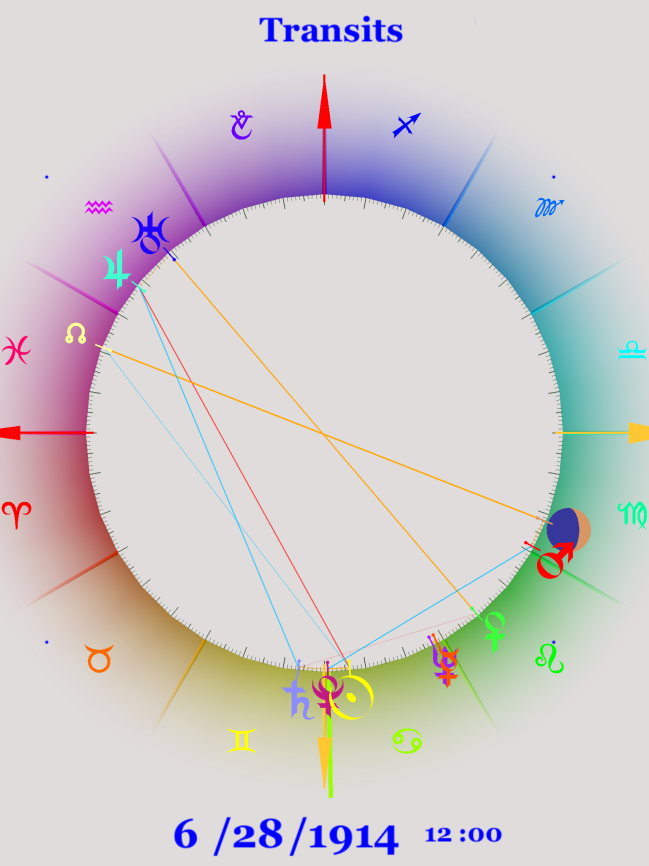
The first one is the start of World War I, exactly 100 years ago this year. Because a number of alliances had been set up in Europe, it only took a spark to set the whole edifice on fire. That spark was the assassination of the Serbian Archduke by a deranged anarchist on June 28, 1914. This assassination allowed the various alliances to take sides, and Russia came to the support of Serbia and then it was all downhill. On this centennial year there have many book s exploring this onset of war, such as The Sleepwalkers, which describes accurately what the world was at the onset of war. For most of the West, the previous 100 years had been a relatively peaceful time, the first in memory. Sure there had been some wars, such as the Civil War in the United States, and the Crimean War, and, though few Americans are aware of it, but you can be sure the Chinese remember it, the Taiping Rebellion in the middle of the Nineteenth Century, which is considered one of the deadliest military conflicts in history, with at least 20 million deaths. But for the West things had been mostly peaceful since the Napoleonic Wars were over. It was considered that peace had broken out and would last forever. Possibly because there had been so little war that many (such as Theodore Roosevelt) worried that men had lost their manliness, and large armies were build up “just in case”.

Image

World War I

In the first chart for the start of World War I, we see that Pluto has just entered the sign of Libra, a Cardinal point. This date, for the assassination, is considered the starting event for the War, but the hostilities didn’t start until at least a month later, and then the war slowly ramped up. The Americans did not enter the war until April of 1917. From the chart you can see that Saturn is conjunct Pluto and the conjunction will get tighter over the next months, as the war starts to build. World War I marked the first time that the developments of the Industrial Revolution could be really applied to warfare. Thanks, submarines, aircraft, automatic weapons, and poison gas could be used. The result was massive bloodshed.

Image

World War II

The standard beginning date for World War II is Germany’s invasion of Poland on September 1, 1939, even though there was a multi-year run-up to the “official” war, including such things as the Spanish Civil War (1936), Japan’s invasion of China (1937), and Germany’s invasion of Czechoslovakia (1938). The chart above is set for the official date. Note that there is a square between Saturn and Pluto; Saturn is retrograde and the square will get weaker before it gets tighter. Note also that Saturn is opposite the North Node of the Moon, and thus conjunct the South Node.

Some consider World War II a continuation of World War I. Certainly the harsh reparation forced on Germany after World War I had an effect. But Germany did enjoy a flowering of culture and democracy, called the Weimar Republic, after the War. This was the “Twenties” in Germany and lasted until the Great Depression started to take effect. We all know what came next.

Image

The First 9/11


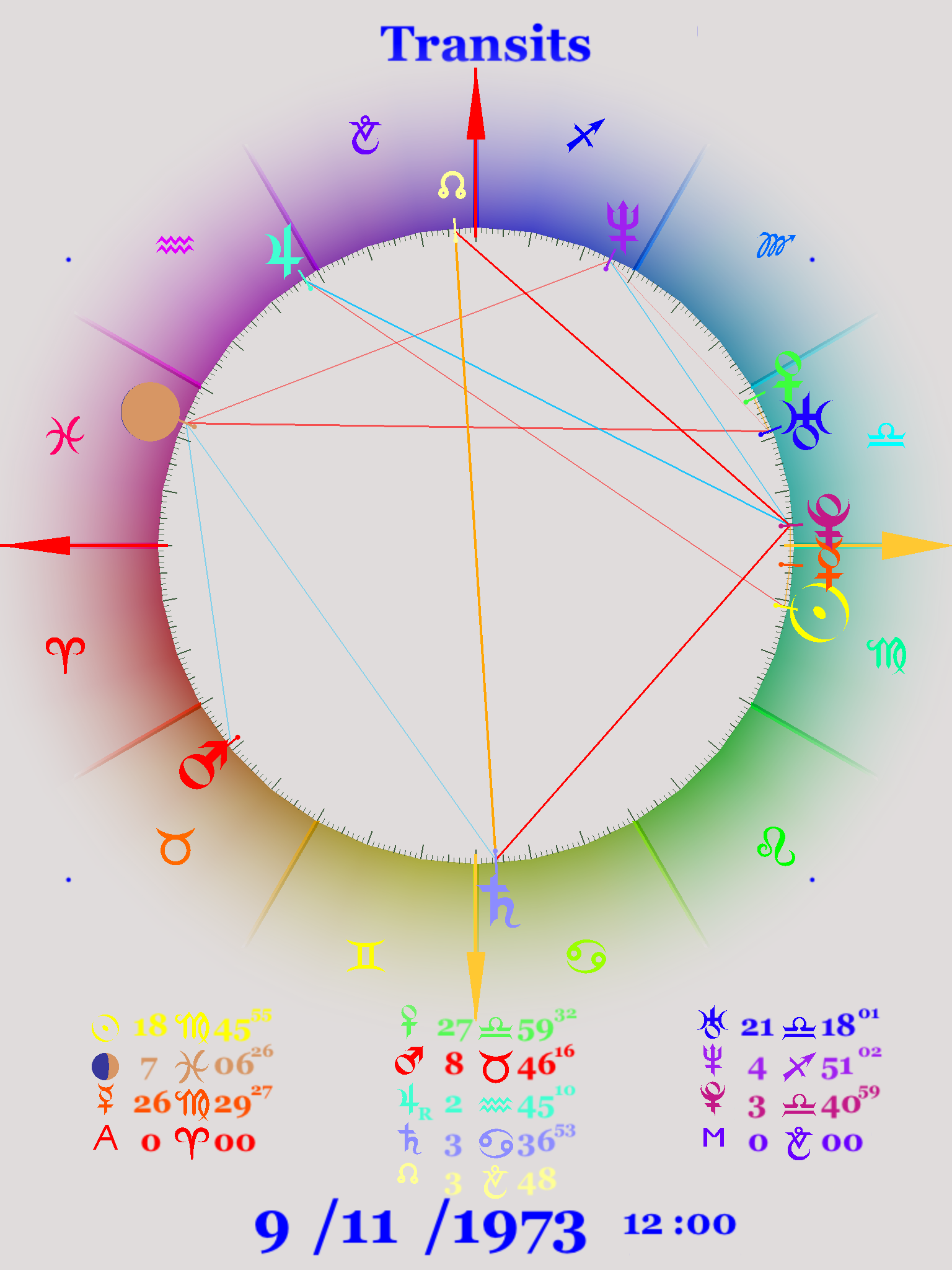
The third chart is for a event called “The first 9/11” by those in the Western hemisphere. There was also an important event in South Africa on a 9/11/1906 in the history of non-violence, but that is a discussion for elsewhere. The event of 9/11/1973 was the occasion of the death of Salvador Allende of Chile and Augusto Pinochet taking power in that country, leading to a military dictatorship that lasted until 1990. Unlike the start of a war, especially World War I, the start of the Chilean dictatorship was very rapid. On this specific day the government of Chile was overthrown and the current president died, whether by the army or his own hand is still unknown. But there was an immediate change in government.

In the chart for 9/11/1973 we again see the Saturn square Pluto, with a very tight orb that is only four minutes of arc. And notice again that Saturn is opposite the North Node of the Moon and thus conjunct the South Node of the Moon, just as we saw in the chart for the start of World War II.

It is interesting that in two of these cases we see Saturn conjunct the South Node of the Moon as well as square Pluto. How should we interpret this? The South Node of the Moon sometimes has Saturnian connotations, especially in Indian astrology. This would increase the Saturnian influence. It also suggests difficulties in connections with others. It goes without saying that in both these instances, this Saturn-Node meaning played itself out.

For more details of Saturn and Pluto see Section V of Cosmos and Psyche by Richard Tarnas.


D-Day

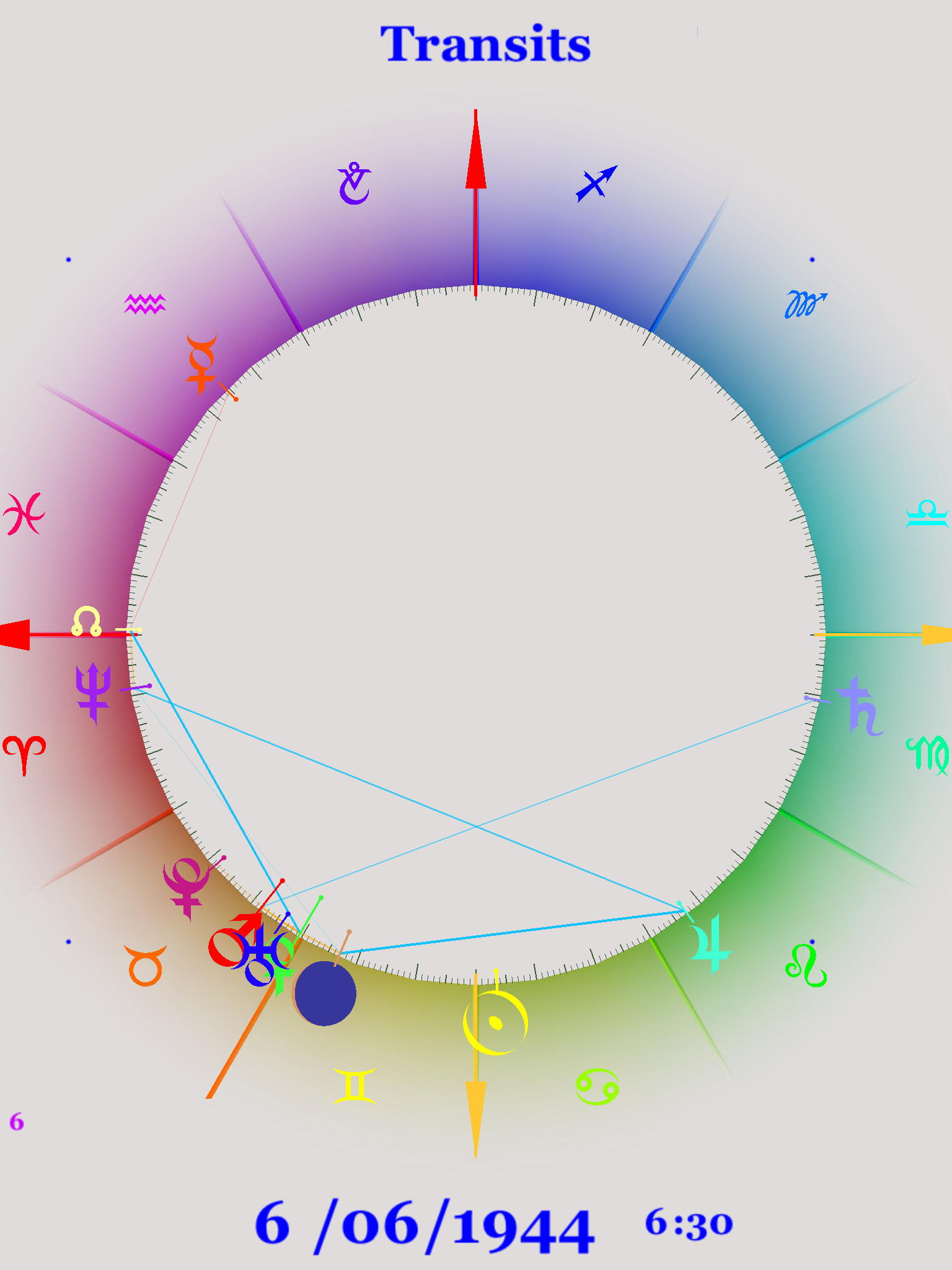
This year seems to be shaping up as a big one for anniversaries ending in zero, and we haven’t even reached to big one this summer. This June has witnessed the seventieth anniversary of the landing of allied troops at Normandy Beach, hastening the end of World War II. This landing started at 6:30 in the morning (time zone two hours East of Greenwich) of June 6, 1944. I really didn’t expect from from looking at the chart of this event, but the most interesting thing was when it was compared to the chart of the United States.

D-Day represented the culmination of long planning for opening a second front in Europe that had been demanded by Stalin years before, since the Soviets were baring the brunt of German war machine. There was an aerial bombardment of the coast earlier in the morning, but the invasion of joint forces from many European and North American countries is considered the D-Day invasion which was recently celebrated. The codename for this was Operation Neptune, and there have been several book published recently with that title. And there are movies about D-Day, the most famous of which is Saving Private Ryan.


D-Day  Event Chart

D-Day Event Chart


This first chart shows the D-Day event at 6:30. You can notice that this is a Full Moon, with the exact Full Moon about 9 hours later. The Full Moon suggests the culmination of some process. In this case it was the culmination of a long process of planning. You can see that the Moon has set and the Sun has just risen, as makes sense at 6:30 in the morning close to the Summer Solstice. There are two conjunction that are noticeable The first one is Mars conjunct Pluto. This conjunction can be read as superhuman strength or brutality. Certainly superhuman strength was needed in the D-Day landing, which taxed the strength of about 150,000 men, half of which were Americans. But not only was great strength needed on the day of the landing, but also much planning which took place before the day; this was necessary to assure a successful invasion. The tightest conjunction – about a quarter of a degree – is Venus and Uranus. At first this did not seem fitting, suggesting sudden love affairs and such. But that is on a personal level. It also suggests dancing and rhythm. In this case the conjunction implies that a great deal of planning and even rehearsal for many months before the final assault. In a way it was like a vary elaborate dance whose moves were planned out well in advance of the exact occasion. This was most necessary.

Then notice that the Moon is almost exactly opposite this Venus-Uranus conjunction. This was the timing indicator, since the Moon travels so fast this tight aspect only last a few hours. It was approaching so it would be exact in another four hours, just as the invasion was reaching it high point.

Another thing to notice is the planet Jupiter down by the IC and opposite the Midheaven. This indicates good luck, fortune at the base of the project, which was the Allied assault at Normandy Beach, and which they certainly needed.

D-Day Sixth Harmonic

D-Day Sixth Harmonic


But there is something else, which we can see most clearly in the sixth harmonic chart of the event. In this we see a wide conjunction of Pluto, Mars, Uranus, Venus, and the Moon, with the three center planets being the tightest. This represents the Mars-Pluto sextile the Venus-Uranus and trine the Moon. All five of these planets which we have talked about were involved in one aspect complex.


D-Day and USA

D-Day and USA


Finally let us look at these planets within the chart of the United States, since the Americans made a large fraction of the soldiers in the invasion. For the United states, which was on Eastern War Time for the D-Day landings, the time was six hours earlier. Notice that the Venus-Uranus conjunction is on the Uranus of the United States and the Mars-Pluto conjunction is on the node of the United States. The United States is definitely connected to this event. Finally notice that the planet Neptune is on the MC of the US. Not only that, but Neptune is opposite the Aries point at about 1 and a half degrees of Libra.; anything connected with the Aries point is connected to the World, since the Aries point is common to the World. That is most appropriate for an operation code-named Neptune. For the United States, the Full Moon has just risen and it is illuminating the chart.


Brown v Board of Education

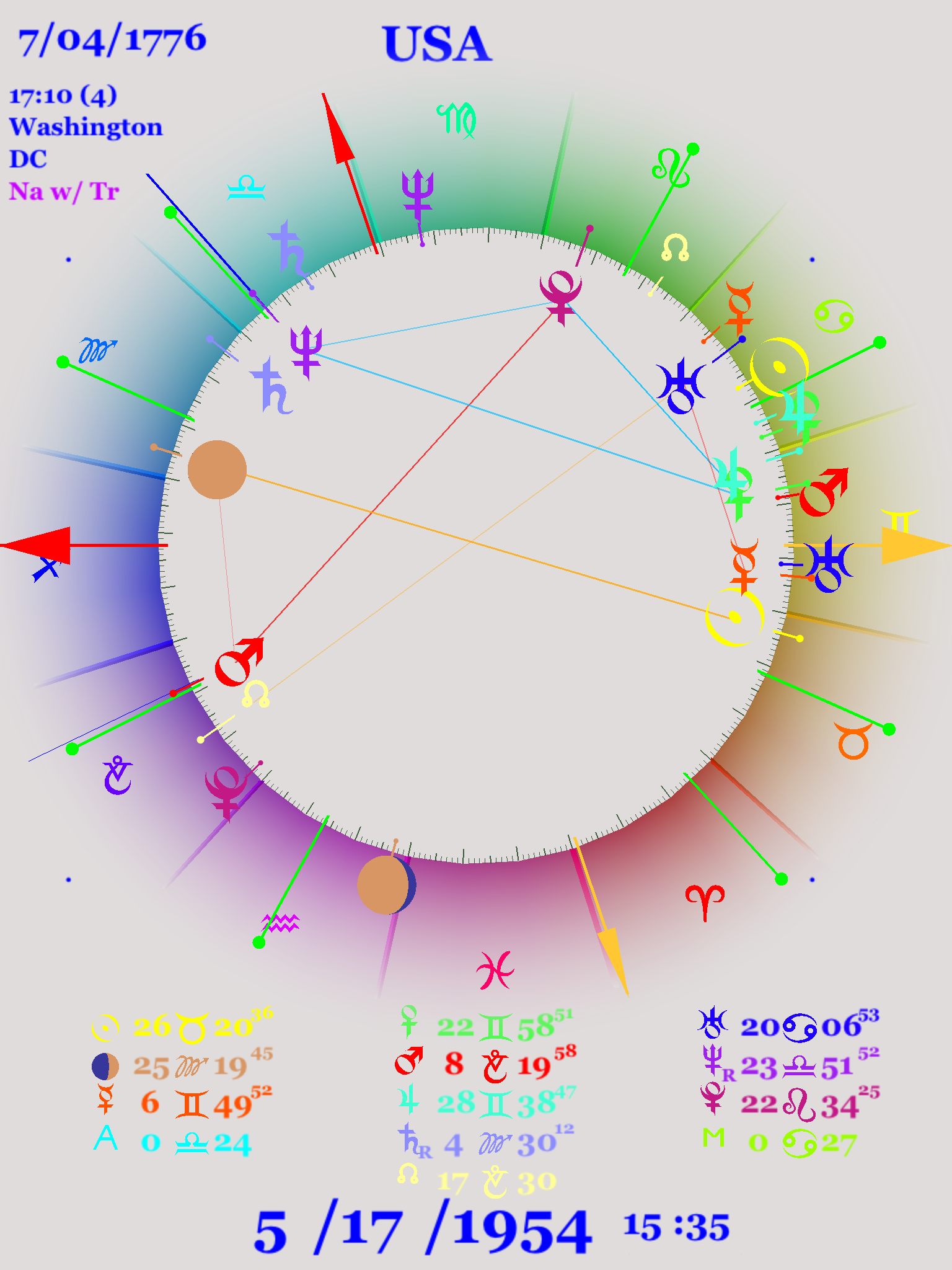
Another anniversary, this time Sixtieth for the Supreme Court decision on May 17, 1954 called Brown vs Board of Education of Topeka, Kansas.

Nations, like people, have their shadow side, the darkness they would rather not admit to. With a person that can sometimes be revealed through introspection or therapy. But for a nation, especially the most powerful nation in the world, such truth is extremely hard to face. We have previously talked about some of the dark side of America, as revealed by its closest aspect, Pluto semisquare Ascendant. This came out, for example, in the Gulf of Tonkin incident and of course the whole Vietnam War. But this side of American behavior is not mentioned in the media, in Fourth of July speeches, or political campaigns. There is a mythic belief of America that is celebrated at such occasions, and much of this is shown by the second tightest aspect in the American chart, Mercury semisquare Uranus.


bbe1

Dark Side vs Bright Side


Before talking about this aspect it is interesting to note its relationship to what I am calling the dark side aspect of American culture, Pluto semisquare Ascendant. These two aspects are opposite one another and connected by two oppositions. Symbolically this is interesting: It shows that the shadow side is the obverse of the more public side. This Uranus semisquare Mercury aspect is above the earth and thus more public, whereas the shadow side is below the earth, and thus more hidden, at least to the Americans. The recipients of our dark side behavior are all too aware of it. Also notice that the bulk of the planets are included in the arc between Uranus and Mercury. This is the core of America – except for the public, the Moon, which is below the horizon and thus out of mind.

Uranus is freedom, revolution, rebels. As a country founded in revolution and that being a revolutionary country is important to our self image, it is not a surprise that Uranus is so prominently placed close to the Descendant. When Uranus is combined with Mercury, it indicates innovative thinking, science, technology. From the beginning science and technology were important to the country, as seen in Benjamin Franklin and his many inventions and John Quincy Adams, who is considered the father of American astronomy. Thomas Jefferson was an architect and scientist. Early America drew rebels such as Thomas Paine and Francis Wright and Robert Dale Owen. Early steam driven printing presses and rotary presses allowed the spread of newspapers and books. Westinghouse, Edison, and Bell are famous inventors from America. And this has continued into the present with the development of computers and the Internet. America is famous for more Nobel Science prize winners, great science teaching in graduates schools, and so forth. Of course, some of this may be changing with the rise of neo-liberalism and the increasing privatization of public education.

The decision on Brown v Board of Education is an example of our better nature. It is considered the most important Supreme Court decision of the Twentieth Century, perhaps of all time in the United States. It can be seen as demonstrating the revolutionary goodness of America, another example of why America is exceptional. This decision, by a 9-0 vote – when is the last time we’ve seen that – overturned Plessy v Ferguson of 1896 that allowed separate by equal. The decision ruled that separate educational facilities for different races were unconstitutional. One of the lead attorneys, from the NAACP, was Thurgood Marshall. a brilliant lawyer. He was later appointed to the Supreme Court by Lyndon Johnson as the first African-American Supreme Court Justice. When he retired he was replace by Clarence Thomas, appointed by George H.W. Bush. I guess he figured that one black justice was the same was another.


Transits

Transits


In the chart of the positions of the planets on this day, we see that there is a transiting Mercury semisquare Uranus also, emphasizing this aspect. But look at the transits to the natal chart of the US. There are strong aspects, among the tightest of the day, of the outer planet Neptune to the planets Uranus and Mercury showing that this aspect was highlighted that day.


bbe3

Emphasis on our Bright Side


While Neptune can represent universal compassion, concern for the helpless, idealism, it also suggests illusion. In this case the promise of Brown v Board of Education, which aligned itself with the positive self-image that America has of itself, was prevented from coming to full fruition by deception. The school boards mostly affected by this decision, from Alabama to Massachusetts, fought against its implementation, It wasn’t until another ten years that the federal government passed a law allowing easier legal redress. Parts of that law have been nullified by the current Supreme Court, the one containing Clarence Thomas. No one noticed the irony. And school segregation, which was supposed to be stopped by this decision, is now more prevalent than before the decision. But Neptune prevents us from fully seeing this.


Wars of America — Part II

In part I we looked at the three wars that divide American history into convenient and appropriate sections: The Revolutionary War, the Civil War, and World War II, and found that these three wars came at intervals of about 84 years, one Uranus cycle. In each case, at some point Uranus was opposite the Ascendant, and thus conjunct the Descendant, of the United States chart. Also during the war, Neptune was either conjunct or opposite the Midheaven of the United States. This may or may not be because Neptune has almost exactly double the period of Uranus and so when Uranus moves around the zodiac once Neptune moves half-way around the zodiac.

Image

King William’s War

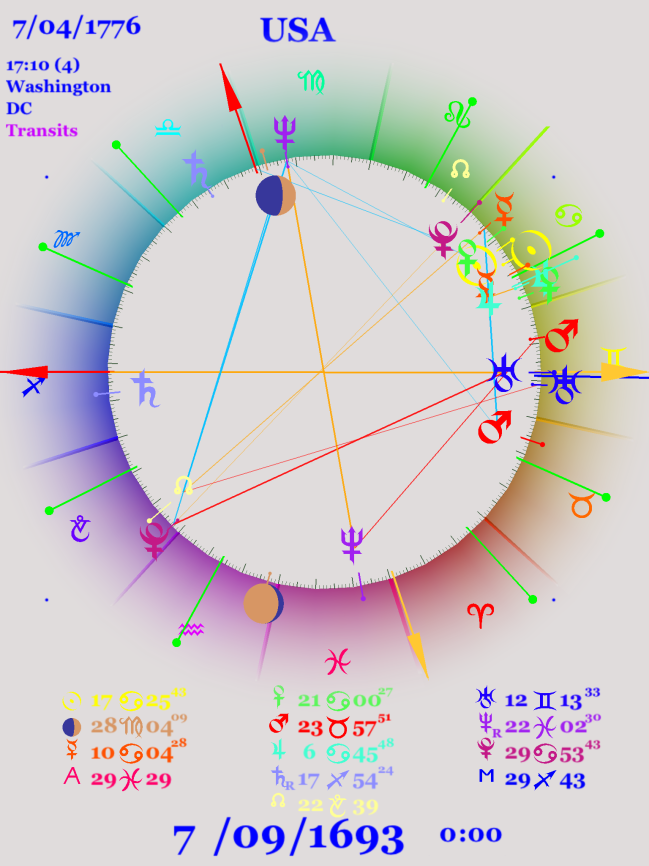
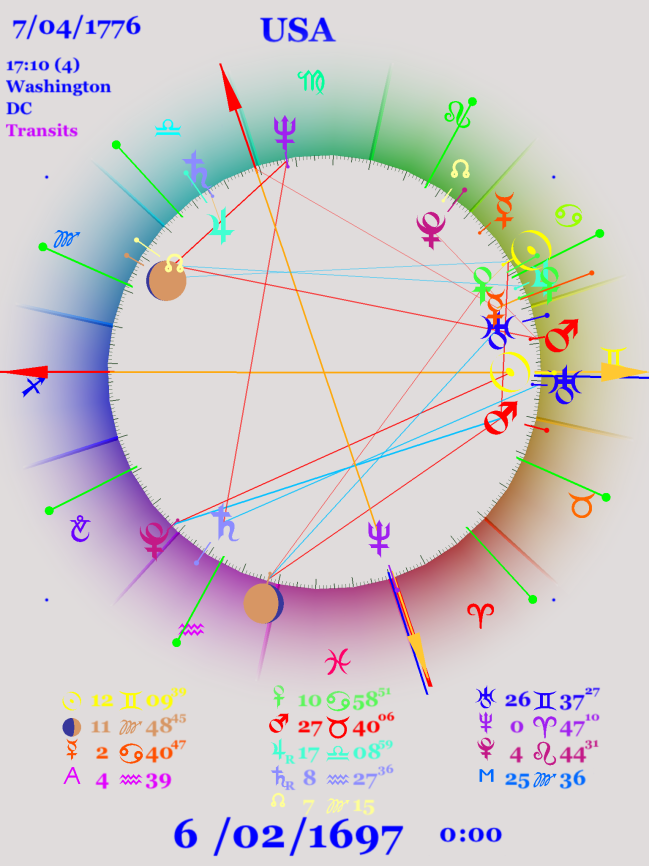
The next thing to do is look at the periods 84 and 168 years before the Revolutionary War, when Uranus was also conjunct the Descendant of the United States. The first time was 1693, when the United States was still a colony of England. At this time there was an ongoing conflict between England and France, who at the time controlled Canada. Part of this conflict took place in North America, and the American colonists were involved on, of course, the side of Britain. What was taking place at the time was the first of three wars which are referred to in high school history books as the French and Indian Wars. This first one was called, in America, King William’s War, for the current king of England, who was imported from the Netherlands, along with his wife, because the British did not want a Catholic king, who had been King James II, who was replaced in the Glorious Revolution. This war, as all the French and Indian wars, was essentially between the French and the English. The war started in 1689 and ended by treaty in 1697, only to be followed in another five years by another war.

Image

King William’s War


In the first chart for July 9, 1693 Uranus has just come to the Descendant of the United States. It also makes a sesquiqadrate to Pluto, again accentuating the Pluto semisquare Ascendant in the natal chart, which is involved in US wars. The second chart for this particular war is for June 2, 1697 where Neptune comes to the IC of the United States. Again we see the pattern that we saw in the Revolutionary War, the Civil War, and World War II repeated. But this war is smaller even than the Revolutionary War.


Image

Starving Time


Image

After the Starving Time

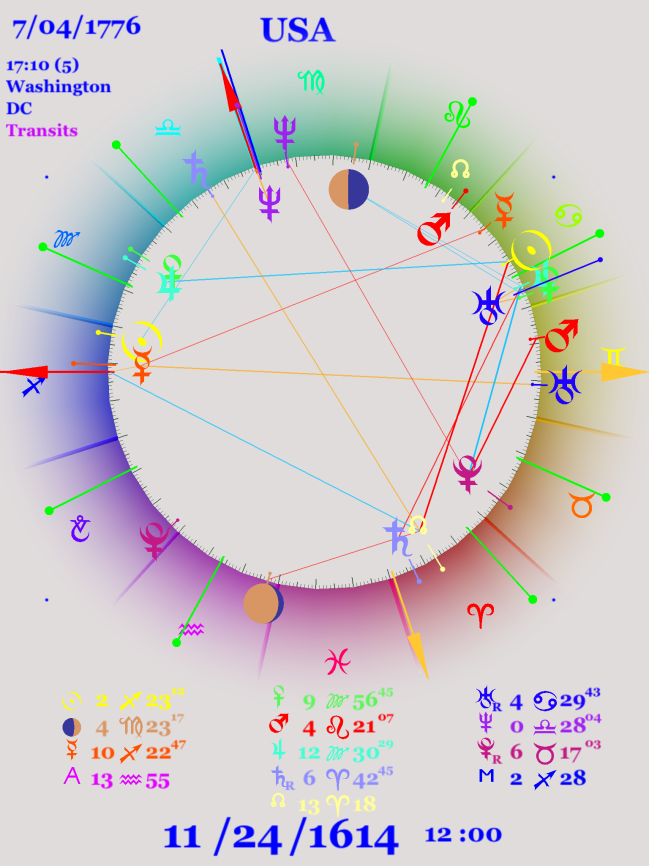
Let’s look 84 years further back. There was only one colony on what would become the United States, at Jamestown. An earlier colony in the Carolinas had disappeared. This colony at Jamestown had been founded on May 14, 1607 but for food they either traded with the Indians or relied on shipments from England. The Winter of 1609-10 was extremely hard, and almost 90% of the colonists died. Domestic animals were killed for food, and some cannibalism took place, as a recent New York Times story tells a about an current archaeological discovery. A fleet from England did finally come, but it had only more colonists and not food. In the summer of 1610 (July 7) as they sailed away another ship with supplies came and they returned to the colony, which then was firmly established. This was the first crisis of America. If we look at chart for November 24, 1609, that winter of the Starving Time, as it has come to be called, we see that Uranus is on the Descendant of the United States, as it was in the previous four charts. However, looking at the next chart for November 24, 1614, when Neptune first came to the Midheaven, we see that it is a full five year after the crisis, and so this does not seem to fit the pattern. Of course, in this example the crisis only lasted a few months, not nearly as long as the others did.


Image

Eleven Years in the Future

Image

A Future War?

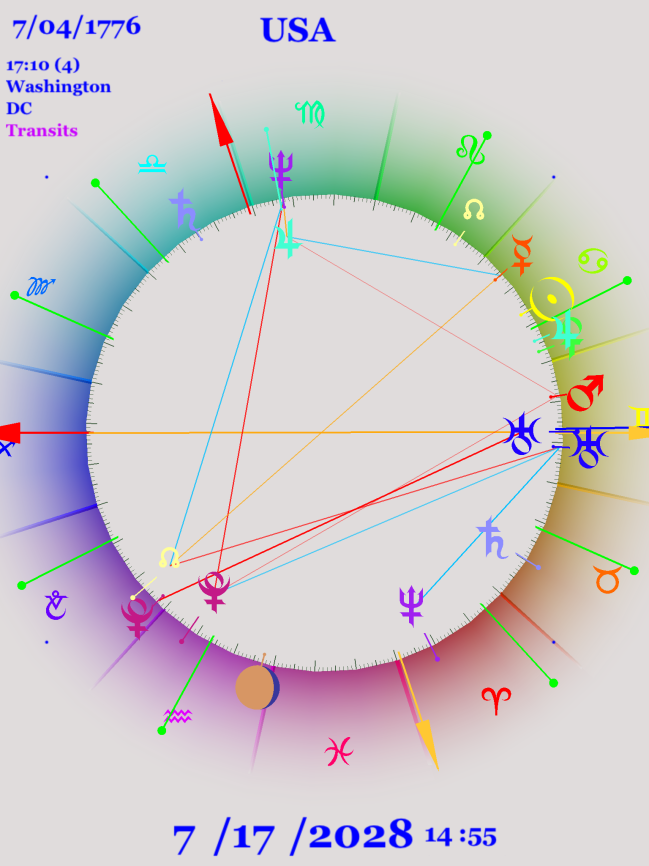
What we have seen is five crises, starting at the birth of the colony at Jamestown and occurring every 84 years with increasing death, violence, and geographical spread happening to the United States. The obvious question is when will this patten happen next. As it tuns out, the next time Uranus comes to the Descendant of the United States is in less than 15 years, as we can see by this last chart, for July 17, 2028. One would expect another war, even bigger than World War II. Several possibilities: Aliens from outer space will invade and the nations of the world will band together to fight them. A bit fanciful, then perhaps it will be an asteroid that will be expected to hit the earth and the nations of the world will band together to fight it. Or perhaps it will be a world wide fight between th 1% and the 99% since inequality has become so much worse than it is now. Or perhaps the final collapse of the ecosystems of the world. But since I’m an optimist (Jupiter conjunct Sun) my best guess is that the nations of the world will finally decide that the global crises are so ominous that they need to band together in a World War II-scale attempt to fight for the survival of the planet. Of course it should have been done in the 1980s. There is much more that needs to be said about this period, one of the most important of at least the 21st Century, but we need to have more background. If this is the type of crises we will face in another dozen years, it suggests that many things will happen between now and then to make the countries of the world think that that type of world wide response is finally necessary. We will look for signs of that in future entries.


Prohibition and its Discontents

The Twenties in the United States was very active, both in the world and astrologically. There were three significant transits to the chart of the United States during this period, but there is one I want to draw your attention to, and that is the transit of Neptune opposite the Moon of the United States. One theme I have mentioned for Moon Neptune is denial, illusion, and that was certainly the case in the speculative binge on the stock market that was taking place in the Twenties. We know how that turned out. While we have drawn attention to meanings of Neptune in another entries there is another one I want to draw your attention to this time: drugs. In general, Neptune is said to rules dugs. Also oil, but that is certainly a drug, as many people including George W. Bush have pointed out. But Neptune rules drugs in general, a change of consciousness. But there are several groups of drugs, and I have the different types ruled by the three outer planets. Uranus rules stimulants, such as caffeine, cocaine, amphetamine, nicotine, in other words uppers. Neptune rules depressants, such as alcohol, opiates, barbiturates, in other words downers. And Pluto rules psychedelics, such as cannabis, LSD, ecstasy.


Image

Prohibition


Neptune opposite the Moon of the United States is a good symbol for the attitudes toward alcohol that were happening in this country. On one hand this was a national extension of the earlier prohibition laws that had been passed at a state level. On the other hand there was a widespread flouting of the law by people from poor to rich and increased drinking of harder liquor, since if you’re going to smuggle contraband you might as well smuggle something concentrated.


In 1846 Maine became the first state in the nation to pass a law outlawing the sale of any beverages containing alcohol. The main proponent of this law was the mayor of Portland, Neal Dow. Five years later this law was strengthened. A few years after that the law had spread to many more states. This was the beginning of Prohibition of alcohol, thought it took another 70 years to make it the law of the land.  Many groups worked to bring prohibition to the national level.

Image

First Prohibition

If we look at a chart of transits to the United States in 1846 we see that Neptune, the planet of drugs, is squarely upon the Moon. The fact that Saturn is also there certainly helps matter, since Saturn represents limits and constriction, which is certainly well in keeping with the Prohibitionist mindset. Often the discovery of a planet – especially Uranus, Neptune, and Pluto – is linked to events that were happening in the world at that time. This was certainly true of Neptune, which was discovered in 1846 just as prohibition was become the law of at least one state.


Drinking was indeed excessive in antebellum United States, as compared to the standard of today. Farmers on the frontier found it was easier to transport corn to the East coast as whiskey than as ears of corn. Hard apple cider was also very popular. While I don’t have the exact figures at hand, the level of drinking was several times higher per person than it is now. And young people were part of the crowd that was drinking. One can well see why prohibition societies grew up.

Image

End of Prohibition Starts

When I saw that Neptune was coming to a conjunction with the US Moon once again, the first time since 1846, the year the planet was discovered, I realized that something would happen in regards to prohibition. Since I could see the trends I did not think that prohibition would make a comeback.

It all started with the legalization of marijuana in the states of Colorado and Washington, after almost happening in California (two years previously) and in Oregon that year of 2012. Then the South American country of Uruguay legalized also. But even more impressive, all kinds of officials are coming out saying that the drug war, which got started with the Harrison Narcotics Act of 1914, is badly conceived and counterproductive. Majorities of the American public agree that marijuana should be legalized and that it will be in a few years.

This is hardly a new idea; one could mention the book Licit and Illicit Drugs by Edward M. Beecher published by that extremely radical organization Consumers Union back in 1972 or the first book by Andrew Weil The Natural Mind, also published in 1972. Other books with the same ideas, such as Marijuana Reconsidered by Lester Grinspoon (1971), also come out in this period, as many authors were reacting to the drug use of the Sixties.

We are also seeing a renaissance of interest in psychedelic drugs, such as LSD, psilocybin, MMDA (ecstasy) for the use in psychotherapy, end-of-life, increased spirituality, among other uses. Many of these “new” findings recapitulate the findings of fifty years earlier, before the inevitable backlash. To someone who has followed the tangled course of the War on Drugs this change of attitude is nothing short of amazing.


A Small Circle of Friends: Kitty Genovese

Another fiftieth anniversary took place two months ago, and a couple of books were published in commemoration of the event. This was the rape and murder of Kitty Genovese in Queens, New York on March 13, 1964. This type of event is, unfortunately, very common in the United States and elsewhere, but this event was special. This event captured the interest of the country (if not the world) and is still mentioned in textbooks. While the brutal crime took place supposedly many people were aware of it and did nothing, so that it is held up as an example of people not wanting to get involved. It was the inspiration of a song by Phil Ochs, a contemporary of Bob Dylan (one rumor has it that Dylan’s song “Positively 4th Street” is about Ochs), his most popular, called “Outside a Small Circle of Friends”. The song would have been more popular except for an ironic anti-drug lyric that offended parents too dull to appreciate the support for the supposed a-motivational syndrome of marijuana in the song.

According to WikiPedia, she arrived back at her apartment from work at about 3:15 the morning of that day, parked and walked to her apartment. I’ve done these charts for 3:20 AM and since they are timed charts we can use the position of the Moon. I did not really except anything to show up, and so again I was surprised. While many girls and women are raped and murdered in the United States each year in an all too common act, this one was special in that in captured, and still captures, the attention of the country.

Image

Let’s look at this first chart, transits for the event to the United States chart. We see the loose Uranus-Pluto conjunction, and since Uranus is behind Pluto, we know that the conjunction is forming. This is the signature of the Sixties, but it has some time to go before it is exact. Notice also that it is a New Moon – about one day before exact, with a conjunction of Sun, Moon, Mercury, and Mars. In fact, Mercury is almost exactly on he Sun. Mars is half way between Sun and Moon. Sun Moon midpoint can be read as man and woman, and with Mars there it could indicate violence between a man and a woman. But of course this midpoint configuration happens often, so while it indicates the nature of the event, it does not say this is special, and of course it could indicate other things as well.

There is an exact conjunction between Mercury and the Sun, within one minute, and the conjunction will be exact by 4 am. This suggests that this is the day (Sun) that communication (Mercury) is important, that something will be communicated. And in fact, the murder of Kitty Genovese was communicated for the next fifty years.

Next we have the Sun opposite Neptune of the United States. There is something Neptunian about this event. Things are unclear, confused. Not only is this true of the event, but even to this time certain important facts are little know, for example, the fact that she was raped as well as murdered is not part of the standard narrative, and the fact that she lived with her female lover is mostly unknown.

And then there is Pluto. It squares the Ascendant and sesquiquadrates the natal Pluto of the United States, both aspects fairly tight. This accentuates the Pluto-Ascendant semisquare that is so fundamental to the character of the United States. My reading of this is that the event was a reminder of the violent nature of the United States as revealed by this natal semisquare, as talked about in the entry about the Gulf of Tonkin, which took place a few months after the Kitty Genovese murder.

Another tight aspect is the trine between Mars and Neptune. Mars Neptune combinations can be problematic and difficult to handle; the square in the chart of United States is one example, but a trine is somewhat different. The keyword I give for hard aspects is “overt”, they force themselves on you, you can not ignore them. Soft aspects are “covert” in that you may not notice their effect. Most people think soft aspect are easier, but more important is the planets involved, and these two together are not easy. With a trine the “unresolved energy” is not obvious but it is still happening.


Image

Since this is a timed chart, the position of the Moon is meaningful. It is opposite Pluto, but to see this more clearly look at the fourth harmonic chart. In this we can see that the Moon-Pluto conjunction (in the fourth harmonic) is almost exact, and almost exactly conjunct the United States Ascendant and opposite the United States Pluto. This was an event that really effected the United States. And that Moon-Pluto tight aspect can be read as brutality (Pluto) to women (Moon).

Image


Looking further at the fourth harmonic chart, we see things that were not evident in the firs harmonic chart. Neptune is at the midpoint, and making aspects with, Saturn and Venus. One simple minded way of thinking about this combination is uncertainly about difficulty with woman. Ebertin says about this midpoint “wrong ideas about love” which is certainly an understatement. There are tight hard aspects between transiting Saturn and Neptune with the natal Mars. This again brings out the unclear and limiting expression of energy – violence – in this event.

Image

Looking at the event chart, we see that transiting Neptune was hight in the sky close to the local Midheaven at the time of the event and would pass over the Midheaven in 11 minutes. This further adds to the confusion – the neighbors did not know whether to call the police – and uncertainty surrounding the event. Neptune was very strong in the murder of Kitty Genovese.