500 Years — Part I

The title of this blog contains the words “500 Years” so we need to show why 500 years is an important period of time, what I call a basic cycle. It is long enough to be a period where many changes happen, and short enough that we have had several during recorded history.

First let’s consider the periods of revolution of the outer planets. This is similar to the Moon rotating about the earth, though in this case these planets are rotating about the Sun. The Moon takes about 27 1/3 days to go around the Earth, as measured from, say, 0 Aries to 0 Aries.

Planet

Period

Number of Periods

Total Years

Jupiter

11.86

42

498.12

Saturn

29.42

17

500.14

Uranus

83.75

6

502.50

Neptune

163.74

3

491.22

Pluto

245.33

2

490.66

The average of the five cycles is 496.53 years. This is not to say that all these planets return to the same position in about 500 years, but only that their relative positions return. Also note that the inner planets not mentions have such small cycles that they of course fit into this scheme. The longest cycle of those not mentioned is Mars, which is only two years.

Next let us consider the synodic period of two planets. This is the period between one conjunction of the two planets and the next conjunction. After the first conjunction the two planets move and so the next conjunction takes place after, and perhaps long after, the faster moving planet returns to the spot where the first conjunction took place. This is similar to the period from one New Moon to the next New Moon. As the Moon moves during 27 1/3 days the Sun moves almost one-twelfth of its total rotation (as seen from the Earth) and so the Moon needs to move a little more after it returns to the spot of the first conjunction – New Moon. That is why consecutive New Moons advance through the zodiac. The synodic period for the Moon-Sun is about 29 ½ days.

Synodic Planets

Period

Number of Periods

Total Years

Jupiter-Saturn

19.86

25

496.50

Jupiter-Uranus

13.81

36

497.16

Jupiter-Neptune

12.78

39

498.42

Jupiter-Pluto

12.46

40

498.40

Saturn-Uranus

45.36

11

498.96

Saturn-Neptune

35.87

14

502.18

Saturn-Pluto

33.42

15

501.30

Uranus-Neptune

171.00

3

513.00

Uranus-Pluto

126.94

4

507.16

Neptune-Pluto

492.33

1

492.33

The average is 500.60 years. This is a relative return of all these cycles.

To sum up, there is a basic cycle of 500 years in which all the planets of the solar system return to their same relative position. This 500 year cycle is the basis of the title of this blog, The 500 Year Party. The next question of course is when does the 500 years start. This is similar to the question of when the 20 year Jupiter-Saturn cycle starts. The Jupiter-Saturn cycle has long been used in astrology; I have seen it in a book of ancient Persian astrology, where it was said to rule the rise and fall of kings. In present times, the cycle starts near the beginning of an even decade, so I call this period the bi-decade and it consists of an outgoing half – from conjunction to opposition – like the lunar cycle from New to Full Moon, the waxing cycle. Then the odd decade – from opposition to next conjunction – like the phase from Full to New Moon, is the waning period. So waxing decades are the Sixties, the Eighties, and the Oughts, whereas the waning decades are the Seventies, the Nineties, and this current decade. I’ll leave it to the reader to find the differences between the waxing and waning decades.

There is another large astrological cycle called the Great Year, based on the Precession of the Equinoxes whereas the first point of Aries – the Vernal Equinox – moves backward through the zodiac at a rate of approximately one degree every 72 years. This causes the Pole Star to change through the ages, and results in the charmingly named Age of Aquarius, which is due any time now. The Great Year is about 26, 000 years. The actual year consists of 12 months, but 52 weeks or 13 4-week periods. This difference between 12 and 13 is the result of attempting to merge the lunar – moon-based – and solar – sun-based calendars. But the ratio of a week to a year is about the same as the ratio of 500 years to the Great Year, so I call this 500 year cycle the Great Week.

From: Astrology: Worlds Visible and Invisible Everett Blackman AFA 1974

Remember the Maine!

The Spanish-American War is widely considered to mark the start of the American Empire.  The event that touched off the war was the explosion of the U.S. cruiser Maine in the Havana harbor the evening of February 15, 1898.  At the time it was widely assumed, helped by the jingoism of the press, that it was an attack by the dastardly Spanish.  Now it is thought to be an explosion on board the ship, but still conspiracy theories abound.  This act led America to invade Cuba – which had long been considered “ours” – and the other Spanish colonies, most notably  the Philippines, leading to a bloody war which featured American water-boarding.

The last Indian wars were past, the frontier had been declared closed, and many American thought it was time to expand beyond our borders.  The Spanish-American War came about at a convenient time. In  fact, America was itching for war.  Back in December 1895  the United States almost got into a war with Great Britain over Venezuela.  Many of the “leaders” of the country, such as  Theodore Roosevelt, were for it  as a  way of increasingly America’s manhood.  It had been so long since this country had a war, and it was time for another one.

Image

Looking at the chart, it seems like a mirror image of the 9/11 chart.  We have the notorious Saturn-Pluto hard aspect, again an opposition, along the Angles.  But in this case Pluto is on the Descendant and  Saturn is on the Ascendant, the opposite of the 9/11 chart.  This makes sense:  on 9/11 the explosion was in the Homeland – the Ascendant – whereas the explosion on the Maine was in a foreign country – the Descendant.  Pluto was also     on the Descendant during the earlier war scare.

Image

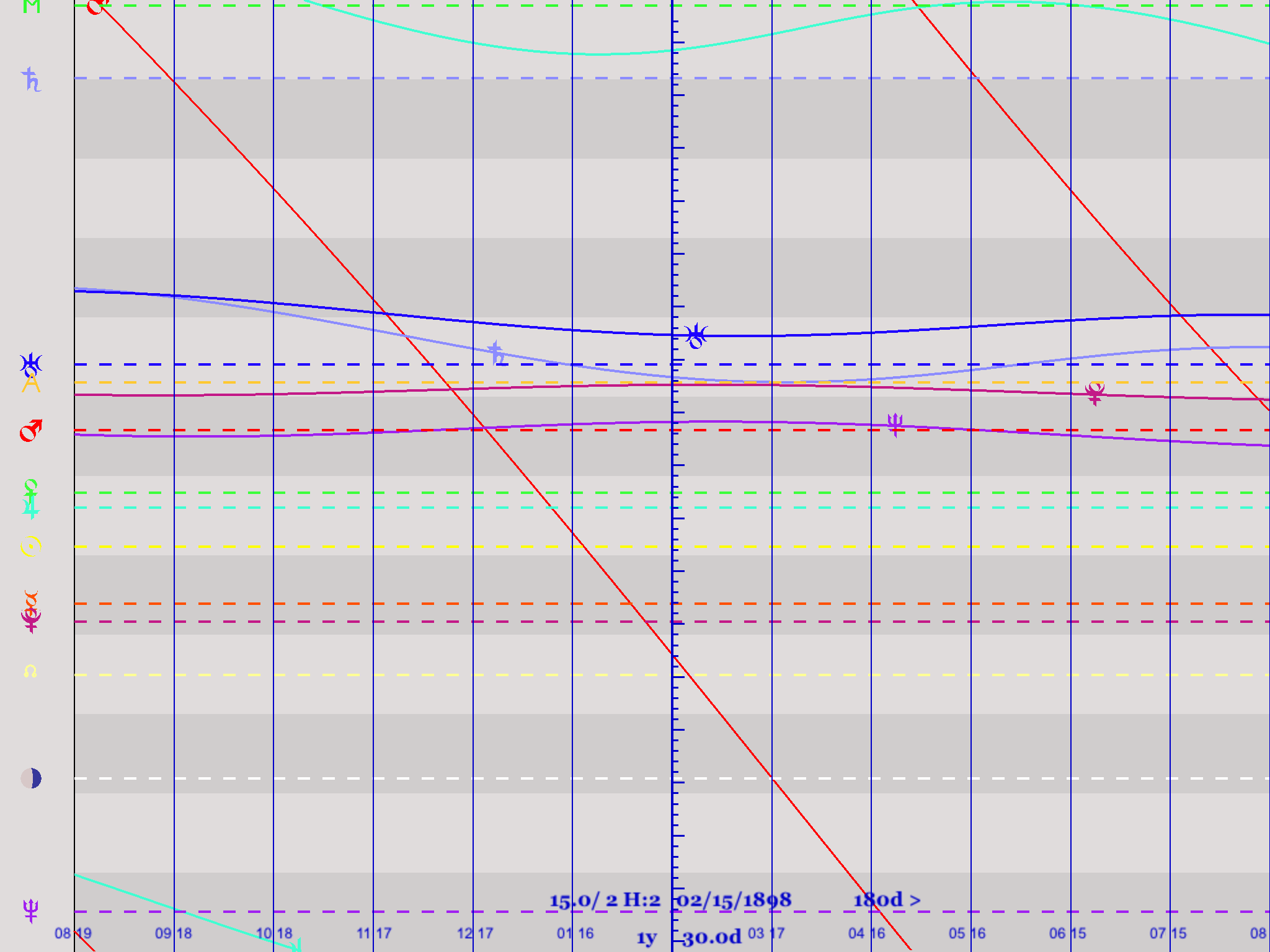
Notice by looking at the graphical ephemeris that Pluto was again stationary about to turn direct and Saturn was slowing down  about to turn retrograde.   The exact opposition took place a couple of weeks later,  on the Ascendant and as both were stationary.  At the time discussion was happening in Congress and the newspapers about the upcoming war.     Also notice the year long conjunction of Neptune with natal Mars, repeating a similar Neptune-Mars theme which we saw in the  9/11 chart.

Mars had passed over Pluto a week before.  I  jokingly call this the sign of mass murders (Ebertin says force, brutality), which doesn’t please those with this common configuration; the conjunction happens every two years, but one can see why I call it that: The killer at Virginia  Tech had  this conjunction.  Also notice that Mars passed over the Moon of the United States in another month as people were getting agitated for war, and by late April when war was declared, Neptune was stationary on natal Mars  and transiting Mars was opposite natal Neptune and square natal Mars, thus accentuating the problematic Mars-Neptune square in the U.S. Chart.

Remember 9/11!

The collapse of the towers of the World Trade Center in New York City was an event that is memorable and has an exact time, if it did not “Change Everything.”  It was such an important event for the United States that it must surely show up in the chart of the U.S if astrology has any validity whatsoever.  And the transits should be appropriate for an event of this magnitude and  nature.  A Jupiter or Neptune transit would not cut it.  As you can see from the chart below, there is no need to worry.  Not only is the transit appropriate to the nature of the situation, but in fact these are the most appropriate transits possible. In fact, this one event caused me to accept the Sibly chart.  Further work with it only increased my certainty.

Let’s look at the most obvious first: Transiting Pluto on the Ascendant.  Pluto is 17′ from exactly on the Ascendant.  But if you look at the graphical ephemeris you will see Pluto went stationary direct right on the Ascendant, and had been there for over a month.  Pluto is big events, explosions even – remember it was discovered in the Thirties –  transformation, things from the underworld that we would rather not think of.   And it took place here, in the Homeland, hence the Ascendant.

911
But wait, there’s more.  Notice the Pluto-Saturn opposition across the Ascendant-Descendant axis.  Fourth harmonic aspects of Saturn and Pluto are notorious.  These were involved at the start of the Spanish-American War, World War I, World War II, the Cold War and now the War on Terror. Also notice that at the time Saturn was slowing down and turned retrograde in two weeks, as can be seen from the graphical ephemeris.

911tg

One other minor point: Notice Neptune opposite the North Node of the Moon and thus conjunct the South Node. The Nodes, among other things, represents the connections among people.  But the North and South nodes also have opposite meanings.  Neptune on the North Node suggests a lack of community-sense (Ebertin).  I hypothesize that on the South node it means the opposite, since immediately after 9/11 there was an increased sense of people being together.

But notice also Uranus  slowly conjoining the Moon – the people will  be excited.  Uranus got closer and went exactly over it while the people were being prepared for the War in Afghanistan. The previous time – 84 years before – when Uranus was in the same position the people were getting prepared for our entry into World War I.  Americans were against an entry into World War I, and Wilson was reelected  in 1916 on the pledge that He Kept Us Out of War.  But that changed quickly as a propaganda campaign took place to get us to hate the Germans – the Huns.  Hamburger was called Salisbury Steak and saurkraut was called Liberty Cabbage.  This time around French Fries were renamed Freedom Fries because the French (who were responsible for our victory in the Revolutionary War, even though it  caused them to lose theirs)  did not support our War on Terror.

Notice transiting Neptune sesquiquadrate natal Mars (almost exact) and also sesquiquadrate natal Neptune.  This highlights the natal Mars square Neptune for the United States.  This square is problematic, and I will write in detail about it later,  but let me just say now that it indicates that this country’s use of violence is somewhat  hinky.   Mars and Neptune are not compatible planets, and the square can be a difficult aspect.  With transiting Neptune’s accentuation of that square and adding its own delusional nature to the mix, one can well understand why our reaction to the  event was so misdirected.

911_4
If we look at the fourth harmonic chart, we see a close opposition of natal Pluto and transiting Pluto, reflecting the semisquare of natal Pluto to the Ascendant in the chart of the United States.  I will write more about that aspect later, but for now I will quote the words of a famous agitator about that Pluto-Pluto aspect:  Those who live by the sword (natal Pluto)  will die by the sword (transiting Pluto).

I  consider this event, along with the  Pluto ingress seven years later (Pluto ingresses to Cardinal Signs have to do with the rise and  fall of nations, among other things)  a bookend of the American Empire.  This will become more clear when I talk about the other bookend and compare it to this one.

The Beatles

A couple of weeks ago we were treated to a boomer nostalgia-fest on the fiftieth anniversary of the Beatles appearing on the Ed Sullivan Show. This followed on the fiftieth anniversary of the Kennedy assassination and we will see many more fiftieth anniversaries over the next few years. How about the fiftieth anniversary of the Trips Festival on January 21, 2016? Of course, this summer we will have the centennial of the start of World War I. I’m guessing that more people are alive and in positions of power who remember the Beatles than remember World War I, and why shouldn’t they be nostalgic since in many ways this period is so unlike 50 years ago, even though we now have the first President born in the Sixties. Much attention has been paid to of late to how the minimum wage, in adjusted dollars, is worth so much less than it was in the Sixties, and, perhaps correspondingly, the spread of incomes is much greater than in the Sixties. People alive at that time remember how hopeful it all seemed, and now only those who are really wealthy can imagine that this is a hopeful time.

beatles

So I figured that I should do my part. Above is the chart for the Beatles’ appearance on the Ed Sullivan Show 8PM Sunday evening February 9, 1964. I didn’t expect to see much since this is not, despite what some think, a very critical moment. But I was wrong. We see the defining signature of the Sixties, Uranus conjunct Pluto, near the top of the chart. We notice Saturn conjoining the Moon of the United States, which it had been for a few months and would remain, getting even tighter, for the rest of 1964. The country had recently witnessed the assassination of the young and seemingly vibrant President, and so of course the people were depressed. But I want to point out aspects that were the most tight. Since I have added Harmonic Charts to the Definitions section I can discuss this event using one of my favorite techniques. These two aspects were transiting Uranus square the United States Uranus and the transiting Pluto sextile the U.S. Sun. Note that the two planets that define the Sixties, Uranus and Pluto, are the ones making the strongest aspects to the U.S. chart. The closeness is most obvious when we look at the harmonic charts. In the fourth, which shows squares as conjunctions, we see that transiting Uranus is almost on top of natal Uranus. Likewise in the sixth, which shows sextiles (as well as trines and conjunctions) as conjunctions, transiting Pluto is almost exactly on top of the U.S. Sun. In this chart transiting Uranus is opposite natal Uranus, because a square is a sextile and a half. Thus we can see that the “Sixties” planets were closely involved with the U.S. on the Beatles’ first appearance.

beatles4

So this period is more important than I thought. In the 84 year Uranus cycle, which has to do with among other things Change and Revolution, this moment was at one quarter of the way through this Uranus cycle that started at then end of World War II. This period was sort of a coming out party for those who were born around the time of the initial conjunction. That statement is almost a cliche but I find it interesting that it is shown so obviously in the transits at the time. The conjunction of Pluto with the Sun took place in the Twenties, which was a transformative time in its way. Forty years later we have the sextile between the two planets. With the sextile the transformation of the country is a much lower key affair, something that you wouldn’t notice except in hindsight. At the time people thought that this was just some crazy teenagers over-reacting to some long-haired youth from across the Ocean. With a perspective of fifty years, things look different.

beatles6