Uranus and the Moon

Over the last few blog posts we’ve seen the important aspects which signify that the second half of this decade will be quite different than the first half. I discussed previously the Jupiter-Saturn square that signifies the beginning of the second half of the decade. Later I discussed the Saturn-Neptune conjunction that happens shortly after the third Jupiter-Saturn square and then finally in February 2026. This time we will discuss an important transit to the US chart that first occurs in late summer of 2024 (elections season) and will occur finally in early 2026 and that is transiting Uranus square the natal Moon.

Transiting Uranus aspects to the Moon of the United States (which simultaneously makes a hard aspect to the Sun) have shown up as an upset (Uranus) to the body politic of the people of the country (the Moon). Since Uranus has a period of 84 years, the quadrature aspects of Uranus to the natal Moon of the United States should happen every 21 years. Since such an aspect is coming up this decade, let us look at the transits of Uranus conjunct, opposed, or square to the natal moon over this history of the United States as a nation.

There is a question among astrologers whether an aspect manifests before the aspect is exact (called partile) or after the aspect is exact. In the following cases we will see examples of both though it appears that the act — war — happens after the aspect is exact more often than not. But of course remember that the aspects relate to something happening to the populace and in most case war is the concrete result, but that is only the outward externalization of a change to the people in the country.

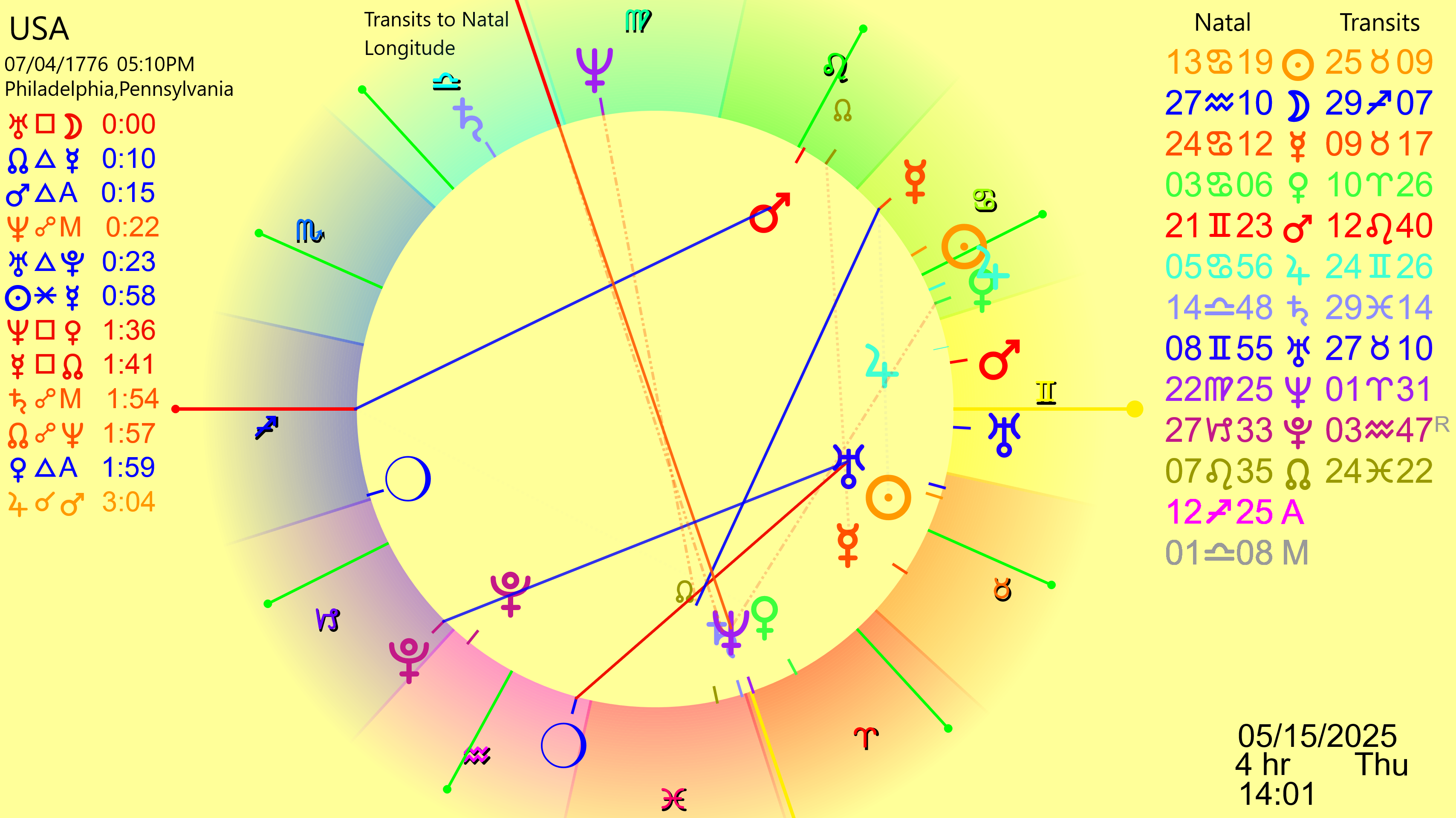
Uranus in hard aspect — conjunction, square, opposition — to the natal moon of the United States is coming up. The first pass is in August and September of 2024 when it goes stationary retrograde right on the Moon; needless to say this is right before the November presidential election of that country. Then in the middle of May 2025 it makes a direct square to the Moon (and also a trine to Natal Pluto). Finally in February of 2026 it goes stationary direct within a quarter degree of the Moon. The United States will experience three years of Uranus squaring its Moon (along with many other interesting aspects that will be discussed in later posts) so it is instructive to look back at previous hard aspects between these two planets during the history of the country.

2002-2003 invasion of Afghanistan/Iraq after the attacks of 9/11.

There was a conjunction of transiting Uranus and the natal Moon in 2002 and 2003; this was the previous hard aspect between these two planets. The transit was shortly after 9/11 when Americans were braying for blood and it was easy to convince them that an invasion of Iraq and Afghanistan were in their best interests. The invasion of Afghanistan took place on October 7, 2001, less than a month after the attacks on 9/11. The invasion of Iraq, discussed earlier, happened about a year and a half later.

1980-81 start of New Cold War with RR also Iran-Iraq War

At the end of 1980 and 1981 Uranus was square the Moon. This period saw the election of Ronald Reagan and the start of the New Cold War (as one book titled it) and also the beginning of the Iraq-Iran war (the US was helping Iraq and Saddam Hussein! since Iran had held our hostages) and there was ongoing fighting in Central America in the countries of Nicaragua, El Salvador, and Guatemala. The USS Honduras (as some wag called it), was a military base set up to allows us to support the Contras, our proxy army in Central America. All three countries saw much violence and the United States was definitely involved, most obviously with the funding an oppositional army called the Contras in Nicaragua. As mentioned previously there was also a Saturn-Pluto conjunction in 1982.

1961-62 start up of Vietnam war

At the beginning of the Sixties – 1961 and 1962 – Uranus was opposite the US Moon. This was the beginning of serious American involvement in Vietnam; many think this did not happen until the Gulf of Tonkin resolution in August 1964, but earlier in the decade Vietnam was a big flash point. Early in 1963 a Buddhist monk burnt himself in protest of the war which had been picking up steam since John Kennedy had been elected. There were already student protests at some college campuses. The book by David Halberstan The Making of a Quagmire describes this period well and shows how the United States got involved in a disaster.

1941-42 World War II

In 1941 and 1942 Uranus squared the Moon in the same type of square that is coming up — this period was 84 years ago — one Uranus cycle before now. In fact the second exact transit of this cycle was on December 20, 1941, less than two weeks after the attack on Pearl Harbor that got America involved in World War II. The American people weren’t terribly convinced of the need to get involved in a war that seemed mostly in Europe, but after this square (“A date that will live in infamy”) there was much more eagerness to go to war.

1918-19 World War I, Red Summer, Prohibition, Palmer Raids
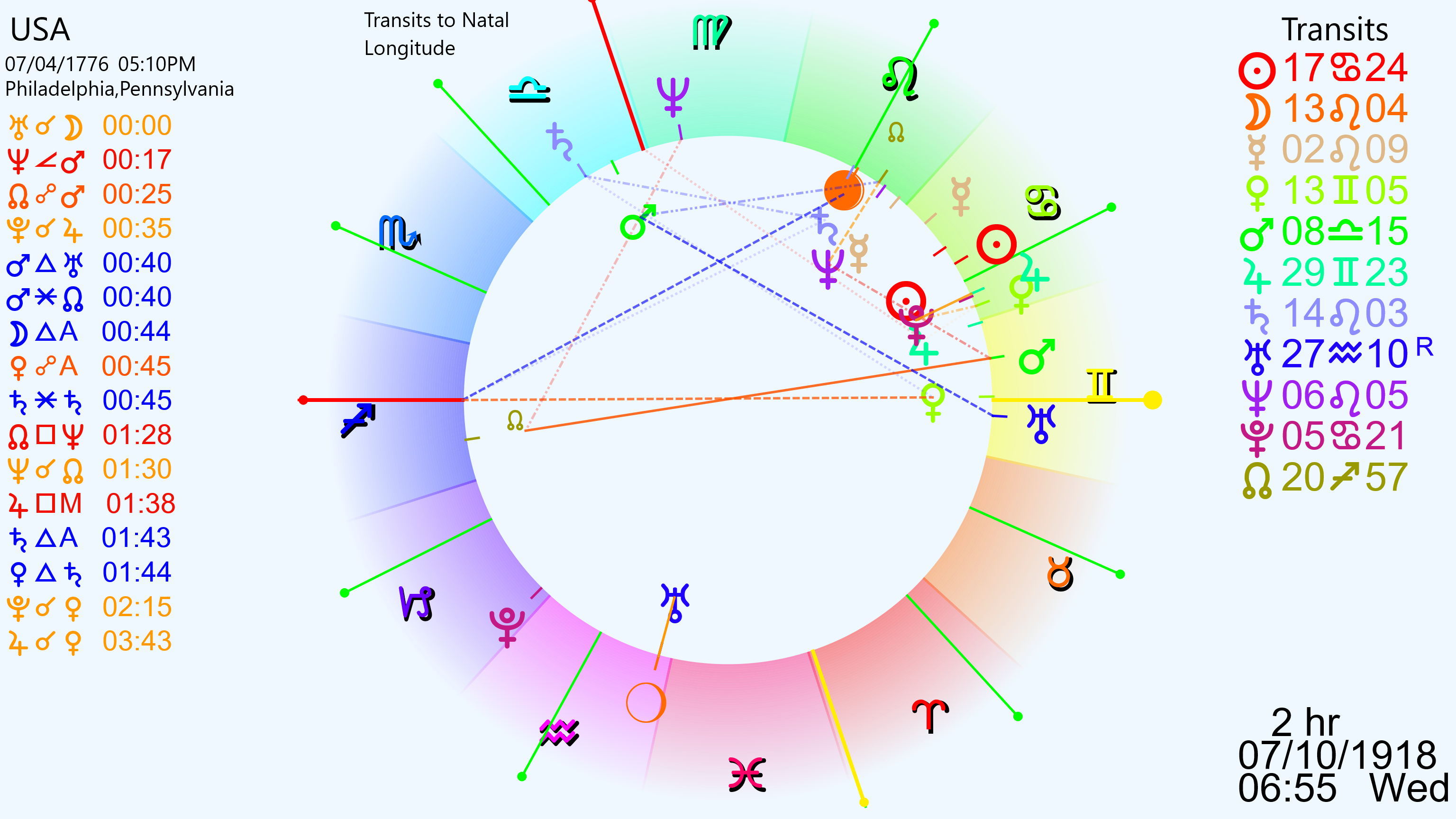
The effects of this square happened both before and after the square was exact. Uranus was conjunct the U.S. Moon in 1918 — as World War I was ending — and 1919 — as the Versailles peace treaty was worked out which was the official end of the war. America did not want to enter World War I and the President Woodrow Wilson ran for his second term — in 1916 — on the slogan ‘He kept us out of War’. Six months later he asked for a declaration of war. But there was a strong propaganda push to get America into the war, lead by among other people Freud’s nephew Edward Bernays. There was also propaganda about the Huns (Germans) raping Belgium nuns (stories of heathens raping our women have also been a popular ploy to get a nation involved in a war or for a lynching); there were people who would speak of the benefits of war before movies were shown, which though still silent were becoming very popular. After war was declared it suddenly became very popular with the masses, with for example a recruiting station in the shape of a battleship set up in New York City’s Union Square. (Suggested reading American Midnight by Adam Hochschild). But another “war” was coming up, though an internal war. 1920 saw the beginning of Prohibition in the United States which lasted until 1933. Prohibition saw a conflict between those supplying illegal alcohol and the government which was trying to prevent the spread of alcohol. Also unusual was the beginning trine between Uranus and Pluto which will be discussed at a different time. There was also upcoming what is called “Red Summer” which saw a lot of racially motivated attack (cf Tulsa Oklahoma) and the Palmer raids on unorthodox opinions.

There was also an invasion of Russia by the United States and several European countries as well as Japan in summer of 1918. This invasion was an attempt to stop the Bolshevik Revolution as part of the Russian Civil War between the “White” Russians — the Menshevicks (Kerensky) — and the “Red” Russians — the Bolsheviks. American forces remained in the country until 1920. All “good” Americans were already fearful of the Bolsheviks.

In June of 1919 several explosions occurred around the country, one of which was at the Washington, DC home of new attorney General, “Fighting Quaker” A. Mitchell Palmer. After the explosion, which did not injure Palmer, his wife, or their daughter, he was aided by Assistant Secretary of the Navy and neighbor Franklin D. Roosevelt, who discovered a collarbone of the bomber who was the only one killed by the blast. But this brush with death encouraged Palmer to start a war on dissidents since he couldn’t go after the bomber who was thought to be a member of a small Italian anarchist sect. Many people were deported as a result of Palmer’s actions. Palmer was assisted by the new director of the Bureau of Investigation John E. Hoover who probably did more than Palmer to round up suspects.


1896-97 Remember the Maine
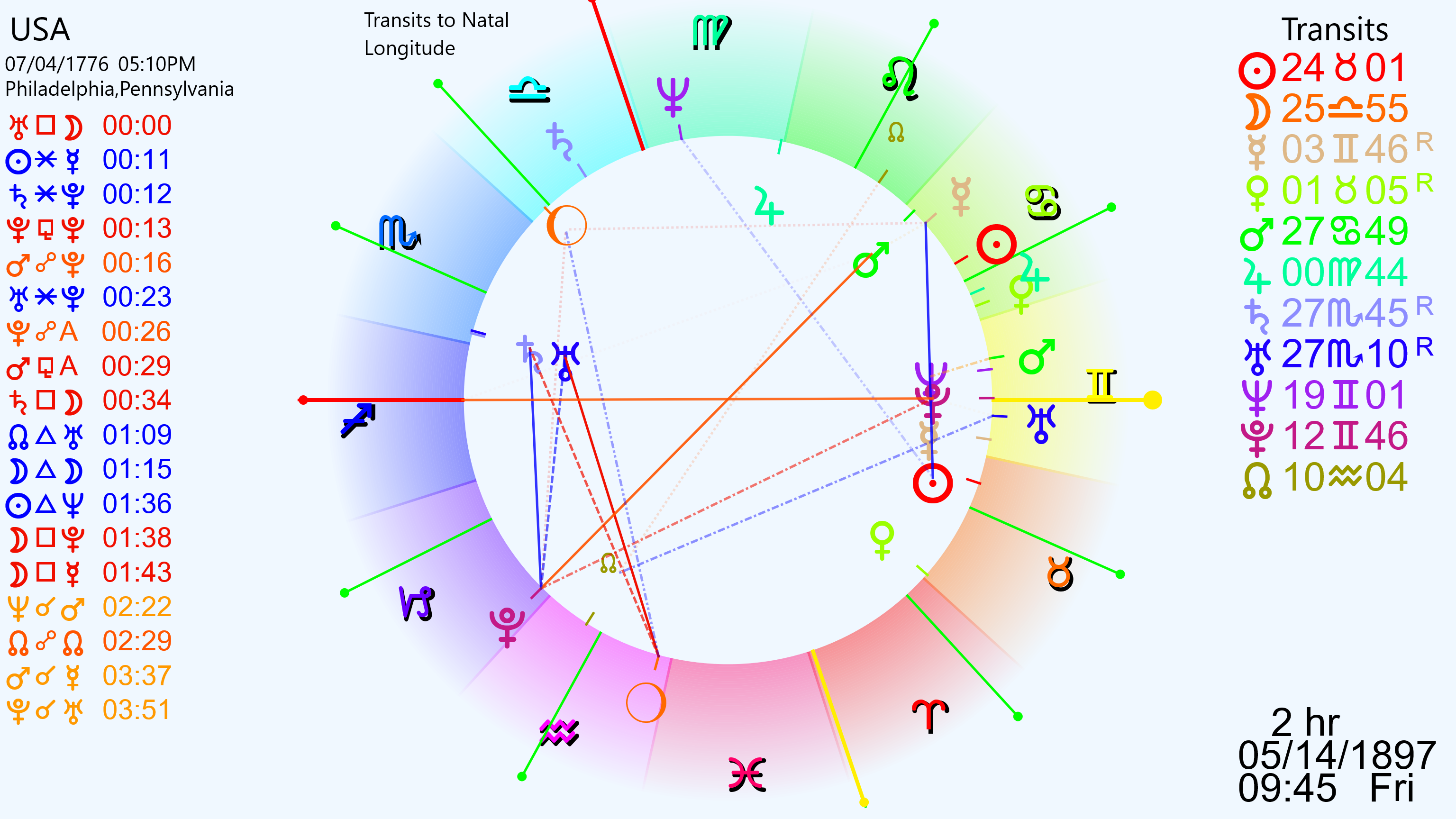
All through 1897 transiting Uranus was exactly square the US Moon. The next year the Spanish-America War broke out. At the time Cuba was a colony of Spain and the inhabitants of that island revolted against their Spanish overlords. The US cruiser Maine was in the Havana harbor when an explosion took place on the ship. It is now widely assumed that the explosion occurred on board, but at the time it was believed that the Spanish had exploded a bomb attached to the Maine. That explosion led to America’s involvement in the War against Spain. As a result of the US victory, many of Spain’s colonies, including Cuba, Puerto Rica, and the Philippines, became colonies of America. The US base at Guantanamo Bay is a result of the victory in the Spanish-American War. Empire became a way of life.

1877-78 End of Reconstruction

The Compromise of 1877 was a very important event in American history and one can imagine things being much different if this Compromise had not happened but it is seldom mentioned. The election of 1876 was inconclusive and so votes were taken with the House, Senate, and Supreme Court to determine the winner. Finally the Republican Rutherford B. Hayes was declared the winner, but the Republican winner withdrew the federal troops from the South (something the Democrats wanted but the Republicans opposed) who had been there since the end of the Civil War; this withdrawal ended Reconstruction and allowed the Democratic politicians of the South to institute what came to be know as Jim Crow laws, as well as countenancing other activities that resulted from the absence of Reconstruction. Lynching of the newly freed people became a popular activity, one that sometimes drew crowds and photographers. The country has still not fully recovered from the effects of the Compromise of 1877.

1857-58 Civil War

In 1857 and 1858 Uranus was in Taurus (two Uranus cycles before now) and square the US Moon. This was the lead up to the Civil War which at the time many people could see coming. Henry Ward Beecher, a prominent preacher (whose sister wrote Uncle Tom’s Cabin) in Brooklyn was providing “Beecher’s Bible” (rifles) to abolitionists in Kansas which resulted in “Bleeding Kansas” as pro and anti abolitionists fought it out over who would dominate that state; also John Brown provided his famous raid on Harper’s Ferry in the next year which many consider the tipping point to war.

1835 Remember the Alamo Texas Revolution
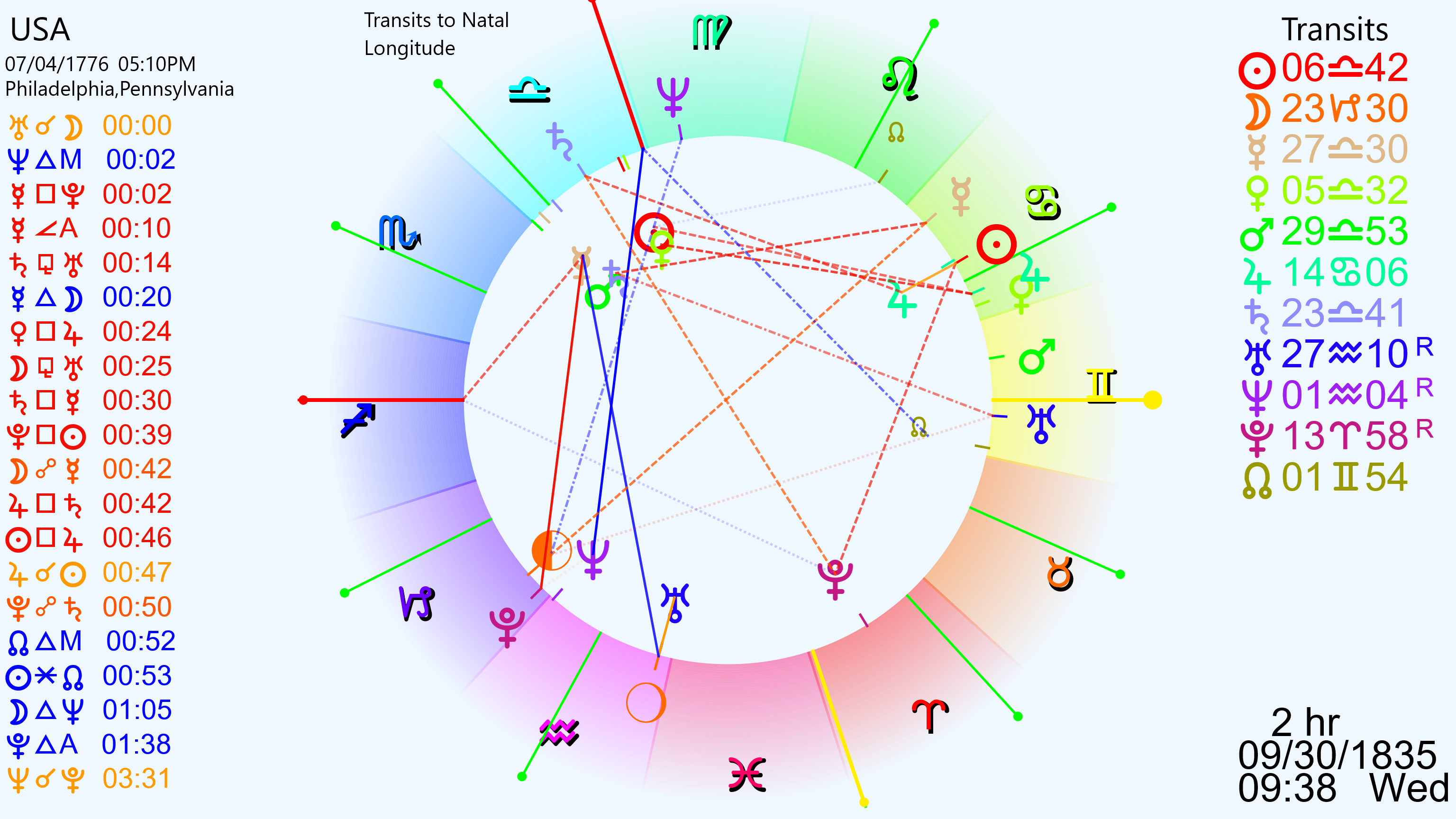
The citizens of Texas, which had been part of Mexico, were trying to establish that territory as a new country. The Battle at the Alamo in that region started as a battle to defeat the Mexican authorities and make Texas an independent country. The battle at the Alamo was not successful, and Texas was finally taken in as part of the United States under the Presidency of John Tyler (vote was defeated) and then officially under the next President Polk.

1813 War of 1812

The British attacked America again after they lost the American Revolution, and this was called the War of 1812. During this war the British succeeded in in burning down parts of Washington, D.C. This always results in a strong reaction. The war is best known for Andrew Jackson’s Battle of New Orleans which actually took place after the peace treaty was signed but communications were slower then.

1793-95 Whiskey Rebellion

The Whiskey Rebellion was the first armed revolt against the new country which was in the first term of the first president. At the time whiskey was very popular (the amount of alcohol consumed in early America is simply astounding!) not only as a beverage, but also as a way of transporting corn. Many farmers in Pennsylvania were angry at the taxes levied on whiskey by the federal government. There was also a Uranus Pluto opposition during the beginning of this rebellion and in 1794 Saturn was square both Pluto and Uranus, making an especially potent conflict. 1794 was the high point and climax of the rebellion. In Europe the French Revolution was going full bore and Jacobins executed the King.

1773-74 Pre-Revolutionary fervor

While the official start of the Revolutionary War took place in 1775 with the Battle of Lexington and Concord, there was much anger leading up to that battle and there was for instance the Boston Tea Party in 1773. In 1774 Britain passed five acts to punish the United States for that party, including the Boston Port Act which closed the port.

Uranus Square Moon First Pass

This year and the next two years will see transiting Uranus square the natal Moon of the United States and also make a semisquare to the US Sun.


Uranus turns stationary retrograde on the US Moon in the last half of 2024, just before the Presidential election. It then makes a clean true pass in early summer of 2025. Finally it goes stationary direct on the natal moon in late winter 2026.
Uranus Square Moon Second Pass

Uranus Square Moon Third Pass

The Three Passes

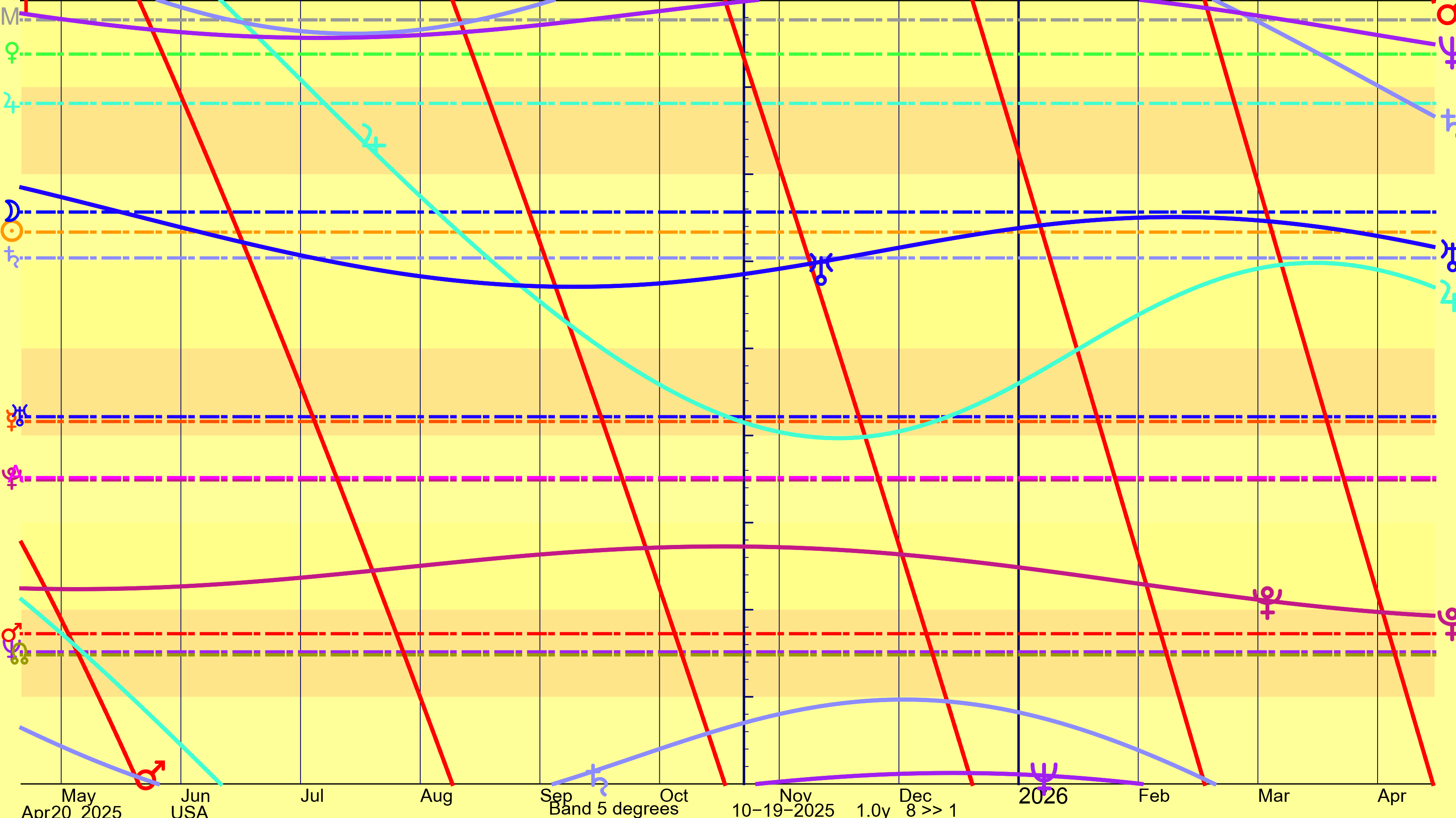
Here is a graphical ephemeris showing the three passes of Uranus square the Moon happening first in September of this year when Uranus goes stationary retrograde on the US Moon at 1. Then in Summer of 2025 at 2 there is the only direct square. Finally Uranus goes stationary direct on the Moon in February 2026 at 3.
Uranus Semisquare Sun

Finally here is a graphical ephemeris to show Uranus making a semisquare to the Sun at about the same time as it makes a square to the Moon. We see this happens in early June of 2025, December of 2025, and April of 2026.

Zeitgeist Changes — Part 5

The Fourth Turning is a 1996 book by William Strauss and Neil Howe that was recently popular during the election of 2016.  It postulates a crisis for America soon, because previous crises have bedeviled America ever 80 to 90 years since the Revolutionary War.  As astrologers, that time period should ring bells, and in fact the cycle has extended longer than Strauss and Howe imagine.  As has been suggested by this blog, it is unfortunate that historians don’t know astrology.  If they did, they would realize that this pattern extends from before the Revolutionary War and corresponds to planetary periods.  By looking at the astrological pattern, we can see this cycle has been occurring since the nation was founded, and is getting more intense with each succeeding cycle.  The period of 80 to 90 years is one Uranus cycle and one-half of a Neptune Cycle.  Let’s look (again) at what happened every 80 to 90 years in American history.


starve1

Starving Time


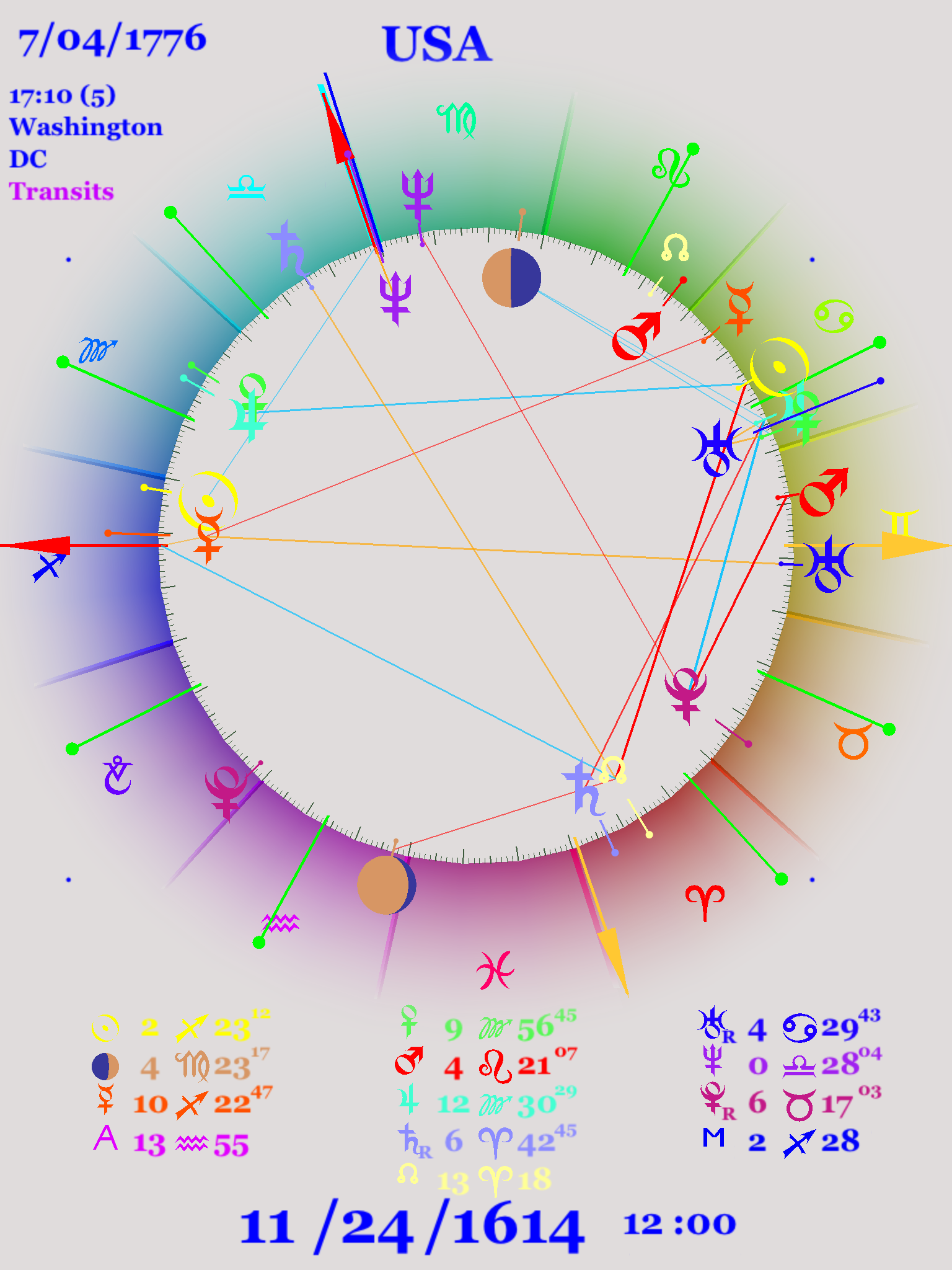
The first successful colony in what has become the United States was in Jamestown in what is now the state of Virginia in May of 1607.  The Winter of 1609-1610 is called the Starving Time: Of the 500 residents of Jamestown in the Fall, only 60 were left by the time Spring rolled around.  Domestic animals were killed for food, and some cannibalism took place, as shown in (for example) a New York Times story about a current archaeological discovery on the James River.  A fleet from England did finally come, but it had only more colonists and not food.  In the summer of 1610 (July 7) as they sailed away, another ship with supplies came and they all returned to the colony, which then was firmly established.  This was the first crisis of America.  If we look at chart for November 24, 1609, that winter of the Starving Time, we see that Uranus is on the Descendant of the United States.  However, looking at the next chart for November 24, 1614, when Neptune first came to the Midheaven, we see that it is a full five year after the crisis, and so this does not seem to fit the pattern.  Of course, in this example the crisis only lasted a few months, not nearly as long as the others did.  Or perhaps since there was no government (represented by the MC axis) there was no transit of the MC.  Note that in this case the Uranus conjunction occured before the Neptune conjunction/opposition, but those two will exchange places over the cycles.


starve2

Starving Time 2


king_wm_war1

King William’s War 1


Several wars occurred in the early colonies, called in general the French and Indian Wars, since both were involved, and each war got a name in the colonies depending on who was the ruler of England at that time.  They had different names in Europe, since France was also involved.  Both France and England had colonies in North America, and the French were allied with the Native Americans, and those two overseas powers were involved in several wars to determine who would have possession of the New World.  Spoiler: England won and would become the dominant force in the world for 150 years.

In 1688, there was the Glorious Revolution in Great Britain that replaced the Catholic King James II (son of King Charles I who was executed in the English Civil War) with Protestants William and Mary from Holland.  Thus the first such war in America was called King William’s War, and it was fought in 1689-97 with England, France, the American Indians, and the American colonists.  This was about 80 to 88 years after the Starving Time, and from the chart we can see that Uranus was at the Descendant during the War, Neptune reached the IC of the United State (not yet born) in 1697, three months before the end of the war.


king_wm_war2

King William’s War 2


Eighty to ninety years later, after all the French and Indian wars had died out, and after the important Seven Years War (1756-1763), which saw England defeating France to become top dog in the world, it was time for the Revolutionary War, and sure enough those two planets were in their correct spots.


Rev_war2

Revolutionary War 1


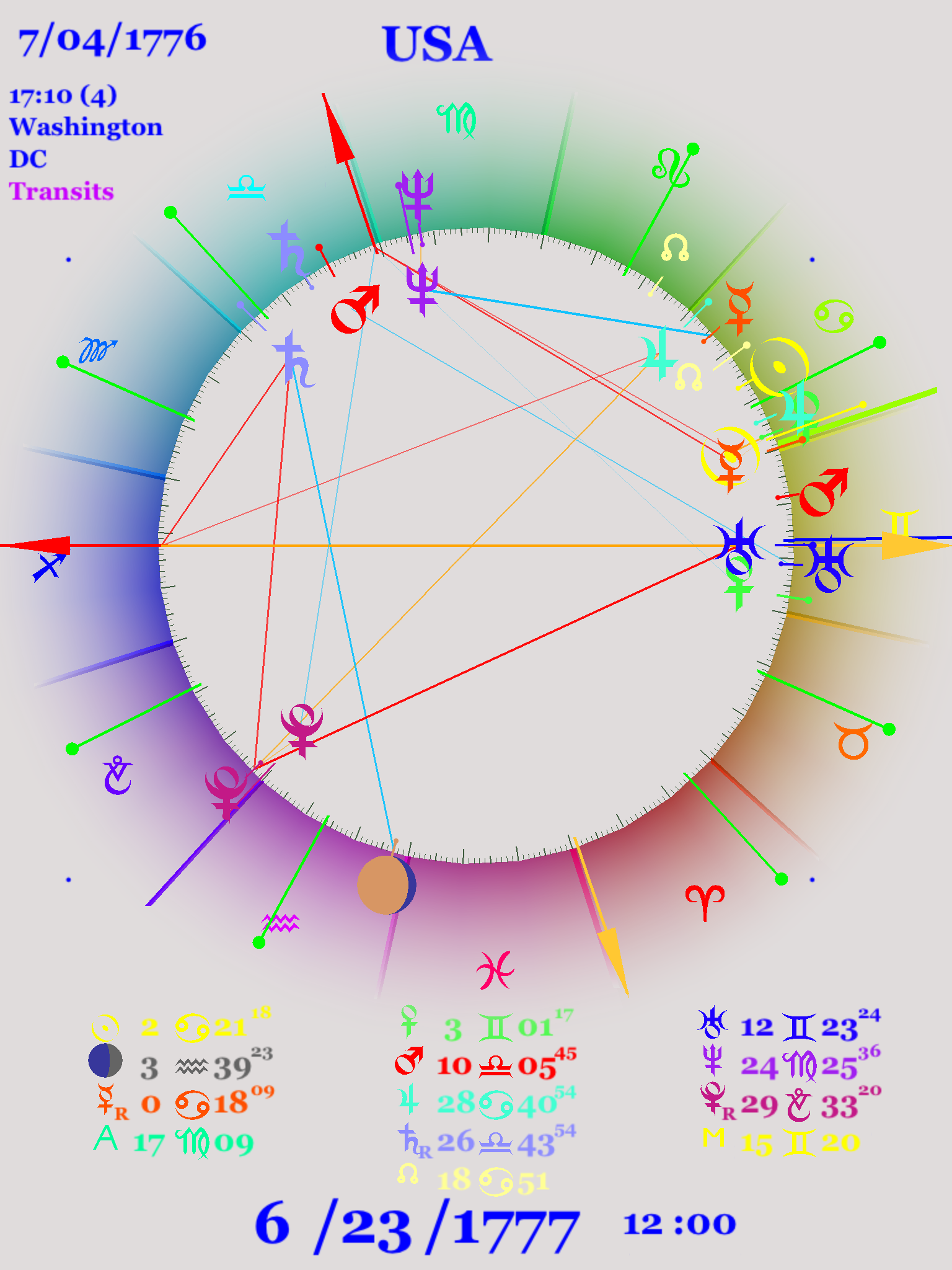
The official dates for the Revolutionary War are from the Battle of Lexington and Concord (April 19,1775) to the surrender at Yorktown (October 19, 1781).  This first image is for June 23, 1777; that date is not, as far as I know, a stand out date in the Revolutionary War.  Notice that all three outer planets are near their birth locations.  This is not surprising, considering that this chart is less than a year after birth.  What the chart does show is that Uranus is passing over the Descendant and on this date is exactly opposite the Ascendant for the first time since birth.  Again, not surprising since the natal position of Uranus is close to the Descendant.  Whereas the Ascendant relates to the personal projection – a good synonym is persona – the Descendant is the opposite point, and indicates how we relate to the outside world.  In personal astrology, this often is used to refer to the partner or people one draws to oneself or open enemies.  In either case, it refer to energy coming to us from outside, which can easily be seen as a war which also comes to us.


rev_war_i

Revolutionary War 2


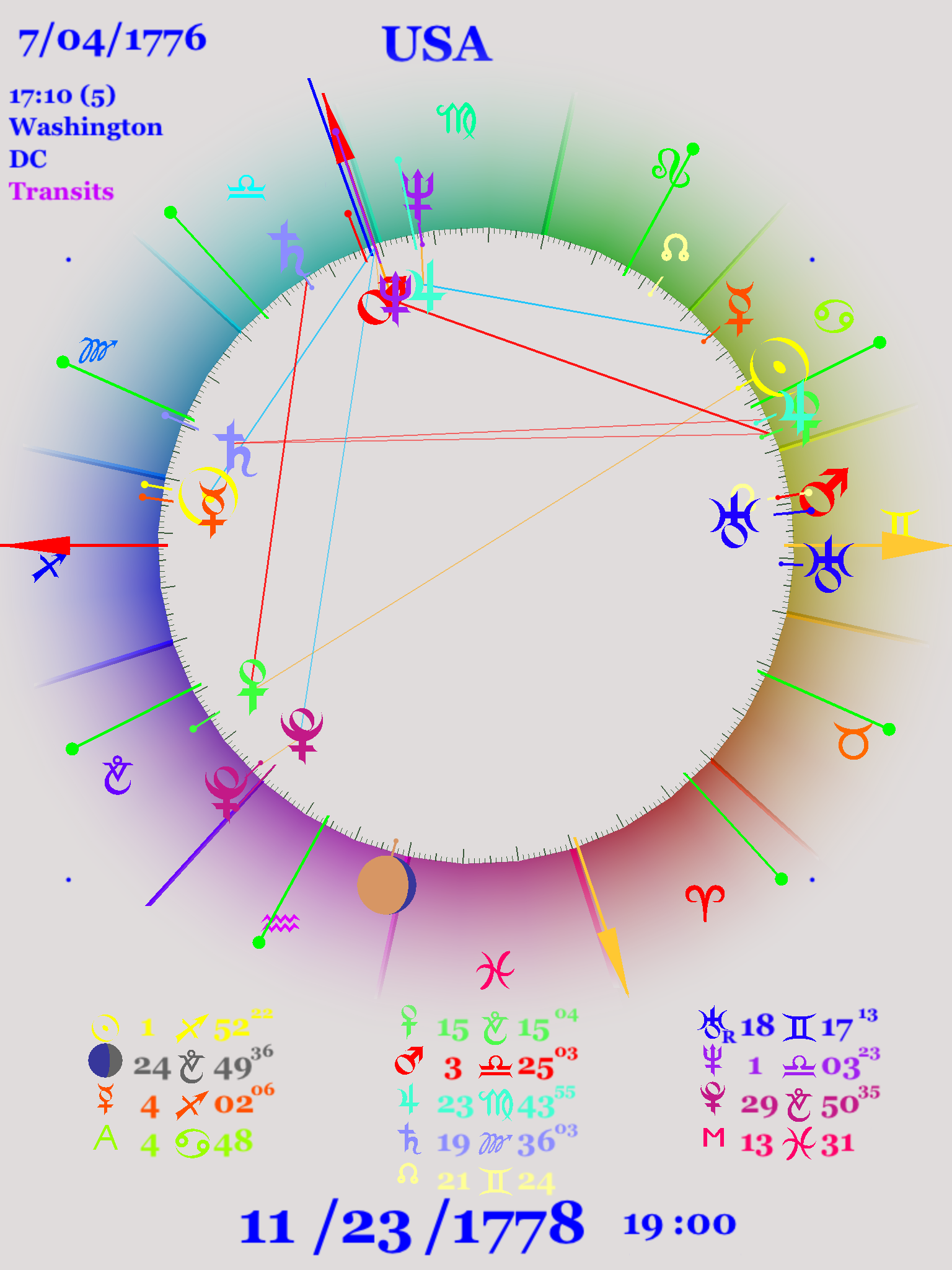
In the second chart, for November 23, 1778 we see that Neptune has come to the Midheaven of the United States.  The Midheaven refers to the way the country relates to the outside world or vice versa; one can see it as a public persona as opposed to the private persona of the Ascendant.  Perhaps this suggests that a war, which involves the government (MC axis) of the United States is always started under the illusion of good intentions and a peaceful outcome.


civil_war_i

Civil War

And 80 to 90 years after the Revolutionary War, along comes the Civil War, sometimes called the Second Revolutionary War, for different reason depending on which side the speaker is on.  The dates for the American Civil War are from the firing on Fort Sumter (April 12, 1861) to the surrender at Appomattox court house (April 9, 1865).  For the the Civil War there is only one chart, for March 11, 1862.  The war had started almost a year earlier.  We see both Uranus opposite the Ascendant as in the first Revolutionary War chart, and Neptune conjunct the IC (Imum Coeli –the Bottom of the Sky) of the United States chart, opposite the Midheaven.  This is about one Uranus cycle, 84 years, after the first chart.  The fact that Neptune is now opposite the earlier position (the second chart for November 23, 1778) is not surprising since the period of Neptune is almost exactly double that of Neptune.  Note also that since the natal Uranus is close to the Descendant and the natal Neptune is close to the Midheaven, these periods are also close to a Uranus return and a Neptune bi-return.  But we do see a pattern.  Notice by this time both Uranus/Descendant and Neptune/Midheaven axis aspects occur at the same time.  We will notice later that the Neptune aspect will occur before the Uranus aspect.


WW2_1

World War II 1


The dates for American participation in World War II – the Americans were definitely late to the party – is measured from the attack on Pearl Harbor (December 7, 1941) to the surrender of Japan (Germany had surrendered 4 months earlier) September 2, 1945.  One notices that the wars get larger – more participants and over a larger area — and more bloody over time.  Starving Time in Jamestown only lasted one winter and less than 500 people died, though of course by percentage of population it is very huge.  Compare that to World War II, which lasted for the Americans four years and less than 500,000 Americans died, though it was a world war and many people from other countries, especially the Soviet Union that bore the brunt of the German invasion, died.


WW2_2

World War II 2


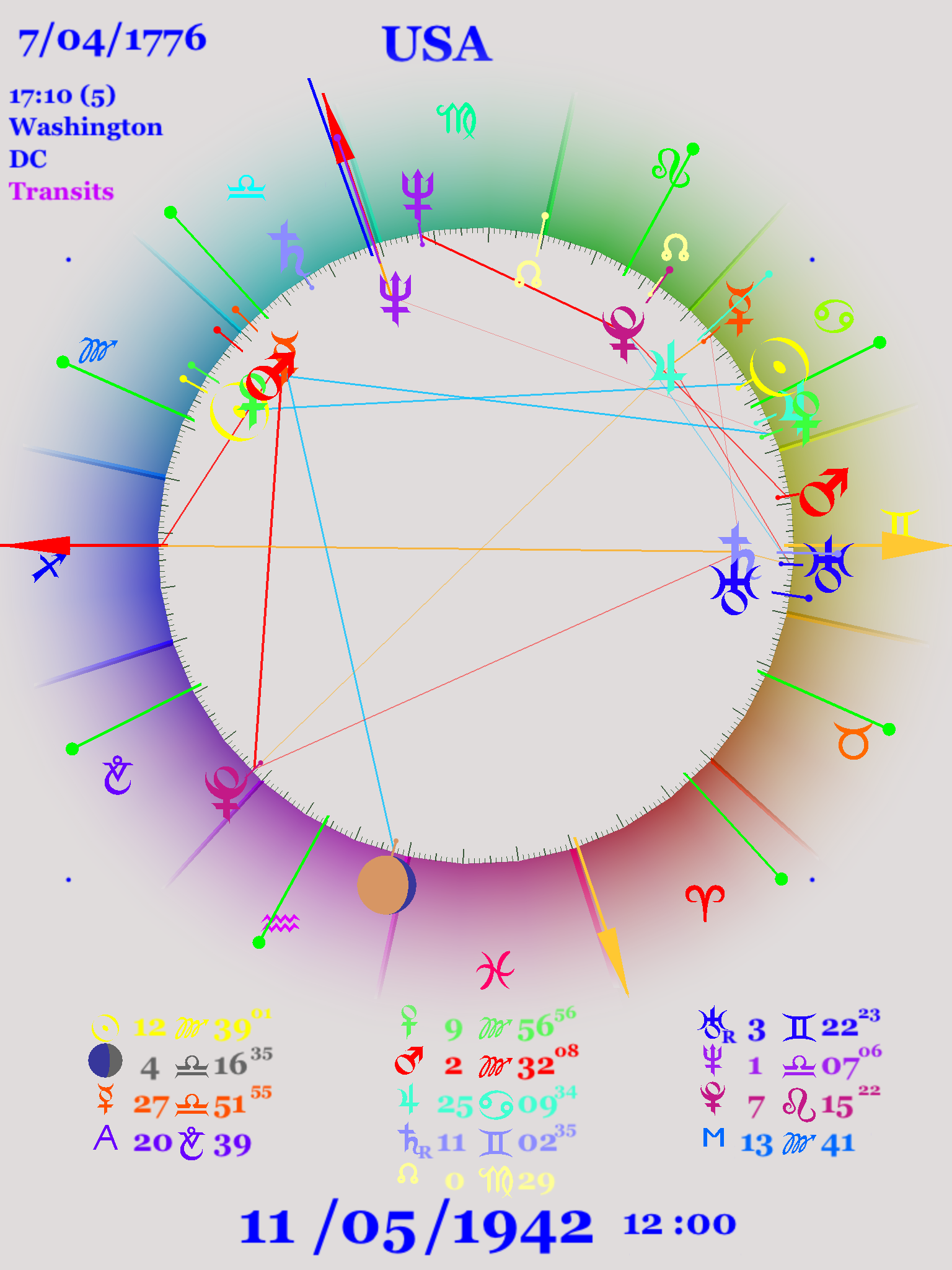
Let’s look at the World War II charts.  The first chart is for November 5, 1942, the first time Neptune conjoined the Midheaven of the United States in this cycle.  Then the second chart for World War II for August 6, 1944, one year to the day before the dropping of the atomic bomb on the Japanese city of Hiroshima, the first pass of Uranus to the Descendant of the United States.  Also Neptune is very close – one degree beyond – the Midheaven.  This was again one Uranus cycle, and one-half a Neptune cycle since the Civil War.  The pattern repeats itself.  Notice how the Neptune aspect now takes place before the Uranus aspect.  The Descendant is where energy comes in to you from outside, and so Uranus on the Descendant suggests disturbance, upset coming into the country, like for example a war.  At least it was in the four cases we looked at.  Since we have only the United States as an example, and only five cases to draw upon, we can’t draw a definite conclusion.  But in every case there was, the correlation was exact.

What we have seen are five crises, starting at the birth of the colony at Jamestown and occurring every 80 to 90 years with increasing death, violence, and geographical spread, involving the United States.  The obvious question is when will this pattern happen next.  As you may already suspect, this is coming up soon, and this is one of several cycles that are coming due at about the same time.  We will leave for later the exploration of the exact date; but first, we must look at another cycle of great importance.

But how will the next turn of the Uranus/Neptune cycle manifest?  One might expect another war, even bigger than World War II.  This reasoning was what caused The Fourth Turning‘s notoriety during the election.   Several possibilities: Aliens from outer space will invade and the nations of the world will band together to fight them.  A bit fanciful, then perhaps it will be an asteroid that will be expected to hit the earth and the nations of the world will band together to fight it.  Or perhaps it will be a world wide fight between the 1% and the 99% since inequality will have become so much worse than it is now.  Several people consider the state of the United States so divisive and contentious – the term used is polarized — that a new civil war is expected to break out, so that is another possibility.  This period could see the Third World War, more horrible that the Second which occurred 84 tears before.  Or perhaps this will see the final collapse of the ecosystems of the world.  But since I’m an optimist (Jupiter conjunct Sun) my best guess is that the nations of the world will finally decide that the global crises are so ominous that they need to band together in a World War II-scale attempt to fight for the survival of the planet.  Of course it should have been done in the 1980s.  There is much more that needs to be said about this period, one of the most important of at least the 21st Century, but we need to have more background.  If this is the type of crises we will face in a few more years, it suggests that many things will happen between now and then to make the countries of the world think that that type of world wide response is finally necessary.  And they are, you need just to look around with eyes unblinded, which is difficult with the constant bombardment of information that we daily receive.  But the signs are all around, we just have to see them through all the chaff.

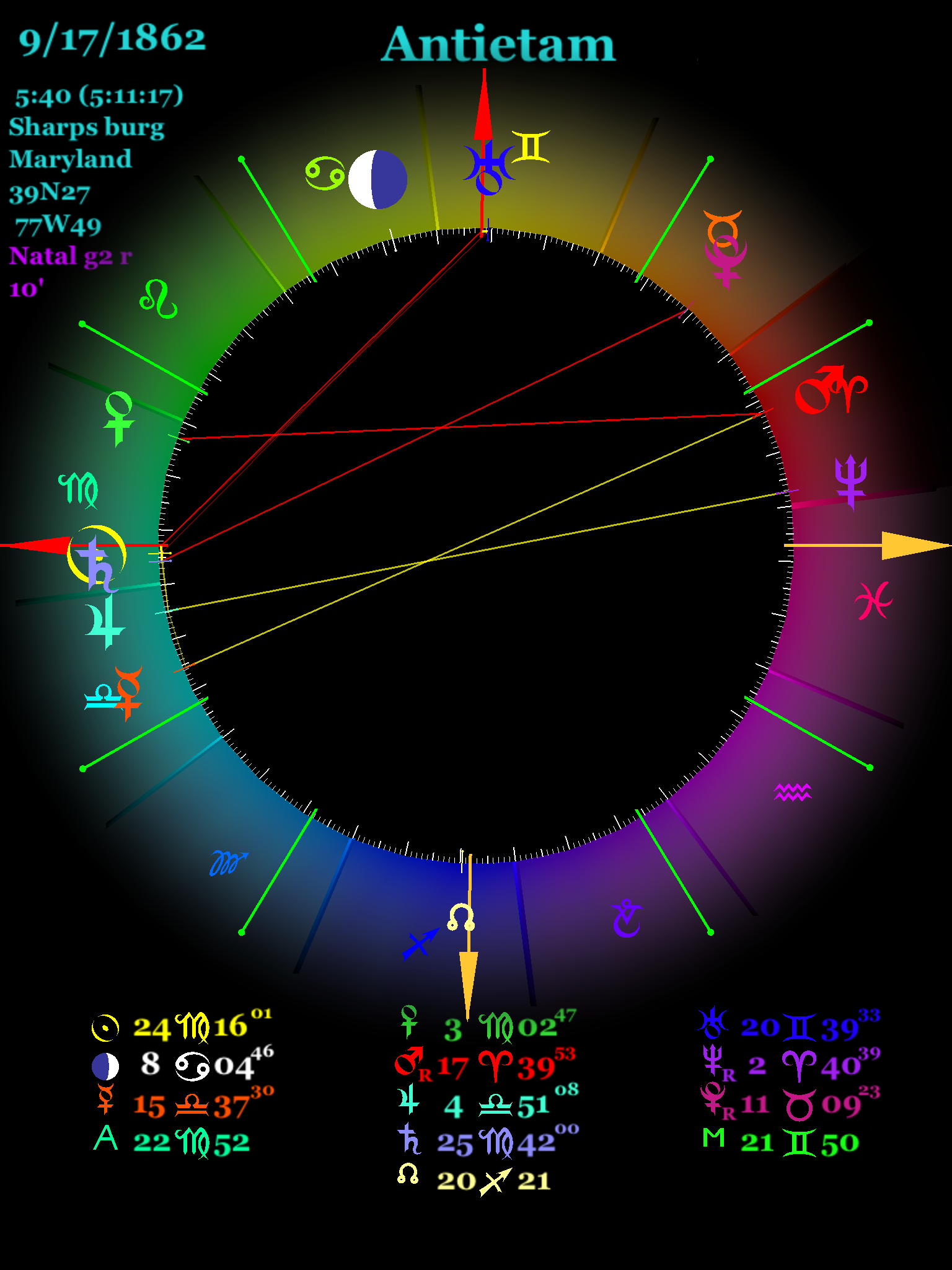
Antietam

The battle of Antietam, also called the Battle of Sharpsburg since it was fought near Sharpsburg, Maryland, was an important battle in what is commonly called the Civil War of the United States.  The Civil War is a term mostly used by descendants of the Union side; the preferred term for the descendants of the Confederacy is “War Between the States”.  In actually, this wasn’t a real civil war, since in the case of a civil war two powers are trying to take over the government; but in this case one power wanted to leave the government.  We see many of these in current times, resulting in Eritrea and Ethiopia, South Sudan and Sudan, and potentially Scotland and Great Britain and Basque and Spain.

The Battle of Antietam is considered the bloodiest day in American History, though a natural disaster in Galveston did claim more lives thought over more days.  It was fought in the state of Maryland on September 17, 1862.  The battle was started before dawn on that day, which gives us a time upon which to draw a chart.  Twenty thousand men were killed, wounded, or missing as a result of that battle.  Even though the battle is seen now as a draw, neither the Union or Confederate sides getting a victory, it was enough to cause the President Abraham Lincoln to feel confident enough to issue a preliminary Emancipation Proclamation, that at last reveled the true nature of the Civil War.  This document allowed Great Britain, who had been thinking of recognizing the Confederate side, even though the UK had emancipated its slaves in 1833, to finally decide that the Union side was the one to back in the country that had been its colony less than 100 years previously.

Sharpsburg is on the Antietam creek, a tributary of the Potomac; it is about a mile north of the Potomac and about fifty miles west of Washington, DC so it was very close to the seat of the Union government and home to President Abraham Lincoln.  Antietam was the first large scale battle to take place in the East where the Confederate soldiers had invaded the Union territory.  This was one of the reason it is considered a important battle, and why it was considered Union victory, even though it wasn’t.  The leaders of the two side were George McClellan of the Union side and Robert E. Lee from the Confederacy.  Even though Lee’s forces were outnumbered, McClellan thought that his forces were outnumbered.  Because of McClellan’s lack of aggressiveness in this and other battles, he was soon relieved of his duties by Lincoln.  The battle is famous for another, more gruesome reason.  Photography had been invented during the Uranus-Neptune conjunction forty years before, and Mathew Brady is famous for photographing scenes from the Civil War.  The photographer Alexander Gardner was working for Brady and in this battle he captured the first photos of dead people where they fell in battle. These were shot in 3-D, Gardner’s standard at the time, and they were shown in Brady’s gallery in New York City and were available by mail order from a catalog.  One can try to imagine the sight of dead American bodies seen by citizens in their parlors — it was quite a shock and truly brought home the carnage of the War to people.

antietam

The Battle Starts


This first chart is an event chart for the beginning of the battle.  According to accounts, the troops started before dawn.  I’ve set this chart for a few minutes before the Sun hit the Eastern horizon: 5:40AM.  I did not see before I did the chart that Uranus was exactly on the Midheaven at that time, which is certainly appropriate for a battle where there is much excitement and changeability.  Mars, of course, is in the Seventh house where the enemy would be met.  Neptune is also there — the fog of war and McClellan’s mistake about Confederate troop strength.  The Sun is square Uranus, which would occur all day.  There is a very tight (under one half degree) sesquiquadrate between Saturn and Pluto.  We have discussed before the tragic consequences that befall the nation and the world under a hard aspects between Saturn and Pluto, and here we see it again.  The Sun is conjunct Saturn — much hard work on that day, but Jupiter is in the first house, and indeed the outcome — the Emancipation Proclamation — was positive.  There are two clear oppositions from the first to the seventh houses — Mars opposite Mercury — angry words — and Jupiter opposed to Neptune — apparent happiness.

antietan_later

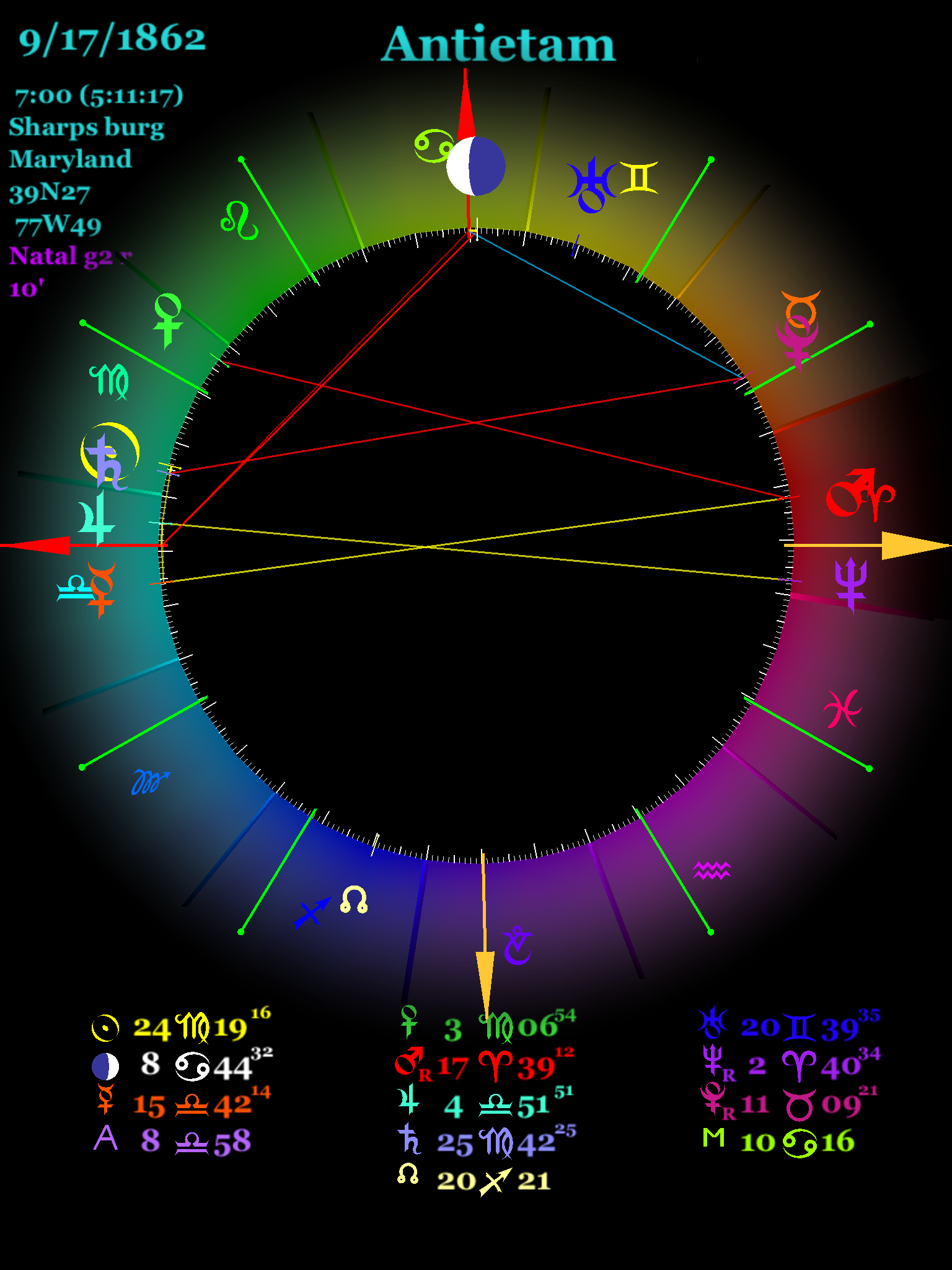
Later That Morning


Here is a chart drawn for 7 that morning.  You can see that the Sun has already risen, but it is still square Uranus.  This chart shows that the last quarter Moon is at the Midheaven in the early morning, where it would be visible.


antietam_usa

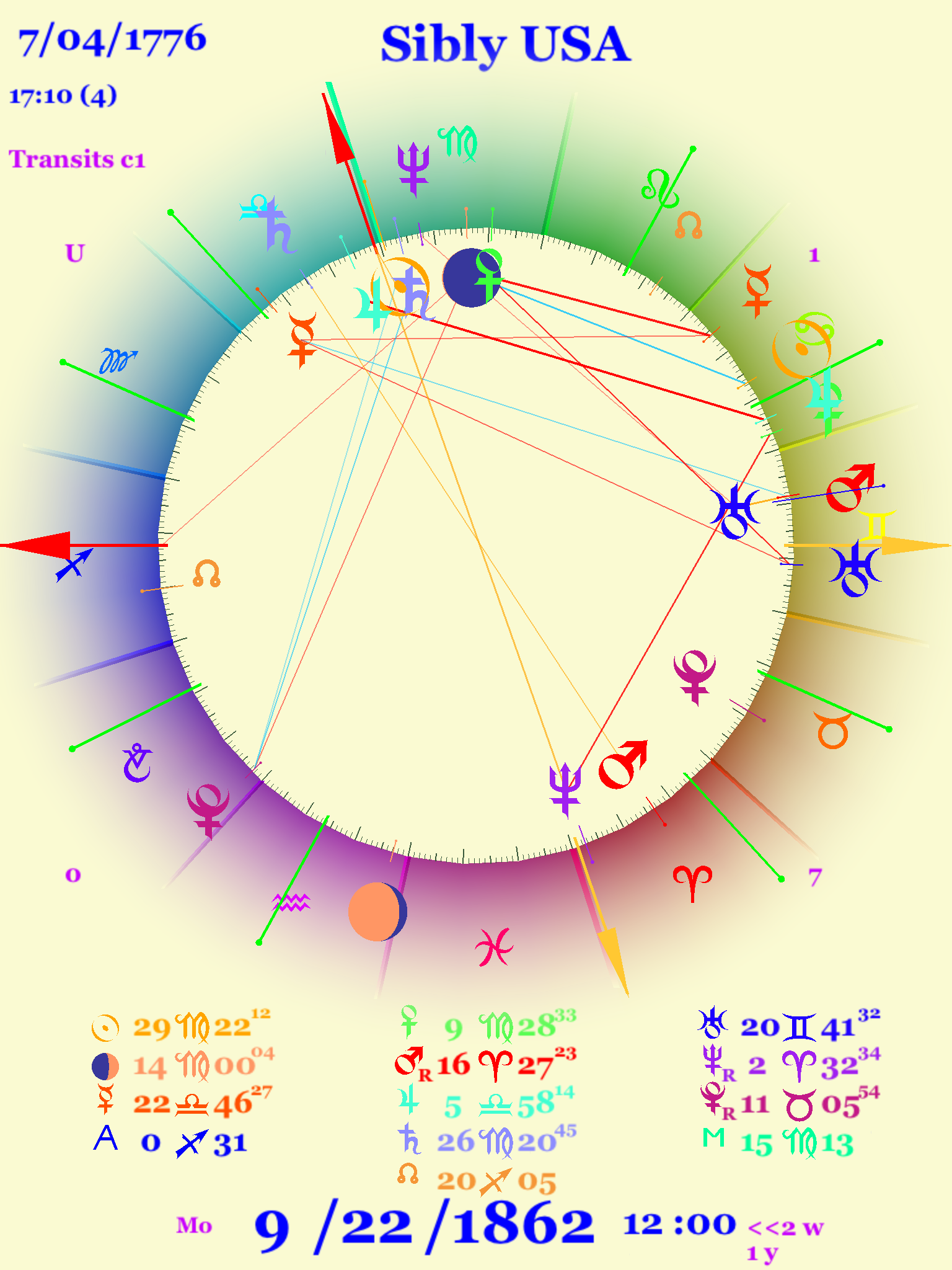
Antietam-USA


And here is a chart for this event within the USA natal chart, where we can see the effects of the battle on the country.  That sun conjunct Saturn is near the top of the chart – the exact conjunction of the Sun with the US Midheaven is about a week later — this is high noon for America for the year.  Neptune is opposite the MC, indicating the the Civil War is a generational crisis of the country.  Probably the most obvious aspect is transiting Uranus conjunct the Mars of the United States, Uranus inflaming the martial spirit of the country, and it has been pointed out this was an important battle where the Confederate troops first invade the North and got near to the capital.

emanc_proc

Emancipation Proclamation


And finally here is a chart for when Abraham Lincoln signed the Emancipation Proclamation.  You can see the Sun has now moved to be conjoined with the MC — this is the crowning point of the year for the US.  And we can see that Venus is conjunct the Moon at 12 noon, which is a good guess for when the bill was signed.  In this case Venus represents Justice, which by signing this bill Lincoln was assuring for the slaves that were affected — those living in states which were in conflict with the Union.  The Moon is almost New — which would happen in a little over a day — signifying  as New Moons do the start of a new cycle.

The Wars of America – Part I

In general, American history is divided into four periods: before the Revolutionary War, from the Revolutionary War to the Civil War, from the Civil War to World War II, and after World War II. This division is not just arbitrary. Obviously there was a big change to the country after it declared itself independent from Great Britain and successfully fought a war to achieve that end. The Civil War allowed former slaves to “vote” and the many industries who had made a profit during the war, and specifically the railroads, were able after the war to continue to get very big and dominate the country – the appropriately named (First) Gilded Age was the result. And after the Second World War the defense industries that were empowered during the War were able to continue their growth with the convenient rise of the Cold War. Many technologies that were developed for the war were put to peace-time use which resulted in a more technological-oriented society.

So below we will look at the astrological patterns that existed during all three of these boundary events, the three wars that defined America. One can think of the first period as one of youth, the second period as one of adulthood, and the third period, the one we are in now, as the period of maturity.

The official dates for the Revolutionary War are from the Battle of Lexington and Concord (April 19,1775) to the surrender at Yorktown (October 19, 1781). The dates for the American Civil War are from the firing on Fort Sumter (April 12, 1861) to the surrender at Appomattox court house (April 9, 1965). The dates for American participation in World War II – the Americans were definitely late to the party – is measured from the attack on Pearl Harbor (December 7, 1941) to the surrender of Japan (Germany had surrendered 4 months earlier) on September 2, 1945. One notices that the wars got larger – more participants and over a larger area — and more bloody over time.

Image


Image


This first image for June 23, 1777 is not, as far as I know, a stand out date in the Revolutionary War. Notice that all three outer planets are near their birth locations. This is not surprising, considering that this chart is less than a year after birth. What the chart does show is that Uranus is passing over the Descendant and on this date is exactly opposite the Ascendant for the first time since birth. Again, not surprising since the natal position of Uranus is close to the Descendant. Whereas the Ascendant relates to the personal projection – a good synonym is persona – the Descendant is the opposite point, and indicates how we relate to the outside world. In personal astrology, this often is used to refer to the partner or people one draws to oneself or open enemies. In either case, it refer to energy coming to us from outside, which can easily be seen as a war which also comes to us. In the second chart, for November 23, 1778 we see that Neptune has come to the Midheaven of the United States. The Midheaven refers to the way the country relates to the outside world, one can see it as a public persona as opposed to the private persona of the Ascendant. I am at a loss for an interpretation of Neptune on the Midheaven that would relate to a war. The symbolism would suggest that our public image is unclear, uncertain, foggy. Perhaps this is just an effect of Neptune having almost exactly twice the period of Uranus (84 vs. 165 years) and Uranus-Descendant is the operative aspect.

Image

Let’s move on the the Civil War. Here there is only one chart, for March 11, 1962. The war had started almost a year earlier. We see both Uranus opposite the Ascendant as in the first Revolutionary War chart, and Neptune conjunct the IC (Imum Coeli – the Bottom of the Sky) of the United States chart, opposite the Midheaven. This is about one Uranus cycle, 84 years, after the first chart. The fact that Neptune is now opposite the earlier position (the second chart for November 23, 1778) is not surprising since the period of Neptune is almost exactly double that of Neptune. Note also that since the natal Uranus is close to the Descendant and the natal Neptune is close to the Midheaven, these periods are also close to a Uranus return and a Neptune bi-return. But we do see a pattern.

Image


Image

Let’s look at World War II. The first chart is for November 5, 1942, the first time Neptune conjoined the Midheaven of the United States on this cycle. Then the second chart for World War II for August 6, 1944, one year to the day before the dropping of the atomic bomb on the Japanese city of Hiroshima, the first pass of Uranus to the Descendant of the United States. Also Neptune is very close – one degree beyond – the Midheaven. This was again one Uranus cycle and one-half a Neptune cycle since the Civil War. The pattern repeats itself.

The Descendant is where energy comes in to you from outside, and so Uranus on the Descendant suggests disturbance, upset coming into the country, like for example as war. At least it was in the three cases we looked at. Since we have only the United States a an example, and only three cases to draw upon, we can’t draw an overwhelming conclusion. But in every case there was, the correlation was definite.

In part two of this subject, we will look at examples of Uranus on the Descendant before the birth of the country to see if the patten holds. And we will look at the obvious – when will this pattern repeat again.