Zeitgeist Changes – Part 2

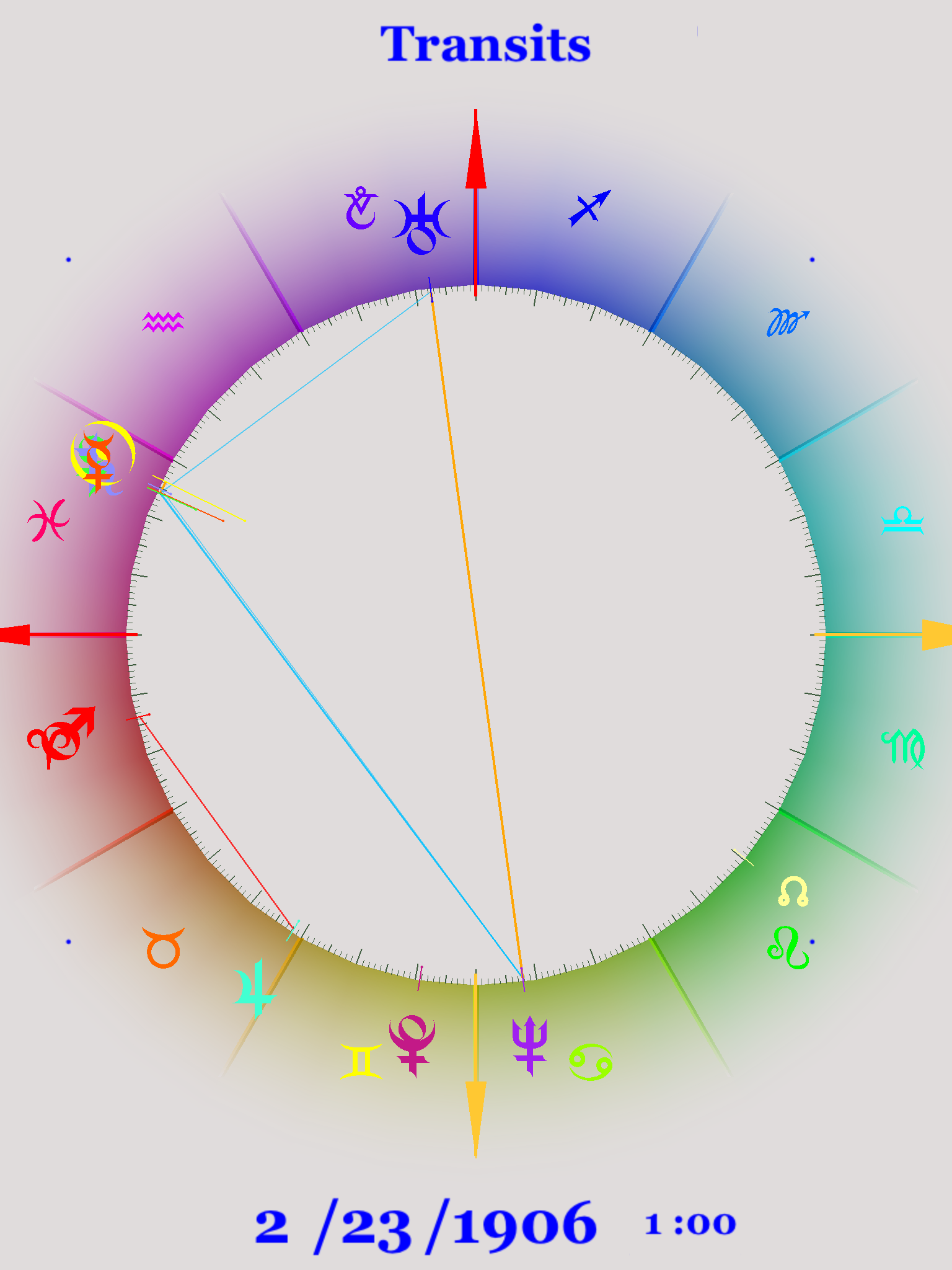
The first decade of the Twentieth Century was filled with many important aspects: The first was the Neptune-Pluto conjunction of the early 1890s; then Uranus opposite Pluto and then Uranus opposite Neptune; Neptune cardinal, then Uranus cardinal and finally Pluto cardinal.  But in the midst of this was Uranus at the midpoint of Neptune and Pluto 1901-1907.  This was  the first zeitgeist change of the Twentieth Century.

urmpnepl

Uranus at Midpoint of Neptune and Pluto


Now, living under the fruits of Modernism, the revolution in the early part of the Twentieth Century, we forget how revolutionary the changes of that period were to those accustomed to the relatively slow-paced life of the Nineteenth Century.  No one is alive today that remember those days.  And what a revolution it was.  Automobiles became increasingly poplar among people who were not wealthy, allowing people to move around at much higher speed than had previously been available for most. Electrification of urban areas allowed the use of nighttime hours, which had only been illuminated by oil or gas lamps.  Cinema was changing people’s perception of life by allowing scenes that had only been seen by few to be seen by many for only a small price.  Some art became totally abstract, and other art was somewhat representational but still widely different from conventional life.  Music took strange atonal paths.  And two great breakthroughs in science — special theory of relativity and quantum mechanics — changed the strictly mechanistic sense of the universe forever.  In psychology, people learned that human motivations was often pushed by unconscious forces that where not imagined previously.  And of course the introduction of the first mechanical airplanes were to change the world forever.  What follows are a few highlights of the revolutionary changes at the beginning of the Twentieth Century.

The first Russian Revolution took place in 1905; it wasn’t successful and made the Russians even angrier.  Then, after the disastrous World War I, they fought the second Russian Revolution of 1917, which was successful.

The Emperor of China, Puyi, who was the twelfth ruler of the Qing Dynasty, served as a child emperor for a few years.  A film was made about his life in 1987.  Born in 1906, he ruled from 1908 to 1912.  He was not only the last emperor of his dynasty, but in fact the last emperor of China.  The Twentieth Century was encroaching on China.  By the end of that century, China would be a place unrecognizable to Puyi.

The NAACP – then called the Niagara Movement, so called because the forming members were not allowed to eat in a hotel in the United States so they had to meet on the Canadian side of Niagara Falls – was formed in the United States in 1905.

The International Workers of the World, commonly known as the Wobblies, were formed in 1905 with the intent to be One Big Union.  They wanted all workers to join together to form a union, and were on the forefront of radical labor action, for which they paid a high price.

An Indian lawyer in South Africa by the name of Mohandas Gandhi, promulgated his doctrine of non-violent protest, called Satyagraha, on September 11, 1906.  This is often referred to as “the first 9/11” but has a much different meaning in history than what the phrase “9/11” usually refers to.  He later moved back to India where that doctrine changed the government.  His doctrine was also adopted by Dr. Martin Luther King in the United States, with far-reaching repercussions.

There were anarchist and syndicalist movements forming all around the world, such as in Korea, China, Japan, Mexico, Puerto Rico, Cuba, Peru, Brazil, Argentina, Egypt, and South Africa.  Details of this international anarchism are found in the book Anarchism and Syndicalism in the Colonial and Postcolonial World 1870-1940 edited by Steven Hirsch and Lucien van der Walt.

In America in 1904 there was one of the biggest ecological disaster that had ever happened in that country.  In that year started a chestnut bight that destroyed an estimated 3.5 billion chestnut trees in the country.  The cause was a fungus imported from Asia.  By the time the Great Depression hit America in less than 30 years the people of especially Appalachia were hit by this lack of food and lumber.

In the realm of science, two major theories were developed in this period which revolutionize science and our concept of the Universe, which up until that time had been based on theories of Issac Newton in the Eighteenth Century.  In the very small quantum mechanics was developed by Max Planck, Niels Bohr, Werner Heisenberg, Albert Einstein, and others.  In the very large the Special and General Theories of Relativity were developed by Albert Einstein with help by Max Planck and others.  Both these theories had profound implications and brought science beyond Newtonian physics.  And in 1912 the meteorologist Alfred Wegener developed theory of continental drift, which was immediately rejected only to be accepted a quarter of a century later.  The theory was first suggested in the late 16th Century under a Uranus-Pluto conjunction. Also in the first decade of the Twentieth century scientists like Henri Becquerel, Ernest Rutherford, and Marie Curie made discoveries that laid the foundation for the atomic bomb.

But there were also big changes in our concept of the interior world, lead by Sigmund Freud and Carl Jung, who first communicated in 1906.  There were many others developing the new fields to explore the mind, such as psychoanalysis and psychotherapy.  The concept of the subconscious and the interest in analyzing dreams were just two of the ways their ideas changed the world.


picasso2

Les Demoiselles d’Avignon

nude_no2

Nude Desdendnig a Staircase No.2

kandinsky_improvisation_x

Improvisation-x Kandinsky

kandinsky_pict_whith_white_form

Picture With White Form – Kandinsky

malevich_samovar

Samovar – Malevich

malevich_suprematism_eight_rectangles

Suprematism Eight Rectangles – Malevich

luigi-russolo-dynamism-of-a-car

Dynamism of a Car – Luigi Russolo

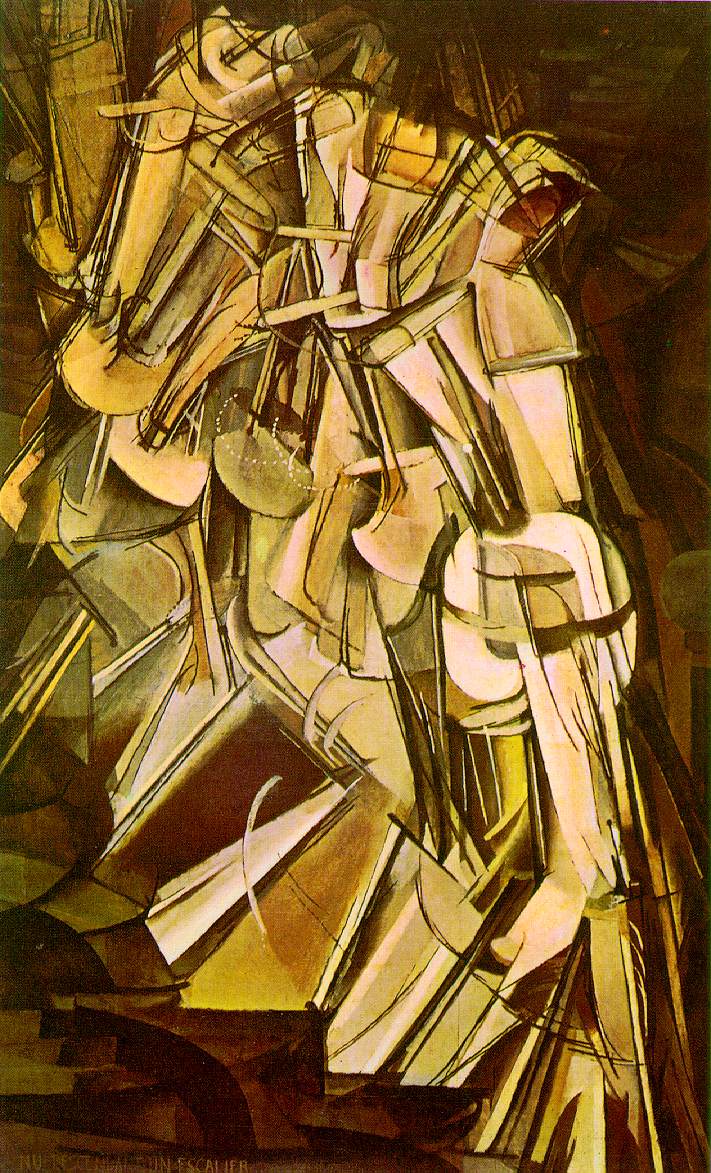
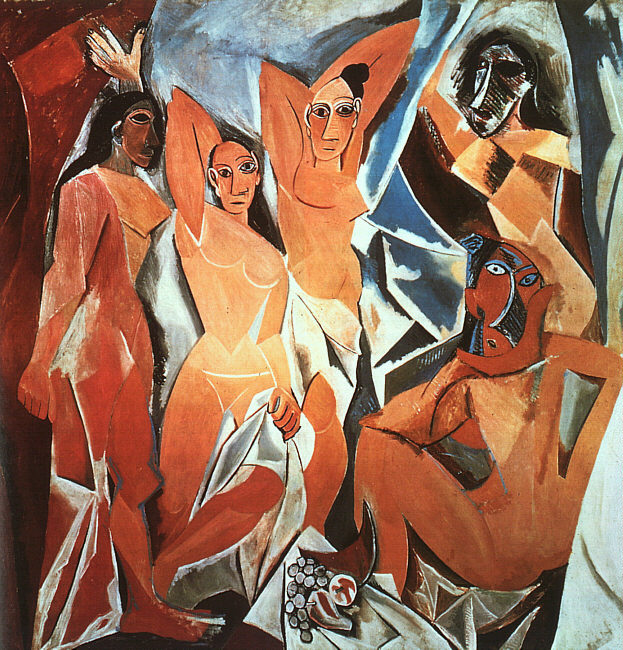
The art world also saw a big burst of change.  The Spanish artist Pablo Picasso and the French artist Georges Braque were starting their careers which would lead to the school of Cubism.  Picasso’s painting Les Demoiselles d’Avignon from 1907 shocked and scandalized the art world.  Also at this time an artist who is considered one of the best of the Twentieth Century, along with Picasso, was at work. This was Henri Matisse.  Marcel Duchamp, who later would be famous in the world of Dada, created the painting called Nude Descending a Staircase, No. 2, which was shown in 1912.  In Italy the movement know as Futurism was developed.  The artists of this school were enchanted by the speed of cars and planes, of the new world forming at the beginning of the century.  In Russia what has been called the Russian avant-garde was developing.  The best known artists of this school were Wassily Kandinsky and Kazimir Malevich but there were many others. They took abstraction far beyond the ideas of Picasso and Duchamp.

Among writers there were James Joyce, who often considered the outstanding author of the Twentieth Century, and Virginia Woolf and the Bloomsbury Group.  Upton Sinclair and Jack London were publishing novels that shook up the view of the world.  And don’t forget L. Frank Baum and his Wonderful Wizard of Oz, rumored to be a political parody, which is still influential.  Theodor Herzl published his idea of Zionism, whose influence is felt strongly 100 years later.

The development of computers took a step forward with the work of Herman Hollerith. He developed the 80-column punch card that could be used to tabulate data automatically.  This device was used to automate the 1890 census, speeding up the time it took to finish the count by a factor of eight.  He founded a company which was later merged to form IBM.  The use of 80 columns was popular in the computer field through the Eighties.

But then an even more important development necessary for the whole modern electronic age happened in the middle of the first decade of the Twentieth Century.  This invention is little remembered today, thought it is as important as others that are still heralded.  This device was the audion or triode, invented by Lee de Forest (called the Father of the Radio) in 1906.  I found him mentioned in a book called The Shallows by Nicholas Carr, which has further references.  The audion was an amplifier for electric currents, and made possible radio and long distance telephone calls, which would otherwise be limited by weak signals.  Vacuum tubes were extremely important in the first electronic computers, invented under the second zeitgeist change of the Twentieth Century, and when miniaturized into transistors, were important in the second generation of electronic computers, developed in the Fifties.

Cars were becoming increasingly popular in the first decade of the Twentieth Century. This popularity was greatly helped by the introduction of the first affordable automobile, the Model T Ford in 1908.  This automobile was released by the Ford Motor Company of Detroit Michigan and not only allowed the middle class to afford an automobile, but provided employment to many, including recent immigrants to the United States and Blacks fleeing the Jim Crow South.  The implication of the automobile were profound but they weren’t realized for many years.  All of the gas burned polluted the atmosphere causing the greenhouse effect, and people stopped moving, leading to many diseases of inactivity.  As a result of the widespread use of the automobile large stretches of open land have been paved over, for highways, parking lots, and driveways—personal parking lots for each home.  In fact , some homeowners associations require all houses to have driveways, whether or not they are used.  If an alien viewed Earth, the alien might believe that automobiles are the dominant life-form on the planet.  These automobiles are attended to by small symbiotes who feed them and keep their outsides clean, and buy them fuzzy dice and dashboard mascots, in exchange for which the small symbiotes are taken places by the automobiles.

Motion pictures were developed during this period.  People like Edison in 1891 and Lumiere in 1895 developed a way of projecting a picture onto a screen: if this was done often enough the human brain would not see individual frames but rather continuous motion.  But by the early years of the Twentieth Century motion pictures became wildly popular as the art of cinema developed and people no longer had to be content with images of simple motion.  By the middle of the first decade of the XXth Century feature films – films longer than one reel – were being produced.  At the same time actors began to get credit and production companies were organized.

But it was not only motion pictures that became increasingly popular, but still pictures that could be taken by an individual.  Today when many people carry camera with them on their cell-phones, we forget what a breakthrough this was since before this time photography was a difficult process not suitable for someone not truly interested in the act.  This change was due to George Eastman and his introduction of the Brownie camera in 1900 with the motto “You push the button, we do the rest”.

The development of the airplane, most famously by the Wright Brothers, in the first decade of the new century, revolutionize life.  Another person famous in the history of powered flight, who may also have a claim to the first flight, is Glenn Hammond Curtiss, who made the first officially witnessed powered flight and founded the aircraft industry. The names of both these pioneers lives in the name of the current aerospace company Curtiss-Wright Corporation.  The dream of flying like a bird had been a long one for mankind, as the myth of Icarus suggests.  It was given a boost with the development of hot-air balloons by the Montgolfier brothers in 1783, allowing humans to float over Paris. But by the Twentieth Century powered flight came into being, and there were many developments after that in the field.  This allowed humans to move easily from place to place around the world, and also, as an unforeseen consequence, to transfer all types of animals and microbes from one part of the world, where immunity existed, to other parts of the world where that particular disease had never been seen.   We are living with the consequences.

Music also changed in this period.  Igor Stravinsky changed music with his Rite of Spring, first performed in 1913.  The production was shocking, and the use of chords changed the way future composers looked at music.  There was also a Futurist movement in music with many of the same origins as in painting.  Charles Ives was one of the first American composers to be known throughout the world.  The French composer Edgard Varese was relatively unknown at the time, but he has influenced many such as the rock artist Frank Zappa.  Sergei Prokofiev was another composer who broke away from the Nineteenth Century.

Another important change for the United States and the rest of the world was that in this period — specifically 1899 — the United States made the conscious decision to become an empire.  Full details are given in the recent book by Stephen Kinzer The True Flag.  In the aftermath of the Spanish-American war, the United States came into possession of colonies: Cuba, Puerto Rico, Guam, and the Philippines.  In the latter, the US was engaged in a fierce struggle to hold on to the islands  against the natives who for some reason did not want to be governed by another foreign power.   The American Anit-Imperialist League was founded to battle this war, and had prominent members such as Mark Twain,  William James, and Andrew Carnegie.


Here we see two charts: One for the explosion of the battleship Maine in the Havana  Harbor, thus beginning the Spanish-American War.  The  second chart is for the explosions on 9/11, thus beginning the War on Terror.  Notice they are the reverse:  The first chart has Pluto on the Descendant of the United States opposite Saturn, indicating an explosion outside the country.  The second chart has Pluto opposite Saturn again, but this time Pluto is on the Ascendant, indicating an explosion in the country.  I see these two events/charts as booklends to the American Empire.

The period 1900-1913 saw the greatest immigration in to the United States.  People from other countries were seeking a new home in the United States, and often working at low paying jobs and living in tenements that had developed in larger cities, unlike the immigrants of earlier times that formed homesteads in rural territories.

This period saw changes in the commercial sphere as well.  The first Sears catalogs had appeared at the end of the Nineteenth Century; they were the Amazon.com of the day, allowing people to look at many products within the comfort of their homes.  The early Twentieth Century saw the improvement of the catalog, which reached more people.  The cash only department stores, that catered to the urban population (still a minority in a country that was basically rural), started to allow products to be bought on the installment plan, which meant that consumers could buy products that were previously unavailable to them because of prices that were beyond their budget.  This  practice of installment buying led to problems during the Great Depression a quarter century later.


plcard1914

Pluto Crosses Cardinal Axis


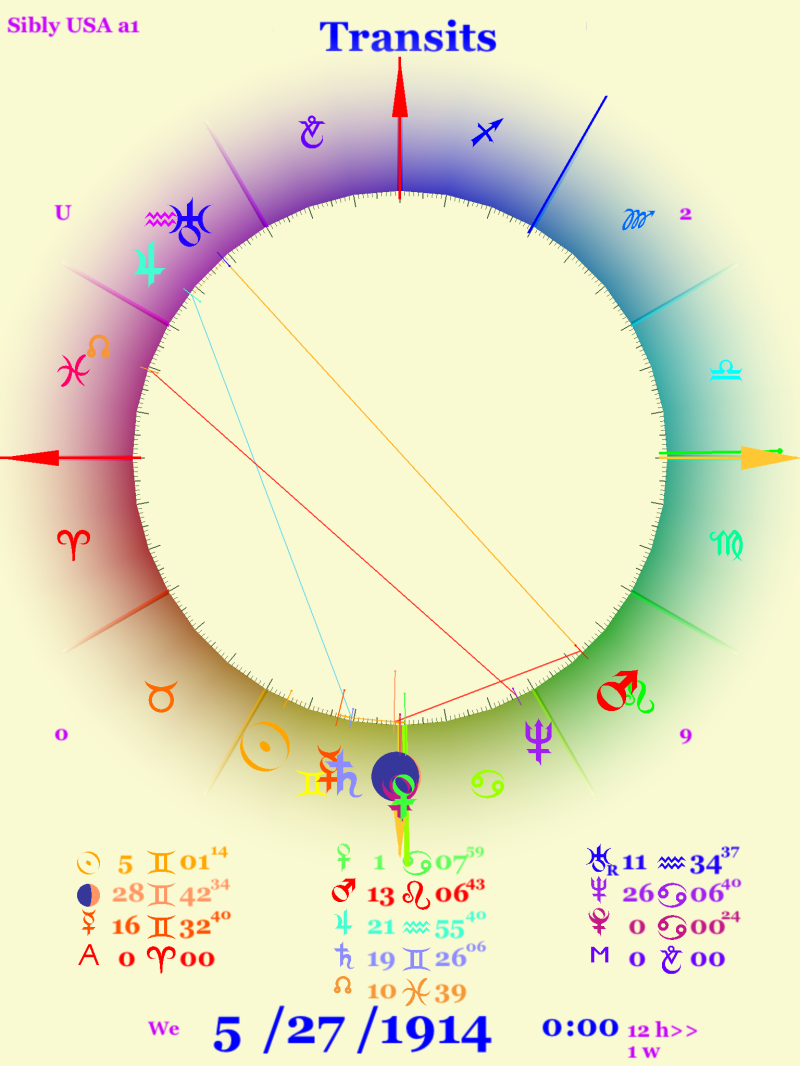
But this whole period of growth was brought to an end by another astrological configuration: Pluto crossed into Cancer.  In Uranian astrology, the world horoscope is based on the cardinal cross: 0 of Aries, Cancer, Libra, and Capricorn.  These form the foundation of the world, hence the term “World Horoscope”.  This is also the basis of the tropical astrological signs.  And Northern Hemisphere centric, they place 0 Cancer at the Tenth house cusp, because the Sun is the highest then in the northern hemisphere. When these outer planets, especially noticeable with Pluto, cross this axis, the world is changed: one example: when Pluto crossed into Capricorn in 2007-09, the world experienced what is called the Great Recession.  Five hundred years before that, at a similar ingress, the Reformation began.  Half way between the two, also a Capricorn Ingress of Pluto, the English defeated the French in Canada during the Seven Years War, and thus became the dominant power in a unipolar world.  In 1914, Pluto made several entrances into Cancer, and within a month of one of those, a royal couple was shot in Sarajevo, igniting the First World War and thus ending the developments of the first decade and a half, under this midpoint of Uranus, Neptune, and Pluto.

Much of this entry was previously published in “Modernism and the Start of the Twentieth Century”;  I have plagiarized several paragraphs.

The major changes of this period are so ingrained in the modern world that there is little controversy about them.  Not so for the next  two zeitgeist changes of the Twentieth Century.  These are still close to the current era, and their effects are still prominent in the current world.

Modernism and the Birth of the Twentieth Century

I define Modernism as more than an art form, which was merely the outward manifestation of the changes that were taking place in civilization.  A number of events, both physical and astrological, defined the birth of the XXth Century, and the changes start before the official date.

In this entry I will start the beginning of the “Twentieth Century” at 1886.  This was before the first major aspect, the twice a millennium conjunction of Neptune and Pluto.

The memorable event of 1886, which is stills as relevant  today, if not more so,  was the Supreme Court ruling know as Santa Clara County v. Southern Pacific Railroad.  The upshot of this decision, even though it wasn’t in the actual decision, is that corporations are people as far as the Fourteenth Amendment goes.  In fact, the Fourteenth Amendment was applied more often to corporation than to the freed blacks that it was intended for.

nepl

Neptune-Pluto Conjunction

The 1890s saw the rise of Corporate Capitalism, the third period of that financial system.  (I am indebted to the historian William Appleman Williams and his book Contours of American History for the  terms for the first three stages of capitalism.  Since the book was published in 1968 he missed  the next two stages which will be described at a later time.)  This  was an entirely different beast from laissez  nous faire  (William’s term) capitalism – leave us alone.  Laissez faire is the mythic system of capitalism that grew up in the 1820s  (we’ll look at the astrological signifiers at a later date) after Adam Smith published The Wealth of Nations in 1776. Often when  people refer to the glories  of capitalism they are thinking of this type of capitalism that has long since gone.

Corporations became increasingly powerful in the 1890s, for example (in the United States)  U. S. Steel (Andrew Carnegie) and Standard Oil (John D. Rockefeller).  The “Trusts” that Progressive politician like Theodore Roosevelt wanted to bust grew up on this period.  The Uranus-Neptune conjunction took place near the Descendant of the United States, which is why the United States was so strongly affected by this Corporate Capitalism.

Another important event of this period was that the United States got an  empire, not just in the Caribbean (Cuba, Puerto Rico) but in Asia (Philippines, Guam).  This started with the Spanish-American War of 1898, America’s first major venture into the outside world, after the North American continent had been conquered and the native population successfully  put down.  The Open Door Policy (Secretary of State John Hay)  gave notice to the rest of the world  that America was a world power, and it would soon surpass Great Britain as the dominant power in the world.

In this period the world  was changing rapidly through electric lighting  (Thomas Edison 1879), the telephone (Alexander  Graham Bell 1876), and the box camera (George Eastman 1900).

In this period there were not only crossings of the cardinal axis by all three outer planets, but there were two important oppositions that describe so much of what was going on in the world at the dawn of the Twentieth Century.  The Uranus opposite Pluto was strongest in the first half of the first decade of the new century, and the Neptune opposite Pluto was strongest during the second half of the decade, extending through a few years of the second decade.   This period was filled with all kinds of  changes, which I will briefly outline below.  A good description of this period is found in many books, such as The Vertigo Years by Philip Blom.

A brief list of the important event in this period:

The first Russian Revolution took place in 1905;  it wasn’t successful and made the Russians even angrier.  Then,  after the disastrous World War I, they fought the second  Russian Revolution of 1917, which  was successful.

The  Emperor of China, Puyi, who was the twelfth ruler of the Qing Dynasty, served as a child for a few years.   A film was made about his life in 1987.  Born in 1906, he ruled from 1908 to 1912.  He was not only the last emperor of his dynasty, but in fact the last emperor of China.  The Twentieth Century was encroaching on China.

The NAACP – then called the Niagara Movement, so called because they were not allowed  to eat in a hotel in the United States so they had  to meet on the Canadian side of Niagara Falls  –   was formed in the United States in 1905.

The International Workers of the World, commonly known as the Wobblies, were formed in 1905 with the intent to be One Big Union.  They wanted all workers to join together to  form a union, and were and the forefront of radical labor action, for which they paid a   high price.

An Indian lawyer in South Africa   by the name of Mohandas Gandhi, promulgated his doctrine of non-violent protest, called Satyagraha,  on September 11, 1906.   This is often referred  to as “the first 9/11”  but has a much different meaning in history that what the phrase “9/11” usually refers   to.  He later moved back to India where that doctrine changed the government.   His doctrine was also  adopted by Dr. Martin Luther King in the United States, with far-reaching repercussions.

There were anarchist and syndicalist movements forming all around the world, such as in Korea, China, Japan, Mexico, Puerto Rico, Cuba, Peru, Brazil, Argentina, Egypt, and South Africa.  Details of this international anarchism are found in the book Anarchism and Syndicalism in the Colonial and Postcolonial World 1870-1940 edited by Steven Hirsch and Lucien van der Walt.

In America in 1904 there was one of the biggest ecological disaster that had ever happened  in that country.  In that year started a chestnut bight that destroyed an estimated     3.5 billion chestnut trees  in  the country.  The cause was   a fungus imported from Asia.  By the time the Great Depression hit America in less than 30 years   the people of  especially Appalachia   were hit by this lack of food and lumber.

In the realm of science, two major theories were developed in  this period which revolutionize science and our concept of the Universe, which up until that time had been based on theories of Issac Newton in the Eighteenth Century.  In  the very small quantum mechanics was developed by Max Planck, Niels Bohr, Werner Heisenberg, Albert Einstein, and others.  In the very large  the Special and General Theories of Relativity were developed by Albert Einstein with help by Max Planck and others.  Both these theories  had profound implications and brought science beyond Newtonian physics.  And in 1912  the meteorologist Alfred Wegener developed  theory of continental drift, which was  immediately rejected only to be accepted a quarter of a century later.  The theory was first suggested in the late 16th Century under a Uranus-Pluto conjunction.  Also in the first decade of the Twentieth century scientists like Henri Becquerel, Ernest Rutherford, and Marie Curie made discoveries that laid the foundation for the atomic bomb.

But there were also big changes in our concept of the interior world, lead by  Sigmund Freud and Carl Jung, who first communicated in 1906.  There were many others developing the new fields to explore the mind, such as psychoanalysis and psychotherapy.  The concept of the subconscious  and the interest in analyzing dreams were just two of the ways their ideas changed the world.

Les Demoiselles d'Avignon

Les Demoiselles d’Avignon

The art world also saw a big burst of change.  The Spanish artist  Pablo Picasso and the   French artist Georges Braque were starting their careers which would lead   to the school of Cubism.  Picasso’s painting  Les Demoiselles d’Avignon from 1907 shocked and scandalized the art world.   Also at this time an artist who is considered one of the best of the Twentieth Century, along with Picasso, was  at  work.  This was Henri Matisse. Marcel Duchamp, who later would be famous in the world of Dada, created the  painting was Nude Descending a Staircase, No. 2, which was shown in 1912.  I  did not see this  clearly until I saw a stroboscopic picture by Gjon Mill of a figure descending.   Duchamp had captured  the idea of strobelights long before they were actually used.

Nude Desdendnig a Staircase No.2

Nude Desdendnig a Staircase No.2

In Italy the movement know as Futurism was developed.  There was recently a show of art from this school at the Guggenheim in New York.  The artists of this school were enchanted by the speed of cars and planes, of the new world forming at the beginning of the century.

Improvisation-x Kandinsky

Improvisation-x Kandinsky

Picture With White Form - Kandinsky

Picture With White Form – Kandinsky
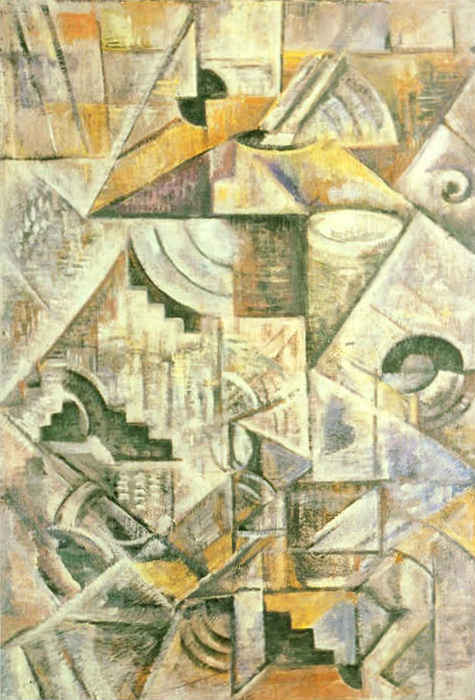
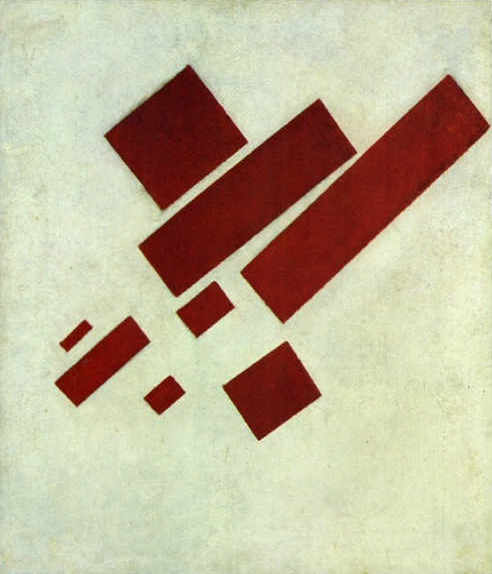
In Russia  what has been called the Russian avant-garde was developing.  The best known  artists of this school  were Wassily Kandinsky and Kazimir Malevich  but there were many others.  They took abstraction far beyond the ideas of Picasso and Duchamp.

Samovar - Malevich

Samovar – Malevich

Suprematism Eight Rectangles - Malevich

Suprematism Eight Rectangles – Malevich

Among writers there was James Joyce,   who often considered the outstanding author of the Twentieth Century, and Virgina Woolf and the Bloomsbury Group.  Upton Sinclair and Jack London were publishing novels   that shook up the view of the world.  And don’t forget L. Frank Baum and his Wonder Wizard of Oz, rumored  to be a political parody, which is still influential. Theodor Herzl published his idea of Zionism, whose influence is felt strongly 100 years later.

The development of computers took a step forward with the work of Herman Hollerith.   He developed the 80-column punch card that could be used  to tabulate data automatically.  This device was used to automate the 1890 census, speeding up the time it took to finish the count by a factor of eight.  He founded a company which was later merged  to form IBM. The use of 80 columns was popular in the computer field through the Eighties.

Cars were becoming increasingly popular in the first decade of the Twentieth Century.      This popularity was greatly helped by the  introduction of the first affordable automobile,  the Model T Ford in 1908.  This automobile was released by the Ford Motor Company of Detroit Michigan and not only allowed the middle class to afford an automobile, but provided employment to many,  including recent immigrants to the United States    and Blacks fleeing the Jim Crow South.    The implication of the automobile were profound but they weren’t realized  for many years.  All of the gas burned  polluted the atmosphere causing the greenhouse effect, and people stopped moving, leading to many   diseases of inactivity. As a result of the widespread use of the automobile   large stretches of open land has been paved over, for highways, parking lots, and driveways—personal parking lots for each home.  In fact , some homeowners associations require all houses to have driveways, whether of not they are used.  If an alien viewed Earth, the alien might believe that automobiles are  the dominant life-form on the planet.  These automobiles are attended by small symbiotes who feed them and  keep their outsides clean, and buy them fuzzy dice   and dashboard mascots, in exchange for which the small symbiotes  are taken places by the automobiles.

Motion pictures    were developed during this period.  Names like Edison in 1891   and Lumiere in 1895 developed a  way of projecting a picture onto a screen – if this was done often enough the human brain would not see individual frames but rather continuous  motion.  But  by  the early years of the Twentieth Century motion pictures  became wildly popular  as the art of cinema developed and people no longer had to be content with images of simple motion.  By the middle of the first decade of the XXth Century feature films – films longer than one reel –  were being produced.  At the same time actors began to get credit and production companies were organized.

But it was not only motion pictures that became increasingly popular, but still pictures that could be taken by an individual.  Today when many people carry  camera with them on their cell-phones, we forget what a breakthrough this was since before this time photography was a difficult process not suitable for someone not  truly interest in the act.  This change was due to George Eastman and his introduction of the Brownie camera in 1900 with the motto “You push the button, we do the rest”.

The development of the airplane, most famously by the Wright Brothers, in the first decade of the new century,  revolutionize life.  Another person famous in  the history of powered flight, who may also have a claim to the first flight, is Glenn Hammond Curtiss, who made the first officially witnessed powered flight and founded the aircraft industry.  The names of both these pioneers lives in  the name of the current aerospace company Curtiss-Wright Corporation.   The dream of flying like a bird had been a long one for mankind, as the myth of Icarus  suggests.   It was given a boost with the development of hot-air balloons by the Montgolfier brothers in  1783, allowing humans to float over Paris.  But by the Twentieth Century powered  flight came into being, and there were many developments after that in the field.  This allowed humans to move easily from place to place in the world, and also, as an unforeseen consequence, to transfer all types of animals and microbes  from one part of the world, where immunity existed, to other parts of the world were that particular disease had never been seen.  We are living with the consequences.

Music also changed in this period. Igor Stravinsky changed music with his Rite of Spring, first performed in 1913.  The production was shocking, and the use of chords changed the way future composers looked at music. There was also a Futurist movement in music with many of the same origins as in painting.  Charles Ives was one of the first American composers to be known throughout the world.  The French composer Edgard Varese was relatively unknown at the time, but he has influenced many such as the rock artist Frank Zappa. Sergei Prokofiev was another composer who broke away from the Nineteenth Century

Much was happening astrologically at this time – it was very crowded.  The first significant aspect was the once every 492 year conjunction of the two most outer planets Neptune and Pluto in the 1890s.   This conjunction took place close to the Descendant of the United States which is why the United States was so strongly influenced by the changes that took place around the world.

During the first 15 years of the Twentieth Century all three outer planets crossed the Cardinal Axis.  In  1901 and 1902 Neptune crossed the Cardinal Axis  at 0 Cancer, then in  1904 and 1905 Uranus crossed the Cardinal Axis at 0 Capricorn.  The whole thing, the changes of the first decade, were brought to an abrupt close when Pluto crossed the cardinal axis in 1913 and 1914.  It was to be a far different world by  1920 that it had been at the end of the Nineteenth Century.

Uranus Opposite Pluto

Uranus Opposite Pluto

There were two important oppositions of the other planets in this period, in addition to the twice a millennium conjunction of Neptune and Pluto.  The  opposition of Uranus and Pluto   was most intense from 1900 to 1903;  this was the opposition preceding the conjunction of those two planets in the 1960s.

urOppne

Uranus Opposite Pluto

But the most important configuration of this period  was Uranus at the Neptune/Pluto midpoint.  Midpoints involving the three outer planets are quite rare, happening about three times a century, and they represent a zeitgeist change so that people living after the midpoint have trouble remembering what life was  like before the midpoint, the changes they have gone through are so profound.  In this case of the first midpoint we see that Modernism grew up, and people soon forgot what the slower world of the Nineteenth Century was like.  The strongest part of the midpoint was 1903  through 1905, and at one point Uranus  was also crossing the cardinal axis, adding more power to the midpoint.  We can see from the graph that this midpoint was close from early 1902 to late 1906  and both were crossing the cardinal axis  together in late 1904.  The most common type of midpoint involving the three outer planets has Uranus as the apex planet, because Uranus is the fastest moving of the three.   That was the case in    this early Twentieth Century midpoint.  The least common is with Neptune at the apex.  There were two other outer planets midpoints in the Twentieth Century, which we will look at later.    One may want to guess as to which turning points in the last Century corresponded to midpoint configurations.

urmpnepl

Uranus = Neptune/Pluto

In this final chart there is a grand overview of all the important configurations taking place in the period we are talking about.  It is a graphical ephemeris for a twenty-year period starting in 1896 on the left. We can see that the Neptune-Pluto conjunction is separating from exact (black arrow).  Then  the Uranus-Pluto opposition takes place (red arrow)  while at the same time Neptune crosses the Aries axis, shown by the horizontal black line.  Next Uranus comes to the Neptune-Pluto midpoint (green arrow) and shortly thereafter both Uranus and the Neptune-Pluto midpoint cross the Aries axis, just before the center of the graph.  Next there is the Uranus opposite Neptune (blue arrow) which lasts longer, five years  exact, than the Uranus-Pluto opposition at two years.      Finally, at the right, we see Pluto cross the Aries axis (yellow arrow) ending the period.  World War I, the War to End All Wars, starts and the world of the Nineteenth Century is totally gone.

twentieth_century_tg

Graphical Ephemeris – 1896-1916 – The Birth of the Twentieth Century