Zeitgeist Changes – Part 3

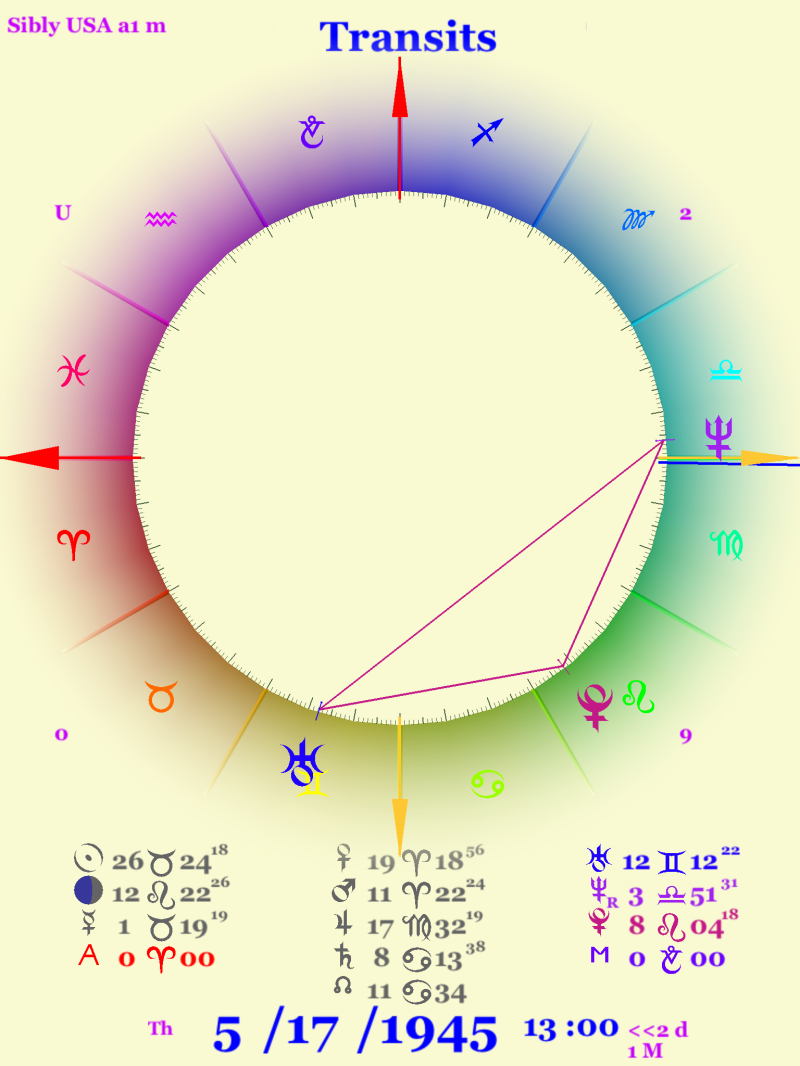
This second midpoint, unlike the first and third midpoints of the Twentieth Century, was a Pluto apex midpoint. And, as we shall see, Pluto was very appropriate.
 

midpoint1945

Second Midpoint of Twentieth Century

This midpoint was only exact once, about a week after German surrendered, called VE-Day, for Victory in Europe.   That holiday is still celebrated in Russia, which lost 20 to 30 million people in World War II.


1945tg


From this graphical ephemeris we can see how the midpoint — Uranus/Neptune is indicated by the blue line near the Pluto line near the top –got  tighter in 1944 and the separated in 1946.

Of course there were many changes because the Second World War ended. Europe had to be reconstructed; war criminals had to be tried; much territory of many countries had been devastated.  But there were other changes as well.  Decolonization broke out around the world: India became its own country and not a colony of Britain . The Korean peninsula, which had been one country for a long time was divided into two along a parallel of longitude.  The new country of Israel was created in the Levant as a home for those Jews who had not perished in the preceding war.  Within the United States new forms of painting were developed, such as abstract expressionism and color field painting.  Whereas before this period American artists had always placed second compared to European artists, with these movements America was recognized as offering a superior new artistic style, one that was followed elsewhere.

pollock.lavender-mist

Abstract Expressionism


rothko-moma1

Color Field Painting


Another extremely important change, that has only gotten more important as time has passed, was the introduction of the first electronic computer.  The idea of a stored program computer had existed since the Nineteenth Century — see for example George Babbage, Ada Lovelace (who had a computer language named after her) and the difference and analytical engines — but the first electronic one is considered the ENIAC, developed in Pennsylvania in 1946.

Here is the chart for when it was dedicated; probably the first operation happened earlier.  The most noticeable aspect to me is the tight conjunction — quarter degree — between Mercury and Venus at 0 Pisces.  Since obviously Mercury in this chart represents the computer, this chart promises the extreme love, even addiction, that people in the future (i.e now) have for computers.


eniac

First Electronic Computer


It was a new world in more ways than one, and many problems that later became manifest originated in this period.  The afore mentioned separation of Korea is still in the news and causing problems.  Israel and its relationship with its Arab neighbors and with the native occupants who were scattered with the arrival of Jewish settlers is still a prominent feature of today’s world.  The fact that French colonies in Southeast Asia were, when the Japanese had been defeated, handed back to the French resulted eventually in the Vietnam War that tor America (not to mention the lands of that part of the world) a part of the Sixties and Seventies, and had effect in following years.

But I want to talk about only three of the changes that occurred with this second midpoint, but these three strongly influence the shape and behavior of the world today. Fortunately for astrologers, we have charts for the beginning of two of these changes.

If no other event happened in the time of the second midpoint, the dropping of the first atomic bomb in wartime (there was a previous nuclear test call Trinity in New Mexico about three weeks earlier) would be significant enough to indicate a zeitgeist change.  And at the time many people commented that the dropping of the atomic bomb cleaved all of history into before the bomb and after the bomb.  They could realize at the time that this was an event of tremendous importance.  People also realized at the time that the world after this event would be different than the peaceful world before.  This is something that we are living now, long after the bomb was dropped, and when nuclear weapons, most far more powerful than the ones dropped on Japan, exist in numbers unimaginable to those of the early postwar years.  We don’t appreciate now how drastically the world has changed from that 80 years ago.

When the bombs were dropped, many thought that it was not necessary.  Both Generals Eisenhower and MacArthur thought so.  Most of the Joint Chiefs did not think that the bombing was necessary or desirable.  The United States Strategic Bombing Survey, a study of the results of US bombing during World War II, predicted that the conflict with Japan would end by December 31, 1945, and most likely by November 1, without a ground invasion, without the atomic bomb, and without the Soviet Union entering the war against Japan, which Stalin said the Soviet army would do three months after the end of the war in Europe, which was on May 8.  One can imagine what the Soviets thought after they saw the US use the atomic bomb on a defeated country that was all set to surrender.  The bombing of Hiroshima should be seen as the opening act of the Cold War and not the closing act of World War II.  Attributing the surrender of Japan to the dropping of the atomic bombs does a great disservice to the troops of the United States (and other allied countries) whose long fight to take back the Pacific areas from Japan should be seen as the act that won the war in the Pacific.

Right after the announcement of the bombing, many people were scared.  Even though only the US had the atomic bomb at the time, many could imagine what it would be like if such a bomb were dropped on NYC.  Scientists pushed the danger also, and suggested that World government was the only thing that would prevent the destruction of the world.  Others pushed the benefits of nuclear power for the country, and painted pretty pictures of the Utopia that would exist once the peaceful atom was harnessed.  For more details of this period see By the Bomb’s Early Light by Paul Boyer.

By the end of the decade, attitudes had changed, partly due to the Soviet Union testing its own bomb in 1949.  Many believed you could survive a nuclear war with fallout shelters, and elaborate plans were made for civil defense and evacuation.  Fallout shelters were a home improvement craze for a few years.

The present belief that the bomb was necessary to end the war in the Pacific without a ground invasion by the United States that would cost a million lives was first started by two articles at the beginning of 1947, the first one in the Atlantic and a more definite one in the February 1947 issue of Harpers by Henry Simpson, who was the Secretary of War.  This proposed that a million soldiers would die in a ground invasion of the Japanese homeland.  This article was necessary because the public was beginning to wonder if dropping an atomic bomb — let alone two of them — was really necessary.  But the two bombs were different: the first one, called Little Boy (what a sweet name for an awesome weapon) was a uranium bomb.  Uranium — named for the planet and god — is the last naturally occurring element.  The elements after that have been created in the laboratory and are thus artificial, even though a couple of them have been found in nature, produced by naturally occurring radioactivity.  The next element after uranium is neptunium, and the one after that is plutonium. The bomb dropped on Nagasaki — Fat Man — was a plutonium bomb, and there has been speculation that it was dropped because the newer device needed to be tested in the real world.


hiroshima


This is the chart for the time the bomb was dropped on Hiroshima at 8:15 in the morning.  It is most appropriate that Uranus was on the MC, and because of the motion of the earth this conjunction would be exact two minutes later.  Uranus is also square the Ascendant with orb less than half a degree.  There was definitely change in Hiroshima on that day and at that time!  Mars is also near the top of the chart.  The Moon is conjunct Saturn, and the conjunction will be exact in twenty minutes.  This conjunction suggests restrictions and limitation on the people, and maybe suffering of women.  And then Pluto is conjunct the Sun (it was exact a few days earlier) which suggest the nature of the event.

The second important event was the passage of the National Security Act of 1947 (passed Congress July 26,1947) creating the National Security State.  The NSS (Marcus Raskin 1967) goes under various names such as the Military Industrial Complex (Dwight Eisenhower 1960) the Power Elite (C. Wright Mills 1956) and the term that has currently become popular the Deep State.  This NSS has caused America to become a militarized State.  Currently, the United States spends 60% of its disposable income for past, present, and future wars. One imagines that this is like a father who spends a majority of his income on firearms and his children are starving and his house is falling apart.  In this case that father would be judged as being quite deficient in his fatherly duties, and if you were a family member an intervention would be considered important to get him to change his ways.

The National Security State  was developed during the Truman Administration and the rise of the Cold War, right after the end of World War II.  Instead of returning the defense expenditures to the lowly amount that it was before the United States entered the War, the leaders of the country remembered that the one thing that finally licked the Great Depression was the increased defense spending that was needed to fight the War, and they decided to use “Military Keynesianism” to prevent a return to depression.  But Truman was warned that in order to have major expenditures for the military, he would have to “scare the hell” out of people.  And to do this he ramped up fear of communism and of the Soviet Union, a country which had lost so many people and whose country had been devastated in the War.  The Cold War was born out of loyalty oaths and the Truman Doctrine,  which gave rise to McCarthyism and many other things that marked Fifties America.  With the passage of the National Security Act, America became a militarized country.  The graph below show where the discretionary expenses of the Federal government go. Notice that 54% goes to the military, and another 6% goes to veterans.  Thus, at least 60% of the US budget goes past, present, and future wars.  This would once be considered impossible, unbelievable, and insane.  But since the zeitgeist has changed, people assume that spending this money for “defense” of a country that is mostly surrounded by oceans is perfectly reasonable.
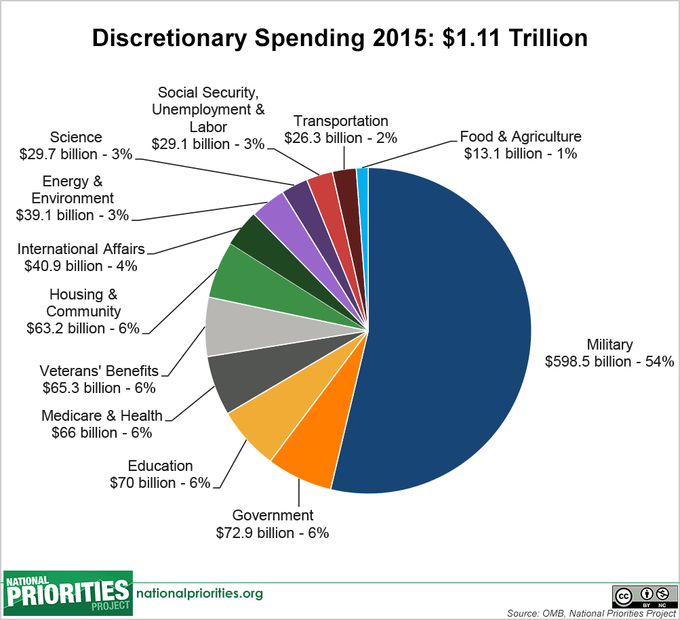
discretionary_spending_pie,_2015_enacted_large


The NSS has a distinct origin in the National Security Act of 1947, which created the CIA (an extension of the wartime OSS — Office Strategic Services — which coordinated spying), changed the War Department to the euphemistically named Defense Department, and created the Air Force as a separate military branch.  Books have been written (cf William Blum) about all the covert acts of the Central Intelligence Agency.  They fomented their first coup in 1948 — only a year after their birth — in Thailand, and then another coup the next year in Syria.  Syria has always been a popular country for the CIA to be involved in.  In fact, the United States just ended the most expensive CIA operation in history — called Timber Sycamore — which was an attempt to overthrow the elected government in Syria.


NSS

National Security Act takes effect


Here is a chart for when most the National Security Act of 1947 became realized.  For a chart such as this one the 12 noon time is correct.  We see that Saturn and Pluto are conjunct.  As noted before, hard Saturn Pluto aspects are not nice, and are often seen at the start of wars.  Here we see the start of the First Cold War.  Mars is semisquare the MC, suggesting war or violence.  Jupiter is conjunct the Ascendant, showing the expansive powers of the National Security State, and in fact it has swallowed up the government.  Mercury is conjunct Neptune, showing the propaganda and false stories (called in better times lying) that is a hallmark of the National Security State.  But the closest aspect is the square between Moon and Pluto with a zero orb.  Pluto semisquare Ascendant is a prominent feature of the US natal chart, and here Pluto again comes to the fore.  Pluto indicates overwhelming power, the kind that the “exceptional” country the United States of America is so willing to use.  As I have mentioned elsewhere, this shows the meme of the US: My Way or the Highway.  Just a brief listing of some of the operations the CIA has engaged in will give an idea of the scope of its operation.  As exposed by the Church Commission in the Seventies, the CIA tried to assassinated several foreign leaders, such as Fidel Castro, who was target perhaps hundreds of times.  Nelson Mandela of South Africa was turned into the South African police by the CIA.  In the early Fifties there was operation call MK-Ultra (see Acid Dreams by Martin Lee and Bruce Shlain) which besides introducing LSD to America, gave unsuspecting people doses of that substance.  In one case, they gave LSD to customers of prostitutes and then watched hidden to see how the subject behaved under the influence.  Another CIA operation was called Mockingbird in which CIA got journalists to plant stories which would make opponents look bad.  And the CIA is still very active in the public sphere, with news that the former director of the CIA (who supported the drone program and voted for the Communist Party in 1976) will be a national security correspondent for NBC and MSNBC, and that 50 ex-CIA employees are running in the 2018 primaries as Democrats.  And of course this year’s most hyped film, Black Panther, has an important role for a white benevolent CIA agent.  Thus the CIA and the National Security State will have even more influence on the public.

Another important feature of this period is called the Great Acceleration, which can be seen as the beginning of the Anthropocene Era.  The chemical industry, that had greatly developed during WW II, spread out after the war with a range of consumer products, since the military would no longer be buying.  These chemicals, like many of the new foods that were developed to sate the increasingly complex American palate, became more widespread, and what was good for America was good for the rest of the world that wanted to become Americans.  So large quantities of pesticides, insecticides and fertilizers were used on the increasingly large crops needed to feed a hungry America.

Plastics had first been developed in the middle of the Nineteenth Century, but little used.  In the Twentieth Century plastics had usually mean Bakelite before the War, expanded again and again after the War.  After the war commercial needs required plastic.  And plastics were based on petroleum.  More and more products were made plastic.  The plastic component of just about everything led to plastic that was no longer used to be just about everywhere, including five plastic “patches” in ocean gyres as shown in the map below.


OceanPlasticGyres


The pesticide industry also expanded greatly after the War.  Before the war, most foods could be considered basically organic.  But after the War, more and more farmers considered that they needed chemical help to beat down the weeds.

Humans expanded to cover more and more territory.  The Baby Boom, that produced so many children starting after the War, required more and more houses to supply more and more families.  And those new families required automobiles and roads to hold the increasing traffic.  And eventually the children of these families produced yet more children and the cycle was repeated.


levittown

Levittown — an Early Postwar Community


And there was more and more production of things and wastes.  Nuclear bomb required nuclear testing.  And the use of atomic power to generate electricity required nuclear power plants along with the danger of radiation.  This produced nuclear fallout and then contaminated areas around each failed nuclear planet; those that hadn’t failed were potential danger zones.  Besides more faming to produce more food for the growing population, there was more fishing using larger tools that would deplete the sea’s population  (already inundated with plastic waste), and more and more consumer items were manufactured that required more “rare” materials, and some not so rare, such as phosphorus and oil.

We are living with the results of the Great Acceleration.

Birth of the National Security State

The end of World War II saw a great many changes in the way the world is today,  so many that people born after this watershed moment cannot remember or imagine a world different than what they have always lived in. This world is radically different from what was before. There were many changes throughout the world. Most were in the developed countries which would affect the developing countries as time went on.  One of the biggest changes, which would affect the whole world  rather quickly, was the development of the National Security State within the United States  and the subsequent development of the Cold War between the United States  and its allies and the Soviet Union and its allies. This Cold War would be played out around the world and not just, or even mostly, in those two countries.

The world changed after the Second World War in so many ways.  Many so-called third world countries that were colonies  of major powers, such as India as a colony of Great Britain, were allowed to choose their own government.  This allowed a great many countries, mostly in Asia and Africa, to become independent and to try and choose their own government.  There was even a movement of the non-aligned countries that tried  to place themselves outside the orbit of either the United States or the Soviet Union.

The industries that developed during the Second World War — especially in the United States since it had not been invaded or directly attacked — subsequently released many consumer products  based on the developments to  support the war.  People had been starved  for new consumer products during the war, so that after the war the bought the new offerings willingly.  Not only were consumers the recipients of these new products, but also industries, such as agriculture, were willing purchasers of these new offerings.

While a couple of plastics, such as Bakelite, existed before World War II, the real explosion of plastics and other artificial materials – the pictures of women trying on nylon stockings right after the War are famous –  came right after the War, encouraged by all the development that happened to support the war effort.  Plastics of all forms  have begun to dominate our society, including the  computer you are viewing this on, and all of the plastic garbage has now begun to accumulate in five zones in our oceans  as well as mount up in our “sanitary” landfills.  We do not realize that there was a  time before plastics were an omnipresent feature of all our landscapes. As the Dustin Hoffman character was told in the 1967 movie The Graduate, plastics are indeed the future.

While fertilizers for crops existed for a long time, the real use of inorganic chemically-created fertilizers took off after World War II, for much the same reason that plastics became increasingly popular.  Chemical industries, some of whom had been active with the Nazis in Germany,  gained a lot of power and strength during the war.  But of course during the War most of the demand on these  industries was to support the war effort, on either side; after the War, all the energy that had driven the chemical industries was available of peacetime use.

What has been said about plastics and fertilizers can apply to many other created compounds.  The period after World War II became the world of “Better Living Through Chemistry” as the modified motto of the DuPont Corporation had it. And that is what the post-war world was all about.  Many, many things were created in the laboratory and sold to the public,  plastics of all types, pesticides and insecticides of all types, and weed killers.  All homes now have many toxic chemical compounds that are used for things from cleaning the toilet to ridding the house of ants.  One can take a tour of any modern house to get an idea of the full extent of artificial chemical compounds everywhere.

Before the Second Word War, most food was organic.  The concept of “conventional” or “non-organic” food did not exist, even though there were a few artificial chemicals used in agriculture.  In the Twenties, there were no ”Organic” sections  of supermarkets;  in fact, there were relatively few supermarkets in existence before World War II.  But soon after the war, chemicals were used to create a faster growth of vegetables  or to kill weeds.  Foods grown without the use of chemicals became more and more rare.

Along with this process was the creation of industrial agriculture. This was  was a case of driving the small, family farmer into the city and the rise of large scale farming  and industrial feedlots for cattle.  As a consequence there was no more grazing in the field, small cramped warrens for chickens, and large scale disposal of the wastes of a massive number of pigs confined to a small space.  The introduction of genetically modified organisms (GMO) was just another step along the path that was set out in the years following World War II.

Television was another phenomena that existed before the War, but came into prominence after the War.  During the late Forties and early Fifties  few people owned television sets, but groups of people would gather in front of shop widows displaying large televisions to catch the latest shows or breaking news events. The effect of television, and not just television advertising, on the development of “culture” is far reaching, and has not stopped yet.  One can notice that the whole of political campaigns changed considerably after enough people had television sets that they could watch national political conventions.  The first television president debate, now a fixture, was inaugurated in 1960 for Kennedy and Nixon after there were enough television viewers.  And the difference that television made is illustrated by the fact that radio listeners thought Nixon had  won the debate, while television views, who could see the haggard face of Nixon (recovering from an illness) thought that Kennedy had won.

I  will  mention one further change in this period before we move on to the mammoth event that dominated the world for the next 45 years.  Along with the industrialisation of agriculture practices, ocean fishing received a big boost.  Larger and larger ships were launched, harvesting more and more fish, to feed a  growing populace.  This fishing was so huge that,  over time, it decimated the stock of fish in the ocean, which people somehow seemed to believe was limitless.  This occurred at  the same time that runoff from the factory farms sent pesticide residue into the oceans, creating dead zone devoid of oxygen and fish, and remnants of all the plastic being used on land were also ending up in the oceans

One big event that happened  in this period, whose significance can not be overstated, was the dropping of two atomic bombs on the country of Japan.   This was something that had never happened,   or really even been contemplated (except for a  few science fiction writers such as H. G. Wells or Cleve Cartmill ) before, and  it changed the way the world  looked at the future.  Almost overnight, it became possible to believe that the entire world could be destroyed in a short period.  As some scientists and writers realized at the time, the world  had changed for good.  We can not begin to imagine the effect of this since most of us have lived with the threat of nuclear war all our lives.  I think that when we look back at this period from the future, we will see that a mass insanity gripped the world because of the knowledge that we could  literally destroy humanity.

nss

Midpoint when Atomic Bomb Dropped

The  significant astrological event happening at the end of World War was the midpoint between the three outer planets: Pluto at the midpoint of Uranus and Neptune. This was only the second time this century that such a configuration had  happened, and note that in the midpoint shown, Pluto is at the apex of the midpoint.  This is not common; most often Uranus is at the apex as was the case for the first midpoint of the century as discussed  on August 22.  This is significant since Pluto rules nuclear bombs, which were of course unknown before this midpoint happened.  Pluto is also prominent in the aspect representing the shadow side of the USA, Pluto semisquare Ascendant, as has been discussed before.

As I have said, these midpoints, at most three a century, indicate a sea change in society so that the future is entirely different from the past.  And that was certainly the case with this one.  For example, almost everyone believes that high defense spending of the US has always gone on, but it is a rather recent development; essentially the high defense spending  needed for World War II never decreased by that much after the war, though our lifestyle certainly did.

nss1

Midpoint at Beginning of Cold War

In   1945, right after the Yalta Conference, Franklin Roosevelt went to Saudi Arabia for a meeting with the King of that country.  As a result of that the world  has gotten oil from that country and  the rest of the world has looked the other way.  Saudi Arabia has backed very reactionary elements, such as Osama Bin Laden, and nothing has  really been said  to them,  while other countries which do not provide the large quantities of oil are subject to much pressure from the United States.  As a result of this meeting the world has had much access to oil but a whole host of problems — see the current Middle East crises for an example — are the result.

During the war, companies were not allowed to increase the wages of their employees, so instead they gave them health care plans.  That decision, made to skirt the law, has had enormous repercussions into the present time.  Company-provided health care has been seen as normal, giving rise to health insurance companies that exist to this degree nowhere else.

But perhaps the most significant  event of this period, and the one that gave its name as title to this article, was the formation of the National Security State (NSS).  Few  people realize  what a change in our military expenditures has happened  since this critical turning point.  Before the Second World War  the United States spent relatively little money on “defense”.  In fact, before the NSS there was no Department of Defense but rather more more accurately named Department of War.  Gore Vidal calls  this inception of the National Security State a coup d’etat;  I’m not sure if this is a metaphor but it certainly an apt description to what has happened in this period.  This led to increased spending for “defense” after the war and the Pentagon, which was built during the War, become a very public symbol of the United States’ fascination with the military, something I’m sure would have alarmed the Founders,  who always warned about foreign entanglements and a standing army.

There are at least two ways of measuring the amount of money spent on defense: percentage of GDP or adjusted dollars.  The graphs below show both.  Since the GDP has increased faster than the defense budget, the actual dollars figure is a more accurate way of showing money spent.

The final way of looking at our defense expenditures is as a percentage of the budget.  In other words, how much of the money that the federal government collects in taxes is spent on military-related items.  But there are  several ways of answering this question that are deceptive, to say the least.    The first is to include income that the government has no control over spending, most obviously Social Security, as part of the budget. Social Security taxes — FICA — are something that most people have seen as a separate tax on their income checks.  This money goes to a trust fund and must be spent for Social Security payments, it is not discretionary.  But often the SS  expenses are included as part of where the government money goes.  This is as deceptive as, for example, if someone gives you $5000 for safekeeping while they are out of the country, only to expect it back when they return.  It would be deceptive to consider the $5000 as part of your money when you consider how much of your money is spent for rent, since it is not really your money but you have it only for a short time.  In the  same way, it is deceptive to consider money collected as Social Security taxes as part of the money the government can spend as it wishes.

Another problem is neglecting the military related expenses that are not in the defense budget.  The could be separate money for wars that are not part of  the initial budget, money for the many covert services, money in the space and nuclear programs that are military related, but the two biggest items that are often not considered are veterans healthcare and pensions  for ex-military personnel, which can go on for many, many years  after the initial war they served in is over, and interest on the debt, much of which  was borrowed to pay for a given war.

When you make the adjustments, the percentage of the budget spent for military purposes  — past, present, and future wars — is much higher than commonly assumed.  The amount these days is 62%, which tells us that the main purpose of our government to to conduct military operations.  This is something most people would rather avoid knowing.

Most of the graphs are from the Washington Post.

defense_adjdol

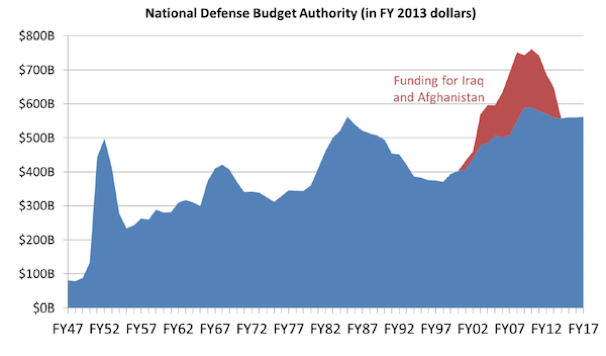
This first graph indicates the national defense budget in 2013 dollars.  Since there has been much   inflation since 1945, it is    necessary to adjust the dollar amount to get an accurate comparison with past expenses.  We can see that the defense budget   ballooned in the late Forties and early Fifties because of the new Cold War and the Korean War.  There is a bump in the late Sixties and early Seventies because of the Vietnam War.   Then there is the huge bump in the Eighties because of the Reagan defense buildup; during this period the defense budget got to be greater than the Cold War beginnings of the early Fifties.  Finally we can see that about 2010 the defense budget rose to another peak, and this is   without counting the expenses of the wars in Iraq and Afghanistan, which were separate.  When these are added in — red peak — the defense expense are 50% higher than in  the beginning of the Cold War, even though the Cold War supposedly ended in  1991.  Note that these figures do not include items mentioned above such as veteran’s benefits.

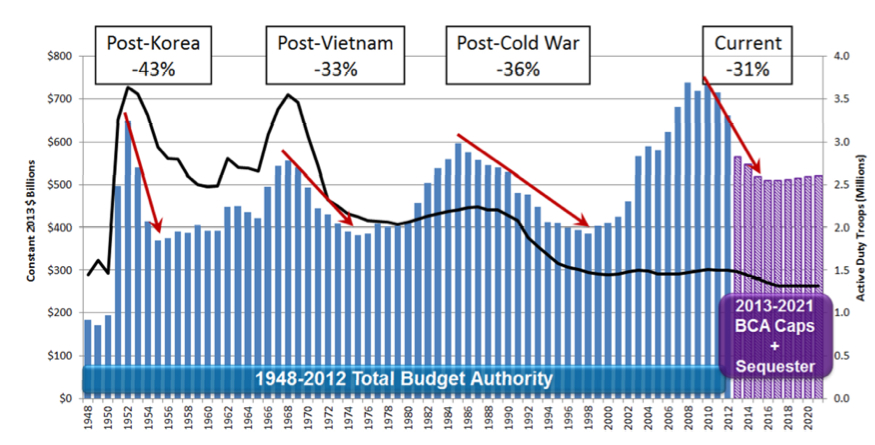
defense_adjdol2The next graph shows the expenditures again, from 1948  to 2012.  You can see the fall-off after Korean, Vietnam, and Cold Wars ended.  It also shows the fall off after  the current wars are ended.  As I write this we have sworn a “bombing campaign” on what is called ISIL or ISIS or IS in Syria and Iraq, so the expenditures will probably go up again.

defense_gdp

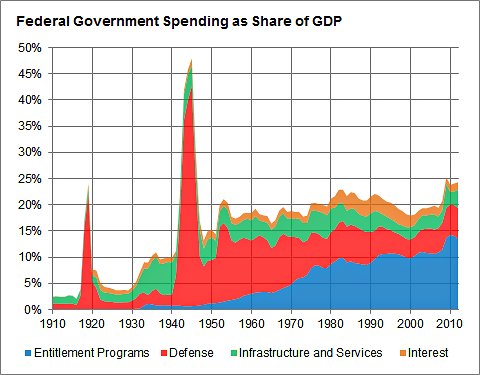
The third graph shows  expenses as a percentage of GDP.  Note that the bottom blue section is labelled “Entitlement” and remember what I said above that these are not part of the discretionary expenses, since most entitlements are from a separate part of the money collected from taxes; they are from FICA and not income taxes.  The part we are interested  in is the red second band.  The defense expenses went way up during World War I, just before 1920 and them returned to almost the same level, about 1 to 1.5%.  They went up again  during World War II in the Forties, but in this case after the War  the defense expenditures did not go back to what they were before the war, but only fell to 8%, at least four times greater than what it was before the war.  These defense expenditures decreased as a percentage of GDP over time, but only because the GDP increased at a faster rate.  The true increase is shown in the first two graphs.

To sum up, spending by the United States for defense increase greatly after World War II, and  has  remained at elevated levels ever since.  One can argue that this increased defense spending was necessitated by the threat of he Soviet Union, even though we were allies with them and they suffered the lion’s share of causalities during that war, but the defense spending did not fall after the Soviet Union did, and in fact the spending now has increased to  almost double what it was at the end of the Twentieth Century.  The question remains whether the defense spending increased after the war because of the threat poised by our erstwhile allies or if the threat of a greatly reduced spending for the military caused the danger of the Soviet Union to be seen.  The Great Depression before World War II never really ended until the increased spending for weapons needed for the War; perhaps after the War some were afraid that the depression would return unless the defense spending remained at high levels.  This is called Military Keynesianism.

Another big event of the period, which was to influence the post-war world and   still has repercussion today, is the Bretton Woods Conference of July 1944.  Delegates from many countries met in New Hampshire to plan out the world economy after the War was over.  The International Monetary Fund (IMF) and the World Bank were both formed during that meeting.  It also resulted in an agreement among the countries of the world to maintain a certain type of order in the world’s financial system.  That agreement was broken when Richard Nixon, in August of 1971, took us out of the Bretton Woods system.  While the system was working, it was a financial golden age for American workers.  The rate of unionism was at a high level,  and many of these same workers joined the middle class.  College education was relatively inexpensive  and many people poured into colleges, resulting in an educated workforce and the many student protests that marked the decade of the Sixties.  Government intervention to assure the financial well being of the nation’s populace  became more used.

spending_2013

This final graph shows the true cost of defense after the end of the Cold War.  Very few people make this knowledge available because America wants you to believe that it is not a war-based economy, but if you remove “entitlements” (as mentioned above) you see the real figure, that 62.5% of the budget — Military and Veteran’s Benefits — goes to past, present, and future wars.  This data is  from the American Friends Service Committee.  It is clear that our country is dominated by defense spending, much, much more that any time in our history before this period when the National Security State took   power in the United States, something that President Eisenhower warned of: the Military-Industrial Complex.