Election 2016

In this election season I am reminded of a story Rob Hand told about astrologers in the Thirties.  Astrologers at the time, unlike now, tended to be conservative.  Even though there was an accurate chart for Franklin Roosevelt, which put his Uranus in the Twelfth House and thus not prominent, many astrologers refused to accept that and were sure his Uranus was in the First House, because such a radical person must certainly have a prominent Uranus.  They were letting their political beliefs overrule their astrological knowledge and thus they drew the wrong conclusion.

I need to do a lecture in this month about the election, and make some charts, so this will just be a display of those charts and a brief interpretation of them.  I will try not to draw any conclusions — and you can draw you own.  This is the most controversial election in recent memory, as several commentators have said, and since I value my life and friends, I will not take a stand.


ploppsu_tg


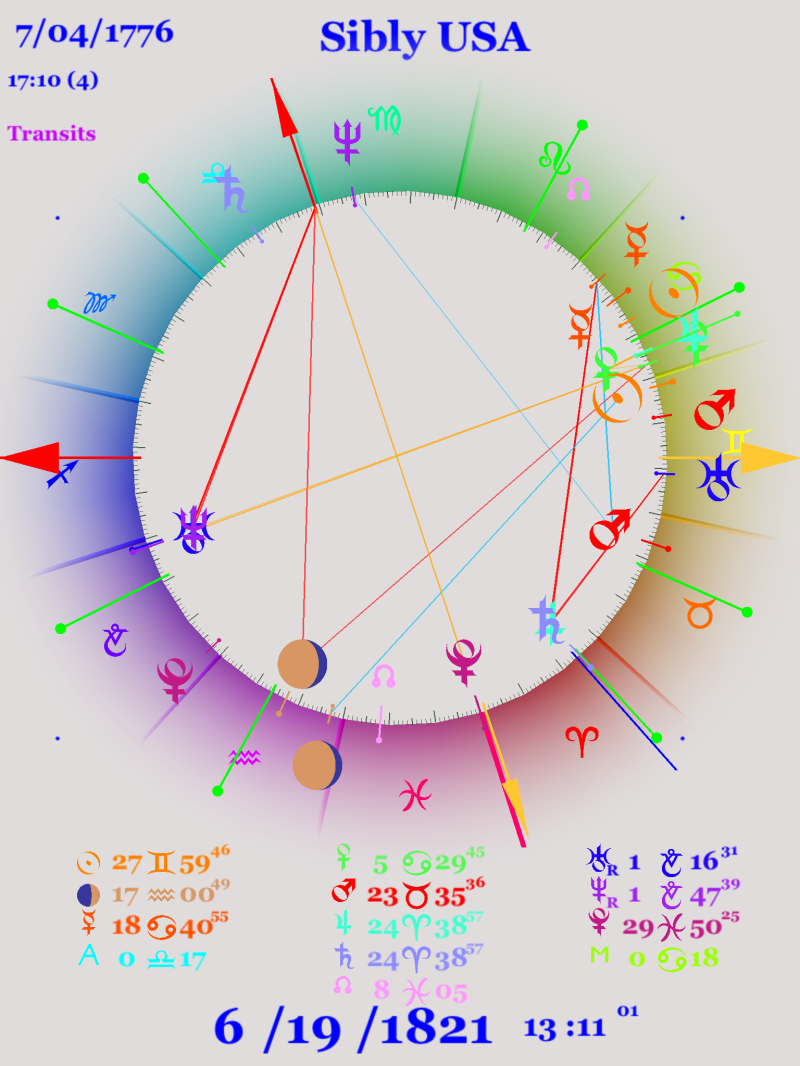
The first thing we must do is look at the overall tenor of the times.  From this graphical ephemeris we can see that Pluto was running opposite the Sun of the United States between 2013 and 2017 (top of graph), with the tightest periods 2014 and 2015; there is a close pass in October of this year right before the election.  Also note that Uranus was square the Sun and thus Uranus was square Pluto, both transiting during part of this period.  Also note (just to the right of the center bar and in the lower half of the graph), and to make it even more interesting, that there is a Saturn square Neptune (discussed previously) happening during 2016, and exact a couple of months before the election.  The Sun in the US chart represents the government and the President; the Pluto opposition indicates that the people of the country are not happy with the government and this has been growing for awhile.  One can see this in the primary elections candidates of both major parties — people are unhappy. Even though this has been going on for decades, since the beginnings of neoliberalism it has now reached a critical point.  Politicians who pretend that things are rosy and even getting better are ignoring the mood of the country.  While the news media can’t totally ignore such a crisis, they do their best to put on a positive face. While the Pluto transit is just about over, this crisis of confidence has reached a critical stage during the passage of Pluto, and it will have to be dealt with.  When things are left hanging, they often work themselves out finally in ways that are not pleasing to most people, but that seems to be the way things operate — ignore a crisis for as long as possible and then try an ineffective way of squelching it.

We have an accurate timed chart for Donald Trump, which was discussed before. Unfortunately we do not have the same accuracy for his opponent, Hillary Clinton.  One would think that after all the years she has been in the public eye there would be a accurate chart.  The best is a time from her mother’s diary, about 8AM. I will use 8:02. There is also an 8PM chart floating around so that is a possibility.  With two charts 12 hours apart, the actual chart time could be anything.
 

octsurprise

October Surprise


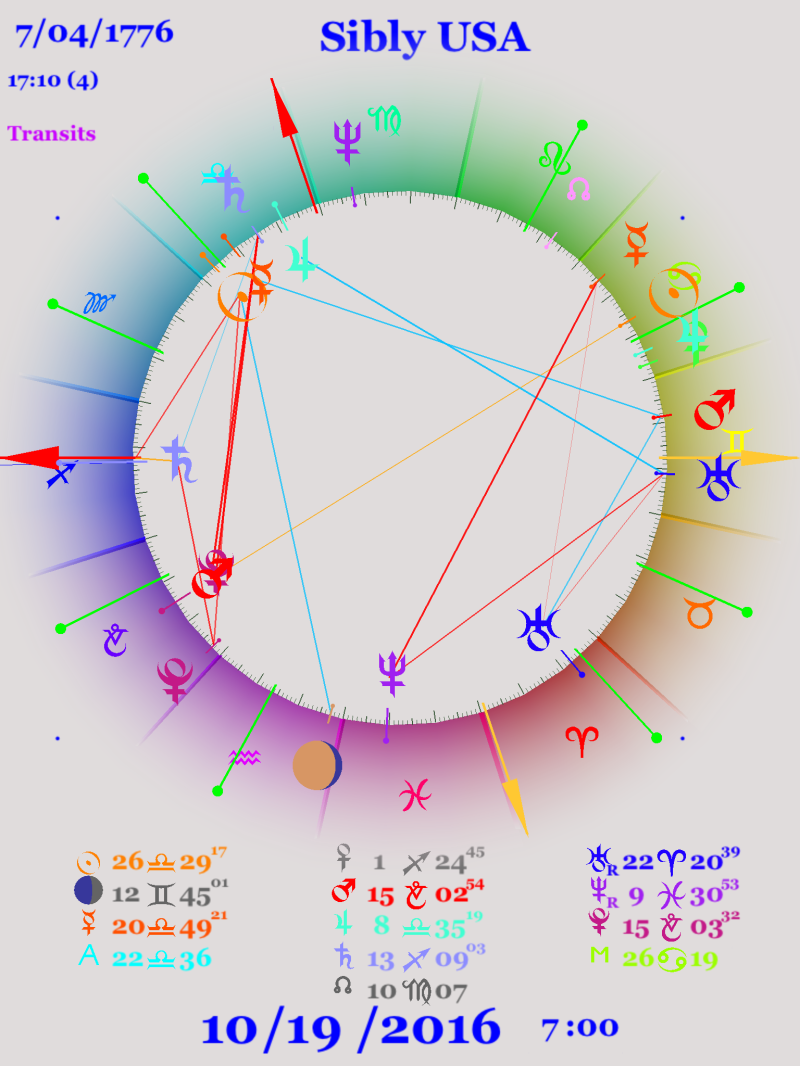
Traditionally, there occurs before a Presidential election what is called an “October Surprise” which is exactly what it sounds like.  And from astrological indications, there will be an October Surprise this year.  In this chart for October 19 (this is only the day it is exact), we have a Mars Pluto conjunction opposite the Sun of the United States and also square natal Saturn.  Also transiting Saturn is conjunct the Ascendant of the United States, Neptune is sesquiquadrate Mercury and square Uranus, and even transiting Uranus, the third outer planet, is making a loose aspect to natal Mercury and Uranus.  A lot is happening. The Mars-Pluto conjunction is problematic to say the least.  Some think that this portends some type of terrorist incident, while others think this chart suggests the long-rumored financial meltdown which is the second act of the Great Recession of 2007 and 2008.  But of course a war could break out between the United States and Russia or China since we seem to be itching for one, or a war  between India and Pakistan.  Or it could be a surprise, something that we can’t see happening.  Since Clinton  has a tight Mars-Pluto conjunction in her natal chart, this transiting conjunction could be a harbinger of her success in the upcoming election.  The hard aspect between Mercury and Neptune suggests deception or outright lying, but predicting that at this time is like shooting fish in a barrel, as the saying has it.  Finally, Saturn on the Ascendant has been talked about before, and says that America’s self-image could take a hit.
 

us_le_elec1

US Lunar Return


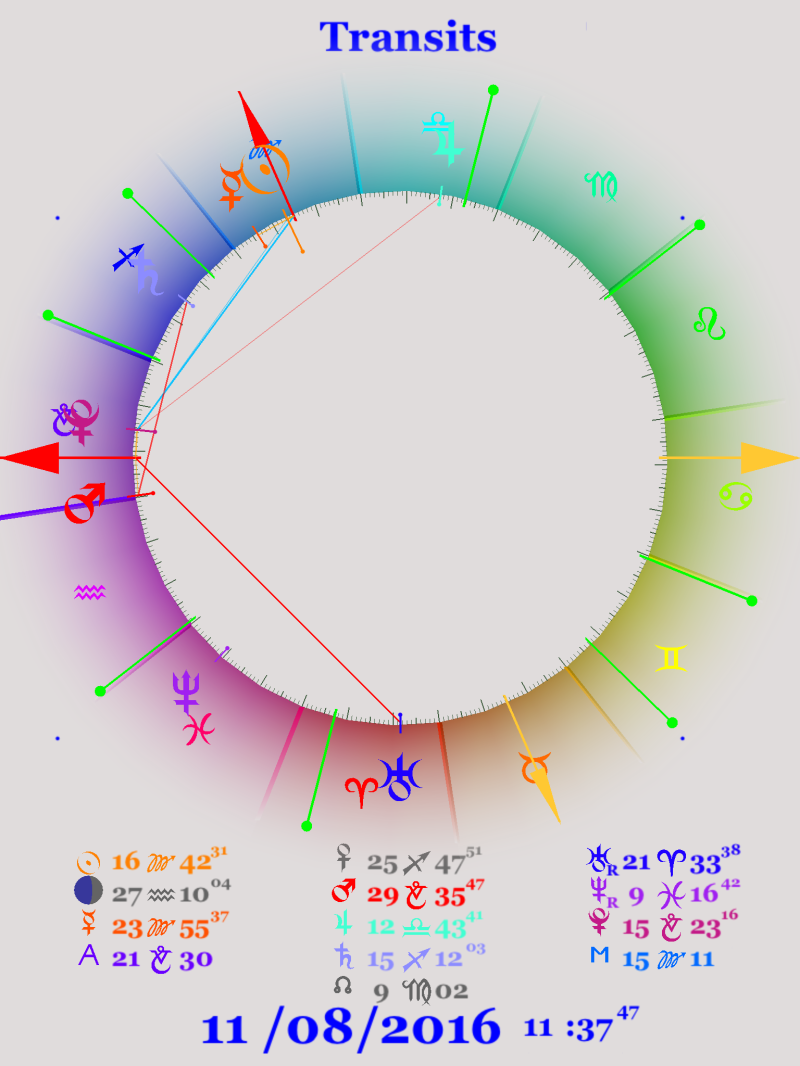
It turns out that election day in the United States is also a lunar return — the transiting moon returns to the position of the natal moon — and so I thought it would be interesting to look at the lunar return for the US, to get an idea of what the next month for the country has in store.  In the lunar return, the Sun is at the Midheaven, indicating the importance of the month starting with the election.  The other important feature is Mars and Pluto conjunct the Ascendant, with their midpoint on the Ascendant.  I’ve already talked about Mars and Pluto before, and this location in the lunar return only emphasizes the point and again the importance of this month following the election, and that there may be a (unpleasant?) surprise in store.


clinton_sr16

Clinton Solar Return


Hillary Clinton has a solar return — where the Sun returns to the position  it was at birth, and is a forecast for the next year — just before the election, so I decided to look at it to see if there is any indication of her success in the election less than two weeks after her birthday.  Note that these solar returns are done for the place of birth.  I’ve done experiments with solar returns and been convinced that the return at the location of birth is accurate whereas the one set for the current location is not.

In the solar return for Clinton, less that two weeks before the election, we see the Moon closely conjunct the Ascendant and Neptune just above the Descendant in the Seventh house, and square Venus.  Moon on the Ascendant does not seem terribly strong for taking office.  Since the Moon represents women, it could signify her role as the first woman candidate for President of a major political party.  It may also show the emotions she has invested in this candidacy.  Neptune near the Descendant may indicate the deceptive nature of her race for the position of President, or that she is being deceived by people close to her.
 

trupmsr16

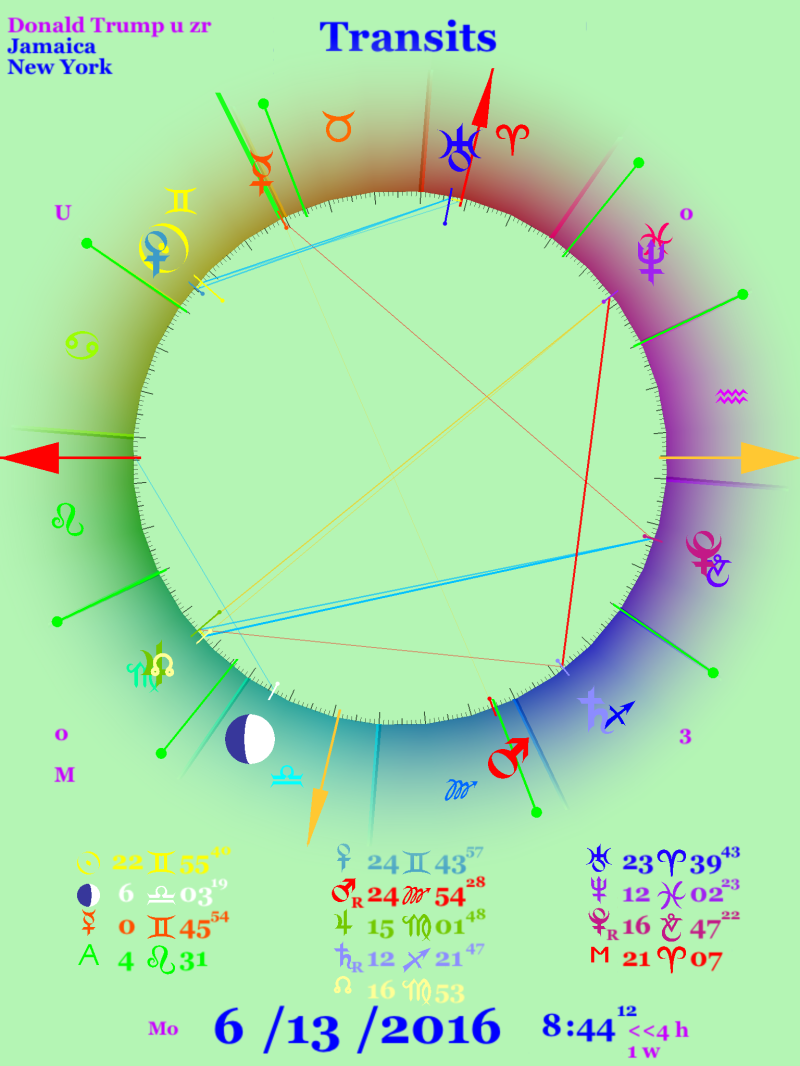
Trump Solar Return


Having done the solar return for one candidate I decided to do one for the other candidate, Donald Trump.  In this one the most obvious significator is Uranus on the Midheaven.  The obvious meaning of this is a change (Uranus) in career (Midheaven).  It was suggested that this could indicate being sent to prison.  There are always alternate ways that an astrological forecast can work out, so one can interpret this however one wishes, or whatever your political desires demand.  Every election season reality is interpreted according to one’s political leaning, more so than at other times when the cues are not as obvious.

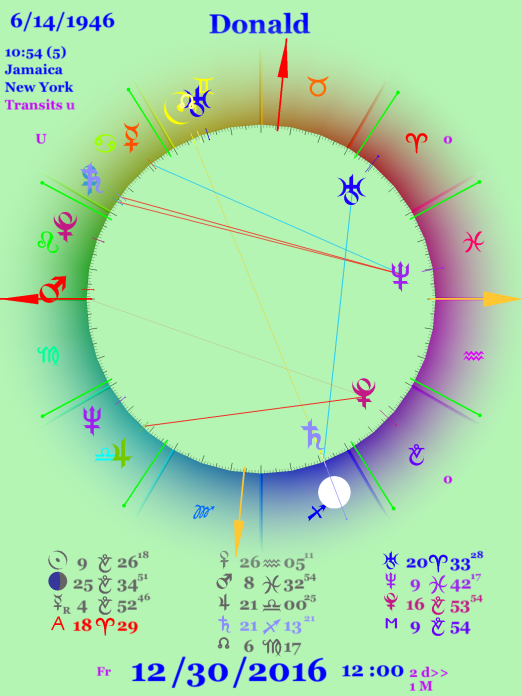
One idea that has been used to predict a successful election is to see if there are transits involving Saturn to a personal point, Sun and Moon, of the candidate after the election. While Saturn gets a bad press by many astrologers, it is obviously a needed planet, like all the others.  In this case, the Saturn transits indicate the responsibilities incurred upon taking office.  An alternative explanation is that Saturn would indicates that the candidate is extremely depressed upon losing the presidential election.
trumptr1


trumptr2


trumptr3


We previously discussed the position of Saturn in Donald Trump’s chart after the election, but I will go over it again.  Saturn crosses his moon, and thus opposes his sun, shortly after the election.  In the first image we see Saturn exactly on his Moon at the end of 2016. After it has moved a ways beyond his Moon, it turns retrograde in April of 2017, as shown in the second image, and then moves back to a close conjunction with his moon again. In the third image we see that finally Saturn turns direct on his moon in August of 201 7, having been stationary on his Moon, and opposed his Sun, for a while earlier in 2017.  It then moves away.  All told, Saturn is on both his personal points for many months following the election.  Either Mr. Trump has an awful lot to learn (Saturn) about the office he has just assumed or he is extremely depressed about having lost the Presidency.


trump-electionday

Trump Election Day


On election day, transiting Jupiter is approaching its natal position, and is only five degrees away. The exact return is almost a month after the election.  A Jupiter return is a time of opportunity.  Jupiter was on his Neptune in early October (as is Clinton’s Jupiter on election Day) and is half way between the two planets.  This suggests a change from the delusion of Neptune to the promise of luck that is Jupiter.  On election day it is at the midpoint of the two planets; perhaps this suggest his delusion about his fortunes in the election that day.


clinton_relocated

Clinton Election Day


For Hillary Clinton, Saturn hangs out in her first house for the end of 2016 and much of 2017, making no obvious aspect except an opposition to her Uranus, which is not considered a personal point.  In general, Saturn opposite Uranus indicates a conflict between the old and the new.  Clinton also has a hard aspect between Pluto and her Ascendant, in this case it is a semisquare and it is to her relocated (Washington, DC) Ascendant and not her natal Ascendant.  This is similar to the Pluto semisquare Ascendant in the natal US chart and perhaps reflects her paeans to American Exceptionalism, most notably in her speech before the American Legion.  Saturn is making a trine to her Mars-Pluto conjunction.  Perhaps this will give restraint to her bellicose proclivities that are indicated by that conjunction and in that speech.  But here again neither Mars nor Pluto are considered personal planets.  Mercury has come to her Ascendant on election day, and Venus is opposite her Uranus  — perhaps this indicates change in fortunes for a woman.

On election day, Clinton has Jupiter conjunct her natal Neptune.  Apparent happiness is what Ebertin says about this combination.  Neptune tends to delude one about whatever it touches; it this case the good times promised by Jupiter is what is not seen clearly.  Perhaps she sees a victory but it is just an illusion.  Hand also suggests happiness (Jupiter) through seclusion (Neptune) for this conjunction.

I imagine whichever candidate loses there will be an awful lot of bloodletting going on.  As I write, the consensus of the chattering classes is the Clinton will win, and the loss by Trump will further weaken the Republican Party, but his loss is expected.  Her victory will assure the elite classes that their program for America is going swimmingly.  Conversely, if Clinton loses it should strike many Democratic leaders that perhaps they put their money on the wrong horse and perhaps they should change their ways.  Possible, but not likely.  They will consider that all those deplorables who voted for Trump  just didn’t like a woman.  Or perhaps it will be blamed on Putin interfering with the election.  Since every pundit has predicted a Clinton victory, her loss should provoke a major rethinking of America’s democracy.

Looking at the transits on Election Day, we see that Trump has hard aspects between Pluto and the Ascendant: Trump has a sesquiquadrate between Pluto and his Ascendant, with orb of 25 minutes. Pluto is stationary and right on his Ascendant for all of September and the first part of October and then it gets farther away though still by election day it is less than one half degree from exact.  Pluto Ascendant hard aspects can either be read as charisma — someone who is immediately noticed when he walks into the room — or increased bellicosity and a desire to control things.  Both seem to be playing out for Mr. Trump.

Watershed Elections – One

The election of 2016 is being billed as the “most important election ever”  (or at least in a long time) and we must of course vote for the proper candidate.  Of course, each presidential election is billed as the most important one ever, until the next election occurs.  But there is a natural astrological cycle, known for thousands of years, that rules the rise and fall of, traditionally, kings.   And this twenty year cycle just so happens to correspond  to the four year election cycle.  We will explore this cycle through United states history; this twenty year cycle also corresponds to what has been called “Tecumseh’s Curse”, which says that every president elected at the start of this cycle will die while in office.   This election season of 2016 is just the tail end of the previous cycle that started in the year 2000, and is just a preparation for the watershed election of 2020.

This  cycle, which was discussed previously, is the twenty year synodic cycle of  Jupiter and Saturn, the two outermost planets known before a few hundred years ago.  This synodic cycle can be seen as similar to the lunar cycle with which we are all familiar:  New Moon — the conjunction of the Sun and the Moon — is the start of  the cycle, which then goes through the Full Moon — opposition — and back to the New  Moon.  For the case of the Jupiter-Saturn synodic cycle, the cycle starts with the conjunction of the two planets and goes through the opposition ten years after the conjunction and then the cycle ends and a new one begins ten years later at a conjunction of the Jupiter and Saturn.

But very  conveniently, and why we can talk about “watershed elections” is that this cycle has, for centuries, corresponded, more or less, to the presidential election cycle, with the conjunctions occurring near the start of an even decade.  Thus what I’m calling a watershed  election occurs at the start of an even decade and corresponds to the conjunction of the planets Jupiter and Saturn.  In many cases the election is significant for the future of the country or of Presidential elections; in other cases the country was on the verge of a significant change that would be felt in the future;  an in some cases both were true.  We will see examples below as we look at each watershed election.

The charts below illustrate the first Jupiter-Saturn conjunction in each cycle.


1800
The first election in the new United States that corresponded to the Jupiter-Saturn conjunction was the election of 1800 — called by one of the participants, Thomas Jefferson, as “The Revolution of 1800”.  This was discussed previously (February 26, 2016) because it corresponded to the transit of Uranus over the MC of the United States.  Briefly this was the first time that a President of one party was replaced by a President of the other party.  Since this had never happened before, many in the country and the world did not know if it would be successful and peaceful, or as in many other situations – the coup of Napoleon in France had just occurred — the losing party would continue to hold power.   Also, because of a bug in the Constitution, there was no winner for months and some were talking about a possible civil war.   But eventually, just in time for the scheduled inauguration, a winner was chosen and it appeared to the world that the United States would be a successful country.  At least, an early crisis had been avoided and the Constitution was changed to correct the bug which had been exposed by the election.


1820
There was not much special about the election of 1820.  It was the second term of James Monroe  and it turned out to be the last time a member of the “Virginia Dynasty” controlled the Presidency of the United States.   The Virginia Dynasty was a string of men from Virginia who controlled the office of the President since the first election of George Washington in 1789.  The only exception was the single term of John Adams of Massachusetts in  1796.  All the other Presidents — George  Washington, Thomas Jefferson, James Madison, and James Monroe were from Virginia and served  two terms each.  1820 was still within the Era of Good Feelings,  after the War of 1812  (often called the second revolution) when there was not much strife in the country and essentially one political party — the Democrat-Republicans — since the Federalist Party had self-destructed after not supporting the War of 1812.  Monroe was elected by a near unanimous vote in the Electoral College, one vote withheld only because of the desire for George Washington to be the only President elected unanimously.  This term would see the proclamation of the Monroe Doctrine, which has influenced foreign  policy down through the years.  This  document was mostly written by Monroe’s Secretary of State, John Quincy Adams.

But the controversy that became apparent at this time, and was to increasingly shape the country for the next 40 years, was slavery. Here are two markers that this question was coming into public consciousness, at least among whites.  One can assume for slaves this had long been an issue of paramount importance.

In Ohio the first abolitionist newspaper — The Philanthropist — was started.  Whenever something becomes so popular that a periodical is published supporting that tendency, you  know that many people are supporting that tendency.   That paper had been started by a Quaker in September of 1817 and was popular in Ohio and neighboring Pennsylvania.  It stopped publication in 1822, but the banner of abolitionism was picked up by others, most famously by William Lloyd Garrison.

And on the national front, we have the Missouri Compromise which brought the division over slavery out into the open, where it would remain for the next 40 years.  This  action sounded, as an elderly Thomas Jefferson said, like a “fire bell in the night”.  America could no longer pretend that the real division between slave and non-slave states did not exist.

Up until that time, the number of slave states and the number of non-slave (called free) states was the same, and so it was thought they balanced each other out, even though the Constitution had given the slave states unequal power by saying that each slave counted as three-fifths of a human being for  determining  the population of that state and thus the number of Representatives and Electoral Votes.  But then Missouri wanted to join the Union as a slave state, upsetting  the balance.  The immediate solution was to split a new state of Maine off of Massachusetts and allow it to come into the Union at the same time as a free state.  Furthermore,  extending the idea of the Mason-Dixon Line, which had originally divided the Northern — free —  and the Southern — slave — states, it was declared that the Southern border of Missouri would serve as a marker so that only slave states would exist below that line and only free states (except for Missouri) above that line.  This compromise lasted for 35  years, and by that time it was obvious (or should have been) that that division would not hold.

The chart above shows the Uranus-Neptune conjunction square the US MC and also square Pluto.  Big changes were coming to the United States and the world: The Age of Jackson, the Industrial Revolution, the Communication Revolution, the invention of photography, the rise of laissez-faire capitalism, to name a few.


1840
The winner of the 1840 election is someone who is mostly forgotten these days, even though he was the son of a signer of the Declaration of Independence, and the grandfather of another President.  This man was William Henry Harrison, who was the oldest person ever to hold the Presidency until Ronald Reagan.  Though Harrison came from a distinguished background, he was portrayed as living in a log cabin and drinking hard apple cider.  This  was known as the Log Cabin and Cider campaign, and the Whigs — his party — had many tchotchkes created that usually involved small log cabins and jugs of cider.  Occasionally a large ball would be rolled from town to town supporting his candidacy. And one distiller— by the name of E. G. Booz — created a log cabin shaped bottle of whisky to commemorate the campaign;  his last name became a popular slang for the substance he was making .  This was the beginning of election paraphernalia that parties now make for their candidate.  Harrison also campaigned for himself, something that had never been done before since it was considered not in keeping with the dignity of the office.  But in an age before trains and planes, all this activity was wearing on what at that time was a elderly person.

Harrison and his Vice-President, John Tyler, campaigned on the slogan Tippecanoe and Tyler, Too, Tippecanoe being one of the Indian battles in which Harrison was a commander.  He defeated  Martin Van Buren, the real founder of the Democratic Party and the first President without an English background, who had been raised in humble surroundings, unlike Harrison.  In the campaign Van Buren’s desires for luxury were compared to Harrison’s humble surroundings, an early example of campaign nonsense.   Van Buren was done in by the Panic of 1937, America’s first financial crisis, which was partially caused by previous president Andrew Jackson’s war with the Second Bank of the United States.

This campaign was also one of the first to feature women in prominent roles.  While of course they would not be able to vote for another 80 years, women helped in other ways such as cooking large Tippecanoe feasts.  Some people found the presence of women in the campaign shocking.

And to prove how similar that campaign was to more recent events, Harrison would given different speeches to different audiences.  For example, he would be against recent immigrants in some cases, but when talking in front of a German audience, he would be all in  favor of these recent arrivals.

And there were rumors spread during this campaign by opposing parties: Since the Democratic Vice President candidate was known to be living with a black woman, and raising her children with the education of whites, the story was spread that Harrison had fathered several children with Indians.   And of course the Democrat’s Presidental candidate — nicknamed Martin Van Ruin for the economic disaster his term had  ushered in — was condemned for his silk-stocking high life.

Once in office, Harrison gave his inaugural speech — a long one written by Daniel Webster — on a cold day in March without a top hat, supposedly so he would not emphasize his age.  He got pneumonia and after a month died.  He served the shortest amount of time of any president, and was in fact the first President to die while in office, and also a first example of the Tecumseh  Curse mentioned above.  Harrison had been involved in the military campaign in which  Tecumseh died, but more likely the man who killed him was the Vice Presidental candidate of the opposing Democratic party.

Since this was the first Presidential death, the country was now sure how things would work out.  His Vice President, John Tyler, assumed the office of the President, thus establishing the fact that the Vice President would replace the President if he died.  But at the time this was not a fact, and Tyler was called “His Accidency”.  Tyler was  only nominally a Whig, but he had been a Democrat from Virginia, and in fact his father had been a roommate of Jefferson’s when they were in college.  Tyler was also a slave holder and the number of the descendants from his involvement with his slaves outnumbers those descendants of Jefferson which are more well known.

The  Whigs such as Henry Clay were not too happy with Tyler’s performance as a Democrat.  Tyler wanted Texas, which had become an independent county in 1836, to  become part of the United States, and in fact Congress finally voted for admission of Texas after Tyler had been replaced by James Polk, but before Polk’s inaugural, but this did not hold up.

In the chart above we see Uranus square the US Mars, and also Sun sesquiquadrate that same Mars and a loose conjunction between Uranus and transiting Mars, all suggesting a sudden event, perhaps violent.


1860
The election of 1860 is quite famous, and so the story of it does not need to be elaborated here.   The first Republican President, Abraham Lincoln, who had been a Whig before the Republicans Party existed, had been elected in November of 1860, and before he became President several states already had withdrawn from the Union and the Civil war was shaping up as  a real possibility.  The previous two Presidents, Franklin Pierce and James Buchanan, had done noting to lessen the impending crisis which had been developing for forty years.  Lincoln was also killed by an assassin shortly after he started his second term, thus again fulfilling Tecumseh’s Curse.

As discussed before, Uranus at the Descendant and Neptune at the MC are highlights of this first major crisis of the United States.

The Civil War represented a major change in American culture and society, even though 150 years later the country has not seemed to have absorbed the ramifications of the Civil War and  its aftermath.