For the last five hundred years, the rational side of human beings — symbolized by the planet Uranus — has grown continually, while the irrational side — symbolized by Neptune — has been considered not worthy of discussion. This growth of the rational at the expense of the irrational — a term now considered so pejorative it is used as an insult — has reached its climax in the current day. But “rational” versus “irrational” can be thought as the same type of polarity as “left brain” versus “right brain” or even Masculine versus Feminine. This dichotomy has been given many names throughout the ages. And usually one side is dominant over the other. (Fortunately, we don’t have a problem with the Masculine dominating the Feminine in this society !!!) Humanity needs both sides of this division in order to survive.
This polarity can also be seen in the concepts Apollonian and Dionysian, a dichotomy made famous by philosopher Friedrich Nietzsche. These names are respectively from the Greek god of the Sun — Apollo — and the Greek god of wine and madness — Dionysus; these two gods and their respective eponymous classifications represent rationality and irrationally, the two opposing ideas of this post. Nietzsche divides people into Apollonians and Dionysians; these concepts appears in popular culture in such widely divergent sources as Eugene O’Neill’s play Desire Under the Elms and Robert A. Heinlein’s novel Stranger in a Strange Land. One can even apply this division to the last two Presidents.
We sometimes confuse the polarity of Uranus-Neptune with that of the Sun-Moon. You can see this conflation in the statement, no longer popular or allowed (but current 100 years ago) that men are rational creatures while women are irrational (and for example shouldn’t be allowed to vote). Perhaps now that women are more noticed/respected in general culture it could presage a greater recognition of Neptune and all that it represents in the zeitgeist.

Gutenberg Bible
This trip into the hyper rational can be considered to have begun with the Uranus-Pluto conjunction of 1453-4 — almost exactly 500 years before the Uranus-Pluto conjunction of 1964-65 — which saw the invention of something that was incredibly important to not only the development of science but also to the Reformation and even the Renaissance itself; that was the creation of the printing press, which has been compared to the development of the Internet as a element of cultural change. Because results could be delivered in the printed form it became possible to communicate scientific discoveries easily. It is hard to list all things that have been “caused” by printing.
The first real printed document is called the Gutenberg Bible, and the first date we have for this is October 22, 1454. In the chart for this event, we see the Uranus-Pluto conjunction in Leo square the Sun and Saturn in Scorpio. There is also a Jupiter-Saturn opposition, showing that this period of time is half-way through the Jupiter-Saturn cycle that began ten years earlier, the equivalent of a full moon.

English Renaissance
The Scientific Revolution in Europe started with the Uranus-Pluto conjunction of 1596 through 1598. In England, this was the High Renaissance, best known for the many famous playwrights such as Shakespeare, Marlowe, and Spenser. A man who is thought of as the father of the scientific method, Francis Bacon, was coming of age in this period and influenced by the pace of the English Renaissance. Galileo, in Italy, made some fundamental discoveries at this time that would later allow for his belief in a book published by Copernicus about 50 years earlier. Kepler was publishing a book that laid the foundation for his belief in the heliocentric theory first promulgated in the same book by Copernicus at the preceding Uranus Pluto opposition.
In the chart for an exact conjunction of those two planets at this time, we see the conjunction in Aries. This was the Uranus-Pluto conjunction one cycle after the one that saw the printing press. Many things had changed in the ensuing 140 years. When the Gutenberg Bible was printed, the Western hemisphere was unknown to Europeans. Note that because of the very elliptical orbit of Pluto, the period between two conjunctions can vary widely.
The scientific movement grew throughout the next century with, for example, the founding of the Royal Society in England on November 28, 1660, a few years after the Uranus conjunct Neptune opposite Pluto, which marked the height of the English Civil War and increasing belief in science. To see how science was growing during this period consider that Galileo died in 1642 and Newton was born less than a year later.
World Turned Upside Down
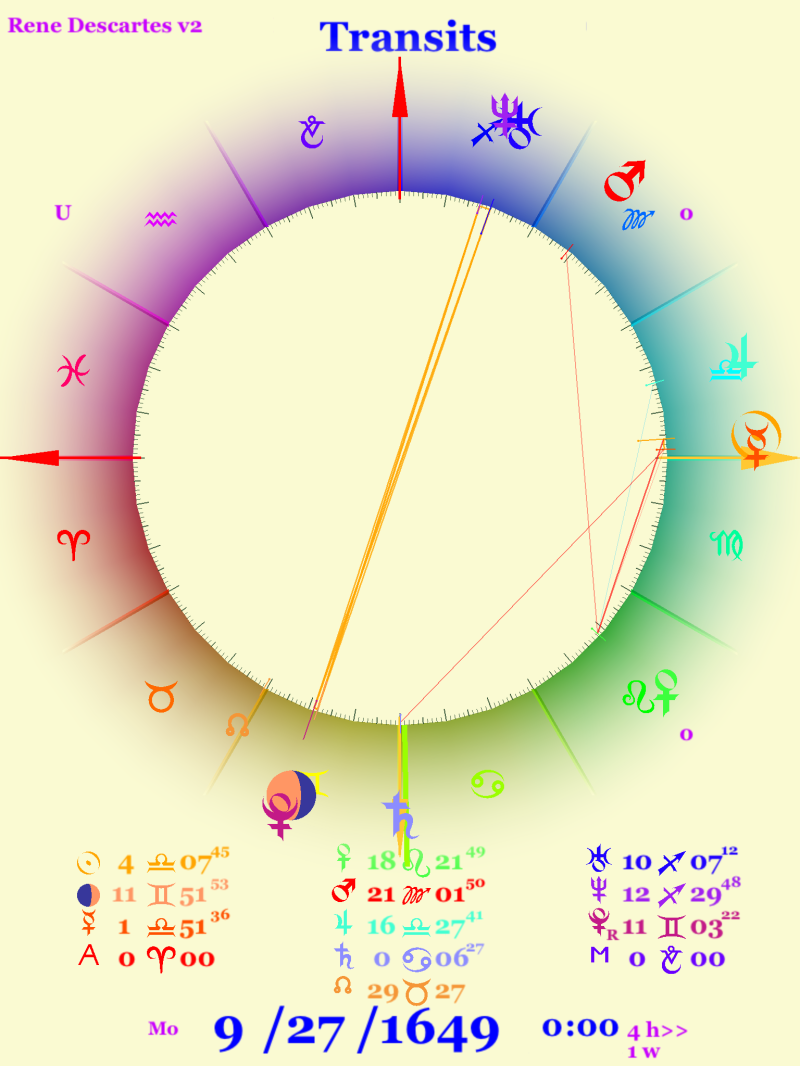
The middle of the Seventeenth Century saw an imposing astrological configuration: Pluto in Gemini opposed to the conjunction of Uranus and Neptune in Sagittarius mentioned previously. This is representative of the powerful changes that occurred in this century, with the English Civil War and all the social changes that went along with that, so many that this time has been call a World Turned Upside Down ( cf history of this period under that title by English historian Christopher Hill).

Rene Descartes
The French mathematician and philosopher Rene Descartes personifies this growing rationalism. He was born during the Uranus-Pluto conjunction of the late Sixteenth Century and died during the Uranus-Pluto opposition in the middle Seventeenth Century which are illustrated above. He invented what is called the Cartesian coordinate system (used in for example the graphical ephemeris) in which the X coordinate is horizontal and the Y coordinate is vertical. Cartesian coordinates allow one to look at reality reduced to points on a graph. This is a concepts all mathematicians know instinctively. Descartes was influenced by the teaching of Galileo and is thought to be the major influence on Newton, so one can see him as a binding person between these two great scientists.

Descartes Death
While we have a time for his death, the time of his birth is only a guess. Some suggest that Descartes, knowing the power of astrology, did not want his birth time revealed, but had no power over the release of his death time. In his birth chart, we see the Uranus-Pluto conjunction on his Sun, an indication of someone who would epitomize the Uranus-Pluto power. At his death the Uranus-Neptune conjunction was trine the Uranus-Pluto conjunction of his birth.

Descartes’ Vision
On November 10, 1619 Descartes has a “vision” where he saw the whole universe and thus human beings as a mathematical system. This vision laid the basis for his mechanistic philosophy that was to influence the beliefs of science from that day forward. If we look at the transits for that day to Descartes’ chart we see a close opposition of transiting Neptune to his Sun, almost a cliche for a vision. There is also Pluto opposite his Midheaven but since his birth time is not good, I would not give this aspect much credence. But since the Sun moves only one degree per day, the Neptune transits is correct.
While Galileo and Newton (among others) are considered the founders of modern science, it is important to note that that they had not totally entered the realm of the hyper-rational which did not develop until the later Nineteenth Century. Galileo was also an astrologer and Newton was an alchemist, interesting but seldom reported facts about two important men in the history of science.

Birth Industrial Revolution
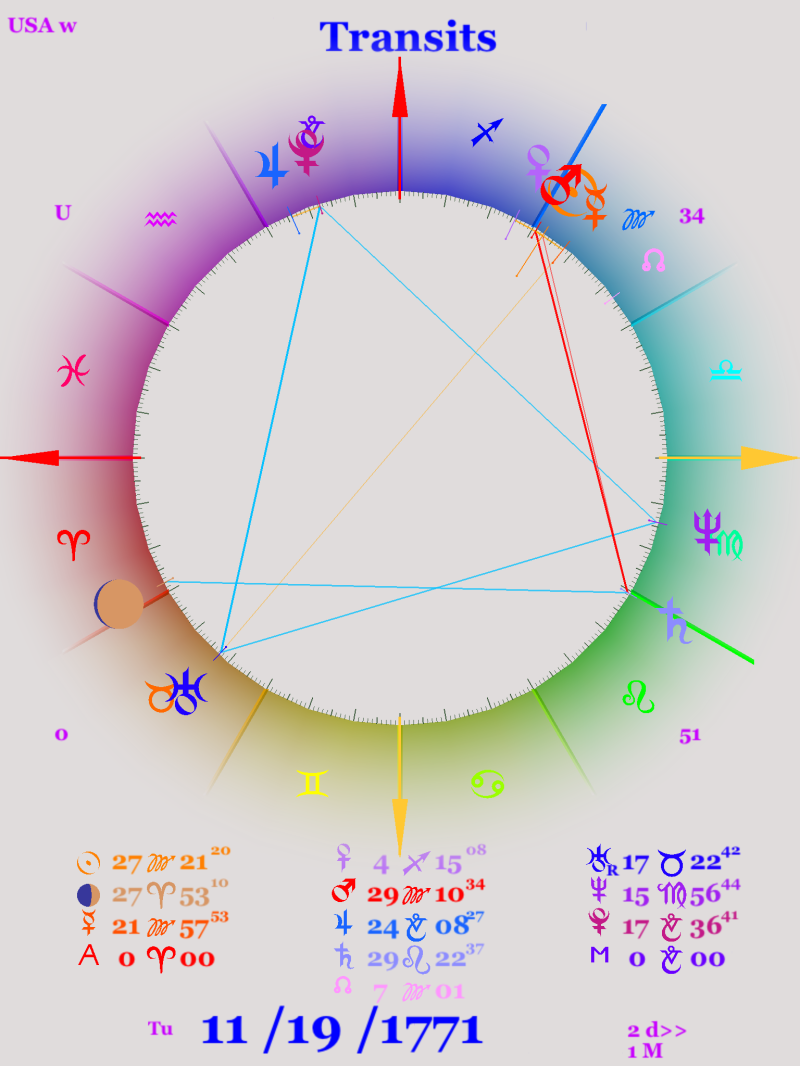
The next century — the Eighteenth — saw the first developments of what was to be called the Industrial Revolution with the next Uranus Pluto conjunction (trine Neptune) of 1710. In England Abraham Darby created iron in a blast furnace powered by coke rather than charcoal setting the stage for the use of iron and steel in manufacturing and Thomas Newcomen created the first practical steam engine (later refined by James Watt) also advancing the coming of industrialism. At the time the Industrial Revolution was only in England, and they kept tight hold of it. The Industrial Revolution came to America with Samuel Slater (illegally) liberating the ideas from Britain and establishing them in America at the end of that Century. The Industrial Revolution hit the rest of Europe by the early Nineteenth Century. This Neptune-Pluto trine was to last most of the century, the Century of the Enlightenment.
The Grandest Trine
This century also saw the Enlightenment, where many rejected the church as a final authority and instead depended on science and reason, the science that had developed in the Seventeenth and Eighteenth Centuries. The French philosopher Rene Descartes is a prime example of Enlightenment thinking though he lived in the previous century. The Enlightenment is best symbolized by the Grand Trine of the three outer planets, a configuration that only occurs once every 500 years.
This growing rationalism resulted in what German sociologist Max Weber called the disenchantment of the world (die Entziehung der Welt). The magic of the world, something known to ancients and also taught in various Mystery Schools, was reduced to a materialistic, mechanistic worldview, symbolized by the Cartesian coordinate system where life and the world are reduced to just a series of events operating as if by clockwork, in which everything can be determined if we only have enough data. In fact, the mechanical clock was a paradigm for how the world and the universe were thought to work. Humans are also thought of as machines, with the mind like a computer, thought this analogy did not occur until the later Twentieth Century.
This split, this disenchantment of the world, was the subject of a popular movie about 40 years ago called Koyaanisqatsi. This title means in the Hopi language “Life Out of Balance” which describes exactly the same conflict we have been describing, that something is out of balance, that the rational — Uranian — side of out natures is not balanced by the much weaker irrational — Neptunian — side, and the movie shows what has been the result. It is not pretty, but we know the resulting world well — the passage of forty years has only made things worse.
This disenchantment has reached its peak in the current era, where it is finally seen that this worldview, that the world is ours to use, is leading in a short time to the destruction of the planet. While it was taught in that ancient text, the Bible, that humans have dominion over the world, it was not until the last 500 years that this could be realized.
There once was a world view opposed to this, believed in by so-called primitive humans who saw the world as a magic place. Perhaps in the current era the foremost proponents of that philosophy are astrologers, who claim that the planets determine/signify what happens here on earth even though science says that is clearly impossible. One can see why this view is called magic by most. For further discussion of these ideas, see The Secret History of the World by Mark Booth, or for traditionalists, The Secret Teachings For All Ages by Manley P. Hall.

 500 Year Party