The First Red Scare

Red Scares are a prominent feature of American life that have happened before there was a Communist Party in the United States.  But the first full-scale red scare took place in the aftermath of World War I, under a Democratic Administration. This happened with Attorney General A. Mitchell Palmer, who was Quaker and had great concern for the underprivileged in keeping with the progressive Democrat under whom he served, Woodrow Wilson.  The Palmer raids of 1919 and 1920 were notorious, but their longest lasting legacy was that Palmer’s young assistant, J. Edgar Hoover,  learned the basics of Communist perfidy at the time.

By 1920 the Communist Revolution in Russia was only a couple of years old, and anarchists and radicals, many from foreign lands, were especially taken with the revolution in that backwards country, Russia, and hoped that such a revolution could happen in more developed countries.  They were extremely enthusiastic with the Revolution that had taken place, and their beliefs had not yet been tempered by the passage of time and experience.


palmer_raid

First Palmer Raid

 
The first Palmer Raid took place on November 7,  1919, two years to the day from the Russian Revolution.  This raid set the pattern for others to come, not only in that period but also after World War II.  In the chart for that event, we see the transiting Uranus squarely on the natal Moon; as we have explained before, such a combination indicates that the people are disturbed, upset.  Such a conjunction happened just before the United States went into Afghanistan earlier this century.  We see that Pluto is conjunct natal Jupiter and thus moving through the core of the United States.  But also notice that transiting Saturn is opposite transiting Uranus;  This opposition, as can be seen by the graphical ephemeris below, was exact in early August (black arrow) and would be exact again in late Spring and early Summer of 1920 (red arrow).   This opposition sets two forces in conflict:  Saturn represents law and order, stability, conventional thinking, whereas Uranus represents unconventional ideas and actions, the promise of the new.  This describes the conflict that was going on then, in the conservative times after World War I.  The Amendment to the Constitution requiring Prohibition had just been passed and was to go into effect on January 17, 1920.  Republicans would replace Democrats as President during the decade of the Twenties, lasting until Democrat Franklin Roosevelt took over after the Great Depression had already started.  Another example of the Saturn Uranus opposition took place in 1965 and 1966, when newly elected, as President, Lyndon Johnson faced a “credibility gap” over the increasing involvement of American soldiers in the Vietnam War.


1919tg

Saturn Opposite Uranus

 
As a result of the First Palmer Raid, a converted troopship left the United States with famous anarchist Emma Goldman and almost 250 others.   This so-called  “Soviet Ark”  was cheered by patriotic Americans, though the massive violations of civil liberties involved in gathering the deportees was ignored by the masses.  The ship left New York harbor on December 21,1919, and arrived in Finland on January 17, 1920.  The deportees were then conducted to the Russian border where they would hopefully be taken, because America certainly did not want them.

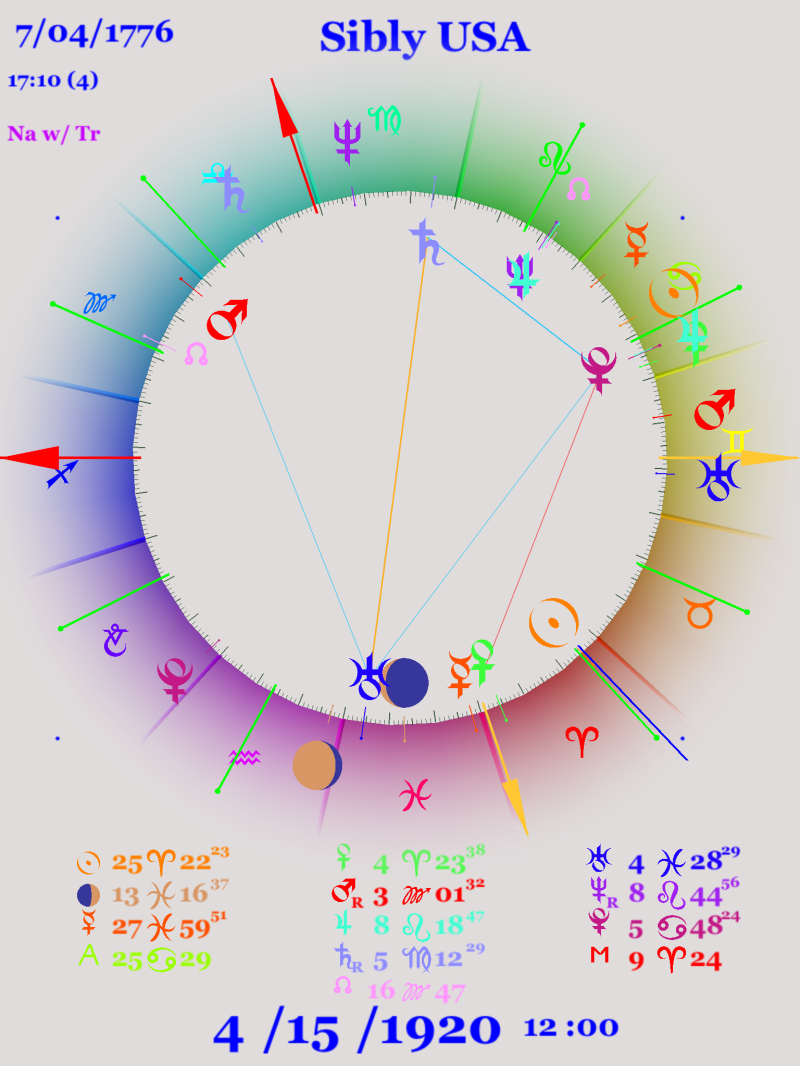
Another famous case from this time involved Italian anarchists Nicola Sacco and Bartolomeo Vanzetti who were eventually executed for the murder of a guard during the robbery of a shoe company in Massachusetts on April 15, 1920.   This case was a cause célèbre for many years, involving letters from all over the world and many famous jurists and lawyers.  Eventually Michael Dukakis, then governor of Massachusetts, declared in 1977 that the two men had not received a fair trial.
 

socco_v

Sacco-Vanaetti

 
In he chart for this murder,  we see clearly the opposition of Saturn and Uranus;  Uranus is no longer on the Moon of the U. S., but Pluto remains in the same position. There is a close conjunction between Jupiter and Neptune, which Ebertin links to idealism, and indeed there was much idealism and hope for a better world among the radicals that were so active in this period.

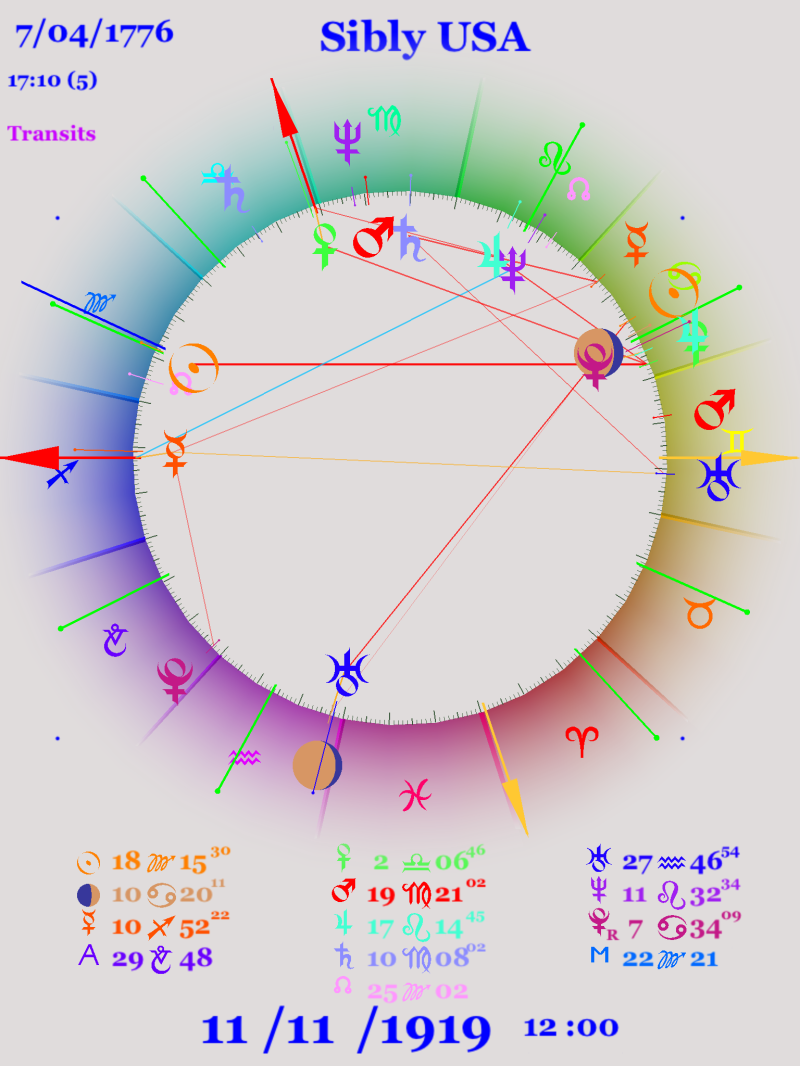
Another powerful movement at this time was the International Workers of the World, called the Wobblies, who had grown in the first decade of the new Century.   There was much persecution of them at this time, the most glaring happened in Centralia, Washington on November 11,  1919, which involved the hanging of a Wobblie who had been removed  from his prison cell  and the deaths of five others.  This happened during a parade celebrating the first anniversary of Armistice Day, the end of World War I.  The  newly-formed American Legion was not happy with the presence of the Wobblies.  The chart for this riot shows many of the same planetary placements we’ve  seen before with Pluto and Uranus and  the Saturn-Uranus opposition.   What is new is the position of the two fast-moving inner planets:  Venus,  the patriotic gathering for the parade, is at the Midheaven, and Mercury is at the Ascendant, and indeed this event is one of the more famous and well-communicated incidents of the First Red Scare.
 

arm_riot

Armistice Day Riot

There was much labor unrest during this period, which further worried the owners of industry.  It has been estimated that 20% of the workers had gone on strike by the end of 1919.  After the war was over, many workers wanted the back pay and raises that they had not received during the war.

Wilson, who had run on the campaign slogan “he kept us out of war” when he ran for re-election in 1916, and then promptly got the United States involved in World War I, did not want dissenters from the war effort, so he got passed the Espionage Act shortly before America entered the War; this Act was designed to prevent talk against the war.  This Act was used to send Socialist Eugene Debs to prison for speaking against the war, and that is where he campaigned for President in 1920.  While the Act has mostly  been against people giving aid to enemies of the United States, this is the same Espionage Act that has been used most against Americans who were not dealing with enemies by our current President to sentence whistle blowers to prison.


espionage_act

Espionage Act

 
In the chart for the Espionage Act, we see that not much had changed in the two years between this  chart and the one for the Palmer Raid.  Saturn is approaching a conjunction with Neptune, signifying the remorse many Americans would feel for the involvement of the country with a European War.  There is also transiting Saturn opposite natal Pluto, always a bad combination which has been discussed before.   A transiting Saturn transiting Pluto conjunction had occurred at the start of this very war.

There was strong dissent among the judiciary to these attempts against free speech. One of the better known was Schenek v United States (Charles Schenek was in the Socialist Party in Philladelphia) in 1919  (where the Court unanimously declared that the Act did not violate the Constitutional protection for free speech), and where Supreme Court Justice Oliver Wendell Holmes famously declared, regarding other cases, that free speech would not allow a man to shout fire in a crowded theater,  but also declared that the government must show that any speech presents a “clear and present danger” to bring about evil that the government must prevent  before it could be limited.   This decision was handed down March 3, 1919.
World War One

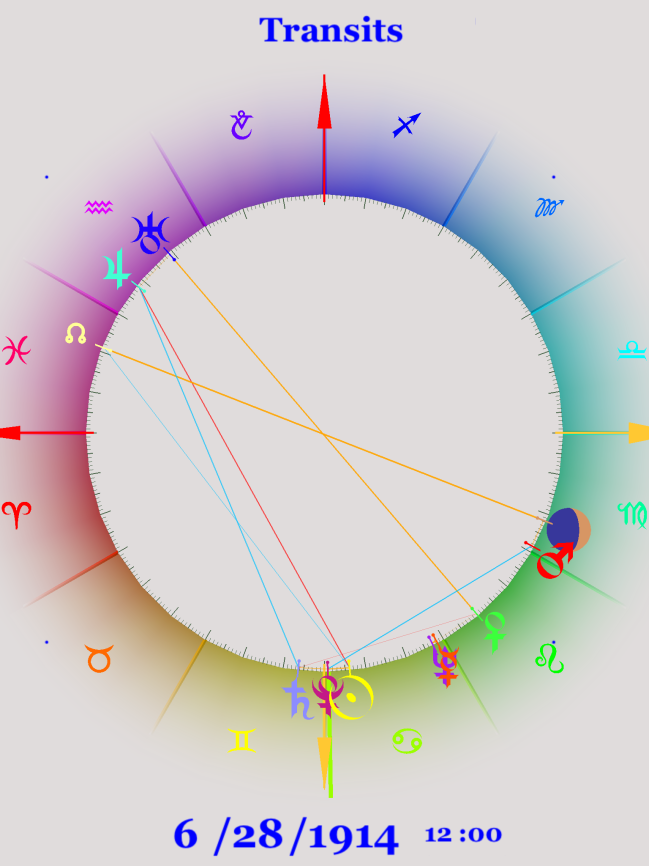
This war started 100 years ago, and there is still controversy about the causes.  The proximate cause, which set the official date for the start of the war, is the assassination of Archduke Franz Ferdinand of Austria and his wife in Sarajevo by the anarchist Gravilo Princip on June 28, 1914.  But there was much buildup  of armed forces in preparation for war at that time, as  well as much hope for peace.  As an example of the latter is the opening of the Peace Palace in The Hague in 1913.  Another question hovering around the edge of the debate is “was the  war inevitable?”  At this point most historians answer that question in the negative.

The world before the outbreak of World War I  was, in many ways, modern, as has been discussed previously.  At the time some people thought that war was possible, some people thought that war was not possible, and some thought that if war came it would last but a few months.  Perhaps the most accurate prediction was from a German general who said that the war would be as violent as the Thirty Years War (1618-48) but would last four years.  Since the Thirty Years War killed at least a third of the German population and laid waste to their territory, this German knew of what he spoke.

The major players in this war showed how incestuous European royalty was.  The leader of England was King George V (grandson of Queen Victoria); of Russia Tsar Nicolas II; and of Germany Kaiser Wilhelm II.  All were cousins, descended from Queen Victoria. Perhaps we should call this the Cousins’ War.  King George  and Tsar Nicolas looked so much alike they could have been mistaken for twin brothers.  By the end of the War, one of those cousins had died, one was no longer in power, and one had changed his name to Windsor, since anti-German feeling was high in Britain during World War I.  After King George V  died he was followed by his son George VI (after another son Edward VIII abdicated to marry the divorcee Wallis Simpson)   who was king during World War II. He was succeeded by his eldest daughter Elizabeth II.  So when you look at the Queen of England  you see a relative of the rulers of the World War I participants.  The year before the start of the war there was a big event — the social happening of the year — which was the wedding  of the daughter of Kaiser Wilhelm II in Germany.  All of the cousins   attended  the event, and people believed that with all the royalty of Europe together war could not possibly happen.

As we saw previously, the first decade of the Twentieth Century saw the growth of Modernism with cars, planes and movies, new types of painting and music.   This was abruptly altered when Pluto crossed the cardinal axis  and went  into the sign of Cancer.  Also, as mentioned previously, the start of the War saw a conjunction of Saturn and Pluto, never a good sign.

worldwar1

World War One

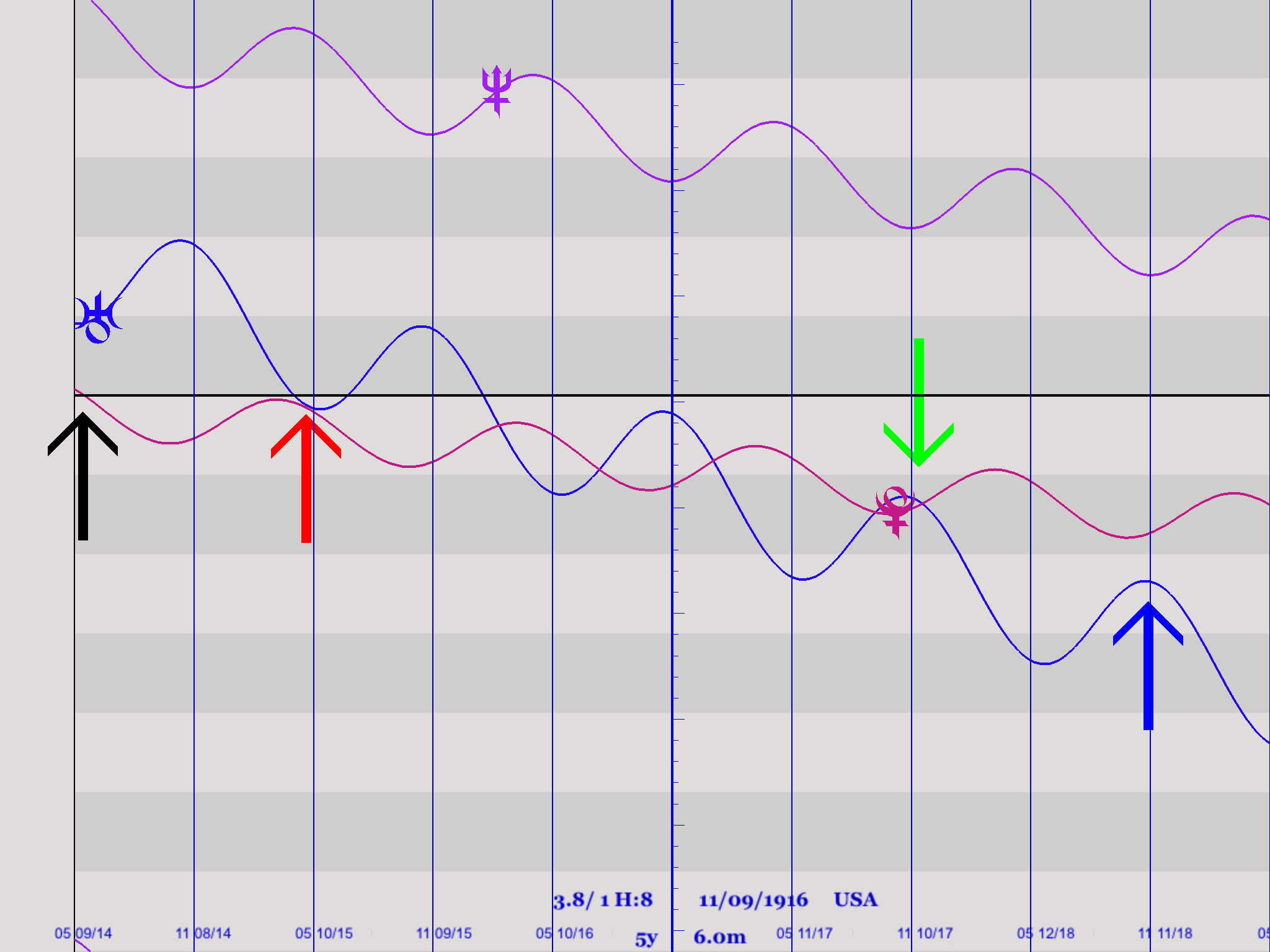
The defining aspect for World War I  was the sesquiquadrate between Uranus and Pluto. If we look at the graphical ephemeris (harmonic eight) we will see that this aspect lasted the length for the war, going in and out of orb during the whole war. From the graphical ephemeris we see that the last time the aspect was close was shortly before the  war ended.  When the War started, Uranus and Pluto were within three degree of a sesquiquadrate and Pluto had just gone over the Cardinal axis (black arrow).    Then, about 10 month later was the first exact Uranus sesquiquadrate Pluto (red arrow); we will look at this chart later.  The last  exact Uranus Pluto sesquiquadrate took place at the end of 1917  (green arrow). Finally, the last close approach of the two planets (blue arrow) happened at the end of the War, reflecting the first close approach at the  start of the War.

The official end — the Armistice — was the eleventh hour of the eleventh day of the eleventh month in 1918.  This brought to an end the fighting , but the justice brought was so harsh  that it helped set the stage for World War II.

The old world — before the War — was no longer. Many things happened to change the world in ways that we are still dealing with.  The end of the War saw the end of a long lasting empire, the Ottoman Empire (started in the Fourteenth Century but it really took off with the fall of Constantinople at the Uranus Pluto conjunction of 1453) which fought on the losing side and was broken up to form the modern Middle East –Syria, Iraq, Lebanon, Jordan — which was created through the Sykes-Picot agreement.  Palestine was promised to the Zionist and, unfortunately  promised to the native people of Palestine as well.

Even though Britain was  on the winning side of the war, and still the major Empire at the time, the position of Britain as the number one power in the world was  over, and the baton was passed to the United States, even though neither realized it at  the time.

After delaying entry to the war for several years — President Woodrow Wilson campaigned in 1916 on “He kept us out of war” — the US entered the War in 1917. Also an influenza epidemic began in the military camps of the US and eventually spread around the world.  There is even some evidence that the outbreak of the epidemic in Germany  hastened the end of the War.  Either through the epidemic from America or the new force of Americans in the War, America helped to bring the end of the War.

After  his successful election in 1916, Wilson assembled a group of people, such as George Creel, Walter Lippmann, Edward Benays, and Harold Lasswell, to create propaganda to convince citizens that entering the war was necessary.  This set the template for  all future war campaigns and today we can witness the successful propaganda to goad us into war.  The public  relations industry was an outgrowth of the pro-war campaign.  One of the notable  achievements of this campaign was the Four Minute Men, who gave a pro-war speech from the stage before cinema performances.

Another event that helped prepare the United States to enter the War was the sinking of the cruise ship Lusitania on May 7, 1915.  At one time the biggest cruise ship, it was torpedoed by a German submarine off the coast of Ireland. The British claimed in was carrying no war supplies, but later it was revealed that it was and thus considered by the Germans as fair game.   The British, who were anxious to get the Americans into the War, used the sinking to inflame American passions.  America did not enter at that time — Wilson still had to  run on his anti-war platform — but this incident did have an effect when  it came to going to war after the election.

lusitania

Sinking of the Lusitania

In this chart, set for the same date as indicated by the red arrow in the graphical ephemeris, we see that the Saturn Pluto conjunction is almost exact at  0 Cancer.  The conjunction of Saturn and Pluto was exact 11 days later.  Also in this chart for the sinking of the Lusitania the Uranus-Pluto sesquiquadrate is exact within 4 minutes.

lusitania_us

Sinking of the Lusitania within US chart

But this event had special repercussions in the United States.   This next chart is for the same event, but as transits to the US chart.  Uranus is sesquiquadrate the Midheaven of the US (black arrow) and Pluto and Saturn are square the Midheaven (red arrow) so  the two transiting planets which are in an almost exact aspect to each other are also aspecting the MC of the US, and there was much public clamor about the event. In addition, transiting Neptune is sesquiquadrate the US Ascendant (green arrow)  and opposite the US Pluto (blue arrow), again pointing to the natal Pluto semisquare Ascendant that we have talked about before.  This aspect suggests some of the uncertainty and confusion about the sinking, which I pointed out previously in terms of the doubt about whether the ship was carrying war implements.  Finally we have Jupiter opposite Neptune and square Mars (yellow arrow) again emphasizing the confusion, the warfare, and the Mars Neptune square in the US chart.  So the US was strongly connected to the sinking of the Lusitania.

The predictions of the German general were borne out  — World War I was the bloodiest yet seen.   The introduction of the Industrial Revolution  into warfare  — which happened to a small  extent  with the Crimean and US Civil Wars — was fully incorporated into World War I.  About 16 million people were killed, with Austria-Hungry, France, Germany, and Russia suffering the most, with over one  million deaths each.   The sheer pointlessness of it all affected many of the poets and writers who survived the War to End All Wars.  Several imperial powers, the Ottoman, German, Austro-Hungarian, and Russian, fell as a result of the War.  This changed the map of Europe and we are still living with the consequences.

Three With Saturn-Pluto

We’ve discussed before the malefic tendency of hard aspects between Saturn and Pluto. We saw two example of this in the 9/11 attack and the Spanish American War. Here are three more examples.


The first one is the start of World War I, exactly 100 years ago this year. Because a number of alliances had been set up in Europe, it only took a spark to set the whole edifice on fire. That spark was the assassination of the Serbian Archduke by a deranged anarchist on June 28, 1914. This assassination allowed the various alliances to take sides, and Russia came to the support of Serbia and then it was all downhill. On this centennial year there have many book s exploring this onset of war, such as The Sleepwalkers, which describes accurately what the world was at the onset of war. For most of the West, the previous 100 years had been a relatively peaceful time, the first in memory. Sure there had been some wars, such as the Civil War in the United States, and the Crimean War, and, though few Americans are aware of it, but you can be sure the Chinese remember it, the Taiping Rebellion in the middle of the Nineteenth Century, which is considered one of the deadliest military conflicts in history, with at least 20 million deaths. But for the West things had been mostly peaceful since the Napoleonic Wars were over. It was considered that peace had broken out and would last forever. Possibly because there had been so little war that many (such as Theodore Roosevelt) worried that men had lost their manliness, and large armies were build up “just in case”.

Image

World War I

In the first chart for the start of World War I, we see that Pluto has just entered the sign of Libra, a Cardinal point. This date, for the assassination, is considered the starting event for the War, but the hostilities didn’t start until at least a month later, and then the war slowly ramped up. The Americans did not enter the war until April of 1917. From the chart you can see that Saturn is conjunct Pluto and the conjunction will get tighter over the next months, as the war starts to build. World War I marked the first time that the developments of the Industrial Revolution could be really applied to warfare. Thanks, submarines, aircraft, automatic weapons, and poison gas could be used. The result was massive bloodshed.

Image

World War II

The standard beginning date for World War II is Germany’s invasion of Poland on September 1, 1939, even though there was a multi-year run-up to the “official” war, including such things as the Spanish Civil War (1936), Japan’s invasion of China (1937), and Germany’s invasion of Czechoslovakia (1938). The chart above is set for the official date. Note that there is a square between Saturn and Pluto; Saturn is retrograde and the square will get weaker before it gets tighter. Note also that Saturn is opposite the North Node of the Moon, and thus conjunct the South Node.

Some consider World War II a continuation of World War I. Certainly the harsh reparation forced on Germany after World War I had an effect. But Germany did enjoy a flowering of culture and democracy, called the Weimar Republic, after the War. This was the “Twenties” in Germany and lasted until the Great Depression started to take effect. We all know what came next.

Image

The First 9/11


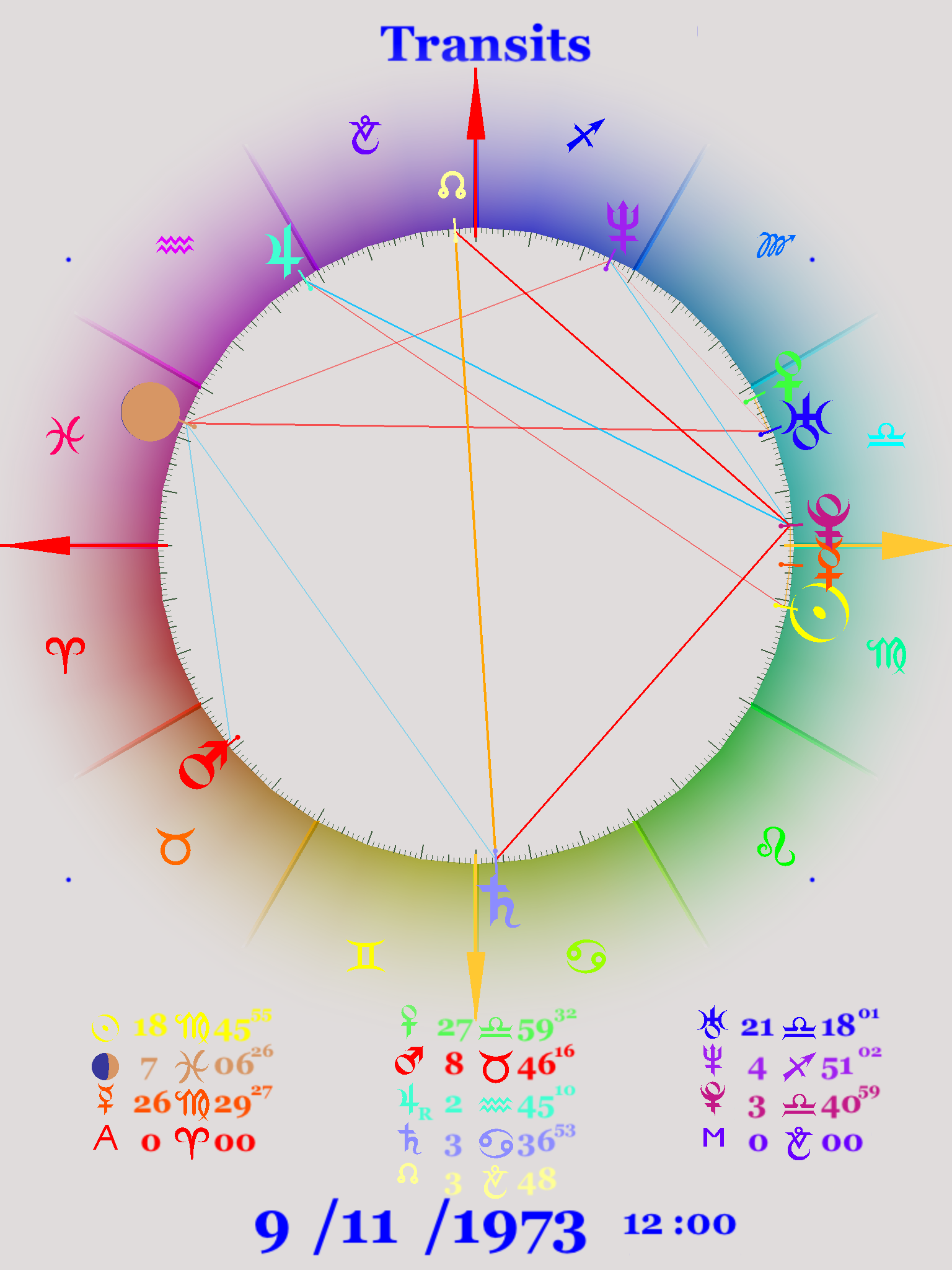
The third chart is for a event called “The first 9/11” by those in the Western hemisphere. There was also an important event in South Africa on a 9/11/1906 in the history of non-violence, but that is a discussion for elsewhere. The event of 9/11/1973 was the occasion of the death of Salvador Allende of Chile and Augusto Pinochet taking power in that country, leading to a military dictatorship that lasted until 1990. Unlike the start of a war, especially World War I, the start of the Chilean dictatorship was very rapid. On this specific day the government of Chile was overthrown and the current president died, whether by the army or his own hand is still unknown. But there was an immediate change in government.

In the chart for 9/11/1973 we again see the Saturn square Pluto, with a very tight orb that is only four minutes of arc. And notice again that Saturn is opposite the North Node of the Moon and thus conjunct the South Node of the Moon, just as we saw in the chart for the start of World War II.

It is interesting that in two of these cases we see Saturn conjunct the South Node of the Moon as well as square Pluto. How should we interpret this? The South Node of the Moon sometimes has Saturnian connotations, especially in Indian astrology. This would increase the Saturnian influence. It also suggests difficulties in connections with others. It goes without saying that in both these instances, this Saturn-Node meaning played itself out.

For more details of Saturn and Pluto see Section V of Cosmos and Psyche by Richard Tarnas.