Crisis and Change

In the previous post I discussed the six crises that have beset American history with the sixth currently happening. Perhaps you haven’t seen the current crisis yet — to paraphrase Gil Scott-Heron, the crisis will not be televised, or for this day and age, the crisis will not be YouTube’d. It is only in hindsight that you can truly judge the strength of the crisis; who could predict the full scale of World War Two from the Japanese invasion of China. And even with a marked start of that crisis — Germany’s invasion of Poland — hindsight is better.

But there is another historical/astrological cycle that is important — what I’ve called in this blog in 2018 a Zeitgeist Change; these are shown by a midpoint configuration involving the three outer planets. This happens two or three times a century, with usually Uranus or Pluto as the apex planet.

There have been three zeitgeist changes in the Twentieth Century; each marked a major shift in the reality of the world. The German word zeitgeist means the spirit of the age and when the zeitgeist changes a new reality becomes dominate, so much so that people begin to forget that the world was once different than it is now — perhaps the current is a New Normal.

First Zeitgeist Change of Twentieth Century

In the first decade of the Twentieth Century such a midpoint configuration existed with Uranus as the apex planet. This period involved a change into the “Modern” world and in fact is a movement called Modernism, seeing for example the development of relativity and quantum mechanics, two theories that completely changed the scientific view of the universe. That decade saw the rising renown of both Sigmund Freud and Carl Jung; after their theories became popular the view of human behavior changed for good. Many artists such as Pablo Picasso and Wassily Kandinsky changed what was accepted as art. And while the automobile was invented in the latter part of the Nineteenth Century, the automobile became popular in this decade with especially the Model T Ford in America. Also invented in the previous century but became extremely popular in the new century were both personal photography with the recently introduced Kodak film camera and motion pictures which allowed everyone to see a new reality. And this first decade of the Twentieth Century also saw the first powered flight that changed the world forever and made it seem much smaller.

Second Zeitgeist Change of the Twentieth Century

The second zeitgeist change of that century was at the end of World War II. This was marked by the explosion of three nuclear weapons — two dropped on Japanese cities — which seemed to cleave time in two and marked the beginnings of a new world. This period has been described as the birth of the Anthropocene Age where so many things changed in a short period of time, the consequences of which would not be known for some time. The direction of many trend lines, such as that for the use of plastic or pesticides, took a rapid upward slant starting after the War. This midpoint had
the apex planet of Pluto which is totally appropriate for the beginning of the atomic age.

Third Zeitgeist Change of Twentieth Century

The third zeitgeist change was in the late seventies and marked the rise to dominance of the political philosophy known as neo-liberalism. Briefly, this is the philosophy that the markets are everything and that (to quote one proponent of neo-liberalism) there is no alternative. The apex planet in this case was Uranus. We now forget that time after World War II and before 1980 when the markets were not so all-consuming as they are now and the United States had the highest tax rate of over 70%.

The last time both events – crisis and zeitgeist change — happened in close proximity was at the end of World War II. With both these events occurring at the same time, the scale of the change was tremendous. Did this fifth crisis caused these massive changes that followed it or was it a coincidence? One can argue either way.
Crisis and Change in the Twentieth Century

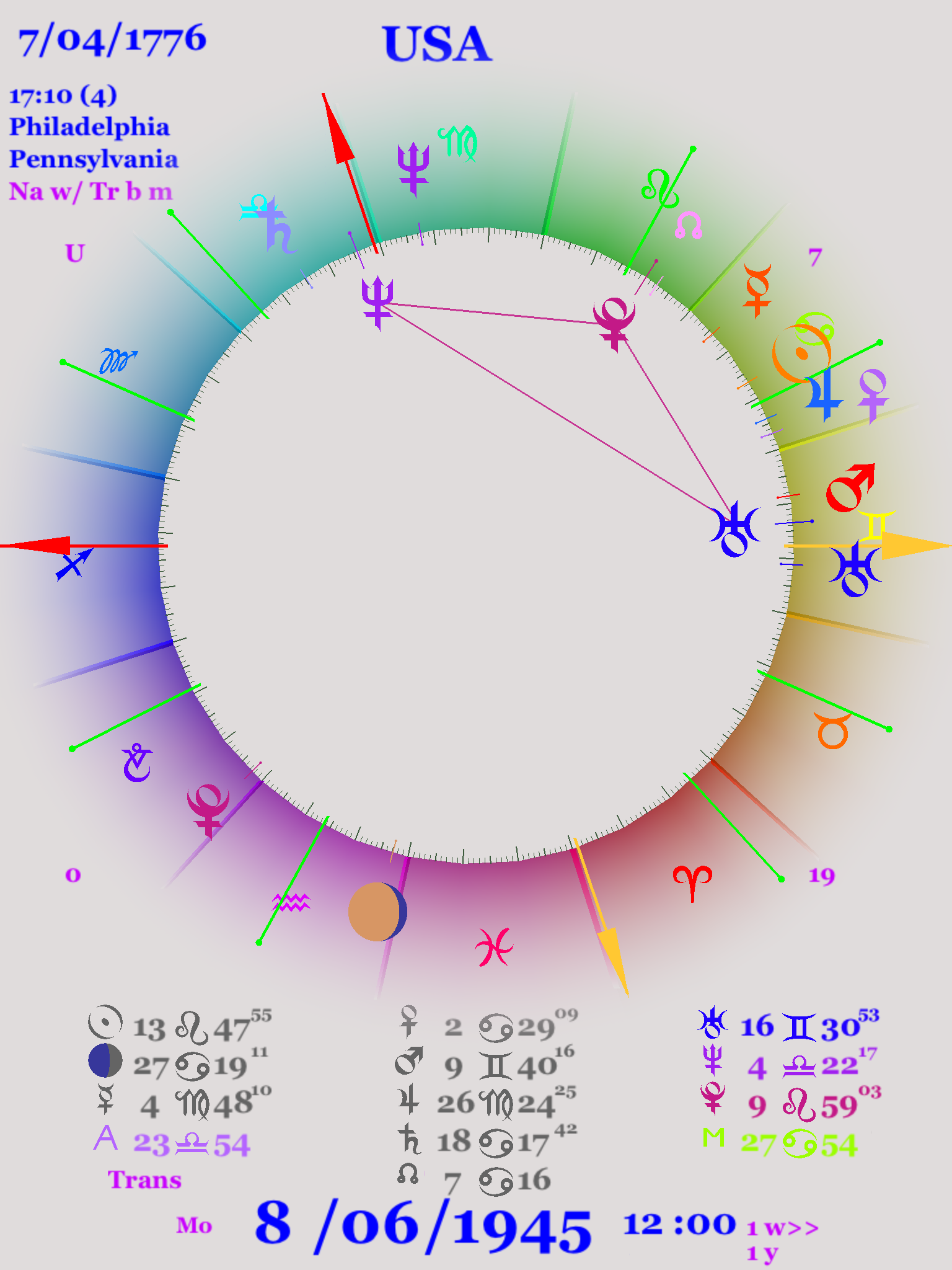
Here is a chart that shows both the midpoint configuration zeitgeist change and the fifth crisis with Neptune near the MC and Uranus near the Descendant of the US. The date is that of the atomic bombing of Hiroshima.

Normally Uranus or Pluto are the apex point of the configuration, but once in every 500 years the apex planet is Neptune; this is the type of midpoint we are having this decade. The previous zeitgeist change 500 years ago brought us the modern world and all that entails with the printing press and the New World, a place that would be totally unrecognizable to a citizen of the Middle Ages or of the ancient world. This was the start of the 500 year party. We could say that we will move into what could be called the “Post-Modern” world if that term were not already in use. Perhaps a better term is a post-party world. As I’ve said before, after a party you have to clean up all the messes made and replenish all the items used up during the party.

Major Zeitgeist Change Sixteenth Century

The midpoint configuration 500 years ago lasted 1503-1507, about half as long as the midpoint this time lasts. We are moving into the Post-Party world, but unfortunately manfy people do not want the party to end. We will see a major conflict as this zeitgeist change takes place.

Major Zeitgeist Change Twenty-First Century

I have previously sketched out the opposing forces in this drama. One side has already let it be known what they want this zeitgeist change to be in books such as the Great Reset by Klaus Schwab (a Bond villain if there every was one) and in the slogan adopted in many places: Build Back Better. Several people have named this side of the drama with such names as Global Capitalism or Mr. Global, but I prefer the more inclusive term (as spelled out previously) of Pluto. ` But for the other side — called by some the Greek word demos (which is not short for demonstrations) which means the people and from which we derive the word democracy and for which I use the symbol Uranus — there is no plan for what the zeitgeist change should bring, no plan B at all. Some ideas have been floated, such as the People’s Reset, but the demos — Uranus — had better get its act together to fight against the plans that Pluto brings, because never in history have the Pluto people had the concerns of the Uranus people in mind. As George Carlin put it: “It’s a big club and you ain’t in it”.

Another way of looking at this split is in how people think about dealing with the upcoming problems of the world that we now hear so much about from political leaders to individuals such Greta Thunberg. It is now the end of the 500 year party but most people only recognize some symptoms rather the underlying problem. One way of dealing with these problems is more technological fixes where all vehicles become electric and we eat meat that is grown in a lab or insects also grown in a lab because those in nature are dying. This proposes a techno-industrial future where we will only live in a virtual world because the natural world is so toxic. This future has been prophesied for a long time — see the story “The Machine Stops” written by E. M Forster over 100 years ago. But at least (from the perspective of Pluto) things do keep on growing and there is money to be made so that is a good outcome. The people who support these ideas are called Bright Greens or as I call them the Pluto Greens.

The other greens (Uranus — the people’s — Greens) believe that only by de-centralizing the governments and de-industrializing the world, returning to the natural, and a policy of de-growth and embracing natural health do we have any hope of saving the planet. One can see this is directly opposite to the Pluto Greens: more growth and “green” industry (an oxymoron), escape from nature, and industrial medicalized health. But there is not as much money made from following the Uranus green ideas. Again we see this basic split in humanity, one that I have referred to often as Pluto versus Uranus or Global versus Local.

Another term I have heard about what the change could be from the Uranus side is called the Great Awakening, perhaps an echo of the Great Awakenings in American history (at least two) that appear to be associated with Uranus-Neptune conjunctions. Note that in the second half of this decade we have a Uranus-Neptune sextile, an aspect not nearly as dynamic as a conjunction, though in this case Pluto is closely involved. I’ve heard that there is a move to form alternative institutions to the current ones which have proven time and again to be hopelessly corrupt. The biggest area of accomplishment seems to be an alternative to the mainstream media; the term I’ve heard used for this alternative is New Media, the kind you won’t find on YouTube or as these folks call it GooTube.

For thousands of years people have lived in a hierarchical society where those at the top, perhaps called kings or patricians (Pluto), had a say over those at the bottom, perhaps called commoners or plebeians (Uranus). That is the same separation into two groups that we see in modern times though now those at the top are so much more powerful than those at the bottom than ever in previous history. Perhaps a real change of the zeitgeist would be to have a real democracy where there is no longer a hierarchical society, so this may be a time for a call for the end of Hierarchy.

The world is heading for disaster (bad stars) in so many ways — a library could be filled with books describing the ugly futures (dystopias) now in store. End of the world books and movies have been around for a while, see for example When Worlds Collide from 1951 (based on a 1933 novel by Edwin Balmer and Philip Wylie), but now the number of these has increased dramatically.

Note that this division between Pluto and Uranus — Up versus Down — is different than the more classic Jupiter versus Saturn — Left versus Right — which is a concept that originated in the French Revolution. People make a mistake if they conflate these two polarities. Supporting Uranus issues is neither necessarily Republican or Democratic though both political parties like to pretend they do.
`
The world has been under the leadership of Pluto for all these millennia. The wagon is racing out of control under the guidance of Pluto and it is demanding (to Uranus) that it be permitted to right the wagon. Pluto wants Uranus to believe that the problem is not with Pluto itself but rather it’s all the fault of Uranus and that Pluto has ways to keep the wagon on the road. Uranus must seize the reins of the wagon before it goes into the ditch. Pluto wants to keep the factions of Uranus separated and fighting among themselves so that Pluto has free reign. It is a long standing dogma of Pluto and why they fear real democracy (cf James Madison): those folks really don’t have the wisdom that Pluto has and so as their betters Pluto must lead them as if they were children.

To sum up, the world is seeing a huge crisis in this decade, one bigger than World War II, more geographically widespread, and involving more death and destruction, followed by the biggest change in (at least) 500 years. This is not surprising since a crisis as big as this one is expected to be will alter society so much that a huge change should be expected. What we are also seeing in this ten year decade is the biggest conflict in world history, something that has gone on for millennia, but, I feel, is coming to a historical climax. This crisis is very big and I believe it is the crisis itself that will change radically how people think of themselves and their so-called leaders. But since this crisis has just begun things have a long way to go. Or as a Scottish friend once said to me: “Hold on to yer hairdos laddies a big storm is coming”.

Zeitgeist Changes – Part 4

There were two main changes in the world with the third midpoint of the Twentieth Century, and we are still living fully with the repercussions of those changes, as well as those from previous times.  One thing that you will notice is that there is no major art movement that corresponds to this third zeitgeist change, unlike the first two.  This is, I believe, because now Art (with a capital A) is a big business.  The major change that occurred at this time — 1978-1980 — was the rise of neoliberalism.  One can not judge anything happening in the world today without accounting for the neoliberalism that rules everything.

Neoliberalism is the doctrine that the markets know all, that only the market is fundamental.  I call neoliberalism Markets Uber Alles, that is Markets above all, reflecting the sayings of the Nazis (Deutschland Uber Alles) and the punk rock group the Dead Kennedys (California Uber Alles).


midpoint1979

Third Zeitgeist Change of Twentieth Century


Here is the third midpoint between the three outer planets.  In the exact midpoint for September 10, 1979 we see that each of the three planets is at the same degree in consecutive signs, so that Neptune and Pluto are sextile and Uranus is semisextile the two other planets.  Since this is not only a midpoint configuration but also important aspects are involved, the configuration is stronger than if it were just a midpoint.  By inspecting the graphical ephemeris, one can see that, depending on the orb you allow, this midpoint configuration lasted at least from late 1977 to late 1980, which saw the election of Ronald Reagan as President of the United States.  The Uranus-Pluto midpoint is indicated by the reddish line which is intersected by the blue line of transiting Uranus in the top half of the chart.


1979tg


Neoliberalism leads to privatization and austerity, which increases inequality; this has main effects on all of the population both rich and poor.  Inequality causes increasing stress among the people, resulting in more gun deaths and racial discrimination, worry about jobs and anger at immigrants.  Now, after 40 years of neoliberalism, things have changed drastically and we don’t remember what came before.  More and more power has devolved into private hands; there has been so much austerity that people are feeling the stress and act in destructive ways, both to themselves and others.  What was once thought as the commons is increasingly controlled by private power.  In several places water, which was once thought as a right of all, is controlled by a business.  Deregulation strips rules that govern the behavior of corporations, since the corporations know best.  Carter started this out with deregulation of the airline industry and the long distance truckers.  We have the greatest percentage of homeless since the Great Depression, and the current wave of homeless started appearing in the early years of the Reagan administration.

Another thing that Carter did that helped get neoliberalism started, even though it cost him the 1980 election, was to appoint Paul Volker head of the US Federal Reserve in July 1979 and Volker soon changed the monetary policy of the country, resulting in bad economic conditions that doomed the Carter presidency.  This policy was carried further on by all succeeding Presidents.

Back in the Twenties, an Italian encyclopedia defined fascism as corporatism, which is the definition that Mussolini adopted for his meaning of fascism.  America is now totally in thrall to corporations, organizations that in early America were chartered by states for a specific purpose, but now are seen as the dominant business form.  Corporations are people, which was “decided” (see this previous entry for the reason of the double quotes) by a Supreme Court decision in 1886, and has only been strengthened by later decisions, such as Citizens United v FCC.  Businessmen and CEOs are heroes of society these days — look at the adulation given to Elon Musk — and it is surprising that it has taken the country so long to elect a businessman as President.  Perhaps neoliberalism is just a further stage of fascism.

Here are some of the signs along the way in the rise of neoliberalism: Margaret Thatcher, the storekeeper’s daughter, was elected Prime Minister of the United Kingdom 1979, and brought neoliberalism to that country with increasing austerity that has never gone away.  She served as a good partner for Ronald Reagan, elected 18 months later, to remake the world in the vision of neoliberalism.  Her motto was TINA — There Is No Alternative.  And she certainly remade England, with her crushing of a coal miners strike being only the most obvious example.  And governments after Thatcher, either Tory or Labor, followed the Thatcher formula.  Even now Britain’s National Health Service, a beacon for the world, is being dismantled and replaced by private practice.  Then Ronald Reagan was elected in the United States, as a perfect complement to Thatcher, and he helped move the neoliberalism agenda (“the problem is government”) along, and all Presidents after have also helped move neoliberalism forward.  In California a referendum was passed in 1978 called Proposition 13, which limited property tax increases and has prevented California from getting enough money to do many things that it wanted.  Passage of this had profound implications for the state, and was a trendsetter for the country.  The major effect of this act was to limit property taxes in the State of California, which hampered the construction of new schools, among other things.  The act also required a two-thirds majority of both houses of the state legislature to change the state taxes.  Since it was difficult to get such a majority in both houses, there became less and less money for such things as education, both for public schools and the state university system, which had been relatively inexpensive for residents and had been renowned for its quality.  Both those things disappears in the aftermath of the passage of this act.  Remember the leader in China that took over in 1978 after Mao died: This man, Deng Xiaoping, is reputed to have said that to get rich is glorious, which is certainly a neoliberal motto, and after that Communist China became a capitalist power.  Notice now how many things are made in China that used to be made in the United States, and how few things are still made in the United States.


urne1

The Nineties


But neoliberalism did not really get going at full speed until the election of that first baby boomer president, Bill Clinton, and the important conjunction of Uranus and Neptune in he early Nineties, which saw the rise of Financial Capitalism.  In the graph below, you can see that sometime in the early Nineties profit from manufactured goods was surpassed with profits from financial services for corporations.


dsc_0129b


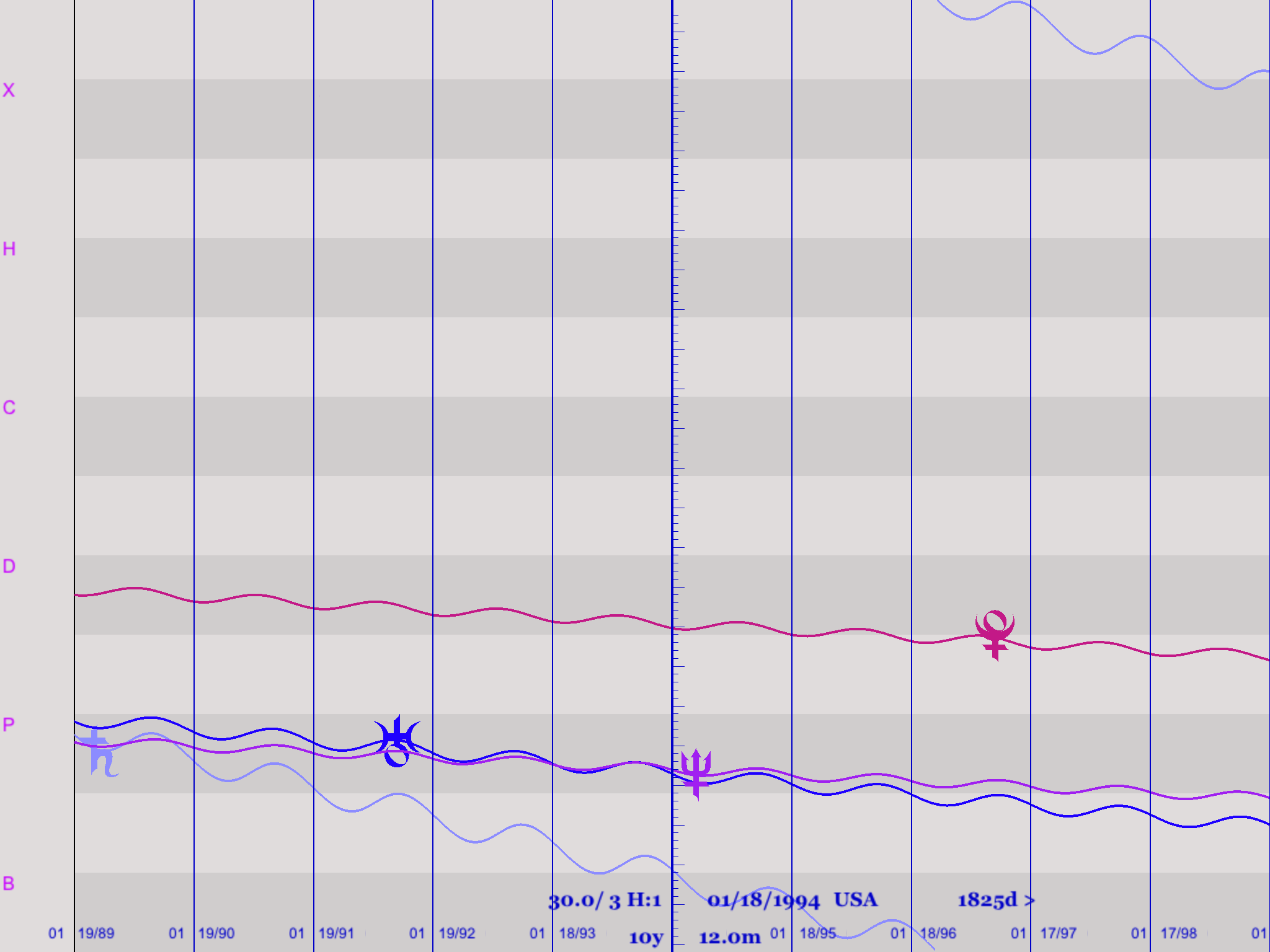
I often think that the Nineties were as important as the Sixties, but they don’t get the credit.  I have an blog post about the Nineties in the works now.  But the Nineties did not have as great a soundtrack as the Sixties.  The Nineties saw the popularity of the Internet, in the guise of the World Wide Web, soar to heights, as well as the rise of financial capitalism.  The aspect indicating all this was the Uranus Neptune conjunction.  In the chart for an exact conjunction of those two planets in September of 1993, notice that in addition to the conjunction Saturn is square Pluto, often a nasty combination, and that the Uranus-Neptune conjunction is square a Mars-Jupiter conjunction.  Much happened at this time. From the graphical ephemeris we see that while the conjunction was tightest in the period 1992 through 1995, it lasted the whole decade of the Nineties.


urne1_tg


Here are a few graphs that show the effects of neoliberalism on America.


wealth-inequality


The first graph shows the percentage of total wealth held by the top 1% and the bottom 90% of the US population starting in 1962.  You can see that the amount held by the upper 1% decreased until the late Seventies, exactly when neoliberalism started to take over, and then their share started to increase.  The share for the bottom 90% reached a plateau in the Eighties, and then started to decrease.  In the following years, the two lines are increasingly separating.


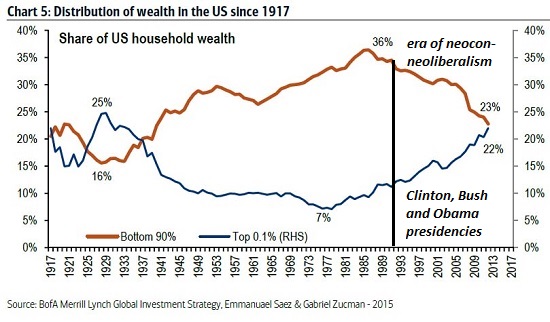
wealth_dist


The next graph reinforces the impressions left by the first.  It shows the wealth of the bottom 90% and the upper 0.1%, that is the upper tenth of the upper 1%.  Again it shows the wealth of the upper 0.1% falling until the late Seventies and then increasing, while the wealth of the bottom 90 % increased until the middle Eighties and then started falling.  As of the last year available for this graph the parentage of wealth for the two groups has almost crossed.


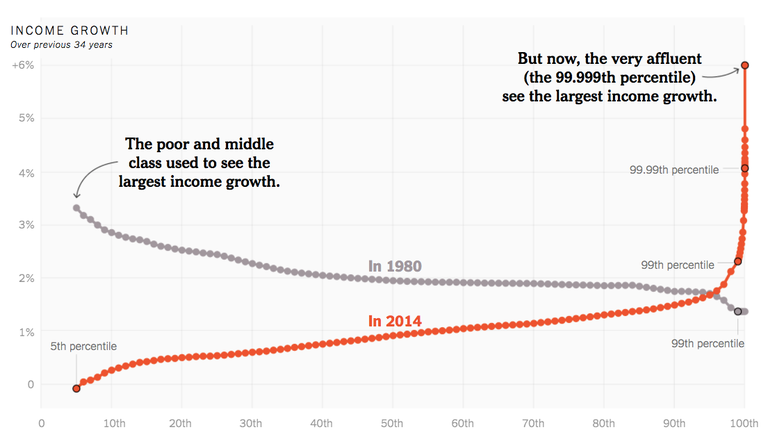
income_growth


This next graph shows the income growth in 1980, before neoliberalism really took off, and in 2014, after the full effect of neoliberalism had happened.  In 1980, most of the income growth went to the poorest people, those who really needed it.  In 2014, the poorest actually lost income (ie negative income growth) and most of the income growth went to the very, very rich.


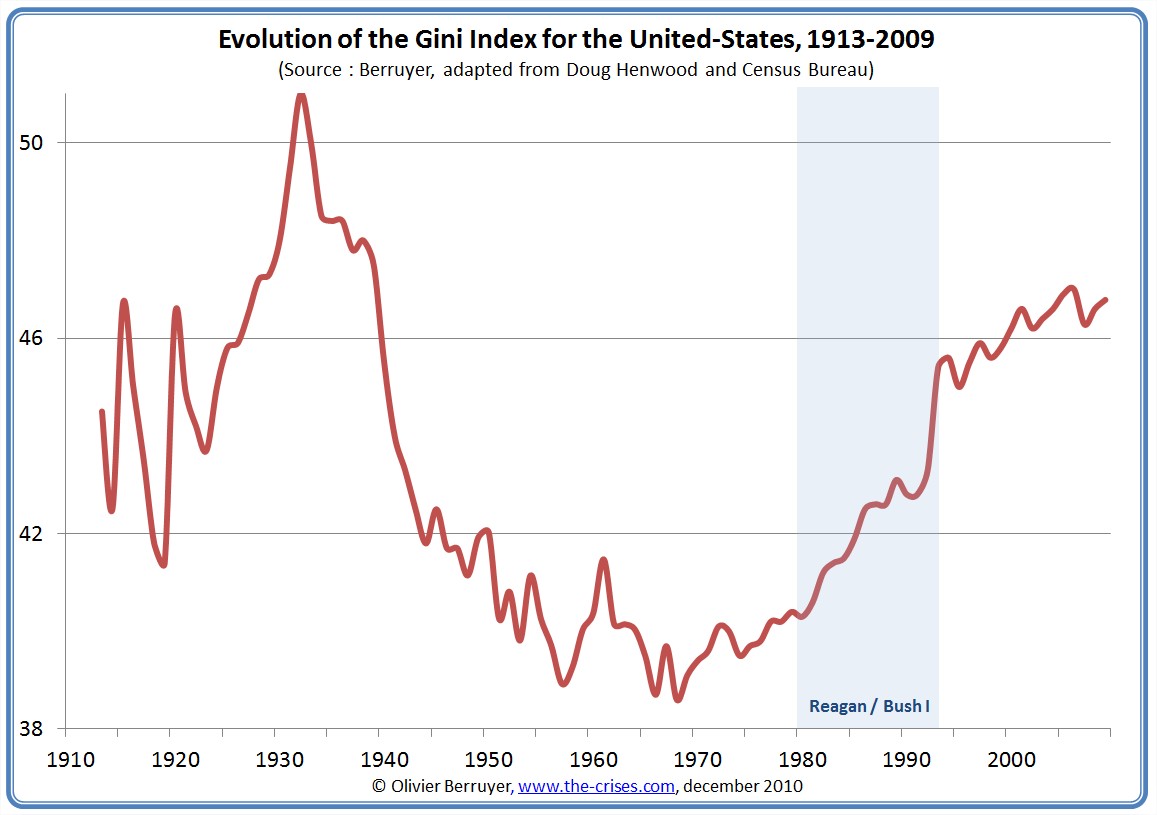
gini-index-usa


Finally here is a graph of the Gini coefficient, the standard measure of income equality. Normally Gini is a number from 0 to 1, but sometimes to avoid decimals it is from 0 to 100.  With a Gini of 1.0, one person has all the wealth (and that person is probably named Jeff Bezos) and with a Gini of 0 the wealth is spread equality to everyone.  Thus decreasing Gini means less inequality, and increasing Gini means more inequality.  We see from this chart that Gini decreased until the late Fifties and then, except for some blips, remained low through the Sixties and even early Seventies, but after that started to take off.  We haven’t reached the heights of Gini we had in the Thirties, but there is still time.  The most unequal country, of modern developed countries, is the USA, far beyond (or below) others, followed by Portugal and Britain.

The effects of increasing inequality are immense, and essentially they destroy society.  There is more violence, racism, teenage pregnancy, mental illness, and everyone is affected, not just those at the lower income.  There are so many changes caused by inequality that a book is needed to document them all, and in fact such a book was published in 2010: The Spirit Level: Why Equality is Better for Everyone by Richard Wilkinson and Kate Pickett.  This is the standard reference for the problems caused by inequality, which has increased because of neoliberalism.  And to add insult to injury, those who are at the upper levels of income condemn those people who act out because of the effects of inequality, calling them such names as “deplorables” and “black predators”.

Another inequality phenomena seen in America is that the average lifespan has decreased for two years running.  Normally, life expectancy always increases, unless something very large happens, such as a major war, depression, or for example in Russia when the Soviet Union fell.  Many of the increased deaths that caused the average life span to fall were suicide, alcoholism, or drug overdose (the opioid crisis).  These are all “deaths of despair”, and despair has certainly increased with the ravages of neoliberalism.


bearsterns

Bear-Sterns Collapse


In the period 2007 through 2009 the world experienced a major financial meltdown called the “Great Recession”.  One signal of that meltdown was the collapse of Bear Sterns, a chart for which is above.  The most significant indicator of this meltdown was Pluto transiting over zero Capricorn, which has been discussed before.  One would think that such a failure of neoliberalism would indicate that major changes were needed.  And one would be wrong.  An incoming President oversaw the transfer of much money to the financial institutions that caused the crash, and very little to the people truly hurt by the crash.  The joke at the time was “Where’s my bailout.”  And unlike the Savings and Loan crisis of the late Eighties, where hundreds of bankers were put in jail, this time no one was imprisoned.  Truly neoliberalism is now much more dominant than it was in the late Eighties; when you don’t solve an obvious problem but rather patch it up, there are only more problems once the patch falls away, and we know this from our own lives.


ploppussu

Revolt Against Neoliberalism


There was a revolt against neoliberalism and the results of the financial crash in the second decade of this century, illustrated by these charts.  Transiting Pluto was opposite the US Sun at the the same time as the opening square (from the conjunction of the Sixties) of Uranus and Pluto.  Thus at the same time as the opposition, Uranus was square the Sun of the United States.  This is even more obvious from the graphical ephemeris, were you can see that Pluto is opposite the Sun (gold dashed line) from 2013 to 2016.  In fact, the last close opposition is just before the election of 2016.  Upon seeing this before the 2012 election, I said that whichever party won the 2012 election would lose the 2016 election.  Whichever party held the Presidency during the Pluto opposition would be so disgraced by the time it was through that they could not hold the Presidency.  The Sun represents the government and the President.  The previous time this aspect happened was before the American Revolution and the Sun represented the King in England.  It was a time after the Seven Years War and Britain was laying taxes on the colonies in order to pay for that war, things such as the Stamp Act and the Tea Act.  The colonists were not happy and the American Revolution eventually resulted.


ploppsu_tg

Pluto Opposite US Sun


The other big change under this third midpoint was the birth of Islamic terrorism, which did not really exist before this period.  After Carter’s national security advisor Zbigniew Brezheniski (died May 2017) got the CIA to stir up trouble in the Soviet aligned government of Afghanistan (still considered the best government among those in the country that remember it) the Soviets invaded and the US and Saudi Arabia trained the mujahideen fighters to combat the Soviet invasion.  The mujahideen were guerrilla fighters from various Muslim counties, at first Afghanistan, and they often fought non-Muslim invaders.  Al Qaeda (which means the Base) was developed from that group of which Osama bin Laden was a member.  From those early terrorist groups, all the modern Islamic terrorists are descended.  When these terrorists groups — and that is what they were, even though they were funded and supported by the United States and Saudi Arabia — had driven the Soviets from Afghanistan, they turned to other opponents, such as when the United States set up troops in Saudi Arabia under the first George Bush.  This is no secret, since Brezheniski bragged about it to a French newspaper, and a British newspaper interviewed Bin Laden when he was fighting the Soviets.

At the same time — 1979 — a group of insurgents attacked a mosque Mecca, the holiest city in the Muslim world and called for the overthrow of the Saudi government.  As a result of this attack, the government of Saudi Arabia decided to more support the extreme branch of Islam call Wahhabism, though it had already been a dominant doctrine in that country.

Also in this period there was a revolution in Iran, in which the Shah — who had been installed in 1953 by a coup organized by the US and UK — was overthrown in a revolution from the religious leaders of Iran and many Americans were held hostage.  This started the long antagonism between the rulers of American and Iran, a dispute that we can see played out currently.

In early 2001 a book was published by scholar Chalmers Johnson called Blowback, which predicted that all this support of terrorist activities would blow back on the sponsors of such terrorists.  The book was mostly ignored until the 9/11 attacks happened a short time later, when suddenly Johnson was praised for his prescience.

And of course blowback is what we are facing now, with for example the group ISIS or Daesh.  One can expect even more blowback from the actions of many countries in their attempt to overthrow the government of Syria, which currently seems to be the hot spot of the world.

But remember, all of this flows from the actions of a certain government in Afghanistan in 1979.  One wonders how many deaths, destruction, and refugees have resulted since.

So here we are forty years into the neoliberal experiment, and with the “War on Terror” (first announced by Ronald Reagan, though this is often forgotten) taking place in many countries, mostly in the Middle East.  People tend to forget how much has altered with this third zeitgeist change and they assume that things have always been as they are now, and will always be the same only more so.  They don’t realize that another zeitgeist change is coming, and that it is not that far off.