Hard aspects, such as squares, oppositions, and even conjunctions (not technically a hard aspect since hard suggests aspect harmonics that are even number, eg squares are harmonic 4) get all the respect in astrology, while soft aspects, such as trines or sextiles, are the Rodney Dangerfield (ask your father) of astrology, they don’t get no respect. In the second half of this decade, the trine aspect will get center stage. As we shall see, trines can be powerful also. One difference I see between hard aspects and soft aspects is that hard aspects are overt — they force you to notice them, it takes no effort on your part — while soft aspects are covert — under the covers, the energy is there but you have to do something to notice them.
As I’ve indicted before, the first and second half of a decade are important and different. But half of a decade is a semi-decade (grammatically proper) whereas the two decade period, which corresponds these days to the Jupiter Saturn twenty year cycle, is a bi-decade. We are now beginning second semi-decade of the second bi-decade of the Twenty-First Century.
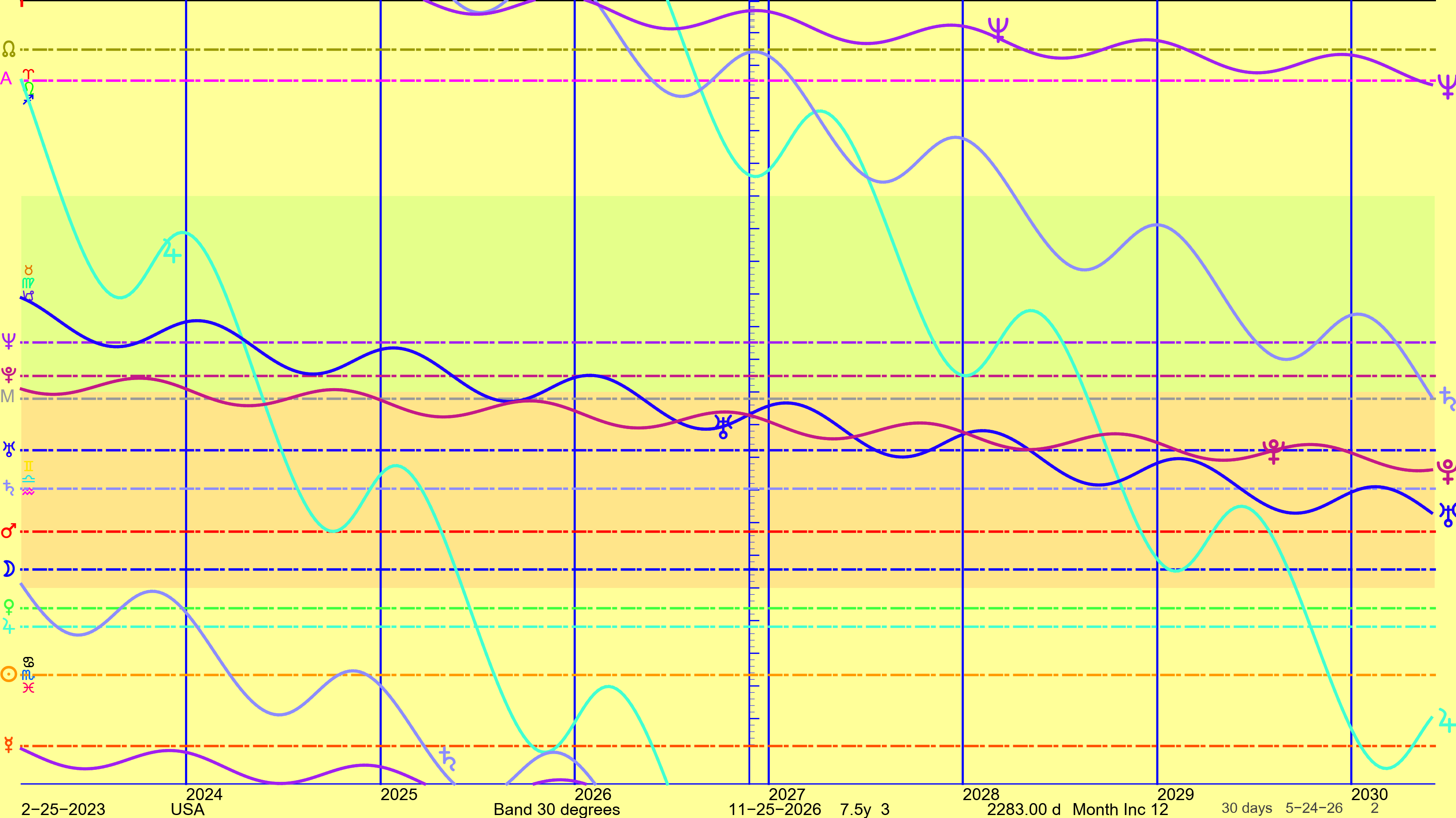
Uranus Pluto Trine Over US Chart
There will be a trine between Uranus and Pluto lasting this whole semi-decade. The conjunction of those two planets happened in the Sixties and gave its flavor to that decade. Richard Tarnas in his Cosmos and Psyche describes the connection. By examining the graphical Ephemeris we can see that this trine lasts from at least 2025 through 2029, this complete semi-decade.
Trines seem to have an effect long before the trine is exact. While this should be true of all aspects, what I’ve recently noticed is that this “before exactitude” affect seems especially prominent for tines. We see that in descriptions of trines below.
Let’s look at a couple of examples of trines involving the outer planets – Uranus, Neptune, and Pluto. The first example is World War II.
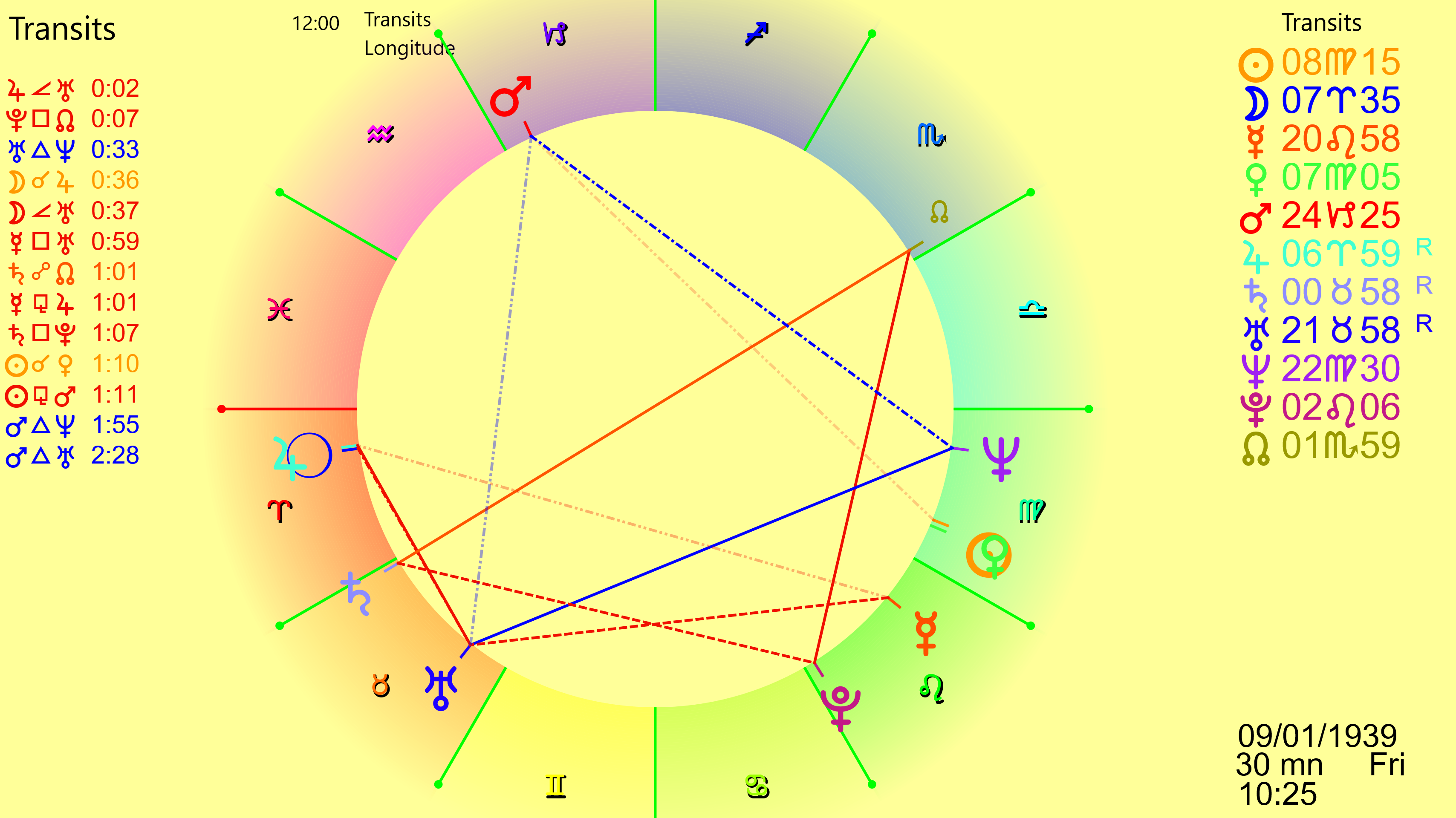
Official Start World War Two
The official start of World War II was September 1, 1939 when the German army invaded Poland. But the decade of the Thirties is infested with violent acts that were a strong precursor to the invasion of Poland and could certainly be considered part of World War II. This will be discussed in a later post. Of course, many Americans don’t think that war started until December 7, 1941 when the Japanese bombed Perl Harbor in Hawaii, which at the time was a colony and not a state of the US. But events like the Spanish Civil War (July 17, 1936 to April 1, 1939) and the Japanese invasion of Manchuria ( initial war was September 18, 1931 to February 1, 1932 followed by an occupation through August of 1945) should also be considered part of World War II even though they occurred before the official star of the War.
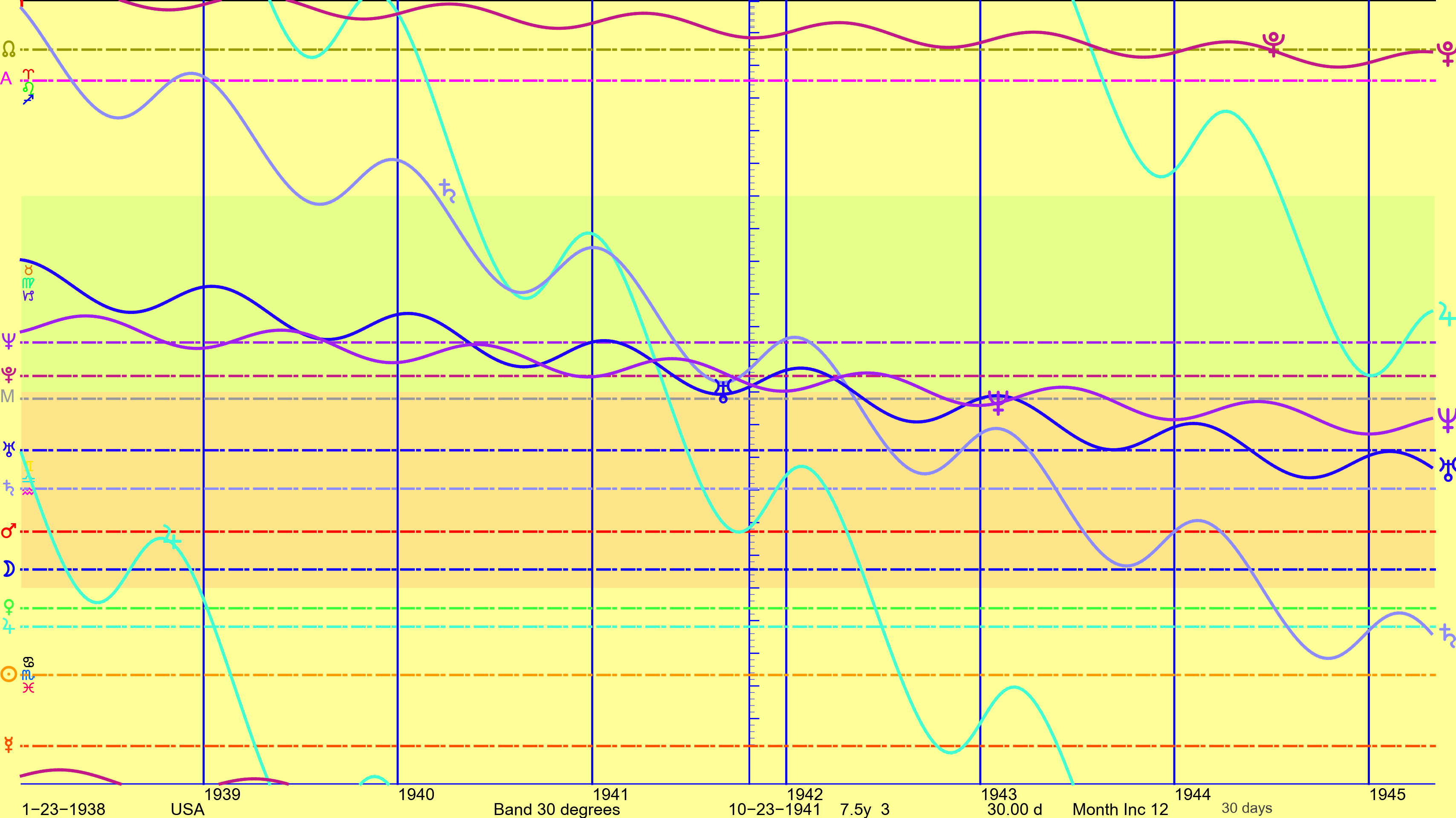
Graphical Epheremis for World War Two
By looking at the graphical ephemeris for the period of the Second World War we see that Uranus and Neptune were trine (depending on the orb used) from 1938 through 1945. The chart for the official start of the war, when Germany invaded Poland on September 1, 1939, shows that trine at one half a degree of orb and, just to make it more suggestive, in a grand trine with Mars, which as the composer Gustav Holst reminds us, is the Bringer of War. There is also a square between Saturn and Pluto. The most intense period of the war was in 1941, 1942, and 1943; that is when Saturn is conjoined with Uranus (a contradictory combination) and thus trine Neptune. Also in 1938 through 1940 Pluto crossed the Aries Point by trine as it moved into Leo.
You can almost follow the progression of World War II by looking at the graphical ephemeris. The year 1942 was probably the most intense, with America entering the war and the Battle of Stalingrad — one of the bloodiest battles of the war — starting. By 1944, as the trine was separating, it was clear to many at the time that the war was headed in a positive direction (for the Allies). The final defeat of Germany was on May 8, 1945 (Victory in Europe Day) and obviously things had been going downhill for Germany before that date. Japan surrendered on September 2, 1945, less than four months later, but again they had been in trouble of a long time.
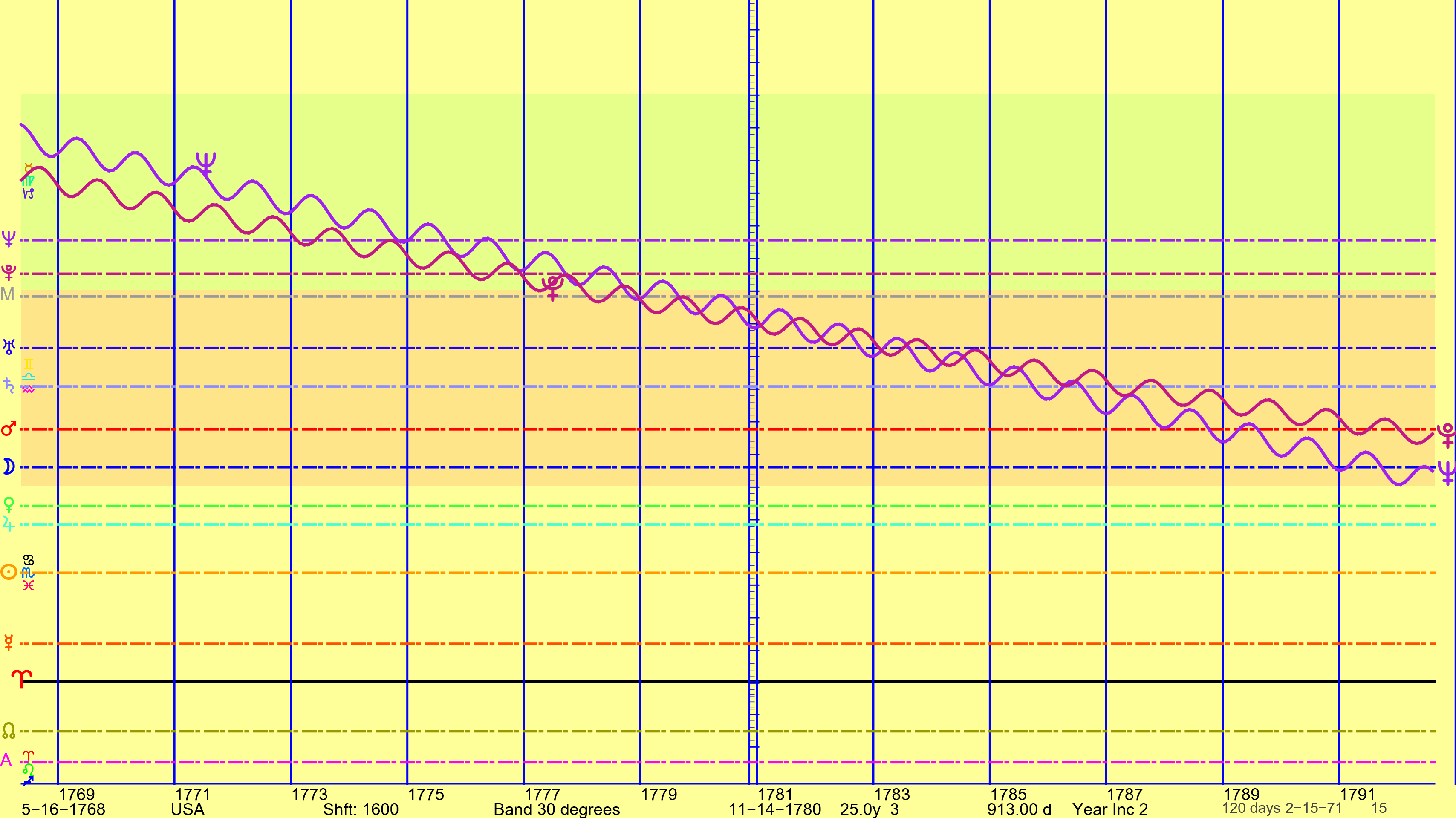
Long-Lasting Neptune Pluto Trine
The only Neptune-Pluto trine in recent history is from about 1768 to 1788; Neptune was conjoined to the MC of the US and so Pluto was trine that point at 1778 through 1780. During that period the war between Great Britain and the United States started and finished. The Peace Treaty of Paris actually ending the war was in 1783. The Constitution of the United States was ratified as this trine was breaking up in 1789. From a wider perspective the movement called the Enlightenment was breaking out and the planet Uranus was discovered in 1781 right when the trine was most exact .
Magna Carta
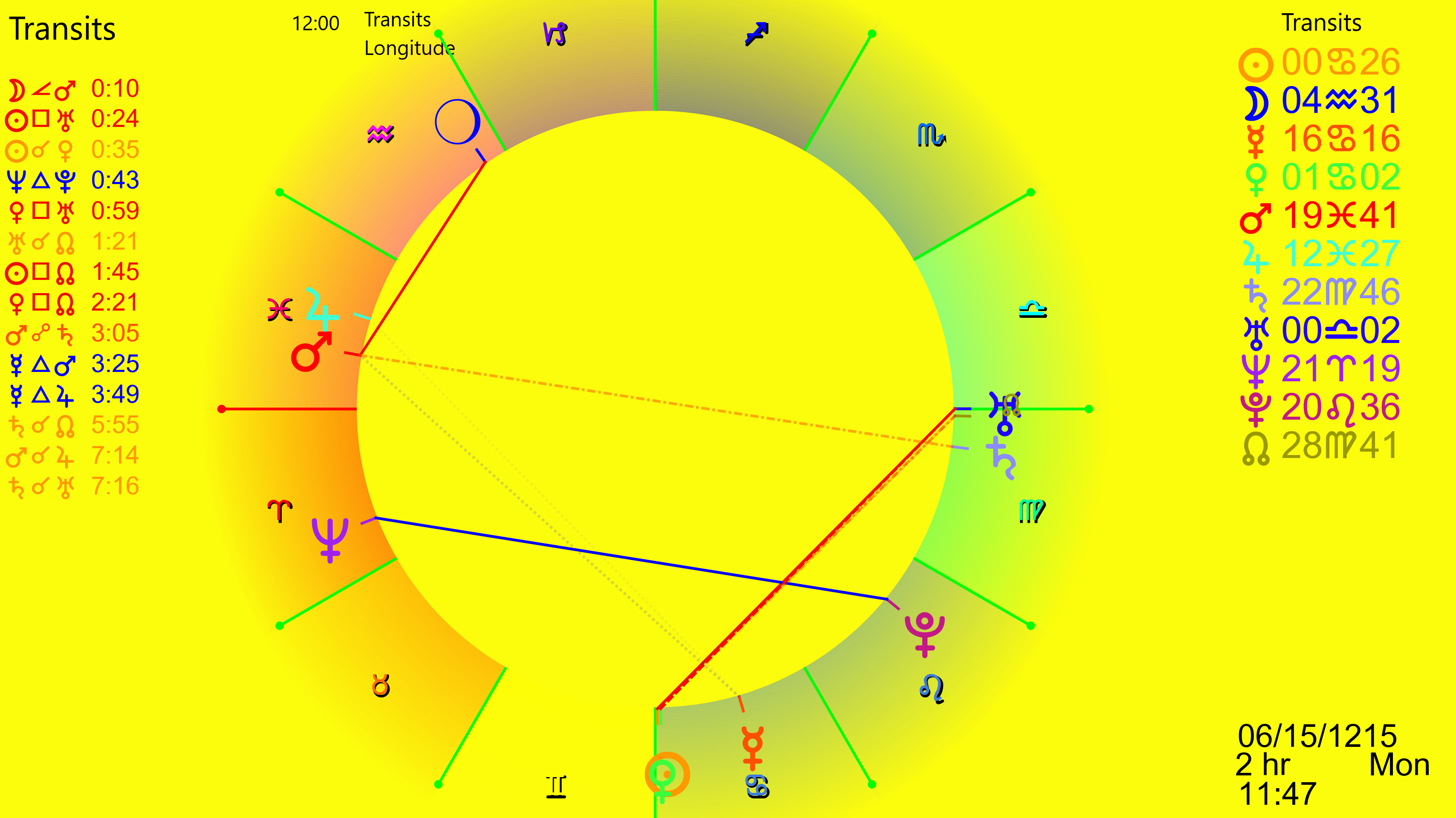
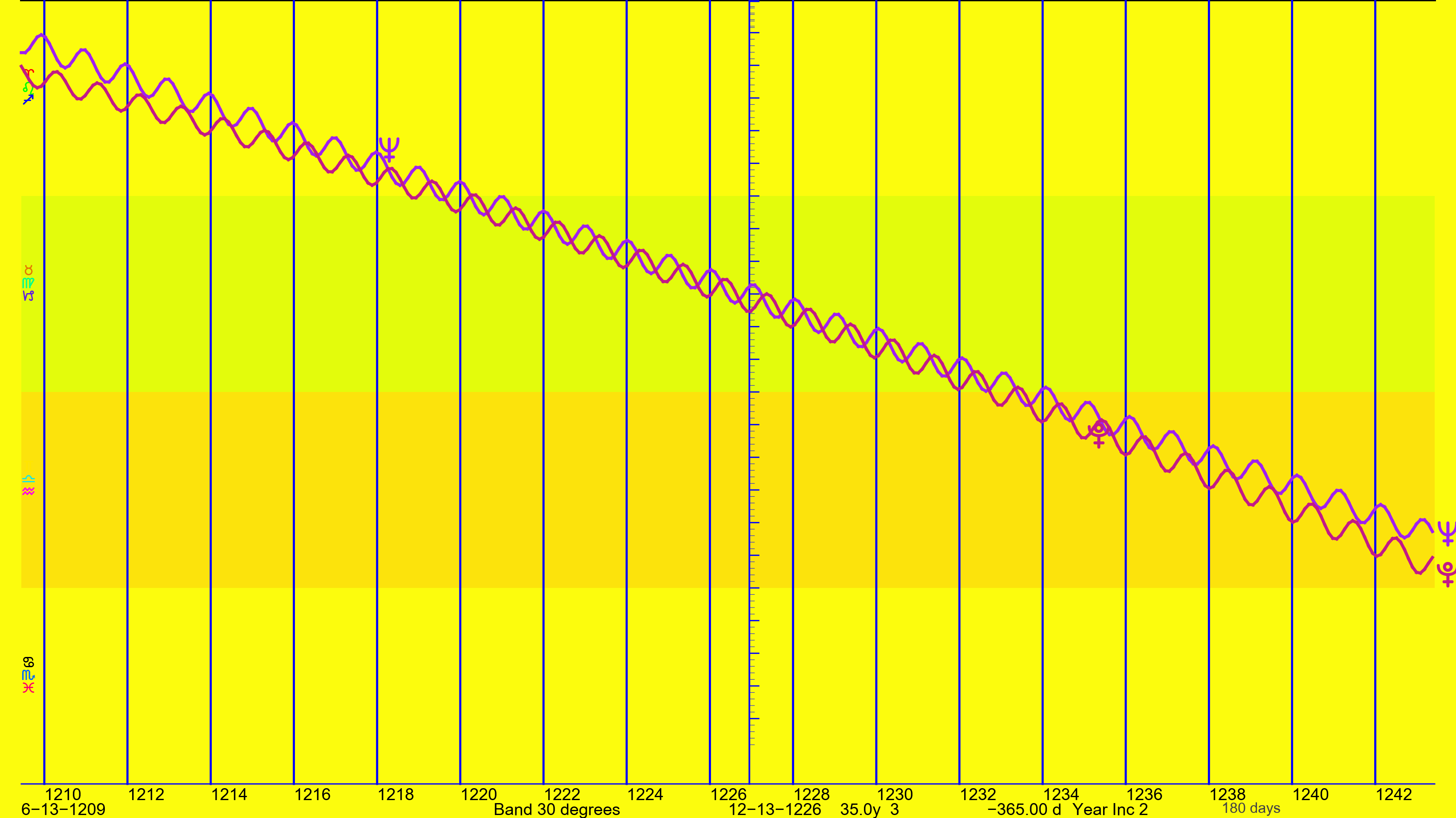
The Magna Carta, one of the foundations of English jurisprudence and all that is related to it, was signed on June 15, 1215, in a three month period where Neptune went retrograde and Pluto went direct — see graphical ephemeris. The trine continued from at least 1212 until 1242. The principles of this document are found in many Constitutions and common law around the world, including (of course since it was once part of England) that of the United States.
Neptune Pluto Trine Around Magna Carta
Magnified Magna Carta Date
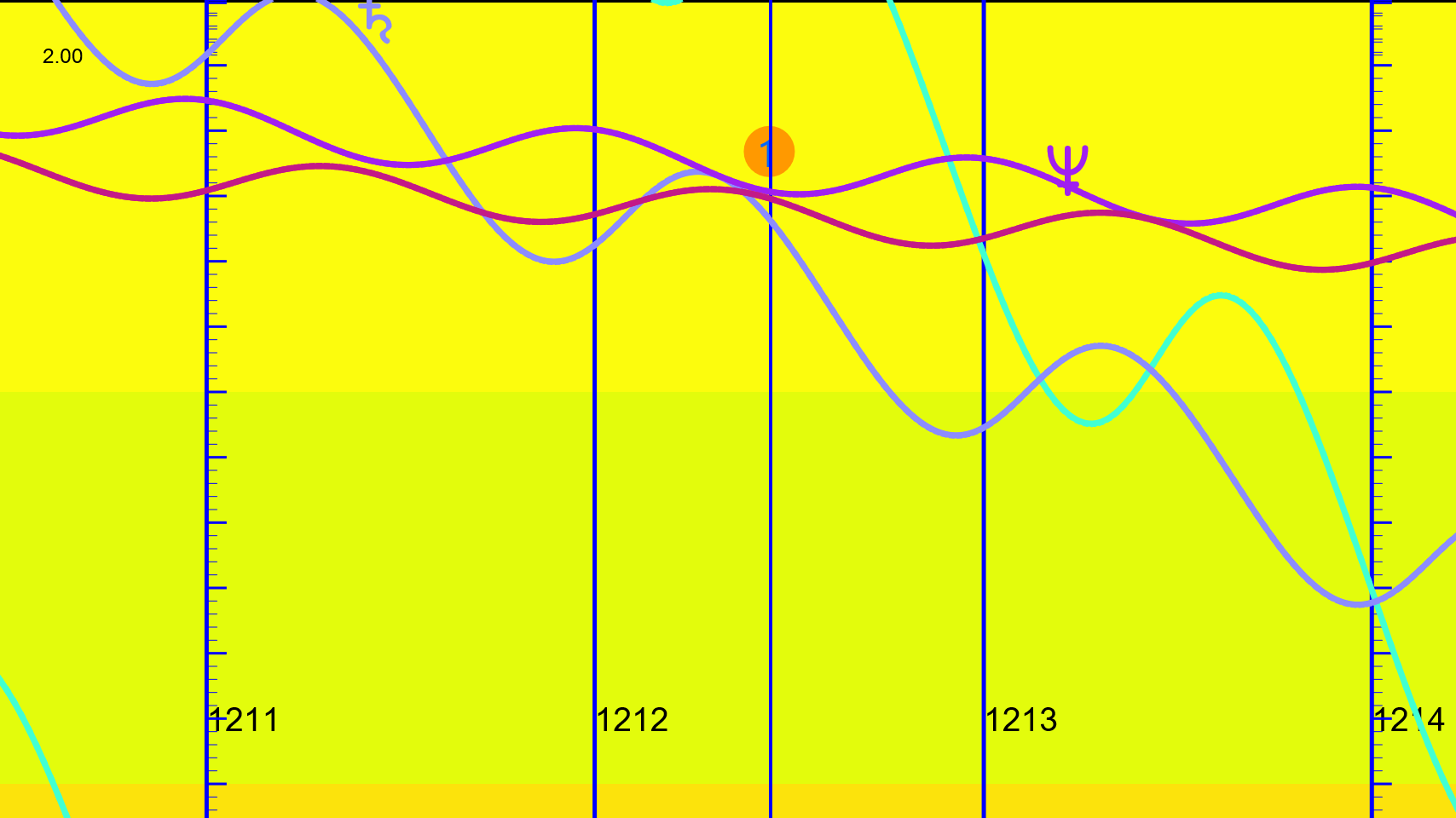
By looking at the period when the Magna Carta was signed, indicated by 1 in the above graphical ephemeris, we can se how close the Neptune Pluto trine was.
Let us now examine trines of Uranus and Pluto — the trine that is occurring now. As I looked at the trine of these two planets over the past couple of centuries, several things stood out consistently. There were important changes in society and culture. These changes were in three general categories, but of course there were other changes that were apparent to people living at the time. One area that saw changes can be loosely classified as art: we will see specific examples below. Another area of change was in politics: there were in the cases examined below the growth of political movements to hasten change. Then there was an increased interest in what I will call metaphysical or esoteric ideas.
Uranus Pluto Trine 1880s
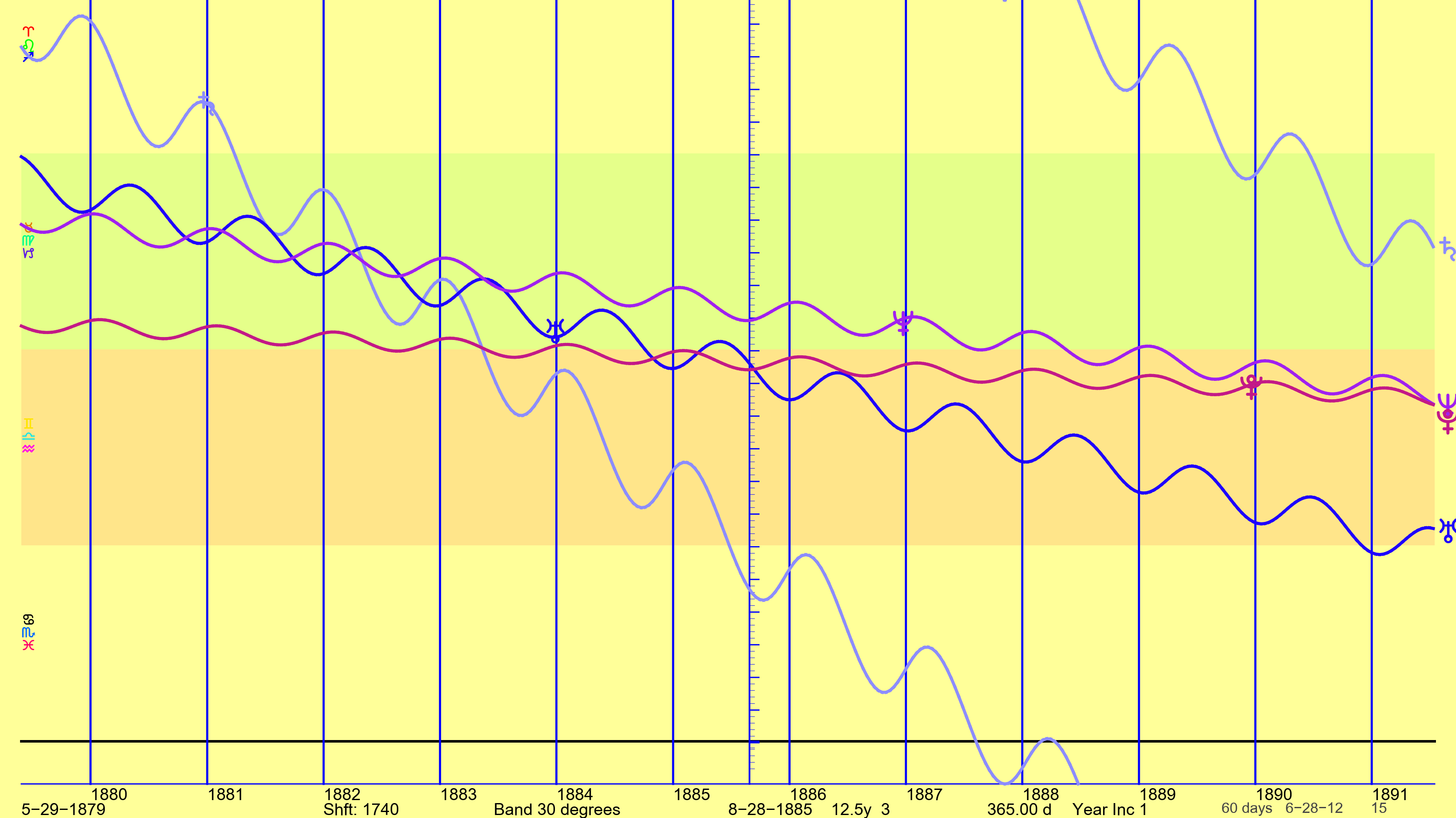
There was a trine of Uranus and Pluto between approximately 1883 and 1887. Interestingly enough, this trine was sandwiched between a trine of Uranus and Neptune (about 1879 through 1884) and the conjunction of Neptune and Pluto (about 1888 through 1896). This makes sense since if a conjunction is about to occur, a planet will trine both planets in turn. This period saw the beginnings of an art movement, centered in France, call Impressionism. This art is highly regarded today, and some of the well known practitioners were Claude Monet and Camille Pissarro in France and Winslow Homer in the United States. British artist JMW Turner, who was operating at the same time, did not consider himself an Impressionist but in his art light certainly is an important characteristic as it is in impressionist paintings. But impressionism also occurred in music and literature, though practitioners are not household names like the relevant artists.
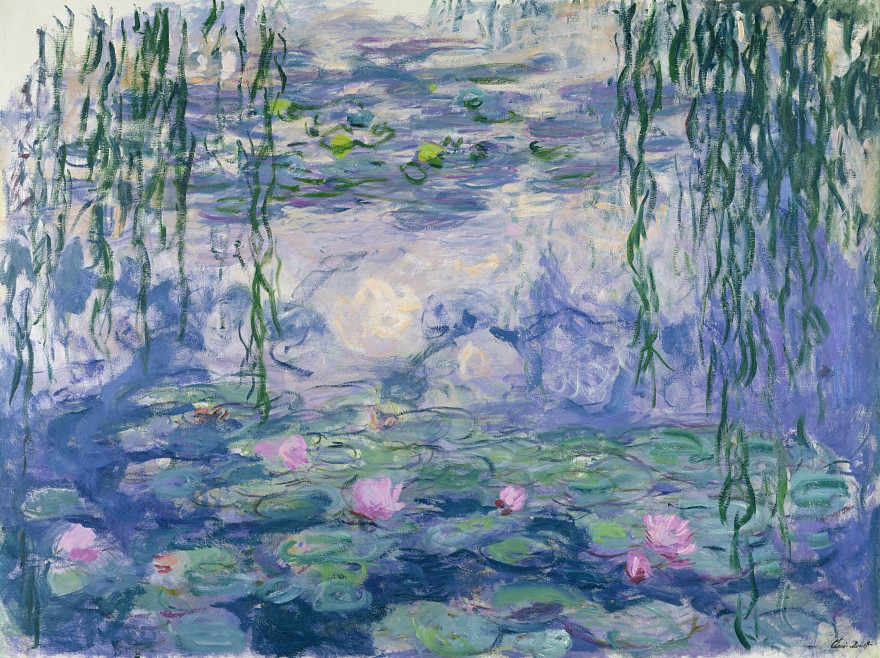
Claude Monet
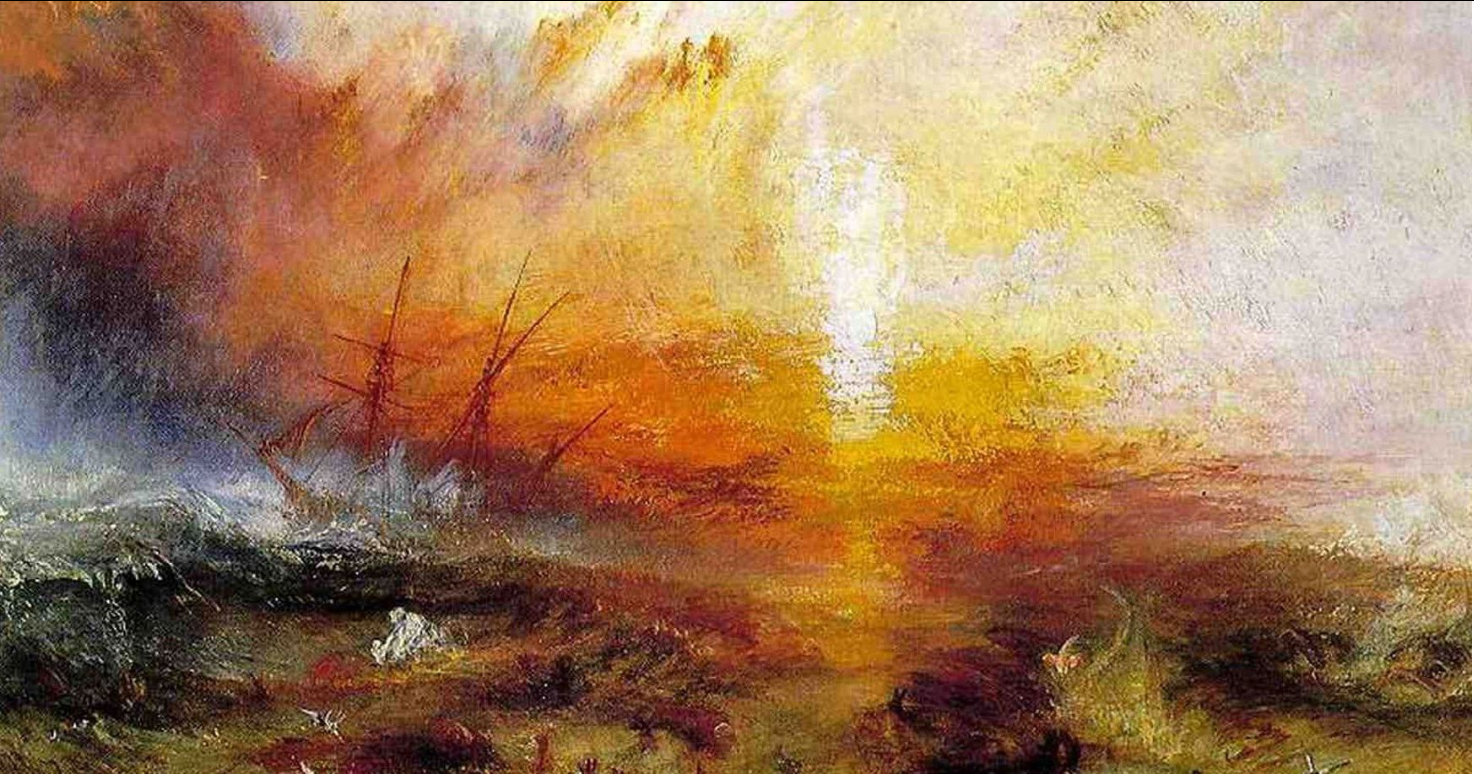
Joseph Mallord William Turner
In the United States there was the “Haymarket Affair” which happened in Haymarket Square in Chicago Illinois on May 4, 1886. Workers were having a rally in support of an eight hour work day and a bomb exploded. The day before at another rally police killed two people. This affair marked a period of great unrest among the working class in the United States. There was much labor agitation during this period. In Ireland there was increasing dissatisfaction with the methods used by the British to control the Irish. Disturbances — called the Belfast Riots — were between the Catholics and the Protestants. These Belfast Riots also occurred in 1886. In the United States a People’s Party was born that in later years became the Populist Party, which lasted until a prominent populist, William Jennings Bryan, ran as a Democrat for President and lost. All these events show great dissatisfaction among the masses.
Theosophy — a form of occultism or a new religious movement, depending on who you ask — was founded in New York City in 1875 by the Russian Helena Blavatsky and some American occultists. Blavatsky moved to India in 1885 and died there in 1891 after which there was decline in interest in theosophy until a rebirth under the next Uranus-Pluto trine.
Also in the mid-1880s the Order of the Golden Damn was established in Great Britain. This was also a group interested in occult teachings. The Golden Dawn group produced their own tarot deck in the late 1880s and that deck influenced the more popular Rider-Waite deck published twenty years later.
Uranus Pluto Trine 1920s
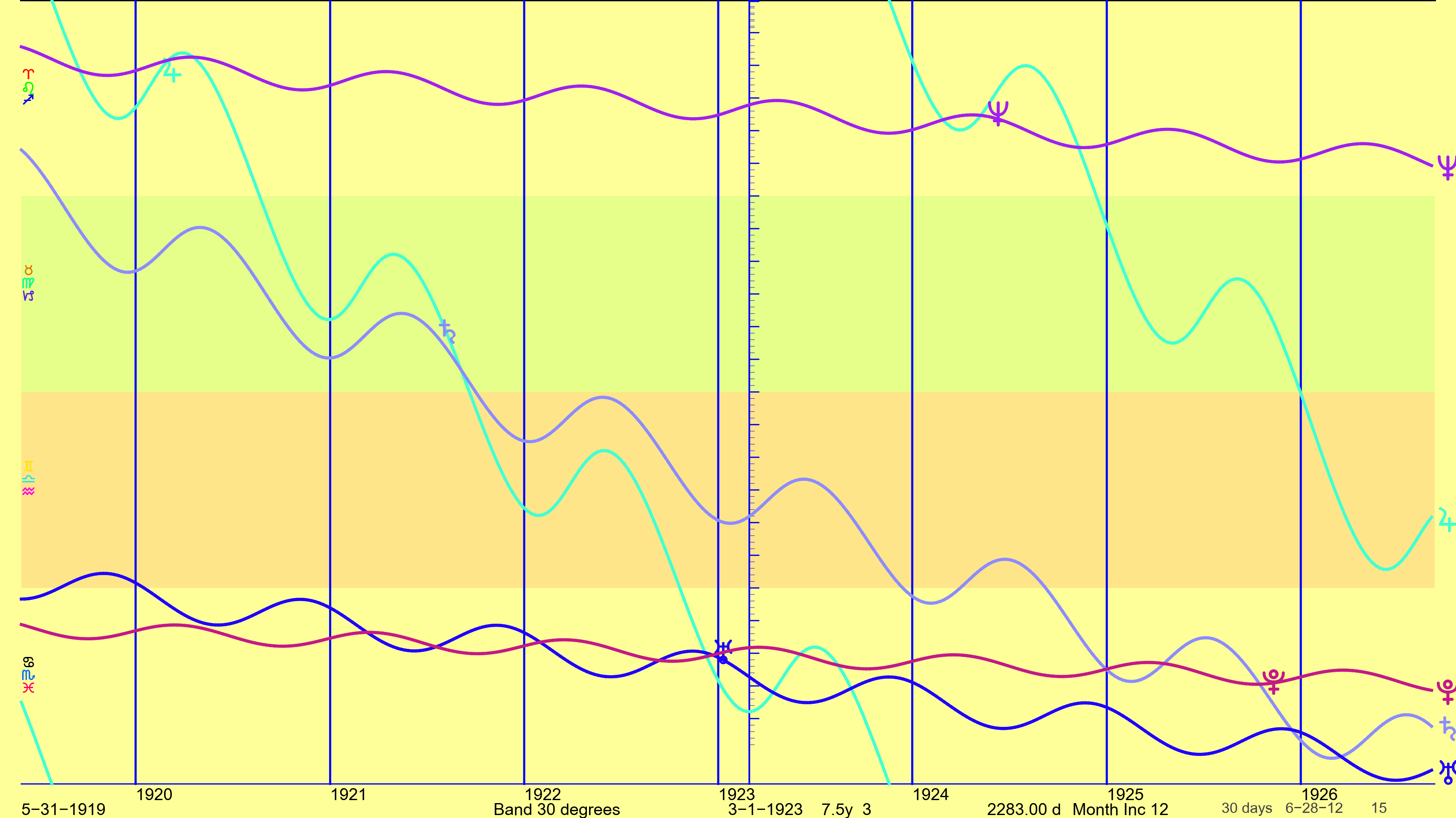
The end of World War One in 1918 caused big changes. That war had seemed beyond reason. As a result there were changes in the way people looked at their world. There was a trine between Uranus and Pluto from 1920 through 1923, the last such trine before now. After the War four empires fell, and the changes are still being felt today. The Russian Empire fell and became the Communist Soviet Union. The Ottoman Empire feel and became Turkiye (Turkey), Iraq, and Israel. The German Empire fell and became a democracy for a while. The Austro-Hungarian empire fell and eventually became Yugoslavia, Czechoslovakia, Austria, Hungary.
This was directly after World War I, and many were shocked by the violence and meaningless loss of life in that war. That affected many people in different ways. Also, in the United States, women got the right to vote after decades of protest. The shock of World War I — there had never been a war that big in human history and with the industrial revolution, that had started two centuries earlier (under a Uranus-Pluto conjunction), this turned out to be the first fully industrial war with airplanes, tanks, and poison gas. During, and especially after the war various art movements started. Dada started in 1916 but came to full bloom after the war; a number of art movements sprang forth in the early Twenties, with names such as Futurism, Constructivism, Cubism, and Surrealism. German Expressionism also emerged in the years after the First World War; a common example of this is the movie Metropolis directed by Fritz Land which was released in 1927.
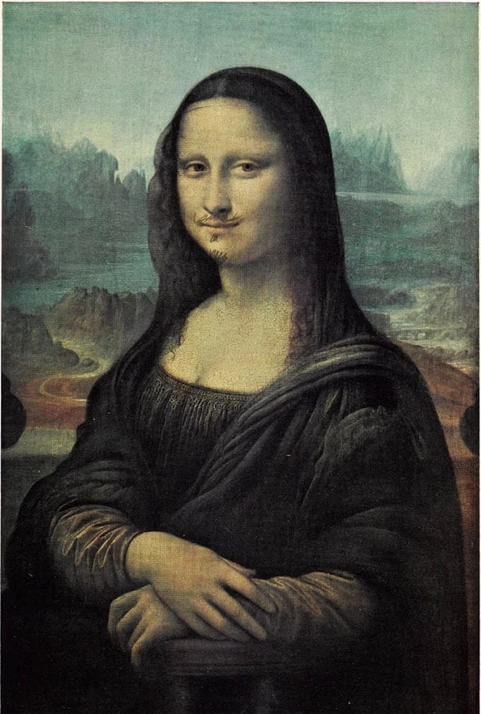
Marcel Duchamp
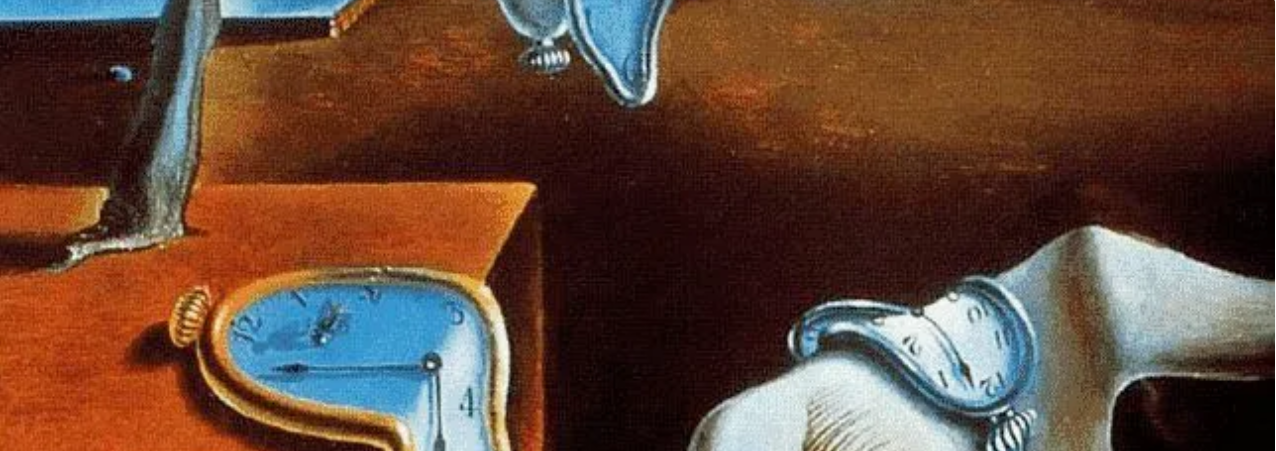
Salvador Dali
In the United States there was the Harlem Renaissance, which was not limited to that section of New York, but occurred throughout the country. it was part of “The New Negro Movement’ and saw the rise of such intellectuals as W.E.B.Dubois. The best known writer to come out of this was the poet Langston Hughes.
There was a whole generation of writers — some who served in World War I — many whom traveled to Europe. These were called the “Lost Generation”. Among the most famous were Earnest Hemingway, Gertrude Stein, T. S. Elliot, and F. Scott Fitzgerald. These writers, like the artists mentioned above, were disillusioned by the war and the aftermath. The period, called the Jazz Age, because that musical form became prominent after the war. In America 1920 saw women getting the right to vote and the sale of alcohol was made illegal. The image of the “Flapper” is a prominent image of that time. Women were much freer that they were before the War, and this freedom showed itself in many many ways that have been chronicled by books and movies. The Twenties were considered a wild time, partly because the Eighteenth Amendment in the United States forbade the sale of liquor creating a large underground economy, much like today; F. Scott Fitzgerald and his wife Zelda were good examples of life in the Twenties. The motion picture, which was limited before the twenties bloomed into a huge market during this decade.
Free speech (First Amendment) cases only started being heard by the Supreme Court in 1919 after Eugene Debs was sentenced over contrasting WWI. Soon Justice Oliver Wendell Holmes spoke out in favor of free speech.
The Communist Revolution in Russia happened at the beginning of this period and inflamed workers around the world who thought there would be a revolution in their country soon. The Communist International — COMINTERN — was founded in 1921 and in the Communist Party of the USA — CPUSA — was founded in 1921. The International Workers of the World — Wobblies — were founded in the previous decade and reached their peak in 1917. The Centralia Tragedy occurred in the State of Washington on November 11, 1919 when in a battle between the American Legion and the IWW several members of the Wobblies were killed or castrated. In America this was time of the first Red Scare. Sacco and Vanzetti were two Italian anarchists who were accused of killing two people in an armed robbery in 1920 and executed in 1927. On the same day someone else who confessed to the crime was also executed.
Aimee Semple McPherson was very popular in Los Angels in 1920s and 1930s. Thought not an occultist she was quite active in the religious realm. She founded the Angelus Temple in Los Angeles which was dedicate January 1923. It is considered the first megachurch.
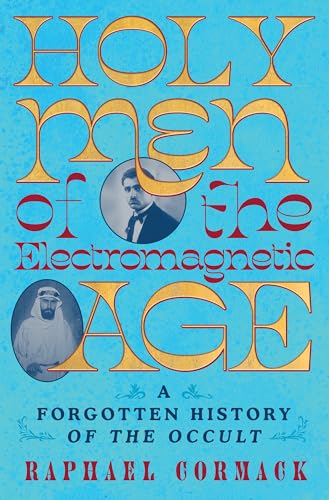
For an idea of the interest in the occult during the Twenties read the book Holy Men of the Electromagnetic Age by Raphael Cormack which describes the wide interest in the occult through the lives of two occult practitioners. As mentioned, Theosophy lost followers when the founder, Madame Blavatsky, moved to India. But interest in Theosophy increased in the Twenties: a British Imperial Administrator by the name of Francis Younghusband was very interested in theosophy and in 1927 published a book about spiritual leaders living on other planets. By this time there was much esoteric work in California, and Ojai (near Santa Barbara) became the location of a theosophical sect. For more details see https://www.patheos.com/blogs/anxiousbench/2021/06/the-great-esoteric-awakening-of-the-1920s/
Uranian Sidebar
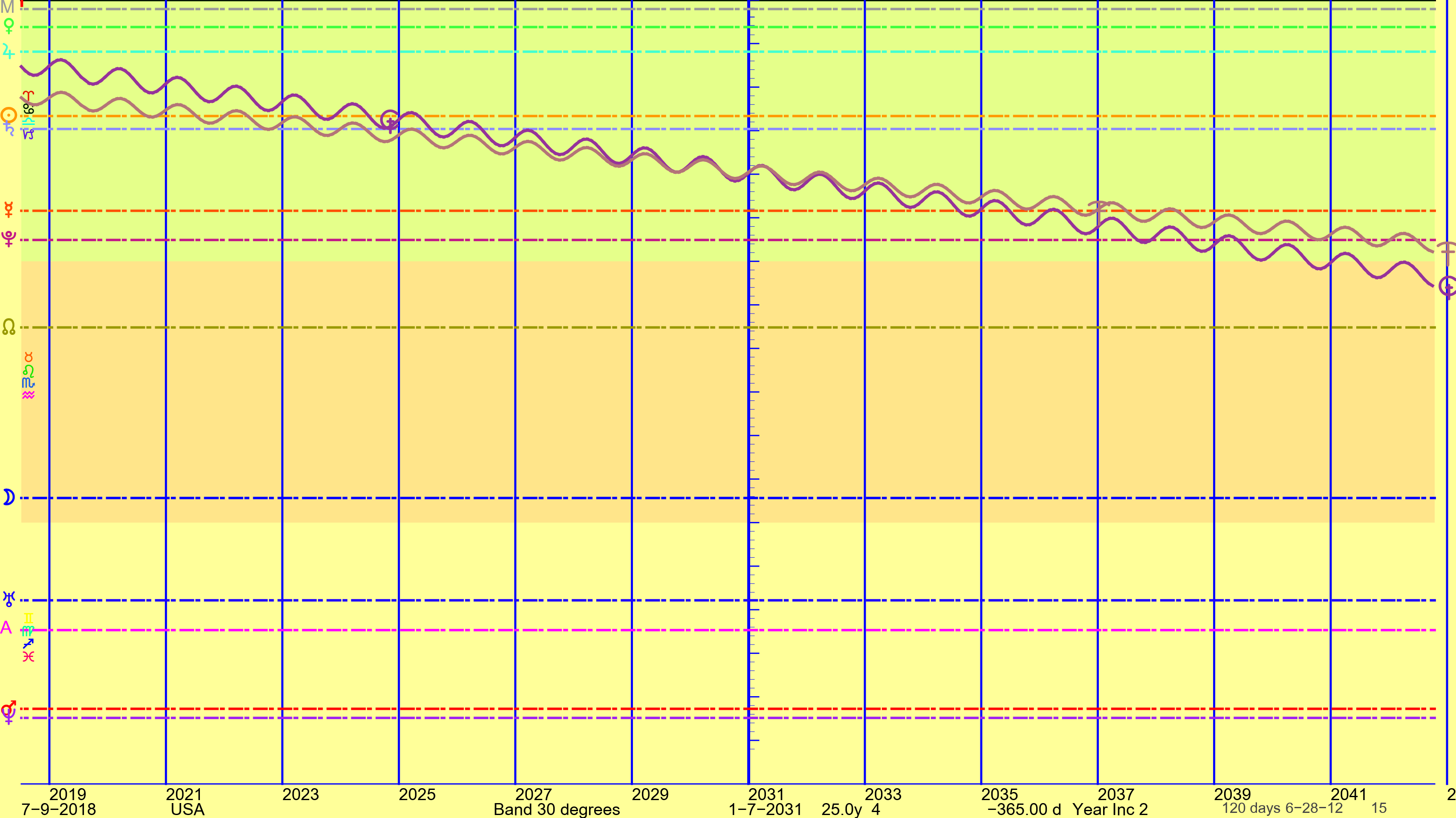
Hades Kronos Conjunction
This period sees a conjunction of the Transneptunian planets Hades and Kronos from roughly 2020 to 2040, the Saturn Jupiter cycle that forms this two decade period. The peak conjunction is about 2029, 2030,and 2031, the end of this decade and the start of the next. The opposition of Jupiter and Saturn — which marks the change of decades — happens five times between 2029 and 2031, the same period as the peck conjunction of those two TNPs. Since this conjunction is in Cancer Kronos is on the Sun of the United States from 2019 to 2024 and Hades is on the US Sun from 2022 to 2025. But of course since these are slow movers the close period lasts longer — see the graphical ephemeris for details. The definition of this conjunction is “Great meanness, poverty, poor government, big time criminal”. You get the picture. But I think there is another meaning from a conjunction of these two planets, the lowest and the highest (call me an optimist, I have Jupiter conjunct my Sun) and that is the world will reach a lowest point (Hades) and because of that depth reach a higher point (Kronos) then we had before. But there is also a trine with the planet Poseidon, said to be an higher octave of Neptune. The standard meaning for these three together is “Wickedness, lies, distortion”. I’m sure we can all find examples of that in the real world. But Poseidon is spirit and light so this combination can also suggest reaching finally a higher level. It’s just going to be a very difficult path to reach that higher level.
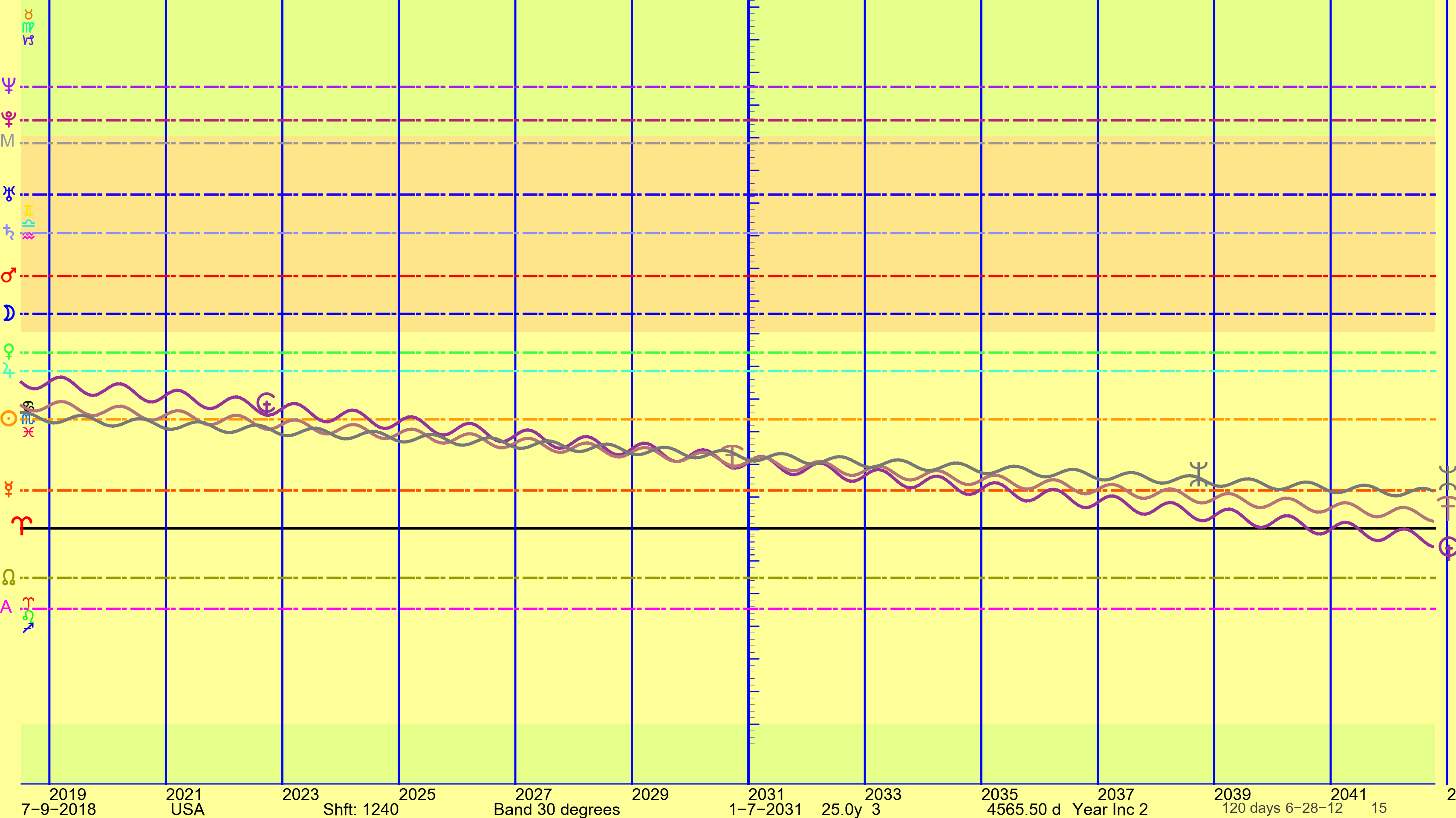
Poseidon tine with Hades Kronos Conjunction
As suggested by other trines detailed above, the affect of this trine started well before 2025 and will continue into the next decade. But of course since we are not looking back at the current time as history we might not see the developments taking place in politics, art, and the metaphysical. Currently the new art form I see is what I call “Artificial Art” that is art, still pictures, movies, memes, that were created by artificial intelligence. There is also a new vision of looking at health and the functions of the body that I see forming, but of course until you can look back at this period we can’t say for sure.

